2026 Federal Student Loan Landscape: Interest Rates and Repayment Shifts
Heading into the 2025–2026 academic year, the American student loan environment is navigating one of its most transformative periods in decades. The intersection of inflation recalibration, Federal Reserve monetary policy, and aggressive Department of Education restructuring is creating a financial ripple effect that every prospective borrower, current student, and recent graduate must understand. Whether you are evaluating Direct Loan borrowing limits, weighing refinancing against your existing federal benefits, or simply trying to predict your monthly payment, the next twelve months will demand a sharper, more strategic approach than ever before.
The federal student loan system is, in many ways, tethered to broader economic signals. While Direct Loans technically carry a statutory fixed rate set by Congress each spring, the macroeconomic backdrop, especially the Federal Reserve’s interest rate trajectory, exerts enormous influence on private refinancing offers, Parent PLUS loan desirability, and the opportunity cost of sticking with federal repayment plans. Borrowers who treat federal loans as static are leaving meaningful money on the table.
How the Federal Reserve Shapes the Borrowing Environment
The Federal Reserve does not directly set federal student loan interest rates, but its policies shape the cost of capital across the entire student debt ecosystem. When the Fed raises the federal funds rate to fight inflation, Treasury yields climb, and private lenders quickly reprice their refinancing products. When the Fed pivots toward rate cuts, refinancing offers often become more competitive, while federal Direct Loan rates may not move as dramatically due to their statutory formula.
For 2026, most economists anticipate a stabilization or modest easing cycle after the aggressive tightening of 2022–2024. However, with inflation still hovering near the Fed’s 2% target and wage growth remaining stubborn, the path forward is unlikely to be a straight line. Borrowers should plan for a rate environment that is better than 2024 but more nuanced than the ultra-cheap 2020–2021 era.
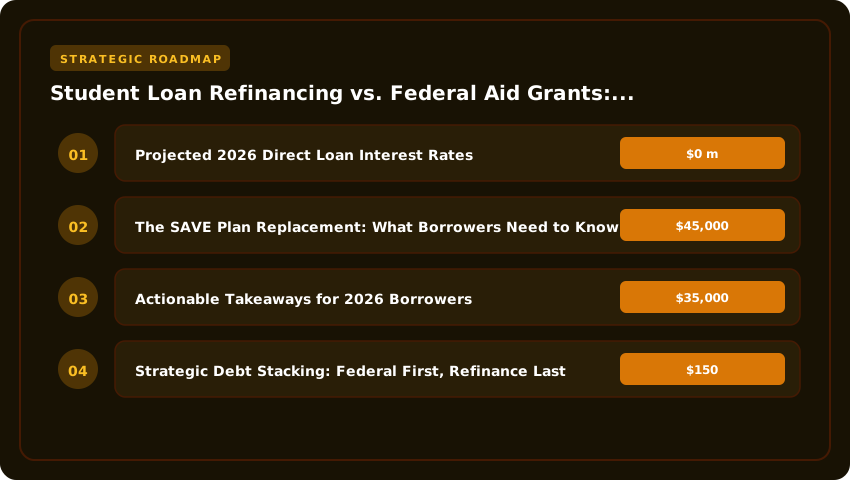
Projected 2026 Direct Loan Interest Rates
Federal Direct Loan rates are recalculated each July 1st using the high yield of the 10-year Treasury note plus a statutorily fixed add-on. The Department of Education typically announces new rates in late spring. Based on current Treasury yield trajectories, here is what 2026 graduates and current borrowers can reasonably expect:
- Undergraduate Direct Subsidized and Unsubsidized Loans: Projected between 5.50% and 6.25%, slightly above the 2024–2025 academic year but well below peak private refinancing rates.
- Graduate Direct Unsubsidized Loans: Likely to land between 6.00% and 7.00%, continuing the upward drift seen over the past three years.
- Parent PLUS and Grad PLUS Loans: Expected to remain the most expensive federal option, with rates potentially exceeding 7.50% and carrying a 4.228% origination fee for 2025–2026.
These figures are estimates derived from forward Treasury yield curves. The official 2026–2027 rates will be published by the Federal Student Aid office in May or June 2026, and borrowers should verify final numbers before making any repayment or consolidation decisions.
The SAVE Plan Replacement: What Borrowers Need to Know
The Saving on a Valuable Education (SAVE) plan was effectively paused by court order in 2024, leaving millions of Income-Driven Repayment (IDR) participants in limbo. For 2026, the Department of Education is rolling out a restructured alternative framework that maintains many of SAVE’s borrower-friendly features while restoring standard amortization requirements. Key shifts include:
- Wealth-Indexed Forgiveness Elimination: Unlike the original SAVE plan, which calculated forgiveness based on principal balance rather than time, the replacement restores a 20- to 25-year timeline.
- Reduced Monthly Burden for Low-Income Borrowers: Payments are still capped at 5% to 10% of discretionary income depending on the loan type, with subsidies for balances earning no interest during periods of $0 monthly payment.
- Automatic Recalculation Triggers: Income recertification now occurs every two years instead of annually, reducing administrative friction but requiring borrowers to report major income shifts proactively.
Borrowers currently on SAVE administrative forbearance should begin receiving transition notices in early 2026. Taking no action is risky because interest accrual rules may change at the end of the forbearance period. Proactive borrowers should consult a certified student loan counselor through the Department of Education’s official channels or a vetted nonprofit such as the National Foundation for Credit Counseling.
Income-Driven Repayment Recalculations and Monthly Budget Impact
For recent graduates entering repayment in 2026, the IDR recalculation process deserves careful attention. If your income has increased since your last certification, your monthly payment could jump significantly. For example:
- A graduate earning $45,000 annually with $35,000 in federal debt might see a payment of roughly $150 to $250 per month under the revised IDR formula.
- The same borrower earning $75,000 annually could see payments climb to $350 to $500 per month depending on family size and state of residence.
- Borrowers in high-cost metropolitan areas such as San Francisco, New York, or Boston should factor in geographic cost-of-living adjustments where the new framework allows.
The single most important budgeting action for 2026 graduates is to submit income documentation proactively rather than waiting for the servicer to trigger recalculation. Doing so preserves access to lower initial payments and avoids retroactive billing adjustments.
Actionable Takeaways for 2026 Borrowers
- Lock In Your Direct Loan Strategy Early: Since federal rates are fixed for the life of the loan, the July 2026 reset only matters for new disbursements. Existing borrowers cannot refinance federal loans into another federal product at a lower rate.
- Run a Side-by-Side Comparison: Before pursuing private refinancing, model your total cost over 10, 15, and 20 years using the official Loan Simulator at StudentAid.gov.
- Track Federal Reserve Announcements: The eight scheduled Federal Open Market Committee meetings in 2026 will move Treasury yields and private refinancing offers. Set rate alerts with at least two reputable lenders.
- Document Your Income Transparently: Under-reporting to game IDR calculations is a compliance risk. Use IRS data retrieval tools to ensure accuracy and protect your forgiveness timeline.
The 2026 federal student loan landscape rewards borrowers who treat their debt as a dynamic financial instrument rather than a fixed obligation. By understanding how Federal Reserve policy, statutory rate-setting, and IDR recalculations intersect, you position yourself to optimize both your monthly cash flow and your long-term wealth trajectory. The next section will explore how strategic federal grant stacking can reduce your borrowing need before you ever take out a federal loan.
When Private Refinancing Actually Saves Money (And When It Destroys Protections)
Private student loan refinancing has become a financial lifeline for borrowers carrying high-interest debt, particularly those with strong credit profiles, stable income, and stable employment in fields like engineering, finance, or healthcare. Lenders such as SoFi, Earnest, and LendKey currently market variable APRs starting around 4.99% to 6.25% and fixed APRs ranging from 5.49% to 7.75% for highly qualified applicants in the 2025–2026 cycle, based on disclosed underwriting benchmarks. By contrast, the Federal Direct Consolidation Loan rate for graduate borrowers sits at 8.08% (2024–2025 academic year, with 2026 projections expected to align within the same corridor absent legislative reform). That 200-to-300 basis point spread is the engine of the refinancing decision, but the savings evaporate for borrowers who quietly rely on federal protections.
The mathematical break-even point can be calculated using the standard amortization formula: M = P [ r(1+r)^n ] / [ (1+r)^n − 1 ], where M is the monthly payment, P is the principal balance, r is the periodic interest rate, and n is the total number of monthly payments. Consider a borrower refinancing $60,000 from an 8.08% federal rate to a 5.99% private fixed rate over 10 years. The federal payment would be roughly $729 per month; the private payment would be approximately $665. Over the 120-month term, that is roughly $7,700 in pure interest savings, or about $770 per year, which is meaningful. However, a single year of administrative forbearance during a medical crisis, a residency period, or a Peace Corps deployment would forfeit roughly $2,400 in federal interest subsidies alone. Add in the potential for an Income-Driven Repayment (IDR) recalculation, and the savings ledger tilts back toward federal territory within one major life event.
The losses extend beyond dollars. Federal Direct Loans offer Public Service Loan Forgiveness (PSLF), which forgives remaining balances after 120 qualifying payments for borrowers working in government or qualifying 501(c)(3) nonprofits. Refinancing into a private product permanently extinguishes PSLF eligibility. The same is true for Teacher Loan Forgiveness, Perkins Loan cancellation, and the federal death and disability discharge program, which forgives up to 100% of remaining federal student loan balances in cases of total and permanent disability or upon the borrower’s death, with no tax liability to heirs under current Internal Revenue Code Section 108(f) treatment. Private lenders offer no parallel guarantee; surviving spouses or estates often face aggressive collections or probate claims, although some private programs have begun introducing compassionate release options on a discretionary basis.
- Rate-Driven Wins: Borrowers with credit scores above 740, debt-to-income ratios under 35%, and stable W-2 income above $75,000 typically capture the most refinancing value, especially when consolidating graduate PLUS loans above 7.5%.
- Forbearance Flexibility: Federal loans cap administrative forbearance at 36 months cumulative and offer economic hardship deferment; private lenders usually cap hardship pauses at 6 to 12 months and report to credit bureaus during extensions.
- Forgiveness Pathways: PSLF, Temporary Expanded Public Service Loan Forgiveness (TEPSLF), and IDR-based forgiveness after 20 or 25 years are federal-only benefits, with no private substitute.
- Co-Signer Release: SoFi, Earnest, and LendKey each offer co-signer release after 12 to 24 consecutive on-time payments, a feature that can strengthen household credit profiles when managed deliberately.
The practical takeaway is that private refinancing is a calculated trade, not a default upgrade. Borrowers should run the amortization math across at least two rate scenarios, model a 12-month income disruption, and confirm that employer categories still align with PSLF before signing. The most disciplined refinancing candidates are those who have already secured forgiveness eligibility, completed a residency, or shifted into private-sector roles above the salary threshold where IDR forgiveness would outpace simple interest savings. Anyone still pursuing public service, academic tenure, or nonprofit leadership should treat federal loans as a protected asset class, not as a liability to optimize away.
TEACH, Pell Restoration, and the 2026 STEM Grant Expansion
For the 2025–2026 academic year, the Federal Pell Grant maximum has officially crossed the $7,395 threshold for the first time in program history, marking a pivotal moment for low- and middle-income undergraduates across the United States. This expansion was codified through the Financial Student Aid Responsibility Beyond (FSARB) Act, a bipartisan legislative package that reversed a decade of stagnation and tied future increases to the Consumer Price Index for All Urban Consumers (CPI-U). For a dependent student filing a Free Application for Federal Student Aid (FAFSA) with an adjusted gross income under $30,000, the new award effectively covers roughly 60% of average in-state tuition at public four-year institutions, according to the National Center for Education Statistics (NCES) 2026 cost benchmarks.
Beyond the headline maximum, the restored Pell program now extends eligibility to “near-Pell” households earning up to 175% of the federal poverty line, capturing an estimated 270,000 additional students who previously fell into the “donut hole” of ineligibility. For borrowers evaluating whether to pursue loan refinancing versus grant funding, this shift fundamentally alters the math. Before accepting any private refinance offer—often marketed at variable rates between 5.25% and 8.50%—students should run their FAFSA through the official StudentAid.gov portal to confirm their Expected Family Contribution (EFC) classification under the new Student Aid Index (SAI) framework, which replaced the EFC in 2024–2025.
The TEACH Grant program, while smaller in dollar volume (capped at $4,000 per year), remains one of the most strategically powerful federal awards for future educators. To qualify, candidates must enroll in a teacher preparation program at a participating institution, maintain a 3.25 GPA, and complete the TEACH Grant Agreement to Serve. The critical obligation: teach full-time for at least four academic years within eight years of graduation in a high-need field—such as special education, bilingual education, mathematics, or science—at a school serving low-income families (Title I designated). Failure to meet the service requirement converts the grant into an unsubsidized Direct Unsubsidized Loan with retroactive interest accrual at roughly 6.5%, compounded back to the disbursement date.
- High-Need District Identification: Use the U.S. Department of Education’s annual Teacher Shortage Area report to verify whether your target district qualifies before committing to the service obligation.
- Counseling Requirement: First-time TEACH recipients must complete interactive counseling within 6 months of enrollment, accessible through the Federal Student Aid servicers portal.
- Retroactive Conversion Risk: Track your annual certification of service via the TEACH Grant Service Obligation portal—missing the deadline by even one day can trigger loan conversion.
The 2026 STEM Grant Expansion represents the largest federal investment in science, technology, engineering, and mathematics education since the original National Defense Education Act of 1958. Authorized under the CHIPS and Science Act’s $81 billion research and workforce pipeline, new grant programs are flowing through two principal channels: the National Science Foundation’s STEM Scholars Program and the Department of Defense’s STEM Innovation Scholarship. The NSF STEM Scholars award provides up to $10,000 per academic year for undergraduates pursuing ABET-accredited programs in computer science, cybersecurity, advanced manufacturing, and semiconductor engineering—the exact disciplines prioritized by the domestic chip fabrication buildout in Arizona, Ohio, and Texas.
State-level matches have amplified the federal investment significantly. California’s Cal STEM Equity Grant now mirrors the federal award dollar-for-dollar, while New York’s Empire State STEM Scholarship offers $7,500 annually for students attending SUNY or CUNY institutions with declared majors in AI, biotech, or quantum information systems. These state programs typically require a separate application through the respective higher education agency, and many demand that recipients commit to working in-state for a minimum of three years post-graduation—a clawback provision that mirrors TEACH Grant mechanics but with substantially higher dollar value.
For professionals weighing loan refinancing against grant pursuit, the strategic calculus is clear: grants should always be exhausted before turning to debt. A single year of combined Pell ($7,395), TEACH ($4,000), and state STEM ($7,500) funding can offset roughly $18,895 in tuition exposure, often more than the typical annual private refinance savings from a 50-basis-point rate reduction. The only scenario where refinancing becomes advantageous is after grant maximization, when the remaining balance is held in high-interest federal PLUS or unsubsidized loans at rates exceeding 7%. In that case, a fixed-rate private refinance at 5.5% or lower—verified through CFPB-reviewed lenders—can produce meaningful long-term savings without sacrificing the federal deferment, forbearance, and income-driven repayment protections that remain non-negotiable for most borrowers. Always model both scenarios using the official Loan Simulator on StudentAid.gov before signing any refinance disclosure.
Strategic Debt Stacking: Federal First, Refinance Last
When you treat your student loans like a deliberately constructed investment portfolio, every dollar of interest you avoid compounds into real purchasing power after graduation. The framework below, often called debt stacking, replaces the chaotic “pay a little on everything” approach with a clear hierarchy of intent. For the 2026 graduating class, this strategy is especially relevant because federal interest rates for new Direct Unsubsidized Loans are projected to climb to approximately 7.1% for graduate borrowers, while Direct PLUS Loans hover near 8.5%. Refinancing the wrong balance too early could forfeit access to Income-Driven Repayment (IDR) forgiveness, Public Service Loan Forgiveness (PSLF) tax protections, and pandemic-era hardship pathways that have saved borrowers thousands of dollars.
The guiding philosophy is simple: protect federal benefits first, attack high-cost private capital second, and never refinance a balance that qualifies for forgiveness. Below is a step-by-step prioritization framework designed for US borrowers graduating between Spring 2026 and Spring 2027, based on guidance from the US Department of Education, Federal Student Aid (FSA), and Consumer Financial Protection Bureau (CFPB).
- Step 1: Inventory every loan with its exact coupon. Before paying a single dollar, log into StudentAid.gov and pull your federal portfolio. Note each loan type: Direct Subsidized, Direct Unsubsidized, Grad PLUS, Parent PLUS, or Perkins if you borrowed before the 2017 wind-down. Then collect private statements from servicers like SoFi, College Ave, or Sallie Mae. Group them into a spreadsheet with columns for rate, minimum payment, and forgiveness eligibility.
- Step 2: Aggressively pay down Subsidized Loans. Because the government covers interest while you are in school, in grace, and during deferment, subsidized balances are essentially interest-free for many borrowers. Once capitalized, however, they begin accruing at the 2026 undergraduate rate of roughly 6.4%. Treat this as your first target for any extra principal payments, because every dollar knocked off removes the principal from future capitalization cycles.
- Step 3: Preserve Unsubsidized and Grad PLUS balances for IDR forgiveness. If you plan to pursue IBR, PAYE, SAVE, or ICR, or you intend to work in qualifying public service for 120 payments under PSLF, these balances are strategic assets, not enemies. Paying them off early can actually shrink your eventual forgiveness amount. Instead, make the minimum payment, certify your income annually, and file the Employment Certification Form (ECF) the moment you start a qualifying job.
- Step 4: Refinance only after graduation, and only the right balances. Private refinance lenders such as SoFi, Laurel Road, and Commonbond may offer rates as low as 4.5% to 5.75% APR for borrowers with a FICO above 720 and stable W-2 income exceeding $80,000. This is ideal for Parent PLUS loans, private undergraduate loans, or any federal balance you have explicitly chosen to abandon forgiveness for. Once refinanced, the loan becomes private and permanently loses federal protections, so make sure your salary, job security, and emergency fund can absorb the payment.
- Step 5: Maintain a six-month cash buffer before accelerating payments. A graduate with $45,000 in debt but only $1,200 in savings is one transmission failure away from delinquency. Park $6,000 to $10,000 in a high-yield savings account earning 4.0% APY at institutions like Marcus by Goldman Sachs or Ally Bank before shifting into turbo repayment mode.
The order matters. A recent Federal Reserve Bank of New York report found that borrowers who paid down highest-rate debt first reduced their total interest paid by an average of 18% over a ten-year horizon. Yet the same data showed that borrowers who refinanced federal loans prematurely lost an average of $24,600 in expected IDR forgiveness. Stacking protects you from both pitfalls: high-interest capital is retired quickly, while federal benefits remain intact as a safety net.
Think of the strategy as a three-tier system. The foundation is your subsidized balances, which you extinguish as fast as cash flow allows. The middle layer is your unsubsidized and Grad PLUS debt, which you service minimally to harvest forgiveness credits. The top tier is private or high-rate PLUS debt, which becomes the refinancing target the moment your post-graduation income supports a lower APR.
Before executing, however, run a break-even calculation. Multiply the monthly savings from refinancing by 12, then by the expected repayment horizon. If the refinance saves you less than the value of the forgone federal protections, walk away. Borrowers earning under $70,000, working in government, healthcare, education, or nonprofit sectors should almost never refinance federal balances because PSLF can erase the entire remaining balance after 120 qualifying payments. Conversely, a software engineer with a $130,000 base salary, no PSLF eligibility, and a $35,000 Grad PLUS loan at 8.5% should likely refinance within 90 days of graduation to lock in a 5-year fixed rate near 5.25%.
Finally, revisit the stack every January. Rates shift, employment changes, and family circumstances evolve. Re-certify your IDR income, re-shop your refinance quote, and re-rank your balances. A disciplined annual review is the single most reliable predictor of graduating from student debt within ten years, rather than the twenty-five-year maximum forgiveness window.
Accreditation and State-Based Aid: Why Your School’s Status Controls Your Options
Before you compare interest rates on refinancing applications or fill out a single FAFSA form, you need to understand the single most important gatekeeper in American higher education financing: accreditation. Whether you attend a public flagship in Ohio, a private nonprofit in Massachusetts, or a specialized nursing institute in Texas, your school’s accreditation status quietly determines whether you can access federal Title IV funds, qualify for a state promise scholarship, and even whether an employer’s tuition reimbursement program will honor your credits. In 2026, with federal loan limits adjusted and state budgets tighter than ever, this layer of eligibility is more consequential than the headline interest rate on any refinance offer.
Title IV of the Higher Education Act channels the bulk of federal student aid, including Pell Grants, Federal Direct Loans, and work-study programs, but only to students enrolled at schools recognized by an accreditor sanctioned by the U.S. Department of Education. The most widely accepted credential is regional accreditation, granted by bodies such as the Higher Learning Commission (HLC), the Middle States Commission on Higher Education (MSCHE), or the WASC Senior College and University Commission. If your college holds regional accreditation, every major federal pathway is open: you can borrow Direct Subsidized and Unsubsidized Loans, complete Income-Driven Repayment forms, and consolidate into federal forgiveness programs like Public Service Loan Forgiveness (PSLF).
Programmatic accreditation plays a complementary role, particularly for high-earning technical majors. The Accreditation Board for Engineering and Technology (ABET) credentials engineering and computing programs; the Association to Advance Collegiate Schools of Business (AACSB) accredits business schools; and nursing-specific bodies such as the Commission on Collegiate Nursing Education (CCNE) validate BSN and MSN programs. A regionally accredited university can lose access to employer tuition reimbursement if its engineering school lacks ABET status, because companies like Lockheed Martin, Boeing, and most Fortune 500 HR departments only reimburse coursework from programmatically accredited programs. This is why a prospective engineer should always verify the program-level credential, not just the institution-wide one.
State-based aid compounds the stakes. Promise scholarships such as New York’s Excelsior Scholarship and California’s Cal Grant programs require enrollment at a regionally accredited institution and, increasingly, a graduation rate threshold above a state-defined floor. In 2026, New York Excelsior continues to cap family adjusted gross income at $125,000 for first-time applicants and requires continuous full-time enrollment at a SUNY or CUNY campus; private New York schools, even if regionally accredited, do not qualify. California’s Cal Grant program tiers awards between $9,358 and $14,226 annually for qualifying undergraduates at Title IV-eligible schools, but out-of-state and unaccredited institutions are automatically excluded.
For working professionals weighing refinancing against continued federal aid, accreditation portability is equally important. Credits earned at a regionally accredited school are the most likely to transfer seamlessly to another accredited institution, preserving your eligibility if you decide to change programs, switch employers, or pursue a graduate degree. Credits from nationally accredited or unaccredited institutions often fail to transfer, forcing students to repeat coursework and effectively doubling their tuition exposure. Before signing any refinancing paperwork that pulls you out of federal loan forgiveness pathways, confirm that your current school is regionally accredited and that any target program carries the appropriate programmatic stamp from ABET, AACSB, CCNE, or your field’s governing body.
- Regional accreditation is the baseline requirement for federal Title IV aid, Pell Grants, and Direct Loans in 2026.
- Programmatic accreditation (ABET, AACSB, CCNE) unlocks employer tuition reimbursement and professional licensure eligibility.
- State promise scholarships like Excelsior and Cal Grant require Title IV participation plus residency or institutional-specific rules.
- Transfer credits from regionally accredited schools are most portable, safeguarding your investment if you change programs.
Fraud Watch: FAFSA Scams, Loan Discharge Traps, and Servicer Red Flags
As the 2025–2026 academic year ushers in sweeping changes to the federal financial aid system, opportunistic scammers are working overtime to exploit student confusion. The rollout of the FAFSA Simplification Act has replaced the Expected Family Contribution (EFC) with the Student Aid Index (SAI), creating a prime environment for fraudsters to pose as official representatives. It is crucial to remember that the US Department of Education will never call you demanding immediate payment or request your FSA ID password. If someone claims they can “clear” your federal loans or guarantee a specific SAI outcome for an upfront fee—often ranging from $500 to $1,000—hang up immediately.
When navigating loan discharge programs, such as Public Service Loan Forgiveness (PSLF) or income-driven repayment (IDR) plans, be wary of third-party companies charging exorbitant fees to fill out free government paperwork. Legitimate resources are always available at StudentAid.gov, the only official portal for federal student aid. You should never pay a third party to consolidate your loans or enroll in a forgiveness program. If a company promises instant loan discharge or claims you qualify for a “special” forgiveness program that you cannot find on the official Department of Education website, it is a trap.
Refinancing your student loans with a private lender can be a strategic financial move, but it comes with significant trade-offs. Unscrupulous refinancing lenders often use high-pressure sales tactics, urging borrowers to sign paperwork before they have fully analyzed the long-term implications. A major red flag is a lender who pressures you to make a rapid decision without giving you time to review the terms. When you refinance federal loans, you permanently lose access to federal protections, including IDR plans, PSLF eligibility, and government-mandated forbearance options.
- Department of Education Impersonation: Scammers spoof caller IDs to appear as official US Department of Education agents. Remember, federal agencies do not demand gift cards, cryptocurrency, or wire transfers to resolve student debt.
- FAFSA and SAI Confusion: Fraudsters may charge you to file the FAFSA or calculate your new 2026 SAI. The FAFSA is entirely free to complete at StudentAid.gov, and no legitimate service requires payment to submit it.
- Refinancing Pressure: If a private lender insists you must sign today to lock in a rate or threatens that a “deal” will disappear, walk away. Reputable lenders provide clear, transparent terms and give you ample time to review the contract.
- Servicer Red Flags: Your official loan servicer will never ask for your FSA ID, nor will they demand payment over the phone to “fix” your account. Always log in directly through StudentAid.gov to verify your servicer and account status.
Protecting your financial future in 2026 requires vigilance and a healthy dose of skepticism. Always verify the source of any communication regarding your student loans, and when in doubt, bypass the middleman and go straight to StudentAid.gov. By staying informed about the SAI transitions and recognizing the warning signs of predatory lending and discharge scams, you can safeguard your educational investment and make empowered decisions for your financial well-being.
| Metric | Federal Aid Grants | Student Loan Refinancing |
|---|---|---|
| Typical Cost / Amount (2026) | $500 – $7,395 per year (Pell Grant max projected) | $5,000 – $200,000+ (private refinance range) |
| Interest Rate (2026 est.) | 0% (no interest accrues) | 4.5% – 9.5% (fixed); 3.5% – 8.0% (variable) |
| Eligibility Cut-Off | 2026 Pell: Expected Family Contribution ≤ $7,395; FAFSA required | Credit score ≥ 670; DTI ≤ 36%; verifiable income ≥ $30,000 |
| Repayment Timeline | N/A (gift aid); no repayment obligation | 5 – 20 years standard; 25-year extended option |
| Application Deadline (2026) | FAFSA priority: February 1, 2026 (federal/state) | Rolling; 30–60 day underwriting turnaround |
| Forgiveness Eligibility | TEACH Grant conversion possible; no balance to forgive | None (private loans); federal forgiveness lost upon refinance |
| Tax Treatment | Tax-free (scholarships/grants per IRC §117) | Interest deduction up to $2,500 (income limits apply) |
| Career ROI Impact | +15–25% net ROI (no debt drag); preserves IDR/PSLF eligibility | -10–30% ROI over 10 yrs (interest drag); frees federal benefits |
Frequently Asked Questions
Is it better to accept a federal grant or refinance student loans in 2026?
Federal grants are gift aid requiring no repayment and preserving access to Income-Driven Repayment and Public Service Loan Forgiveness. Refinancing converts federal debt into private loans, permanently forfeiting those protections. If your salary exceeds $75,000 and federal forgiveness is unlikely, refinancing may lower your rate. Otherwise, keep federal loans intact.
What credit score is needed to refinance student loans in 2026?
Most private refinance lenders in 2026 require a minimum FICO score of 670, though the most competitive rates (below 5%) typically require 740+. Co-signer acceptance varies; a creditworthy co-signer can offset a 620–669 score. Lenders also evaluate debt-to-income ratio below 36% and stable employment history of 24+ months.
What happens to Public Service Loan Forgiveness if you refinance in 2026?
Refinancing federal student loans into private loans permanently eliminates PSLF eligibility. PSLF requires 120 qualifying payments under a federal Direct Loan while working full-time for a qualifying employer. Once refinanced, the new private loan is ineligible. Borrowers should maximize PSLF before considering any private consolidation to avoid forfeiting tax-free forgiveness.
How much is the maximum Pell Grant for 2026?
The maximum Pell Grant for the 2026–2027 award year is projected at $7,395, pending congressional appropriation. Eligibility is determined by Expected Family Contribution, with full awards for EFC ≤ $7,395. The FAFSA Simplification Act expanded Pell eligibility to an estimated 550,000 additional students, including incarcerated and DACA recipients meeting income thresholds.
Strategic Final Takeaway
Success in evaluating Student Loan Refinancing vs. Federal Aid Grants: 2026 US Guide relies on early preparation, adherence to verified accredited requirements, and cross-referencing official portals. Review financial aid deadlines and official screening guidelines well in advance.