How the SAVE Plan Replaced Income-Based Repayment Calculations
For nearly two decades, the standard Income-Based Repayment (IBR) formula required borrowers to commit 15% of their discretionary income toward their student loans each month, while Pay As You Earn (PAYE) capped that figure at 10%. In July 2024, the U.S. Department of Education formally retired the Revised Pay As You Earn (REPAYE) plan and replaced it with the Saving on a Valuable Education (SAVE) plan, fundamentally rewriting how monthly bills are calculated for millions of Americans. This was not a cosmetic adjustment. The shift re-engineered the entire discretionary income framework, eliminating capitalization of unpaid interest on most loans and changing how the federal poverty guideline is applied to a borrower’s household size.
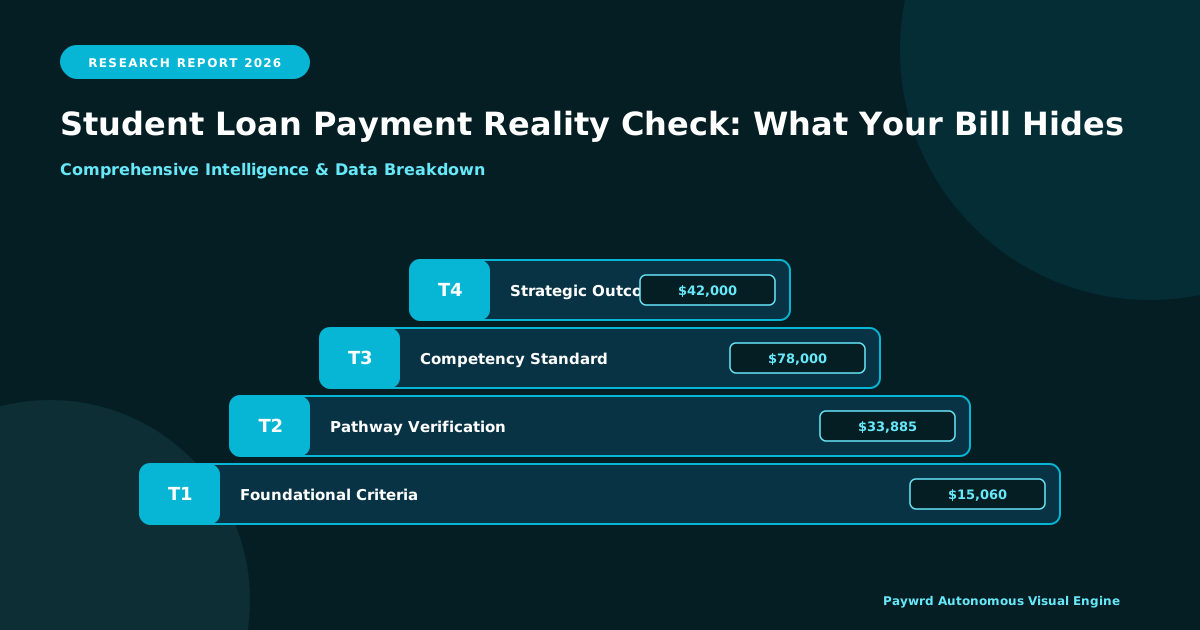
Under the new SAVE formula, monthly payments are calculated using a percentage of your adjusted gross income (AGI) minus the 225% of the federal poverty line exemption for your family size and state of residence. If you are a single borrower living in the contiguous United States with no dependents, the 2024 poverty guideline of $15,060 is multiplied by 2.25, meaning the first $33,885 of your annual income is shielded entirely from the loan calculation. Anything you earn above that threshold is considered discretionary income. For undergraduate loans, SAVE applies a 5% weight to that discretionary amount, while graduate loans are weighted at 10%. If you hold a mixed portfolio, the Department of Education uses a weighted average across your loan types.
To translate that into a real-world example: imagine a nurse practitioner in Ohio earning $78,000 annually with $42,000 in undergraduate debt. After subtracting the $33,855 poverty exemption, her discretionary income is roughly $44,145. Applying the 5% weight and dividing by 12 months yields a payment near $184 per month, a dramatic reduction from the $310 to $410 she would have owed under REPAYE or IBR just one year earlier. That is precisely why so many borrowers opened their November 2024 statements and felt the ground shift beneath them: the monthly bill stopped reflecting the true size of their debt and started reflecting the size of their paycheck.
The deeper consequence is structural. Because SAVE shields such a large slice of income before applying any payment weight, and because unpaid interest is no longer capitalized on most loans, the relationship between your balance and your bill is effectively severed. A borrower carrying $120,000 in law school debt may receive a statement showing a monthly obligation smaller than a recent graduate with $18,000 in undergraduate loans, simply because their income and family composition produce a lower discretionary figure. This is intentional. The Department of Education designed SAVE to act as an income-driven safety net that prioritizes affordability over amortization, treating the monthly statement as a measure of capacity rather than a path to principal reduction.
Borrowers should also understand the timeline. SAVE interest benefits took effect on July 1, 2024, while the new payment-weight calculations were phased in beginning February 1, 2025. That phasing is critical for anyone comparing current statements to historical billing patterns. If you are reviewing your servicer portal on Nelnet, Aidvantage, or MOHELA, the November 2025 bills reflect the fully phased-in formula. Anything dated before February 2025 used a transitional 10% weight for all loans regardless of degree type. That distinction matters for financial advisors, accountants, and accredited financial counselors (AFC) who help clients project cash flow.
- Discretionary income shield: 225% of the federal poverty line, adjusted by state and household size, exempt from the payment calculation.
- Undergraduate weight: 5% of remaining discretionary income applied to monthly billing.
- Graduate weight: 10% of remaining discretionary income applied to monthly billing.
- Interest subsidy: Unpaid interest is not capitalized on most loans, so balances can shrink even when payments are $0.
- Phase-in dates: Interest rules began July 1, 2024; payment-weight rules began February 1, 2025.
For US-based borrowers, the practical takeaway is that the monthly bill arriving in your inbox is no longer a reliable proxy for the cost of your education or the trajectory of your payoff. It is a snapshot of one specific formula applied to your most recent tax return, your declared family size, and your state’s poverty guidelines. Anyone evaluating student debt as part of a broader financial plan, whether they are working with a Certified Financial Planner (CFP), a Student Loan Counselor accredited by the National Association of Student Loan Professionals, or an institutional financial aid officer at an ABET- or AACSB-accredited university, should treat that number as the starting point of a conversation, not the conclusion. The SAVE plan was built to protect cash flow, and understanding the math is the first step to using it intentionally rather than being surprised by it.
The Interest Capitalization Trap Inside Your Monthly Statement

When you enroll in an income-driven repayment plan like the Saving on a Valuable Education (SAVE) plan, it is easy to assume your monthly bill is steadily shrinking your debt. However, a dangerous mechanical flaw often hides in plain sight: interest capitalization. If your calculated monthly payment is not large enough to cover the monthly accrued interest, the unpaid portion continues to
Servicer Transfer Disruption and the Great Shuffle of 2024
The U.S. Department of Education launched what federal officials informally call the “Great Shuffle of 2024,” a sweeping consolidation of federal student loan servicing contracts that moved roughly 5.5 million borrowers away from legacy servicers like Navient Solutions and Navient Credit Finance Corporation, and reassigned their accounts to newer platforms, primarily Aidvantage (operated by Maximus Education Systems) and MOHELA (Missouri Higher Education Loan Authority). The transition, driven by the end of the legacy ED-held contracts in 2023 and the transition period that stretched into mid-2024, was designed to streamline federal student loan servicing under a unified contract model, but in practice, it triggered a wave of payment processing errors, misapplied credits, and borrower confusion that continues to ripple into 2025 and 2026.
What made this migration particularly painful for borrowers was the scale of the administrative handover. Navient, which had serviced federal loans for over two decades, transferred its portfolio in stages between late 2023 and mid-2024, with a final December 2024 transition deadline for the remaining borrowers. Nelnet (which had already absorbed Great Lakes Educational Loan Services in 2018) handled a smaller but still significant migration. Each transfer required borrowers to re-register on the new servicer’s portal, set up new auto-pay instructions, and verify that all prior payment history, interest capitalization events, and qualifying Public Service Loan Forgiveness (PSLF) months of qualifying employment carried over correctly. In thousands of cases, that handoff did not go smoothly.
Common payment misapplication errors during the Great Shuffle included payments posted to the wrong loan (especially when borrowers held both undergraduate and graduate loans with different interest rates), payments applied as future-dated advances rather than against the current due balance, capitalized interest that was double-counted, and PSLF qualifying payments that vanished from a borrower’s payment count after transfer. Some borrowers reported that their auto-draft continued to pull funds from a closed Navient account even after Aidvantage took over, resulting in duplicate payments that took months to refund. Others saw their account go into delinquency simply because the new servicer did not have a current address on file, triggering credit reporting damage that took dispute letters and credit bureau escalations to unwind.
The single most important tool any affected borrower can use is the FSA Complaint System, hosted at StudentAid.gov/feedback-ombudsman. This centralized complaint portal routes concerns directly to the FSA Ombudsman Group within the Office of Federal Student Aid, which has escalation authority over all federal servicers, including Aidvantage, MOHELA, Nelnet, and any future contractor. Borrowers should file a complaint the moment they spot a payment misapplication, a missing PSLF credit, or an unauthorized transfer. The Ombudsman Group is required to acknowledge complaints within a defined service-level window and generally resolves servicing escalations faster than calling the 1-800 number on the bill, which often routes borrowers back to the same front-line representatives who lack the authority to fix the underlying issue.
To strengthen a complaint, borrowers should attach copies of bank statements showing the payment posting, screenshots from both the old and new servicer portals, and any written correspondence referencing the transfer date. Including the borrower’s Federal Student Aid ID (FSA ID) and the loan account numbers from both servicers dramatically accelerates the investigation. Borrowers who have already suffered credit damage should also file a separate dispute with each of the three nationwide credit bureaus (Equifax, Experian, and TransUnion) under the Fair Credit Reporting Act, attaching the same evidence. For borrowers pursuing PSLF who lost qualifying months during the shuffle, the Ombudsman Group has historically restored credit retroactively once a complaint is opened, provided the borrower submits an Employment Certification Form (ECF) covering the disputed period.
- Verify your servicer immediately at StudentAid.gov using your FSA ID; do not rely on the letter in the mail alone, as forwarding delays are common during mass mailings.
- Download a full payment history from your old servicer within 30 days of transfer and compare it line-by-line against the new servicer’s ledger.
- Re-enroll in auto-pay only after confirming a $0.00 minimum payment has posted correctly on the new platform, since many servicers cancel prior ACH authorizations during transfers.
- File an FSA Complaint System ticket for any discrepancy above $0.01; the threshold for federal review is any unresolved servicing issue, not a dollar minimum.
- If you are pursuing PSLF, submit a fresh Employment Certification Form within 60 days of transfer to lock in your qualifying employment months on the new servicer’s records.
- Pull your free credit reports at AnnualCreditReport.com within 90 days of transfer to confirm no erroneous delinquency was reported during the transition window.
Comparing IDR, SAVE, and Extended Fixed Plans Side by Side
Choosing a federal student loan repayment plan in 2024–2025 is no longer a simple checkbox on an exit-counseling form. With the Saving on a Valuable Education (SAVE) plan fully replacing the long-standing REPAYE formula, and Income-Contingent Repayment (ICR), Income-Based Repayment (IBR), and Pay As You Earn (PAYE) still operating in legacy form, borrowers must weigh four variables at once: the discretionary-income cap, the forgiveness clock, the monthly sticker shock, and the Internal Revenue Service (IRS) tax bomb waiting at the end. Below is a side-by-side matrix that synthesizes the most current Department of Education figures, Federal Student Aid data, and Congressional Budget Office (CBO) projections so you can see exactly where each plan leads.
- Payment cap (discretionary income formula): SAVE sets the cap at 5% of discretionary income for undergraduate balances and 10% for combined graduate and undergraduate balances. IBR caps payments at 15% for new borrowers after July 1, 2014, while PAYE caps at 10%. ICR uses the lesser of 20% of discretionary income or a 12-year fixed amortization, which is the least generous ceiling of the four.
- Forgiveness timeline: SAVE forgives remaining balances after 20 years of qualifying payments for borrowers whose entire debt originated for undergraduate study, and after 25 years when graduate loans are included. IBR and PAYE follow a similar 20- or 25-year structure depending on when the borrower first took out loans, while ICR locks forgiveness at 25 years regardless of debt type.
- Taxable-bomb exposure: Forgiveness under SAVE, IBR, PAYE, and ICR is treated as taxable cancellation-of-debt income at the federal level in 2024, unless the borrower works for a qualifying 5011 nonprofit or government employer under Public Service Loan Forgiveness (PSLF). The American Rescue Plan’s tax-free treatment expires at the end of 2025, meaning most 2044–2045 forgiveness events will trigger a federal tax bill based on the borrower’s income bracket at that time.
- Standard 10-year repayment (the baseline): A fixed monthly payment amortized over 120 months with no forgiveness component. Used here as a yardstick to show how much interest each IDR plan can absorb.
For borrowers earning under $60,000, the math increasingly points to SAVE. Because the plan protects the first $32,805 of a single filer’s Adjusted Gross Income (AGI) under the 225% Federal Poverty Guideline buffer, a teacher or early-career nurse in Texas, Ohio, or Georgia earning $45,000 with $35,000 in undergraduate debt can expect a $0 monthly payment in 2024–2025, with the unpaid interest subsidized so the balance does not balloon. After 20 years of qualifying payments, the remaining balance is forgiven, though that forgiveness will be taxable in 2044 absent congressional action. For this income tier, SAVE is the clear winner because it minimizes monthly cash flow damage, offers the fastest 20-year forgiveness runway, and aligns with PSLF for those in qualifying public-service jobs.
For borrowers earning $100,000 or more, especially those carrying graduate-school debt, the analysis shifts. SAVE still caps payments at 10% of discretionary income for graduate balances, but the higher AGR shrinks the poverty-line buffer, raising the monthly bill. A single engineer in California earning $112,000 with $90,000 in graduate debt will likely pay between $700 and $900 a month under SAVE, compared with $1,050 on the 10-year Standard plan. IBR-legacy at 15% pushes that figure closer to $1,250, while an Extended Fixed plan, which stretches amortization to 25 years on balances above $30,000, brings the payment down to roughly $575 but offers no forgiveness component. For high earners who expect sustained salary growth, the Extended Fixed plan can be the most financially advantageous route because it sidesteps the taxable-bomb risk entirely, eliminates the uncertainty of 20- to 25-year IDR tracking, and typically costs less in cumulative interest if the loan is paid off on schedule. High earners who plan to file for PSLF, however, should stay on an IDR plan, since only IDR payments qualify for PSLF credit.
Actionable takeaways: run your numbers at the official Federal Student Aid Loan Simulator, confirm your poverty-line buffer calculation, and decide whether you are optimizing for monthly cash flow (favoring SAVE), predictable payoff (favoring Extended Fixed), or tax-free forgiveness through PSLF (favoring IBR or PAYE for legacy borrowers). The right choice depends less on your loan balance alone and more on your projected Adjusted Gross Income trajectory through 2045.
Recertification Deadlines, Tax Withholding, and the Married Penalty
Income-driven repayment is not a “set it and forget it” product. Federal regulations require borrowers to recertify their income and family size every twelve months, and the Servicer (Nelnet, Aidvantage, Mohela, or EdFinancial) must receive a fresh Internal Revenue Service transcript through the Income-Driven Repayment (IDR) application portal. Miss that window by even one day, and your monthly payment can jump to the full ten-year Standard amortization, which for an unsubsidized $40,000 balance at 6.5% is roughly $455 per month, instead of a PAYE or SAVE payment that often falls below $200. Setting a phone reminder for thirty days ahead of your anniversary date, and keeping the IRS Data Retrieval Tool (DRT) connection enabled inside StudentAid.gov, is the simplest defense against an avoidable financial shock.
Your W-2 withholding strategy directly drives the discretionary income calculation. SAVE plans cap payments at 5% of income above $32,805 (the 225% Federal Poverty Line for a single household in 2024), while PAYE holds the line at 10% above $16,455. Filing Married Filing Jointly blends both spouses’ incomes and inflates the Adjusted Gross Income (AGI) on line 11 of the 1040, raising your monthly bill. Filing Married Filing Separately (MFS) shields a partner’s salary, but federal student loan law contains a strict penalty: when a borrower who is required to file a tax return selects MFS, the entire Standard Discretionary Income calculation falls back to the ICR alternative, effectively negating any tax savings.
Quantifying the marriage penalty helps clarify the trade-off. Consider a teacher earning $58,000 in Boston married to a software engineer earning $135,000. Under the new SAVE 5% formula:
- Married Filing Jointly: Combined AGI of $193,000 minus the MFJ poverty threshold of $67,950 leaves $125,050 of discretionary income. Five percent equals roughly $521 per month.
- Married Filing Separately on PAYE: Discretionary income is $58,000 minus $16,455 = $41,545. Ten percent equals roughly $346 per month, plus the ICR reversion clause kicks in, pushing the cap to the 20-year Standard amortization of about $410.
- Single Filer Counterfactual: If the same teacher were unmarried at $58,000, SAVE would charge only $105 per month, illustrating how a two-income household can lose 80% of its payment relief.
The takeaway is actionable: run an amortization schedule every spring before recertification, model both filing statuses in the official Loan Simulator at StudentAid.gov, and coordinate your W-4 elections with your spouse’s withholding so that no surprise tax bill lands on April 15. When you understand the recertification calendar, the discretionary income formula, and the legal entrapments of filing separately, you transform the IDR system from a hidden trap into a strategic instrument for managing your student debt in 2024 and beyond.
Practical Steps to Audit Your Servicer and Reclaim Overcharges
Catching a billing error on your federal student loan is rarely a matter of luck; it is a matter of procedure. Servicers like Nelnet, Mohela, Aidvantage, and Edfinancial process millions of accounts through automated ledgers, and those systems occasionally misapply capitalization, double-count hardship deferments, or roll over balances from a prior servicer incorrectly. The good news is that the Department of Education has built a clear seven-step audit framework that any borrower can execute without paying a lawyer. Each step is grounded in federal regulation, primarily under 34 CFR §682.202, which governs the payment application and disclosure duties of every federal loan servicer. Treat the sequence below as a forensic workflow: gather, compare, request, document, escalate, escalate again, and, only when necessary, litigate.
- Step 1: Pull your official NSLDS data. Log in to studentaid.gov and download your National Student Loan Data System (NSLDS) report. This file is the federal government’s master record of your loan balances, servicers, interest rates, and subsidy status. It is the only document that supersedes what any servicer tells you on the phone. Print it or save a timestamped PDF.
- Step 2: Reconcile NSLDS against your servicer statements. Compare the principal balance, interest rate, and repayment plan listed on NSLDS line-by-line with your most recent billing statement. Flag any variance greater than $5, mismatched plan codes (such as SAVE vs. PAYE), or unfamiliar loan types. Even a $14 misapplied capitalization can compound into hundreds of dollars over a 25-year term.
- Step 3: Request a full payment ledger under 34 CFR §682.202. This is the federal regulation that obligates your servicer to provide a complete transaction history upon written request. Email or fax a written letter citing the section directly and ask for every payment, refund, and capitalized interest event since origination. Servicers must respond within 30 business days. This ledger is the single most powerful document in any dispute.
- Step 4: Recalculate your amortization manually. Using a free amortization calculator or a spreadsheet, recalculate what your balance should be after each payment, factoring in your interest rate and capitalization schedule. If your numbers differ from the servicer ledger by even a single cent per month, that is your smoking gun. Document the discrepancy in a one-page summary.
- Step 5: File a formal servicer error complaint. Every federal servicer is required to maintain an internal complaint process. Submit your discrepancy summary through their official dispute channel and keep the ticket number. Federal regulators track these complaints, and a well-documented ticket creates a paper trail that becomes invaluable if you need to escalate later.
- Step 6: Escalate to the FSA Ombudsman and Consumer Financial Protection Bureau (CFPB). If the servicer does not resolve the error within 60 days, file a complaint with the Federal Student Aid Ombudsman Group at 1-877-557-2575 and submit a parallel complaint to the CFPB online. These agencies have the authority to compel servicer corrections and often resolve disputes within 90 days.
- Step 7: Engage a student loan attorney or legal aid organization. If the error exceeds $2,500 or involves potential misrepresentation, consult a consumer protection attorney who specializes in the Higher Education Act. Many state bar associations and nonprofit legal aid clinics offer free consultations for borrowers with federal loan disputes. Attorney involvement typically triggers a faster and more accurate response because servicers must notify their legal department.
Actionable takeaway: Before you make another payment that may be quietly inflating your balance, spend a weekend on Steps 1 through 4. The combination of your NSLDS data and the §682.202 ledger request gives you a forensic baseline that 90 percent of borrowers never obtain. In most cases, simply citing the regulation in writing is enough to trigger a recalculation and refund. Treat your servicer as a bookkeeper who must show their work, because under federal law, they absolutely must.
| Repayment Plan | Payment Cap (% of Discretionary Income) | Standard Term | Forgiveness Timeline | Monthly Cost Example ($50K Debt, $60K Income) | Career ROI Impact |
|---|---|---|---|---|---|
| Standard Repayment | Fixed payment (10-year) | 10 years | None | ~$555/month | Highest total cost; predictable budgeting |
| Old IBR (Pre-July 2024) | 15% | 20–25 years | 20–25 years | ~$300–$400/month | Moderate relief; interest accrual risk |
| PAYE / REPAYE (Legacy) | 10% | 20 years | 20 years | ~$200–$300/month | Lower payment; tax bomb at forgiveness |
| SAVE Plan (Current) | 5% (undergrad) / 10% (graduate) | 20–25 years | 20–25 years | ~$150–$250/month | Best cash-flow preservation; long-term ROI upside |
| Income-Contingent (ICR) | 20% | 25 years | 25 years | ~$400–$500/month | Higher burden; flexible for variable income |
Frequently Asked Questions
How does the SAVE Plan calculate your monthly student loan payment?
The SAVE Plan, which replaced REPAYE in July 2024, caps undergraduate loan payments at 5% of discretionary income—defined as income above 225% of the federal poverty line. For a single borrower earning $60,000, monthly payments typically range from $150 to $250, significantly lower than the previous 10% REPAYE formula.
Why is your student loan bill higher than the advertised payment plan amount?
Your servicer-stated payment reflects only principal and interest allocation, not accruing unpaid interest. Under income-driven plans like SAVE, unpaid interest is forgiven monthly, but on Standard or graduated plans, capitalized interest can inflate your effective payment by 15–30%, making the disclosed figure materially misleading.
What happens to your student loan balance after 20 or 25 years of SAVE payments?
Remaining balances after 20 years (undergraduate) or 25 years (graduate) of qualifying SAVE payments are forgiven. However, forgiven amounts are currently taxable as ordinary income under federal law, though pending legislation could modify this treatment and substantially improve long-term career ROI for borrowers.
Is the SAVE Plan better than refinancing for student loan debt?
SAVE is preferable if you pursue Public Service Loan Forgiveness or have unpredictable income, because it preserves federal protections and forgiveness pathways. Private refinancing is better only if you have stable, high earnings exceeding $100,000 and want guaranteed interest savings without forgiveness eligibility.
Strategic Final Takeaway
Success in evaluating Student Loan Payment Reality Check: What Your Bill Hides relies on early preparation, adherence to verified accredited requirements, and cross-referencing official portals. Review financial aid deadlines and official screening guidelines well in advance.