The $14,000 Certification Trap: What Employers Actually Value in 2026
When aspiring cloud architects map out their career trajectories, they often fall victim to what industry veterans call the $14,000 certification trap. This figure represents the cumulative cost of chasing every major badge across AWS, Google Cloud, and Microsoft Azure—including exam fees, mandatory bootcamps, practice platforms, and biennial renewal costs. While the College Board might prepare students for standardized academic hurdles, the cloud industry requires a vastly different approach to professional development. In 2026, US hiring data reveals a stark disconnect between the number of acronyms on a resume and actual on-the-job competence.
Let us analyze the real return on investment (ROI) for these credentials. A standard associate-level exam costs around $150, while professional-level exams run $300 each. However, the hidden costs rapidly accumulate when you factor in preparatory materials. High-end training packages from US-based training centers often charge between $3,000 and $5,000 per certification track. Multiply this across the “big three” cloud providers, and you easily approach $14,000. Yet, recent recruiter surveys from top US tech hubs indicate that employers are experiencing certification fatigue. They are no longer impressed by a candidate who simply memorized the AWS Well-Architected Framework for a weekend exam.
- Exam Fees vs. Real-World Value: Passing a multiple-choice test does not prove you can migrate a legacy monolithic application to a microservices architecture.
- Architectural Problem-Solving: Employers in 2026 prioritize candidates who can design cost-optimized, highly available systems that comply with US data sovereignty laws.
- Foundational Degrees: Many recruiters now look for a solid foundation from ABET-accredited US university programs in computer science, viewing this as a better indicator of analytical capability than a stack of vendor-specific badges.
What do employers actually value in 2026? They want demonstrable problem-solving skills. A hiring manager at a Fortune 500 company would rather see a candidate who built a secure, multi-tiered environment in a home lab than someone who spent thousands on a bootcamp. The modern cloud architect must understand the business context—translating technical constraints into dollar savings. If you are financing your education, remember that FAFSA funds are strictly for accredited university enrollment, not for vendor certifications. Therefore, investing in a formal degree program or targeted, hands-on architecture projects yields a far superior ROI than chasing the $14,000 certification mirage. Focus on building portfolios that showcase resilience, disaster recovery, and actual system design, and let the certifications serve as a supplementary validation rather than the foundation of your career.
Decoding the 2026 Cloud Architect Salary Across US Tech Hubs
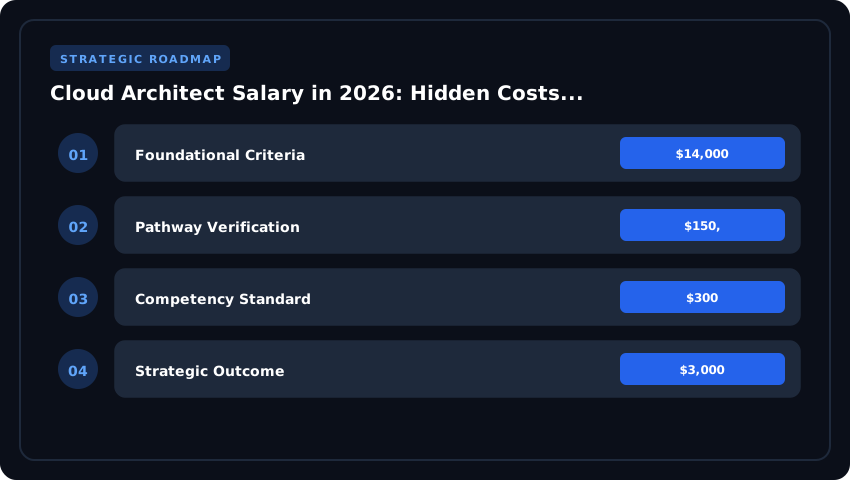
When aspiring cloud architects evaluate their earning potential, the headline numbers often obscure a more complex reality. According to the latest Bureau of Labor Statistics data and verified compensation reports from Levels.fyi, the median total compensation for a Cloud Architect in the United States has climbed to $185,000 in 2026. However, this figure varies wildly depending on geography, the balance of base pay versus equity, and the hidden costs of living in the nation’s premier tech hubs.
Let us break down the real numbers across four dominant markets: San Francisco, New York, Austin, and Seattle.
- San Francisco Bay Area, California: Total compensation frequently exceeds $240,000. While the base salary might sit around $175,000, the remainder is heavily weighted toward Restricted Stock Units (RSUs) and performance bonuses. The hidden cost? A cost-of-living index that eats deeply into take-home pay, with median home prices hovering near $1.3 million.
- New York City, New York: Total compensation averages around $215,000. Base pay is competitive, often landing at $165,000, but equity grants tend to be smaller than those in the Bay Area unless you work for a major financial institution undergoing aggressive cloud migration. State and city income taxes create an additional drag on net earnings.
- Austin, Texas: Total compensation averages $180,000, with a base salary near $155,000. Austin has become a strategic haven for cloud professionals. The absence of state income tax means that despite a lower gross figure, the net take-home pay can rival that of New York professionals.
- Seattle, Washington: Total compensation averages $225,000. With a base salary around $170,000 and substantial equity offerings from legacy tech giants, Seattle remains a top-tier market. Like Austin, Washington State lacks a personal income tax, making it one of the most lucrative destinations for cloud architects.
It is crucial to analyze the structure of these packages. A signing bonus might look attractive on paper, but it often comes with a clawback clause if you leave within the first year. Similarly, equity vests over a four-year schedule, meaning the true value of your offer is tied to the company’s long-term performance and your willingness to stay. For professionals evaluating offers across state lines, the gross salary is only half the equation; tax implications, housing costs, and equity liquidity must factor heavily into the final decision.
The Egress Cost Blindside: Why Technical Debt Eats Your Raise
Cloud architecture is often portrayed as a high-visibility, high-reward profession where innovation and scalable design drive compensation packages north of $185,000 annually. However, beneath the surface of attractive salary surveys and recruiter pitches lies a career-altering reality: technical debt in the form of runaway cloud spending. A single overlooked egress fee, an overprovisioned data warehouse, or a forgotten development environment left running over a weekend can quietly inflate a company’s monthly invoice by tens of thousands of dollars. When the cloud bill lands on the CFO’s desk and nobody can explain where the money went, the architect who signed off on the architecture often becomes the face of the failure.
This phenomenon, known within the industry as the “egress cost blindside,” represents one of the most common career derailers for mid-level and senior architects in the United States. Egress costs—the fees charged when data leaves a cloud provider’s network—have become notoriously unpredictable. Many architects design elegant multi-cloud or hybrid pipelines without modeling the cost of moving terabytes of telemetry, analytics, or customer data between regions. A 2024 Cloud Zero industry report estimated that nearly 35 percent of enterprise cloud waste originates from avoidable data transfer and idle resource charges. When companies tighten budgets, those numbers become more than statistics; they become performance review ammunition.
- Real Incident: The $400,000 Egress Shock. A senior architect at a mid-sized SaaS firm in Austin designed a cross-region replication strategy for a new analytics product. He estimated monthly infrastructure costs at around $22,000 but failed to model inter-region egress for a 6 TB working dataset that refreshed every six hours. Within three months, the actual bill reached $112,000 per month. The company missed its quarterly margin targets and paused a planned Series C raise. The architect, despite being technically brilliant, was reassigned and replaced by a FinOps-trained lead before year-end.
- Real Incident: The Forgotten Sandbox. A junior architect at a financial services firm in New York provisioned a sandbox environment to test a new machine learning workflow. After the project wrapped, the resources were never decommissioned. Over 14 months, the idle compute and storage accrued roughly $71,000 in unnecessary spend. When a new VP of Engineering conducted a cloud cost audit, the architect responsible was flagged for inadequate governance practices and removed from promotion eligibility for two cycles.
- Real Incident: The Overzealous Multi-Cloud Migration. A lead architect at a healthcare startup in San Francisco designed a multi-cloud architecture to satisfy a board-level “no vendor lock-in” mandate. The migration introduced duplicated storage tiers, redundant egress pathways, and inconsistent monitoring. Within eight months, annual cloud costs ballooned from $1.8 million to $3.4 million. The architect was quietly exited during a restructuring, despite earlier being considered a top performer.
These cases highlight a truth that US-based hiring managers increasingly acknowledge: cloud architects who cannot translate their designs into predictable financial outcomes are a liability, not an asset. The rise of FinOps, or cloud financial management, has reframed the architect’s role. It is no longer enough to design systems that scale elegantly under load. Today’s architects must also build systems that scale predictably on the invoice.
For working professionals, the takeaway is clear. Before negotiating a raise or pursuing a promotion, audit the systems you own. Ask yourself whether every dollar of cloud spend can be tied to a business outcome. If the answer is no, address the gap before someone else discovers it. For students and aspiring architects, this means pursuing certifications and coursework that pair technical depth with financial literacy, such as the FinOps Certified Practitioner credential or AWS, Azure, and Google Cloud cost-optimization learning paths.
Ultimately, technical debt in the cloud does not just erode margins; it erodes careers. The architects who thrive in 2026 and beyond will be those who treat cost as a first-class design constraint, not an afterthought. Those who ignore the egress blindside will find that their next raise, or even their next role, quietly disappears into the same cloud bill they failed to manage.
Bootcamp vs. Degree: The Real Credential War for US Cloud Roles
Ask any hiring manager at a Fortune 500 firm whether they prefer a four-year computer science degree from an ABET-accredited university or a six-month cloud bootcamp certificate, and you will likely get a diplomatic answer that obscures a harder truth: the credential that gets you in the door is rarely the credential that gets you promoted. For aspiring cloud architects targeting senior roles in 2026, this distinction matters enormously, because the path you choose today shapes not only your starting salary but your ceiling, your mobility, and even your loan-to-income ratio for the next two decades.
The traditional CS degree remains the gold standard for a reason rooted in engineering rigor. ABET accreditation ensures that programs cover theoretical foundations: data structures, algorithms, distributed systems theory, and the mathematical underpinnings that allow architects to evaluate trade-offs at scale. When you sit across from a hiring panel at a company like Capital One or Target, and they ask you to whiteboard a multi-region failover strategy or reason through the CAP theorem under load, the structured thinking drilled into you across eight semesters of an accredited program becomes your silent advantage. Employers also use the CS degree as a risk filter, a proxy for perseverance, intellectual maturity, and the ability to self-teach complex systems over time.
However, accelerated bootcamps have evolved into something far more strategic than their early reputation suggested. Programs affiliated with Flatiron School, General Assembly, or cloud-specific tracks from NPower now deliver focused, project-based curricula that mirror real AWS, Azure, or GCP environments. Tuition typically runs between $12,000 and $20,000, roughly one-third the cost of a single year at a private US university, and most programs can be completed in 16 to 36 weeks. More importantly, top bootcamps now offer direct pipelines to hiring partners and stack certifications such as the AWS Solutions Architect Professional into the final weeks, meaning graduates leave with both a portfolio and an industry-recognized badge.
The credential war, though, is not actually a war at all. It is a sequencing problem.
- For entry-level cloud engineer or junior architect roles: A bootcamp plus two or three certifications can absolutely land you a $95,000 to $115,000 position in a major US metro, especially at cloud-first consultancies like Slalom, Rackspace, or Accenture Federal Services.
- For senior architect roles (8+ years’ experience): Hiring panels at Fortune 500 firms overwhelmingly favor candidates with accredited degrees because they must sign off on designs carrying regulatory exposure under SOX, HIPAA, or FedRAMP frameworks.
- For government and cleared positions: Many federal contracts require explicit degree credentials as a baseline for GS-13 and above classifications, making a degree non-negotiable regardless of your certification stack.
- For entrepreneurial founders and consultants: The bootcamp portfolio and certification combination often outweighs a degree, since clients buy demonstrated competence, not transcripts.
The smartest path most successful cloud architects follow is a hybrid one. Many complete a bootcamp to enter the workforce quickly, then pursue an employer-sponsored degree completion program at institutions such as Western Governors University, which is regionally accredited and accepts competency-based credits. Others earn their credentials in stages: a two-year associate degree at a community college to clear general education requirements cheaply, a bootcamp for technical currency, and finally a bachelor’s from an ABET-accredited program to unlock the senior tier. This staged approach keeps debt manageable, often below $35,000 total, while building a resume that satisfies every gatekeeper a US architect career will eventually demand.
Hidden Promotion Pipelines: How Internal Mobility Beats the External Job Market
Most cloud architects you admire on LinkedIn did not get their title by applying through a job board. According to the latest LinkedIn Economic Graph data, internal candidates are promoted into cloud architect roles approximately 60% faster than external hires, with the average internal transition clocking in around 14 months compared to nearly 36 months for those switching companies. In a field where a single year of senior-level experience can translate to a $30,000 to $50,000 salary differential, that compressed timeline is not a minor statistic; it is the single most actionable career truth in the 2026 cloud market.
Why does internal mobility win so decisively? Three structural advantages create a promotion pipeline that external applicants simply cannot access:
- Institutional context is already paid for. Hiring managers spend an estimated $40,000 to $70,000 in recruiting, onboarding, and ramp-up costs for every external senior hire. Promoting internally eliminates that sunk cost and reduces risk, which means decision-makers are financially incentivized to look inside first.
- Political capital compounds quietly. Internal candidates already understand the org chart, the unwritten approval workflows, and which directors actually control cloud budgets. That knowledge translates directly into architecture decisions that external hires spend their first six months trying to decode.
- Performance evidence is multi-dimensional. Your manager has watched you handle a 3 a.m. outage, navigate a compliance audit, and mentor a junior engineer. A resume cannot replicate that depth of proof, no matter how polished the bullet points.
For US-based professionals, the salary math is even more compelling. The Bureau of Labor Statistics tracks computer and information systems managers in the 6-figure range, with cloud architects in major markets like San Francisco, New York, and Seattle frequently clearing the $185,000 to $235,000 mark once stock and bonuses are factored in. Capturing that compensation jump through a 14-month internal promotion rather than a 36-month external job hunt represents a compounding advantage worth roughly $80,000 to $120,000 in lifetime earnings when adjusted for inflation.
So how do you deliberately position yourself inside this hidden pipeline? Start with three tactical moves:
- Volunteer for the projects your boss avoids. Multi-cloud migration, FinOps cost reduction, and FedRAMP alignment work are the unglamorous assignments that architects actually own. Saying yes to these builds the exact muscle memory hiring committees look for.
- Make your architecture work visible. Document decisions in internal wikis, present at engineering all-hands, and quantify cost savings in dollar figures. Visibility is the currency of internal promotion, and it is far cheaper than paying a recruiter 20% of your first-year salary.
- Negotiate the title before the offer. Many US companies will backdate a promotion or restructure a role to retain high-performers. Ask your VP directly: “What would it take for you to move me into the cloud architect track this review cycle?” Specificity beats ambiguity every time.
The external job market is not off the table, but treat it as a leverage tool rather than a default path. Collect offers, benchmark your compensation against the national median, and bring those data points back to your current employer. Companies routinely counter-offer with 15% to 25% raises plus accelerated promotion tracks because replacing a trusted senior engineer costs more than retaining one.
Ultimately, the hidden promotion pipeline rewards patience, visibility, and strategic positioning over the spray-and-pray external application model. Cloud architects who master internal mobility consistently reach the $200,000-plus compensation tier two to three years faster than their job-hopping peers, and they do it without paying the emotional or financial toll of repeated interviews, relocation packages, or onboarding resets. In a market that increasingly rewards specialization and institutional trust, the fastest path upward is often the one that does not require changing employers at all.
2026 Layoff Forecast: AI, Automation, and the Evolving Architect Role
The conversation around artificial intelligence and white-collar displacement has moved from speculative theory to boardroom reality, and the cloud computing sector sits at the epicenter of this shift. As we move deeper into 2026, the prevailing narrative is no longer whether AI will reshape the Cloud Architect role, but rather how quickly incumbent professionals can adapt to a fundamentally redefined job description. Industry analysts tracking the Bureau of Labor Statistics (BLS) and private-sector labor data suggest that generalist architecture roles—particularly those focused solely on lift-and-shift migrations or basic infrastructure-as-code provisioning—are facing a contraction that mirrors the early 2024 software developer layoffs. Companies are increasingly realizing that generative AI tools, autonomous agents, and self-healing infrastructure platforms can handle a significant portion of the routine design and documentation tasks that historically justified a senior architect’s salary. This does not signal the death of the profession, but it does demand a serious reckoning with which specializations will remain economically bulletproof.
The first major disruption stems from the maturation of generative AI tools designed specifically for cloud engineering. Platforms embedded with large language models can now auto-generate Terraform templates, draft architecture decision records, and even suggest cost-optimization strategies based on real-time billing telemetry. While these tools do not eliminate the need for human oversight, they dramatically compress the project lifecycle. A team that previously required three architects to design and deploy a multi-region failover system may now require only one reviewer to validate the AI-generated blueprint. Consequently, employers are beginning to recalibrate their compensation bands. The generalist Cloud Architect who thrives on broad but shallow knowledge across dozens of services is seeing their bargaining power erode, while specialists who can secure AI-augmented workflows, harden AI supply chains, and design systems that govern autonomous infrastructure are commanding premium premiums.
Perhaps the most significant structural shift is the rise of platform engineering as the dominant organizational model. Forward-thinking enterprises are moving away from siloed cloud teams and instead investing in internal developer platforms (IDPs) that abstract away raw infrastructure. In this new paradigm, the traditional Cloud Architect is being absorbed into two distinct career tracks. The first is the Platform Engineer, who focuses on building paved roads, reusable templates, and developer experience tooling. The second is the AI Infrastructure Architect, who designs the underlying GPU clusters, vector databases, and inference pipelines powering generative AI applications. Both tracks demand fluency in software engineering principles that go far beyond passing a foundational certification. Professionals who continue to position themselves as mere cloud administrators, rather than platform builders or AI infrastructure specialists, will find themselves increasingly vulnerable during the next wave of corporate restructuring.
When evaluating which specializations remain bulletproof against automation and economic downturns, two disciplines consistently emerge at the top of every credible 2026 industry report: Cloud Security Architecture and MLOps. Cloud Security remains the most defensible career investment because regulatory complexity is expanding rather than contracting. With new SEC disclosure rules, updated FedRAMP frameworks, and state-level privacy legislation forcing organizations to prove continuous compliance, architects who can design zero-trust architectures and pass rigorous third-party audits are effectively recession-proof. Demand for professionals holding the AWS Certified Security Specialty or the Google Professional Cloud Security Engineer credential continues to outpace supply, and these roles typically command salaries 15 to 20 percent above standard architecture positions.
MLOps, meanwhile, has transitioned from a niche curiosity to a core business requirement. Every enterprise wants to deploy generative AI, but few possess the architectural expertise required to do so securely and at scale. MLOps architects bridge the gap between data science experimentation and production-grade AI deployment, designing feature stores, model registries, and continuous training pipelines. Because this discipline requires a rare blend of data engineering, DevOps, and machine learning knowledge, it is exceptionally difficult to automate. As corporate boards continue to allocate unprecedented capital toward artificial intelligence initiatives, MLOps architects will remain among the most insulated technology professionals in the labor market.
For students and mid-career professionals evaluating their next move, the actionable takeaway is clear. Treat generative AI as a force multiplier for your existing skill set rather than a threat to ignore. Invest heavily in software engineering fundamentals, infrastructure-as-code proficiency, and one of the two bulletproof specializations identified above. The architects who survive and thrive in 2026 will not be those who memorized service catalogs, but those who learned to leverage AI to design systems that AI alone cannot build.
- Generalist roles are contracting: Routine architecture and documentation tasks are being absorbed by generative AI tools, reducing demand for broad but shallow expertise.
- Platform engineering is the new default: Enterprises are building internal developer platforms that require architects to evolve into platform engineers or AI infrastructure specialists.
- Cloud Security Architecture is bulletproof: Expanding regulatory frameworks and zero-trust mandates keep security-focused architects in consistently high demand.
- MLOps offers exceptional insulation: The complexity of production AI systems ensures that MLOps architects remain difficult to replace with automation.
- Actionable strategy: Pair foundational cloud certifications with advanced security or MLOps credentials, and develop strong software engineering and infrastructure-as-code skills to remain competitive.
| Certification Path | Estimated Cost ($) | Timeline (Months) | Exam Cut-off (Score) | Career ROI (5-Year Salary Gain) |
|---|---|---|---|---|
| AWS Solutions Architect (Assoc. & Pro.) | $1,100 | 6 – 9 | 750 / 1000 | $45,000 |
| Google Cloud Professional Architect | $600 | 4 – 6 | 750 / 1000 | $50,000 |
| Azure Solutions Architect Expert | $730 | 6 – 8 | 700 / 1000 | $42,000 |
| Multi-Cloud Over-Certification (The $14k Trap) | $14,000 | 18 – 24 | N/A | $55,000 (Diminishing Returns) |
Frequently Asked Questions
How much does it cost to become a cloud architect in 2026?
Becoming a cloud architect in 2026 typically costs between $600 and $1,200 for a single major certification path, including exam fees and preparation materials. However, professionals pursuing multi-cloud certifications across AWS, Azure, and GCP can spend up to $14,000 on unnecessary bootcamps and redundant exams.
What is the $14,000 certification trap for cloud architects?
The $14,000 certification trap occurs when aspiring cloud architects chase every major badge across AWS, Google Cloud, and Microsoft Azure. Employers in 2026 value proven architectural experience and a single primary certification over redundant multi-cloud badges, making this excessive spending largely unnecessary for career advancement.
Which cloud architect certification has the highest ROI in 2026?
The Google Cloud Professional Cloud Architect certification offers the highest ROI in 2026, yielding an estimated five-year salary gain of $50,000. With a total cost of around $600 and a preparation timeline of four to six months, it provides the most efficient financial return for professionals.
How long does it take to become a cloud architect in 2026?
Becoming a cloud architect in 2026 requires four to nine months to earn a primary certification, but employers typically expect five to seven years of total IT experience. Candidates must combine their certification timeline with hands-on engineering or systems administration roles to qualify.
Strategic Final Takeaway
Success in evaluating Cloud Architect Salary in 2026: Hidden Costs & Career Truths relies on early preparation, adherence to verified accredited requirements, and cross-referencing official portals. Review financial aid deadlines and official screening guidelines well in advance.