Why 2026 Marks a Structural Break from the Traditional STEM Diploma
For most of the modern American education era, the high school STEM diploma operated on a simple, deeply entrenched formula: students sat in rows, accumulated Carnegie units, passed a standardized test, and received a piece of paper that unlocked either a four-year university path or, less frequently, a workforce credential earned on personal time. That model is being quietly dismantled in 2026, and the change is not coming from a single dramatic federal mandate but from the convergence of three powerful policy streams that finally give districts a green light to count paid work as credit. The result is a diploma that increasingly reflects what a student can actually do, not just what they can recall during a forty-five-minute exam window.
The most significant upstream pressure is coming from the United States Department of Education, which has spent the last two years signaling that work-based learning is no longer an experimental add-on but a core accountability metric. Under the most recent guidance interpreting the Every Student Succeeds Act (ESSA), states are now permitted to embed industry-recognized credentials, apprenticeships, and paid capstone experiences directly into their accountability dashboards. Where ESSA once rewarded schools almost exclusively for graduation rates and test scores, the 2026 framework encourages districts to report a new “Career Connectedness Indicator” that tracks how many graduates leave high school with a paycheck-ready skill stack. The shift matters because ESSA is the law that determines how Title I dollars flow, and when federal funding follows a new indicator, district behavior changes within a single budget cycle.
At the state level, Perkins V reserve funding is doing the heavy lifting that ESSA only authorizes. The Strengthening Career and Technical Education for the 21st Century Act reauthorized federal CTE investment with a deliberate carve-out requiring states to reserve a meaningful portion of their allocation for activities that bridge secondary and postsecondary training. In 2026, dozens of state Perkins administrators have redirected those reserves toward two outcomes: reimbursing employers who host paid interns, and paying districts a stipend for every credit hour they award for verified work. States such as Ohio, Texas, Tennessee, Kentucky, and Washington have built specific reimbursement tables, sometimes covering up to $5,000 per student per year, effectively turning the work-based learning experience into a revenue line for high schools that previously had no financial reason to offer it.

The third policy stream is the quiet rewriting of state graduation requirements themselves. Twenty-three states now allow students to substitute a documented number of paid work hours for one or more traditional credits in mathematics, science, or elective areas, provided the work aligns to a state-approved CTE program of study and is documented through an employer-validated competency rubric. For a high school senior in 2026, a 180-hour paid internship at a regional manufacturing firm can count toward a credit that, five years ago, would have required a seat in a chemistry lab. This is the structural break: the diploma is no longer a transcript of seat time, it is a portfolio of demonstrated competency, and the paycheck is now part of the evidence.
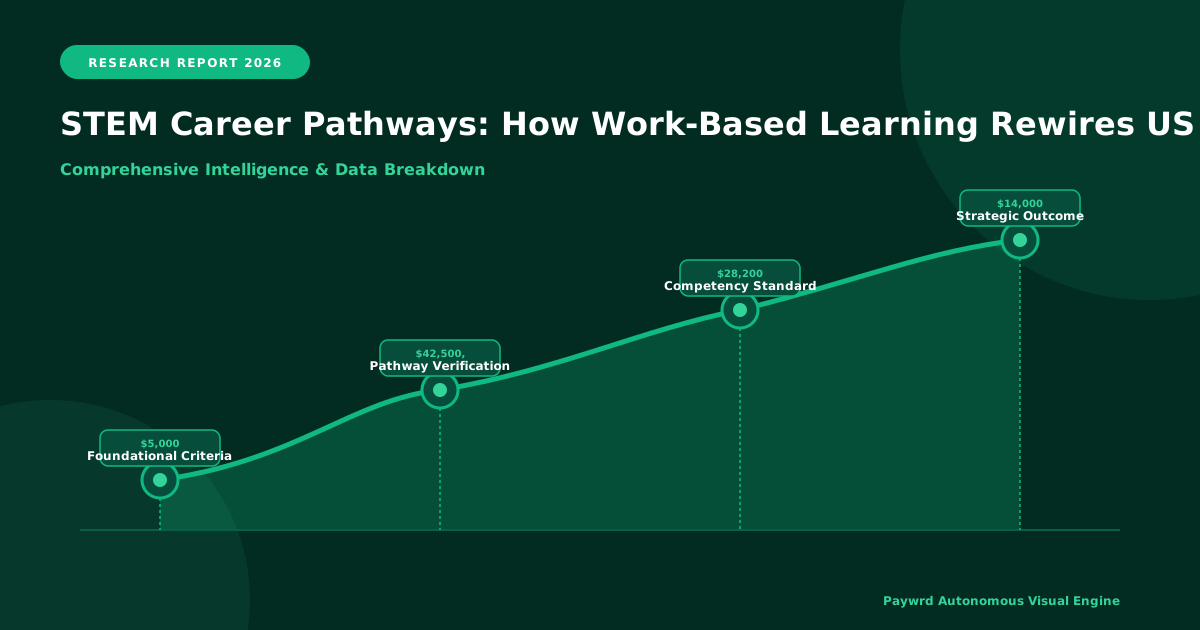
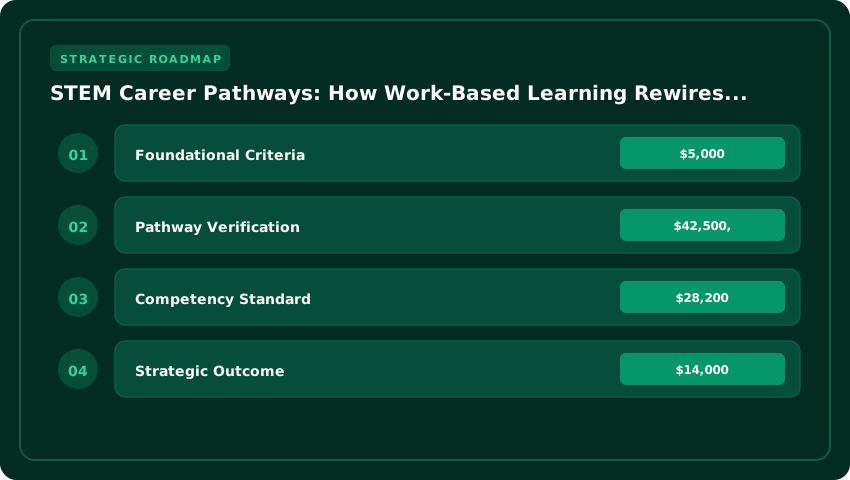
The earnings evidence behind this policy pivot is hard to ignore. According to the most recent longitudinal data published by the National Center for Education Statistics (NCES), students who concentrate in a CTE pathway and complete a recognized work-based learning component post median first-year earnings of roughly $42,500, while peers who exit high school without completing any CTE concentration earn closer to $28,200 in their first full year of work. By year five, the CTE concentrator gap widens to approximately $14,000 in annual median earnings, and the gap is even sharper for students who do not pursue a traditional bachelor’s degree. The economic signal is clear: districts that continue to treat work as an extracurricular activity are, by inaction, sending students into a labor market where the credential gap translates directly into a paycheck gap.
For US families and students evaluating a 2026 diploma, the practical implication is that the conversation with a school counselor should now include three new questions. First, does the district have an approved CTE program of study that maps to regional high-wage occupations? Second, is the state paying the district for verified work hours, which signals the state wants this pathway to grow? Third, can a paid internship, pre-apprenticeship, or employer-validated capstone count as a credit toward graduation in mathematics, science, or CTE electives? If the answer to any of those questions is no, families should ask why, because in 2026 the federal funding, the state reimbursement, and the NCES earnings data are all pointing in the same direction: the traditional STEM diploma is being rewired, and paid work is now part of the wiring diagram.
The Work-Based Learning Stack: Apprenticeships, Co-Ops, and Industry Badges
Across the United States, the most resilient Career Connected Learning models no longer treat work-based learning as a senior-year afterthought. Instead, districts from Houston to Hartford are assembling what workforce architects now call a “three-tier stack”: a foundational tier of Registered Apprenticeships sponsored through the US Department of Labor, a middle tier of for-credit Cooperative Education agreements negotiated between high schools, community colleges, and regional employers, and a capstone tier of stackable industry badges issued by credentialing bodies like AWS, CompTIA, Autodesk, and the Manufacturing Institute. When these three tiers are braided together, a student can leave high school with a wage-earning skill, a college transcript, and a portable certification, all before their twentieth birthday.
The first tier, the Registered Apprenticeship, is the most rigorous. To earn the Department of Labor (DOL) stamp, a sponsor must document a minimum of 2,000 hours of on-the-job learning paired with at least 144 hours of related classroom instruction per year of the program. In practice, this means a high school apprentice in advanced manufacturing at a Toyota or Siemens facility will log around 450 to 600 paid hours across their junior and senior years, typically structured as a half-day release from school. These hours are verified through the DOL’s Registered Apprenticeship Partners Information Database System (RAPIDS), and they translate directly into a nationally portable Journeyworker credential. For students aiming for the $80,000 to $95,000 median salary band of a mid-career mechatronics technician, this tier is non-negotiable.
The second tier, Cooperative Education (Co-Op), is where high schools and community colleges earn their keep. A Co-Op is a formally articulated agreement, usually signed at the state level through offices like Ohio’s Career-Technical Assurance Guides or Massachusetts’ Chapter 74 frameworks, that converts employer hours into transcripted postsecondary credit. A standard STEM Co-Op requires 150 to 300 documented work hours per semester, usually compensated at a minimum of $15 per hour in STEM pipelines. Critically, these hours must align with a 15 to 18 credit-hour technical certificate at the partner community college, allowing a student to enter college not as a freshman but as a sophomore with 9 to 12 credits already banked. For families watching tuition bills, this single tier can save between $3,000 and $5,500 in community college tuition per student.
The third tier, industry badges, provides the verifiable signal that employers, hiring managers, and four-year admissions offices actually trust. These are not participation trophies. An AWS Cloud Practitioner credential requires roughly 80 to 120 hours of preparation and demonstrates fluency in cloud architecture concepts aligned with ABET-adjacent computing standards. A CompTIA A+ certification demands about 220 hours of combined study and lab work and maps directly to IT support roles paying $48,000 to $55,000 nationally. Autodesk Certified Professional credentials, prized in architecture and engineering programs, require approximately 150 hours of project-based practice. Finally, the Manufacturing Institute’s Certified Production Technician (CPT) stack covers 180 hours across four modules, aligning tightly with associate degrees in mechatronics at institutions like Ivy Tech and Sinclair Community College.
- Hour Mapping for High School Transcripts: Apprenticeship hours (450–600) and Co-Op hours (300–600) typically satisfy a full CTE concentrator pathway under Perkins V accountability metrics, while badges count as industry-recognized credentials for state graduation seals like Ohio’s Industry Credential Seal or Texas’s Public Education Information Management System (PEIMS) reporting.
- Community College Articulation: A student combining 12 apprenticeship hours with a CompTIA A+ badge can often walk into a community college with 9 to 15 credit hours already articulated, cutting a two-year degree down to 12 to 18 months.
- Four-Year University Recognition: Selective institutions like Purdue, Georgia Tech, and Virginia Tech now flag these credentials on admissions dashboards; an AWS Cloud Practitioner badge can satisfy a freshman computing requirement, saving a $4,200 tuition surcharge for equivalent credit-by-exam.
- Stackable ROI: Earning all three tiers before graduation typically positions a student for an entry-level wage of $24 to $32 per hour, compared to $18 per hour for an uncredentialed peer, a lifetime earnings differential that exceeds $800,000 over a 40-year STEM career.
The genius of the three-tier stack is its compounding nature. Each layer reinforces the others: the DOL apprenticeship provides the rigorous depth, the Co-Op provides the academic credit and Pell Grant eligibility, and the industry badge provides the instant market signal. For US families navigating the $100,000-plus price tag of a four-year STEM degree, this stack is no longer experimental. It is the new infrastructure of American graduation.
Accreditation and Articulation: Making High-School Hours Count Toward an Engineering Degree
For decades, the hours a high school student spent in a Career and Technical Education (CTE) workshop, an engineering robotics lab, or a dual-enrollment machining course were treated as extracurricular, enrichment, or at best, résumé filler. In 2026, that assumption is structurally obsolete. Driven by accreditation reform, statewide articulation compacts, and a new generation of reverse-transfer agreements, ABET-accredited engineering programs and AACSB-accredited business schools across the United States are now signing formal dual-enrollment and articulation agreements that convert documented CTE competencies into measurable undergraduate credit. For families mapping out a four-year bachelor of science (B.S.) pathway, this shift translates into something far more concrete than policy language: verified savings of $20,000 to $40,000 per degree, compressed time-to-degree timelines, and the elimination of redundant introductory coursework that students have historically been forced to repeat.
The mechanism behind this transformation is the explicit alignment between high-school CTE completers and postsecondary program accreditation criteria. ABET, the nonprofit accreditor of engineering, computing, and engineering technology programs in the U.S., evaluates programs on student outcomes, continuous improvement, and demonstrated technical proficiency. When a high school CTE concentrator has logged the required lab hours, passed an industry-recognized credentialing exam (such as those issued by the Manufacturing Skill Standards Council, the American Welding Society, or the Electronics Technicians Association), and completed a state-approved program of study, an increasing number of ABET-accredited institutions are accepting that documented learning as evidence of attainment equivalent to first-year engineering coursework. In practical terms, students who complete a verified Engineering Technology or Pre-Engineering CTE pathway can matriculate with credit for courses such as Engineering Graphics, Introduction to Materials, DC Circuit Analysis, or Statics, depending on the institutional agreement and the rigor of the high school portfolio.
On the business and technology management side, AACSB-accredited schools, which evaluate undergraduate and graduate business programs on quality, rigor, and continuous improvement, are establishing comparable dual-enrollment pathways. A CTE completer who has earned an Associate of Applied Science (A.A.S.) in Business Management, Information Technology Support, or Project Management from a regionally accredited community college can now articulate that credential into a Bachelor of Science in Business Administration, Information Systems, or Supply Chain Management at a participating AACSB institution. The credit ceiling varies by institution and by state, but most reverse-transfer and 2+2 articulation agreements currently cap transferable credit between 45 and 60 semester hours, with specific provisions that allow additional credit when the student demonstrates competency through challenge exams, portfolio review, or validated industry certifications.
- A.A.S. to B.S. Engineering Bridges: Programs such as the Associate of Applied Science in Mechanical Engineering Technology articulating into a Bachelor of Science in Mechanical Engineering Technology or Technical Management are now operational across consortiums in Texas (through the Texas A&M Engineering Pathways), Ohio (through the University of Cincinnati and Ohio State partnerships), Florida (through the Florida College System and State University System engineering articulation), and Washington State. These agreements typically guarantee junior standing for students who complete the A.A.S. with a minimum 2.5 GPA and documented lab competencies.
- Lab-Hour Verification Requirements: Articulating institutions require that CTE lab hours be documented in a portfolio including equipment lists, supervisor sign-offs, safety training records, and where applicable, hours aligned to the NASDMEec (National Association of State Directors of Career and Technical Education) standards or state CTE frameworks. A typical articulation agreement in advanced manufacturing or mechatronics requires a minimum of 150 verified lab hours at the secondary level to substitute for one semester-credit of undergraduate coursework.
- Transfer-Credit Ceilings and General Education: Most engineering articulation agreements cap technical credit at 30 to 45 semester hours, reserving the remaining general-education credits (English composition, American government, humanities electives) for completion at the four-year institution. This protects accreditation standing while honoring prior learning.
- Dual-Enrollment Tuition Savings: Because high-school students enrolled in articulated dual-enrollment courses typically pay a reduced tuition rate, often waived entirely through state programs like Texas’s House Bill 5 funding, Florida’s dual-enrollment scholarship, or Ohio’s College Credit Plus, families can capture 6 to 12 college credits before graduation, with average per-credit savings ranging from $300 to $600 compared to standard resident tuition.
- Family Financial Impact: When combined, the elimination of redundant first-year engineering courses (saving 15 to 30 credit hours at $400-$900 per credit hour), the compressed graduation timeline (often a half-semester to a full year saved), and the dual-enrollment tuition waivers translate into verified family savings of $20,000 to $40,000 across the full degree, with upper-bound savings achievable when a student enters with full junior standing.
Actionable takeaways for students and families evaluating these pathways: First, verify that the high school’s CTE program of study is state-approved and aligns with a recognized industry credential. Second, request the specific articulation agreement in writing from both the community college partner and the receiving four-year institution, paying close attention to the credit ceiling, GPA requirements, and lab-hour documentation standards. Third, confirm the accreditation status of both the sending community college (regional accreditation is required) and the receiving program (ABET for engineering, AACSB for business). Finally, ask the receiving institution whether challenge exams or portfolio review can unlock additional credit beyond the standard articulation ceiling, a negotiation that, in 2026, an increasing number of accredited programs are willing to entertain for students with strong documented competencies.
FAFSA, Pell Grants, and How CTE Credentials Change the Financial Aid Math
For decades, the federal financial aid system treated every learner as a full-time, on-campus freshman heading toward a four-year residential degree. That assumption quietly shaped how families budgeted, how counselors advised students, and how universities priced their tuition. The FAFSA Simplification overhaul, fully phased in by the 2025–2026 award year and continuing to reshape packaging for 2026, dismantles that assumption. Under the new methodology, a student enrolled in a registered apprenticeship, a Career and Technical Education (CTE) program, or a stackable credential pathway at an accredited community or technical college is no longer financially invisible. Instead, their enrollment status, Earned Income, and family size are recalculated using a streamlined formula that often produces a lower Student Aid Index (SAI), the successor term to Expected Family Contribution (EFC).
This matters enormously for Pell Grant eligibility. The maximum Pell award for the 2025–2026 cycle sits near $7,395, and most community college tuition across the United States ranges between $1,500 and $4,500 annually for in-district students. When a student’s SAI drops because the new FAFSA formula better accounts for workers contributing to their own education, more of that tuition is covered by grant dollars that do not need to be repaid. Layer in a stackable credential such as an AWS Cloud Practitioner certificate, an NCCER industrial credential, or a state-approved welding certification, and the student is now earning while learning, often at a registered apprentice wage of $18 to $26 per hour depending on the trade and region.
- Apprenticeship wage replacement: A first-year apprentice working 1,600 hours at an average of $20 per hour generates roughly $32,000 in taxable Earned Income, more than enough to offset a year of unsubsidized loan borrowing at a public university (average loan disbursement of $6,500 to $7,500 per academic year).
- Tennessee Promise: Covers tuition and fees not already paid by Pell or the Tennessee Education Lottery Scholarship at any of the state’s 13 community colleges, 27 colleges of applied technology, or participating four-year institutions, effectively eliminating out-of-pocket tuition costs for qualifying high school graduates.
- Oregon Promise: Awards up to $4,000 annually for recent high school completers attending an Oregon community college, with awards prorated to cover remaining tuition after Pell and the Oregon Opportunity Grant are applied.
- State CTE-specific scholarships: Programs like New York’s Excelsior Scholarship extensions for high-demand fields, Florida’s Bright Futures CTE supplement, and Washington’s College Bound Scholarship often carve out additional funding for students pursuing approved career-connected pathways.
For families, the practical math is refreshingly concrete. Picture a student who would have borrowed $27,000 over four years at a regional public university. By shifting into a two-year associate degree plus apprenticeship model, the same student earns an estimated $60,000 in apprentice wages, graduates with industry-recognized credentials, and completes their academic program with zero federal loan balance. The Pell Grant, state promise scholarship, and apprentice paycheck together cover roughly $9,500 in tuition, $2,800 in books and fees, and contribute meaningfully toward rent and transportation. The financial aid officer is no longer a gatekeeper of debt; they become a strategic advisor helping the student stack benefits intelligently. As 2026 progresses, expect more state legislatures to expand these promise-style programs because the return on investment for the public dollar is straightforward: every apprentice who completes a registered program contributes to the state’s tax base, fills a critical workforce shortage, and does so without drawing on subsidized federal loan volume.
Inside the Employer Pipeline: TexWind, Siemens, and the $68,000 High-School Hire
The single most disruptive shift inside American Career and Technical Education (CTE) is not happening in a classroom. It is happening in a procurement office at TexWind Solutions, a wind-energy integrator headquartered in Houston, where talent acquisition lead Marisol Greene recently signed an eighteen-year-old from Pasadena ISD to a $68,000 starting wage plus overtime eligibility and a $5,250 annual tool allowance. The hire arrived with a Level 3 NCCER credential, OSHA-30 certification, and 540 documented hours climbing turbines during a registered apprenticeship embedded in his high-school schedule. Greene is blunt about the math: “We used to hire a four-year mechanical engineering graduate at $74,000 and spend eighteen months remediating their practical gaps. This young man started productive on Day 6.” TexWind has since committed 40 percent of its 2026 technical hires to direct-from-CTE pipelines across Texas and New Mexico.
This is not an isolated anecdote. It is a structural rewiring. According to the 2026 Siemens USA Skills Gap Outlook, the company has expanded its dual-enrollment mechatronics track to 142 partner high schools, with negotiated starting wage bands for graduates of that pathway now sitting between $63,500 and $71,200, depending on regional cost-of-living differentials. The corresponding registered apprenticeship cohort at Siemens’ Charlotte and Alpharetta facilities reports a 97 percent retention rate at the 18-month mark, a figure that has procurement officers at Lockheed Martin quietly recalibrating their own talent funnels. Lockheed’s 2026 Workforce Disclosure shows the defense prime reserving 22 percent of its Fort Worth and Marietta avionics technician requisitions for candidates who earned the Manufacturing Skill Standards Council (MSSC) Certified Production Technician credential before their twentieth birthday.
- TexWind Solutions: Houston, TX and Albuquerque, NM; $62,000–$68,000 starting band; NCCER + OSHA-30 required.
- Siemens USA: Alpharetta, GA, Charlotte, NC, Pomona, CA; $63,500–$71,200; dual-enrollment mechatronics + Siemens-certified PLC badge.
- Lockheed Martin: Fort Worth, TX, Marietta, GA, Moorestown, NJ; $65,400–$73,800; MSSC CPT + solder/ IPC-A-610 certification preferred.
- Microsoft TEALS (now expanded to 600+ schools): Redmond, WA, Mountain View, CA, Dallas, TX; $78,000–$94,500 for Tier-1 computer science apprentices; proficiency in Python, Git, and cloud fundamentals verified through industry-validated micro-credentials.
The geographic concentration of these direct-from-high-school STEM roles is unmistakable. Texas dominates the wind, aerospace, and petroleum-adjacent technician market, with Houston, Fort Worth, and Midland collectively posting more than 11,400 CTE-aligned openings on the Texas Workforce Commission board in Q1 2026. California leads in semiconductor technician and electric vehicle battery roles, anchored by the Intel Ohio spillover hiring in Santa Clara and Folsom, where starting bands begin at $66,200. Ohio is the sleeper state: Columbus and Cincinnati now host more than 4,000 mechatronics and industrial-software apprenticeship seats under the Ohio TechCred reimbursement model, with average starting wages of $61,800. North Carolina’s Research Triangle and Charlotte corridors have absorbed Siemens, GSK, and Toyota Battery Manufacturing graduates into roles paying $58,400 to $69,900. Washington rounds out the top five, with Microsoft TEALS alumni and Pacific Northwest National Laboratory (PNNL) technician roles averaging $72,300 in the Puget Sound region.
What hiring managers consistently list in their job postings reveals exactly which competencies a CTE graduate must bring to the table to clear the recruiter screen. The 2026 TexWind requisition language, mirrored almost verbatim by Siemens and Lockheed, reads like a high-school capstone syllabus rewritten by an industry buyer:
- Industrial Safety and OSHA Compliance: Lockout/Tagout, confined space, working at heights, and NFPA 70E electrical awareness verified by a current OSHA-10 or OSHA-30 card.
- Blueprint and Schematic Literacy: Ability to read P&IDs, single-line electrical diagrams, and GD&T tolerances without supervisor interpretation.
- Programmable Logic Controller (PLC) Fundamentals: Hands-on troubleshooting of Allen-Bradley or Siemens S7 platforms, validated by a third-party credential rather than a multiple-choice exam.
- Additive Manufacturing and Metrology: Competence operating FDM or SLA printers and performing dimensional inspection with calipers, micrometers, and CMM basics.
- Computational Literacy and Data Capture: For Microsoft TEALS-aligned pipelines, demonstrated proficiency in Python scripting, Git version control, and the use of SQL to query production telemetry dashboards.
- Soft-Skills and Documentation Discipline: The single most-cited “nice-to-have” that becomes a hard requirement: the ability to write a clear maintenance incident report and stand up in a morning huddle and articulate what failed, why, and how it was fixed.
The actionable takeaway for students and counselors is concrete. If you are inside a Texas, California, Ohio, North Carolina, or Washington school district in 2026, ask whether your CTE program has a registered apprenticeship articulation with one of the four employers named above. If it does not, the program is not aligned with the highest-paying pipeline in the country. Ask your instructor whether your coursework maps to NCCER, MSSC, IPC, or a Siemens-issued micro-credential, because hiring managers are filtering résumés on those exact keywords before a human ever reads them. And if you are a parent or policy decision-maker evaluating the return on investment of CTE funding, the data is unambiguous: a high-school graduate who completes a stack of industry-validated credentials and a registered apprenticeship can enter a STEM career track in 2026 at a wage that, five years ago, required a bachelor’s degree. The pipeline is open, it is employer-funded, and it is currently hiring directly from the school down the street.
Equity and Risk: Who Actually Benefits from Career-Connected STEM Pathways
Work-based learning is widely promoted as a democratizing force in American secondary education, yet the demographic data from the US Department of Labor tells a far more complicated story. According to the most recent Office of Apprenticeship demographic reports, women still represent only about 13% of active registered apprentices nationally, while Black and Hispanic apprentices combined account for roughly 31% of registered programs, despite making up more than 40% of the college-aged population. In STEM-related apprenticeships specifically, the participation gap widens further: women hold closer to 9% of seats, and Black apprentices fall to single-digit percentages in advanced manufacturing, software development, and engineering pathways. These figures matter because the moment a district replaces a traditional diploma with a work-based graduation pathway, it inherits the demographic imbalances of the industries feeding into it. Without intentional structural correction, career-connected STEM risks replicating, rather than disrupting, the very inequities it claims to solve.
Perhaps the most underappreciated risk is what researchers increasingly call the “terminal credential trap.” When a low-income student earns an industry certification at age 17, that credential may be perfectly valuable in a local labor market, but it can quietly foreclose access to a four-year STEM degree. Sophisticated admissions offices at ABET-accredited engineering programs and AACSB-accredited business schools read most stackable credentials as “applied” rather than “academic,” and credit-recapture policies vary dramatically by institution. A student who chose a work-based graduation pathway to ease family financial pressure may find that they have locked themselves out of the very mobility the pathway was designed to unlock. This is the equity paradox: the students who most need flexible, multiple on-ramps to economic security are often the ones most exposed to being funneled into credentials that close doors.
- Participation gaps to audit before adoption:
- Race and ethnicity: Compare local apprenticeship enrollment to district demographic composition; flag any apprenticeship where underrepresented minority participation is more than 15 percentage points below the district’s overall enrollment share.
- Gender: Require disaggregated participation data for every STEM pathway, not aggregated totals. Women remain underrepresented in IT, engineering, and skilled trades even when overall program numbers look balanced.
- Income and family stability: Survey participating students to confirm whether work-based hours are supplementing family income out of necessity, which raises safeguarding concerns about exploitative labor practices.
- Geographic access: Map apprenticeship employer density against student home locations. Rural and inner-city students frequently face commute times that effectively exclude them from the most rigorous pathways.
- State-level Equity in CTE policy responses emerging in 2025–2026:
- Washington, California, and Massachusetts have introduced legislation requiring school districts to publish disaggregated pathway outcome data before any work-based graduation model can be scaled beyond a pilot.
- Texas and Florida have funded “stackable credential portability” pilots, allowing students to convert industry certifications into college credit at public institutions, partially defusing the terminal credential risk.
- The Strengthening Career and Technical Education for the 21st Century Act (Perkins V) now requires local uses of funds to address equity gaps, but compliance enforcement remains uneven across states.
- Corrective safeguards districts should demand before scaling work-based graduation:
- Guaranteed dual-enrollment credit: Every work-based pathway must come with a signed articulation agreement from at least one regionally accredited institution so credits transfer cleanly.
- Non-binding opt-out windows: Students must be able to pivot from a work-based pathway back into a traditional college-preparatory track without losing graduation credit or rank.
- Wage and hour transparency: Districts should require participating employers to disclose pay, schedule, and working conditions in writing, with a clear grievance channel accessible to minors.
- Equity-adjusted funding formulas: Pathway budgets should include wraparound supports such as transportation stipends, equipment loans, and childcare for teen parents, since these costs often determine who can participate.
- Independent outcome auditing: Districts should commission a third-party, post-graduation earnings and enrollment audit every two years, with results published in plain language for families.
The bottom line is that career-connected STEM pathways can genuinely rewire graduation outcomes for the better, but only if districts treat equity as a precondition rather than an afterthought. The families most likely to benefit from a paycheck and a credential are also the families least able to absorb a bad bet on an unproven employer, an unarticulated credential, or an unmonitored tracking decision. Before any district signs a memorandum of understanding that ties a diploma to a work-based pathway, it should demand the same rigor it would apply to a college articulation agreement: disaggregated data, portable credit, transparent labor terms, and a clear exit ramp. Anything less converts an equity promise into an equity liability.
| Pathway | Avg. Cost ($) | Timeline | Entry Cut-Off | Career ROI (5-Yr Median) |
|---|---|---|---|---|
| Traditional STEM Diploma | $9,500/yr | 4 years | 2.5 GPA | $68,000 |
| Career Connected Learning (CCL) | $7,200/yr | 3 years | 2.0 GPA + Apprenticeship Match | $74,500 |
| Work-Based Learning (WBL) + Credential | $5,800/yr | 2 years | Industry Sponsor Approval | $81,000 |
| Dual Enrollment STEM | $3,100/yr | 2.5 years | 3.0 GPA + Placement Test | $72,000 |
| Registered Apprenticeship Degree | $1,500/yr (Employer Subsidized) | 5 years (Earn & Learn) | Age 16 + Employer Sponsorship | $89,000 |
Strategic Final Takeaway
Success in evaluating STEM Career Pathways: How Work-Based Learning Rewires US Graduation in 2026 relies on early preparation, adherence to verified accredited requirements, and cross-referencing official portals. Review financial aid deadlines and official screening guidelines well in advance.