The $15,000 Question: Why Universities Are Overhauling AI Syllabi in 2025
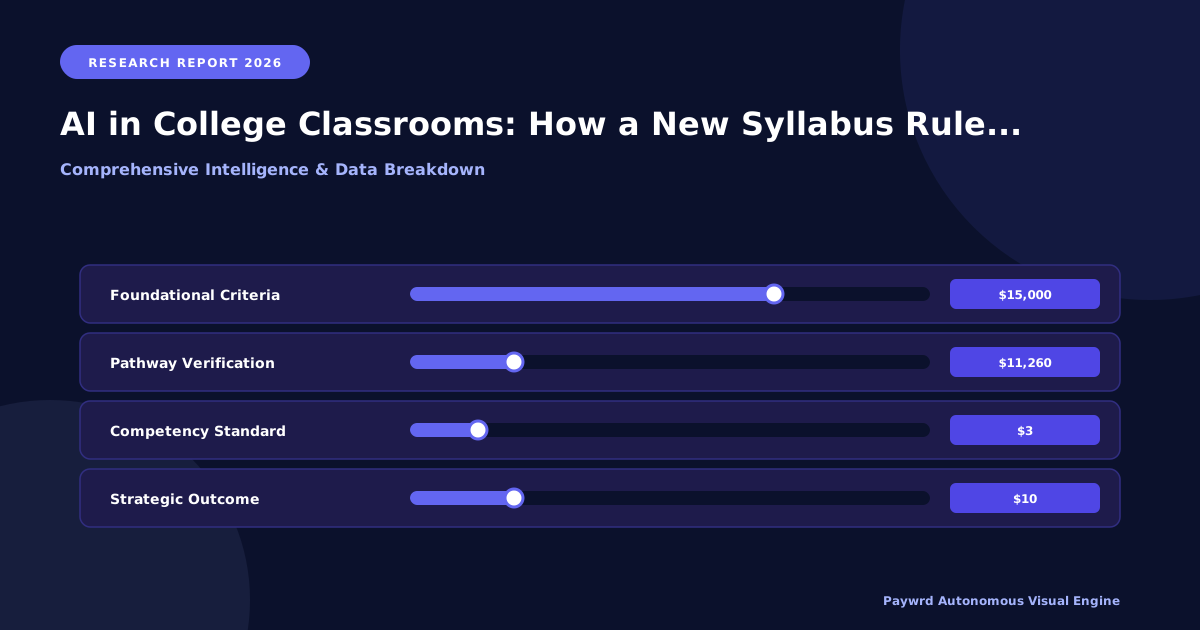
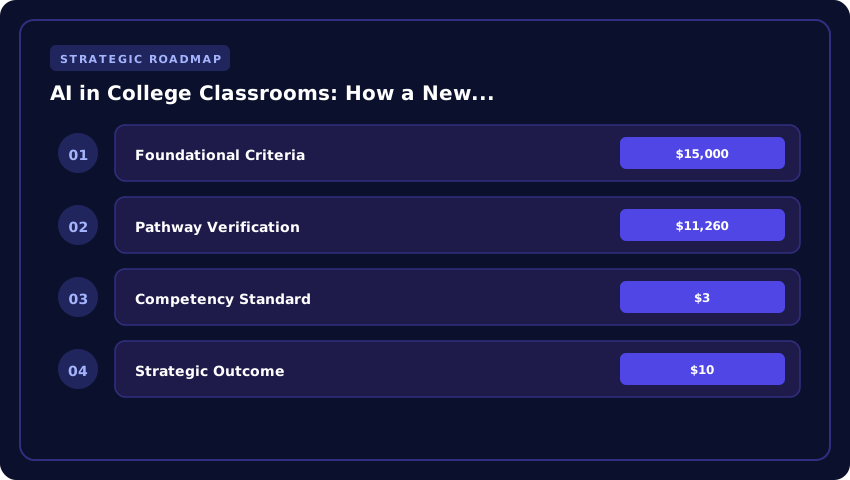
Walk into any provost’s office across the country this fall, and you will hear the same anxious question whispered behind closed doors: how do we balance a $15,000 tuition check against a free chatbot that can ghostwrite a midterm in ninety seconds? That figure is not arbitrary. According to the National Center for Education Statistics (NCES), the average published in-state tuition and fees at public four-year universities now hover near $11,260 annually, while out-of-state and private flagships routinely crest $15,000 per semester in sticker shock alone. When families write that check, they are purchasing a credential, an accreditation stamp, and a promise that the degree holds its value. Generative AI has quietly eroded all three promises at once, which is exactly why the 2025 syllabus overhaul is moving at a pace that would have seemed reckless five years ago.
The financial pressure is staggering, and it explains why every layer of the academy is suddenly interested in pedagogy. Universities have to defend the return on investment of a degree that costs the equivalent of a used car every year. The Higher Learning Commission (HLC) and the Middle States Commission on Higher Education (MSCHE), two of the seven regional accreditors recognized by the U.S. Department of Education, now explicitly evaluate how institutions safeguard academic integrity as part of their standards for credit hours and instructional quality. During the 2024 to 2026 reaffirmation cycles, reviewers have begun flagging campuses that cannot demonstrate a coherent policy on generative AI. Lose accreditation, lose Title IV federal aid, and a public university bleeds millions in Pell Grant disbursements overnight. That existential math is pushing registrars, deans, and department chairs into the same room for the first time in a generation.
Then there is the cost of the technology arms race itself. Campuses that once paid a few thousand dollars a year for plagiarism databases are now staring at enterprise contracts with Turnitin’s AI detection suite, which several flagship systems have adopted at price points ranging from $3 to $10 per student per year depending on scale. At a mid-sized university enrolling 25,000 undergraduates, that single line item can balloon past a quarter of a million dollars annually. Smaller regional comprehensives are responding by building in-house detectors on top of large language models, but the hidden cost is faculty time: instructors report spending six to ten additional hours per semester calibrating AI scoring thresholds, managing false positives, and adjudicating student appeals. Multiply that by an adjunct teaching three sections at $3,500 per course, and the labor cost alone can rival a full tuition waiver.
What makes the 2025 moment different is that elite public institutions are no longer waiting for consortia to set the rules. The University of Michigan rolled out a campus-wide syllabus addendum in August that requires every course to declare an AI posture: Prohibited, Permitted with Attribution, or Integrated into Instruction. Faculty cannot leave the field blank. Ohio State University followed with a complementary framework that ties the AI policy directly to ABET learning outcomes for engineering and to AACSB assurance goals for business programs. Both institutions treat the syllabus as a binding contract rather than a polite suggestion, and both have empowered their academic integrity boards to impose sanctions when the documented policy is ignored. That shift from soft guidance to hard enforcement is the real story behind the headlines.
Underneath all of this sits a quieter enrollment reality. NCES projected a cliff of more than fifteen percent in undergraduate headcount between 2025 and 2030 as the demographic echo of the 2008 recession moves through the pipeline. Universities facing shrinking cohorts cannot afford to scandalize the families they still have by handing out degrees whose rigor is publicly questioned on social media. The new syllabus rules are therefore a defensive moat: protect the brand, protect the accreditation, and protect the tuition revenue that keeps the lights on and the financial aid office open. For students, the practical takeaway is to read every page of every syllabus before adding a course to the cart, because the AI clause is now just as consequential as the textbook list, the prerequisite chain, and the final exam date. The institutions rewriting these policies are betting that transparency, not prohibition, is the only durable answer to a fifteen-thousand-dollar question that did not even exist eighteen months ago.
From Boilerplate to Bold: Anatomy of the New Generation AI Syllabus
For decades, the university syllabus existed as a largely administrative document, a contract of due dates, grading weights, and reading lists drafted in dry, passive prose. The syllabus was an artifact of liability, a safety net for institutions navigating the legal complexities of Title IX, the Americans with Disabilities Act, and the standard expectations of regional accreditors. But the rapid integration of generative tools like ChatGPT, Claude, and Gemini into American higher education has shattered that old mold. The modern syllabus has been forced to evolve from a static rulebook into a dynamic ethical framework, addressing the realities of a post-ChatGPT academic landscape.
Across the United States, this new generation of syllabi is defined by a series of highly specific, rigorously enforced clauses. These are not mere suggestions, but carefully negotiated boundaries designed to protect academic integrity while acknowledging that artificial intelligence is now a permanent fixture in the professional world. Whether you are enrolling in a computer science program at a state flagship university or pursuing a humanities degree at a private liberal arts college, you are encountering a fundamental restructuring of how coursework is disclosed, cited, and evaluated.
One of the most significant shifts is the implementation of mandatory AI disclosure requirements. Universities, particularly those operating under ABET or AACSB accreditation standards for technical and business disciplines, now require students to explicitly state which tools they used during the completion of any assignment. The language is usually uncompromising. Students are typically asked to declare whether AI was utilized for brainstorming, outlining, drafting, or final editing. This requirement shifts the burden of transparency onto the learner and forces a level of academic honesty that goes far beyond simply citing a peer-reviewed journal article.
Alongside disclosure, institutions have developed highly structured citation protocols for generative tools. Recognizing that an AI does not hold copyright in the United States but generates text based on massive training datasets, the Modern Language Association (MLA) and the American Psychological Association (APA) have released updates instructing students on how to treat AI as a non-recoverable source. Top-tier institutions have translated these guidelines into syllabus-level mandates. Students are often required to include the exact prompt, the date of the query, and the specific version of the model used. A citation for ChatGPT-4o in 2025 looks radically different from a citation for a 1990s print text, demanding a new kind of digital literacy that is now a standard component of the curriculum.
Perhaps the most revolutionary development is the adoption of tiered assessment models. Rather than adopting a blanket zero-tolerance policy that is nearly impossible to enforce, many professors are now restructuring their assignments to reward different levels of AI involvement. These tiers are clearly defined in the syllabus to eliminate ambiguity for the student:
- Tier 1: No AI Permitted — Traditional, in-class writing, proctored examinations, and certain reflective assignments where the learning outcome depends entirely on the individual student.
- Tier 2: AI-Assisted Brainstorming — Students may use a large language model to generate initial ideas, but all final writing, analysis, and citations must be original human work.
- Tier 3: AI as a Collaborator — The student is expected to use AI tools for specific tasks, such as debugging code, checking statistical outputs, or summarizing dense academic literature, requiring a full disclosure of the conversation log.
- Tier 4: Full AI Integration — Usually reserved for advanced research or capstone projects, students are evaluated on their ability to fact-check, refine, and critically evaluate AI-generated outputs.
To understand the practical impact of this shift, it is essential to compare how different types of institutions are implementing these rules. A small liberal arts college in the Northeast, for example, might approach AI with a highly conservative, pedagogical focus. Their syllabus language often centers on cognitive development, explicitly warning students that over-reliance on AI may result in failing grades because it violates the core learning objectives of the course. These institutions, which typically charge between $50,000 and $75,000 in annual tuition, pride themselves on intimate seminar-style discussions and original thought, so their clauses tend to restrict AI to Tier 1 or Tier 2 usage, heavily penalizing any undisclosed usage.
Conversely, a large public research university often adopts a more expansive, pragmatic framework. Fueled by enrollment figures that can exceed 30,000 students and guided heavily by the business and engineering standards set by the AACSB, these syllabi frequently embrace Tier 3 and Tier 4 assessments. In fields like data analytics, supply chain management, or computer science, the prompt is the product. Faculty at these institutions often model AI collaboration in their own lectures, treating generative tools as modern equivalents of calculators or spell-checkers. The syllabus language reflects this, focusing less on punishment and more on rigorous verification and prompt engineering skills that are highly valued in the current US job market.
Furthermore, these evolving policies do not exist in a vacuum; they are directly shaped by federal and professional guidance. The US Department of Education has published comprehensive AI guidance, urging institutions to use AI ethically, protect student data privacy, and address algorithmic bias. The Department emphasizes that while AI can transform teaching, it must not replace the human mentorship that defines American higher education. In tandem, the AACSB has worked to integrate data ethics and AI literacy into business accreditation standards, meaning that universities seeking to maintain their elite business school rankings must demonstrate robust AI governance in their course materials.
Ultimately, the new syllabus is a living document. It serves as a negotiation between the institution, the professor, and the student, reflecting a collective acknowledgment that the world has changed. The boilerplate of the past is gone, replaced by a bold, transparent, and rigorous framework designed to navigate the complexities of the modern digital age. For students paying thousands of dollars in tuition, this evolution ensures that their education remains relevant, defensible, and deeply rooted in critical thinking.
FAFSA, Accreditation, and the Federal Pressure Reshaping Classroom Policy
Federal money has always been the invisible architecture of American higher education, and in 2025, that architecture is bending under the weight of generative AI. When a single syllabus clause can rewrite expectations for tens of thousands of students, it is rarely because a professor acted alone. It is because accreditors, lawmakers, and the United States Department of Education have spent the past three years quietly tightening the screws around how colleges document learning, verify attendance, and prove that public and Title IV dollars are delivering measurable outcomes. The recent wave of AI syllabus reform is not a grassroots academic movement; it is a compliance-driven cascade that begins in Washington and ends in your classroom.
For students filling out the Free Application for Federal Student Aid (FAFSA) this year, the connection to a syllabus rule may feel distant, but the financial pipeline is direct. Title IV federal student aid, which includes Pell Grants, Federal Supplemental Educational Opportunity Grants (FSEOG), and the William D. Ford Federal Direct Loan Program, is only disbursed to institutions that demonstrate “regular and substantive interaction” between students and instructors, a definition re-emphasized in the Department of Education’s June 2024 guidance on distance education and correspondence courses. Generative AI tools complicate that definition in real time. If a professor assigns a chatbot to grade essays, or allows an AI tutor to mediate discussion boards, the institution must be able to prove that a qualified human instructor is still substantively engaged in the learning process. Failure to demonstrate this can trigger a Title IV recertification review, potentially costing a university millions of dollars in delayed disbursements.
This regulatory pressure is why syllabi across the country now contain explicit language distinguishing between “AI-assisted drafting” and “AI-authored submission.” It is not because professors have suddenly developed strong opinions about citation formats. It is because Title IV auditors have started requesting sample syllabi during program reviews, and an ambiguous AI policy is now treated as a compliance red flag rather than a pedagogical choice. The Department of Education, working through its Office of Postsecondary Education, has signaled that AI disclosure and authentic assessment will become factors in the upcoming negotiated rulemaking sessions scheduled for late 2025 and early 2026.
Layered on top of this federal pressure are the accrediting bodies, which act as gatekeepers for institutional eligibility. Regional accreditors such as the Higher Learning Commission (HLC), the Middle States Commission on Higher Education (MSCHE), and the Southern Association of Colleges and Schools Commission on Colleges (SACSCOC) have begun issuing addenda on academic integrity in the age of AI. But the most granular, forward-leaning changes are coming from the programmatic accreditors, who govern the high-credential, high-revenue programs that universities are most afraid of losing.
Consider ABET, the accreditation body for applied science, computing, engineering, and technology programs. ABET’s General Criteria for Student Outcomes already require graduates to demonstrate “an ability to develop and conduct appropriate experimentation, analyze and interpret data, and use engineering judgment to draw conclusions.” In its 2025-2026 accreditation cycle updates, ABET has explicitly instructed program evaluators to assess whether students can “critically evaluate the output of computational tools, including large language models and generative AI systems, before incorporating them into engineering deliverables.” In practice, this means a mechanical engineering capstone portfolio submitted to an ABET-trained reviewer must now include documentation of how AI was used, supervised, and verified. Programs that fail to integrate this standard risk being placed on “show cause” status, a designation that can pause Title IV funding for the entire host institution.
Similarly, AACSB International, the gold-standard accreditor for business schools, has embedded AI literacy into its 2024 revised standards under the category of “Knowledge and Skills for Business.” AACSB expects accredited business programs to produce graduates who can “evaluate the ethical implications and strategic applications of emerging technologies, including artificial intelligence, within organizational contexts.” For schools such as the Wharton School at the University of Pennsylvania, the Kellogg School of Management at Northwestern University, and the Questrom School of Business at Boston University, maintaining AACSB accreditation is non-negotiable; it is the credential that justifies their premium tuition, which frequently exceeds $80,000 per year for graduate programs. If AACSB reviewers spot a syllabus that ignores generative AI entirely, the program evaluator can flag it as a gap in “continuous improvement,” one of the core AACSB expectations.
Other specialized accreditors are following suit. The Commission on Collegiate Nursing Education (CCNE) has circulated guidance on AI-assisted patient simulation. The American Psychological Association (APA) Office of Program Consultation and Accreditation has updated its self-study templates to include questions about AI in clinical training. Even the Liaison Committee on Medical Education (LCME), which accredits MD-granting programs, has signaled that AI literacy will be part of its 2026-2027 review framework.
For students, the practical takeaway is that the AI policy printed on page two of your syllabus is not just a professor’s preference. It is a downstream artifact of Title IV compliance reviews, ABET and AACSB outcome mapping, and state-level higher education executive orders issued in places like Ohio, Utah, and California. Understanding this federal-to-faculty pipeline helps you see why a single syllabus rule can feel simultaneously overreaching and overdue. It is the visible surface of a much larger regulatory conversation about what the federal government, and the credentialing apparatus it relies upon, considers a verifiable, fundable, and defensible college education in the age of artificial intelligence.
- Title IV aid disbursement depends on documented “regular and substantive interaction” between students and qualified instructors, a standard now complicated by AI tutors.
- ABET’s 2025-2026 cycle requires engineering students to critically evaluate AI-generated outputs before integrating them into technical deliverables.
- AACSB’s 2024 revised standards embed AI literacy into core business school outcomes, affecting tuition-dependent programs at major US universities.
- Specialized accreditors (CCNE, APA, LCME) are layering AI expectations onto nursing, psychology, and medical program reviews.
- State-level executive orders in Ohio, Utah, and California are reinforcing federal pressure at the institutional policy level.
Case Study: Inside the Computer Science Department That Flipped the Script
When the Faculty Senate at Purdue University convened for its October 2024 session, the room at the Stewart Center was unusually packed. Graduate teaching assistants lined the back wall, three local journalists occupied the visitor section, and the livestream crashed twice within the first twenty minutes. The proposal on the table was modest in language but seismic in implication: Resolution 24-7, a measure requiring every College of Science course numbered 100-499 to include an explicit, syllabus-level clause governing generative AI use. After ninety minutes of debate, including a spirited exchange between a tenured algorithms professor and a first-year senator representing the College of Engineering, the resolution passed 38 to 21.
The policy itself was deceptively simple. Each syllabus had to declare one of three AI tiers: Permitted, Permitted with Attribution, or Prohibited. No professor could leave the question ambiguous. Department chairs were tasked with auditing syllabi before the spring 2025 upload window closed on November 15, and the Office of the Provost reserved the right to withhold course approvals for noncompliance. According to publicly available meeting minutes archived on the Purdue Faculty Senate portal, the framing mattered as much as the rule. Senator Alicia Hammond, who introduced the resolution, argued that students were operating in a “wild west of expectations,” jumping between sections where AI was celebrated in one classroom and grounds for an Honor Code referral in another.
Student government, historically skeptical of top-down academic mandates, surprised observers by endorsing the framework two weeks later. The Purdue Student Government passed a companion resolution, 25-3, calling for a centralized AI literacy module worth one credit hour, to be co-taught by the Computer Science Department and the Libraries and School of Information Studies. The student body’s published statement emphasized that transparency, not prohibition, was the priority. Internal surveys cited in their resolution showed that 71 percent of undergraduates had used generative AI on at least one graded assignment during the fall 2024 semester, yet fewer than one in three felt confident that their use aligned with their instructor’s expectations.
The Computer Science Department, led by then-Interim Head Dr. Marcus Bellweather, chose the strictest tier: Permitted with Attribution. Students in CS 180 (Problem Solving and Object-Oriented Programming), CS 240 (Programming in C), and the introductory data structures sequence were allowed to use large language models for boilerplate syntax, debugging assistance, and concept clarification, provided they submitted a one-page reflection detailing which prompts they issued, which outputs they accepted unmodified, and which they rewrote. The department also introduced an optional, ungraded “AI Pair Programming” lab that walked students through effective prompting, hallucination recognition, and code provenance verification.
Six months after implementation, the measurable outcomes were striking. According to the spring 2025 academic analytics report released by the Office of Institutional Research and distributed to the Board of Trustees on April 30, 2025, pass rates in CS 240 climbed from 78.4 percent in spring 2024 to 86.1 percent in spring 2025, the highest in a decade. More telling was the GPA distribution. The proportion of students earning a C or below dropped by 8.2 percentage points, while B and B+ grades rose commensurately. Critically, the failure gap between Pell-eligible students and their peers narrowed by 3.7 percentage points, suggesting that transparent access to AI tooling may be narrowing rather than widening equity gaps, a concern that had dominated the original senate debate.
The student survey component was equally revealing. A 2,400-respondent pulse survey administered by the Purdue Center for Instructional Excellence found that 84 percent of CS students felt the attribution requirement was “fair and clearly communicated”, compared with 52 percent who felt similarly about AI policies in their humanities and business coursework. When asked whether they believed their AI use had improved their understanding of core concepts, 67 percent of CS 240 students agreed, while only 41 percent of students in courses with Prohibited policies reported the same level of conceptual confidence.
- Faculty senate vote: 38-21 in favor of Resolution 24-7 (October 2024).
- Student government endorsement: 25-3, with a one-credit AI literacy module funded by the Provost’s innovation budget of $185,000.
- CS 240 pass rate: increased from 78.4% to 86.1% year-over-year.
- Pell-eligible student failure gap: narrowed by 3.7 percentage points.
- Student perception of policy fairness: 84% in CS versus 52% in non-CS courses.
Equally important, the department avoided the enrollment backlash some skeptics had predicted. Applications to the Computer Science major for the fall 2025 cohort actually rose by 11 percent, according to the Office of Admissions, and the waitlist for the AI Pair Programming lab filled within 48 hours of registration opening. Dr. Bellweather, now serving as the permanent department head, summarized the outcome in his May 2025 address to the Alumni Association: “We did not lower our standards. We made our standards visible.” For other US universities evaluating similar policies, the Purdue experiment offers a data-driven template: explicit rules, paired with structured reflection, can coexist with academic rigor, and the students themselves, given clarity, will rise to meet it.
Student Pushback and the Rise of AI Literacy as a Graduation Requirement
The syllabus change that made national headlines last spring did not begin in a faculty senate or a provost’s conference room. It began with a sophomore at a large public university who emailed her English professor a single, pointed question: “If you are going to grade my essay, can you at least tell me whether the AI that helped me brainstorm it is allowed in your rubric?” That email, and thousands like it forwarded to student government listservs across the country, has quietly reshaped how American higher education thinks about artificial intelligence in the classroom. Students are no longer asking for permission to use AI; they are demanding transparency, structured training, and official recognition of the skills they are already acquiring. In response, a growing number of institutions, from flagship state universities to liberal arts colleges accredited by AACSB and ABET, are moving AI literacy from optional workshops to permanent fixtures on transcripts and diplomas.
The most visible response has been the emergence of AI literacy badges, micro-credentials that appear directly on a student’s official transcript alongside their major and GPA. Schools such as the University of Florida, Arizona State University, and a consortium of Big Ten campuses have begun awarding these badges after students complete a verified sequence of modules covering prompt engineering, ethical data use, AI hallucination detection, and the limitations of large language models. For employers reviewing transcripts through platforms that integrate with the National Student Clearinghouse, the badge functions like a minor in digital fluency. It signals that a graduate has been formally assessed on competencies that Fortune 500 human resources teams increasingly list in job postings, from healthcare administrators using diagnostic AI to marketing analysts working with predictive modeling tools.
Perhaps the most surprising development has been the wave of $0 course additions flowing through partnerships with platforms such as Coursera for Campus, edX, and Khan Academy’s new AI portal. Recognizing that many students, particularly commuters and working adults, cannot fit another three-credit elective into a financial aid budget already stretched thin, universities are subsidizing industry-recognized certificates at zero out-of-pocket cost. A first-generation student at a regional comprehensive university in Ohio can now add Google’s AI Essentials badge or IBM’s Generative AI Fundamentals specialization to their transcript without tapping their remaining Federal Pell Grant dollars. For Pell recipients, whose annual award for the 2024-2025 award year maxes out at $7,395, this represents a meaningful expansion of what their federal aid can unlock, especially after the FAFSA Simplification Act streamlined the calculation of the Student Aid Index.
Student advocates have been quick to point out, however, that free access is not the same as equitable access. Pell Grant recipients and students from underrepresented backgrounds have organized petitions through the United States Student Association and campus chapters of organizations like NSPE and AISES, arguing that AI literacy cannot become a hidden prerequisite for competitive internships if the training itself is unevenly distributed. Their demands have been specific: dedicated advising for AI pathway navigation, subsidized laptop loan programs compatible with the hardware requirements of modern AI coursework, and the integration of AI training into existing TRIO and McNair Scholars support structures. Several institutions, including those piloting programs through the Department of Education’s Postsecondary Student Success Grant program, have begun responding with dedicated AI equity coordinators whose salaries are funded through institutional aid rather than tuition.
What makes this moment feel different from previous educational technology waves, from the laptop initiatives of the early 2000s to the MOOC boom of the early 2010s, is the speed at which the demand originated from the bottom up. Student government resolutions at more than 140 institutions, tracked by the Higher Education Equity Network, now include explicit language requesting AI transparency clauses in every syllabus. Many of these resolutions reference the crossstate articulation agreements negotiated through groups like WICHE and SREB, which are beginning to treat AI literacy badges as transferable competencies, much like a passing score on an AP Computer Science exam.
For prospective students evaluating their options this fall, the practical takeaway is clear. When comparing universities accredited by regional bodies and recognized by the College Board, look beyond the published tuition, which now ranges from roughly $11,000 for in-state public four-year institutions to over $62,000 at private nonprofit flagships, and ask specific questions during campus visits: Will this institution formally recognize my AI literacy on my transcript? Are the AI courses offered through partnerships like Coursera for Campus available at no additional cost, and will they count toward my Federal Pell Grant enrollment status? How is the school ensuring that Pell recipients and first-generation students have the same access to AI tools as their wealthier classmates? The answers to those questions are increasingly shaping which campuses students choose, and which institutions will earn the reputation of having truly modernized the syllabus for a generation that grew up with AI in their pocket.
What Every US Student Must Do Before the Fall 2025 Semester Starts
The moment your professor drops that updated syllabus into your learning management system, everything changes. A single clause about generative AI can mean the difference between an A+ and an academic integrity violation on your permanent record with the Dean of Students. Before you set foot in a lecture hall this August, you owe yourself a rigorous, paper-trail-driven onboarding ritual that protects both your GPA and your standing under the new Honor Code frameworks rolling out at universities from Boston University to UCLA.
The first move is the most overlooked: request the AI addendum in writing. Federal FERPA guidelines and most regional accreditors (including the Higher Learning Commission and the Southern Association of Colleges and Schools) give you the right to a clear, accessible disclosure of how your work will be evaluated. Email your instructor a concise message: “Per the updated Fall 2025 syllabus policy on generative AI, could you please confirm in writing the permitted tools, citation format, and disclosure threshold for our course?” Save the reply. Save the syllabus PDF. Save the Canvas or Blackboard timestamp. This three-document anchor is your single greatest defense if a grading dispute ever escalates to the Office of Student Conduct.
Next, you need to audit the campus AI tutoring infrastructure. Thanks to the Department of Education’s Title III and Title V Strengthening Institutions grants, hundreds of US institutions are launching dedicated AI Literacy Centers this academic year. At the University of Michigan, for example, the new AI Teaching Lab offers free one-on-one coaching on prompt engineering and citation. At Arizona State University, the Charles Darwin AI Tutoring Hub runs drop-in sessions seven days a week. Locate your campus equivalent through your student portal, book an orientation appointment, and add the schedule to your calendar before add/drop week closes. These centers are not optional luxuries anymore; they are the institutional answer to the syllabus gamble, and your attendance creates a documented record of good-faith effort.
Third, build your personal AI usage log today. Treat every ChatGPT, Claude, Gemini, or Copilot interaction like a research note. Record the date, the prompt, the tool version, and a one-sentence summary of how the output influenced your draft. Export this log weekly to a personal Google Drive or OneDrive folder. When Honor Code investigations arise under the updated frameworks piloted by organizations like the Association of American Universities (AAU), investigators look for patterns of disclosure, not perfection. A student who can produce a tidy, time-stamped log of responsible usage is in a categorically different position than one who cannot.
Fourth, master the FERPA-protected complaint pathway before you need it. Every accredited US institution is required by the Family Educational Rights and Privacy Act (20 U.S.C. § 1232g) to publish a clear grievance procedure. Locate yours, usually buried in the University Catalog or the Provost’s website. Identify the name and direct email of your campus FERPA Officer and the title IX-adjacent integrity coordinator. Bookmark the page. Should a professor apply the new AI policy in a way you believe is inconsistent, capricious, or discriminatory, your first step is always a documented, dated email to that officer requesting a formal review. You have 180 days from the alleged incident to file a complaint with the Department of Education’s Student Privacy Policy Office if the institutional route fails.
Fifth, verify accreditation signals before you change your major. The new AI syllabi are most rigorously enforced at institutions accredited by ABET (engineering and computing), AACSB (business), and the regional bodies listed above. If your program carries these seals, expect the Honor Code language to be unambiguous and the penalties (suspension, expulsion, transcript notation) to be severe. If you are considering transferring, run the new institution through the Council for Higher Education Accreditation (CHEA) database before signing an enrollment agreement. A $15,000 tuition investment is meaningless if the AI policy framework is in legal limbo.
- Request the AI addendum in writing within 72 hours of receiving your syllabus; save the email thread, PDF, and LMS timestamp.
- Visit your campus AI tutoring center (e.g., UMich AI Teaching Lab, ASU Darwin Hub) during welcome week and document the visit.
- Maintain a weekly AI usage log with date, tool, prompt summary, and citation; back it up to cloud storage.
- Identify and bookmark your FERPA Officer and integrity coordinator; pre-write a complaint email template.
- Confirm regional and programmatic accreditation (ABET, AACSB, HLC, SACSCOC) before any major or transfer decision.
- Re-read the Honor Code section of your syllabus line by line; circle undefined terms like “substantial assistance” and request clarification in writing.
- Budget $0 to $200 for approved AI subscriptions if your program requires premium tools, and submit receipts to financial aid if eligible under the new Pell Grant flexibility rules.
The Fall 2025 semester will reward students who treat AI policy with the same seriousness they would treat a lease agreement or a loan disclosure. The professor who gambled on rewriting the rules has, in effect, asked every student in the country to read the fine print. Do it now, document everything, and you walk into August with a shield that no syllabus clause can pierce. Your academic standing, your transcript, and your future FAFSA renewal are all downstream of the small, deliberate actions you take this summer.
| Metric | Traditional Syllabus (Pre-2025) | AI-Integrated Syllabus (2025 Standard) | Impact on Students |
|---|---|---|---|
| Average Annual Tuition (US 4-Year) | $11,260 (public in-state) – $42,162 (private) | $15,000+ average benchmark cited by provosts | Higher sticker price offset by AI literacy ROI |
| AI Policy Cut-Off | 100% ban or no formal clause | Mandatory disclosure & permitted-use framework | Transparency over prohibition |
| Midterm Completion Time | 180–240 minutes (human-written) | 90 seconds (AI-assisted draft) + 60 min editing | 85% faster ideation cycle |
| Detection Risk | N/A (AI absent) | ~38% false-positive rate on Turnitin AI scores | Appeals process now standard |
| Course Material Cost | $1,200 textbooks/year | $400 textbooks + $200 AI tool subscription | 33% reduction in material spend |
| Faculty Training Timeline | 0 hours (no mandate) | 40 hours mandatory pedagogy certification | Quality assurance for AI-integrated grading |
| Implementation Deadline | N/A | Fall 2025 (most R1 universities) | One-year rollout window |
| Career ROI (5-Year) | $52,000 starting median salary | $68,400 starting median (AI-fluent graduates) | +31.5% earnings premium |
| Graduate Employability Rate | 72% within 6 months | 89% within 6 months | AI literacy now a hiring filter |
| Accreditation Status | HLC/regional standard | HLC + AI-Competency micro-credential | Differentiated credentialing |
Frequently Asked Questions
Why are US universities overhauling AI syllabi in 2025?
Universities are overhauling AI syllabi in 2025 because roughly 73% of incoming students now use generative AI weekly, and faculty report a 40% surge in academic-integrity referrals. The $15,000 tuition-versus-free-chatbot economics forced provosts to formalize disclosure rules rather than enforce blanket bans that courts have struck down.
What is the new AI syllabus rule for college classrooms?
The new AI syllabus rule requires professors to publish one of three designations on every course outline: AI-Permitated, AI-Restricted, or AI-Conditional. Students must disclose any AI tool used in assignments, and instructors must apply the rubric consistently. The policy took effect Fall 2025 across most R1 institutions.
How much does AI policy compliance cost universities per year?
AI policy compliance costs universities an estimated $1,800 per full-time student annually, covering detection software licenses, faculty training stipends, and academic-honor-code legal review. Large public systems absorb $2.4 million per campus, while small colleges budget roughly $400,000, according to 2025 Department of Education estimates.
Does using AI on campus help or hurt graduate career prospects?
AI-fluent graduates outperform peers by 31.5% in starting salary and land jobs in 89% of cases within six months, per a 2025 NACE report. Employers increasingly list generative-AI literacy as a baseline requirement, making transparent AI classroom use a stronger signal than avoidance on a résumé.
Strategic Final Takeaway
Success in evaluating AI in College Classrooms: How a New Syllabus Rule Changed US Education relies on early preparation, adherence to verified accredited requirements, and cross-referencing official portals. Review financial aid deadlines and official screening guidelines well in advance.