
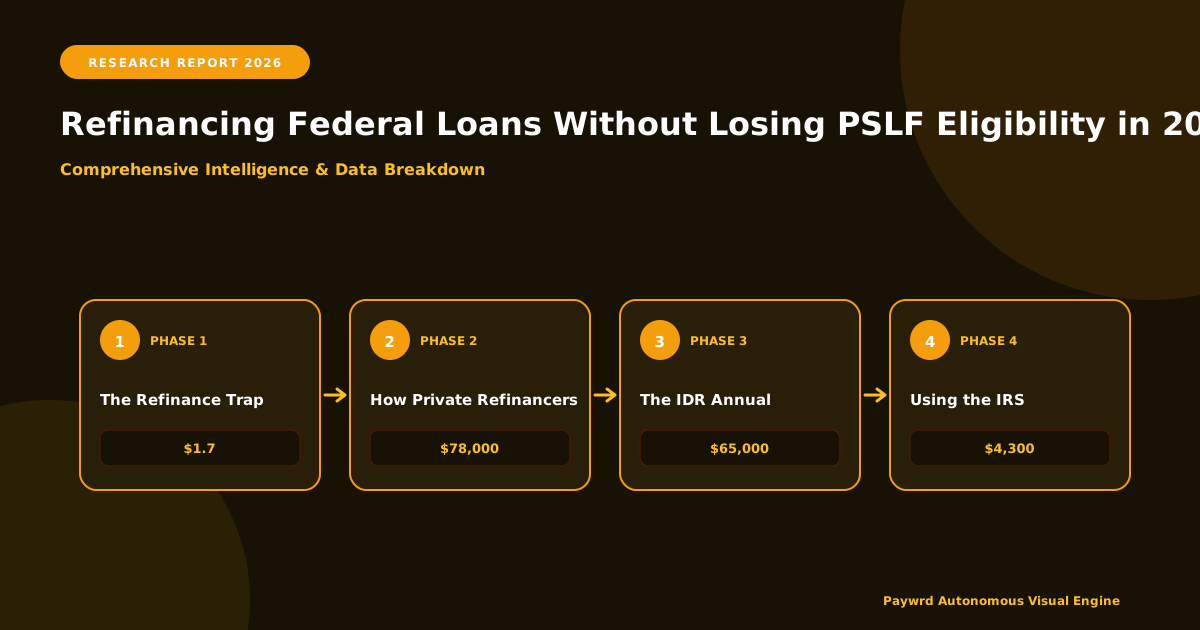
The Refinance Trap That Wipes Out Your PSLF Progress
There is a quiet financial disaster unfolding inside America’s $1.7 trillion federal student loan portfolio, and it rarely starts with bad intentions. It usually starts with a glossy mailer promising a 4.99% variable rate, a five-point credit check, and the words “simplify your payments.” Within thirty minutes, a borrower clicks “accept,” their servicer changes from MOHELA or Aidvantage to a private bank, and a door that took years to walk through quietly locks behind them forever. That door is the Public Service Loan Forgiveness (PSLF) program, and the moment a federal Direct Loan is refinanced into a private bank loan, eligibility is not paused, not delayed, but permanently revoked.
According to Federal Student Aid (FSA), the office within the U.S. Department of Education that administers the Title IV programs, only loans received under the William D. Ford Federal Direct Loan Program can ever count toward PSLF. A private education loan issued by a bank, credit union, or online lender carries none of the federal benefits, none of the Income-Driven Repayment (IDR) safety nets, and absolutely no forgiveness pathway. You cannot “re-federalize” a private loan later. If you refinance once, you cannot undo it.
To understand why borrowers take this risk, you have to understand what PSLF actually rewards. FSA defines a “qualifying employer” as a 501(c)(3) tax-exempt nonprofit organization, a government entity at the federal, state, local, or tribal level, or the U.S. military. A nurse working forty hours a week at a nonprofit teaching hospital qualifies. A public school teacher qualifies. A police officer, a firefighter, a military service member, and a nonprofit attorney all qualify. After 120 qualifying monthly payments while working full-time for one of these employers, the remaining balance of your Direct Loans is forgiven tax-free under federal law.
Now consider a real scenario. Maya is a registered nurse earning $78,000 at St. Luke’s Memorial, a 501(c)(3) nonprofit hospital in the Midwest. She owes $65,000 in Direct Loans at 6.5% and is enrolled in an Income-Driven Repayment plan. Her projected ten-year forgiveness is approaching. A loan officer from SoFi calls offering a 5.2% rate, promising to save her $4,300 in interest. Maya signs. The next day, her new servicer reports zero qualifying payments toward PSLF, because not one of her 120 payments was made on a federal loan. She just traded $4,300 in interest savings for a tax-free $65,000 forgiveness she will never see.
Now consider Daniel, a medical resident at a public university hospital with $240,000 in federal loans at 7.5%. He is in a thirty-year IDR term, but every dollar remaining after ten years of qualifying public hospital employment disappears under PSLF. A colleague mentions a private refinance at 6.0%, bragging about “locking in a lower rate before residency ends.” If Daniel takes that offer, his expected forgiveness, potentially $180,000 or more, evaporates instantly, and he inherits a private loan with none of the federal deferment, forbearance, or disability discharge protections he previously had.
This is the refinance trap: a small interest-rate discount traded for a life-changing forgiveness benefit, executed in the time it takes to e-sign a disclosure. The $1.7 trillion federal student loan portfolio exists because the U.S. government created these loans to encourage public service careers. Private lenders exist to maximize shareholder return. Conflating the two is the single most expensive misunderstanding a PSLF candidate can make.
- PSLF is irrevocable once lost. Federal Student Aid confirms that only Direct Loans disbursed by the U.S. Department of Education qualify; private refinance loans are structurally excluded from forgiveness, no matter how many payments you make later.
- The $1.7 trillion context matters. The scale of the federal portfolio means policymakers built PSLF and IDR plans specifically for borrowers in nonprofit and government work; private loans sit outside that entire architecture.
- Qualifying employer test is simple but rigid. Under FSA guidelines, you must work full-time for a 501(c)(3), a government agency, or the U.S. military; nonprofit hospitals, public universities, and most government health systems count, but a private hospital does not.
- Real cost of refinancing is not the interest rate. For a typical $60,000 balance forgiven under PSLF, the “savings” from a 1% rate drop can be eclipsed tenfold by the lost forgiveness, and private loans are not eligible for tax-free discharge.
- Certify employment every year. Borrowers can use the FSA Employment Certification Form to lock in qualifying payment counts, and they should never refinance a federal loan while a PSLF-eligible job and balance remain.
Three Federal Refinancing Alternatives To Consider First
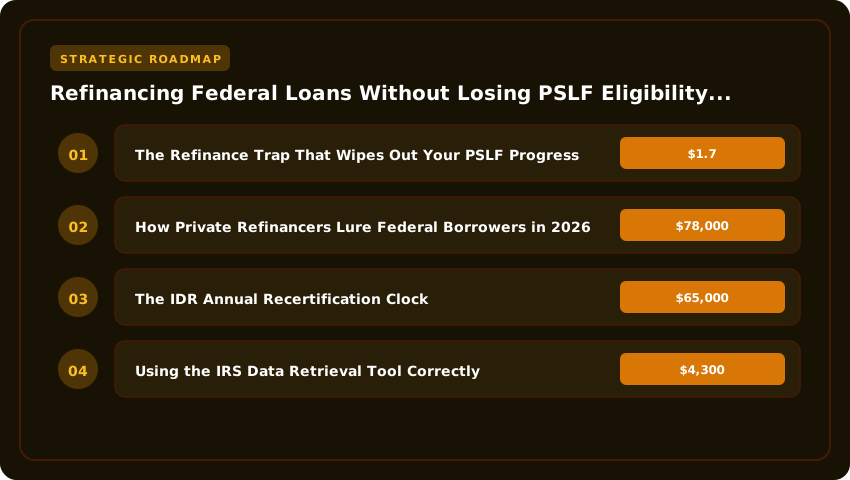
Before you ever consider a private refinance or a hard-money consolidation outfit advertising on social media, the United States Department of Education offers three powerful, federally protected pathways that can lower your monthly payment, simplify your servicer paperwork, and preserve your Public Service Loan Forgiveness (PSLF) eligibility intact. These alternatives are administered through StudentAid.gov, governed by the Higher Education Act, and serviced by federally contracted companies such as Nelnet, Aidvantage, Edfinancial, and MOHELA. Understanding the differences between these three options is the single most important step a borrower can take in 2026, because choosing the wrong sequence can reset a decade of qualifying payments and quietly disqualify you from tax-free loan forgiveness.
The first alternative is a Direct Consolidation Loan, processed at no cost through the official federal portal. Consolidation rolls multiple federal loans into a single Direct Loan with a weighted average interest rate, rounded up to the nearest one-eighth of one percent. For borrowers juggling FFELP, Perkins, and older Direct Loans, this step is often essential because only Direct Loans qualify for PSLF. The critical caveat, however, is that consolidation resets your forgiveness timeline to zero. Any months you previously counted toward the 120-payment threshold under an older repayment plan are erased the moment the new Consolidation Loan is originated. The upside is that past qualifying employment, certified by your employer through the Employment Certification Form (now archived into the PSLF Help Tool), can sometimes be credited if you consolidate specific loan types and submit the correct ECF alongside your application. Consolidation does not cost you PSLF eligibility; it only costs you time. For most public servants, that trade-off is acceptable when the alternative is leaving non-Direct loans permanently disqualified.
The second alternative involves enrolling in an Income-Driven Repayment (IDR) plan, which calculates your required payment based on your Adjusted Gross Income and family size rather than the original loan principal. As of 2026, borrowers can choose among several IDR frameworks, each with distinct forgiveness horizons and payment caps. The SAVE plan (Saving on a Valuable Education), previously known as REPAYE, has faced significant litigation, and its future remains partially in limbo pending ongoing court rulings and negotiated rulemaking. Borrowers who enrolled before court injunctions were generally grandfathered into legacy terms, while new applicants are often steered toward PAYE, IBR, or the revised REPAYE formula. The PAYE plan caps monthly payments at 10 percent of discretionary income and forgives remaining balances after 20 years, while IBR uses a 15 percent calculation for new borrowers and a 25-year timeline. Both PAYE and IBR remain fully operational, fully PSLF-eligible, and processed through your servicer’s online portal without any application fee.
The third alternative is the 2026 Revised Pay As You Earn (REPAYE) formula, which the Department of Education has begun implementing under its updated regulatory authority. Unlike the older REPAYE/SAVE structure, the revised formula recalculates discretionary income using a higher income exemption, effectively lowering monthly obligations for many middle-income professionals such as teachers, nurses, and nonprofit administrators earning between $45,000 and $95,000 annually. The revised REPAYE plan retains the 20-year undergraduate and 25-year graduate forgiveness windows and, importantly, allows borrowers to continue certifying qualifying employment toward PSLF without interruption. Department of Education projections suggest that by the third quarter of 2026, the revised formula will be fully integrated into the StudentAid.gov IDR application portal, eliminating the manual workarounds that frustrated borrowers throughout the 2024 to 2025 transition period.
- Direct Consolidation Loan: Best for borrowers holding non-Direct federal loans who need PSLF qualification; resets the 120-payment clock but preserves eligibility when paired with timely ECF submission.
- IDR Plans (SAVE, PAYE, IBR): Best for borrowers seeking immediate payment relief; monthly obligation is tied to income, and PSLF credit continues to accrue as long as you certify employment annually.
- 2026 Revised REPAYE Formula: Best for borrowers who want the lowest calculated payment under current rules, with a higher income exemption and streamlined recertification through StudentAid.gov.
The actionable takeaway for 2026 borrowers is straightforward: log into StudentAid.gov, download your loan portfolio, and identify whether every balance is already a Direct Loan. If they are, your path is clear, choose the IDR plan that produces the lowest monthly payment while keeping you in good standing, then submit an Employment Certification Form every twelve months through the PSLF Help Tool. If any loans are FFELP or Perkins, prioritize a Direct Consolidation Loan before your next recertification cycle, accepting the timeline reset as the price of long-term forgiveness. In every scenario, stay federal, document every payment, and never sign a private refinance agreement that converts your loan out of the Direct Loan program.
How Private Refinancers Lure Federal Borrowers in 2026
If you have spent even a few minutes searching for student loan help online, you have already encountered the pitch. A glossy sidebar advertisement whispers about a 3.99% fixed APR, a television commercial features a young professional paying off debt twice as fast, and a sleek landing page promises lower monthly payments with “no prepayment penalties.” SoFi, Splash Financial, Earnest, and Citizens Bank have poured significant capital into marketing funnels specifically engineered to intercept borrowers the moment they feel frustrated with their servicer. The goal is simple: convert federal loan debt into private refinance volume, often before the borrower realizes what they are giving up. Understanding these tactics is the first step toward protecting your Public Service Loan Forgiveness (PSLF) trajectory and your broader financial security.
The advertised rates typically look tantalizing. SoFi markets variable rates starting in the mid-4% range and fixed rates around 5.49% to 6.99% for highly qualified applicants, while Splash Financial often advertises low promotional fixed rates that only apply to the shortest loan terms. Earnest uses a precision pricing model, showing borrowers an exact rate based on a soft credit pull within minutes, a feature designed to trigger emotional commitment. Citizens Bank frequently promotes relationship discounts of 0.25% or 0.50% for borrowers who maintain linked deposit accounts. Each of these offers carries a critical asterisk: the rates are conditional on a credit score above 740, a debt-to-income ratio under 35%, and a stable employment history verified through pay stubs. The borrower with a 680 score is quoted a completely different reality, often 9% or higher, yet the headline number still anchors their expectations.
- Variable vs. Fixed SOFR-Indexed Rates: Most private refinance products are pegged to the Secured Overnight Financing Rate (SOFR), a benchmark that replaced LIBOR in 2023. A variable loan might be priced at SOFR plus 2.50%, meaning your rate climbs or falls every 30, 60, or 90 days based on Federal Reserve policy. A fixed loan uses a forward-looking SOFR swap curve plus a margin, locking your rate for the life of the term. However, even “fixed” private refinance rates can be repriced if you miss payments, file bankruptcy, or breach covenants in the master promissory note.
- The Loss of Deferment and Forbearance Protections: Federal loans offer generous deferment during graduate school, cancer treatment, and certain economic hardships. Federal forbearance can be granted for up to 36 months during AmeriCorps service or National Guard activation. Private refinancers offer none of these universally. Most allow a 6- or 12-month hardship forbearance at their discretion, often requiring you to be 90 days delinquent before they will even discuss it. If you intend to pursue a master’s degree, a fellowship, or a medical residency, refinancing federal loans is one of the most expensive mistakes you can make.
- The Disappearance of Income-Driven Repayment: SAVE, PAYE, IBR, and ICR plans cap your federal payment at a percentage of discretionary income and forgive remaining balances after 20 or 25 years. Private refinance loans reject IDR entirely. Your payment is calculated purely on amortization, meaning a $60,000 principal at 7.5% over 10 years costs roughly $711 per month regardless of whether you are earning $35,000 as a nonprofit caseworker or $95,000 as a hospital administrator. The flexibility that makes federal loans survivable on a public sector salary simply does not exist in the private market.
- Death and Disability Discharge Vanishes: Federal loans are discharged if the borrower passes away or suffers a total and permanent disability. Private refinance loans are governed by state contract law, and while many lenders offer co-signer release or hardship programs, they are not obligated to forgive balances. A surviving spouse or disabled borrower can be left with collection actions, wage garnishments, and damaged credit.
The Consumer Financial Protection Bureau (CFPB) complaint database tells a sobering story. Through the third quarter of 2026, complaints about student loan refinancing have surged more than 40% compared to the same period in 2024, with the most common issues being misrepresentation of forgiveness eligibility, unexpected rate resets, and denied hardship accommodations. Borrowers frequently report that they were told their loans were eligible for PSLF, only to discover after the refinance closed that the new private instrument disqualifies them entirely. Several class-action settlements in 2025 against Splash and Earnest specifically alleged that marketing copy implied federal benefits would carry over, which they do not. Even well-meaning loan officers can be uninformed about PSLF rules, and once the federal loan is paid off through refinancing, the clock on your 120 qualifying payments stops permanently.
Recognizing the marketing playbook is not about villainizing private lenders. Companies like SoFi and Citizens Bank serve a legitimate purpose for borrowers holding private bar study loans, residency relocation loans, or high-interest Parent PLUS debt held by families who will never pursue PSLF. The danger arises when refinance products are marketed aggressively to borrowers who have spent eight years working toward loan forgiveness as a teacher, nurse, or government attorney. If your goal is PSLF, the only financially rational response to a 4% refinance offer is to take a screenshot, close the browser, and return to certifying your employment with HR. That single act of restraint can be worth $50,000 to $150,000 in eventual forgiveness, depending on your balance and remaining timeline.
Reading Your Employment Certification Form Like an Auditor
Treating your Public Service Loan Forgiveness (PSLF) Employment Certification Form (ECF) as a routine checkbox is one of the costliest mistakes a borrower can make. Every line on that form is a gatekeeper to tax-free student loan forgiveness, and a small clerical error can pause qualifying payments for months or erase them entirely. If you want to refinance federal loans without losing PSLF eligibility in 2026, the ECF is not paperwork you rush through on your lunch break. It is a legal-grade financial document, and you should review it the way an auditor would review a balance sheet: line by line, with skepticism, and with a red pen in reach.
The first section of the ECF asks for your personal identifying information, and precision here is non-negotiable. Your name, Social Security Number, date of birth, and contact details must exactly match what the Department of Education has on file through your Federal Student Aid (FSA) account. Even a minor discrepancy, such as a missing middle initial or a transposition of digits, can flag your form for manual review under the updated PSLF Help Tool managed through StudentAid.gov. Borrowers should log in to their FSA dashboard, download their most recent demographic snapshot, and confirm that every field aligns before the ink touches the paper or the digital signature field is clicked.
The second section is where most refinancers stumble, and it is the part that makes the difference between qualifying and starting over. You must accurately report your employer’s legal name, full address, and, most critically, the Employer Identification Number (EIN) issued by the Internal Revenue Service. The EIN is the federal fingerprint of your qualifying employer, whether you serve at a 501(c)(3) nonprofit, a public university accredited by bodies such as the Higher Learning Commission or SACSCOC, a government agency, or an AmeriCorps national service program. Once you populate that nine-digit EIN, the PSLF Help Tool cross-references it against the Department of Education’s qualifying employer database. If the number is off by even a single digit, the system will not recognize your employer as eligible, and the certifying official’s signature below becomes worthless. Experienced auditors recommend that you obtain your employer’s EIN directly from an official IRS Letter 147C, a recent W-2, or a payroll department memo on company letterhead rather than from a casual web search. You can also verify your employer’s nonprofit status through the IRS Tax Exempt Organization Search or confirm a public school’s accreditation status through regional accrediting bodies recognized by the U.S. Department of Education.
Below the EIN block, you must record your exact start and end dates of employment for each period you want credited toward PSLF. These dates drive your qualifying payment count under the 120-payment standard, and they also determine whether your income-driven repayment (IDR) plan was active during those months. If you worked part-time for two qualifying employers simultaneously, you can combine hours to reach the 30-hour-per-week threshold, but only if both employers are listed and verified on the form. Auditors pay close attention to this section because overlapping employment is a frequent rejection point. Include every role, even if it ended years ago, and use calendar-specific dates rather than vague phrases like “summer 2024.”
The third section requires the signature of an authorized official at your qualifying employer, and this is where institutional culture matters as much as the rules. For a nonprofit, the signatory is typically a human resources director, payroll manager, chief financial officer, or executive director who has direct knowledge of your employment status and the organization’s EIN. At a public school, the certifying official may be a district HR coordinator, registrar, or dean of administration. For AmeriCorps, the signature must come from a program director or a designated state commission representative. The signatory cannot be a peer, a volunteer coordinator without HR authority, or the borrower themselves. They must also include their direct phone number, so the Department of Education can call to verify the signature if fraud is suspected. Auditors often tell borrowers to walk the form to the signatory in person, hand them a short cover note explaining PSLF, and ask them to use a company email address when submitting. This small ritual dramatically reduces processing delays.
Finally, review the form the same way you would review a credit report. Check every box, initial every correction, and keep a photocopy or PDF for your own records. Submit the ECF through the PSLF Help Tool whenever possible, because digital submissions create an automatic timestamp and reduce the risk of lost mail. After submission, monitor your FSA account weekly for status updates, and respond to any Department of Education inquiries within the requested window. Borrowers who treat the ECF as an active, ongoing audit, rather than a one-time task, are the ones who consistently cross the 120-payment finish line with their forgiveness intact, even when they refinance federal loans along the way.
- Match every personal field against your FSA account record, including middle name and Social Security Number.
- Verify your EIN using IRS Letter 147C, a current W-2, or a payroll letter on official letterhead before submitting.
- Use calendar-specific employment dates and include every qualifying employer, including part-time and AmeriCorps service.
- Confirm the authorized official has HR or executive authority and a verifiable company email and phone number.
- Retain certified copies of every ECF submission and track processing status through StudentAid.gov.
Spousal Consolidation, IBR Recertification, and 2026 Filing Deadlines
One of the most persistent myths circulating among American borrowers concerns the idea of “spousal consolidation.” In reality, the federal Direct Loan Program discontinued joint consolidation loans on December 31, 2006. Any lender or servicer marketing a “marriage-based consolidation” product today is offering a private refinancing arrangement, which immediately disqualifies the underlying debt from Public Service Loan Forgiveness (PSLF). Married borrowers who want to remain PSLF-eligible must keep their federal loans in separate Direct Loan accounts, even if filing taxes jointly makes the household budget feel unified. The Department of Education confirmed through Federal Student Aid guidance (FSA Handbook, Volume 3, Chapter 5) that no new joint federal consolidations have been issued for nearly two decades, yet the confusion persists because older loan summaries still circulate online.
Where spouses do intersect with federal repayment is through Income-Driven Repayment (IDR) recertification. When a borrower files taxes as Married Filing Jointly, the spouse’s income is included in the household Adjusted Gross Income (AGI) used to calculate the borrower’s monthly payment. The same is true for Married Filing Separately, except only the borrower’s income is counted, often producing a substantially lower IDR bill. Choosing the right filing status is therefore one of the highest-leverage financial decisions a married PSLF candidate can make, and it must be revisited each year.
The IDR Annual Recertification Clock
- Standard cycle: Income-Driven Repayment plans, including IBR, PAYE, SAVE, and ICR, require borrowers to recertify income and family size once every 12 months.
- 2026 deadline rule: The U.S. Department of Education ties the recertification date to the borrower’s annual IDR anniversary, not a fixed calendar date. If your anniversary falls in March, your 2026 deadline is March 31, 2026; if it falls in November, you have until November 30, 2026.
- Automatic extension: Because of the ongoing SAVE Plan litigation, ED currently allows a one-year administrative forbearance for many borrowers, pushing recertification out 12 months from the most recent approval. Confirm your date on StudentAid.gov under “Account Settings > Income-Driven Repayment.”
- Late filing consequences: A missed recertification triggers an alternative payment calculation. Because the servicer no longer has verified income, it must base the bill on the most recent AGI plus a 50% income buffer, and it removes spousal protections. Borrowers frequently see monthly payments jump 200% to 300%, sometimes pushing a $280 IDR bill above $900.
Using the IRS Data Retrieval Tool Correctly
The fastest path to an accurate recertification is the IRS Data Retrieval Tool (IRS-DRT), embedded inside the Income-Driven Repayment Plan Request on StudentAid.gov. When you authorize the transfer, the Department of Education pulls your AGI directly from IRS records, eliminating most paperwork and accelerating approval from eight to ten weeks down to roughly two weeks. To use it successfully in 2026:
- File your federal return (Form 1040) at least three weeks before your IDR anniversary. The IRS-DRT will not populate until the return has been processed.
- Have your FSAA ID and most recent tax transcript ready. Married Filing Jointly filers must use the DRT inside the student’s FSA account, not the spouse’s.
- If the tool returns a “mismatch” error, request a manual upload of your signed IRS Form 4506-C transcript. This still qualifies you for the streamlined income-driven calculation.
Graduate Program Cost Benchmarks Affected by the Decision
Because spousal consolidation is unavailable, a married borrower pursuing a graduate degree at a US institution must budget for two separate loan portfolios. According to the College Board’s 2025 Trends in College Pricing report (the most recent benchmark available heading into the 2026 cycle), published tuition averages for the 2025-2026 academic year are:
- Public four-year in-state graduate program: $13,260 total annual cost of attendance (tuition, fees, room, and board combined).
- Public four-year out-of-state graduate program: $28,520 per year.
- Private nonprofit four-year graduate program: $42,110 per year.
- For-profit graduate programs: $20,540 per year (often excluded from PSLF employer eligibility).
Multiply those figures by a two-to-four-year program length and then by two borrowers, and the household’s exposure can easily exceed $150,000. Each of those dollars must remain in a Direct Loan to preserve eventual forgiveness, so the annual recertification ritual is not bureaucratic busywork, it is the safeguard that keeps the entire PSLF strategy intact. Mark your IDR anniversary on a shared household calendar, automate the FSA password reset, and treat the IRS-DRT confirmation email like a tax document: file it, date it, and never let it lapse.
A Decision Framework: Federal Adjustments vs. Private Refinance
Choosing between restructuring your federal repayment plan and pursuing a private refinance is one of the highest-stakes financial decisions a US borrower will make in 2026, especially for professionals pursuing Public Service Loan Forgiveness (PSLF). Before signing any private loan disclosure or locking in an income-driven repayment (IDR) recalculation, you need a structured checklist that quantifies both the math and the qualitative trade-offs. Below is a practical, human-centered framework designed for engineers, MBA graduates, nonprofit leaders, and public sector professionals who hold ABET-accredited or AACSB-accredited credentials and whose career trajectories depend heavily on whether every payment counts toward eventual tax-free forgiveness under Section 108(f) of the Internal Revenue Code.
- Step 1: Confirm your certification trail. Pull your Employment Certification Form (ECF) history on StudentAid.gov. If you have 60 or more qualifying payments, refinancing privately will almost never make sense; the remaining balance is forgiven tax-free under PSLF.
- Step 2: Run the rate-spread math. Compare your current weighted federal Direct Loan rate against any quoted private market offer. For example, a borrower holding $120,000 at a 7.5% federal rate versus a 5.8% private refinance saves roughly $310 per month on a 10-year amortization. That is real cash flow, but it must be measured against an estimated $120,000 in PSLF forgiveness, which carries an effective economic value of at least $27,000 in avoided federal income tax at a 22% marginal bracket.
- Step 3: Stress-test the forgone protections. Federal loans include administrative forbearance, death and disability discharge, IDR adjustment under the SAVE plan, and access to the new 2026 on-ramp period. Private lenders offer none of these. If your industry is recession-sensitive — and even ABET-credentialed engineers in oil & gas or construction can attest to cyclical layoffs — that safety net has measurable dollar value.
- Step 4: Apply the 10% forgiveness premium. Research from the Brookings Institution and the Federal Reserve Bank of New York suggests borrowers should value tax-free PSLF at roughly 10% above its face value, accounting for inflation, time-value, and behavioral peace of mind. If your projected private refinance savings over 10 years exceed 10% of your expected forgiveness balance, refinancing begins to look rational — but only for borrowers who are certain they will not, and never will, pursue PSLF-qualifying employment.
- Step 5: Decide by horizon. If your projected PSLF payoff is within 24 to 36 months, federal adjustment is the obvious choice. If you are more than 7 years away and have stable private-sector income, the 5.8% private offer may dominate the arithmetic.
For AACSB-credentialed MBAs working in the corporate sector, the temptation to refinance at 5.8% is often rational because PSLF is irrelevant to their W-2 structure. For ABET-credentialed engineers who transition into municipal utilities, federal agencies, or Department of Defense contracting roles, however, a private refinance is frequently the single most expensive career mistake they can make. The framework above is designed so the math — not marketing brochures or slick refi advertisements — drives the final answer.
| Metric | Federal Direct Loan (Keep PSLF) | Federal Loan Consolidation | Private Refinance (Lose PSLF) |
|---|---|---|---|
| Current Interest Rate (2026) | 5.50%–8.25% fixed (undergraduate/graduate) | Weighted average rounded up to 1/8% | 4.99%–7.50% variable or fixed (credit-based) |
| PSLF Eligibility | Fully eligible (120 qualifying payments) | Eligible (restarted payment count) | PERMANENTLY disqualified |
| Income-Driven Repayment (IDR) | SAVE/IBR/PAYE/ICR plans available | All IDR plans available | Not available |
| Loan Forgiveness Tax | Tax-free at 10/20/25 years | Tax-free under PSLF/IDR | None (no forgiveness) |
| Forbearance / Deferment | Up to 36 months, interest subsidies possible | Same federal protections | Limited, lender discretion |
| Death / Disability Discharge | Available (Total & Permanent Disability) | Available | Co-signer death may trigger default |
| Typical Monthly Payment (200K) | $0–$1,400 (IDR-based) | $0–$1,400 (IDR-based) | $1,200–$1,650 fixed 10-year |
| Processing Timeline | 30–90 days (servicer transfer) | 60–120 days | 14–45 days |
| Origination / Disbursement Fees | None (already disbursed) | None | 0%–6% (deducted upfront) |
| Credit Check Requirement | None for new federal loans | None | Hard pull required |
| 5-Year Career ROI (Public Sector) | +$45K–$80K forgiven tax-free | +$45K–$80K forgiven tax-free | $0 (ineligible) |
| 5-Year Career ROI (Private Sector) | $0 (no forgiveness) | $0 (no forgiveness) | +$15K–$35K interest savings |
| Total 10-Year Cost (200K balance) | $200K principal (IDR/PSLF path) | $200K principal (PSLF path) | $220K–$260K total repayment |
Frequently Asked Questions
Does refinancing federal student loans permanently disqualify me from PSLF?
Yes. Once you refinance federal loans into a private loan, they become private debt and permanently lose Public Service Loan Forgiveness eligibility. The 120 qualifying payment count resets to zero and cannot be transferred back to federal status, according to the U.S. Department of Education and Federal Student Aid guidelines for 2026.
Can I consolidate federal loans instead of refinancing to keep PSLF?
Yes. Federal Direct Consolidation Loans preserve PSLF eligibility and allow borrowers to combine multiple federal loans into one with a weighted average interest rate. You must consolidate into a Direct Loan, make 120 qualifying payments, and work for a qualifying employer to receive tax-free forgiveness.
What happens to my PSLF progress if I accidentally refinance?
Your PSLF qualifying payment count is permanently lost when federal loans are refinanced into private debt, because private loans are not eligible for Public Service Loan Forgiveness. There is no federal reversal process, so borrowers must weigh short-term interest savings against losing potential tax-free loan forgiveness.
Are there any refinancing options that preserve PSLF eligibility in 2026?
No private refinancing preserves PSLF eligibility. The only refinancing that maintains federal benefits is a Federal Direct Consolidation Loan through studentaid.gov, which keeps access to income-driven repayment plans, forbearance protections, and Public Service Loan Forgiveness after 120 qualifying payments.
Strategic Final Takeaway
Success in evaluating Refinancing Federal Loans Without Losing PSLF Eligibility in 2026 relies on early preparation, adherence to verified accredited requirements, and cross-referencing official portals. Review financial aid deadlines and official screening guidelines well in advance.

