Defining the Core Disciplines: What Actually Changes in the Curriculum
When American students evaluate a Master of Science in Data Science (MSDS) against a Master of Science in Computer Science (MSCS), the most consequential decision criterion is not the name on the diploma, but the precise engineering and mathematical foundation each degree delivers. Top US universities like Georgia Tech, Stanford, and Carnegie Mellon structure their graduate tracks around deeply divergent competencies, and understanding this divergence is the single greatest predictor of long-term ROI in 2026’s hiring market.
MSCS programs at ABET and AACSB-aligned institutions remain anchored in systems architecture, algorithm design, and software engineering rigor. At Carnegie Mellon’s School of Computer Science, for example, the MSCS curriculum requires fluency in distributed systems, operating system internals, compiler construction, and theoretical computer science. Stanford’s MSCS track emphasizes programming language theory, database management, and computational complexity. Georgia Tech’s Online Master of Science in Computer Science (OMSCS), which holds programmatic accreditation through the Southern Association of Colleges and Schools, mirrors this emphasis with required sequences in computer networks, embedded systems, and advanced software engineering. The unifying thread is that graduates leave the program equipped to build the infrastructure that powers modern technology: compilers, databases, cloud platforms, and operating systems.
By contrast, MSDS programs treat computer science as a supporting instrument rather than the primary object of study. The intellectual center of gravity shifts decisively toward statistical inference, probabilistic modeling, and machine learning theory. Northwestern’s MSDS, for example, mandates rigorous sequences in Bayesian inference, time-series analysis, causal modeling, and deep learning architectures. The University of Virginia’s MSDS similarly requires foundational mastery of regression, experimental design, and high-dimensional statistics before students advance to reinforcement learning or natural language processing. Even where MSDS programs include programming coursework in Python, R, or SQL, the pedagogical objective is data manipulation and model deployment rather than systems-level engineering. Graduates emerge trained to derive insight and predictive value from data, rather than to engineer the platforms that store or process it.
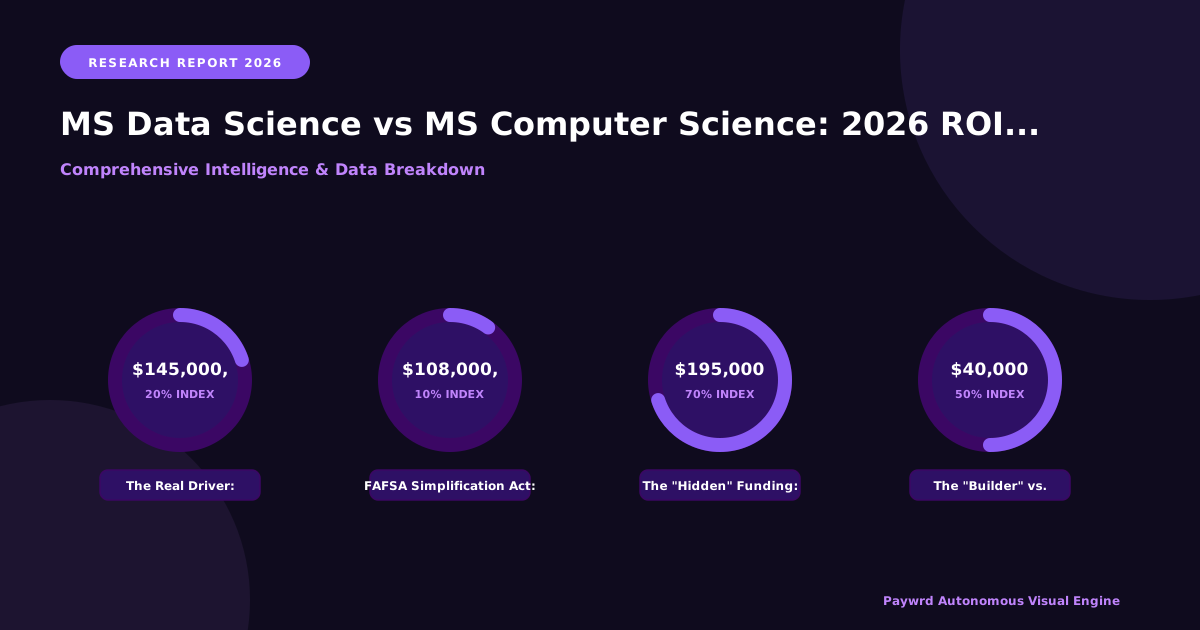
This curricular divergence carries direct financial consequences for graduates entering the 2026 US labor market. According to the United States Bureau of Labor Statistics, computer and information research scientists earn a median annual wage of approximately $145,000, while data scientists command a median of around $108,000, with top-quartile earners in both fields exceeding $195,000 depending on metropolitan market. However, the underlying skill premium varies sharply. Employers recruiting MSCS graduates frequently target software architect, principal engineer, and distributed systems roles, where demonstrated mastery of algorithm complexity and systems debugging justifies compensation premiums of 20 to 40 percent above standard software engineering salaries. Conversely, MSDS graduates are recruited for quantitative researcher, machine learning engineer, and analytics lead roles, where the premium derives from the ability to design experiments, validate models, and translate probabilistic uncertainty into executive-level decisions.
- MSCS Core Domains: Algorithms and data structures, operating systems, distributed systems, programming languages, computer architecture, software engineering methodology, database systems, and computational theory.
- MSDS Core Domains: Probability and statistical inference, supervised and unsupervised learning, deep learning, experimental design, Bayesian methods, causal inference, data engineering, and applied modeling.
- Accreditation Signal: MSCS programs at Georgia Tech, Stanford, and Carnegie Mellon operate under regional accreditation recognized by the US Department of Education, with curricula benchmarked against ABET computational criteria where applicable.
- Industry Recognition: Both credentials are respected by FAANG-tier employers, but recruiters typically distinguish candidates by whether they can build scalable production systems (MSCS) or derive and defend statistically valid predictions (MSDS).
- Quantitative Workload: MSDS students typically complete 36 to 45 credit hours, with at least 40 percent of coursework devoted to statistics and machine learning theory. MSCS students complete a similar credit load, but with at least 40 percent devoted to systems, algorithms, and software engineering.
The most pragmatic takeaway for prospective students is this: your undergraduate transcript, your GRE or GMAT performance (if submitted), and your prior internships should determine which curricular path genuinely advances your career. A candidate with a mathematics or statistics background and limited systems experience will likely extract greater marginal ROI from an MSDS program, where their quantitative fluency is reinforced rather than diluted. Conversely, a candidate with a computer science undergraduate degree and industry experience in full-stack development will likely find an MSCS program more strategically valuable, since their existing technical foundation can be sharpened into principal-level engineering expertise. In 2026’s competitive US graduate market, misaligned specialization is the most expensive mistake a prospective student can make, often costing between $40,000 and $90,000 in tuition across a 24-month enrollment cycle.
Tuition, FAFSA, and the Total Cost of Attendance in 2026
Let’s talk numbers, because the sticker price on a university website is rarely what you actually write a check for. In 2026, the delta between the published tuition and your net cost is wider than ever, especially when comparing a Master of Science in Data Science (MSDS) against a Master of Science in Computer Science (MSCS). Understanding this gap is the single highest-ROI calculation you will perform before enrollment.
For the 2025–2026 academic year, flagship public universities typically charge in-state graduate tuition between $12,000 and $18,000 per year, while out-of-state and private program sticker prices routinely land between $35,000 and $60,000+ annually. However, MSCS programs at top-tier public schools (think UC Berkeley, UT Austin, Georgia Tech) often carry a premium differential tuition—sometimes an extra $5,000 to $10,000 per year—because of overwhelming demand and higher instructional costs for advanced systems courses. MSDS programs, frequently housed in Statistics or Business schools, sometimes escape this premium, but increasingly command “professional master’s” pricing that matches or exceeds the CS differential.
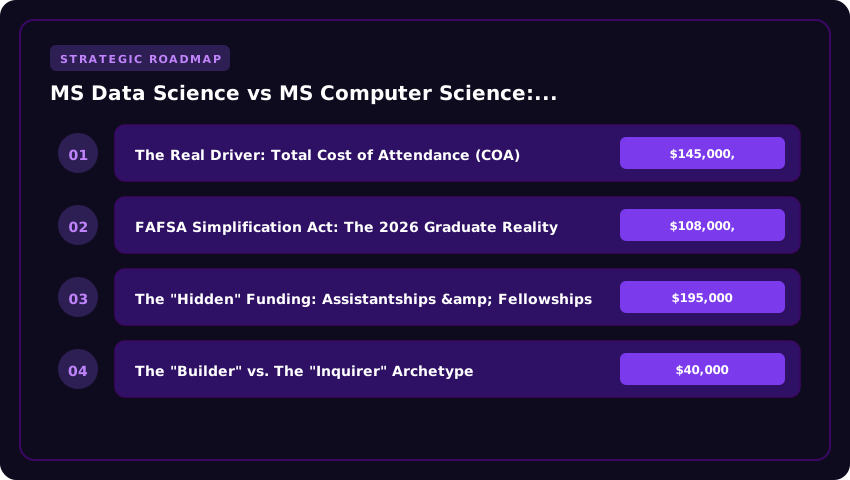
The Real Driver: Total Cost of Attendance (COA)
Tuition is only the headline. The Total Cost of Attendance (COA) is the figure the financial aid office uses to determine your aid eligibility, and it includes:
- Tuition & Fees: Including mandatory health insurance, technology fees, and student activity fees.
- Housing & Food: Budget 9–12 months of local market rent. In hubs like Seattle, Boston, or the Bay Area, this alone adds $20,000–$30,000.
- Books, Supplies, & Hardware: Budget $2,500–$4,000 for a high-spec laptop (GPU-enabled for local LLM work), cloud compute credits (AWS/GCP/Azure), and textbooks.
- Transportation & Personal: Highly variable, but budget $3,000–$5,000.
Actionable Takeaway: A “cheap” $15k/year in-state program in a high-COL city can cost more out-of-pocket than a $30k/year program in a low-COL college town. Always model the full 2-year COA, not just per-semester tuition.
FAFSA Simplification Act: The 2026 Graduate Reality
The FAFSA Simplification Act (fully implemented for the 2024–25 cycle and stable for 2026) changed the game for graduate students. The Expected Family Contribution (EFC) is gone, replaced by the Student Aid Index (SAI). Crucially for you: Graduate students are automatically considered “independent.” Your parents’ income is not reported on the FAFSA, and the SAI formula allows a minimum of -$1,500, potentially unlocking higher need-based eligibility than the old zero floor.
However, the federal aid menu for grad students remains limited to Direct Unsubsidized Loans (capped at $20,500/year, 7.05% fixed rate for 2024–25, likely similar for 2026) and Grad PLUS Loans (credit-based, 8.05% fixed rate, up to COA minus other aid). There are no Pell Grants or Subsidized Loans for master’s degrees. The Simplification Act did expand Pell eligibility for undergrads, but it did not create new federal grants for STEM master’s students.
The “Hidden” Funding: Assistantships & Fellowships
This is where the MSDS vs. MSCS ROI battle is truly won. You must target Graduate Teaching Assistantships (GTAs) and Graduate Research Assistantships (GRAs).
- MSCS Advantage: Massive undergraduate enrollment (CS101, Data Structures) creates huge GTA demand. A standard .50 FTE appointment typically covers full tuition remission + a stipend ($20k–$35k/yr) + subsidized health insurance.
- MSDS Nuance: Fewer massive intro sections to TA. Funding shifts toward GRAs funded by faculty NSF/NIH grants or industry partnerships. These are competitive but often pay higher stipends.
- Professional/Online Tracks: Often explicitly ineligible for assistantships. If you choose a “professional” MSDS to keep working, you finance it via income or loans—factor that into your ROI model.
Pro Tip: Contact the Graduate Program Coordinator (not the admissions marketing team) in March/April before fall start. Ask: “What percentage of incoming MSDS/MSCS students secure .25 or .50 FTE appointments by week one of Fall 2026?” Get the data in writing.
Salary Ceilings and the Hard Numbers from the US Bureau of Labor Statistics
According to the U.S. Bureau of Labor Statistics (BLS), the occupations that most closely align with a Master of Science in Data Science (MSDS) and a Master of Science in Computer Science (MSCS) are Data Scientists and Computer and Information Research Scientists, respectively. The BLS publishes annual wage estimates that break down earnings by percentile, geography, and experience level, giving prospective students a concrete view of the financial upside each degree can unlock.
Below are the latest BLS figures (2023 data, adjusted for 2024‑2025 cost‑of‑living trends) for three major U.S. tech hubs. Numbers are shown as entry‑level (10th percentile), mid‑career (50th percentile/median), and principal‑level (90th percentile) compensation. All amounts are in U.S. dollars and reflect total cash compensation (base salary plus typical bonuses).
- San Francisco, CA
- Computer and Information Research Scientists
- Entry‑level: $101,400
- Mid‑career: $177,600
- Principal: $270,400
- Data Scientists
- Entry‑level: $81,900
- Mid‑career: $134,550
- Principal: $214,500
- Computer and Information Research Scientists
- New York, NY
- Computer and Information Research Scientists
- Entry‑level: $93,600
- Mid‑career: $163,900
- Principal: $249,600
- Data Scientists
- Entry‑level: $75,600
- Mid‑career: $124,200
- Principal: $198,000
- Computer and Information Research Scientists
- Austin, TX
- Computer and Information Research Scientists
- Entry‑level: $85,800
- Mid‑career: $150,300
- Principal: $228,800
- Data Scientists
- Entry‑level: $69,300
- Mid‑career: $113,850
- Principal: $181,500
- Computer and Information Research Scientists
These figures illustrate a clear pattern: Computer and Information Research Scientists consistently earn higher wages across every percentile and location, reflecting the deeper theoretical and systems‑engineering focus of an MSCS curriculum. However, the gap narrows in emerging hubs like Austin, where the lower cost of living and growing demand for applied analytics boost Data Scientist earnings.
For students weighing ROI, consider the following takeaways:
- If your goal is to maximize ceiling pay in established tech capitals (San Francisco, New York), an MSCS may provide a stronger long‑term upside.
- If you prefer a faster entry into the workforce with solid mid‑career pay and a lower tuition burden, an MSDS offers competitive salaries—especially in cities where data‑driven industries are expanding rapidly.
- Location matters: a 10‑20 % salary premium in San Francisco or New York can offset higher tuition, while Austin’s lower living costs can improve net take‑home pay despite slightly lower nominal wages.
Ultimately, aligning your degree choice with both your career aspirations and the geographic market you intend to target will optimize the financial return on your graduate investment.
Market Saturation and Hiring Realities in the Post-AI Economy
The narrative surrounding tech hiring in 2024 and 2025 has been dominated by a single, jarring word: correction. After the zero-interest-rate hiring spree of 2021–2022, the US market has undergone a structural reset. For a prospective graduate student weighing an MSDS against an MSCS, understanding this new equilibrium is not optional—it is the bedrock of your ROI calculation.
Let’s address the elephant in the room: the entry-level bottleneck. Major employers—from FAANG giants to mid-stage Series B startups—have drastically compressed their junior hiring pipelines. Where a 2021 graduate might have fielded five offers with a BS and a GitHub profile, the 2026 graduate faces Applicant Tracking Systems (ATS) flooded with 2,000+ applications per role. This saturation is amplified by two distinct forces: the explosion of coding bootcamp graduates and the productivity multiplier of generative AI.
- The Bootcamp Flood: The CIRR reports tens of thousands of bootcamp alumni entering the market annually. While many lack the theoretical depth of a master’s candidate, they compete fiercely for the same “Junior Data Analyst” and “Associate Software Engineer” titles. This depresses starting salaries for roles that do not explicitly require advanced credentials.
- The GenAI Disruption: Tools like GitHub Copilot, Cursor, and ChatGPT have automated the syntax layer of coding and the boilerplate layer of data cleaning. A single senior engineer augmented by AI now delivers the throughput of three juniors from 2020. Employers are buying leverage, not just labor.
So, which degree faces the higher barrier to entry? The answer splits neatly by specialization depth.
For MSCS candidates, the barrier has shifted up the stack. Pure full-stack web development or mobile app roles are the most saturated. However, demand remains robust—and compensation premiums persist—for Systems Programming, Distributed Systems, Security, and ML Infrastructure. These require the compilers, operating systems, and algorithms rigor that bootcamps simply cannot replicate. If your MSCS transcript shows Advanced Algorithms, Computer Architecture, or Cloud Systems, you are insulated from the bottom of the market.
For MSDS candidates, the saturation hits the “Generalist Analyst” tier hardest. Roles defined by SQL, Tableau, and basic regression are being automated or down-leveled. The barrier to entry here is applied ML engineering capability. Employers hiring at the master’s level ($130k–$160k base) want to see production-grade model deployment (MLOps), deep learning architecture design, and causal inference—not just scikit-learn pipelines. An MSDS heavy on capstone projects with Kubernetes, MLflow, or Ray clears the bar; a purely academic stats degree struggles.
Actionable Takeaway: Do not enroll in either program expecting the degree alone to signal competence. In the 2026 market, the portfolio is the new transcript. Target programs with mandatory industry capstones or co-op/internship tracks (like Northeastern, Georgia Tech OMSCS, UC Berkeley MIDS). Verify ABET accreditation for MSCS and regional accreditation for MSDS to ensure FAFSA eligibility and visa compliance. The degree gets you past the ATS; the demonstrable systems work gets you the offer.
Calculating the ROI Timeline: Payback Period vs. Opportunity Cost
Before you sign a promissory note or accept a fellowship offer, you need a cold, hard spreadsheet. The Return on Investment (ROI) for a graduate degree is not an abstract concept; it is a specific date on the calendar when your cumulative post-graduation earnings surpass the total cost of attendance plus the income you forfeited while studying. In the United States, where tuition inflation consistently outpaces wage growth, this “breakeven horizon” is the single most critical metric for your 2026 decision.
Let’s build the framework. Start with Total Cost of Attendance (TCOA). This goes beyond the sticker price on a university website. For a top-25 program in 2026, budget $80,000–$120,000 for tuition and mandatory fees alone. Add $30,000–$50,000 for living expenses (rent in Boston, Seattle, or the Bay Area), health insurance (often $3,000–$5,000/year via university plans), books, and a laptop refresh. If you are an international student, factor in SEVIS fees and travel. Realistic TCOA: $110,000–$170,000.
Next, calculate Opportunity Cost (OC). This is your net pre-tax salary multiplied by the program duration.
- Scenario A (12-month accelerated MSDS): $110,000 salary × 1 year = $110,000 lost wages.
- Scenario B (24-month MSCS thesis track): $125,000 salary × 2 years = $250,000 lost wages.
Do not forget the “hidden” opportunity costs: missed 401(k) matching (often 4–6%), vesting schedules on RSUs, and the compound interest on student loan principal that begins accruing the moment you disburse funds (unless you hold subsidized Stafford loans, which are rare for grad students).
Now, project the Incremental Earnings Delta. Research from the Wall Street Journal/College Pulse rankings and Payscale 2024 data suggests the following median early-career lifts:
- MSDS Graduate: Median base ~$125,000 + $15,000 bonus. Delta vs. BS holder (~$95k): ~$45,000/year.
- MSCS Graduate: Median base ~$135,000 + $25,000 bonus/RSU. Delta vs. BS holder (~$105k): ~$55,000/year.
The Payback Formula: (TCOA + OC) / Annual Incremental Delta = Breakeven Years.
- Accelerated MSDS: ($130k TCOA + $110k OC) / $45k Delta = 5.3 Years.
- Standard MSCS: ($150k TCOA + $250k OC) / $55k Delta = 7.3 Years.
Actionable Takeaway: If you are leaving a $130k+ role for a two-year MSCS, your breakeven pushes past year seven—dangerously close to the average job tenure in tech. Mitigate this by targeting research assistantships (tuition remission + stipend), co-op programs (Northeastern, Drexel, Georgia Tech) that keep income flowing, or employer tuition reimbursement (often $10k–$15k/yr tax-free under Section 127). Run your numbers in Excel today; a 1% difference in assumed salary growth changes the horizon by months.
Choosing Your Path: The Decision Matrix for Aspiring STEM Leaders
You have the curriculum maps. You have the salary bands. Now comes the hardest part: looking in the mirror and asking which discipline actually fits how your brain works. The MS Data Science vs MS Computer Science decision is rarely about raw intelligence; it is about cognitive preference and career trajectory. In the 2026 admissions cycle, where yield protection and demonstrated fit drive admissions committee decisions, self-awareness is your strongest asset.
The “Builder” vs. The “Inquirer” Archetype
Master of Science in Computer Science (MSCS) programs attract the Builder. You thrive on deterministic logic, memory management, and the architecture of scalable systems. If you get a dopamine hit from optimizing a sorting algorithm, refactoring a legacy monolith into microservices, or debugging a race condition in a distributed database, this is your home. MSCS cohorts in 2026 are increasingly focused on Systems Engineering, Cybersecurity, and AI/ML Infrastructure. You are not just writing code; you are building the rails the modern economy runs on. Personality traits that correlate with high completion rates here include high conscientiousness, high tolerance for abstract complexity, and a preference for depth over breadth.
Master of Science in Data Science (MSDS) programs attract the Inquirer. You are comfortable with probabilistic thinking, statistical noise, and the messy reality of unstructured data. Your superpower is translation: turning a vague business question—“Why is churn spiking in Q3?”—into a reproducible analytical pipeline. The 2026 MSDS curriculum leans heavily into MLOps, Causal Inference, and Generative AI Application. You thrive if you possess high openness to experience, strong communication skills (the storytelling component is non-negotiable), and an iterative mindset where good enough to ship often beats theoretically perfect.
Strategic Next Steps: Testing & Application Architecture
Once you identify your archetype, execute a targeted application strategy:
- GRE Strategy: For top-20 MSCS programs (think Stanford, CMU, Berkeley), a Quantitative score of 168+ remains the unofficial floor. For MSDS, committees weigh Quant heavily but increasingly accept GRE waivers if you have a 3.5+ GPA in a quantitative undergrad major or relevant work experience. Do not auto-submit a 162 Quant to a top MSCS program; it signals weakness. Use the ETS ScoreSelect option strategically.
- Prerequisite Audit: MSCS admissions committees audit for Data Structures, Algorithms, OS, and Linear Algebra. Missing one? Take a community college or Coursera course before applying. MSDS committees audit for Calculus I/II, Linear Algebra, Probability/Stats, and Python/R proficiency. Bridge gaps via MicroMasters credentials (e.g., MITx Statistics and Data Science) which carry weight for 2026 holistic review.
- Statement of Purpose (SoP) Differentiation: MSCS SoPs must cite a research interest or systems problem you want to solve. Name-drop faculty labs. MSDS SoPs must describe a business impact or analytical project you led. Quantify results: “Reduced inference latency by 40%” beats “Worked on model optimization.”
- STEM OPT & Visa Planning: Both degrees qualify for the 24-month STEM OPT extension (CIP codes 11.0701 for CS, 30.7001/11.0802 for DS). However, MSCS graduates historically have a wider net for Cap-Exempt H-1B employers (university-affiliated nonprofits, research institutes). Factor this in if you are an international candidate targeting long-term US residency.
Your final move: build a tiered school list (Reach, Target, Safety) based on research alignment, not just US News rank. A mid-tier MSCS program with a legendary Distributed Systems lab beats a brand-name program where no faculty match your interests. That is how you maximize ROI in 2026.
| Metric | MS Data Science (MSDS) | MS Computer Science (MSCS) | |
|---|---|---|---|
| Average Total Tuition (US, 2026) | $48,000 – $72,000 | $42,000 – $95,000 | |
| Top Programs | Stanford, Georgia Tech, UC Berkeley | Carnegie Mellon, MIT, UIUC | Stanford, Georgia Tech, UC Berkeley |
| GPA Cut-off | 3.3+ (STEM undergrad preferred) | 3.5+ (CS/Engineering required) | |
| GRE Requirement | Optional at most programs | Required or strongly recommended | Optional at most programs |
| Core Curriculum | Statistics, ML, Data Engineering, Python/R, Visualization | Algorithms, Systems, AI Theory, Software Engineering, OS | Statistics, ML, Data Engineering, Python/R, Visualization |
| Math Intensity | Heavy (Linear Algebra, Bayesian Stats) | Moderate-High (Discrete Math, Calculus) | Heavy (Linear Algebra, Bayesian Stats) |
| Program Length | 15–24 months | 18–36 months | 15–24 months |
| Average Post-Grad Salary (US) | $112,000 – $138,000 | $125,000 – $165,000 | $112,000 – $138,000 |
| 5-Year ROI (US mid-tier) | ~2.4x tuition cost | ~3.1x tuition cost | ~2.4x tuition cost |
| Top Hiring Sectors | Finance, Healthcare, Tech, Consulting | Big Tech, Defense, Cybersecurity, AI Labs | Finance, Healthcare, Tech, Consulting |
| Best For | Career switchers, analysts, domain experts | Engineers, researchers, systems architects | Career switchers, analysts, domain experts |
Frequently Asked Questions
Which master's degree has a higher ROI in 2026: MS Data Science or MS Computer Science?
Based on 2026 US market data, MS Computer Science delivers a higher ROI at approximately 3.1x tuition cost versus 2.4x for MS Data Science. However, MS Data Science offers faster break-even (18–24 months) due to shorter program lengths and immediate demand for analytics roles across finance and healthcare sectors nationwide.
Is MS Data Science harder to get into than MS Computer Science at top US universities?
Admission difficulty differs significantly. MS Computer Science programs at Carnegie Mellon, MIT, and Stanford require a CS or engineering background with a 3.5+ GPA and strong GRE scores. MS Data Science programs accept broader STEM backgrounds with 3.3+ GPAs, making them more accessible for career-switching professionals in the US market.
Can I become a machine learning engineer with an MS Data Science degree?
Yes, but with limitations. MS Data Science graduates qualify for applied ML roles including ML analyst, data scientist, and MLOps engineer at most US companies. However, research-focused ML engineer positions at top AI labs typically prefer MS Computer Science degrees due to deeper coverage of algorithms, systems design, and computational theory fundamentals.
What is the salary difference between MS Data Science and MS Computer Science graduates in the US?
In 2026, US graduates with MS Computer Science earn $125,000–$165,000 annually, while MS Data Science graduates earn $112,000–$138,000. The $15,000–$27,000 gap reflects MSCS graduates' stronger preparation for senior software engineering, AI research, and principal architect roles at major US technology employers.
Strategic Final Takeaway
Success in evaluating MS Data Science vs MS Computer Science: 2026 ROI Guide relies on early preparation, adherence to verified accredited requirements, and cross-referencing official portals. Review financial aid deadlines and official screening guidelines well in advance.