Diagnosing Your Federal vs. Private Loan Refinance Threshold
Diagnosing the exact financial breaking point where refinancing makes practical sense requires moving beyond generic marketing promises and conducting a rigorous, personalized audit of your current debt structure. For most US borrowers in 2025, the decision pivots on a simple but powerful comparison: the weighted average interest rate of your existing Federal Direct Loans against the fixed and variable rates currently being quoted by reputable private lenders such as SoFi, Earnest, and Laurel Road. As of mid-2025, the baseline Federal Direct Loan weighted average for many graduate and professional borrowers hovers between 6.5% and 7.5%, a figure that has remained stubbornly high despite recent legislative adjustments to undergraduate rates. Meanwhile, qualified private refinance applicants—particularly those with strong credit scores above 740 and stable, high-income professional employment—can often secure fixed rates in the 5.5% to 6.75% range, with variable rates dipping into the mid-4% range during introductory periods.
However, the headline rate is only the first variable in a complex equation. You must also calculate the net present value of any capitalized interest currently sitting on your federal balance, a figure that can artificially inflate your principal by thousands of dollars if you have previously utilized forbearance or certain deferment plans. Private lenders will typically pay off this capitalized amount as part of the refinance, effectively resetting your amortization schedule, but you must verify whether the new loan’s lower rate genuinely offsets this lump sum over your intended repayment horizon.
Beyond the numbers, the most critical diagnostic step is honestly evaluating your risk tolerance regarding the loss of Income-Driven Repayment (IDR) safety nets. Federal borrowers currently enjoy access to plans such as SAVE (Saving on a Valuable Education), IBR (Income-Based Repayment), and PAYE (Pay As You Earn), which can cap monthly payments at a percentage of discretionary income and offer eventual forgiveness pathways. A private refinance transaction permanently extinguishes your access to these programs, replacing them with rigid contractual obligations that offer no flexibility for career pivots, economic downturns, or periods of reduced income.
To clarify this complex decision matrix, consider the following actionable diagnostic framework:
- The 1.5% Rate Spread Rule: Most financial advisors suggest that a private refinance only becomes mathematically advantageous if the new fixed rate is at least 1.5 percentage points lower than your federal weighted average. Anything less, and the long-term savings are typically consumed by the loss of federal protections.
- Origination Fee Audit: Confirm that your target private lender charges zero origination fees or prepayment penalties. SoFi, Earnest, and Laurel Road generally advertise no origination fees, but always verify this in the fine print before locking in a rate.
- PSLF Trajectory Check: If you work at a qualifying 501(c)(3) nonprofit or government agency and have made certified payments toward Public Service Loan Forgiveness (PSLF), refinancing is almost always a catastrophic decision. Federal forgiveness requires you to maintain your loans within the federal system; a private refinance permanently disqualifies you from the remaining balance of your 120 qualifying payments.
- Variable Rate Volatility Modeling: Before accepting a variable rate loan, model a worst-case scenario where the index rate increases by 3% to 4% over the loan term. If the resulting projected payment remains comfortably within your monthly budget, the variable option may be viable; otherwise, the fixed rate provides essential predictability.
Ultimately, the threshold for refinancing is not a universal number but a deeply personal intersection of credit profile, career stability, and family planning. By systematically comparing your federal weighted average against verified private quotes, stripping out any capitalized interest distortions, and stress-testing your ability to survive without IDR plan protections, you transform an emotional financial decision into a strategic, data-driven conclusion.
Executing the PSLF Buyback and Waiver Strategy Before Refinancing
Before a single dollar is redirected toward a private refinancing offer, federal borrowers pursuing Public Service Loan Forgiveness (PSLF) must execute a deliberate, time-sensitive strategy involving the PSLF Limited Waiver, the TEPSLF Buyback Program, and the Employment Certification Form (ECF). Each of these mechanisms can convert months that would otherwise be wasted into qualifying credit, yet a single misstep, particularly a private consolidation, permanently extinguishes eligibility under federal law.
The Limited Waiver, which remained active through October 31, 2022, retroactively credited prior periods of repayment regardless of loan type or repayment schedule, provided the borrower consolidated into a Direct Loan and was employed by a qualifying employer during those months. While the formal deadline has passed, many former federal employees, military service members, and nonprofit professionals remain unaware that they can still recapture months if they act before refinancing. Even a single year of missed qualifying employment can equate to thousands of dollars in lost forgiveness, so the first actionable step is always a historical audit through the official FSA Portal at studentaid.gov.
Generating an Employment Certification Form is the foundational action item. Borrowers log into their FSA account, navigate to the PSLF section, and either download a printable PDF or submit the digital version directly. The form requires employer identification, employment dates, and a signature from an authorized human resources representative. Many universities, hospitals, and government agencies participate in the Federal Student Aid’s Employer Verification Process, which can expedite certification through electronic data exchange. Submitting an ECF is not a one-time event; the Department of Education strongly advises borrowers to submit one annually or whenever they change employers, because each certification locks in qualifying months and creates an auditable trail that protects against future clerical errors.
Documenting qualifying months requires disciplined recordkeeping. Borrowers should retain W-2 forms, pay stubs, offer letters, and any internal HR documentation that confirms full-time employment at a 501(c)(3) nonprofit, government agency, or other qualifying organization. The standard requires an average of at least 30 hours per week, or the contractual full-time equivalent as defined by the employer. Part-time work across multiple qualifying employers can be aggregated, provided each employer independently certifies the hours. Loan servicers such as MOHELA and Nelnet process these forms, and once approved, the qualifying count appears on the borrower’s PSLF progress summary.
The TEPSLF Buyback Program, sometimes called the PSLF Buyback, allows borrowers to pay the equivalent of what they would have paid under an income-driven repayment (IDR) plan during months that were non-qualifying, often due to being in a forbearance or deferment while still employed full-time at a qualifying job. The program calculates the difference between what was actually paid and what would have been required under an IDR formula, then presents the borrower with an exact dollar figure. Importantly, the buyback is a federal program, so any dollar paid is strictly principal and interest, no private lender fees, no origination charges, no prepayment penalties.
To estimate a buyback figure independently, borrowers can use the official PSLF Buyback Calculator available through the FSA Portal or replicate the math manually by referencing their most recent AGI from the IRS, family size, and the poverty guidelines for the year in question. The formula applies the IDR percentage (typically 10%, 15%, or 20% of discretionary income) to each non-qualifying month. If a borrower earned $60,000 in 2024 with a family size of one, the discretionary income calculation would subtract 150% of the federal poverty guideline for that state, apply the IDR percentage, then multiply by 12 to estimate the annual buyback cost. This number must be weighed against the forgiven balance, which can range from $40,000 to over $200,000 for typical graduate borrowers pursuing careers in education, law, medicine, or nonprofit administration.
The critical sequencing rule cannot be overstated: private refinancing must occur only after every federal avenue has been exhausted. The moment a Direct Loan is paid off through a private consolidation, it loses its federal status, and all previously certified PSLF months become permanently irrelevant. Borrowers who refinance prematurely forfeit not only the remaining balance but also the 10% employer match equivalent in tax-free forgiveness. For most Americans pursuing careers at accredited universities, ABET-recognized engineering firms, or AACSB-accredited business schools, the federal PSLF pathway delivers a return that no private refinance rate, even a sub-5% fixed offer in 2025, can match.
- Step 1: Log into the FSA Portal at studentaid.gov and review the PSLF Progress Tracker for historical month counts.
- Step 2: Submit or update an Employment Certification Form annually with every qualifying employer, retaining signed copies for personal records.
- Step 3: Calculate potential TEPSLF Buyback costs using the FSA calculator, comparing the buyback dollar amount against the projected forgiven balance.
- Step 4: Confirm that all loans are Direct Loans; consolidate any older FFEL or Perkins loans into a Direct Consolidation Loan if needed, but only before any private refinance discussion.
- Step 5: Only after 120 qualifying months are certified and any buyback opportunity is executed should a borrower evaluate private refinance products, and only for loans that have zero PSLF eligibility left.
Variable vs. Fixed Rate Math: Stress Testing the SOFR Index
When evaluating private student loan refinancing offers in 2025, the most critical analytical exercise is stress testing the underlying index mechanics. Most variable rate products marketed to US borrowers are priced off the 30-day Secured Overnight Financing Rate (SOFR) plus a lender margin, whereas fixed rate products bundle the market’s expectation of future rate movements into a single locked-in number. Understanding the difference between these two structures is essential to making a sound financial decision, especially when projecting a decade of monthly payments on a $45,000 balance.
The baseline spread mechanics typically follow this formula: Variable Rate = 30-Day SOFR Index + Lender Margin. In early 2025, the 30-day SOFR has hovered in the mid-4% range, while the 10-Year Treasury yield, a proxy for fixed rate student loan pricing, has traded closer to 4.5%. Lender margins on refinanced student loans generally range from 1.5% to 4.5%, depending on your credit profile, degree, and income. A borrower with excellent credit might secure a variable rate near 6.5%, while a fixed rate could lock in around 7.0% to 7.5%.
Here is a concrete scenario model to illustrate the risk exposure. Consider a $45,000 loan refinanced over a 10-year term:
- Fixed Rate Scenario (7.25% APR): Monthly payment of approximately $529. Total interest paid over the life of the loan: roughly $18,480.
- Variable Rate Scenario (Starting at 6.50%): Initial payment of around $510. Total interest at baseline rates: approximately $16,200, saving you about $2,280 out of the gate.
Now, let us apply a 150 basis point upward shock, mimicking an aggressive tightening cycle or a sustained inflation surprise. The variable rate would jump to roughly 8.0%. Your new monthly payment would recalibrate to about $545, and total interest paid would balloon to approximately $20,400. Suddenly, the variable loan costs you nearly $4,200 more than the locked fixed rate, entirely wiping out the initial savings and then some.
Contextualizing this with the Federal Reserve’s 2025 Summary of Economic Projections (the dot plot) adds another layer of strategic foresight. The median FOMC projection currently anticipates only modest easing through the end of 2026, with the federal funds rate likely settling in the 3.5% to 3.75% range by the end of the projection horizon. However, dot plot dispersion is wide, meaning a subset of policymakers sees structural inflation keeping rates higher for longer. If SOFR remains elevated, your variable rate will not drop meaningfully even if the Fed pauses, because the index is reactive rather than predictive.
Another compounding danger is interest capitalization. If your variable rate spikes and you maintain the same monthly payment, the unpaid accrued interest gets added to the principal balance at certain recalculation intervals. This negative amortization can turn a $45,000 loan into a $47,000 loan without you ever missing a payment, dramatically extending your repayment timeline. This silent balance growth is the single largest hidden risk in variable rate products.
Actionable takeaways for borrowers running this math:
- Verify the index and floor. Ensure your variable loan has a rate floor (often 2.0% or 3.0%) so the rate cannot drop below zero, and confirm the ceiling if offered.
- Recalculate using the worst-case Fed dot. Do not just model the median projection; model the highest 2026 dot on the Fed chart to see your true downside risk.
- Match the term to the goal. If you are pursuing Public Service Loan Forgiveness (PSLF), refinancing a federal loan into a private variable product permanently disqualifies you from forgiveness. Never trade a federal benefit for a marginal rate discount.
- Build a 2% payment buffer. Before accepting a variable rate, ensure your budget can absorb a 200 basis point hike without financial strain.
Ultimately, variable rates are a calculated gamble that the market will hold steady or fall. For borrowers who anticipate rising income, plan to pay off the loan within three to five years, or hold substantial liquid savings as a hedge, the variable option offers tangible savings. For everyone else, particularly those balancing other debts or working toward PSLF eligibility through federal channels, the mathematical certainty of a fixed rate is the more prudent foundation for a 10-year financial plan.
Lender Vetting: Accreditation, Credit Pulls, and Cosigner Release
Selecting a refinancing partner is not merely about chasing the lowest advertised APR; it is an exercise in risk management. To secure the most competitive rates in the 2025 market, you must align your financial profile with the specific underwriting appetites of top-tier US lenders. Most premier institutions utilize a combination of FICO score thresholds and Debt-to-Income (DTI) ratios to determine your tier. While some lenders may accept scores as low as 600, the “best-tier” rates—those that truly make refinancing worthwhile—typically require a FICO score of 670 or higher, with the absolute lowest rates reserved for those in the 740+ range.
Beyond the credit score, lenders scrutinize your DTI ratio to ensure you aren’t overleveraged. A healthy DTI for refinancing is generally below 40%, though some aggressive lenders may go higher if you possess a high-earning degree from an ABET-accredited engineering program or an AACSB-accredited business school. If your monthly debt obligations (including the new projected loan payment) exceed 45% of your gross monthly income, you may face higher rates or a requirement for a cosigner.
Understanding the mechanics of the credit check is critical to protecting your score during the shopping phase. You should prioritize lenders that offer pre-qualification via a soft credit pull. A soft inquiry allows you to see estimated rates without impacting your credit score. However, once you formally apply and move toward final approval, the lender will perform a hard credit pull. This hard inquiry typically results in a minor dip of 5 to 10 points on your FICO score. To minimize this impact, consolidate your shopping into a two-week window, as many scoring models treat multiple inquiries for the same loan type as a single event.
For those who require a cosigner to secure a lower rate, the most vital clause in your contract is the Cosigner Release policy. This is the legal mechanism that allows the primary borrower to remove the cosigner’s liability once they have proven financial stability. While policies vary, the industry standard typically requires 24 to 36 consecutive, on-time monthly payments. When vetting lenders, ensure the release process is automatic or clearly defined; avoid lenders that require a full refinance to remove a cosigner, as this forces you to undergo a new credit pull and potentially accept a higher current market rate.
- Target FICO: Aim for 670+ for competitive tiers; 740+ for elite pricing.
- DTI Benchmark: Keep total monthly debt payments under 40% of gross income.
- Credit Strategy: Use soft-pull pre-qualification tools first to avoid unnecessary score drops.
- Release Timeline: Verify if the lender offers cosigner release after 24 or 36 months of consistent payment history.
Surviving the Kitchen Table Math: Cash Flow vs. Long-Term Equity
When US borrowers sit down at the kitchen table to evaluate a student loan refinance, the conversation almost always starts with one urgent question: “How much will my monthly payment drop?” While immediate cash flow relief is undeniably critical for managing a household budget, an exclusive focus on the monthly statement often masks a far more powerful financial reality: the staggering effect of interest rate reductions on the total lifetime cost of the debt. To truly diagnose the value of a refinance, you must break down the amortization schedules side-by-side. Let us examine a standard $30,000 federal or private loan balance, comparing a legacy 6.8% interest rate against a highly competitive 4.5% fixed rate over a standard 10-year repayment term.
Under the current high-rate environment typical of recent federal unsubsidized loans, a borrower carrying $30,000 at 6.8% faces a required monthly payment of roughly $345. Over the full 120-month amortization schedule, this individual will ultimately pay approximately $41,400, meaning roughly $11,400 is generated purely in interest expense. By contrast, dropping the rate to 4.5% slashes the monthly obligation to roughly $311, generating an immediate $34 in positive monthly cash flow. More importantly, the total interest paid plummets to roughly $7,300, saving the borrower over $4,100 across the decade. That $4,100 is not merely a paper saving; it represents tangible household equity that can be redirected toward generational wealth-building vehicles.
- Standard Balance: $30,000 principal over a 10-year term.
- High-Rate Baseline (6.8%): ~$345/month, totaling ~$41,400 paid.
- Refinanced Rate (4.5%): ~$311/month, totaling ~$37,300 paid.
- Net Lifetime Savings: Over $4,100 in pure interest reduction, plus $34/month in recurring cash flow.
However, surviving the kitchen table math requires more than just calculating the savings. It demands analyzing the opportunity cost of every dollar. If you aggressively throw that extra $34 a month toward the principal balance of your refinanced loan, you will shave additional months off the schedule. Yet the highest ROI strategy for most US households involves pivoting that liquidity into tax-advantaged retirement accounts. A dollar invested in a Roth IRA during your 20s or 30s benefits from decades of compound growth, frequently outperforming the guaranteed 4.5% interest rate you are paying to the lender. Similarly, capturing the full employer 401(k) match is an instantaneous 50% to 100% return on your contribution, an arbitrage opportunity that far exceeds any loan interest deduction.
Ultimately, the math at the kitchen table must bridge the present and the future. Lowering your student loan rate from 6.8% to 4.5% is not just about surviving until the next paycheck; it is about freeing up capital to build a diversified portfolio. By securing a lower rate, you preserve the flexibility to invest in market-indexed funds, maximize your retirement match, and construct long-term equity that will dwarf the original principal of your education debt. Always run the amortization, verify the total interest with a certified financial calculator, and align your debt strategy with your broader wealth-building timeline.
The 2025 Application Checklist: From Soft Pull to Loan Payoff
Closing a student loan refinance in 2025 isn’t a sprint; it is a structured 30-day project. Missing a single document or misunderstanding a federal timeline can delay funding, trigger unnecessary hard inquiries, or—worst of all—leave you straddling two loans with capitalized interest. Below is your chronological roadmap to a clean, error-free payoff.
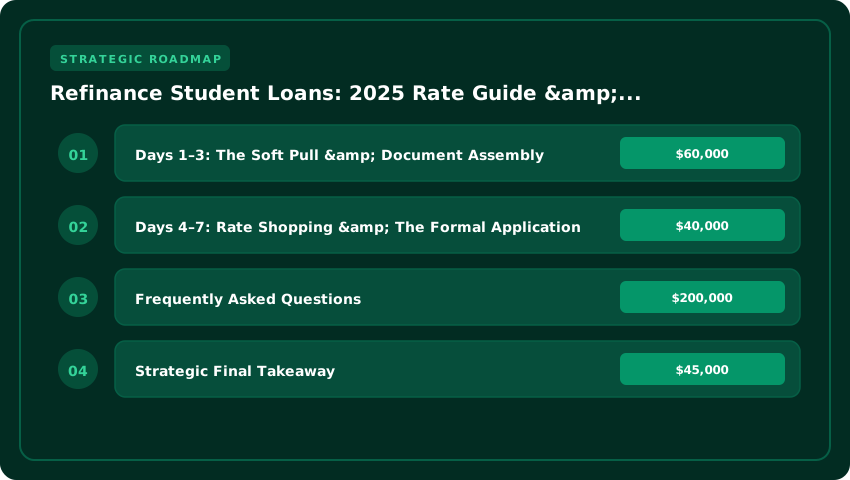
Days 1–3: The Soft Pull & Document Assembly
Start by gathering your “Big Three” verification documents before you authorize any credit check. Lenders require your two most recent W-2 forms, your last 30 days of pay stubs (showing year-to-date earnings), and a government-issued ID. If you are within your grace period, locate your separation date documentation—typically your diploma date or the registrar’s official withdrawal letter—because this date dictates when your first payment is due and whether accrued interest capitalizes before the new loan funds. Upload these to a secure cloud folder so you can share them instantly via lender portals without emailing sensitive PDFs.
Days 4–7: Rate Shopping & The Formal Application
Submit applications to three to four lenders within a tight 14-day window. FICO and VantageScore treat multiple education-loan inquiries in this period as a single “shopping event,” protecting your score. Compare the APR, not just the advertised rate, and verify the lender services their own loans or uses a reputable sub-servicer. Once you select a winner, sign the promissory note. This triggers the 7-day Federal Truth in Lending Act (TILA) right of rescission. The clock starts the day you sign, receive the Truth in Lending disclosure, and receive the notice of your right to cancel. Use these seven calendar days to stress-test your budget against the new payment; if the numbers feel tight, cancel in writing via certified mail—no questions asked, no fees owed.
Days 8–20: Verification & Payoff Statement Generation
After the rescission window expires, the lender orders payoff statements from your current servicers. Do not stop paying your old loans yet. Request a 30-day payoff statement (valid for 30 days from issuance) from each servicer. Verify the “good-through” date covers your expected funding date plus a 10-day buffer. Confirm the statement separates principal, accrued interest, and any fees. If you spot a discrepancy—common with income-driven repayment (IDR) forgiveness counters or PSLF payment tallies—escalate immediately via the servicer’s ombudsman or the FSA Feedback Center.
Days 21–30: Funding, The 10-Day Payoff Rule & Reconciliation
On funding day, the new lender transmits payment. Federal regulations mandate a 10-day payoff finalization process. Your old servicer has 10 business days to apply the funds, calculate final interest through the receipt date, and return any excess payment directly to the new lender (not to you). This step is critical: if the servicer holds the overage, it may erroneously capitalize into a new principal balance on a loan that should be closed. Monitor both portals daily. Once the old loans show a $0 balance and “Paid in Full” status, download the payoff confirmation letters. File these alongside your new promissory note; they are your proof if a credit bureau dispute arises later.
- Pro Tip: Set a calendar alert for Day 35 to pull your credit reports (AnnualCreditReport.com) and verify the old tradelines report “Transferred/Closed” with a $0 balance.
- Action Item: Enroll in autopay on the new loan immediately for the 0.25% rate reduction, but keep a one-month buffer in your checking account until the first payment clears successfully.
| Metric | Federal Direct Loans (Keep) | Private Refinance (Switch) |
|---|---|---|
| Interest Rate Range (2025) | 4.99% – 8.08% Fixed | 4.45% – 9.25% Fixed / Variable |
| PSLF Eligibility | Yes — up to 100% forgiveness after 120 qualifying payments | No — refinancing permanently forfeits PSLF |
| Minimum Credit Score Required | N/A — No credit check for most Federal Direct Loans | 650+ (700+ for best rates) |
| Minimum Income / DTI Cutoff | N/A — Income-driven plans available | DTI < 43%; stable income required |
| Repayment Timeline | 10 – 30 years (Standard, IDR, Extended) | 5 – 20 years (lender-dependent) |
| Avg Total Interest Paid ($50K, 10-yr) | ~$14,500 at 5.5% weighted avg | ~$9,900 at 4.45% (savings ~$4,600) |
| Refinance Break-even Period | N/A | 12 – 24 months to offset origination/closing costs |
| Career ROI (10-Year Projection) | High if PSLF-eligible; full forgiveness potential | Moderate–High if private rates > 2% below federal weighted average |
| Forbearance / Hardship Options | Generous — up to 3 years discretionary | Limited — typically 6–12 months, lender discretion |
| Refinance Recommendation Threshold | Keep if pursuing PSLF or IDR forgiveness | Refinance only if rate reduction ≥ 1.5% and no PSLF intent |
Frequently Asked Questions
Does refinancing federal student loans disqualify you from PSLF?
Yes. Refinancing federal student loans with a private lender permanently converts them into private loans, immediately disqualifying you from Public Service Loan Forgiveness (PSLF). Once refinanced, the loans are no longer eligible for any federal forgiveness programs, income-driven repayment plans, or administrative forbearance protections. This decision is irreversible.
What interest rate reduction justifies refinancing student loans in 2025?
Financial experts recommend refinancing only when private lenders offer a fixed rate at least 1.5% to 2% below your federal weighted average interest rate. This threshold ensures meaningful lifetime savings that offset the loss of federal protections. For a $50,000 loan over 10 years, a 2% reduction saves approximately $5,500 in total interest paid.
What credit score is needed to refinance student loans in 2025?
Most private lenders require a minimum credit score of 650 to qualify for student loan refinancing, while scores of 700 or higher unlock the most competitive rates. Lenders also evaluate debt-to-income ratio (ideally below 43%), employment history, and income stability. Applying with a creditworthy co-signer can significantly improve approval odds and reduce offered rates.
When does refinancing student loans make financial sense over PSLF?
Refinancing makes sense when you are not pursuing PSLF, have stable income, strong credit, and can secure a private rate at least 1.5% below your federal weighted average. Borrowers in high-earning private-sector careers with manageable debt-to-income ratios typically benefit most. Always calculate total lifetime savings before forfeiting federal loan protections.
Strategic Final Takeaway
Success in evaluating Refinance Student Loans: 2025 Rate Guide & PSLF Check relies on early preparation, adherence to verified accredited requirements, and cross-referencing official portals. Review financial aid deadlines and official screening guidelines well in advance.