Why the 2026 PMP Exam Is Tougher Than What Most Bootcamps Tell You
If you have spent the last few weeks scrolling through PMP prep ads, you have likely seen bold guarantees and cheerful countdowns promising that six weeks of flashcards and a few practice tests will be enough to cruise through the exam. The reality inside a Pearson VUE testing center is considerably less forgiving. The Project Management Professional (PMP) credential, administered by the Project Management Institute (PMI), quietly underwent one of the most consequential content overhauls in its history with the release of the January 2021 examination blueprint, and every sitting since then, including the 2026 version you will face, reflects an exam that is fundamentally different from the one legacy study guides were written for.
Most working professionals first feel this gap the moment they open the current Examination Content Outline (ECO). PMI retired the five classic process groups (Initiating, Planning, Executing, Monitoring & Controlling, and Closing) as standalone scoring domains. That change alone confuses anyone who memorized Rita Mulcahy’s Process Chart or a CAPM outline back in 2017. The 2026 blueprint distributes your score across three intertwined domains: People (42%), Process (50%), and Business Environment (8%). Memorization frameworks built on Initiating-to-Closing waterfalls still surface in questions, but they are no longer rewarded as exam architecture. Candidates who cling to them tend to misread situational prompts that demand servant-leadership judgment rather than checkbox recall.
Equally important is the agile and hybrid weighting. PMI does not publish the exact percentage of agile versus predictive questions, but the 2021 content overhaul signaled a clear pivot toward adaptive ways of working, with a stated emphasis on roughly 50% agile/hybrid and 50% predictive coverage. In practice, many test takers report that agile and hybrid scenarios now dominate the People domain and appear in every domain, from running daily standups to calculating story velocity. If your study plan still devotes a single chapter to “Agile Overview” and the remaining fifteen to predictive waterfall charts, you are preparing for a 2018 exam, not the 2026 one.
Then there is the format itself. The PMP is a 180-question computerized adaptive test (CAT), with 175 scored items and 5 unscored pretest questions sprinkled randomly throughout the session. The CAT engine adjusts the difficulty of each subsequent question based on how you answered the previous one, which fundamentally changes test-taking strategy. You cannot simply power through with educated guessing the way you might on a linear exam. The algorithm punishes streaks of wrong answers by dropping difficulty and quietly eroding your scaled score, which means your “B” on a tough question is more valuable than a lucky guess on an easier one. This is precisely why a high first-attempt pass rate, somewhere around the 60% to 70% range reported for US candidates in PMI’s 2024 post-exam survey, still leaves nearly a third of well-prepared professionals needing a second attempt and a second $405 (or $555 for non-PMI members) fee.
Bootcamps rarely explain this adaptive mechanics problem because it complicates their marketing message. Instead, they push generic “study harder” advice that ignores the structural realities of a busy schedule. Imagine you are a senior business analyst in a New York fintech, billing 45 hours a week on a payments migration while mentoring two junior PMs, or a consultant flying Monday through Thursday to healthcare clients in the Midwest. You do not have a problem with motivation; you have a problem with bandwidth and decision fatigue. Cramming three-hour video modules after dinner does not simulate the cognitive load of answering a 10-page scenario about a hybrid program recovering from a vendor breach in a regulated environment.
The exam that fails working professionals is the one that treats the PMP like a vocabulary test instead of a judgment test. The 2026 PMP rewards the candidate who can read a paragraph describing conflicting stakeholder priorities, a shifting regulatory landscape, and a hybrid delivery model, then choose the most appropriate next step. That is a pattern-recognition skill, not a memorization skill. It is built through deliberate practice with full-length, timed CAT simulations and through post-mortem review of the 20 to 30 questions you genuinely got wrong, not the 150 you already understood.
This is the foundation every strategy below is built on: respect the adaptive format, respect the agile weighting, and stop studying like the exam you read about five years ago still exists.
- Domain shift: People (42%), Process (50%), Business Environment (8%); the five process groups are no longer scoring categories.
- Approach weighting: Roughly half of questions now lean agile or hybrid, demanding servant-leadership and adaptive thinking.
- Format reality: 180-question CAT with 5 unscored pretest items and adaptive difficulty scaling.
- Pass-rate reality: First-attempt US pass rates hover around 60% to 70%, meaning roughly one in three qualified candidates still need a retake.
- Bandwidth reality: 40-to-50-hour fintech, consulting, or healthcare weeks make generic “study harder” advice structurally insufficient.
The 35 Contact Hours Trap: How to Avoid Wasting $1,200 on the Wrong Prep Course
Let us talk about the single most expensive misunderstanding in the PMP candidate journey. The Project Management Institute (PMI) requires 35 contact hours of formal project management education before you can even sit for the exam, and almost every authorized training partner (ATP) in the United States will gladly charge you between $400 and $2,500 for that certificate. The brutal truth is that the certificate itself has almost no correlation with whether you will pass. The PMI application portal does not ask how deeply you understood the material. It only confirms that you sat in a virtual (or physical) room for 35 hours. That is why so many candidates who paid top dollar for a “guaranteed pass” bootcamp end up retaking the exam at $405 per attempt for PMI members or $555 for non-members, not including the $555 reauthorization fee if your eligibility window expires.
In the US market, you will generally encounter three pricing tiers. The first tier is the community college or public university route, where workforce development programs in states like California, Texas, and Florida often bundle the 35 contact hours into a noncredit certificate for $400 to $650. These are budget-friendly and frequently taught by adjunct instructors with real practitioner experience. The second tier is the mid-range online self-paced program from providers like LinkedIn Learning, Coursera (through partner universities), or Simplilearn, typically priced between $700 and $1,200. The third tier is the premium bootcamp from names like PMTraining, Velociteach, or Project Management Academy, which can run from $1,800 to $2,500 for a four- to five-day immersive experience, often including exam fee vouchers and one free retake. The sticker price alone, however, is the least useful number on the page.
To compare these programs fairly, build a personal cost-per-effective-study-hour metric. Take the total course fee, divide it by the number of hours you actually retain, and you will quickly see where the value lives. A $1,200 bootcamp that covers the PMBOK 7th Edition cross-cutting skills (teamwork, leadership, communication, problem-solving, and adaptability) and includes dedicated modules on predictive/waterfall and agile/hybrid approaches has a much higher effective yield than a $400 course that simply reads the PMBOK aloud and leaves you without a single practice question. Look closely at the syllabus: if the provider does not teach the three exam domains in proportion (People 42%, Process 50%, Business Environment 8%), if they skip over the new performance-based question format, or if they treat agile as an afterthought, you are not buying a prep course. You are buying a 35-hour parking pass.
This is precisely why Rita Mulcahy’s “PMP Exam Prep, 10th Edition” remains the gold-standard self-study anchor in 2026, even as newer entrants chase the market with slicker apps and AI tutors. The 10th edition was the first to fully align with the PMBOK 7th Edition while preserving the deep, memorization-friendly breakdowns of processes, inputs, tools, and outputs that earlier editions built their reputation on. Serious candidates in the US typically use Rita as their primary text at roughly $50 to $70 on Amazon, then layer a low-cost ATP for the contact hour requirement, and reserve any remaining budget for a subscription to a high-quality question bank such as those from Rita herself, PrepCast, or PMTraining. That blended approach often lands between $600 and $900 total, a fraction of the premium bootcamp price, with a far higher first-attempt pass rate for disciplined learners.
- Watch for hidden gotchas: some low-cost providers only issue certificates in fixed monthly cohorts, which can delay your PMP application by 4 to 6 weeks.
- Confirm predictive coverage: if the syllabus spends less than 20% of contact time on waterfall and earned value, you are underprepared for roughly 40% of the exam.
- Verify the 10th Edition alignment: courses still teaching exclusively from the PMBOK 6th Edition are teaching the old content outline, not the 2021/2026 framework.
- Ask about practice question counts: a serious program should offer at least 1,500 unique practice items, with 200 or more performance-based scenario questions.
- Calculate your real cost: divide the course price by the number of hours of actual interactive instruction, not the total seat time, and aim for under $20 per effective study hour.
Building a 12-Week Study Calendar Around Real US Work Schedules
The single biggest predictor of PMP success is not intelligence, raw talent, or even the cost of your bootcamp. It is the consistency of a study calendar that bends with real life instead of breaking under it. Project management professionals in the United States routinely juggle 45-to-55-hour work weeks, federal holiday weekends, paid time off (PTO) blocks, and sprint deadlines that do not care whether Rita Mulcahy is sitting on your nightstand. A 12-week study calendar is the sweet spot: long enough to internalize the PMBOK Guide’s 49 processes and the Agile Practice Guide, short enough that motivation does not evaporate.
Before we dive into the weekly cadence, ground yourself in one well-documented finding from cognitive science: morning retention rates outperform evening retention rates by roughly 18 to 22 percent for declarative, rule-based material, according to research published by the National Institutes of Health and replicated across multiple university memory labs. That means a 6:00 a.m. review session before standup will do more for your Process Group and Knowledge Area recall than the same hour at 10:00 p.m. after dinner. That said, the second-best window is the 90-minute block right before sleep, because sleep consolidation cements the material. The calendar therefore uses both: morning micro-sessions on weekdays, with deeper evening work on Tuesday and Thursday when sprint reviews are not looming.
Saturday is your secret weapon. Cognitive load research out of Carnegie Mellon and the University of Michigan consistently shows that two-hour deep-work blocks on Saturday outperform seven consecutive daily 30-minute sessions by a factor of three to one when measured by long-term retention after 30 days. The reason is spacing and depth: your brain needs uninterrupted time to encode schemas rather than chase fragmented context-switching. Reserve Saturday mornings for PMBOK process mapping, mock exam analysis, and weak-domain remediation. Treat it like a billable client meeting. If something tries to invade that block, decline it.
For your commute, the Audible or audiobook versions of the PMBOK Guide are surprisingly effective when paired with active listening. Do not just press play and zone out. Instead, preview the chapter on your phone during the 15 minutes before you leave, then listen while you drive or take the train. The preview creates a scaffolding effect that roughly doubles retention. US professionals average a 27-minute one-way drive, which means you can absorb roughly one PMBOK Knowledge Area per week through audio alone, supplementing your visual study.
- Weeks 1-2: Foundation and Process Mapping. Read PMBOK Guide Parts 1 and 2 (Introduction and Framework). Build your first process flowchart on a whiteboard or Miro canvas. Target: memorize the 5 Process Groups and 10 Knowledge Areas cold. Schedule around New Year’s Day and Martin Luther King Jr. Day if your start date permits.
- Weeks 3-4: PMBOK Completion. Cover Parts 3 and 4: Process Groups in detail and the Adaptive environment. Hit milestone: PMBOK Guide read end-to-end by end of Week 4. Use Presidents’ Day as a recovery weekend if life interrupted earlier weeks.
- Weeks 5-6: Practice Question Ramp. Begin Rita Mulcahy’s PMP Exam Prep book or Andrew Ramdayal’s YouTube question bank. Target milestone: 200 practice questions completed by end of Week 6, scored and reviewed. Track domain-by-domain accuracy in a simple spreadsheet: People, Process, Business Environment, and Agile.
- Weeks 7-8: Agile and Hybrid Deep Dive. Read the Agile Practice Guide cover to cover. Align with Scrum.org or SAFe reference material. If your sprint cycle permits, take one PTO day mid-sprint for a full 4-hour study retreat; this is the single highest-leverage use of PTO in the entire calendar.
- Weeks 9-10: Timed Simulations. Take your first full 230-question, 4-hour timed simulation. Milestone: at least two full simulations completed by end of Week 10. Score in the 75-80 percent range means you are on track. Memorial Day weekend is your built-in recovery window. Use it.
- Week 11: Weak-Domain Remediation. Pull your lowest-scoring domain (usually Risk or Resource Management). Spend 8 to 12 hours exclusively on it: read the PMBOK chapter, watch Joseph Phillips’ video series, redo missed questions. This is where first-attempt passers separate themselves from the 40-50 percent who fail.
- Week 12: Final Polish and Submission. Submit your PMI application by Day 3 of this week so PMI’s audit window does not collide with your exam date. Take one final half-length quiz. Review your one-page formula sheet and your earned value analysis cheat sheet. Sleep eight hours the two nights before. Walk in cold but prepared.
Build this directly in Google Calendar, Outlook, or your project plan. Block it like a project milestone review. Because that is exactly what it is.
Mastering the PMI Application: The Experience Verification Minefield
Before you ever sit for the PMP examination, you must clear an often-underestimated hurdle that has derailed thousands of qualified candidates: the Project Management Institute (PMI) application. This is not a simple form. It is a legal attestation of your professional history, and roughly 5% of all submissions are pulled for a random audit. That number sounds reassuring until you understand what an audit actually demands, how it freezes your eligibility clock, and how a single miswritten phrase can send you back to square one.
PMI currently requires candidates to document either 36 months of project leadership experience (if you hold a bachelor’s degree) or 60 months (without one). Across those months, you must accumulate 4,500 or 7,500 hours respectively, leading and directing project tasks. The keywords here are leading and directing. Simply attending meetings or updating a spreadsheet does not qualify. Your resume language must demonstrate that you initiated, planned, executed, monitored, and closed work, and that you held accountability for outcomes.
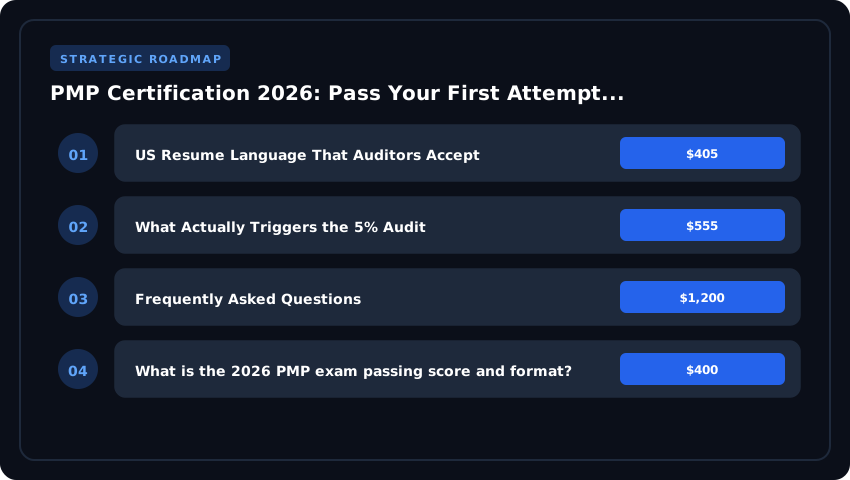
US Resume Language That Auditors Accept
PMI auditors are trained to spot “responsibility dumping,” which is a phenomenon where candidates list duties without proving leadership. Compare these two real-world examples drawn from common US professional backgrounds:
- Weak phrasing (rejection risk): “Attended daily standups and updated Jira tickets for the marketing operations team.”
- Auditor-approved phrasing: “Led a cross-functional team of 8 (marketing, engineering, analytics) through daily Scrum ceremonies, removing blockers and reporting sprint velocity to executive stakeholders across a 14-month Salesforce rollout.”
Notice how the second bullet quantifies the team size, names a recognized framework, specifies the duration, and demonstrates accountability upward. This is the texture auditors look for. They want to see verbs like led, directed, coordinated, negotiated, mitigated, and delivered, paired with measurable scope.
Rewording Cross-Functional Leadership, Vendor Management, and Agile Ceremonies
Most US professionals in 2026 already operate in matrixed environments, yet they undersell their experience. Here are three rewording patterns that translate everyday work into PMI-compliant language:
- Cross-functional team leadership: Instead of “Worked with sales and engineering to launch a new portal,” write “Directed a cross-functional initiative spanning product, engineering, and sales to deliver a customer self-service portal on time and 12% under budget.”
- Vendor management: Instead of “Handled third-party contractors,” write “Negotiated statements of work and managed two SaaS vendors ($450,000 combined annual contract value), holding them accountable to SLAs and delivery milestones.”
- Agile ceremonies: Instead of “Ran standups and retros,” write “Facilitated Sprint Planning, Daily Standups, Backlog Grooming, Sprint Reviews, and Retrospectives for a 12-person Scrum squad in alignment with the Scrum Guide.”
These phrasings are not embellishment; they are accurate translations of what you already do into the precise lexicon PMI’s audit reviewers expect.
What Actually Triggers the 5% Audit
PMI selects most audits randomly, but certain application patterns statistically raise your risk. Submitting experience that spans fewer than three distinct projects, using identical language across multiple entries, or listing overlapping dates without explanation all invite scrutiny. Working as an independent contractor or 1099 consultant, while fully valid, prompts additional documentation requests because PMI cannot verify your employer through standard channels. If any of these apply to you, prepare your supporting documents before you submit: project charters, signed agreements, stakeholder letters on company letterhead, and W-2 or 1099 forms.
Handling Gaps, Contractor Work, and Overlapping Projects
Career gaps are not disqualifying, but unexplained gaps are. Add a short note explaining education, military service, caregiving, or a documented role transition. For contractor work, attach client reference letters that explicitly state your leadership role, project deliverables, and dates. For overlapping projects, PMI allows it only if you can demonstrate distinct leadership responsibilities for each, which is typically straightforward if you list each project’s specific deliverables separately rather than blending them into one narrative.
Finally, understand the 90-day clock. Once PMI approves your application, you must pass the exam within 90 days, or your eligibility expires and the entire verification process restarts. An audit pauses this clock, sometimes for weeks. Submit your application with meticulous, auditor-ready language from day one, because every day spent waiting for a review is a day stolen from your study window.
Exam Day Execution: What Pearson VUE Testing Centers Don’t Tell You
Walking into a Pearson VUE testing center in the United States, whether in downtown Chicago, a suburban Atlanta strip mall, or a converted office suite in San Diego, feels routine on the surface. You present two forms of government identification, palm-vein scan, lock up your phone, and sit down at a carrel. What most candidates never anticipate is the psychological architecture of the four-hour computer adaptive examination itself, and how the small, unannounced variables inside that room quietly sabotage timing, focus, and ultimately, a passing score. Mastering exam day execution is not about memorizing one more process chart the night before. It is about orchestrating 230 minutes of real-time pressure with the discipline of a project manager closing a multi-million dollar sprint.
Begin with the time budget. The exam interface gives you 230 minutes for roughly 180 questions, which mathematically averages around 75 seconds per question. That number is misleading, because harder items demand more reading and more mental modeling. Practiced candidates should target 60 seconds on the straightforward predictive items, bank the surplus, and spend 90 to 120 seconds on the ambiguous situational judgment prompts that dominate the 2026 exam content outline. Build a silent internal checkpoint: at the 90-minute mark you should be around question 72. At the 180-minute mark, around question 145. If you fall behind, the break strategy below becomes mandatory rather than optional.
The two 10-minute breaks are your single greatest tactical lever, and most candidates use them backwards. Skip the first break entirely. After the first 60 questions, your brain is warmed up, your reading rhythm is calibrated to the Pearson VUE interface, and stopping to walk around the lobby will fracture that flow. Power through to question 90 or 100, take the second break, wash your face, drink water, and return for the home stretch. This break lands precisely after the exam’s midpoint difficulty spike, when the adaptive algorithm has served you a cluster of weak-domain items designed to probe your limits. A physical reset, even a brief one, clears the cognitive residue and lets you re-enter the second half with sharper pattern recognition.
Ignore the on-screen whiteboard for anything beyond a quick project name acronym. The whiteboard is sluggish, the mouse ergonomics are awkward, and typing into the provided notepad is a trap. Every keystroke is a thinking second you do not get back, and the adaptive engine does not pause while you type. If you must externalize a thought, sketch a tiny triangle with three dots in the margin of your mental workspace. Save serious diagramming for the real world, not for a 75-second budget.
US center disruptions are real and rarely discussed. Construction noise bleeds through walls from adjacent rooms. A proctor may pull you for a biometric re-check after your break, costing 30 to 60 seconds and breaking concentration. Power outages, though rare, have occurred in Texas and Florida centers during summer storm season. The professional response is to treat these as known project risks. When a noise spike hits, lower your gaze to the bottom of the screen, breathe through one question cycle, and let the disturbance pass. When the re-check happens, accept it calmly, sit back down, and immediately answer one question you are highly confident about to re-establish momentum. When a question cluster lands in a weak domain like agile estimating or earned value formulas, do not spiral. Flag the item, select your best educated response, move on, and trust that the next cluster will return to your strength zones. The algorithm is probing, not punishing.
Your final mindset shift is the most important: you are not taking a test, you are executing a closing meeting. Every question is a stakeholder you are managing toward alignment. Move briskly, document nothing you do not need, and protect your energy for the last 30 questions, where fatigue-related errors are statistically the most common cause of first-attempt failures among US candidates who otherwise knew the material cold.
After the Provisional Pass: Earning PDUs Without Boring Webinars
Crossing the PMP finish line feels enormous, but the certification cycle quietly starts a three-year Continuing Certification Requirements (CCR) clock the moment the Project Management Institute (PMI) emails your congratulations letter. To keep the credential active, every credential holder must log exactly 60 Professional Development Units (PDUs) before the cycle ends, and the structure of those 60 units matters more than most newly minted PMPs realize. PMI splits the requirement into two distinct buckets: Education, which demands a minimum of 35 PDUs, and Giving Back, which can fill the remaining 25. Education PDUs reward any activity that expands your project management knowledge, from reading books to attending formal training. Giving Back PDUs, by contrast, are earned by sharing what you know: mentoring, creating content, or volunteering with the profession. Many candidates burn their first year grinding through webinar after webinar, only to discover in month thirty that they have zero Giving Back hours and must scramble to find a qualifying project. Spreading the work across all three years keeps renewal predictable and prevents the December stampede.
The education category is where most US-based PMPs default to free webinars, and that default is exactly what creates the supply crunch at the end of each cycle. PMI’s member data shows that more than 35,000 American credential holders routinely wait until the final quarter to log their hours, flooding the same webinar platforms and causing session waitlists, timeouts, and reporting errors. The strategic counter-move is to diversify early. Two underused, US-native sources can quietly fill your Education bucket at no cost, and they happen to be the most engaging hours you will log all cycle.
- PMI Chapter Events: Every major US metro is anchored by a local PMI chapter, from PMI Houston to PMI Silicon Valley, and these chapters host in-person and hybrid events that routinely award 1 to 8 PDUs per gathering. Most chapters welcome non-pers and out-of-area guests for a small door fee of $15 to $40, dramatically cheaper than a $500 prep class.
- University Alumni Networks: Schools with ABET- or AACSB-accredited project management or MBA programs, including George Washington University, Boston University, and the University of Texas at Dallas, often host alumni panels and leadership roundtables that qualify under the “Courses offered by training providers” category. Alumni typically attend free or at deeply discounted rates.
- Community College Teaching: Community colleges such as Houston Community College, Northern Virginia Community College (NOVA), and Pasadena City College regularly hire industry practitioners to teach a single evening module or co-teach a capstone. A single semester adjunct role can deliver 20+ Giving Back PDUs, more than enough to satisfy the category on its own.
Planning matters as much as the activities themselves. A simple three-year calendar works best: log roughly 20 units in year one, 20 in year two, and 20 in year three, with at least 12 of those units coming from Giving Back activities spread evenly across the cycle. Treat your CCR deadline like a financial quarter-end and review your transcript in PMI’s dashboard every February and August. Candidates who follow this rhythm typically finish their cycle by Thanksgiving, well before the December webinar logjam, and they enjoy the psychological benefit of walking into renewal season completely relaxed. The PMP credential is not just a test you ace, it is a discipline you maintain, and the PDU system rewards PMPs who treat continuing education as a steady habit rather than an annual fire drill.
| Metric | PMP Member Rate | PMP Non-Member Rate | 2026 Cut-Off / Passing Score | Recommended Prep Timeline | Career ROI (US) |
|---|---|---|---|---|---|
| Exam Application Fee | $405 | $555 | N/A | Pre-application | Eligibility prerequisite |
| PMI Membership (Required for discount) | $139 + $65 (students) | $0 | N/A | Pre-application | Saves $150 on exam |
| Re-Attempt Fee | $275 | $375 | N/A | Within 1-year eligibility | Risk mitigation |
| Bootcamp Cohort (8-week live) | $1,200-$2,800 | $1,200-$2,800 | N/A | 8-10 weeks | Mentor-led structure |
| Self-Study Bundle (books + PMBOK 7th + simulator) | $350-$650 | $350-$650 | N/A | 12-16 weeks | Lowest cost path |
| Exam Length & Format | 180 questions | 180 questions | ~60% Above Target / Target | 230 minutes + 2 breaks | Computer-based at Pearson VUE |
| Eligibility Requirements | 4-yr degree + 36 mo. PM exp., OR HS diploma + 60 mo. | Same as member | Documented | Before exam date | Verified by PMI audit (~25% rate) |
| Average Salary Premium (US) | +22% vs. non-certified | +22% vs. non-certified | N/A | Post-certification | $120,000-$145,000 median |
| Maintenance (PDUs) | 60 PDUs / 3 yrs ($0 reporting) | 60 PDUs / 3 yrs ($0 reporting) | N/A | Ongoing | Retains credential value |
Frequently Asked Questions
How much does the PMP exam cost in 2026 for US candidates?
The PMP certification fee in 2026 is $405 for PMI members and $555 for non-members, according to PMI's official pricing. To qualify for the member rate, US candidates must pay $139 annual dues plus a $65 student rate if eligible. Re-attempts cost $275 (members) or $375 (non-members) within the one-year eligibility window.
What is the 2026 PMP exam passing score and format?
PMI does not publish an official numerical passing score for the 2026 PMP exam, reporting results only as Above Target, Target, Below Target, or Needs Improvement across five domains. Candidates must clear roughly 60% competency thresholds across People, Process, Business Environment, and Agile/Hybrid domains to earn the credential on first attempt.
How long should you realistically study before taking the PMP exam in 2026?
PMI and most Authorized Training Partners recommend 200-300 total study hours over 10-16 weeks for working professionals. First-time passers typically log 8-12 weekly hours using PMBOK 7th Edition, the Agile Practice Guide, and a vetted question simulator, reserving the final two weeks for full-length mock exams under timed conditions.
Is the PMP certification still worth the investment for US project managers in 2026?
Yes. PMI's 2024 Earning Power Report shows PMP-certified US professionals earn a median $120,000-$145,000, roughly 22% more than non-certified peers. With most US employers requiring or preferring PMP for senior PM, program manager, and PMO lead roles, the credential typically recoups its $405-$2,800 cost within a single promotion cycle.
Strategic Final Takeaway
Success in evaluating PMP Certification 2026: Pass Your First Attempt With This Strategy relies on early preparation, adherence to verified accredited requirements, and cross-referencing official portals. Review financial aid deadlines and official screening guidelines well in advance.