What PMP Certification Actually Means for US Project Managers in 2025
For project managers across the United States, the Project Management Professional (PMP) credential issued by the Project Management Institute (PMI) remains the most globally recognized benchmark of excellence in the field. In simple terms, the PMP certification validates that a professional has the experience, education, and competency to lead projects, programs, and portfolios using a standardized, evidence-based framework. It is not a degree. It is not a vendor-specific software certificate. It is an industry-validated credential that signals to employers, clients, and peers that the holder has mastered a rigorous body of knowledge and can apply it across industries ranging from healthcare and information technology to construction, finance, and defense contracting.
What makes the PMP particularly meaningful in 2025 is the way the exam itself has evolved. PMI completed its most recent major content update in 2024, and the 2025 exam continues to reflect that refreshed blueprint. The exam is now organized around three core performance domains: People (which accounts for 42% of the exam and focuses on leadership, team building, conflict resolution, and stakeholder engagement), Process (50% of the exam, covering predictive, agile, and hybrid project management methodologies, risk, scope, schedule, and cost management), and Business Environment (8% of the exam, addressing benefits realization, compliance, organizational change, and strategic alignment). This shift is significant because it recognizes that modern project managers are no longer just task schedulers — they are business strategists who must balance technical delivery with organizational value.
The weight placed on the People domain is perhaps the most telling change. PMI is essentially communicating that soft skills, emotional intelligence, and adaptive leadership matter as much, if not more, than Gantt charts and earned value calculations. For US professionals preparing for the 2025 exam, this means study plans must include servant leadership, mentoring, and cross-functional collaboration topics alongside traditional schedule and budget controls.
Beyond the exam content, the credential carries powerful market credibility. PMI has consistently reported that 71% of Fortune 500 companies either require or strongly prefer PMP-certified professionals for their project management roles. This statistic matters because it translates directly into hiring pipelines, contract eligibility, and promotion pathways. Many federal contractors, Department of Defense suppliers, and large healthcare systems in the United States list “PMP preferred” or “PMP required” directly in job postings, and government proposal teams often highlight the number of PMP-certified staff they can deploy as a competitive differentiator.
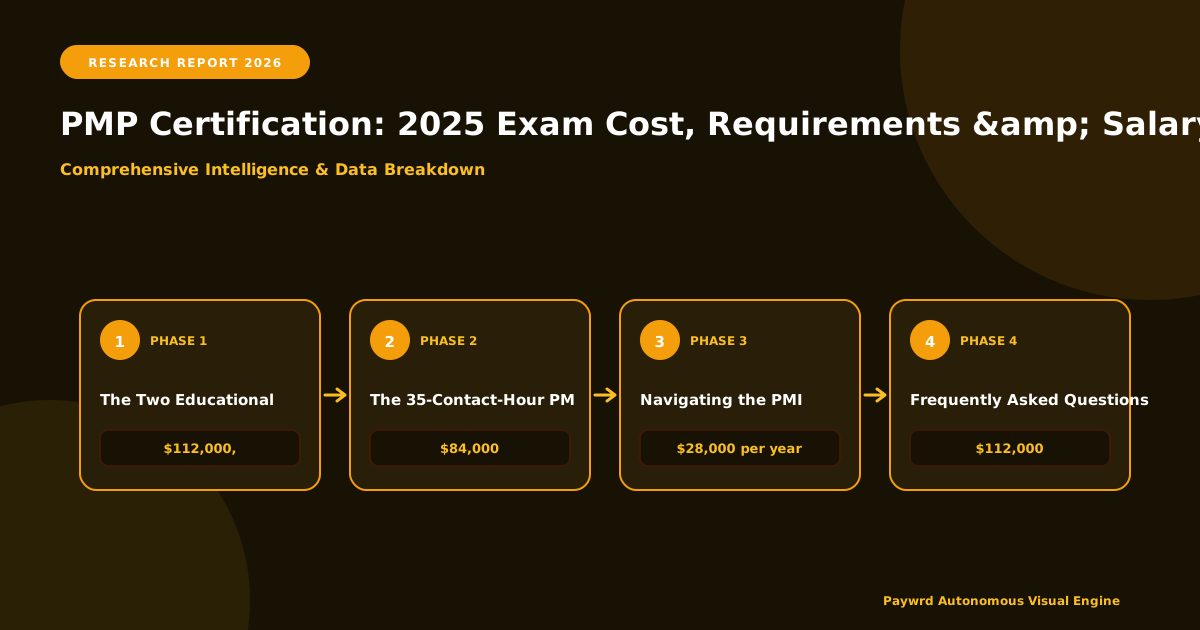
The financial case is equally compelling. According to PMI’s most recent Earning Power: Project Management Salary Survey, PMP-certified professionals in the United States earn a median annual salary of approximately $112,000, compared to roughly $84,000 for non-certified peers. That gap of nearly $28,000 per year is not a marginal difference — it represents a real, measurable return on the time and money invested in certification. Over a ten-year career, that differential compounds to more than a quarter of a million dollars in additional earnings, before accounting for bonuses, expanded benefits, and accelerated promotion cycles that PMP holders often experience.
It is worth pausing on what this number actually represents. It is not a guarantee, and it is not uniform across every industry or geography. Salary outcomes in tech-heavy metro areas such as San Francisco, Seattle, Boston, and the Washington, D.C. corridor tend to skew higher, while salaries in smaller Midwestern markets may cluster closer to the median. Industry also matters: PMP holders in IT, financial services, and aerospace typically command premiums over those in nonprofit or smaller commercial sectors. Nevertheless, the directional signal is unambiguous — the PMP credential is one of the highest-leverage professional certifications available to US-based project managers in 2025, both in terms of career mobility and long-term earning potential.
- Credential issuer: Project Management Institute (PMI), the world’s leading not-for-profit project management association.
- 2025 exam domains: People (42%), Process (50%), Business Environment (8%), reflecting a modern, leadership-driven framework.
- Industry recognition: 71% of Fortune 500 companies require or prefer PMP-certified project managers.
- Salary impact: Median US salary of approximately $112,000 for PMP holders versus $84,000 for non-certified peers — a ~$28,000 annual premium.
Breaking Down the Real PMP Exam Cost: Application, PMI Membership, and Retake Fees

Understanding the true financial commitment of pursuing the Project Management Professional (PMP) certification requires looking far beyond the headline exam price. While PMI publishes a base application fee, the actual out-of-pocket investment for United States candidates in 2025 typically spans exam registration, membership dues, study materials, practice tests, and ongoing renewal obligations. Let’s break down every dollar figure, every hidden cost, and every strategic opportunity to keep your PMP journey as affordable as possible.
The foundational expense is the PMP exam application fee, which PMI structures into two primary tiers. Candidates who hold an active PMI membership pay $405 to sit for the exam, while non-members pay $575. That $170 differential essentially prices in roughly one year of individual PMI membership (which costs $139 plus a $10 application fee for new members, totaling $149). Smart candidates immediately recognize this gap and align their membership purchase with their exam application to capture the discount. If you are sitting for the exam in 2025 and have not yet joined PMI, the math is straightforward: the membership pays for itself within a single exam attempt.
- PMI Member Exam Fee: $405
- Non-Member Exam Fee: $575
- PMI Individual Membership: $139 annually ($149 for first-year joiners, including the $10 application fee)
- Effective Member Savings: Approximately $21 to $31 net savings on your first attempt when membership is timed correctly
The second cost pillar is the retake fee, a reality that thousands of US candidates face each year. PMI charges $405 for members and $555 for non-members to retake the exam after an unsuccessful attempt. Notably, the retake fee for non-members is only $20 less than the original non-member price, meaning non-members essentially receive no meaningful retake discount. This pricing structure is a deliberate nudge from PMI toward maintaining continuous membership. Candidates should budget for at least the possibility of a retake, even if they plan to pass on the first attempt, because the financial exposure is significant.
- Member Retake Fee: $405
- Non-Member Retake Fee: $555
- Mandatory Waiting Period: One reapply eligibility period (typically 90 days for first retake, then longer subsequent waits)
A lesser-known savings opportunity is the $10 student discount available through PMI’s student membership tier. Full-time university students enrolled in an accredited US degree program can apply for student membership at a reduced rate, unlocking the $405 member exam price while paying less than the standard $139 annual dues. For graduate students or undergraduates pursuing project management concentrations at ABET- or AACSB-accredited institutions, this is a frequently overlooked advantage worth $30 to $50 in annual savings.
The third financial pillar, often forgotten by first-time candidates, is the renewal cycle. PMP certification is valid for three years (36 months), and maintaining it requires earning 60 Professional Development Units (PDUs) plus paying a $169 renewal fee for PMI members or $269 for non-members. The $100 renewal differential, like the exam fee differential, reinforces the long-term value of sustained PMI membership. Over a typical 12-year career holding four certification cycles, a member saves approximately $400 in renewal fees alone compared to a non-member who lapses and rejoins periodically.
- Member Renewal Fee (3-Year Cycle): $169
- Non-Member Renewal Fee (3-Year Cycle): $269
- PDU Requirement: 60 units every 3 years, aligned with the PMI Talent Triangle (Ways of Working, Business Acumen, Power Skills)
Beyond PMI’s published fees, candidates must budget for hidden study costs that can range from $150 to over $1,000 depending on preparation style. The PMBOK Guide (current 7th edition or earlier editions bundled with PMI membership) often costs $40 to $80 for non-members, though PMI members receive digital access included. Rita Mulcahy’s PMP Exam Prep runs approximately $40 to $60, while practice exam bundles from providers like PMI’s own practice portal, Simplilearn, or Velociteach typically cost $50 to $200. Premium instructor-led bootcamps, offered by Registered Education Providers (REPs), range from $600 to $2,500 and often include the 35 contact hours of project management education required for exam eligibility.
- PMBOK Guide (Print/Digital): $40–$80 (often free with PMI membership)
- Rita Mulcahy PMP Exam Prep Book: $40–$60
- Online Practice Exams: $50–$200
- Instructor-Led Bootcamp (35 Contact Hours Included): $600–$2,500
- Self-Paced Online Course: $150–$500
For US candidates seeking maximum savings, the most effective Talent Triangle-aligned strategy involves three layered moves. First, join PMI at least 30 days before applying for the exam to lock in the $405 member rate. Second, select a self-paced or employer-sponsored prep course that bundles the mandatory 35 contact hours required by PMI’s eligibility criteria. Many US employers, especially those in defense contracting, IT services, and Fortune 500 project management offices, reimburse PMP exam costs entirely under professional development budgets. Third, use free or low-cost PDU opportunities, such as PMI chapter events, on-demand webinars, and volunteer activities, to meet the 60-PDU renewal requirement without paying premium continuing education fees.
Ultimately, a well-planned PMP investment for a US candidate in 2025 typically totals $750 to $1,500 when factoring in exam fees, membership, study materials, and one possible retake buffer. By contrast, PMI’s salary survey data consistently shows PMP holders in the United States earning 25% to 33% more than non-credentialed peers, often translating to a $20,000 to $40,000 annual salary increase that recoups preparation costs within the first two to three months of employment. Strategic spending, not minimal spending, is the real path to PMP ROI.
PMP Eligibility Requirements: Contact Hours, Education, and Application Strategy
Before you ever sit for the PMP examination, the Project Management Institute requires every candidate to demonstrate a specific blend of professional experience and formal education. Understanding these prerequisites is the single most important step in your certification journey, because failing to meet them is the number-one reason applications get rejected or delayed. PMI designed the eligibility framework to ensure that every PMP-credentialed professional has already spent meaningful time leading real projects, not just studying project management theory in a classroom.
The eligibility structure is built around two parallel tracks, and which one you follow depends entirely on your highest level of completed education. PMI accepts degrees from any US institution accredited by agencies recognized by the Council for Higher Education Accreditation (CHEA), including regional accreditors such as the Higher Learning Commission, Middle States Commission on Higher Education, and WASC Senior College and University Commission. International degrees are evaluated case by case, so if you studied abroad, plan to have transcripts reviewed early.
The Two Educational Tracks Explained
- Four-Year Degree Track (Bachelor’s or Global Equivalent): If you hold a four-year degree from an accredited university, you must have accumulated at least 36 consecutive months of professional project management experience within the last eight years. In hours, that translates to roughly 6,000 hours of leading and directing projects. The experience must be non-overlapping and verifiable, and your role must have included core PM responsibilities such as scope, schedule, budget, risk, and stakeholder management.
- High School Diploma or Associate’s Track: If your highest credential is a high school diploma or an associate’s degree, the bar rises significantly. You must document at least 60 consecutive months (7,500 hours) of project management experience within the last eight years. This track is essentially PMI’s way of rewarding additional real-world experience in lieu of a four-year academic credential.
Across both tracks, the experience must reflect the five process groups outlined in the PMBOK Guide: Initiating, Planning, Executing, Monitoring & Controlling, and Closing. A common mistake applicants make is listing only one or two process groups, which triggers an audit or denial.
The 35-Contact-Hour PM Training Requirement
Every PMP candidate, regardless of track, must complete 35 contact hours of formal project management education before submitting the application. These hours cannot be self-study; they must be delivered by a PMI Authorized Training Partner (ATP). Several US-based institutions consistently rank among the most respected ATP providers:
- Villanova University — widely recognized for its online PMP prep, typically priced between $1,000 and $1,400.
- George Washington University (GWU) School of Business — offers a more premium live-virtual cohort often ranging from $1,200 to $1,800.
- UCLA Extension — a longstanding ATP known for instructor-led evening and weekend formats, generally $1,100 to $1,500.
Other reputable ATPs include PMI itself, Simplilearn, and Project Management Academy, but university-affiliated programs often appeal to US professionals who want a transcript they can verify with their alma mater. When you complete the course, the ATP issues a certificate showing the contact hours, and you upload that document directly into your PMI application portal.
Navigating the PMI Audit Process
Once you submit your PMP application and pay the exam fee, PMI randomly selects roughly 5% to 10% of applications for audit. While 90–95% of candidates sail through without review, those selected must supply supporting documentation: degree transcripts, supervisor verification of project hours, and copies of the 35-contact-hour training certificate. If you are audited, PMI gives you 90 days to respond, and most candidates who prepared honest, well-documented applications clear the audit within two to three weeks.
Actionable strategy: Before you ever click submit, build a project experience log with start and end dates, organization names, project titles, and a brief description of each process group you touched. Save PDFs of every certificate and transcript in a dedicated folder. Treat the audit as a probability game: even though your odds are excellent, a ten-minute prep job protects you from a sixty-day scramble.
Best US PMP Prep Courses: Pricing, Pass Rates, and ATP Comparison
Selecting the right Project Management Professional (PMP) preparatory course is one of the most consequential decisions a candidate makes on the journey toward PMI certification. With over 100,000 PMP credential holders in the United States and median salaries hovering around $95,000 according to the PMI Salary Survey, investing in a reputable Authorized Training Partner (ATP) program directly influences both first-attempt pass rates and long-term career mobility. However, the American prep market is crowded, with pricing ranging from $40 per month for self-paced subscriptions to more than $2,100 for premium university extensions. Understanding what each tier delivers in terms of contact hours, instructor quality, and post-course guarantees is essential.
Rita Mulcahy’s PMP Exam Prep Boot Camp remains the gold standard reference, and the live, instructor-led boot camp is priced between $1,295 and $1,795 depending on whether the candidate selects the standard 4-day classroom format or the 35-hour online live option. Published pass rates for RMC sit consistently around 95% for first-time test takers who complete all assignments, and every enrollment includes a free course retake, a printed copy of the Rita Mulcahy Hot Topics flash cards, and access to a 35-hour completion certificate that satisfies PMI’s mandatory prerequisite. The premium pricing reflects the depth of the simulation exams, the inclusion of a dedicated success coach, and the brand authority of Rita Mulcahy herself as a former PMI board member.
- Rita Mulcahy Boot Camp ($1,295–$1,795): Live or virtual 4-day format, 35 contact hours, free retake guarantee, 95%+ pass rate.
- Simplilearn ($999): Self-paced online with optional live boot camp add-on, 35-hour certificate, mobile-friendly content, six simulation test attempts.
- Coursera Google Project Management Certificate ($49/month): Foundational certificate pathway providing approximately 100 hours of project management training, transferable college credit through ACE, and preparation for the CAPM credential rather than the PMP directly.
- LinkedIn Learning ($40/month): Over 25 hours of PMP-specific videos, quiz prep, and a certificate of completion that some PMI ATP providers accept for the 35-hour requirement when paired with a capstone course.
- NYU School of Professional Studies ($2,100): University-backed live online boot camp, six-month access to recordings, 35 contact hours, instructor with PMP and PgMP credentials, free retake within six months.
- UC Berkeley Extension ($1,850): Live virtual classroom with Berkeley-branded certificate of completion, 35 contact hours, two full PMP simulation exams, and a 90-day money-back guarantee.
When evaluating live versus self-paced formats, working professionals in metropolitan hubs like New York, Chicago, and San Francisco often gravitate toward the structured accountability of an instructor-led boot camp. The RMC, NYU, and UC Berkeley options all provide real-time access to PMI-certified instructors who can clarify nuanced 2025 exam content around predictive, agile, and hybrid methodologies. Self-paced alternatives such as Simplilearn, Coursera, and LinkedIn Learning offer scheduling flexibility at a fraction of the cost, but candidates must demonstrate greater self-discipline to actually complete the required 35 hours and progress through the recommended study schedule.
The 35-hour completion certificate is non-negotiable for PMP eligibility per PMI’s current exam handbook, so any course advertised must explicitly state that it meets this prerequisite. Authorized Training Partners carry an ATP seal on the PMI website, and prospective students should verify their chosen provider against the official PMI ATP registry before enrolling. Free retakes and money-back guarantees vary significantly: RMC, NYU, and Simplilearn offer course retakes, while UC Berkeley’s 90-day refund policy is one of the strongest consumer protections in the premium tier. LinkedIn Learning and Coursera subscriptions can be canceled at any time, effectively offering an unlimited “money-back” option, though neither qualifies as a true ATP without supplemental capstone training.
For candidates seeking university extension credibility and ABET/AACSB-style institutional backing, the NYU and UC Berkeley programs deliver the strongest resume signal. Both universities are regionally accredited by the Middle States Commission on Higher Education (NYU) and the WASC Senior College and University Commission (UC Berkeley), ensuring that the certificate of completion carries weight with HR departments and federal contractors who require PMI-aligned training documentation. Ultimately, the best PMP prep course aligns with the learner’s budget, preferred modality, and need for accountability. Professionals with disciplined study habits can confidently pass using a $40 monthly LinkedIn Learning subscription plus an inexpensive exam simulator, while those seeking the highest first-attempt pass rate and robust institutional support will find the strongest return on investment in the RMC, NYU, or UC Berkeley live boot camp tier.
Documented Salary Increase Data: What PMP Certification Is Actually Worth
When US professionals ask whether the PMP credential actually moves the needle on compensation, the most credible answer comes from the Project Management Institute’s (PMI) triennial Earning Power Report, which surveys more than 40,000 credentialed project managers across 40+ countries. According to the most recent published data, PMP-certified practitioners in the United States report a 33% higher median salary compared to their non-credentialed peers holding equivalent job titles and years of experience. That figure is not aspirational marketing; it is a documented median drawn from self-reported compensation across industries, regions, and seniority bands.
Translated into real dollars, that 33% premium typically lands between $20,000 and $30,000 in additional annual compensation for project managers working in major US metropolitan markets. In Washington, DC, where federal contracting and defense program offices anchor demand, PMP-certified professionals frequently report salary bumps at the upper end of that range, with Senior PM and Program Manager roles clearing $145,000-$170,000 base. In New York City, financial services and healthcare systems drive PMP compensation into the $140,000-$165,000 band, while in the San Francisco Bay Area, where technology product cycles demand rigorous methodology, PMP-certified PMs at director level routinely command $165,000-$195,000 before equity and bonuses.
The salary lift is not uniform across industries, and understanding the variance helps candidates choose where to position themselves. PMI’s segmented data shows Information Technology delivering a 28% salary premium for PMP holders, reflecting the credential’s strong adoption among product, agile, and infrastructure teams. Healthcare reports a 24% premium, where regulatory complexity and EHR implementation projects make certified methodology immediately valuable. Construction leads the field at 31%, driven by federal infrastructure spending, MEGA-project oversight, and OSHA-compliant delivery standards that increasingly require certified leadership on bids and RFPs.
- Federal Contracting & Defense (DC Metro): PMP-aligned roles average $135,000-$175,000, with TS/SCI-cleared program managers reaching $190,000+.
- Financial Services & Insurance (NYC): PMP-certified PMs in regulatory transformation roles earn $130,000-$160,000 median base plus performance bonuses.
- Technology & SaaS (SF Bay Area): Senior PM and Group PM roles range $150,000-$195,000, with Director of PMO positions exceeding $215,000.
- Healthcare Systems (National): PMP-certified EHR and clinical informatics PMs average $115,000-$145,000 in hospital systems and payer organizations.
- Construction & Engineering (TX, CA, NY): Certified PMPs leading commercial and infrastructure builds earn $120,000-$160,000 with project-based incentives.
Beyond raw salary, the PMP credential measurably accelerates promotion velocity. PMI longitudinal data indicates that PMP-certified professionals move into Senior Project Manager, Program Manager, and Director of PMO roles within 18 to 24 months of certification, compared to a 36-48 month average for non-certified peers tracking the same career path. This compressed timeline matters because the cumulative earnings differential compounds quickly; a $25,000 annual premium earned two years earlier represents $50,000-$75,000 in additional lifetime earnings by the five-year mark, even before considering the compounding effect of equity grants, expanded bonus pools, and consulting rate uplifts that follow senior certification.
For US professionals evaluating the PMP as a career investment, the data is unambiguous. The credential pays for itself within the first promotion cycle in most metro markets, and the ROI strengthens substantially in federal contracting, healthcare IT, and large-scale construction environments where methodology rigor is contractually mandated rather than merely preferred.
PMP Exam Day Logistics and Study Timeline: From Application to Pass in 90 Days
Passing the Project Management Professional (PMP) exam in roughly 90 days is an ambitious but achievable goal for motivated US-based candidates who commit to a structured plan. Before you ever set foot in a Pearson VUE testing center, you need to understand two parallel tracks: the administrative path through PMI, and the intellectual path through the exam content itself. Running these tracks simultaneously is the single biggest advantage you can create, because PMI application approval often takes five to seven business days, and you can be studying while your file is under review.
The exam itself is delivered by computer at more than 300 Pearson VUE locations across the United States, from Manhattan and Chicago to smaller sites in Boise, Idaho and Wilmington, Delaware. You will face 180 questions over 230 minutes, broken into two 10-minute scheduled breaks that you can use to stretch, hydrate, and reset. The 180 questions include 5 unscored pretest items that PMI uses to test future questions, so do not panic if a few seem wildly outside your preparation. The exam uses a mix of multiple-choice, multiple-response, drag-and-drop, hotspot, and matching items, which is why Study Hall by PMI is such a valuable resource: it is the only practice platform that uses the exact same question engine as the live exam.
Your study timeline should be broken into three distinct phases across 10 to 12 weeks:
- Weeks 1-3: Foundation Phase (10-12 hours per week) — Read the PMBOK Guide 7th Edition cover to cover, but read it actively. Take handwritten notes on the 12 Principles of Project Management and the 5 Process Groups from the 6th Edition, which PMI still tests. Pair this reading with the Agile Practice Guide, dedicating one full chapter per week to Scrum, Kanban, and hybrid delivery models. Your goal here is fluency with terminology, not memorization.
- Weeks 4-7: Knowledge Application Phase (12-15 hours per week) — Begin using Rita Mulcahy’s PMP Exam Prep or Andrew Ramdayal’s TIA videos to translate your reading into exam-style reasoning. Take one full 180-question Study Hall mock exam at the end of week 7 to establish a baseline score. Most first-attempt scores land between 55% and 65%, which is a healthy starting point.
- Weeks 8-10: Intensive Practice Phase (15-18 hours per week) — Work through all remaining Study Hall question banks, focusing heavily on the expert-level and difficult-tier questions. Review every incorrect answer, write down the underlying principle being tested, and revisit that section of the PMBOK. By the end of week 10, you should be consistently scoring 75% or higher on full-length exams.
- Weeks 11-12: Final Review and Confidence Building (8-10 hours per week) — Light review only. Re-read your mistake journal, watch the Ricardo Vargas process group video one final time, and take one full mock exam under strict timed conditions three days before your scheduled test date.
Because the 2025 PMP exam weighs 50% agile and hybrid approaches against 50% predictive/waterfall content, your practice questions must reflect that balance. If your Study Hall analytics show you are acing predictive questions but missing agile servant-leadership scenarios, shift your study time toward the Agile Practice Guide and resources like the Scrum Guide. Conversely, if earned value management and risk quantification questions are tripping you up, return to the PMBOK performance domain chapters and work through the relevant Practice Hall mini-exams.
A few proven day-of strategies can make the difference between passing and retesting. First, eat a protein-rich breakfast and arrive 45 minutes early to your Pearson VUE center, since late arrivals are routinely turned away. Second, during the exam, flag any question that makes you pause for more than 90 seconds, mark your best guess, and move on. You will have time to return during your second pass. Third, treat the two scheduled breaks as non-negotiable resets: stand up, drink water, and look at something more than 20 feet away to rest your eyes. Fourth, remember that PMI tests mindset, not memorization. When two answers seem correct, choose the one that demonstrates a proactive, servant-leader approach who escalates appropriately and serves the team rather than the one who issues commands or works in isolation.
Finally, schedule your exam before you start studying. Knowing that you have a non-refundable $405 PMI fee (or $575 if you are not a PMI member) and a $250 Pearson VUE seat on the calendar creates the kind of positive pressure that converts intention into action. Most successful US candidates report that a fixed test date was the single most important factor in their 90-day success story.
| Metric | PMI Member | Non-Member | Details / Notes |
|---|---|---|---|
| Exam Fee (2025) | $405 | $555 | Membership ($139/yr + $10 app fee) saves $150 instantly. |
| Eligibility: 4-Year Degree | 36 Months Exp. | 36 Months Exp. | 4,500 hrs leading projects + 35 contact hours required. |
| Eligibility: High School/Assoc. | 60 Months Exp. | 60 Months Exp. | 7,500 hrs leading projects + 35 contact hours required. |
| Application Audit Risk | ~5-10% | ~5-10% | Random selection; requires supervisor sign-off & documentation. |
| Exam Format & Duration | 180 Questions / 230 Min | 180 Questions / 230 Min | Two 10-min breaks; People (42%), Process (50%), Bus. Env (8%). |
| Prep Course Cost (Avg.) | $300 – $800 | $300 – $800 | Includes 35 contact hours; live bootcamps cost $1,500+. |
| Recertification (CCRs) | 60 PDUs / 3 Years | 60 PDUs / 3 Years | PMI Talent Triangle: Ways of Working, Power Skills, Bus. Acumen. |
| Median Salary Boost (US) | +22% / ~$15k/yr | +22% / ~$15k/yr | PMI Salary Survey 2023/24: Median $120k vs $98k non-cert. |
| Total First-Year Investment | ~$850 – $1,350 | ~$1,000 – $1,500 | Exam + Membership + Prep Course + Materials. |
| ROI Payback Period | < 1 Month | < 1 Month | Based on median $15k annual salary increase post-certification. |
Frequently Asked Questions
How much does the PMP certification cost in total for 2025?
Total first-year PMP investment ranges from $850 to $1,500. PMI members pay $405 for the exam plus $149 membership dues; non-members pay $555. Adding a quality prep course ($300–$800) and study materials ($100–$200) brings the realistic budget to roughly $1,000–$1,350 for members.
What are the 2025 PMP eligibility requirements for experience hours?
Candidates with a four-year degree need 36 months (4,500 hours) leading projects; those with a high school diploma or associate’s degree need 60 months (7,500 hours). Both tracks require 35 contact hours of formal project management education, which can be satisfied by a prep course.
What is the average salary increase after obtaining PMP certification in the US?
PMP holders in the US report a median salary of $120,000, approximately 22% higher than non-certified peers at $98,000. This translates to an average annual boost of $15,000–$20,000, yielding a return on investment in under one month for most professionals.
How long does it take to prepare for the PMP exam in 2025?
Most candidates require 8–12 weeks of dedicated study (10–15 hours weekly) after completing the mandatory 35 contact hours. The 180-question, 230-minute exam covers People (42%), Process (50%), and Business Environment (8%) domains, demanding fluency in predictive, agile, and hybrid methodologies.
Strategic Final Takeaway
Success in evaluating PMP Certification: 2025 Exam Cost, Requirements & Salary Boost relies on early preparation, adherence to verified accredited requirements, and cross-referencing official portals. Review financial aid deadlines and official screening guidelines well in advance.