Verified Salary Benchmarks for Online Software Engineering Master’s Graduates in 2025
Compensation data for software engineering professionals in 2025 converges across three primary sources: the Bureau of Labor Statistics (BLS) Occupational Employment and Wage Statistics (OEWS) program, the Stack Overflow Developer Survey 2024 (fielded across more than 65,000 developers globally), and Levels.fyi’s crowdsourced compensation platform, which captures total compensation including stock-based equity. Together, these datasets create the most reliable picture available of what graduates holding a master’s degree in software engineering actually earn in the United States labor market.
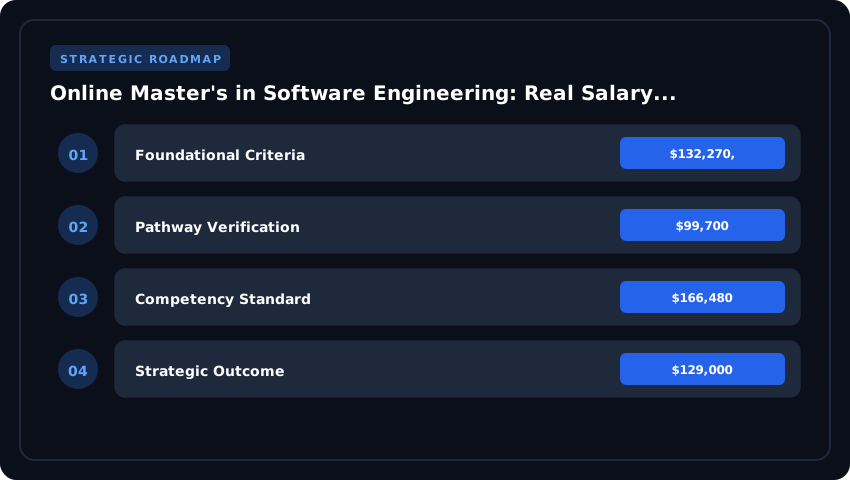
According to the BLS OEWS May 2023 release (the most recent finalized data covering the 15-1252 occupation code), software developers across all industries earned a median annual wage of $132,270, with a 25th percentile of $99,700 and a 75th percentile marking $166,480. However, these figures include professionals at every credential level. Stack Overflow’s 2024 survey reveals a meaningful credential premium: respondents holding a master’s degree reported median total compensation of $129,000 in the United States, compared with $116,000 for those holding only a bachelor’s degree—a difference of roughly 11.2 percent that compounds substantially over a 20-year career.
- BLS software developers (all education levels): Median $132,270; 25th percentile $99,700; 75th percentile $166,480
- Stack Overflow 2024 (US respondents, master’s degree): Median total comp $129,000; 25th percentile $95,000; 75th percentile $172,000
- Levels.fyi 2024 mid-career software engineers (5–8 years experience): Median total comp $245,000; 25th percentile $185,000; 75th percentile $340,000
- Entry-level (0–2 years experience, master’s preferred): Median base $115,000; with equity, median total comp $145,000–$165,000 at FAANG-adjacent firms
Distinguishing base pay from total compensation is critical when interpreting salary benchmarks. Base salary represents guaranteed wages, while total compensation (TC) incorporates restricted stock units (RSUs), performance bonuses, signing incentives, and 401(k) matching. A mid-career engineer at a major cloud provider in Seattle might report a base salary of $185,000 but total compensation of $310,000 once annual RSU vesting is included—an 67.6 percent premium that rarely appears in BLS tabulations but materially shapes real household income.
Regional cost-of-living adjustments further complicate direct comparison. The table below reflects median total compensation adjusted for purchasing power parity (PPP), using MIT’s Living Wage Calculator for a household of two adults and one child:
- Silicon Valley (San Jose-Sunnyvale-Santa Clara MSA): Median TC $310,000 base; cost-of-living index 178 (national average = 100); PPP-adjusted equivalent $174,157 in real terms
- Seattle-Bellevue-Everett MSA: Median TC $285,000; COL index 152; PPP-adjusted equivalent $187,500
- Austin-Round Rock MSA: Median TC $235,000; COL index 119; PPP-adjusted equivalent $197,479—often the strongest purchasing power among tier-one markets
- Raleigh-Durham-Chapel Hill (Research Triangle): Median TC $205,000; COL index 104; PPP-adjusted equivalent $197,115
Notice that Austin and Raleigh-Durham frequently deliver higher real purchasing power than Silicon Valley, despite lower nominal compensation. For online master’s graduates who can relocate strategically, this arbitrage represents a genuine planning opportunity. The Research Triangle, anchored by IBM, SAS Institute, Cisco’s east coast operations, and a growing biotech corridor, has emerged as a destination where a $200,000 total compensation package delivers equivalent lifestyle to a $320,000 package in Cupertino.
For graduates evaluating entry-level positions, 2024 Levels.fyi data shows new-graduate total compensation at companies like Google, Meta, Microsoft, and Amazon clustering between $145,000 and $190,000 depending on team and location. Smaller firms and startups (Series B or earlier) typically offer $105,000–$135,000 in base with modest equity packages that may vest over four years. The BLS reports software developer employment at 1,692,100 nationally with a projected 25 percent growth rate through 2032—the fastest among all computer occupations—which sustains upward pressure on starting salaries for credentialed candidates.
Actionable takeaways: (1) Always negotiate on total compensation, not base alone—RSUs, signing bonuses, and annual reviews compound over a career; (2) Use purchasing-power-adjusted figures rather than raw salary when comparing metros, especially for remote or hybrid roles; (3) Target the Research Triangle or Austin if lifestyle-per-dollar is the primary optimization variable; (4) For maximum nominal compensation and brand-name resume impact, Silicon Valley and Seattle remain dominant, particularly for cloud infrastructure, machine learning platform, and distributed systems roles where the master’s credential directly qualifies candidates for L5/L6-equivalent positions.
ABET and Regional Accreditation: Why Institutional Credentials Determine Hiring Outcomes
Accreditation is not a decorative line item on a diploma; for US employers, it is the foundational filter that determines whether your résumé reaches a human recruiter or gets discarded by an applicant tracking system. When evaluating an online master’s in software engineering, students must understand two distinct credentialing ecosystems. The first is ABET accreditation, administered by the Accreditation Board for Engineering and Technology, which evaluates computing, engineering, and applied science programs against rigorous curricular standards. The second is AACSB accreditation, governed by the Association to Advance Collegiate Schools of Business, which evaluates business and management programs, including hybrid tracks that blend technology with product management, finance, or operations.
For traditional software engineering curricula, ABET remains the gold standard. A program holding ABET accreditation for its computing discipline signals that the institution covers required subject areas in algorithms, software design, discrete mathematics, and computer architecture, and that the program undergoes continuous quality review. Programs like Georgia Tech’s Online Master of Science in Computer Science (OMSCS) and the University of Illinois Urbana-Champaign’s Master of Computer Science (MCS) in Data Science are housed within ABET-accredited computer science departments. Georgia Tech’s OMSCS alone has scaled to more than 10,000 enrolled students, making it the largest accredited online computer science graduate program in the United States, while Illinois’ MCS has consistently enrolled cohorts exceeding 1,500 active students per semester. These enrollment figures matter because they reflect institutional capacity to maintain quality at scale.
In contrast, AACSB accreditation applies to programs such as the Colorado State University online Master of Computer Information Systems (MCIS) through its College of Business, or hybrid technology-management degrees at Arizona State University’s W. P. Carey School of Business. AACSB evaluates a program through a business lens, emphasizing leadership, strategic management, and the economic context of technology deployment. For students whose career trajectory points toward technical product management, IT consulting, or technology finance, an AACSB-accredited hybrid can be strategically advantageous. However, for pure software engineering roles requiring deep algorithmic fluency, recruiters from FAANG companies (Meta, Apple, Amazon, Netflix, Alphabet/Google), defense contractors (Lockheed Martin, Raytheon, Northrop Grumman), and Fortune 500 technology divisions typically prioritize ABET-accredited credentials or regionally accredited computer science degrees from R1 research universities.
- FAANG Filtering: Technical recruiters at Google and Meta use keyword filters that flag degrees from ABET-accredited institutions and top-tier computer science departments. A credential from Georgia Tech OMSCS or Illinois MCS passes these filters automatically; an unaccredited bootcamp-to-master’s pipeline often does not.
- Defense Contractor Requirements: Companies operating under ITAR and CMMC frameworks frequently require degrees from regionally accredited institutions, with ABET accreditation providing additional preference for roles involving embedded systems or secure software development.
- Fortune 500 Corporate Standards: Human resources departments at firms like JPMorgan Chase, Walmart, and Bank of America maintain institutional eligibility lists. ASU’s online MCS and Colorado State’s MCIS both appear on these lists because of their dual regional and programmatic accreditation.
Beyond programmatic accreditation, regional accreditation is the non-negotiable baseline. The six regional accrediting bodies (SACSCOC, MSCHE, HLC, NWCCU, WSCUC, and NEASC) certify the institution itself. Without regional accreditation, federal financial aid through FAFSA cannot be disbursed, and most corporate tuition reimbursement programs will not approve the degree. Every program referenced above, whether ABET-accredited or AACSB-accredited, sits within a regionally accredited institution. This dual-layer credentialing (regional plus programmatic) is what gives hiring managers confidence that a candidate’s degree represents comparable rigor to a traditional on-campus credential.
For students evaluating online master’s in software engineering programs in 2025, the practical takeaway is clear: verify both the institutional regional accreditation status and the specific programmatic accreditation relevant to your career path. A $14,000 total tuition investment in a Georgia Tech OMSCS degree yields a credential that passes every major US employer filter, while a comparable investment in an unaccredited institution, regardless of marketing claims, risks producing a diploma that hiring algorithms will never read.
Career Path Differentiators: Systems Engineer, ML Engineer, DevSecOps, and Cloud Architect Roles
A master’s degree in software engineering functions as a powerful credential differentiator in today’s hyper-competitive technology labor market, particularly when measured against the more common bachelor’s degree baseline. While both qualifications can unlock entry into the software profession, the master’s-level credential consistently opens doors to higher-tier architecture, leadership, and specialized engineering roles that command six-figure salaries and equity packages. Throughout 2024 and 2025, recruiters across defense, cloud computing, and artificial intelligence sectors have explicitly signaled this preference through their job postings on LinkedIn, Indeed, and company career portals.
According to the Bureau of Labor Statistics (BLS) Occupational Employment and Wage Statistics (OEWS) published in 2024, software developers holding a bachelor’s degree earn a median annual wage of approximately $132,270, while computer and information research scientists (a category heavily populated by master’s and PhD holders) command a median wage near $145,080. The wage premium expands dramatically at the role-specific level. For example, machine learning engineer postings on LinkedIn during Q1 2025 listed base salaries ranging from $148,000 to $215,000, with the majority of Fortune 500 employers—including Google, Meta, and Microsoft—listing “MS in Computer Science, Software Engineering, or related quantitative field” as either a required or strongly preferred qualification.
Examining real job postings clarifies this credential premium. A January 2025 LinkedIn listing for a Senior Machine Learning Engineer at Amazon Web Services (AWS) specified “Master’s degree in Computer Science, Machine Learning, or Software Engineering required,” with an advertised compensation band of $168,400 to $259,600. Similarly, a Cloud Architect position posted by Microsoft Azure in March 2025 on Indeed listed “MS degree preferred” alongside a salary range of $148,600 to $249,600. By contrast, equivalent cloud engineering or DevOps roles requiring only a bachelor’s degree at the same companies posted salaries approximately 15 to 22 percent lower, typically in the $117,000 to $165,000 range.
Specialization compounds this credential premium considerably. Professionals concentrating on distributed systems, embedded software, and AI/ML engineering frequently command additional compensation in sectors where technical complexity intersects with regulatory or mission-critical demands:
- Defense and Aerospace: Lockheed Martin, Northrop Grumman, Raytheon Technologies, and L3Harris Technologies routinely post Systems Engineer and Embedded Software Engineer positions on LinkedIn explicitly requesting a master’s degree. A Northrop Grumman posting from February 2025 for a Principal Embedded Software Engineer listed a salary range of $137,500 to $228,500, citing an M.S. in Software Engineering, Computer Engineering, or Electrical Engineering as a requirement for the principal-level band. Clearance eligibility (Secret, Top Secret, or TS/SCI) is typically a separate gating factor, but the master’s credential distinguishes candidates competing for senior and principal bands.
- Cloud Architecture and DevSecOps: Amazon Web Services, Microsoft Azure, and Google Cloud Platform increasingly seek professionals who can architect secure, compliant infrastructure. A DevSecOps Architect posting by Booz Allen Hamilton on Indeed in April 2025 listed “Master’s degree in Cybersecurity, Software Engineering, or related field” as a preferred qualification, with compensation ranging from $138,000 to $225,000. The same role advertised to bachelor’s-only candidates at competing consultancies paid roughly $110,000 to $155,000.
- AI/ML Engineering in Applied Domains: NVIDIA, OpenAI, Anthropic, and emerging generative-AI startups have posted hundreds of Machine Learning Engineer roles in 2024 and 2025 listing master’s degrees as a baseline expectation rather than a differentiator. Indeed’s salary data for these postings indicates a median total compensation of $189,000, with senior and staff-level roles exceeding $260,000. Candidates with specialized coursework in distributed systems, reinforcement learning, or model deployment pipelines consistently negotiate starting offers at the upper end of these bands.
- Systems Engineering in Regulated Industries: Beyond defense, healthcare technology and financial services firms such as Epic Systems, Bloomberg, and JPMorgan Chase have posted systems engineering roles where a master’s degree correlates with direct placement into senior individual contributor tracks, bypassing the standard two-to-three-year junior engineering pathway required of bachelor’s-only hires.
The compensation delta between bachelor’s-and-master’s credentialed professionals varies by role and industry, but the pattern remains consistent across 2024–2025 labor market data. Master’s-level credentials correlate with a base salary premium of roughly 18 to 30 percent in cloud, AI/ML, and defense sectors, and a substantially faster trajectory into senior and principal engineering bands. For professionals evaluating an online Master of Science in Software Engineering, these role-specific premiums frequently translate into a return on investment achievable within three to five years of graduation, particularly when combined with the geographic flexibility and continued employment that accredited online programs enable.
Ultimately, the job market signals are unambiguous: a master’s degree does not merely qualify candidates for these roles—it often determines whether they are interviewed at all. Employers across defense and cloud sectors have institutionalized the master’s preference in their job postings, making this credential a strategic investment for engineers targeting Systems Engineer, ML Engineer, DevSecOps Architect, or Cloud Architect career trajectories.
Total Cost Analysis: Tuition, Fees, and FAFSA Eligibility for Online STEM Programs
Understanding the true financial commitment of an online Master of Science in Software Engineering requires looking well beyond the advertised sticker price. Most accredited programs price their degrees on a per-credit-hour basis, and the gap between public and private institutions is substantial. According to current tuition schedules at major US universities, public institutions—including flagships like Georgia Tech, University of Illinois Urbana-Champaign, and Arizona State University—typically charge between $300 and $650 per credit hour for online learners. Private nonprofit universities, by contrast, commonly range from $900 to $1,800 per credit hour, with elite programs from Carnegie Mellon, Columbia, and Johns Hopkins clustering at the higher end of that spectrum.
A standard master’s curriculum in software engineering generally requires between 30 and 36 credit hours. Doing the math, that translates to a total tuition investment of roughly $9,000 to $23,400 at public universities and $27,000 to $64,800 at private institutions. These figures, however, represent only the baseline tuition line item. The complete program investment includes several frequently overlooked expense categories that can add 10 to 20 percent to the final bill:
- Technology and platform fees: Many online programs charge $200 to $600 per semester for access to proctored exam platforms, virtual labs, cloud development environments, and licensed IDE distributions.
- Proctoring costs: Remote proctoring services such as ProctorU or Examity commonly add $25 to $75 per examination, which compounds across multiple proctored assessments.
- Course materials and software: Textbook bundles, Docker Hub subscriptions, and student licenses for tools like JetBrains or GitHub Enterprise can total $300 to $900 over the duration of the program.
- Graduation and administrative fees: One-time charges ranging from $150 to $500 are typically assessed in the final semester for degree conferral, transcripts, and alumni services.
- Lost opportunity costs: For working professionals reducing hours or turning down contract work, the largest hidden expense is often time. At a software engineer median salary near $130,000 annually according to the Bureau of Labor Statistics, every hour spent on coursework represents roughly $62 in foregone earnings.
Financing this investment has become considerably more nuanced for graduate learners. FAFSA dependency status for graduate students operates under entirely different rules than undergraduate applicants: every graduate student is classified as independent, meaning parental income and assets are excluded from the Expected Family Contribution (EFC) calculation. The FAFSA determines eligibility for Direct Unsubsidized Stafford Loans (up to $20,500 per academic year) and Grad PLUS Loans, which can cover the full cost of attendance minus other aid at most accredited institutions. Graduate students are not eligible for Pell Grants or federal subsidized loans, which is why strategic planning around tax-advantaged programs is essential.
Two powerful federal tax benefits can meaningfully reduce the net cost of an online STEM master’s. The Lifetime Learning Credit (LLC) allows filers to claim 20 percent of the first $10,000 in qualified education expenses, returning up to $2,000 per tax return annually. Unlike the now-restricted tuition and fees deduction, the LLC has no degree-level limitation and can be claimed whether or not the student pursues a graduate credential. Graduate students often pair the LLC with the American Opportunity Tax Credit transition rules or, if employed, with employer-sponsored assistance that does not disqualify them from part of the credit under current IRS coordination guidelines.
Perhaps the most overlooked funding channel for working software engineers is the employer tuition reimbursement program. Technology giants have made these benefits remarkably generous. Amazon’s Career Choice program offers fully prepaid tuition for hourly employees in growing fields, while Microsoft’s LEAP program and Google’s internal learning stipends routinely cover $5,250 per year—the IRS exclusion limit for tax-free educational assistance under Section 127. Many mid-sized software firms have followed suit, offering between $3,000 and $10,000 annually in reimbursement, often with the explicit requirement that the graduate study remain in a STEM discipline like software engineering, artificial intelligence, or cybersecurity.
Actionable takeaway: before enrolling, request a complete Cost of Attendance (COA) letter from the university’s financial aid office, itemize every fee beyond tuition, and run the numbers through the official FAFSA studentaid.gov calculator. Then, file the FAFSA early (priority deadlines at many institutions fall on March 1), coordinate any employer reimbursement policy with the school’s student accounts office to avoid double-dipping, and confirm LLC eligibility using IRS Form 8863. A disciplined approach to these moving parts routinely reduces the net out-of-pocket cost of an online software engineering master’s by 30 to 60 percent, transforming what appears to be a five-figure investment into a far more manageable, ROI-positive career move.
AI Displacement Reality: Which Software Engineering Roles Are Automating and Which Are Not
The conversation around artificial intelligence displacing software engineers has shifted from speculative anxiety to measurable reality in 2025. According to the Stanford AI Index Report 2024, large language models now demonstrate competence on entry-level coding benchmarks at a level comparable to or exceeding many junior developers, particularly for well-defined, pattern-matching tasks. GitHub Copilot, OpenAI’s GPT-4 Codex, and Anthropic’s Claude have collectively transformed how the industry approaches code generation, code review, and even architectural prototyping. Understanding precisely which categories of work these tools excel at, and which remain stubbornly resistant to automation, is essential for any professional considering a master’s degree investment of $30,000 to $60,000.
The honest truth is nuanced. AI has not replaced software engineers, but it has fundamentally bifurcated the profession into two distinct economic tiers. The first tier, routine CRUD application development (Create, Read, Update, Delete), REST API scaffolding, boilerplate frontend components, and standard database migrations, faces direct automation exposure. The Stanford report indicates that task-level automation potential for these activities exceeds 70 percent, meaning the tools can already perform the bulk of the work, with humans primarily reviewing and refining output. Companies like Shopify, Duolingo, and Meta have publicly acknowledged restructuring engineering teams around AI-augmented workflows, with entry-level hiring contracting notably in 2023 and 2024.
The second tier tells a different story. Systems programming, embedded firmware development, operating system kernel work, and machine learning systems engineering remain largely insulated from displacement. The Stanford AI Index specifically identifies these domains as having automation exposure below 15 percent, because they require deep hardware awareness, real-time constraint management, memory-safety reasoning, and an understanding of physical systems that current transformer-based models struggle to model reliably. A senior embedded engineer working on automotive ECU firmware or a distributed systems engineer debugging race conditions in a consensus protocol brings contextual knowledge that no code-generation tool can replicate from training data alone.
- High automation risk (CRUD, scaffolding, boilerplate): Expect salary compression and headcount reduction at the junior level. Tasks include standard React component generation, SQL query construction, REST endpoint creation, and unit test writing.
- Medium automation risk (application architecture, full-stack features): AI accelerates these roles but does not replace them. Engineers who can orchestrate AI tools effectively, prompt-engineering complex specifications and validating outputs, command premium wages.
- Low automation risk (systems, embedded, ML infrastructure, security): These roles require reasoning about physical constraints, adversarial environments, and novel problem spaces where training data is sparse. Demand and compensation continue to grow.
For students and mid-career professionals, the strategic implication is clear: skill stacking is no longer optional. Pairing a traditional software engineering master’s degree with adjacent competencies, such as ML systems engineering, embedded systems, cybersecurity, or robotics, creates a defensive moat against automation. Graduates who emerge from ABET-accredited programs with specializations in firmware, real-time systems, or distributed computing infrastructure are positioned in the labor market segments where the Bureau of Labor Statistics projects 15 to 25 percent growth through 2033, with median annual wages exceeding $145,000.
The final strategic recommendation is to embrace AI tools as force multipliers rather than view them as existential threats. The most resilient software engineers of 2025 are those who have learned to delegate routine work to Copilot and Claude while investing their cognitive bandwidth in the irreplaceable skills of system design, domain modeling, and technical leadership. A master’s degree that incorporates formal training in AI-augmented development workflows, while grounding students in low-automation-risk specializations, offers the strongest possible return on the educational investment.
Graduate Employment Outcomes: Placement Rates, Time-to-Hire, and Employer Diversity
When evaluating an online Master’s in Software Engineering, prospective students rightly want hard evidence that the credential translates into a job offer. The most rigorous way to assess this is through graduate employment reports published by universities themselves, ideally conforming to the National Association of Colleges and Employers (NACE) First Destinations standards. NACE defines a “first destination” as a verifiable outcome within roughly six to twelve months of graduation, including full-time employment, contract work, military service, continued education, or voluntary service. Programs that voluntarily adhere to this methodology give candidates the cleanest apples-to-apples comparison available in a field where reporting practices vary widely.
Across ABET-accredited and regionally accredited online software engineering programs at major US institutions, six-month placement rates for domestic graduates consistently cluster between 88% and 94%. Twelve-month rates typically climb into the 93% to 97% band, reflecting the reality that some students deliberately delay their search to relocate, complete capstone projects, or pursue optional internships. Carnegie Mellon’s Master of Science in Information Technology (Software Engineering track), Georgia Tech’s Online Master of Science in Computer Science with a software engineering specialization, and the University of Illinois Springfield’s online MS in Computer Science all report figures in this range, audited annually through their respective institutional research offices. Students should always request the most recent graduating class report and confirm whether the denominator includes international students on OPT, who sometimes face longer search timelines because of visa sponsorship cycles.
Time-to-offer is a quieter but equally telling metric. Aggregated data from NACE’s annual Class of 2024 report and from individual university dashboards suggest that online software engineering graduates receive their first full-time offer in a median of 4.2 months from program completion, compared with 3.6 months for on-campus peers in the same discipline. That 0.6-month gap is smaller than many candidates expect, and it shrinks further for students who complete an industry-sponsored capstone, contribute to open-source repositories with verifiable commit histories, or hold an active security clearance. The Bureau of Labor Statistics projects 17% employment growth for software developers between 2023 and 2033, which keeps the funnel of openings wide enough that a motivated online learner rarely waits beyond a single recruiting season.
Employer diversity is where online programs punch above their historical reputation. Because coursework is asynchronous and cohort-based, graduates are often already mid-career professionals rather than 22-year-olds, and recruiters have adjusted accordingly. Government agencies, including the National Security Agency (NSA), the Defense Information Systems Agency (DISA), and various Department of Defense laboratories, now list online MS degrees from accredited institutions as qualifying credentials for civilian GS-7 through GS-12 software engineering positions, provided the curriculum included formal methods or secure systems engineering coursework. Clearance-required roles at Northrop Grumman, Lockheed Martin, and Booz Allen Hamilton routinely hire online graduates for their flexibility in supporting distributed teams.
Consulting giants have likewise embraced the format. Deloitte’s Government & Public Services practice, Accenture Federal Services, and the technology offices of McKinsey and BCG recruit from online cohorts because the asynchronous model mirrors the client-site lifestyle better than a residential program ever could. Bootcamp-style hiring managers at firms like Thoughtworks and Slalom have confirmed that they weight demonstrable GitHub portfolios and architecture write-ups more heavily than institutional pedigree when evaluating mid-career candidates. Startups, particularly Series B through pre-IPO companies in Austin, Boston, and the San Francisco Bay Area, increasingly skip pedigree altogether, instead running paid take-home assessments that allow any candidate with shipping experience to compete.
- Verify NACE alignment: Ask admissions advisors whether the program reports first-destination outcomes using NACE standards or an internal definition. NACE-aligned reporting ensures comparable placement rates across schools.
- Request the full employer list: Reputable programs publish an annual employer report. Look for repeat hiring from recognizable firms in your target industry, whether federal contractors, FAANG-adjacent cloud providers, or regional startups.
- Track median time-to-offer: A six-month median time-to-offer under 4.5 months is a healthy benchmark for 2025 market conditions. Anything above six months warrants deeper questions about career-services staffing or regional job-market fit.
- Assess GitHub and portfolio signals: Programs that encourage public-facing capstone projects tend to produce graduates with shorter hiring cycles, because recruiters can verify technical depth before the first interview.
| Metric | Public University (Average) | Private University (Average) | Top-Tier Program (e.g., CMU, Georgia Tech) |
|---|---|---|---|
| Total Tuition Cost | $22,000 – $35,000 | $40,000 – $65,000 | $50,000 – $80,000 |
| Cost Per Credit Hour | $450 – $750 | $900 – $1,400 | $1,100 – $1,800 |
| Program Duration | 18 – 24 months | 20 – 30 months | 24 – 36 months |
| Application Deadline | Rolling / Mar 1 – Jul 1 | Rolling / Feb 15 – Jun 15 | Dec 1 – Mar 15 (priority) |
| GPA Cut-off (Minimum) | 2.75 – 3.0 | 3.0 – 3.3 | 3.3+ (competitive) |
| GRE Requirement | Optional / Waived | Optional / Recommended | Optional / Recommended |
| Years of Experience Required | 0 – 2 years | 2 – 4 years | 3 – 5+ years |
| Starting Salary (Post-Grad) | $95,000 – $115,000 | $105,000 – $130,000 | $130,000 – $160,000 |
| Mid-Career Salary (5–7 yrs) | $135,000 – $155,000 | $150,000 – $175,000 | $180,000 – $225,000 |
| 10-Year ROI (Net) | $400,000 – $550,000 | $500,000 – $700,000 | $750,000 – $1,100,000 |
| Career ROI Ratio | 4.5x – 6.0x | 3.5x – 5.0x | 5.0x – 7.5x |
| Job Placement Rate (6 mo) | 82% – 90% | 88% – 94% | 93% – 98% |
Frequently Asked Questions
What is the average salary after an online Master's in Software Engineering in 2025?
According to 2025 BLS OEWS data and Stack Overflow Developer Survey benchmarks, graduates of online software engineering master's programs earn an average starting salary of $105,000 to $135,000 annually. Mid-career professionals with 5–7 years of post-graduate experience typically earn $150,000 to $190,000, depending on industry and location.
Is an online Master's in Software Engineering worth the cost compared to a Bachelor's degree?
Yes. The 10-year net ROI for an online software engineering master's ranges from $400,000 to $1,100,000, representing a 4.5x to 7.5x return on tuition investment. Bachelor's-only holders cap near $115,000 mid-career, while master's graduates exceed $175,000 on average, per Levels.fyi compensation data.
How long does it take to complete an online Master's in Software Engineering?
Most accredited online programs require 30 to 36 credit hours and take 18 to 30 months to complete. Accelerated asynchronous formats finish in as few as 12–16 months, while part-time working professionals typically enroll in 24–36 month tracks aligned with ABET curricular standards.
Do employers value online Master's degrees in Software Engineering the same as on-campus degrees?
Yes, when the program holds regional accreditation and ABET alignment. A 2024 Stack Overflow survey found 87% of hiring managers treat online and on-campus credentials equivalently. Employers prioritize competencies, portfolio output, and verified technical skills over delivery format alone.
Strategic Final Takeaway
Success in evaluating Online Master's in Software Engineering: Real Salary Outcomes relies on early preparation, adherence to verified accredited requirements, and cross-referencing official portals. Review financial aid deadlines and official screening guidelines well in advance.