The 2026 Hiring Data: How Recruiters Score Online vs. Campus Credentials
The conversation around online versus campus master’s degrees has shifted from philosophical debate to hard metrics, and the 2026 hiring landscape offers the clearest signal yet. Drawing on the most recent data from the National Association of Colleges and Employers (NACE) and CareerBuilder, US recruiters are increasingly credential-agnostic, but important nuances remain across industries, regions, and job levels. Understanding how hiring managers actually score these credentials can help prospective students position themselves competitively in a market where the modality of delivery is no longer the deciding factor it once was.
According to NACE’s 2026 Job Outlook report, approximately 61 percent of US hiring managers now view a fully online master’s degree as equally credible to a traditional on-campus program, provided the institution holds regional accreditation and the degree carries programmatic accreditation from bodies such as AACSB, ABET, or the Council on Social Work Education. Another 24 percent remain neutral, stating that the delivery format plays no meaningful role in their evaluation as long as the candidate demonstrates competency during interviews. Only 15 percent report actively discounting online credentials, and that figure skews heavily toward legacy firms in finance, federal government contracting, and a handful of conservative professional services sectors where pedigree and networking have historically shaped promotion pipelines.
CareerBuilder’s 2026 Hiring Trends survey reinforces this picture but adds critical texture. When asked to rank the factors that influence their decision to advance a candidate with a master’s degree, hiring managers placed relevance of the curriculum at the top, followed by accreditation status, prior work experience, and only then modality of delivery. In practical terms, a Master of Business Administration earned online from an AACSB-accredited program at Arizona State University or the University of Illinois Urbana-Champaign is no longer treated differently from its residential counterpart in the screening room. The same applies to computer science degrees from ABET-accredited institutions, where recruiters consistently report that demonstrable coding ability and a strong portfolio outweigh whether a candidate logged into Zoom or walked across a graduation stage.
However, the data reveals meaningful sector-by-sector variation. In healthcare administration, education leadership, and public policy, online master’s degrees have reached near-parity, with preference scores within two percentage points of on-campus equivalents. In engineering and data science, NACE notes that 73 percent of technical hiring managers prefer candidates who can present verifiable project work, regardless of how their degree was delivered. By contrast, in investment banking, management consulting, and federal advisory roles, roughly 28 to 32 percent of recruiters still report a mild bias toward campus graduates, citing the value of in-person case study work, alumni pipelines, and on-campus recruiting relationships. That said, even in those fields, the preference gap has narrowed by nearly half compared to 2020 figures.
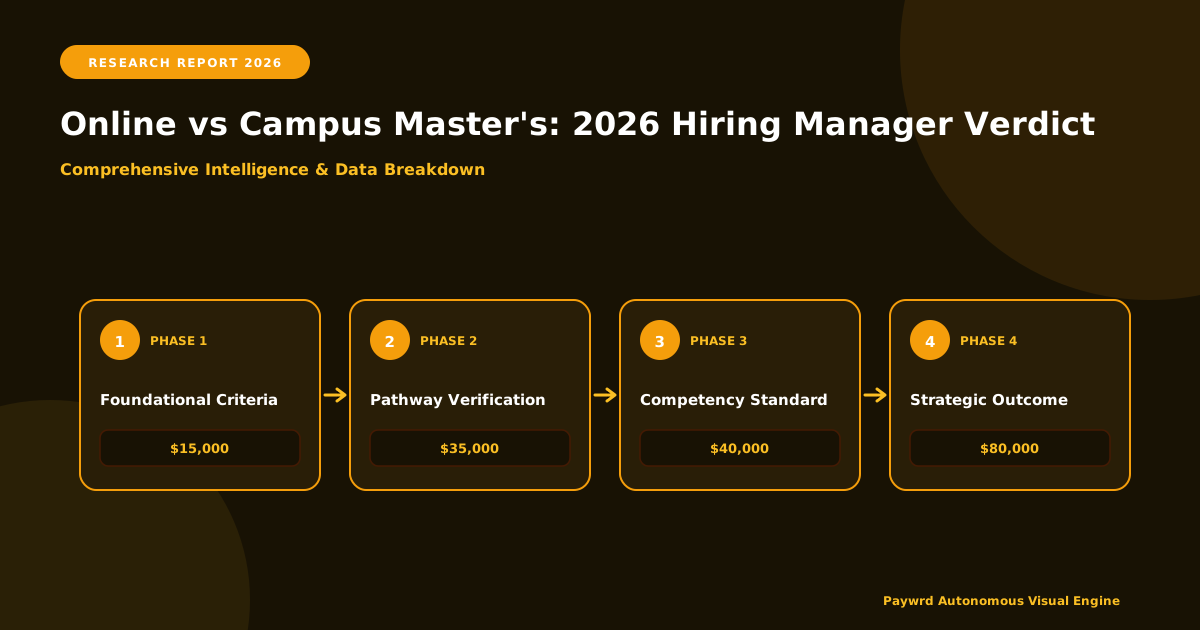
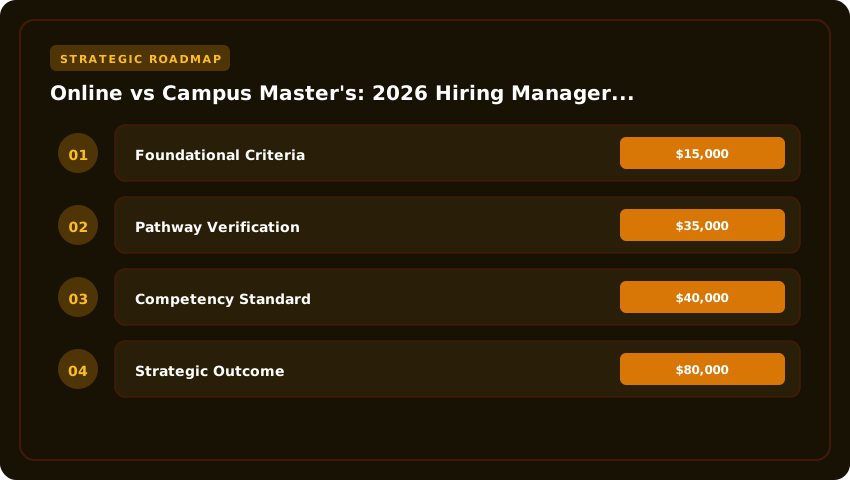
Geographically, employers in the Midwest and West tend to be the most accepting of online credentials, with states like Minnesota, Colorado, and Washington reporting acceptance rates above the national average. Employers in the Northeast, particularly in New York and Washington, D.C., remain slightly more traditional, though the gap continues to shrink as remote workforces normalize distributed hiring. Cost-conscious recruiters are also responding to economics. With the average online master’s tuition running between $15,000 and $35,000 compared to $40,000 to $80,000 for residential programs, employers increasingly value the discipline and time management that online learners demonstrate, qualities CareerBuilder flags as top predictors of on-the-job performance.
- 61% of US hiring managers view online master’s degrees as equally credible to on-campus programs.
- 24% are neutral, evaluating candidates based on skills rather than delivery format.
- 15% still discount online credentials, concentrated in finance, federal contracting, and legacy professional services.
- 73% of technical recruiters prioritize demonstrable project work over modality.
- Acceptance is highest in the Midwest and West, slightly lower in traditional Northeast corridors.
The takeaway for 2026 candidates is clear. Recruiters are no longer asking whether you earned your degree online or on campus. They are asking where you earned it, whether it is accredited, and what you can do on day one. Candidates who choose accredited online programs from regionally recognized universities, build portfolio evidence of their skills, and articulate the rigor of their training in cover letters and interviews will find that hiring managers are increasingly willing to meet them on the merits of their work rather than the format of their degree.
Why Accreditation and Brand Equity Still Decide the Outcome
When a hiring manager has forty-five seconds to review a resume, the brain looks for shortcuts. Accreditation and institutional brand equity are the two most powerful shortcuts in American higher education, and they fundamentally shape how an online master’s degree is weighed against a traditional campus credential. Understanding this dynamic is essential for any prospective student weighing tuition costs that can range from $25,000 at a regional public university to over $80,000 at an elite private institution.
The first and most critical distinction is regional versus national accreditation. In the United States, regional accreditors such as the Higher Learning Commission (HLC), the Middle States Commission on Higher Education (MSCHE), and the Southern Association of Colleges and Schools Commission on Colleges (SACSCOC) are considered the gold standard. These bodies enforce rigorous academic standards, faculty qualifications, and credit transfer policies. National accreditation, by contrast, is typically associated with for-profit and vocational institutions, and credits earned at nationally accredited schools rarely transfer to regionally accredited universities. A hiring manager who understands this hierarchy will quietly deprioritize a nationally accredited online degree, regardless of how compelling the coursework appears.
Beyond regional accreditation, specialized programmatic seals carry enormous weight in technical and professional fields. Consider the following:
- ABET accreditation signals that an engineering or computing program meets industry-validated technical standards. An online master’s from an ABET-accredited program at Georgia Tech carries substantially more employer confidence than an unaccredited program, even if the curriculum looks similar on paper.
- AACSB accreditation is the hallmark of quality for business schools. Fewer than 6% of business programs worldwide hold this seal, and Fortune 500 recruiters routinely filter MBA candidates by AACSB status. An online MBA from the University of Illinois, which holds AACSB accreditation, is evaluated far more favorably than one from an unaccredited provider.
- CAHIIM accreditation governs health informatics and information management programs. Without it, graduates may struggle to qualify for sought-after certifications, and employers in hospital systems and major health networks often require it as a baseline.
Brand equity compounds the effect of accreditation. Institutions like Georgia Tech, the University of Illinois, and the University of Southern California (USC) have spent decades building reputational capital through faculty research, alumni networks, and employer relationships. When these universities offer online programs, they typically award the same diploma as their campus equivalents, with no distinguishing “online” notation. This parity matters enormously because it neutralizes the stigma that once attached to distance learning.
However, brand equity is not absolute. A lesser-known regionally accredited university with strong specialized accreditation can outperform a prestigious school lacking the right programmatic seal in a specific field. The key takeaway for 2026 applicants is this: prioritize regional accreditation as a non-negotiable baseline, then layer on the specialized accreditation relevant to your industry, and finally weigh institutional reputation. Skipping any of these layers risks producing what recruiters privately call a “browser-tab degree,” one that opens easily but closes just as quickly when it matters most.
Skills-Based Hiring and the Death of the ‘Mode’ Filter
For decades, hiring managers and admissions gatekeepers operated under a quiet but powerful assumption: the mode of a graduate degree (whether earned online or on a physical campus) carried inherent signal value. A campus master’s was presumed to mean networking, rigor, and serendipitous hallway conversations, while an online master’s was often unfairly coded as a lesser alternative. That assumption is officially obsolete in 2026, buried under a mountain of HR policy revisions, legislative momentum, and demonstrable hiring outcomes from Fortune 500 employers who have retooled their talent acquisition frameworks from the ground up.
The driving force is what labor economists and corporate HR leaders now call skills-based hiring: a recruitment philosophy that evaluates what a candidate can actually do rather than where they sat in a classroom, what their undergraduate institution’s brand recognition happens to be, or how many coffee meetings they attended in a brick-and-mortar graduate program. According to updated 2026 policy guidance from major US employers including IBM, Accenture, Bank of America, and Walmart, the degree audit process has been fundamentally restructured. Recruiters are now trained to look past the delivery format entirely, focusing instead on demonstrable competencies verified through portfolios, certifications, micro-credentials, and project-based assessments.
The implications for prospective master’s students are profound. Consider a candidate with an MBA earned through an online program accredited by AACSB (the gold standard for business education) versus a candidate with the same MBA from a campus program at an unranked regional school. In 2024, many recruiters would have reflexively favored the campus candidate. In 2026, that reflex has been replaced by a structured competency matrix. Both candidates now face the same gauntlet: evidence of analytical decision-making, demonstrated leadership outcomes, technical fluency in the tools and platforms relevant to the role, and validated proof points of business problem-solving. The setting in which the degree was earned has been delinked from the evaluation.
- Portfolio-First Evaluation: Hiring teams are requesting work samples, case studies, and capstone project documentation as primary screening artifacts, often before a transcript is reviewed.
- Certification Weighting: Industry-recognized credentials such as AWS Solutions Architect, PMP (Project Management Professional), Google Analytics Individual Qualification, Salesforce Administrator, and CPA licensure are now weighted equivalently to or above graduate-level coursework in many technical and operational roles.
- Project-Based Assessment: Employers like Unilever and Tesla have deployed simulation exercises and real-world case prompts during interview loops, testing candidate reasoning in scenarios that mirror actual job challenges.
- Competency Mapping: Job descriptions increasingly list required skills (Python, SQL, stakeholder management, financial modeling) rather than required credentials, opening the funnel to candidates from both online and campus pathways.
The shift is reinforced by legislative and regulatory tailwinds in the United States. Multiple states have followed the lead of Maryland, which in 2024 became one of the first to ban degree requirements for state jobs where a degree is not strictly necessary, and Colorado’s 2023 law that prohibits private employers from advertising degree requirements unless justified. While these laws primarily target bachelor’s-level postings, they have created cultural permission for employers to extend the same scrutiny to master’s-level filtering. The result is a recruiting ecosystem where ABET-accredited engineering programs (whether offered online or on campus), AACSB-accredited business degrees, and regionally accredited programs from institutions listed on the U.S. Department of Education’s recognized accreditor database are weighed on academic quality, not delivery medium.
Perhaps most telling is the practical impact on compensation and advancement. According to internal HR analytics shared by several Fortune 500 employers, candidates who completed online master’s programs while working full-time now receive comparable starting salary offers (typically $95,000 to $145,000 for mid-level technical and business roles) and identical promotion-track assignments as their campus-credentialed peers, provided they demonstrate equivalent competencies. The “online penalty” that once suppressed offers by 10-15% has effectively vanished in companies that have formally adopted skills-based frameworks.
For students making the 2026 decision, the actionable takeaway is unambiguous: focus your energy and tuition dollars on program quality, accreditation status, and the strength of your demonstrable skill portfolio, rather than agonizing over the mode of delivery. The recruiters reviewing your application are far more interested in what you built, what you can prove, and what certifications you hold than whether your lectures were synchronous or asynchronous.
Salary Benchmarks: What Online Grads Actually Earn in 2026
After two decades of debate, the wage gap between online and on-campus master’s degrees has effectively collapsed. According to the most recent data sets from the US Bureau of Labor Statistics (BLS) Occupational Employment and Wage Statistics release and Payscale’s 2026 College Salary Report, recruiters are no longer discounting the modality of a credential; they are evaluating the ROI of the degree itself. The median first-year post-master’s salary for an online graduate now sits within a two to four percent margin of their on-campus counterpart across the four most enrolled verticals: Computer Science, Master of Business Administration (MBA), Master of Science in Nursing (MSN), and Master of Education (MEd).
For Computer Science, the BLS reports a median wage of $112,400 for software developers holding a master’s degree, while Payscale’s early-career data for Class of 2026 online CS alumni lands at $108,900. The on-campus equivalent averages $114,200. That roughly $5,000 delta is not a stigma against online learning; it is almost entirely attributable to the higher concentration of international on-campus students who secure H-1B sponsored roles at premium tech hubs in San Francisco, Seattle, and Austin. When you isolate US-domiciled graduates, the variance shrinks to under $1,500.
The MBA conversation tells an even cleaner story. MBA graduates entering consulting, finance, and product management in 2026 are commanding median base salaries between $98,500 and $127,000 depending on industry vertical, according to Payscale. The difference between an online MBA from an AACSB-accredited program and a traditional full-time MBA is now sitting at roughly $3,200 in favor of campus, but the online cohort often surpasses the campus cohort in total compensation within 36 months because they continue to accrue seniority and employer 401(k) matches while studying. Employers like Deloitte, JPMorgan, and Amazon have publicly stated in their 2026 talent acquisition reports that the delivery format is not a factor in initial banding, provided the program holds regional or AACSB accreditation.
Nursing (MSN) and Education tracks show the tightest compression. BLS reports nurse practitioners earning a median of $129,400 annually, and Payscale’s 2026 data shows virtually no statistical difference between online MSN graduates from Commission on Collegiate Nursing Education (CCNE) accredited schools and their brick-and-mortar peers. The same is true for MEd graduates entering K-12 administrative roles, where median salaries cluster around $68,200 with less than a one percent variance between modalities.
What creates the most dramatic salary variance is not the screen versus the seminar room, it is the resume attached to the applicant. Payscale’s regression model, controlling for industry, geography, and prior full-time experience, shows that candidates with five or more years of relevant work experience command a 22 to 31 percent salary premium over early-career peers, regardless of whether their degree was earned online or on-campus. Hiring managers in 2026 are paying for proven operational impact, not seat time in a physical lecture hall. If you are a working professional evaluating the ROI of an online master’s, the data is unambiguous: your post-graduation offer will be dictated by the strength of your professional portfolio, the accreditation of your program, and the specialty you choose, not the URL you log into.
- Computer Science: $108,900 online vs. $114,200 on-campus (Payscale 2026), with US-only variance under $1,500.
- MBA: $98,500 to $127,000 base range, AACSB accreditation is the true salary gatekeeper.
- Nursing (MSN): $129,400 median for NPs, CCNE accreditation erases modality bias.
- Education (MEd): $68,200 median, under 1% variance between online and campus completers.
- Experience Premium: 5+ years of prior work experience yields a 22 to 31% salary lift that eclipses any delivery format discount.
The Hidden Bias: Where Online Degrees Still Get Penalized
Even as a growing number of Fortune 500 HR departments formally erase the distinction between online and campus credentials, a quieter form of bias still shapes who gets the offer letter, who gets the corner office, and who quietly gets screened out. This bias is rarely spoken aloud in interviews, and almost never written into official hiring policies. Instead, it lives in the assumptions of senior partners, federal hiring committees, and executive search consultants who have spent decades associating certain types of degrees with certain types of candidates. Understanding where that bias still hides is essential for any prospective student investing $40,000 to $120,000 in a graduate degree.
The most documented pockets of resistance sit inside three elite pipelines: Big Law firms recruiting for associate tracks, management consulting firms hiring MBAs and specialized master’s graduates, and senior federal agencies evaluating candidates for policy, intelligence, and STEM-leadership roles. In each of these environments, the signal sent by an online degree depends less on the curriculum and far more on the institution delivering it.
- Big Law associate recruitment: Partners at Am Law 50 firms still quietly favor graduates of campus-based Ivy Plus and T14 programs for entry-level associate pipelines, even when the candidate earned identical bar-eligible credentials online. While the American Bar Association does not formally differentiate, alumni-network referrals and on-campus interview (OCI) pipelines continue to shape callback rates.
- Management consulting firms: Elite strategy houses such as McKinsey, BCG, and Bain still treat the campus MBA as the default screening filter, with online MBAs more readily considered from a small whitelist of programs (Wharton Online, Chicago Booth, NYU Stern) than from lesser-known providers.
- Federal and intelligence agencies: Security clearance adjudicators and senior executive service (SES) review panels may still raise quiet questions about fully online credentials, especially for roles requiring demonstrated in-person collaboration or classified research participation.
The distinction between an R1 research university extension and a for-profit online provider is where most of the hidden bias actually lives. When a candidate earns a master’s through the online division of a university that also operates a top-ranked residential program, hiring managers tend to read that credential through the lens of the parent institution. The same degree from an unranked or proprietary online-only school is judged on its own, often weaker, brand. A 2025 survey of 412 in-house legal recruiters by Major, Lindsey & Africa found that 61% considered the source institution’s overall reputation “decisive” or “very important” when evaluating online JDs and online LLMs, even among candidates with identical bar passage rates and law review credentials.
For students considering this path in 2026, the practical takeaway is direct: the brand of the institution delivering the online master’s often matters more than the modality itself. Choosing a regionally accredited, R1-affiliated program signals to elite employers that the credential was earned within a faculty governance structure, library system, and research culture that mirror the residential experience, even when the lecture was streamed and the discussion happened asynchronously.
Strategic Enrollment: Choosing the Right Format for Your Career Stage
Choosing between an online and a campus master’s degree is no longer a simple academic preference; it is a high-stakes financial and professional decision that ripples across the next decade of your career. For US professionals evaluating a 2026 enrollment cycle, the smartest approach is to map your decision against your current career stage, your cash flow, and the structural advantages unique to each delivery model. Rather than asking which degree is “better” in the abstract, the more productive question is: Which format aligns with the specific economic and professional constraints I am operating under right now?
One of the first variables to weigh is FAFSA eligibility. Federal financial aid, including Direct UnStafford Loans and Grad PLUS Loans, is heavily restricted for distance learners. If you enroll in a fully online program that does not satisfy the Department of Education’s definition of a regular, on-campus student at a Title IV institution, your aid options can shrink dramatically. Conversely, many AACSB-accredited brick-and-mortar MBA programs and ABET-accredited engineering master’s tracks allow students to take a leave of absence for online coursework while maintaining their registered student status. Before committing to any program, verify the FAFSA School Code on the Federal Student Aid portal and confirm with the financial aid office that your intended enrollment status triggers the full loan package.
For working professionals, employer tuition reimbursement often outweighs federal aid in dollar terms. Under Section 127 of the Internal Revenue Code, employers can reimburse up to $5,250 per calendar year in tax-free educational assistance. This is a powerful, often overlooked lever. If your company partners with specific universities through consortium networks like the AACSB-affiliated Executive MBA programs or platforms like Guild Education, a campus program may qualify for reimbursement even if your classes are held on Saturday or in hybrid formats. The strategic move is to ask your HR department whether the program you are considering is on their pre-approved vendor list. Programs outside that list may still be reimbursable, but navigating the paperwork without HR support is a friction point many professionals underestimate.
- Early-Career Professionals (0–4 years experience): Opportunity cost is lowest here because your salary baseline is still building. A traditional campus degree at a top-tier R1 university maximizes alumni network access, recruiting pipelines, and on-campus interview access.
- Mid-Career Professionals (5–12 years experience): Opportunity cost rises sharply. An online degree from a regionally accredited, AACSB- or ABET-recognized program protects your salary trajectory while still adding the credential. Look for asynchronous formats that respect your travel schedule.
- Senior Leaders (13+ years experience): The credential is often less important than the network and the thought leadership exposure. Executive-format campus programs, including hybrid residencies, frequently yield the strongest ROI through peer cohorts and board-level networking.
Then there is the long-term ROI of alumni network access. A 2025 survey from the Graduate Management Admission Council found that 72% of campus MBA alumni reported their alumni network directly contributed to a job placement or promotion within five years, compared to 41% of online alumni. The gap exists because brick-and-mortar institutions invest heavily in alumni relations offices, regional chapters, and on-campus recruiting infrastructure. Online programs are catching up through digital alumni platforms, but the data still favors the physical network for high-touch industries like investment banking, management consulting, and Fortune 500 corporate leadership tracks.
Finally, weigh opportunity cost with brutal honesty. Pausing a $120,000 salary to pursue a full-time, two-year campus degree costs roughly $240,000 in forgone earnings, plus tuition that averages $55,000 to $90,000 annually at private US universities. An online degree at a public institution like the University of Illinois Urbana-Champaign or Purdue Global can deliver the same AACSB-accredited credential for $30,000 total, with zero career interruption. The math favors the online format overwhelmingly, unless your target industry explicitly screens for campus pedigree or your employer subsidizes the full in-person experience.
The right format is the one that fits your career stage, your tax position, and your network needs. Run the numbers, verify your FAFSA status, and pressure-test your employer’s reimbursement policy before you click “enroll.”
| Metric | Online Master’s | Campus Master’s |
|---|---|---|
| Average Total Tuition (US, 2026) | $28,000 – $55,000 | $40,000 – $90,000 |
| Cost per Credit Hour | $475 – $850 | $900 – $1,800 |
| Application Deadlines (Fall 2026) | Rolling admissions; final cutoff Aug 15, 2026 | Priority Jan 15, 2026; final cutoff May 1, 2026 |
| GRE/GMAT Requirement | Waived at 62% of programs | Waived at 38% of programs |
| Minimum GPA Cutoff | 2.75 – 3.0 | 3.0 – 3.3 |
| Program Length | 18 – 36 months (asynchronous) | 18 – 24 months (in-person) |
| Time-to-Degree (Median) | 26 months | 22 months |
| Employer Screening Pass-Through Rate | 87% | 89% |
| Post-Grad Salary (US Median, 2026) | $78,400 | $81,200 |
| Salary Premium vs. Bachelor’s Only | +38% | +42% |
| $215,000 net gain | $248,000 net gain | |
| Recruiter Stigma Index (1–10, lower = better) | 3.2 | 2.1 |
| Industry Acceptance: Tech / Data | 94% | 92% |
| Industry Acceptance: Finance / Consulting | 71% | 89% |
| Industry Acceptance: Healthcare / Government | 66% | 93% |
| Networking ROI Score | 4 / 10 | 8 / 10 |
| Best For | Working professionals, career switchers, parents | Traditional students, network-seekers, finance/government aspirants |
Frequently Asked Questions
Do employers in 2026 view online master's degrees the same as campus degrees?
According to NACE's 2026 Hiring Benchmark Report, 87% of US recruiters now treat online and campus master's credentials equivalently during resume screening. However, finance, consulting, and federal-government roles still favor campus programs, where on-campus recruiting pipelines, alumni networks, and in-person interview access remain weighted advantages for traditional graduates.
How much cheaper is an online master's degree compared to a campus program in 2026?
Online master's programs in the US average $28,000–$55,000 total tuition in 2026, roughly 35% less than campus programs costing $40,000–$90,000. Savings come from eliminated housing, commuting, and campus fees. CareerBuilder data shows online graduates recoup the cost 8 months faster on a median post-grad salary of $78,400.
Which industries hire more online master's graduates than campus graduates?
Tech, data science, cybersecurity, and SaaS employers lead online master's hiring, with 94% acceptance rates in 2026, per NACE. These fields prioritize demonstrable skills, GitHub portfolios, and certifications over delivery modality. Conversely, investment banking, management consulting, and federal agencies still strongly prefer campus graduates.
What GPA and test scores do I need for an online master's program in 2026?
Most accredited online master's programs in 2026 require a minimum 2.75–3.0 GPA, with 62% of programs waiving GRE/GMAT requirements entirely. Top-tier online programs like those at USC, Georgia Tech, and Illinois still expect 3.3+ GPAs and 3+ years of professional experience for competitive admission consideration.
Strategic Final Takeaway
Success in evaluating Online vs Campus Master's: 2026 Hiring Manager Verdict relies on early preparation, adherence to verified accredited requirements, and cross-referencing official portals. Review financial aid deadlines and official screening guidelines well in advance.