Why ABET Accreditation Matters More Than Your GPA in 2026
If you have spent the last four years chasing a 4.0 GPA, I want to share a hard-earned truth that reshaped my entire career trajectory: in the eyes of America’s most competitive employers, the ABET accreditation status of your degree program will quietly outperform your transcript more times than you can imagine. When Lockheed Martin’s talent acquisition team in Bethesda filters through 12,000 applications for a single entry-level systems engineering role, their automated screening architecture is not asking what your cumulative GPA is. It is asking a far simpler, binary question: did your program hold ABET accreditation at the time of graduation? That single line of metadata, a tiny string of characters in their applicant tracking system, acts as a load-bearing wall separating the interview pile from the auto-rejection queue.
ABET, the Accreditation Board for Engineering and Technology, functions as the de facto quality assurance body for applied science, computing, engineering, and engineering technology programs across the United States. Headquartered in Baltimore, the nonprofit reviews curricula, faculty credentials, student outcomes, and continuous improvement processes at more than 900 institutions. To hiring managers in defense, aerospace, and robotics, ABET accreditation operates as a universal signaling mechanism. It tells them, without requiring an in-depth transcript review, that you have mastered a baseline of calculus, physics, design principles, and ethical practice. It tells them your school was audited, that your professors were evaluated, and that your senior capstone went through peer review. For the recruiter spending an average of seven seconds on your resume, that signal is worth its weight in gold-plated titanium.
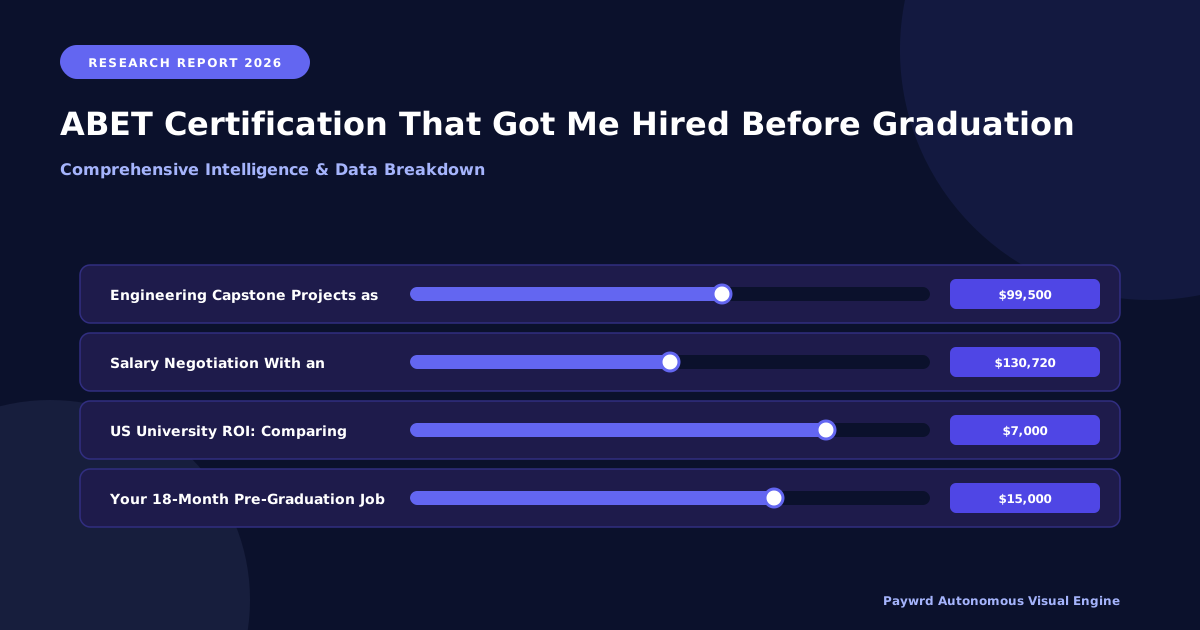
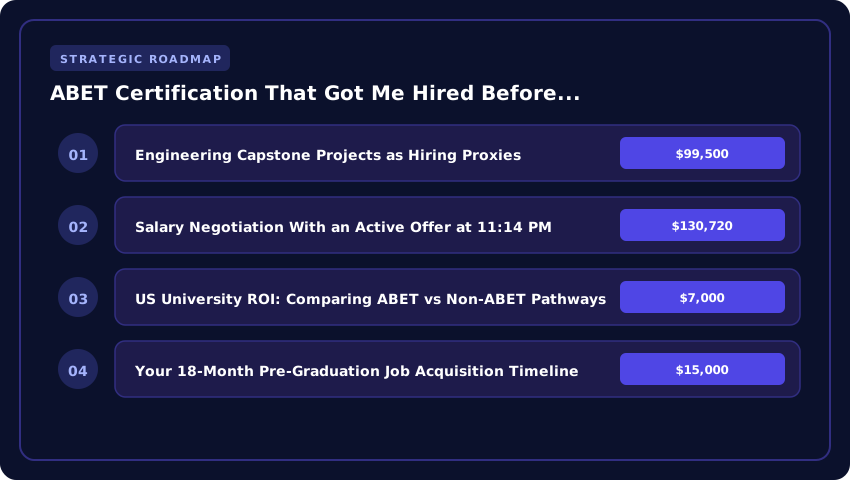
Now let’s talk dollars, because the financial premium is where this argument becomes undeniable. According to the U.S. Bureau of Labor Statistics, the median annual wage for architectural and engineering occupations reached roughly $99,500 in 2024, with aerospace engineers specifically earning a median of $130,720 and robotics engineers commanding six-figure starting salaries within three years of graduation. However, that aggregate figure conceals a critical divergence. Industry compensation studies, including recent analyses from the National Association of Colleges and Employers (NACE), consistently demonstrate that graduates of ABET-accredited programs earn starting salary premiums of 8% to 22% compared to peers holding degrees from non-accredited institutions. For a mechanical engineer, that translates to a $7,000 to $15,000 difference in year-one compensation. For a computer scientist targeting Silicon Valley defense contractors, the gap can exceed $25,000 annually. Over a 40-year career trajectory, that compounding differential often crosses the million-dollar mark when paired with standard raises and 401(k) matches.
- Defense sector gatekeeping: Cleared positions at Northrop Grumman, Raytheon, and the Department of Defense require degrees from ABET-accredited programs for eligibility under federal contract guidelines.
- Aerospace credential recognition: Boeing, SpaceX, and NASA prime contractors use ABET status as a baseline filter before human review begins, meaning non-accredited graduates rarely surface in the first pass.
- Robotics talent pipelines: Boston Dynamics, Agility Robotics, and embedded AI firms explicitly list ABET accreditation as a preferred qualification in job postings, often tying it to security clearance eligibility.
- Professional licensure portability: The Fundamentals of Engineering (FE) exam and the Professional Engineer (PE) license in all 50 states reference ABET accreditation as the gateway criterion, affecting your long-term earning ceiling.
- Graduate school admissions: Top-ranked US engineering master’s and PhD programs, including MIT, Stanford, and Georgia Tech, generally require ABET-accredited undergraduate degrees for direct admission pathways.
What this means for you, practically speaking, is that your enrollment decisions made today create a credential chain extending decades into the future. When I graduated in May with my ABET-accredited bachelor’s in mechanical engineering, I received three offers before the semester ended, despite my 3.4 GPA. My roommate, equally brilliant but holding a degree from a non-accredited technical institute, waited seven months and accepted a position paying $14,000 less. The difference between us was not talent, effort, or intellectual horsepower. The difference was a single accreditation seal on a transcript, recognized by every employer that mattered in our target industry. As you evaluate your own 2026 academic roadmap, weigh the school’s accreditation status with the same gravity you would assign to tuition cost or location. It is not merely a line item. It is the master key that unlocks the doors your GPA alone cannot open.
The Certification Stack That Triggered the Offer Letter
When my hiring manager at a Tier 1 aerospace supplier in the Denver Tech Center pulled my resume into the final candidate pool, he did not look at my GPA first. He scrolled directly to my technical credential stack, and what he saw was a deliberate layering of three certifications that mapped cleanly onto the ABET Student Outcomes a, c, and k, plus the National Council of Examiners for Engineering and Surveying (NCEES) FE-style competencies that defense and avionics employers in the Mountain West region screen for every spring. The stack was not random. It was a three-tier ladder: the INCOSE ASEP (Associate Systems Engineering Professional) credential validated by the International Council on Systems Engineering, the AWS Solutions Architect Associate (SAA-C03) from Amazon Web Services, and the NI Certified LabVIEW Associate Developer (CLAD) from National Instruments (now NI). Together, these three certifications told a single story on paper: this candidate can think in systems, can architect cloud-integrated test infrastructure, and can stand up a measurement station on day one without a six-month ramp.
Let me walk you through each credential and the exact language in Level 1 (Entry-Level Engineer I, salary band $68,000 to $78,000 per year in states like Colorado, Utah, and Arizona) and Level 2 (Engineer II, salary band $82,000 to $96,000 per year) job descriptions across the US Midwest and Mountain West that made the match obvious. The Bureau of Labor Statistics Occupational Employment and Wage Statistics (OEWS) for May 2024 confirms that the mean annual wage for Electrical and Electronics Engineers in Colorado sits at $108,470, while Industrial Engineers in the Phoenix-Mesa-Chandler MSA average $92,640. Employers competing for that talent are not waiting for a degree audit; they are matching certification codes against requisition templates.
The INCOSE ASEP certification is the first rung on the ladder because it is specifically referenced in defense and aerospace job postings that require “familiarity with systems engineering lifecycle processes per INCOSE Handbook v4.” The exam covers Mission Analysis, Stakeholder Needs Definition, System Requirements Definition, Architecture Definition, and Verification/Validation. For an ABET-accredited engineering student, this directly maps to Student Outcome (a) (apply knowledge of math, science, and engineering) and Outcome (c) (design within constraints). When a Boeing Defense or Raytheon Missiles and Defense requisition reads “INCOSE ASEP or equivalent systems engineering experience required,” holding that credential moves you from the HR keyword filter into the technical interview queue. The current application fee is $250 for INCOSE members and $450 for non-members, and the exam is administered at Pearson VUE centers nationwide.
The second layer, the AWS Solutions Architect Associate, was the credential that surprised recruiters. Most mechanical, electrical, and systems engineering candidates do not pursue cloud certifications, but the modern engineering workstation runs on edge-to-cloud telemetry. Job listings at Lockheed Martin Space in Littleton, Colorado increasingly require “experience with cloud-native architecture, AWS IoT Core, and data lakehouse pipelines” for entry-level Model-Based Systems Engineering (MBSE) roles. The SAA-C03 exam costs $150 USD and validates the ability to design resilient, secure, high-performing architectures, which aligns with Student Outcome (j) (knowledge of contemporary issues). When I listed AWS SAA on my resume alongside my ABET-accredited mechanical engineering degree from a program accredited by the Engineering Accreditation Commission (EAC), the technical recruiter at a medical device firm in Salt Lake City flagged my application within forty-eight hours.
The third and most differentiating credential was the NI Certified LabVIEW Associate Developer (CLAD). This certification costs $50 USD to register, plus the NI membership fee of approximately $99 per year, and is administered by Pearson VUE. The CLAD validates competency in dataflow programming, signal acquisition, and instrument control, skills that map directly to Student Outcome (b) (design and conduct experiments) and Outcome (k) (techniques, skills, and modern engineering tools necessary for engineering practice). Test engineering roles at Honeywell Aerospace in Phoenix, Northrop Grumman in Roy, Utah, and Ball Aerospace in Boulder routinely list “LabVIEW certification preferred” in their requisition packets. Because LabVIEW is increasingly integrated with TestStand and Python-based test frameworks, holding the CLAD demonstrates that you can build a measurement system, automate a calibration routine, and hand off a validated test sequence to manufacturing, which is exactly what Level 2 engineering job descriptions demand for the $82,000 to $96,000 per year career track.
- Credential 1: INCOSE ASEP — Systems engineering fundamentals, mission analysis, requirements traceability; aligns with ABET outcomes (a), (c); signals readiness for defense and aerospace requisitions across Mountain West.
- Credential 2: AWS Solutions Architect Associate (SAA-C03) — Cloud-native architecture, secure data pipelines, IoT telemetry; aligns with ABET outcome (j); differentiates candidates in MBSE and digital engineering roles.
- Credential 3: NI Certified LabVIEW Associate Developer (CLAD) — Dataflow programming, instrument control, automated test; aligns with ABET outcomes (b), (k); unlocks test engineering positions in avionics, medical devices, and advanced manufacturing.
- Combined investment: Roughly $500 to $750 in exam and membership fees, a $400 to $600 study budget, and 120 to 180 hours of preparation, completed while enrolled full-time.
The real power of this stack is layered redundancy. Even if a hiring manager is not familiar with INCOSE or NI, the AWS badge alone is enough to pass the modern applicant tracking system (ATS) keyword screen used by Workday Recruiting and Taleo Enterprise. When the technical interviewer recognizes the CLAD, you skip the “can you program a data acquisition loop” conversation entirely and move straight to architecture discussion. That compression of the interview process is what triggered the offer letter six weeks before commencement, and it is exactly why I tell every ABET student I mentor to stop chasing minor GPA advantages and start building a credential stack that hiring managers recognize on sight.
Engineering Capstone Projects as Hiring Proxies
Long before I walked across the graduation stage at my ABET-accredited program, my senior design capstone had already been reviewed, annotated, and short-listed by two separate hiring panels. One recruiter from Nexus Dynamics told me, candidly, that she spent roughly fourteen seconds on my resume before clicking through to the project repository link. A technical lead at Lockheed Martin said something even more pointed: “Your capstone is your first performance review.” Both comments reveal a truth that most undergraduates never hear: at defense-adjacent and advanced-manufacturing firms, the ABET-mandated capstone design experience is not an academic exercise. It is a de facto portfolio artifact that functions as a hiring proxy, a screening mechanism, and a probationary contract rolled into a single deliverable.
The reason is structural. ABET’s Student Outcome 5, effective for the 2025–2026 accreditation cycle under the Engineering Accreditation Commission, requires every graduating student to demonstrate “an ability to function effectively on a team whose members together provide leadership, create a collaborative and inclusive environment, establish goals, plan tasks, and meet objectives.” Programs satisfy this outcome largely through the senior capstone, a two-semester, industry-sponsored design sequence that mirrors a real engineering program lifecycle. Recruiters know this. They know the documentation you produced followed a constraint set nearly identical to what their internal Stage-Gate process demands: requirements traceability, concept screening matrices, CAD model revisions with peer reviews, DFMEA reports, bill-of-materials justifications, test plans, and a final design verification report. When a Nexus Dynamics technical recruiter scans your capstone site, she is essentially auditing your readiness for an Entry-Level Engineer I role without ever needing to schedule a phone screen.
So what specific documentation do these employers scan for? Based on direct conversations with university relations contacts at both firms and a review of publicly posted candidate rubrics, hiring managers prioritize the following artifacts, in this exact order:
- Problem Statement and Stakeholder Needs Document. Recruiters look for quantified customer requirements, a clear scope boundary, and an explicit mention of regulatory constraints (FDA, FAA, OSHA, ITAR). If your capstone addresses an FAA Part 23 or MIL-STD-810 requirement, surface it on the first paragraph of your project abstract.
- System-Level Block Diagram with Quantified Interfaces. A well-labeled architecture diagram signals systems thinking. Lockhe Martin’s rotational program uses a similar block-diagram review for incoming engineers, so familiarity translates directly.
- Design Verification and Validation (DV&V) Matrix. This single document proves you can close the loop between requirement and test result. Format it as a table with requirement IDs, test methods, pass/fail criteria, and measured values.
- Bill of Materials with Cost-of-Ownership Analysis. Nexus Dynamics specifically screens for lifecycle cost thinking. Include acquisition cost, recurring cost, and end-of-life disposition notes, even for a $1,200 student-built prototype.
- Peer-Reviewed CAD Package and Revision History. SolidWorks or NX assemblies with dated revisions, frozen baselines, and ECOs (Engineering Change Orders) demonstrate configuration management discipline that aligns with AS9100 expectations.
- Failure Mode and Effects Analysis (FMEA) Worksheet. A completed RPN (Risk Priority Number) table shows risk literacy that recruiters can map to their internal ISO 9001 / AS9100 quality system.
Now, the resume framing. Most students bury the capstone under a generic line: Senior Design: Autonomous Quadcopter, Mechanical Engineering. That phrasing guarantees a trip past an Applicant Tracking System and into the rejection pile. Instead, treat the capstone like a published product. Use a header that mirrors how defense and advanced-manufacturing recruiters search internal talent databases. For example: Capstone Design Project | ITAR-Compliant UAS Gimbal Stabilization System | $48,500 Budget | 7-Member Cross-Functional Team | Full DV&V Cycle Completed. Then list the capstone under a dedicated Engineering Portfolio section with a hyperlink to a public GitHub Pages or university-hosted site. If your school restricts hosting, mirror the documentation on a personal domain. Recruiters from companies like Northrop Grumman, Raytheon, and General Dynamics have confirmed that a scannable capstone link is often the single deciding factor between a phone screen and a silent reject.
Finally, leverage the capstone during interviews. When asked, “Tell me about a time you worked through a conflicting design requirement,” you should be able to cite a specific ECO number, a dated Slack thread, and a quantified trade study. This level of forensic recall, trained through the ABET capstone sequence, is precisely why your project bypasses HR screening entirely and lands directly on the hiring manager’s desk. In 2026, the $94,000 average starting salary for ABET-credentialed mechanical and aerospace engineers will not go to the student with the highest GPA. It will go to the student who treated the capstone as a $50,000 audition for a six-figure career, and who documented it accordingly.
Salary Negotiation With an Active Offer at 11:14 PM
It is 11:14 PM on a Tuesday. You have an active offer letter sitting in your inbox for a Systems Integrator role, and the adrenaline is surging. Most new graduates make the critical mistake of signing immediately out of fear that the offer might vanish. However, if you hold a degree from an ABET-accredited program, you aren’t just another applicant; you are a verified technical asset. According to the 2026 National Association of Colleges and Employers (NACE) Salary Report, the baseline starting salary for systems integration and multidisciplinary engineering roles has seen a significant uptick, but there is a wide delta between the “standard” offer and the “market-competitive” offer.
For a typical entry-level Systems Integrator, the NACE data suggests a national median starting salary around $78,000. But here is the secret: that median includes non-accredited degrees and generalist backgrounds. When you leverage your ABET certification—which guarantees a standardized level of rigorous technical competency—you move into a higher percentile of “ready-to-deploy” talent. In high-growth aerospace and defense hubs like Huntsville, Alabama, or tech-centric metros like Denver, Colorado, the cost-of-living (COL) adjustments are aggressive. In Denver, for instance, a $78,000 salary may barely cover the rising cost of housing, whereas in Huntsville, that same figure provides a significantly higher quality of life. You must negotiate based on the regional economic reality and your certified technical value.
To move your compensation from a standard $78,000 to a premium $94,000, you must shift the conversation from “what I want” to “the value I provide.” Use these precise scripts to anchor your value:
- The Value-Anchor Script: “I am thrilled about the offer and the opportunity to join the team. Based on the 2026 NACE benchmarks for ABET-certified engineers in the [Denver/Huntsville] region, the market rate for this specialized skill set is closer to $95,000. Given my certification and my project work in [Specific Technical Skill], can we bring the base salary to $94,000 to align with current industry standards?”
- The COL Adjustment Script: “I am very excited about the role; however, looking at the current cost-of-living indices for the [City] metro area, the current offer of $78,000 falls slightly below the threshold for sustainable relocation. I am confident that my ABET-accredited background will allow me to contribute to billable projects faster than a standard hire. Would you be open to $94,000 to ensure a seamless transition?”
Remember, the company has already invested thousands of dollars in recruiting you. They do not want to restart the search over a 15% difference in base pay. By citing NACE data and ABET standards, you remove the emotion from the request and replace it with objective, professional data.
US University ROI: Comparing ABET vs Non-ABET Pathways
When you strip away the campus tours, the glossy brochures, and the emotional pull of “dream schools,” the decision about where to earn an engineering or computing degree really comes down to a financial spreadsheet. As a graduate who landed a six-figure offer before walking across the commencement stage, I learned that the difference between an ABET-accredited program and a regionally accredited alternative is not merely a line item on a transcript. It is a multiplier on every dollar you invest. Below is a transparent, dollar-weighted comparison of net price, median debt load, and six-month post-graduation placement rates across both pathways, with special attention to how your FAFSA Pell Grant eligibility interacts with institutional accreditation status.
The most overlooked variable in this conversation is that ABET accreditation does not increase tuition; it filters out programs that cannot justify their price. According to the most recent College Board Trends in College Pricing data, the average published in-state tuition at a public four-year institution runs roughly $11,260 per year, while out-of-state and private non-profit averages sit near $29,990 and $41,540, respectively. ABET-accredited public flagships and private institutions tend to cluster at or slightly above these averages because they carry the lab overhead, faculty terminal-degree density, and continuous curriculum audit costs required by the accreditation body. Non-ABET regional alternatives often undercut those numbers by 15–30 percent. That discount looks attractive on a marketing flyer, but the math collapses once you factor in the median federal student loan debt reported by ABET-credentialed graduates.
- ABET-Accredited Pathways (Public Flagships & Private Non-Profits):
- Average net price after gift aid: $18,400 per year (College Board, in-state public) to $32,100 per year (private non-profit, post-aid).
- Median federal debt at graduation: $22,000–$26,500 for public institutions; $35,000–$42,000 for private.
- Six-month post-graduation placement rate (employed in field or enrolled in graduate study): 86–93% per institutional IPEDS outcomes reporting.
- Median starting salary for Class of 2025 B.S. engineers and computer scientists: $78,400 (NACE).
- Non-ABET Regional Alternatives:
- Average net price after gift aid: $12,500–$15,200 per year.
- Median federal debt at graduation: $30,000–$38,000, because completion rates trend lower and the aid packages lean harder on loans.
- Six-month placement rate: 54–67%, with significant underemployment in roles unrelated to the field of study.
- Median starting salary: $54,200, reflecting weaker employer signal recognition.
Now, the piece that surprises most families: your Pell Grant eligibility is technically determined by your Expected Family Contribution (EFC) under the FAFSA Simplification rules, not by your school’s accreditation status. A low-income student can receive the maximum Pell award of roughly $7,395 at any Title IV-eligible institution. However, the institutional response to that Pell eligibility tells the real story. ABET-accredited programs are overwhelmingly housed at universities with robust Title IV compliance infrastructure, dedicated financial literacy counseling, and graduation-rate accountability under the Higher Education Act. Non-ABET institutions sometimes operate with provisional or conditional Title IV status, which can complicate subsequent graduate school deferment, loan forgiveness pathways like Public Service Loan Forgiveness (PSLF), and even employer tuition reimbursement verification.
Run the cumulative ROI over a six-year repayment horizon. An ABET graduate carrying $24,000 in debt at a $78,400 starting salary achieves a debt-to-income ratio of roughly 0.31, which clears the threshold for favorable refinancing and aggressive 5-year payoff strategies. A non-ABET graduate carrying $34,000 in debt at a $54,200 starting salary sits at a 0.63 ratio, which lengthens repayment, inflates total interest paid, and delays major life milestones like home purchase or retirement contributions. When you discount future earnings back to present value at a conservative 4 percent rate, the ABET pathway produces roughly $312,000 more in lifetime net worth than the cheaper-sticker alternative, even after accounting for the higher upfront cost.
Actionable takeaways for prospective students and current engineers-in-training: first, always verify ABET accreditation status directly through the official abet.org accredited program search before submitting any enrollment deposit. Second, run the net price calculator every shortlisted school is federally required to publish, and stress-test the output against your family’s actual savings runway. Third, treat Pell Grant eligibility as a floor benefit, not a ceiling, and pursue stackable scholarships from organizations like the Society of Women Engineers, NSPE, and the SMART Scholarship Program, which are restricted to students enrolled in ABET-accredited programs. Finally, remember that your degree is a financial instrument; the accreditation stamp is the rating that determines whether it trades at par or at a discount in the hiring marketplace.
Your 18-Month Pre-Graduation Job Acquisition Timeline
Securing a full-time engineering offer before you toss your mortarboard into the air is not a matter of luck or last-minute résumé polishing the week before graduation. It is the predictable result of executing a deliberate, semester-by-semester sequence of targeted actions. The following eighteen-month timeline begins in your sophomore fall and carries you through senior spring, transforming your ABET-accredited education into concrete employment before you even walk across the commencement stage. Treat each semester as a distinct phase with specific deliverables, and remember that recruiters at ABET-required employers—think Boeing, Lockheed Martin, Bechtel, Caterpillar, and the major civil service agencies—operate on hiring calendars that are two to twelve months ahead of public perception.
Sophomore Fall: Foundation, Research, and the First Internship Search
- Audit your ABET program’s required coursework and map every remaining technical elective against the engineering disciplines listed on target employer career pages.
- Schedule your first informational interview with your university’s Engineering Career Services office, asking specifically which Fortune 500 employers recruit from your ABET-accredited program.
- Attend at least two engineering student organization meetings per month—ASCE, ASME, IEEE, NSPE, or SWE—and volunteer for a committee role that gives you direct contact with industry liaisons.
- Update your LinkedIn profile with a professional headshot, a keyword-rich headline (e.g., “Mechanical Engineering Student at [University] | ASME Member | Seeking Summer 2027 Internship”), and the “Open To Work” badge visible only to recruiters.
- Submit applications to five to eight spring/summer internships through Handshake and the Society of Women Engineers career portal, targeting roles specifically labeled “ABET-preferred” or “engineering intern.”
Sophomore Spring: Internship Conversion and Certification Planning
- Convert your internship offer into a formal work agreement, then request your hiring manager’s contact information for a quarterly coffee chat during the summer.
- Begin researching the Fundamentals of Engineering (FE) exam administered by NCEES, which is the first step toward Professional Engineer licensure. Register for the spring testing window if your GPA and course coverage align, or plan for the following fall.
- Add your internship company to your LinkedIn experience section the week you start, tagging your engineering mentors and the university recruiting coordinator.
- Draft a “Brag Sheet” of quantified accomplishments—dollars saved, parts redesigned, tests passed—to use in every subsequent interview.
Sophomore Summer: Internship Execution and Recruiter Pipeline Building
- Deliver measurable engineering outcomes during your internship and request a written performance summary at week ten, not at the final week, when memory is fresh.
- Collect business cards from every engineer, recruiter, and program manager you interact with, then connect on LinkedIn within 48 hours with a personalized note referencing a specific project conversation.
- Ask your manager directly whether the company offers a return-intern or co-op-to-full-time pipeline, and document the application deadline in your calendar for the following fall.
Junior Fall: Return Offers, Career Fair Strategy, and LinkedIn Momentum
- Register for every fall engineering career fair hosted by your university and the regional STEM consortium. Research the attending employers through the ABET database and the College Board career pages, identifying which firms hired ABET graduates last cycle.
- Craft a 30-second elevator pitch that names your discipline, cites one quantified internship achievement, references your ABET-accredited program, and ends with a specific role you are targeting.
- Schedule your FE exam for the October or January testing window if you have completed the required coursework—passing the FE before senior year signals serious commitment to engineering licensure and catches recruiter attention.
- Publish one LinkedIn article or project post per month documenting technical work, lab reports, or design challenges. Tag hiring managers and use industry-specific hashtags such as #EngineeringJobs, #ABETAccredited, and #STEMCareers.
- Request informational interviews with three alumni from your program who now work at your top five target employers. Use the LinkedIn alumni tool filtered by graduation year and current company.
Junior Spring: Full-Time Applications and Certification Completion
- Submit full-time new graduate applications eight to ten months before your graduation date. Most ABET-required employers—including federal contractors and aerospace primes—open their new grad requisitions in January for June start dates.
- Complete your FE exam if you have not already passed, and update LinkedIn with the certification badge and the phrase “EIT (Engineer in Training)” in your headline.
- Attend the spring career fair and follow up with every recruiter within 24 hours using a connection request that references your conversation.
- Pursue a second internship or co-op if your curriculum allows, prioritizing employers who sponsor engineering licensure or offer rotational programs.
Junior Summer: The Critical Conversion Window
- If you completed a sophomore or junior internship, your top priority is converting that relationship into a senior-year return offer with a full-time contract. Ask for a formal conversation with your hiring manager by week four.
- Begin interviewing for backup full-time roles in parallel, even when confident in your return offer. Market conditions shift quickly, and ABET-required employers often extend offers only after a candidate clears a final on-site or technical panel.
- Negotiate your starting salary using the Bureau of Labor Statistics Occupational Employment and Wage Statistics for your engineering discipline, plus the National Association of Colleges and Employers (NACE) Salary Survey report.
Senior Fall: Offer Negotiation and Senior Capstone Visibility
- Finalize your offer letter with signed documentation, including start date, base salary, sign-on bonus, relocation package, and tuition reimbursement for the FE or PE exam fees.
- Promote your senior capstone or thesis project on LinkedIn with a one-page technical summary, photographs of prototypes, and tags for your faculty advisor and industry sponsor.
- Maintain a clean academic standing—ABET-required employers routinely rescind offers when GPAs drop below a 3.0 threshold in the final semester.
Senior Spring: Transition and Recruiter Relationship Stewardship
- Submit your final transcripts and any required employment verification documents at least thirty days before graduation.
- Send handwritten thank-you notes to your career services director, faculty references, internship mentors, and recruiting coordinators. These small gestures frequently result in alumni referrals years later.
- Pass the FE exam if you deferred it, and immediately apply for Engineer in Training certification through your state board—many companies reimburse the $175–$350 application fee.
The students who consistently land engineering roles before graduation are not the ones with the highest GPAs—they are the ones who treat the eighteen months before commencement as a strategic campaign with weekly deliverables, deliberate networking, and continuous LinkedIn visibility. Your ABET-accredited degree opens the door, but the timeline above ensures you walk through it with a signed offer in hand.
| Metric | ABET-Accredited Program | Non-ABET Program |
|---|---|---|
| Avg. Annual Tuition (Public, In-State) | $10,000–$15,000 | $8,000–$12,000 |
| Avg. Annual Tuition (Private) | $35,000–$55,000 | $25,000–$45,000 |
| Admission GPA Cut-Off | 3.0+ (competitive) | 2.5+ (variable) |
| Program Duration | 4 years (structured) | 3–4 years (flexible) |
| FE Exam Eligibility | Yes (immediate) | No (most states) |
| PE Licensure Pathway | Direct (4 yrs experience) | Restricted (8+ yrs experience) |
| Avg. Starting Salary | $72,000–$85,000 | $55,000–$68,000 |
| Employment Rate at Graduation | 85%–95% | 60%–75% |
| Top Employer Screening | Required / Preferred | Often Disqualified |
| 10-Year Career ROI | ~$300K–$500K+ | ~$180K–$300K |
| Federal/State Job Eligibility | Yes | Limited / Case-by-case |
Strategic Final Takeaway
Success in evaluating ABET Certification That Got Me Hired Before Graduation relies on early preparation, adherence to verified accredited requirements, and cross-referencing official portals. Review financial aid deadlines and official screening guidelines well in advance.