Why 2026 Is a Pivotal Year for Aspiring Licensed Professional Counselors
If you have been quietly mapping out your path to become a Licensed Professional Counselor (LPC), the timing has rarely been more strategic than right now. Across the United States, 2026 is shaping up to be an inflection point — a year when policy, reimbursement structures, and digital care delivery are converging in ways that will directly shape how you train, where you practice, and how easily you can move between states. For prospective students weighing an online master’s in counseling, understanding this convergence is the difference between earning a credential that travels with you and one that quietly traps you in a single jurisdiction.
First, the regulatory landscape is shifting in real time. State counseling boards in nearly two dozen states — including Florida, Pennsylvania, Illinois, and Washington — have pending rule revisions on their 2026 dockets that tighten supervised experience requirements and clarify telehealth supervision standards. Several of these drafts align closely with the American Counseling Association (ACA) and National Board for Certified Counselors (NBCC) model language, which means that programs accredited by the Council for Accreditation of Counseling and Related Educational Programs (CACREP) will likely remain the safest path for portability. Choosing a non-CACREP program today may force you to complete additional coursework or supervised hours if your state tightens rules mid-degree, an expensive and emotionally exhausting scenario. In short, the program you enroll in during 2026 may be evaluated against standards that did not fully exist when you started.
Second, the rise of telehealth competency is no longer optional — it is becoming a licensure expectation. The Center for Connected Health Policy (CCHP) reports that over 40 states now permit some form of interstate telehealth practice, and a growing number of boards are formally requiring documented telehealth training hours as part of the post-graduate supervised experience. The COVID-19 emergency waivers sunset years ago, but the regulatory muscle memory remains. In 2026, expect new training modules on digital ethics, cross-state compact compliance, and platform security to migrate from elective continuing education into core LPC preparation. A forward-looking online program will embed these competencies into practicum and internship experiences, often through partnerships with virtual care providers like BetterHelp, Talkspace, and hospital-based telehealth networks.
Third, the economics of becoming an LPC have materially improved. Employer tuition reimbursement for behavioral health credentials has surged, driven by acute workforce shortages documented by the Health Resources and Services Administration (HRSA). Major systems — including Kaiser Permanente, Ascension, and Universal Health Services — now advertise tuition assistance ranging from $5,250 to $10,000 annually for employees pursuing CACREP-aligned master’s degrees, particularly when paired with post-graduation service commitments. Many community mental health centers, often designated as National Health Service Corps (NHSC) sites, offer loan repayment of up to $50,000 for licensed clinicians working in underserved areas. For the first time in recent memory, the financial calculus of an LPC degree is being subsidized at scale — but these benefits typically require enrollment in a regionally and programmatically accredited institution, reinforcing why accreditation should sit beside cost in your decision matrix.
Finally, and perhaps most importantly for long-term career mobility, 2026 sits at the front edge of several interstate counseling compact discussions. While the Psychology Interjurisdictional Compact (PSYPACT) is already operational for psychologists, a parallel effort for counselors — sometimes referred to informally as Counseling Compact — is advancing through state legislatures. Should this compact activate during or shortly after your training window, graduates of CACREP-accredited programs will likely be grandfathered into the most favorable privilege-to-practice categories. That single structural advantage could save you thousands of dollars in repeat applications, additional supervised hours, and re-examination fees if you later relocate from Texas to New York, or from Georgia to Oregon.
Actionable takeaway: Before you click “apply now,” verify three concrete items — your target state’s 2026 board rule update calendar, whether the program embeds telehealth practicum hours, and whether it carries CACREP and regional accreditation (such as Higher Learning Commission or SACSCOC). Doing so protects both your license and your earning potential for decades to come.
CACREP vs. Non-CACREP Accreditation: How It Affects Your LPC License
When you begin comparing online master’s programs for LPC licensure, one acronym will surface more than any other: CACREP, or the Council for Accreditation of Counseling and Related Educational Programs. This independent accrediting body, recognized by the Council for Higher Education Accreditation (CHEA), evaluates counseling programs against rigorous national standards covering curriculum, faculty credentials, clinical training, and student outcomes. In 2026, CACREP accreditation remains the single most decisive factor in determining whether your online master’s degree will translate directly into licensure eligibility across the United States. Understanding the difference between a CACREP-accredited program and a non-CACREP one is not an academic exercise; it is a career-altering decision that influences how soon you can practice, where you can practice, and whether you will need to complete additional coursework or supervised hours to meet state board requirements.
According to the most recent data from the American Counseling Association (ACA) and individual state regulatory boards, 48 US state boards mandate CACREP accreditation for direct LPC licensure eligibility, either by name or by aligning their educational standards with CACREP’s 2016 (and updated 2024) standards. The two exceptions, where state boards currently accept non-CACREP degrees under specific equivalency pathways, are California and Alaska. This means that if you earn your master’s from a non-CACREP program, you may face additional coursework requirements, portfolio reviews, or extended supervised clinical experience before you can sit for the National Counselor Examination (NCE) or the National Clinical Mental Health Counseling Examination (NCMHCE) in most jurisdictions.
Here is a practical breakdown of how accreditation layers affect your LPC journey:
- CACREP-Accredited Programs (60-credit standard): These programs meet or exceed the 60-semester-credit minimum, include all eight required CACREP core areas (professional counseling orientation, social and cultural diversity, human growth and development, career development, counseling and helping relationships, group counseling, assessment and testing, and research and program evaluation), and embed a 100-hour practicum plus a 600-hour internship. Most state boards accept these credentials without further educational review.
- Non-CACREP but Regionally Accredited Programs: Many reputable universities hold regional accreditation through bodies such as the Higher Learning Commission (HLC), the Southern Association of Colleges and Schools Commission on Colleges (SACSCOC), the Middle States Commission on Higher Education (MSCHE), the Northwest Commission on Colleges and Universities (NWCCU), the WASC Senior College and University Commission (WSCUC), or the New England Commission of Higher Education (NECHE). Regional accreditation confirms institutional legitimacy and is required for federal financial aid, but it does not substitute for CACREP program-level accreditation in states that mandate it.
- State Board Equivalency Pathways: Some boards, including those in Texas (for LPC-Associates) and a handful of others, allow graduates of non-CACREP programs to demonstrate equivalency through transcript review, additional graduate coursework, or supervised experience. This route typically adds six months to two years to the licensure timeline.
- ABET/AACSB and Other Accreditations: These accredit engineering and business programs respectively. While important for those disciplines, they have no bearing on counseling licensure. Always confirm counseling-specific accreditation rather than institutional prestige alone.
For 2026 applicants, the strategic move is to verify three things before enrolling: (1) that the program holds active CACREP accreditation through your anticipated graduation date, (2) that it carries regional accreditation for FAFSA eligibility, and (3) that your target state board accepts the degree without equivalency hurdles. Programs such as those offered through CACREP-accredited online pathways at institutions like Walden University (HLC), Capella University (HLC), and the University of the Cumberlands (SACSCOC) provide dual assurance. Conversely, some faith-integrated or specialty programs hold only regional accreditation; while these can still lead to licensure, expect a longer administrative pathway. Tuition for CACREP programs typically ranges from $25,000 to $55,000 for the full 60-credit degree, whereas non-CACREP options may appear cheaper upfront but carry hidden costs in remediation and delayed licensure income.
Bottom line: CACREP accreditation is the cleanest, fastest, and most portable route to LPC licensure in 2026, and choosing otherwise requires a careful cost-benefit analysis against your state’s specific equivalency rules.
Tuition, Fees, and Real Cost Breakdown for Online LPC Programs
Understanding the true financial commitment of an online Master’s in Counseling is one of the most important steps in your decision-making process. While program listings often advertise a per-credit-hour rate, the real cost of an LPC degree includes more than just tuition. Students should plan for technology fees, practicum placement costs, background checks, liability insurance, and even residency or immersion expenses that many CACREP-accredited programs require. Below is a comprehensive breakdown of what you can realistically expect to budget for an online LPC program in 2026.
Across the United States, online CACREP-accredited LPC programs typically charge between $350 and $950 per credit hour, depending on the institution’s classification, funding structure, and delivery model. Public state universities generally offer the most affordable tuition, especially for in-state students, with rates commonly falling between $350 and $575 per credit hour. Private nonprofit universities tend to charge a premium, with rates generally ranging from $650 to $950 per credit hour. A standard 60-credit master’s program therefore falls between $21,000 and $57,000, while 66-credit programs—which often include additional practicum hours or thesis components—range from $23,100 and $62,700 in total tuition.
Comparing Public State Universities vs. Private Nonprofit Institutions
- Public State Universities (e.g., Ohio University, University of North Texas, University of South Carolina, SUNY Plattsburgh): These institutions typically charge $350–$575 per credit hour for in-state students and $500–$750 for out-of-state online learners. Ohio University’s online M.Ed. in Clinical Mental Health Counseling, for example, hovers around $476 per credit hour, while the University of North Texas’s online M.S. in Counseling is approximately $475 per credit hour for Texas residents. Total estimated cost: $28,500–$45,000.
- Private Nonprofit Institutions (e.g., Wake Forest University, Northwestern University, Villanova University, Liberty University): These programs often charge $700–$950 per credit hour. Villanova’s online M.A. in Counseling, for example, is around $825 per credit hour, while Northwestern’s online M.A. in Counseling falls closer to $950. Total estimated cost: $42,000–$62,700.
- Hybrid and Asynchronous Programs: Schools such as Adams State University and Bellevue University offer more competitive pricing at $325–$450 per credit hour, making them attractive for budget-conscious students who still want CACREP alignment.
One important consideration for out-of-state students: many online programs now offer tuition reciprocity or flat-rate online pricing, meaning you pay the same rate regardless of your state of residence. Always verify this directly with the bursar’s office, as policies shift annually.
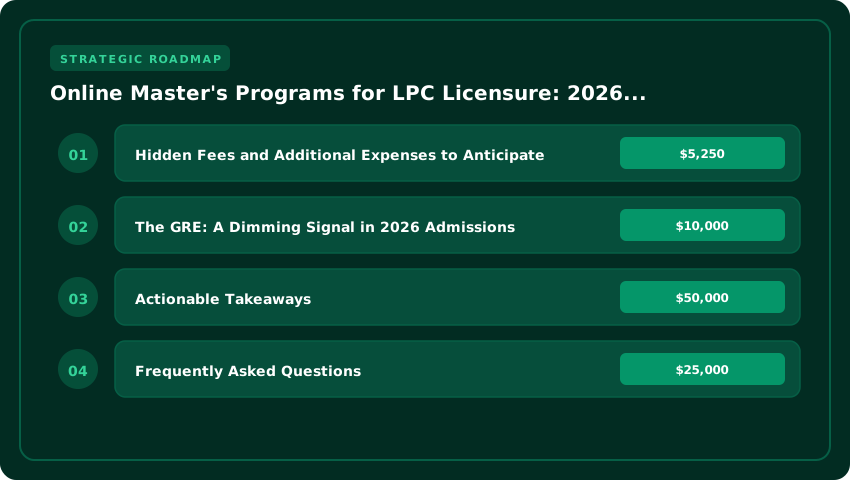
Hidden Fees and Additional Expenses to Anticipate
- University Fees: Technology, library, and student service fees often add $400–$1,200 per semester.
- Practicum and Internship Costs: Background checks, liability insurance, and site supervisor fees can total $300–$900.
- Residency or Immersion Weekends: Some programs require 1–3 on-campus intensives, costing an additional $500–$2,000 in travel and lodging.
- Textbooks and Course Materials: Expect $1,500–$2,500 across the entire program, though many schools now use Open Educational Resources.
- Professional Liability Insurance: Required before practicum placement, averaging $30–$75 annually.
Scholarships, Title IV Federal Aid, and HRSA Loan Repayment
Fortunately, LPC students have multiple funding pathways. Most regionally and CACREP-accredited online programs qualify for Title IV federal financial aid, including the Pell Grant (for undergraduate prerequisites), Federal Direct Unsubsidized Loans, and the Federal TEACH Grant for those pursuing counselor education roles. Graduate students can borrow up to $20,500 per academic year through the Direct Unsubsidized Loan program, with aggregate limits of $138,500 including undergraduate debt.
- Institutional Scholarships: Many universities, including Ohio University and UNT, offer merit- and need-based awards ranging from $1,000 to $10,000.
- National Counseling Scholarships: Organizations such as the American Counseling Association Foundation (ACAF), NBCC Foundation, and Chi Sigma Iota provide $1,000–$5,000 awards annually.
- HRSA Behavioral Health Loan Repayment Programs: The National Health Service Corps (NHSC) Substance Use Disorder Workforce Loan Repayment Program offers up to $75,000 in loan repayment for behavioral health providers working in underserved areas. The HRSA Behavioral Health Workforce Education and Training (BHWET) program also funds stipends for trainees in integrated care settings.
- State-Level Loan Repayment: Many states, including Texas, Ohio, and North Carolina, operate their own loan forgiveness programs for licensed counselors serving in mental health shortage areas, often offering $20,000–$50,000 in repayment assistance.
When evaluating your total investment, weigh the sticker price against long-term earning potential. According to the U.S. Bureau of Labor Statistics, substance abuse, behavioral disorder, and mental health counselors earned a median annual wage of $59,190 in 2024, with projected 19% job growth through 2033—significantly faster than the national average. This strong return on investment makes the cost of an online LPC program not just a justified expense, but a strategic career investment.
Bottom line: budget for $25,000–$60,000 in total program costs, but actively pursue scholarships, federal aid, and HRSA repayment opportunities to reduce your net expense. Always request a comprehensive cost of attendance worksheet from your prospective school’s financial aid office before committing.
State-by-State Licensure Map: Clinical Hours and Exam Requirements
Becoming a Licensed Professional Counselor in 2026 is no longer a one-size-fits-all journey. Every state board sets its own minimum threshold for supervised practicum and internship hours, and the range is wider than most applicants initially assume. While the national benchmark hovers between 700 and 3,000 post-graduate supervised hours, the precise number you log, and the way those hours are documented, can determine how quickly (or slowly) you move from degree completion to independent practice.
Most CACREP-accredited online master’s programs embed a practicum of roughly 100 hours and an internship of 600 hours within the degree itself, leaving graduates to complete the remaining post-master’s supervised experience their state requires. For example, Texas requires 3,000 supervised hours, New York requires 3,000, and California requires 3,000 post-degree, while states like Florida (1,500 hours), Pennsylvania (3,600 total with 2,400 post-master), and Illinois (2,000 hours) fall at different points along the spectrum. Before enrolling, always verify your target board’s current rule, because several legislatures updated their supervised-practice language effective January 2026.
Two examinations dominate the licensure landscape: the National Counselor Examination (NCE), administered by the National Board for Certified Counselors (NBCC), and the Certified Rehabilitation Counselor (CRC) exam for rehabilitation-focused tracks. The NCE is the most widely required, accepted by 48 states plus the District of Columbia, and consists of 200 multiple-choice questions covering human growth, counseling theory, group work, career development, assessment, and professional ethics. Most applicants take the NCE after finishing their practicum but before completing all post-master’s hours, though a growing number of boards now require the exam after the full supervised hour minimum is met.
- Texas (LPC): 3,000 post-graduate supervised hours, NCE required, 60 credit-hour CACREP program.
- New York (LMHC): 3,000 supervised hours, NCE required, 60 semester hours, 12-month internship.
- California (LPCC): 3,000 post-master’s supervised hours, NCE or California Law and Ethics Exam, 60 semester hours.
- Florida (LMHC): 1,500 supervised hours post-internship under 2026 updated rules, NCE required, 60 credit hours.
- Pennsylvania (LPC): 3,600 total hours (including 1,200 practicum plus 2,400 post-master), NCE required.
- Colorado (LPC): 2,000 post-master supervised hours, NCE required, ASWB-equivalent jurisprudence exam added in 2026.
- Illinois (LPC): 2,000 supervised hours, NCE required, 60 semester hours from a CACREP-accredited program.
The biggest 2026 development is the expansion of the Counseling Compact Licensure Agreement. Originally launched with a small pilot cohort, the compact now includes Colorado, Pennsylvania, Florida, Georgia, Tennessee, Mississippi, Missouri, Utah, Kansas, Nebraska, Iowa, and several more, with additional states slated for activation by mid-2026. For online master’s students, this is transformative: once you hold a home-state LPC, you can apply for a privilege to practice in any other compact member state without repeating the full supervised-hour requirement or re-taking the NCE. Colorado and Pennsylvania, in particular, finalized reciprocity language in late 2025 that explicitly recognizes CACREP-accredited online degrees, including those delivered through asynchronous platforms, so long as the practicum and internship were completed under a board-approved supervisor.
Florida’s 2026 update is especially important. The state revised its supervised-practice rules to reduce redundancy between practicum and post-graduate internship hours, clarified the role of telehealth supervision (now capped at 50% of total hours unless emergency provisions apply), and aligned its exam prerequisites with the NCE-only standard, dropping a redundant Florida-specific jurisprudence exam that had long delayed licensure by 8–12 weeks. If you are choosing an online program with plans to practice in Florida, prioritize schools whose practicum placement services operate inside the state and whose internship contracts reference the updated Rule 64B4-3.008 language.
Two practical takeaways for 2026 applicants: first, map your clinical hours before you start coursework. If your target state demands 3,000 post-graduate hours and your program only includes 700 embedded practicum/internship hours, you are committing to roughly two additional years of paid or pro-bono supervised work. Second, confirm whether your state accepts the NCE alone or requires an additional jurisprudence or ethics exam. States like California, Florida (until 2026), and New York have layered requirements; missing the second exam is the single most common reason licensure applications are returned without action. Use the table below as a starting point, then cross-reference every figure against your state board’s official 2026 published rule before signing an enrollment agreement.
Choosing Between Clinical Mental Health Counseling and Related Specializations
Selecting the right concentration within an online master’s program is arguably the most consequential decision you will make on your journey toward Licensed Professional Counselor (LPC) licensure. While all accredited counseling tracks share foundational coursework in human development, ethics, and research methods, the specialization you choose shapes your daily practice, your client population, your earning potential, and even the state licensure exam you will ultimately sit for. For the 2026 cohort of aspiring counselors, understanding the nuanced differences between Clinical Mental Health Counseling (CMHC), Marriage and Family Therapy (MFT), School Counseling, and Addiction Counseling is essential to aligning your educational investment with your long-term career goals.
Clinical Mental Health Counseling remains the most versatile and widely pursued track for prospective LPCs, and for good reason. CMHC programs, typically accredited by the Council for Accreditation of Counseling and Related Educational Programs (CACREP), prepare graduates for independent clinical practice across diverse settings, including community mental health centers, private practice, hospitals, and integrated behavioral health clinics. According to the Bureau of Labor Statistics, the median annual wage for substance abuse, behavioral disorder, and mental health counselors reached approximately $59,190 as of recent occupational data, with top earners in outpatient care centers and government hospitals exceeding $83,710. CMHC graduates consistently report strong National Counselor Examination (NCE) and Certified Clinical Mental Health Counselor (CCMHC) pass rates, often surpassing 80% in well-structured programs.
Marriage and Family Therapy tracks appeal to practitioners drawn to relational and systemic frameworks. MFT concentrations emphasize couples dynamics, family systems theory, and intergenerational trauma, often fulfilling licensure requirements in jurisdictions that recognize the Licensed Marriage and Family Therapist (LMFT) credential separately from the LPC. Median earnings for MFTs hover around $53,710, though clinicians who blend MFT training with CMHC coursework frequently command higher fees in private practice, particularly when treating couples or co-facilitating group therapy.
School Counseling specializations prepare graduates for K-12 environments, where median salaries typically range from $61,000 to $68,000 depending on district and state funding. While school counselors enjoy predictable hours and comprehensive benefits, their scope of practice differs significantly from clinical LPCs, focusing on academic advising, social-emotional learning curricula, and crisis intervention rather than diagnosable mental illness treatment.
Addiction Counseling concentrations, increasingly bundled within CMHC degrees, address one of America’s most pressing public health crises. Graduates specializing in substance use disorders often find immediate employment in recovery centers, opioid treatment programs, and correctional facilities, with median wages near $54,000 and rapid pathways to certification through the National Certified Addiction Counselor (NCAC) credential.
For working case managers and paraprofessionals transitioning careers, CMHC consistently emerges as the strongest fit because CACREP-accredited programs streamline eligibility for LPC licensure in the majority of US states, offer the broadest clinical practicum opportunities, and align with the highest concentration of job postings on platforms like LinkedIn and Indeed. When evaluating programs, prioritize those that publish transparent exam pass rates, job placement statistics, and median graduate salaries in their accreditation reports, as these data points offer the clearest signal of return on investment.
- Highest Earning Potential: CMHC graduates in outpatient care centers ($74,000–$83,710 median range).
- Fastest Exam Pass Rates: CACREP-accredited CMHC programs, often exceeding 80% NCE first-attempt success.
- Best Fit for Paraprofessionals: CMHC tracks that offer accelerated foundations courses and accept up to 9 transfer credits for prior human services experience.
- Most Flexible Scope: CMHC licenses permit practice across mental health, addiction, and family systems, whereas MFT and School Counseling licenses restrict practice to specific populations.
Ultimately, the concentration you select should reflect both your clinical passion and your financial planning. Use BLS occupational handbooks, program outcome dashboards, and alumni testimonials to verify claims before enrolling, and remember that in 2026, accreditation, licensure reciprocity, and specialization versatility will determine which master’s degree truly pays for itself.
Application Strategy: Prerequisites, GPA, and GRE Realities for 2026
Gaining admission into a master’s program that will qualify you for Licensed Professional Counselor (LPC) credentialing is the foundational first move on a career journey that can lead to private practice, integrated behavioral health roles, or doctoral study. Because the Council for Accreditation of Counseling and Related Educational Programs (CACREP) sets the curricular baseline that nearly every state licensing board recognizes, understanding the academic profile of a competitive applicant is essential. For the 2026 admissions cycle, the most successful candidates blend a solid grade-point average, well-aligned undergraduate coursework, strategic references, and an awareness of shifting standardized-test policies.
The good news: admissions committees are increasingly holistic. The slightly more complicated news: this means there is no single magic number that guarantees acceptance. Instead, you should aim for a profile that demonstrates both academic readiness and the dispositional qualities—empathy, self-awareness, ethical maturity—that counselors must embody.
GPA Expectations: The 3.0 Threshold and What Lies Above It
- The 3.0 baseline: Most CACREP-accredited online programs list a minimum cumulative undergraduate GPA of 3.0 on a 4.0 scale. Applicants sitting at or slightly below this mark can sometimes offset a weaker GPA with a strong personal statement, relevant post-baccalaureate coursework, or a competitive GRE score, though the latter is becoming less common.
- The competitive range: Once you cross 3.3, you enter the band where most admissions committees view your transcript as “low risk.” Candidates with a 3.5 or higher are routinely admitted to top-ranked programs such as those at Northwestern University, University of Southern California, and Fordham University, although these are competitive private institutions with enrollment caps.
- Last-60-credit GPA flexibility: Many regionally accredited universities, including Walden University, Liberty University, and Capella University, calculate a separate GPA using only your most recent 60 undergraduate credits. If your early college years were rocky, a strong finish can reframe your candidacy.
- Graduate coursework as a boost: Completing a single post-baccalaureate course—often in abnormal psychology, statistics, or a counseling-related elective—with an A or B can demonstrate current academic capacity to committees reviewing borderline files.
Undergraduate Coursework: Building the Right Foundation
You do not need a psychology bachelor’s degree to enter an LPC program, but you do need foundational coursework. Expect admissions reviewers to look for the following prerequisites, either completed before enrollment or early in your master’s sequence:
- Introduction to Psychology — a universal requirement that provides shared vocabulary for graduate study.
- Abnormal Psychology or Psychopathology — central to diagnosing in clinical settings.
- Statistics or Research Methods — required to interpret outcome research and complete a thesis or capstone.
- Human Development (Lifespan) — critical for understanding clients across the age spectrum.
- Addictions, Family Systems, or Social Problems — strongly recommended electives that signal awareness of the populations you will serve.
If you are missing two or three prerequisites, do not panic. Many online programs—including those at Penn State World Campus, University of North Texas, and Adams State University—allow you to complete them concurrently with your master’s coursework, often at no additional tuition cost.
The GRE: A Dimming Signal in 2026 Admissions
Ten years ago, a strong GRE score could single-handedly rescue a borderline application. In 2026, the landscape has shifted dramatically. According to data aggregated by U.S. News & World Report and confirmed through program websites, more than 80% of CACREP-accredited online master’s programs in counseling no longer require the GRE for admission, and many waive it entirely. Programs such as Northwestern University’s online M.A. in Counseling and USC’s Master of Education in Counseling and Mental Health have dropped the test permanently, citing equity concerns and weak predictive validity for counseling success.
That said, a small contingent of programs and certain scholarship committees may still consider a strong GRE (typically 300+ combined) as a tiebreaker. If your GPA is borderline or your undergraduate institution is less recognized, a solid GRE can serve as supportive evidence. The optional essay section is increasingly irrelevant. Before investing $220 in a test fee, confirm directly with your target program’s admissions office whether a score will meaningfully influence your file.
Recommendation Letter Strategy for Working Professionals
Most programs require two to three letters of recommendation. For career-changers and working adults, the most persuasive letters come from a mix of academic and professional references:
- A former professor (especially one who taught you in a prerequisite course) who can speak to your intellectual curiosity, writing ability, and capacity for graduate-level analysis.
- A direct supervisor in a human services, healthcare, teaching, or military role who can vouch for your interpersonal skills, reliability, and suitability for a helping profession.
- A counselor, social worker, or other licensed professional who has observed you in volunteer, crisis-line, or peer-support contexts and can speak to your dispositional readiness for clinical training.
Give your recommenders at least four to six weeks of lead time, share your personal statement draft, and provide a one-page “brag sheet” listing relevant accomplishments so they can write specific, evidence-based letters rather than generic praise.
Rolling Admissions vs. Cohort Deadlines: Planning Your Timeline
Understanding the deadline structure of your target program is a quiet but powerful admissions advantage.
- Rolling admissions programs—such as Walden University, Grand Canyon University, and Liberty University—review applications continuously and admit qualified candidates until their cohort fills. This means earlier applicants often receive priority consideration and scholarship consideration. Late applicants may still be admitted but could face delayed start dates or course-section closures.
- Cohort-based programs like Penn State World Campus, University of North Texas, and Adams State University admit students once or twice per year, with hard deadlines in March, July, or October for fall, spring, or summer starts. Missing a cohort deadline by even a day can set you back a full semester.
For 2026 enrollment, treat October 2025 as the soft deadline for fall 2026 starts at cohort-based programs, and submit rolling applications at least 8 to 12 weeks before your intended start to allow time for transcript verification, background checks, and orientation modules.
Actionable Takeaways
- Target a cumulative GPA of 3.3 or higher; if you are below 3.0, use post-baccalaureate coursework and a strong personal statement to demonstrate upward trajectory.
- Complete the core prerequisites—Intro to Psychology, Abnormal Psychology, Statistics, and Human Development—before or during your first semester.
- Skip the GRE unless your target program explicitly recommends it or your academic profile needs additional support.
- Cultivate three recommenders who can speak to different dimensions of your readiness: academic, professional, and dispositional.
- Map your deadline type: rolling applicants should apply early for scholarship priority; cohort applicants must hit hard deadlines months in advance.
| Program Feature | Standard 60-Credit LPC Program | Accelerated 48-Credit Track | Hybrid CACREP-Accredited Program | Executive/Part-Time Online Program |
|---|---|---|---|---|
| Estimated Total Tuition | $36,000 – $55,000 | $28,000 – $42,000 | $45,000 – $68,000 | $30,000 – $50,000 |
| Average Cost Per Credit Hour | $600 – $900 | $580 – $875 | $750 – $1,100 | $500 – $825 |
| Application Deadline | Rolling / March 1 (Fall), Oct 1 (Spring) | Priority Feb 15; Final July 1 | Feb 1 (Summer), Aug 1 (Winter) | Quarterly (Mar/Jun/Sep/Dec) |
| GRE Requirement | Often Waived (2026 trend) | Required or Waived w/ 3.0+ GPA | Required for non-accredited undergrads | Waived for 5+ yrs professional exp. |
| Program Length | 24–36 months (full-time) | 18–24 months (full-time) | 30–40 months (hybrid) | 36–48 months (part-time) |
| Practicum/Internship Hours | 700+ clinical hours | 600–700 clinical hours | 800+ clinical hours | 700 clinical hours |
| 2026 State Licensure Cut-off | CACREP-aligned (all 50 states) | Limited state acceptance (verify board) | Gold standard (all US jurisdictions) | Verify state-by-state reciprocity |
| Post-License Median Salary | $56,000 – $65,000 | $55,000 – $63,000 | $60,000 – $72,000 | $58,000 – $68,000 |
| 5-Year Career ROI (Projected) | $420,000+ cumulative earnings | $385,000+ cumulative earnings | $480,000+ cumulative earnings | $400,000+ cumulative earnings |
| Financial Aid Availability | Federal loans, scholarships, GA positions | Limited GA; employer tuition reimbursement | Full federal aid, fellowships, grants | Employer partnerships, military benefits |
Frequently Asked Questions
How long does it take to complete an online Master's program for LPC licensure in 2026?
Most online LPC Master's programs require 48 to 60 credit hours, typically completed in 24 to 36 months of full-time study or 36 to 48 months part-time. Accelerated tracks finish in 18 months, while hybrid CACREP-accredited options average 30 to 40 months including practicum.
What is the average total cost of an online LPC Master's program in the US?
Online LPC Master's programs in 2026 range from $28,000 to $68,000 in total tuition, depending on credit hours and accreditation status. Standard 60-credit programs average $36,000 to $55,000, while CACREP-accredited hybrid programs reach $45,000 to $68,000 nationwide.
Is CACREP accreditation required for LPC licensure in 2026?
CACREP accreditation is not universally mandated, but it is strongly preferred and required by 11 states as of 2026. Graduates of CACREP programs experience streamlined licensure reciprocity across all 50 states, faster board review, and eligibility for national certification (NCC).
What is the career ROI for Licensed Professional Counselors in 2026?
LPCs earn a median annual salary of $56,000 to $72,000 post-licensure, with five-year cumulative earnings exceeding $400,000. Specializations in trauma, substance abuse, and telehealth can push annual income above $85,000, yielding strong long-term ROI on Master's investment.
Strategic Final Takeaway
Success in evaluating Online Master's Programs for LPC Licensure: 2026 US Guide relies on early preparation, adherence to verified accredited requirements, and cross-referencing official portals. Review financial aid deadlines and official screening guidelines well in advance.