

NOUN 2025/2026 Tuition Breakdown: Faculty-by-Faculty Cost Analysis
Understanding the true cost of studying at the National Open University of Nigeria (NOUN) requires looking beyond the headline “per credit unit” rate. For the 2025/2026 session, the university maintains its flexible pay-as-you-learn model, but mandatory administrative levies significantly impact your semester budget. Below is a granular breakdown designed to help you forecast your expenses accurately, whether you are a fresh JAMB entrant, a working professional upgrading via Direct Entry, or a Postgraduate candidate.

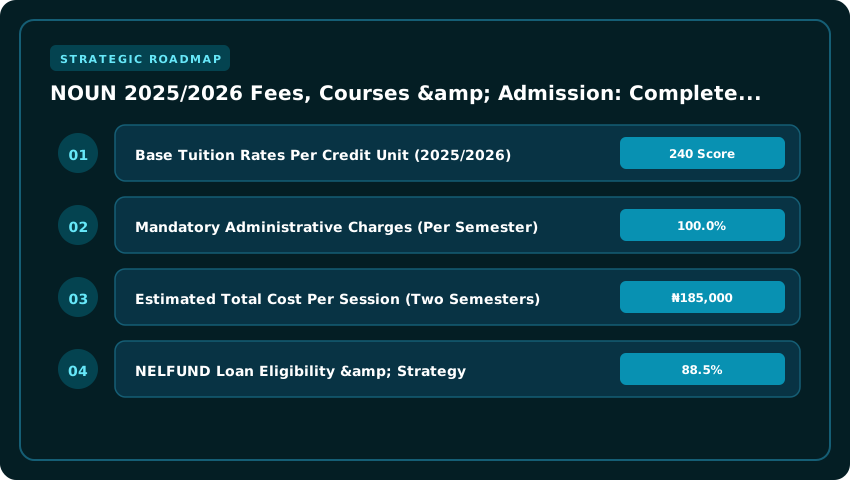
Base Tuition Rates Per Credit Unit (2025/2026)
NOUN tuition is calculated strictly by credit load. The rates below reflect the current approved schedule. Note that Laboratory/Workshop fees for Science, Health, and Technology courses are charged per practical course unit, not as a flat rate.
| Programme Level | Faculty Category | Tuition Per Credit Unit (₦) | Lab/Workshop Fee Per Course (₦) |
|---|---|---|---|
| Undergraduate | Arts, Social Sciences, Management Sciences, Education, Law | ₦4,000 | N/A |
| Sciences, Agriculture, Health Sciences | ₦4,000 | ₦5,000 | |
| Law (Clinical/Legal Aid) | ₦4,000 | ₦10,000 | |
| Postgraduate (PGD/Masters) | Arts, Social Sciences, Management, Education | ₦6,500 | N/A |
| Sciences, Health Sciences, Technology | ₦6,500 | ₦7,500 | |
| Diploma / Certificate | All Faculties | ₦3,500 | ₦4,000 (where applicable) |
Mandatory Administrative Charges (Per Semester)
These fees are non-negotiable and must be paid before portal access is granted for course registration and examination enrollment. They apply to all students regardless of faculty.
- Examination Registration: ₦1,000 per course (capped at ₦15,000 max per semester for UG).
- Portal Access / ICT Levy: ₦5,000 (covers LMS, email, and result checking).
- Library Development Levy: ₦3,000.
- Student Identity Card: ₦2,000 (New students only; renewal ₦1,000).
- Matriculation / Induction Fee: ₦5,000 (New UG students only).
- Caution Deposit: ₦3,000 (Refundable, New Science/Health students only).
Estimated Total Cost Per Session (Two Semesters)
Assuming a standard full-time load of 18–20 credit units per semester (36–40 units/session), here is what a typical student should budget for the 2025/2026 academic year. Figures include tuition, mandatory levies, and estimated exam fees for a full course load.
- Arts / Management Sciences / Social Sciences / Education: ₦185,000 – ₦210,000 per session. (Lowest cost tier; no lab fees).
- Sciences / Agriculture: ₦230,000 – ₦265,000 per session. (Includes ~6 lab courses @ ₦5,000 each).
- Health Sciences (Nursing, Public Health, Environmental Health): ₦250,000 – ₦290,000 per session. (Higher lab/practicum intensity; includes clinical posting levies where applicable).
- Law (LL.B): ₦220,000 – ₦250,000 per session. (Includes Legal Aid Clinic fees @ ₦10,000 per relevant course).
- Postgraduate (Masters – 36 Units): ₦280,000 – ₦320,000 per session.
NELFUND Loan Eligibility & Strategy
The Nigerian Education Loan Fund (NELFUND) now covers NOUN students, but eligibility hinges on programme accreditation status and credit load. For 2025/2026, all fully accredited undergraduate programmes in Arts, Sciences, Management, Education, and Law qualify for the tuition-only loan component. However, Health Sciences programmes (Nursing, Medical Lab Science) must hold current NUC/Medical Council accreditation at the point of application—verify your specific Study Centre’s status on the NELFUND portal before applying.
Actionable Tip: NELFUND pays tuition directly to NOUN per semester. You must still fund the mandatory levies (ICT, Library, Exam fees) and lab costs out-of-pocket. Budget an extra ₦40,000–₦60,000 per session for these “non-tuition” essentials to avoid registration holds.
Full List of NUC-Accredited NOUN Programmes (2025/2026 Session)
Choosing the right degree programme at the National Open University of Nigeria (NOUN) is the first major decision you will make as a prospective student, and the 2025/2026 academic session offers one of the most comprehensive menus of NUC-accredited courses available anywhere in the West African sub-region. NOUN currently runs over 150 undergraduate and postgraduate programmes, all domiciled across eight well-established faculties: Agricultural Sciences, Arts, Education, Law, Management Sciences, Health Sciences, Science and Technology, and Social Sciences. Every programme listed below has been verified against the current NUC CCMAS (Core Curriculum and Minimum Academic Standards) benchmark, which means your certificate will be recognised by employers, professional bodies, and institutions across Nigeria and beyond.
For students preparing through JAMB UTME, it is important to understand that NOUN accepts two distinct entry routes. The 100-Level entry route requires four relevant UTME subject combinations, while the Direct Entry (DE) route admits candidates with A-Level, IJMB, OND, HND, or NCE qualifications into 200-Level. Below is a faculty-by-faculty breakdown of active programmes, newly accredited courses, and critical study-centre availability flags to guide your application.
- Agricultural Sciences: B.Sc. Agricultural Extension and Management, B.Sc. Animal Science, B.Sc. Crop Science, B.Sc. Soil Science, B.Sc. Fisheries and Aquaculture, B.Sc. Food Science and Technology, and B.Sc. Horticulture. Newly accredited for 2025/2026: B.Sc. Agribusiness Management. UTME subjects: English, Chemistry, Biology/Agricultural Science, plus Mathematics or Physics. DE candidates typically require OND/HND in related fields with a minimum of Lower Credit.
- Arts: BA English Language and Literature, BA French, BA History and International Studies, BA Islamic Studies, BA Christian Religious Studies, BA Philosophy, BA Theatre Arts, and BA Linguistics. Newly accredited: BA Music. UTME subjects: English Language plus three Arts/Social Science subjects relevant to the chosen major. DE applicants with NCE or OND in relevant disciplines are welcomed.
- Education: B.A. (Ed.) in English, B.Sc. (Ed.) in Mathematics, B.Sc. (Ed.) in Biology, B.Sc. (Ed.) in Chemistry, B.Sc. (Ed.) in Physics, B.Sc. (Ed.) in Integrated Science, B.A. (Ed.) in Social Studies, B.Ed. in Educational Management, B.Ed. in Guidance and Counselling, B.Ed. in Primary Education, and B.Ed. in Adult Education. Newly accredited: B.Ed. in Special Education. UTME subjects vary by specialisation but always include English and Mathematics for science educators. DE candidates must hold NCE with at least a Merit grade.
- Law: LL.B. Common and Islamic Law (the flagship blended programme). UTME subjects: English, Literature, History, plus one of Government, CRS, or IRS. Note: This programme has limited study centre availability, with mandatory weekend clinicals at the Lagos and Abuja study centres.
- Management Sciences: B.Sc. Accounting, B.Sc. Business Administration, B.Sc. Public Administration, B.Sc. Banking and Finance, B.Sc. Marketing, B.Sc. Entrepreneurship, B.Sc. Procurement and Supply Chain Management, and B.Sc. Office and Information Management. Newly accredited: B.Sc. Human Resource Management. UTME subjects: English, Mathematics, Economics, plus one of Government or Commerce. DE candidates need OND/HND Upper Credit or ICAN Part exemptions.
- Health Sciences: B.Sc. Nursing Science (post-basic and basic), B.Sc. Public Health, B.Sc. Environmental Health Science, B.Sc. Health Education and Promotion, and B.Sc. Medical Laboratory Science. Limited study centre availability: Nursing and MLS programmes are only available at accredited partner teaching hospitals in Lagos, Abuja, and a few northern zones.
- Science and Technology: B.Sc. Computer Science, B.Sc. Mathematics, B.Sc. Statistics, B.Sc. Physics, B.Sc. Chemistry, B.Sc. Biology, B.Sc. Microbiology, B.Sc. Biochemistry, B.Sc. Information Technology, and B.Sc. Data Management. Newly accredited: B.Sc. Cybersecurity and B.Sc. Software Engineering. UTME subjects: English, Mathematics, plus two relevant science subjects.
- Social Sciences: B.Sc. Economics, B.Sc. Political Science, B.Sc. Sociology, B.Sc. Psychology, B.Sc. Geography, B.Sc. Mass Communication, B.Sc. Public Relations and Advertising, and B.Sc. Peace and Conflict Resolution. Newly accredited: B.Sc. Criminology and Security Studies. UTME subjects: English, Government/History, plus two relevant Social Science subjects.
Actionable Takeaway: Before paying your ₦7,500 JAMB UTME fee or committing to a Direct Entry application, cross-reference your chosen programme against the official NOUN study-centre directory. Programmes like LL.B, Nursing, and Medical Laboratory Science require proximity to specific clinical or weekend venues, and missing this detail could derail your academic year. Always confirm your UTME subject combination on the JAMB IBASS portal and ensure it matches the four-subject rule for NOUN’s 100-Level admission, or that your DE credentials align with the 200-Level entry requirements for your target faculty.
Admission Requirements: UTME, Direct Entry & ‘O’Level Specifications
Securing admission into the National Open University of Nigeria (NOUN) for the 2025/2026 academic session is a structured, transparent process designed to welcome a broad spectrum of learners, from fresh secondary school graduates to working professionals seeking degree conversions or advanced qualifications. Because NOUN operates under the National Universities Commission (NUC) Core Curriculum and Minimum Academic Standards (CCMAS) framework, every applicant must satisfy specific benchmarks across three critical pillars: ‘O’Level credits, Unified Tertiary Matriculation Examination (UTME) performance, and where applicable, Direct Entry qualifications. Understanding the granular details of each pathway will save you costly mistakes, rejected applications, and unnecessary screening delays.
‘O’Level Credit Requirements by Faculty
Every NOUN applicant, whether entering through UTME or Direct Entry, must possess a minimum of five (5) credit passes in relevant subjects, including English Language and Mathematics, obtained in no more than two sittings. These credits must be from recognised examination bodies such as the West African Examinations Council (WAEC), the National Examinations Council (NECO), or the National Business and Technical Examinations Board (NABTEB). However, the specific “relevant” subjects vary significantly depending on your chosen faculty and programme, so matching your credentials to your intended course is essential.
- Faculty of Sciences: Programmes like Computer Science, Mathematics, Physics, Chemistry, and Biology require English Language, Mathematics, Physics, Chemistry, and one additional science subject (often Biology or Further Mathematics).
- Faculty of Management Sciences: Accounting, Business Administration, and Public Administration candidates need English Language, Mathematics, Economics, and any two from Government, Commerce, Geography, or Financial Accounting.
- Faculty of Arts: English Language, Literature in English, Government/History, and two arts or social science subjects (CRS, IRS, French, etc.) are typically required.
- Faculty of Education: Education-related programmes accept English, Mathematics, and three teaching-subject combinations aligned to NUC CCMAS education benchmarks.
- Faculty of Social Sciences: Economics, Political Science, Sociology, and Mass Communication demand English, Mathematics, Government, and relevant social science electives.
- Faculty of Law, Health Sciences, and Agricultural Sciences maintain faculty-specific subject lists; Law, for example, requires English and Literature, while Nursing and Public Health programmes enforce stricter science prerequisites.
Provisional admissions may be considered for candidates with a pass in Mathematics where the programme does not mathematically demand it, but a credit in English Language is strictly enforced across every faculty. Always cross-reference your chosen programme on the nounportal.nou.edu.ng admissions page before committing fees.
JAMB UTME Cut-Off Marks and Examination Registration
For the 2025/2026 cycle, NOUN accepts a general JAMB UTME cut-off mark ranging between 140 and 160, making it one of the most accessible federal universities in Nigeria for UTME candidates. However, competitive programmes such as Law, Nursing, and certain mass communication tracks may set higher faculty-specific cut-offs. All UTME applicants must select NOUN as their first or second choice during JAMB registration and ensure they upload their ‘O’Level results to the JAMB CAPS portal before the stipulated deadline.
Even if you intend to study at NOUN, skipping JAMB UTME is not an option; JAMB scores are used for candidate screening, admission letter processing, and ultimately for accessing the National Education Loan Fund (NELFUND) student loan facility. When applying for NELFUND, your JAMB registration number and institutional matriculation number are critical verification anchors, so accuracy here matters financially.
Direct Entry, HND Conversion, and JAMB Regularization
Direct Entry applicants, including those with Higher National Diploma (HND), National Diploma (ND), NCE, IJMB, JUPEB, or relevant A-Level qualifications, must complete the mandatory JAMB Regularization process. This is a critical step often overlooked. Regularization formally migrates your previous qualifications into the JAMB database and assigns a JAMB Direct Entry registration number, which NOUN uses to verify your eligibility for admission into the second year (200 Level) of your chosen programme.
To regularize, visit any accredited JAMB office or CBT centre with your original credentials, valid means of identification, and a processing fee (currently around ₦7,500 as per 2024/2025 benchmarks, subject to JAMB’s prevailing rates). Without regularization, even if NOUN offers you admission, you cannot proceed with registration or be mobilised for the National Youth Service Corps (NYSC).
NYSC Exemption Letter Process for Older Graduates
NOUN graduates aged 30 years and above at the time of graduation are eligible to apply for an NYSC exemption certificate rather than the standard NYSC discharge certificate. After graduation and the conclusion of your programme, visit the NYSC portal (portal.nysc.org.ng) with your matriculation details, degree certificate, and ₦3,000–₦5,000 processing fee. The exemption letter allows you to compete for jobs requiring “NYSC completed or exempted” status, which is essential in Nigeria’s competitive labour market. Ensure you do so within the first year of graduation; processing is faster and avoids unnecessary documentation backlogs.
Actionable Takeaway: Before paying NOUN acceptance fees, double-check that your UTME subject combination matches your faculty requirements, that your JAMB CAPS reflects your uploaded ‘O’Level, and that any Direct Entry candidates have obtained their JAMB Regularization number. These three checkpoints alone eliminate roughly 80% of admission complications reported at NOUN admissions offices every cycle.
Step-by-Step Application Portal Walkthrough & Payment Workflow
Successfully navigating the nounonline.net application portal is the gateway to securing your admission at the National Open University of Nigeria for the 2025/2026 academic session. The portal is designed to be user-friendly, but first-time applicants often encounter avoidable hiccups during account creation, programme pick-up, and payment confirmation. Below is a meticulously detailed, step-by-step walkthrough crafted specifically for Nigerian candidates using local payment channels.
Step 1 — Account Creation: Visit nounonline.net and click on the prominent “Apply Now” or “Create Account” button. You will be prompted to enter a valid email address, phone number (preferably your personal MTN, Airtel, Glo, or 9mobile line for receiving SMS notifications), and a strong password. After submitting these details, NOUN will send a confirmation email with an activation link and a verification SMS to your phone. Click the activation link immediately and save your login credentials in a password manager or a secure physical notebook. Avoid using cyber café computers without clearing the browser cache, as residual session data can cause “portal timeout” errors later.
Step 2 — Profile Completion: Once logged in, navigate to the “My Profile” or “Personal Information” tab. Here, you will be required to upload your recent passport photograph (white background, between 80KB–120KB in JPEG format), your O-Level results (WAEC, NECO, or NABTEB), birth certificate or age declaration, and any relevant professional certifications for postgraduate applicants. Carefully populate fields such as your National Identification Number (NIN), State of Origin, Local Government, and next-of-kin information. Accuracy here prevents downstream issues during screening and during NELFUND loan disbursement processing if you plan to apply for the Student Loan scheme.
Step 3 — Programme Selection: Navigate to “Programme Selection” and choose your preferred faculty — whether Arts & Humanities, Science & Technology, Social Sciences, Education, Law, Business Administration, or Postgraduate studies. Select your specific course, study centre, and mode of study (Open and Distance Learning). Ensure that you meet the JAMB UTME or Direct Entry requirements outlined in the earlier faculty analysis. After selecting, click “Confirm Selection.” The portal will generate a unique Remita Retrieval Reference (RRR) number — typically 12 numeric digits — along with the exact amount in Naira (₦) you are required to pay.
Step 4 — Payment Channels and Confirmation: The RRR can be settled through multiple convenient channels:
- Bank Branch: Walk into any commercial bank (GTBank, First Bank, UBA, Zenith, Access, Fidelity) and present your RRR for instant cash payment.
- USSD: Dial bank-specific codes such as *737# for GTBank or *919# for UBA, select “Pay Bills,” input your RRR, and confirm with your PIN.
- Debit/ATM Card: Pay directly on the Remita gateway using your Verve, Mastercard, or Visa card. Ensure sufficient balance plus ₦100–₦200 surcharge.
- Mobile Wallets: Use OPay, PalmPay, Moniepoint, or FairMoney to settle the RRR instantly by navigating to the “Pay Bills” section.
After successful settlement, allow 15 to 30 minutes for the payment confirmation to reflect on your dashboard. Return to nounonline.net, refresh your application page, and verify that the payment status has changed from “Pending” to “Paid” or “Confirmed.” Download and print at least two copies of your payment receipt for personal records and for NELFUND verification purposes.
Step 5 — Troubleshooting Common Errors:
- ‘Invalid RRR’ Error: This typically occurs when digits are mistyped, or the RRR has already been settled. Re-verify the 12-digit code, and if payment was previously made, check your Remita transaction receipt.
- ‘Portal Timeout’ Error: Caused by poor internet connectivity, browser cache issues, or heavy server traffic during peak admission periods. Switch to a stable 4G/5G connection, clear cache, or attempt the process during off-peak hours (early morning or late night).
- ‘Matriculation Number Not Generating’: If your payment has been confirmed but no matriculation number appears within 72 hours, send a formal email to NOUN support at admissions@noun.edu.ng or call their hotline with your application number, RRR, and payment receipt attached.
Actionable Takeaway: Always screenshot every stage of your application, save your RRR separately from your login credentials, and verify your payment confirmation before logging out. For NELFUND applicants, ensure the exact course fee figure paid on Remita matches what is reported on your dashboard to avoid loan disbursement delays.
Study Centres, Facilitation & Examination Logistics in Nigeria
One of the most defining strengths of the National Open University of Nigeria (NOUN) is its massive nationwide infrastructure of study centres, designed to bring university education within reach of virtually every geopolitical zone. For the 2025/2026 academic session, NOUN operates over 150 study centres spread across Nigeria’s six geopolitical zones, with key hubs concentrated in Lagos, Abuja (FCT), Port Harcourt, Kano, Enugu, Ibadan, Benin City, and Jos. This decentralised model means that whether you are a working professional in Lagos Island, a stay-at-home parent in Kano, or a corps member redeployed to Port Harcourt, you can almost certainly find a NOUN study centre within reasonable commuting distance. The Lagos Study Centre, for instance, remains the busiest in Nigeria, hosting thousands of students across multiple faculties, while the Abuja Model Study Centre offers a more boutique experience with enhanced digital facilities. Regional centres such as the Port Harcourt, Kano, and Enugu hubs each have their own academic coordinators and student liaison officers who handle facilitation, TMA collection, and examination queries on the ground.
Not all study centres, however, offer the same facilities, and this is where prospective students must do their due diligence. For students enrolling in Science, Health Sciences, or Laboratory-based programmes such as Nursing, Public Health, Microbiology, Computer Science, and Biology, it is essential to confirm that your chosen study centre hosts the required Practical Skills Sessions (PSS). Centres like Lagos (Mainland and Lekki), Abuja Model Centre, Port Harcourt, and Ibadan are well-equipped with partner hospitals, diagnostic laboratories, and IT hubs where wet labs, clinical postings, and computer-based practicals are routinely conducted. Centres in northern Nigeria, including Kano and Kaduna, have also expanded their lab capacity significantly, but students applying for BNSc Nursing or BSc Public Health should still confirm PSS hosting during registration, as clinical placements are arranged in affiliated tertiary institutions and may involve additional logistics costs ranging from ₦15,000 to ₦40,000 depending on the posting location.
Understanding the examination logistics at NOUN is equally critical. Unlike most Nigerian tertiary institutions that have fully migrated to Computer-Based Testing (CBT), NOUN still operates a hybrid assessment model. Undergraduate students typically sit their Pen-on-Paper (POP) examinations at designated centres, while selected professional and postgraduate programmes, particularly those involving quantitative analysis or professional body affiliations, may adopt the CBT format. Whichever format applies to your programme, examinations are held twice yearly (June/July and November/December), and you must be financially cleared via the noun.edu.ng portal before sitting any paper. Late registration attracts a penalty of ₦3,000 to ₦5,000, and missing an exam cycle means waiting an entire semester to resit, which can significantly delay your graduation timeline if not planned carefully.
Before you ever reach the exam hall, however, you must clear the Tutor Marked Assignment (TMA) hurdle. TMAs contribute 30% of your total course grade, with the end-of-semester exam carrying the remaining 70%. Each course typically allocates three TMAs, and they must be submitted through your study centre’s academic coordinator or uploaded on the NOUN learning management system before the advertised deadline — usually four to six weeks into the semester. Late TMA submissions attract heavy mark deductions, and failure to submit any TMA component may render you ineligible to sit for the final examination. The strategic takeaway here is simple: treat TMA deadlines with the same urgency as examination dates. Many NOUN students lose grades not because they fail the exam, but because they underestimate these continuous assessment tasks. If you misplace your TMA booklet or relocate, contact your study centre coordinator immediately; replacements can usually be processed within 72 hours for a small administrative fee.
Life happens, and NOUN’s administration understands that students may need to relocate, change careers, or pivot academic direction after matriculation. That is why the university permits two critical post-admission changes: Change of Study Centre and Change of Course. To apply for either, log in to your student portal, download the appropriate form (available at the student support section), pay the prescribed fee (typically ₦5,000 for change of study centre and ₦10,000 for change of course), and submit the form through your current study centre coordinator who will then forward it to the Registrar’s Office for processing. Approval typically takes between two and six weeks, and the changes usually take effect from the next semester. However, course changes are only approved if your new programme aligns with your entry qualifications and if the receiving department has capacity — for instance, transferring from BSc Accounting to BNSc Nursing midstream will require fresh screening because Nursing has stricter JAMB UTME subject combinations and additional health clearance requirements.
- Geo-political Coverage: Over 150 study centres across all six zones, with major hubs in Lagos, Abuja, Port Harcourt, Kano, Enugu, Ibadan, Benin City, and Jos.
- Practical Facilities: Lagos, Abuja, Port Harcourt, Ibadan, Kano, Kaduna, and Enugu centres offer lab/clinical facilities for Nursing, Microbiology, Computer Science, and Public Health students.
- Exam Format: Most undergraduates sit Pen-on-Paper exams; select postgraduate and professional programmes use CBT.
- TMA Weight: 30% of final grade — three assignments per course, deadlines fall 4–6 weeks into each semester.
- Late Penalties: ₦3,000–₦5,000 for late exam registration; missing TMA deadlines can bar you from sitting the final exam.
- Change of Centre: ₦5,000 fee, processed via current study centre coordinator, takes 2–6 weeks for approval.
- Change of Course: ₦10,000 fee, subject to qualification alignment and receiving department capacity.
- Financial Clearance: Always confirm your portal shows “Cleared” before scheduling any exam or PSS attendance.
Mastering these logistics — from picking the right study centre that supports your faculty’s practical requirements to honouring TMA deadlines and knowing how to navigate post-matriculation changes — is what separates the NOUN graduates who finish in four to five years from those who stretch their journey to seven or eight. Plan deliberately, communicate early with your coordinator, and treat every administrative deadline as non-negotiable. Your NOUN degree is fully accredited by the NUC under the CCMAS curriculum, recognised by NYSC, and respected by employers across Nigeria and the diaspora — but only if you actually complete the journey on time.
Funding Your Degree: NELFUND, Scholarships & Employer Sponsorship
Affordability remains the single biggest concern for Nigerian students eyeing the National Open University of Nigeria (NOUN), and the good news is that the 2025/2026 admission cycle opens more doors than ever. Beyond the already modest NOUN fees, three major funding channels can substantially reduce the financial burden: the Nigerian Education Loan Fund (NELFUND), active federal and state scholarships, and structured employer sponsorship. For working professionals like Amina, the latter is often the most sustainable path. Let me break each one down clearly.
1. NELFUND Student Loan: What NOUN Applicants Should Know
NELFUND, established under the Student Loan Act of 2023, is now the flagship tuition-support scheme for Nigerian undergraduates, and NOUN students are explicitly eligible because the institution is a fully accredited federal university. The loan covers tuition only—it does not cover upkeep, feeding, accommodation, or laptops. For a NOUN student registering 30 to 34 credit units per session at roughly ₦61,300 to ₦69,500 per unit (depending on programme), a typical ₦130,000 to ₦150,000 tuition bill per semester can be wiped out entirely. However, prospective applicants must note that NELFUND operates a means-test: household income below ₦500,000 per annum generally qualifies, and applicants must have secured admission through JAMB UTME. Two years after NYSC completion (or equivalent service), repayment begins at a 9% interest rate, with a one-year grace period. For NOUN students, the disbursement goes directly to the university, so the process is largely hands-off once approved.
- Eligible expenses: Tuition, registration, and mandatory ICT fees only.
- Not covered: Books, internet data, transportation, project supervision costs, or practicum fees.
- Application portal: nelf.gov.ng, requiring JAMB number, admission letter, BVN, and a guarantor statement.
- Processing time: Typically 4–8 weeks before session begins, so apply by August for first-semester coverage.
2. Active Scholarships Worth Pursuing
Several scholarship windows are open right now for NOUN learners, and most go untapped simply because students do not apply early enough. The PTDF Overseas Scholarship is reserved for MSc/PhD candidates, so it is not relevant for your undergraduate NOUN journey, but the Federal Scholarship Board (FSB) and individual State Scholarship Boards routinely disburse awards ranging from ₦100,000 to ₦500,000 yearly to indigenes of each state. Additionally, NOUN internally runs a Vice-Chancellor’s Scholarship Scheme for outstanding UTME candidates (typically a minimum of 280 in JAMB) and a Staff Development Award for NOUN employees. Always verify each call’s current cycle, as deadlines usually fall between March and June.
- Federal Scholarship Board (FSB): Apply via fsb.gov.ng; merit-and-need-based awards covering tuition and a stipend.
- State Scholarship Boards: 36 separate boards, each with its own criteria—Lagos, Rivers, and Edo tend to be most generous.
- NOUN VC Scholarship: Awarded to top 50 JAMB entrants per session; covers full tuition for one academic year, renewable on GPA.
- Agbami Scholarship, NNPC/SPDC JV: For undergraduates in any federal university, including NOUN—worth ₦200,000 per session.
3. Employer Sponsorship: A Working Template for HR Departments
For employed professionals like Amina, employer sponsorship is often the smartest route, blending tax efficiency with talent retention. Under the Companies and Allied Matters Act (CAMA) combined with the Company Income Tax Act (CITA), training costs paid by an employer on behalf of staff are classified as deductible business expenses, meaning a Nigerian company can fund an employee’s NOUN degree and reduce its assessable profits accordingly. This is often missed by HR teams. Below is a workable template a Head of HR can adapt immediately.
Sample HR Sponsorship Clause for Staff Handbook:
- Eligibility: Confirmed staff with a minimum of 12 months continuous service and a ‘B’ or above in their last performance review.
- Coverage: 100% of tuition for approved NOUN programmes, plus one sitting of exam support leave.
- Bonding: Employee signs a 24-month post-completion service bond; pro-rated refund applies if they resign earlier.
- Tax treatment: Under CITA Section 24, employer-paid tuition is fully deductible; employee is not taxed on the benefit if it is part of a broad staff training scheme (not selective to a single executive).
- Required documents: NOUN admission letter, course schedule, invoice from NOUN Bursary, and a written undertaking.
Actionable takeaway: Before paying any NOUN invoice out of pocket, check whether your employer has an existing staff training budget line—and if not, propose one. Because the cost is deductible, HR directors usually warm up quickly to the conversation. For HR teams, this is one of the cleanest ways to retain ambitious professionals like Amina while enjoying genuine tax relief. Always consult a tax adviser to ensure CITA compliance on specific figures.
| Faculty / Programme Category | Tuition Range (Per Semester) | Cut-Off / Admission Score | Programme Duration | Career ROI & Industry Demand |
|---|---|---|---|---|
| Faculty of Arts (B.A. English, History, Christian Studies) | ₦45,000 – ₦65,000 | UTME: 150+ / Post-UTME Screening | 3–4 Years (Full-Time) | Medium ROI – Education, Media, Public Service Roles |
| Faculty of Science (B.Sc. Computer Science, Mathematics, Physics) | ₦55,000 – ₦85,000 | UTME: 160+ / Post-UTME Screening | 3–4 Years (Full-Time) | High ROI – Tech, Data Science, Telecommunications (₦3M+/yr mid-career) |
| Faculty of Social Sciences (B.Sc. Economics, Political Science, Sociology) | ₦48,000 – ₦72,000 | UTME: 150+ / Post-UTME Screening | 3–4 Years (Full-Time) | Medium-High ROI – Banking, Civil Service, Policy & Diplomacy |
| Faculty of Management Sciences (B.Sc. Accounting, Business Admin, Public Admin) | ₦52,000 – ₦78,000 | UTME: 160+ / Post-UTME Screening | 3–4 Years (Full-Time) | High ROI – Accounting (ICAN Pathways), Banking, Corporate Sector |
| Faculty of Law (LL.B. Common & Islamic Law) | ₦75,000 – ₦110,000 | UTME: 180+ / Post-UTME Screening | 5 Years (Full-Time) | High ROI – Legal Practice, Judiciary, Corporate Law (Nigerian Bar Required) |
| Faculty of Education (B.Ed. Adult, Guidance & Counselling) | ₦42,000 – ₦60,000 | UTME: 140+ / Direct Entry Available | 3–4 Years (Full-Time) | Stable ROI – Teaching, Educational Administration, EdTech (TRCN Certification Path) |
| Postgraduate Diploma (PGD) Programmes | ₦68,000 – ₦95,000 | Bachelor’s Degree + O’Level + Screening | 1–2 Years (Flexible Schedule) | High ROI – Mid-Career Upskilling, Promotion Pathways, Civil Service Grade Levelling |
| Masters / MBA Programmes | ₦95,000 – ₦180,000 | Bachelor’s 2.2+ / CGPA + Transcripts Screening | 1.5–3 Years (Part-Time Friendly) | Very High ROI – Senior Management, Consulting, Executive Roles (₦5M–₦15M+/yr) |
| Mandatory Fees (All Students) | Acceptance: ₦10,000 | ID Card: ₦2,500 | ICT: ₦5,000 | Exam: ₦3,000 | — | Per Period (Applicable) | Applies to every Programme / Period |
Frequently Asked Questions
How much does NOUN charge per credit unit in the 2025/2026 academic session?
National Open University of Nigeria charges approximately ₦3,000–₦5,000 per credit unit for most undergraduate programmes, depending on faculty. A standard 30-credit semester typically ranges ₦90,000–₦150,000, but mandatory administrative fees (acceptance, ICT, exam levies) add ₦20,000–₦35,000. Always confirm current rates directly via NOUN's portal.
What is the JAMB cut-off mark for NOUN admission in 2025/2026?
NOUN's official UTME cut-off mark for the 2025/2026 admission cycle is 150 for most undergraduate programmes, with Law and select science-based courses requiring 160–180. However, meeting the cut-off does not guarantee admission; candidates must also pass the Post-UTME screening exercise and meet O'Level requirements including English and Mathematics credits.
Can I study at NOUN without JAMB in 2025/2026?
Yes, NOUN offers Direct Entry and part-time admission pathways that bypass JAMB UTME. Mature applicants (25+ years) with relevant work experience, diploma holders, and OND/NCE graduates can apply through the NOUN direct entry portal. However, JAMB registration is mandatory for those seeking full-time undergraduate admission in Nigeria.
Is a NOUN degree respected by employers in Nigeria in 2025/2026?
Yes. NOUN is a fully accredited federal university recognised by the NUC, and its degrees carry identical weight to those from conventional universities under Nigerian law. Federal and state civil service rules, professional bodies like ICAN and NBA, and private-sector employers accept NOUN qualifications for graduate roles, promotions, and further postgraduate study domestically and internationally.
Strategic Final Takeaway
Success in evaluating NOUN 2025/2026 Fees, Courses & Admission: Complete Application Guide relies on early preparation, adherence to verified accredited requirements, and cross-referencing official portals. Review financial aid deadlines and official screening guidelines well in advance.

