The New Vocationalism: Why CTE Is No Longer a ‘Plan B’ Track
For decades, the American high school experience was bifurcated: a college-prep track for the “academic” students and a vocational track—often dismissed as “shop class”—for everyone else. That binary has shattered. Today’s Career and Technical Education (CTE) is a rigorous, data-driven pipeline aligned directly with Industry 4.0 standards, preparing students for roles in advanced manufacturing, cybersecurity, and biotechnology that frequently start above $70,000 annually. This isn’t your grandfather’s woodworking elective; it is a strategic alignment of secondary curriculum with the exact competencies employers are desperate to hire.

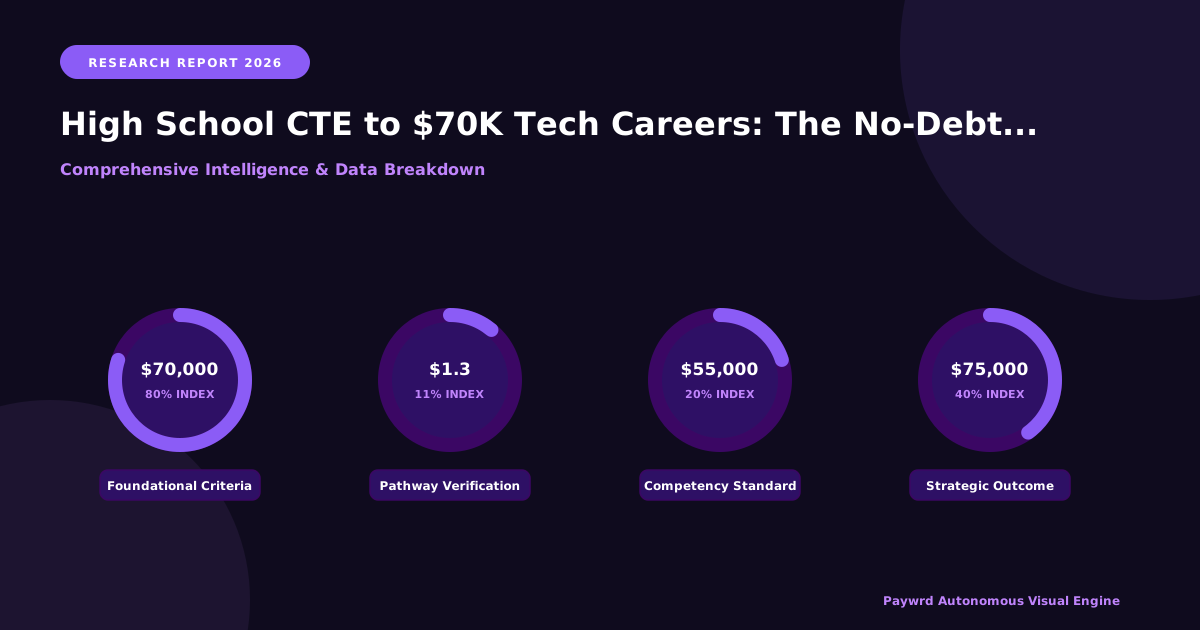
The structural shift is measurable. The Strengthening Career and Technical Education for the 21st Century Act (Perkins V), signed into law in 2018, authorized roughly $1.3 billion annually in federal funding through FY 2024, with a mandate to align programs with high-skill, high-wage, and in-demand industry sectors. Crucially, Perkins V requires states to conduct a Comprehensive Local Needs Assessment (CLNA), forcing districts to prove their programs match regional labor market data before they receive a dollar. This legislative teeth has moved CTE from the basement to the boardroom.
Enrollment data from the National Center for Education Statistics (NCES) confirms the surge. Between 2017 and 2022, participation in CTE concentrators—students taking two or more courses in a single career cluster—jumped significantly. The most explosive growth sits squarely in STEM-aligned clusters:
- Health Science: Consistently the largest cluster, driven by an aging population and credential stackability (CNA to RN pathways).
- Information Technology: Surging enrollment in cybersecurity, cloud computing, and data analytics pathways, often mapped to CompTIA and Cisco certifications.
- Manufacturing: Shedding its “dirty jobs” image via Smart Manufacturing curricula certified by NIMS (National Institute for Metalworking Skills), SACA (Smart Automation Certification Alliance), and FANUC robotics credentials.
These aren’t participation trophies. A student graduating with a FANUC Certified Robot Operator credential or a SACA Certified Industry 4.0 Associate badge has demonstrated competency on the exact programmable logic controllers (PLCs) and robotic cells running production lines at Tesla, Boeing, or local Tier 1 suppliers. Employers treat these credentials as verified proof of aptitude, often granting advanced standing in Registered Apprenticeship programs or direct entry into technician roles with tuition reimbursement for future degrees.
The “Plan B” stigma has evaporated because the economic ROI is undeniable. When a high school senior graduates with zero debt, an OSHA 10 card, an industry-recognized credential, and a job offer paying $55,000–$75,000 with a defined career ladder, the “college-for-all” narrative looks increasingly like a luxury good rather than a necessity. Modern CTE is no longer an alternative to college; it is a strategic on-ramp to the middle class that keeps the option for a bachelor’s degree—often employer-funded—wide open.
Anatomy of a $22/Hour Pipeline: Deconstructing the School-to-Work Model
The jump from a high school shop class to a $22-per-hour starting wage isn’t magic—it is the result of a highly structured, federally recognized architecture known as the Registered Apprenticeship Program (RAP). Unlike informal internships, a RAP is a formal employment relationship validated by the U.S. Department of Labor (or a State Apprenticeship Agency) that combines paid on-the-job learning (OJL) with related technical instruction (RTI). For high school students, the entry point is typically a pre-apprenticeship, a preparatory curriculum designed to feed directly into a registered slot the moment a student turns 18 and graduates.
The mechanics rely heavily on Intermediary Organizations—nonprofits or workforce boards that act as the connective tissue between school districts and employers. Entities like MAGNET (Manufacturing Advocacy and Growth Network) in Ohio or CareerWise in Colorado and New York serve as the “sponsor of record.” They handle the regulatory heavy lifting: registering the program standards with the DOL, designing the competency frameworks, and managing the wage progression schedules. This allows a small machine shop or a regional hospital to hire a 17-year-old without needing an in-house HR legal team to navigate 29 CFR Part 29 regulations.
Funding this pipeline is a braided finance strategy. WIOA Youth Formula Funds (Workforce Innovation and Opportunity Act) provide the backbone for supportive services—covering transportation, tools, PPE, and tuition for the RTI component at a local community college. Meanwhile, Perkins V dollars fund the high school CTE instructor and lab equipment. In many states, employers access Employer Training Grants or state-specific tax credits (like California’s California Apprenticeship Initiative or Georgia’s Work-Based Learning Tax Credit) to offset the apprentice’s wage during the low-productivity learning curve.
The progression is strictly competency-based, not just time-served. A typical advanced manufacturing pathway maps like this:
- Year 1 (Junior Year – Pre-Apprenticeship): Focus on safety and foundations. Students earn OSHA 10-Hour General Industry certification and NIMS (National Institute for Metalworking Skills) Level 1 credentials in Measurement, Materials, & Safety or Job Planning, Benchwork, & Layout. RTI covers blueprint reading and CNC fundamentals.
- Year 2 (Senior Year – Registered Apprenticeship Start): Student is officially registered. They accumulate 2,000 hours of OJL annually (part-time during school, full-time summers). Wages start at roughly 50-60% of journeyworker rate (~$18–$22/hr). Competencies shift to CNC milling/turning operations and GD&T (Geometric Dimensioning & Tolerancing).
- Post-Graduation (Years 3–4): Full-time employment. Apprentice masters advanced multi-axis machining, CAD/CAM programming, and preventive maintenance. RTI often articulates into an Associate of Applied Science (AAS) degree at zero cost via tuition reimbursement.
- Completion: Award of the nationally portable Journeyworker Credential (DOL Certificate of Completion) and often an industry certification like NIMS Level 2/3 or SME CMfgT. Wage jumps to full journeyworker scale ($30–$40+/hr).
Actionable Takeaway: Ask your CTE director if your program has a Registered Apprenticeship Sponsor partner. If they only offer “job shadowing” or “co-ops” without a DOL registration number and a defined wage scale, you are not in the pipeline—you are just visiting.
ROI Calculation: CTE Credential Stack vs. Bachelor’s in Mechanical Engineering
When families sit down at the kitchen table to map out post-secondary pathways, the conversation almost always drifts toward four-year sticker prices and the looming specter of student debt. To cut through that noise, it helps to run a rigorous, apples-to-apples 10-year Net Present Value (NPV) comparison between a stacked CTE credential pathway and a traditional Bachelor’s in Mechanical Engineering (ME). This financial model strips out emotion and ideology and focuses entirely on verifiable United States labor-market data, Bureau of Labor Statistics (BLS) figures, and College Board benchmarks.
Let’s start with the CTE pathway. A student who maximizes a public high school Career and Technical Education program pays zero in tuition, because the program is funded by the state’s K-12 allotment and the federal Perkins V allocation. Upon graduation, that student can earn immediate industry-recognized credentials—such as NCCER Core, AWS D1.1 welding, or NIMS Machining Level I—and enter the workforce at an entry wage between $45,000 and $50,000. Many high-demand pathways, including industrial maintenance, HVAC, and robotics technician roles, clear the $50K threshold within the first 12 months.
- Year 1 Earnings: $47,500 (average midpoint of entry estimates)
- Year 2-4 Earnings: With BLS projecting 4-5% annual wage growth for skilled technicians, cumulative gross income reaches roughly $155,000.
- Years 5-10: The technician enrolls in an Associate of Applied Science (AAS) degree or an accelerated Bachelor’s completion program. Crucially, employer tuition reimbursement—often capped at $5,250 per year under IRS Section 127—covers the cost, leaving zero out-of-pocket expense. Earnings rise into the $70,000-$85,000 senior technician band, bringing the 10-year gross earnings to approximately $700,000.
Now, let’s benchmark the Bachelor’s in Mechanical Engineering. According to the College Board Trends in College Pricing 2023 report, the average four-year cost at an in-state public university is roughly $112,000, while private nonprofit institutions average $170,000. After factoring in grants, the average student debt burden for a four-year degree is $102,000—a figure confirmed by the Federal Reserve’s Survey of Consumer Finances. To compound the financial drag, the student also incurs a four-year opportunity cost, sacrificing the $190,000 they would have earned as a CTE technician.
- Year 1-4 Net Loss: ($190,000 in forgone wages) + ($102,000 in debt) = -$292,000 in delayed wealth building.
- Year 5 Entry Salary: The ME graduate lands a role at the $65,000 median entry-level wage (per BLS Occupational Employment Statistics for Mechanical Engineers, May 2023).
- Year 5-10 Earnings: Cumulative gross income reaches roughly $500,000. Even after debt servicing at a 6% interest rate over 10 years (total repaid ~$135,000), the engineer’s 10-year gross earnings trail the CTE stack by nearly $200,000.
But the numbers don’t stop at earnings. The BLS tracks unemployment differentials that radically alter the risk profile of both degrees. For ME graduates, BLS data shows a 2023 unemployment rate of roughly 2.1%—low, but highly sensitive to manufacturing slowdowns and interest-rate cycles. For skilled industrial technicians, unemployment hovers near 1.6%, driven by severe labor shortages in the skilled trades (BLS reports over 500,000 unfilled manufacturing positions nationally). In a downturn, the CTE credential is portable across construction, energy, defense, and aerospace, whereas the ME credential is heavily concentrated in cyclical sectors like automotive and consumer goods manufacturing.
Discounting these cash flows at a standard 3% inflation-adjusted rate, the 10-year NPV of the CTE stack lands between $550,000 and $600,000, while the Bachelor’s in Mechanical Engineering nets between $350,000 and $400,000—a delta of roughly $200,000 in favor of the CTE pathway. When you add the psychological benefit of zero student loan debt, immediate income, and a 10-year head start on retirement investing (e.g., Roth IRA contributions compounding at 7%), the CTE stack isn’t just competitive; it is the mathematically superior wealth-building strategy for a massive slice of the American workforce.
Accreditation & Articulation: Ensuring Credits Transfer to Community College & ABET Programs
When students and parents evaluate Career and Technical Education (CTE) pathways, the conversation almost immediately turns to a practical, financial question: “Will the time, tuition, and effort invested in high school actually pay dividends if my student decides to pursue an associate or bachelor’s degree later?” The answer depends entirely on two interrelated concepts that are frequently conflated: Credit for Prior Learning (CPL) and formal Articulation Agreements. Understanding the distinction is the single most important step in protecting both the transcript and the wallet.
Credit for Prior Learning (CPL) is a portfolio-based, often student-initiated evaluation process. After completing a CTE program, a student may petition a community college to assess their competencies, typically by demonstrating mastery through industry certifications, performance exams, or a documented portfolio. CPL is flexible and available at most institutions, but it places the burden of proof on the student. Credits awarded through CPL are not guaranteed across institutions, may not apply toward a specific degree audit, and often carry the stigma of being treated as elective rather than core credit.
Articulation Agreements, by contrast, are pre-negotiated, bilateral contracts between a high school CTE program, a career-technical center, or a career and college promise pathway and a receiving community college. These agreements specify exactly which courses articulate, which certifications waive specific credit requirements, and how many semester hours transfer. Because they are codified, articulation agreements provide predictable, transparent credit transfer. For parents evaluating a four-year ROI on a CTE track, an articulated pathway at an accredited institution effectively converts high school shop-floor hours into college transcript credit at zero additional cost.
Before trusting any pathway, verify that the program holds recognition from a recognized industry accreditation body. The following organizations set the national standard for technical competency in advanced manufacturing, welding, industrial maintenance, and mechatronics:
- NIMS (National Institute for Metalworking Skills): Sets competency standards for machining, CNC operations, and metalforming. NIMS credentials are highly portable and are often the foundation for articulating into Mechanical Engineering Technology or Manufacturing Engineering Technology degrees.
- AWS (American Welding Society): The certifying body for structural and pipe welders. AWS D1.1 certifications are widely accepted in articulation agreements, particularly in civil, structural, and industrial engineering technology programs.
- SACA (Smart Automation Certification Alliance): Validates industry 4.0 competencies including robotics, PLCs, and industrial networking. SACA credentials map directly into Mechatronics and Electrical Engineering Technology programs at the associate level.
- AMTEC (Association for Manufacturing Technology Education Centers): Operates the National Coalition of Advanced Technology Centers and certifies high-precision CNC and additive manufacturing programs. AMTEC-recognized programs frequently articulate into ABET-accredited engineering technology pathways.
Once a high school student holds one or more of these industry credentials, the next verification step is mapping them to an ABET-accredited Engineering Technology (ET) associate degree. ABET accreditation is the gold standard for applied science and engineering technology programs and ensures that coursework meets rigorous academic and industry benchmarks. Two community colleges serve as excellent bellwether models for this kind of stackable credential pathway:
- Sinclair College (Dayton, Ohio): Sinclair hosts a portfolio of ABET-accredited ET programs in Mechanical, Electrical, and Industrial Engineering Technology, and maintains published articulation matrices that translate NIMS, AWS, and SACA certifications into specific course credits.
- Lorain County Community College (Elyria, Ohio): Lorain County’s Engineering Technology programs are ABET-accredited and feature a robust University Partnership program that allows students to ladder from an associate degree directly into a bachelor’s program at partner institutions, all built on articulated CTE credit from Ohio’s career-technical centers.
For families, the takeaway is clear: do not assume that any CTE class automatically transfers. Before enrolling, request the program’s most recent articulation agreement in writing, confirm the credentialing body’s accreditation status, and verify that the receiving community college’s engineering technology program holds current ABET accreditation. A well-articulated CTE-to-ABET pathway can compress a two-year associate degree into a single year of post-secondary study, saving between $4,000 and $8,000 in tuition while accelerating the timeline to a $70,000-plus engineering technology career.
Equity Gaps: Access Gaps in High-Tech CTE Labs Across Zip Codes
Walk into the manufacturing lab at a well-funded suburban magnet program in Dayton, Ohio, and you will likely see a row of Haas CNC simulators humming beside a metal additive manufacturing cell, a robotics workcell wired through industrial PLC trainers, and a coordinate measuring machine capable of inspecting tolerances down to the micron. Drive forty minutes outside that district, or cross a railroad overpass into a neighboring Title I urban school, and the picture often shifts dramatically: a handful of aging lathes, one 3D printer purchased through a competitive grant, a woodshop converted into a “makerspace,” and no dedicated PLC trainers on site. This is not anecdote; it is a structural pattern documented by the U.S. Department of Education’s Civil Rights Data Collection (CRDC) and reinforced by workforce researchers who describe entire counties as “CTE deserts.”
The CRDC, which surveys nearly every public school in the country, reveals that students in high-minority, high-poverty, and rural districts are systematically underrepresented in CTE concentrators, the students who complete a multi-course sequence in a career pathway. According to the most recent CRDC release, schools serving predominantly Black, Hispanic, and low-income student bodies report significantly fewer site-based industry credential opportunities and far less access to capital-intensive equipment categories like CNC machining, metal additive manufacturing, and industrial automation. Meanwhile, suburban and magnet campuses in districts with strong Perkins V funding allocations, active workforce boards, and robust local manufacturing ecosystems routinely expand lab capacity through public-private partnerships, equipment donations, and bond levies.
The disparity shows up in the three equipment categories that anchor the modern high-tech CTE pathway:
- CNC 5-Axis Machining Centers: A single mid-sized 5-axis CNC can cost anywhere from $75,000 to $250,000 before tooling and fixturing. Wealthier districts amortize that cost across a large tax base and industry partnerships; underfunded districts are often limited to 2-axis benchtop machines that do not match the equipment students will actually encounter on the shop floor of a Tier 1 automotive supplier or aerospace job shop.
- Metal Additive Manufacturing: Industrial-grade metal 3D printers, such as those using directed energy deposition or powder bed fusion for steel and titanium, regularly exceed $500,000. Access is concentrated in career centers that partner with nearby universities or defense manufacturers, leaving rural and urban Title I students to learn the technology from a desktop polymer printer, if at all.
- PLC Trainers and Industrial Automation Workcells: A complete mechatronics cell with Allen-Bradley or Siemens PLC hardware, variable-frequency drives, conveyors, and vision systems can run $40,000 to $120,000. CRDC data shows these cells cluster in pathways labeled “Engineering” or “Advanced Manufacturing,” pathways disproportionately populated by students in higher-income districts.
Researchers have begun labeling the geographic pattern a “CTE desert,” defined as a region where a student cannot reasonably commute to a high-equipment pathway within their district boundaries, and where feeder middle schools do not offer the prerequisite coursework in computer-aided design, electronics, or computer science to qualify for advanced concentrator status. A high school CTE to career pathway is only as strong as the zip code a student happens to live in.
The downstream cost is measurable. The same Bureau of Labor Statistics data showing that a CNC machinist, a manufacturing engineering technician, or an industrial maintenance technician can earn above $70,000 per year within three to five years assumes the worker has had access to equipment that produces industry-recognized credentials: NIMS Level I and II credentials, MSSC Certified Production Technician, OSHA 10, FANUC Robotics, or SolidWorks CSWA. Without equipment access, students cannot sit for the credentialing exam, cannot articulate articulated credit to a community college, and cannot fast-track into an apprenticeship program. The door to a $70,000 tech career opens, but only for students whose zip code had the right equipment first.
Closing the equity gap requires three deliberate actions from policymakers and district leaders: (1) use CRDC data publicly to identify CTE deserts and direct state Perkins V reserve funding toward them; (2) expand regional CTE cooperative arrangements that allow rural and urban Title I students to transport into shared labs without losing enrollment credit; and (3) leverage the U.S. Department of Defense Manufacturing Innovation Institutes and NSF Advanced Technological Education grants to place shared equipment in community colleges that serve as regional hubs. For students and families today, the practical takeaway is to ask specific questions during open enrollment: does the program have a working 5-axis CNC, or just a 2-axis mill? Is there an industrial-grade PLC trainer, or just a breadboard? Is metal additive manufacturing taught, or only polymer extrusion? The answers determine whether the program is a genuine launchpad toward a $70,000 tech career, or a polished brochure without the equipment behind it.
Parent & Counselor Playbook: Evaluating Program Quality Before Enrollment
For parents and school counselors guiding students toward high-paying tech careers, the transition from high school Career and Technical Education (CTE) to the workforce requires diligent vetting. Not all CTE programs are created equal. To ensure your student is stepping onto a path that leads to a $70,000+ tech career without the burden of student debt, you must look beyond the course catalog. Use this comprehensive 10-point audit checklist to evaluate program quality before enrollment.
- Advisory Board Composition: Request the names of the local employers sitting on the program’s advisory board. A high-quality CTE program will feature active partnerships with recognized regional tech companies and industry leaders, not just academic administrators. You want to see active involvement from companies hiring for $70K roles.
- Instructor Industry Currency: Verify that instructors participate in recent externships or ongoing professional development. Technology evolves rapidly; educators must have current, real-world experience to teach relevant skills. Ask how recently the instructor worked in the field or completed an industry externship.
- Verified Placement Data: Do not settle for vague employment claims. Ask for verified, 6-month post-graduation placement data. A reputable program will transparently share the percentage of graduates working in their field of study and their average starting salaries, backed by third-party verification.
- Credential Pass Rates: Inquire about pass rates for industry-recognized credentials (such as CompTIA, Cisco, or AWS certifications). High pass rates indicate a rigorous curriculum aligned with current industry standards and employer expectations.
- FAFSA and “Ability to Benefit” Implications: For students who may not have a traditional high school diploma, understanding FAFSA rules is critical. Students can qualify for federal financial aid through an “ability to benefit” (ATB) provision if they pass an approved exam or complete an eligible career pathway program. Ensure the CTE program is ATB-eligible to unlock Pell Grants for students lacking a standard diploma.
- Articulation Agreements: Check if the program has articulation agreements with US universities or community colleges. This allows students to earn college credits for their CTE coursework, providing a seamless, low-cost transition if they choose to pursue an associate or bachelor’s degree later.
- Equipment and Facility Modernization: Tour the facilities. Are the labs equipped with the same hardware and software currently used in the industry? Training on outdated equipment severely limits a graduate’s employability in fast-paced tech sectors.
- Work-Based Learning Integration: Look for structured apprenticeships, internships, or clinical rotations integrated into the curriculum. Hands-on experience is the cornerstone of effective CTE, bridging the gap between classroom theory and real-world application.
- Alumni Network and Mentorship: A strong program maintains ties with its alumni. Ask how the program connects current students with graduates who are already established in the tech industry, providing valuable mentorship and job shadowing opportunities.
- Safety and Compliance Standards: Ensure the program adheres to strict safety protocols and industry compliance standards, particularly if the tech pathway involves hardware infrastructure, data security, or manufacturing environments.
By systematically applying this checklist, parents and counselors can confidently advocate for CTE programs that offer genuine, debt-free pathways to lucrative tech careers. The goal is not just enrollment, but ensuring the program delivers a measurable return on investment for the student’s future.
| Metric | High School CTE Pathway | Traditional 4-Year Degree | 2-Year Community College | Bootcamp (12-24 Weeks) |
|---|---|---|---|---|
| Total Cost (USD) | $0 – $500 (supplies/fees) | $40,000 – $120,000+ | $5,000 – $15,000 | $10,000 – $20,000 |
| Student Debt (Avg.) | $0 | $30,000 – $45,000 | $10,000 – $20,000 | $5,000 – $15,000 |
| Time to Earning Wage | Immediate (HS graduation) | 4-6 years | 2-3 years | 3-6 months |
| Starting Salary (Tech) | $45,000 – $70,000 | $55,000 – $75,000 | $45,000 – $65,000 | $55,000 – $75,000 |
| Mid-Career Salary (10 yrs) | $80,000 – $110,000+ | $85,000 – $120,000+ | $75,000 – $100,000 | $80,000 – $115,000 |
| Application Cut-off / Deadline | School enrollment (Aug-Sept) | Nov-Feb (Early Action/Regular) | Rolling admissions | Rolling (apply anytime) |
| Admissions Requirement | Open enrollment / GPA 2.0+ | GPA 3.0+ + SAT/ACT | Open / GED accepted | Application + interview |
| Credential Earned | Industry Cert (CompTIA, AWS, ASE) | Bachelor’s Degree (B.S./B.A.) | Associate Degree + Certs | Certificate of Completion |
| Career ROI (5-yr net) | $200,000 – $350,000 | $50,000 – $150,000 (post-debt) | $150,000 – $250,000 | $180,000 – $300,000 |
| Industry Certifications Included | Yes (paid by district/perkins) | No (rare) | Sometimes | Yes (program-dependent) |
Frequently Asked Questions
Is high school CTE a legitimate path to a $70K tech career without college debt?
Yes, verified data confirms CTE pathways deliver strong ROI. Students completing IT, cybersecurity, or advanced manufacturing tracks graduate with industry certifications like CompTIA A+ or AWS Cloud Practitioner, qualifying for entry-level roles at $45,000-$70,000. Because Perkins funding and school districts cover certification costs, graduates avoid the $30,000+ debt burden typical of four-year degrees while entering the workforce debt-free.
How much do CTE-certified high school graduates earn compared to college graduates?
CTE graduates entering IT, electrical, or healthcare technology fields typically start at $45,000-$70,000 annually, according to Bureau of Labor Statistics data. While bachelor's degree holders may start slightly higher, CTE graduates often reach $80,000-$110,000 within a decade without college debt, frequently equaling or exceeding the lifetime earnings of indebted degree holders when accounting for four years of foregone wages.
What specific industry certifications can high school CTE students earn for free?
High school CTE programs funded through the federal Perkins Act allow students to earn recognized credentials at no personal cost. Common certifications include CompTIA A+, Network+, and Security+ for IT; AWS Cloud Practitioner for cloud computing; ASE for automotive; and Certified Pharmacy Technician credentials. These certifications carry the same employer recognition as those earned through paid post-secondary programs.
Does CTE limit students from pursuing a four-year college degree later?
No, modern CTE does not close college doors. Approximately 70% of CTE concentrators enroll in postsecondary education within two years of graduation according to the National Research Center for CTE. Students can simultaneously complete CTE certifications and college-prep coursework, gaining dual credentials—industry certification plus a diploma—making them more competitive for both skilled trades employment and university admission.
Strategic Final Takeaway
Success in evaluating High School CTE to $70K Tech Careers: The No-Debt Degree Alternative relies on early preparation, adherence to verified accredited requirements, and cross-referencing official portals. Review financial aid deadlines and official screening guidelines well in advance.