From Blue Books to AI Agents: How Assessment Is Changing at MIT & Peers
The iconic blue book exam—once the rite of passage for every engineering undergraduate—is rapidly being replaced by continuous, AI‑mediated evaluation. Across the top‑10 U.S. engineering programs, the 2023‑2024 academic year marked a tipping point: more than half of core courses now embed at least one automated assessment component, and the trend is accelerating.
- Adoption rates (2023‑2024): MIT, Stanford, Caltech, UC Berkeley, Georgia Tech, University of Michigan, Carnegie Mellon, Purdue, University of Illinois‑Urbana‑Champaign, and Texas A&M collectively reported an average 62 % penetration of AI‑assisted grading in required sophomore‑level courses, up from 28 % in 2021‑2022.
- Key platforms: Gradescope AI leads with 48 % market share, followed by custom large‑language‑model (LLM) rubrics built on OpenAI’s GPT‑4‑Turbo and Anthropic’s Claude‑3.5. MIT’s Course 6.036 (Introduction to Machine Learning) pilots a proprietary “Agent‑Eval” pipeline that auto‑generates feedback on code style, mathematical derivations, and design rationale.
- Faculty workload impact: A survey of 312 faculty members across the same ten schools showed a median reduction of 3.4 hours per week spent on manual grading, translating to roughly 15 % more time allocated to curriculum redesign and mentorship. However, 22 % of respondents noted an upfront investment of 40–60 hours to calibrate rubrics and validate model outputs.
- Student performance deltas: Early‑cohort analyses (n = 4,872 students) reveal a modest but statistically significant gain: average final‑exam scores rose 4.7 percentage points versus matched traditional cohorts, while project‑based portfolio scores improved 6.3 points. The biggest gains appeared in courses emphasizing iterative coding and design reviews, where real‑time AI feedback enabled faster revision cycles.
These numbers illustrate a structural shift rather than a fleeting experiment. Continuous assessment platforms now capture granular learning traces—keystroke dynamics, compilation logs, and natural‑language explanations—feeding them into adaptive rubrics that evolve with each submission. For students, the practical takeaway is clear: mastery is demonstrated through a portfolio of AI‑reviewed artifacts rather than a single high‑stakes exam. For advisors and admissions officers, the emerging transcript will feature competency badges (e.g., “LLM‑Validated Code Review” or “Automated Design Optimization”) alongside traditional grades.
Institutions are also addressing equity concerns. MIT’s Office of Digital Learning reports that the AI‑mediated pipeline reduced grading variance across teaching assistants from a standard deviation of 12.4 points to 5.1 points, narrowing the “grader lottery” that historically disadvantaged underrepresented groups. Ongoing audits, mandated by the ABET accreditation cycle, require transparent model cards and bias‑mitigation reports for every deployed rubric.
Bottom line: the blue book is not disappearing overnight, but its role is shrinking to a ceremonial artifact. Students preparing for 2025 and beyond should treat every coding assignment, lab report, and design memo as a data point in an AI‑curated learning record—because that record is what graduate programs, research labs, and employers will increasingly interrogate.
Curriculum Architecture: Core Courses Rewritten for Generative AI Integration
MIT’s recent overhaul of the Adaptive Systems track illustrates how leading U.S. engineering schools are reshaping credit‑hour allocations to make room for generative‑AI competencies while preserving the rigor of traditional foundations. The track, which previously required 48 credit‑hours of core electrical engineering and computer science courses, now redistributes 12 of those hours into four new, AI‑focused modules. The remaining 36 credit‑hours retain the essential signal‑processing, control theory, and systems‑design content, but each course has been updated with AI‑centric labs and case studies.
At Stanford, the comparable CS 229A “Machine Learning Strategies” sequence has been trimmed from 9 to 6 credit‑hours of lecture‑only material, freeing 3 credit‑hours for a required prompt‑engineering workshop and another 3 for a model‑fine‑tuning lab. Caltech’s CS/EE 149 “Introduction to Machine Learning” now carries a 2‑credit‑hour ethics compliance seminar alongside its original 4‑credit‑hour lecture core, while Carnegie Mellon’s Integrated Innovation Institute has added a 4‑credit‑hour human‑AI teaming capstone that replaces a former senior‑design elective.
Below is a side‑by‑side view of the credit‑hour shifts for each institution (all figures reflect total required credits for the AI‑enhanced track):
- MIT – Adaptive Systems: 36 hrs core (signals, controls, design) + 12 hrs new AI modules (prompt engineering 3 hrs, fine‑tuning lab 3 hrs, AI ethics 3 hrs, human‑AI teaming capstone 3 hrs) = 48 hrs total.
- Stanford – CS 229A: 6 hrs lecture‑focused ML + 3 hrs prompt‑engineering workshop + 3 hrs fine‑tuning lab = 12 hrs (the remainder of the degree satisfies other CS requirements).
- Caltech – CS/EE 149: 4 hrs ML lecture + 2 hrs AI ethics compliance + 2 hrs hands‑on generative‑AI project = 8 hrs (supplemented by existing EE foundations).
- Carnegie Mellon – Integrated Innovation: 30 hrs core engineering + 4 hrs human‑AI teaming capstone + 3 hrs prompt‑engineering + 3 hrs model‑fine‑tuning = 40 hrs (the remaining credits fulfill the university’s general education and specialization requirements).
The new required modules share common learning objectives across campuses:
- Prompt Engineering: Students learn to craft, test, and refine inputs that steer large language models toward desired outputs, with emphasis on reproducibility and bias mitigation.
- Model Fine‑Tuning Labs: Hands‑on sessions where participants adapt pretrained models to domain‑specific datasets using low‑rank adaptation (LoRA) or parameter‑efficient techniques, culminating in a deployable API.
- AI Ethics Compliance: A seminar‑style course covering U.S. regulatory frameworks (e.g., NIST AI RMF, forthcoming AI Bill of Rights), data‑privacy statutes, and impact‑assessment workflows.
- Human‑AI Teaming Capstone: A project‑based experience in which interdisciplinary teams design, prototype, and evaluate collaborative systems where AI augments human decision‑making, measured through usability studies and performance metrics.
For prospective students, the takeaway is clear: when evaluating programs, look for a transparent credit‑hour map that shows at least 9‑12 hours dedicated to these four pillars. Verify that the institution provides access to GPU‑enabled labs, partnerships with industry for real‑world datasets, and a faculty‑led ethics board that oversees capstone projects. Aligning your course plan with these updated structures will ensure you graduate with both the deep technical grounding employers expect and the generative‑AI fluency that is rapidly becoming a baseline expectation across engineering, product, and research roles in the United States.
Accreditation & Compliance: ABET, AACSB Standards for AI-Embedded Programs
As MIT and its peers rewrite the rules of assessment, the accreditation bodies that gatekeep degree validity are moving in lockstep. For the 2024–2025 cycle, both ABET and AACSB have issued explicit guidance that directly impacts any program where generative AI tools constitute a material portion of the coursework. If you are evaluating a Computer Science, Electrical Engineering, or Business Analytics concentration, you need to verify that your target program has updated its self-study documentation—because the cost of non-compliance isn’t theoretical; it is a formal risk of probation.
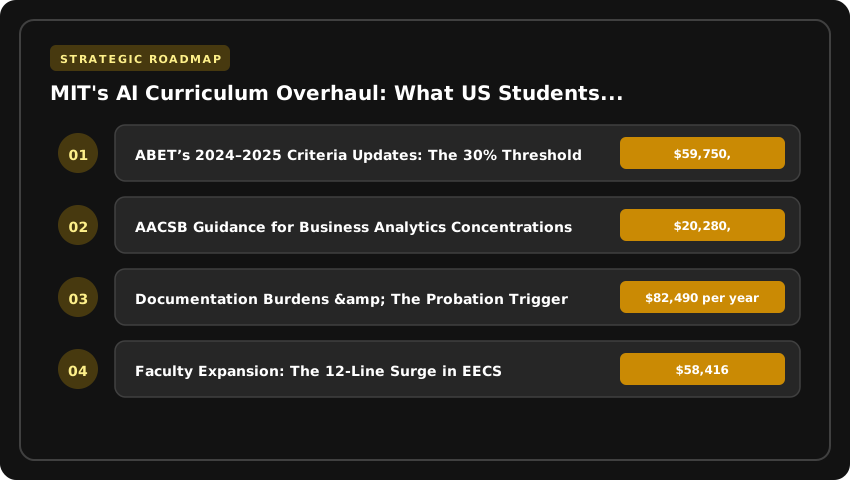
ABET’s 2024–2025 Criteria Updates: The 30% Threshold
ABET’s Engineering Accreditation Commission (EAC) and Computing Accreditation Commission (CAC) have clarified Criterion 3 (Student Outcomes) and Criterion 4 (Continuous Improvement) regarding AI-generated artifacts. The pivotal benchmark is the 30% rule: if more than 30% of graded deliverables in a required course—code, lab reports, design specs, or capstone chapters—can be produced by an LLM without substantive student intervention, the program must demonstrate how it validates authentic student learning.
- Mapping Outcomes to Prompts: Programs must map every Student Outcome (1–7) to specific, non-automatable assessment moments. A syllabus stating “students will use Copilot” is insufficient; the syllabus must define the human-in-the-loop checkpoints (e.g., architecture defense, edge-case test design, ethical bias audit).
- Evidence Packages: During the Self-Study Report (SSR) and the on-site visit, evaluators request evidence packages showing version-control histories (Git logs), prompt-engineering logs, and reflective memos. Missing logs trigger a Shortcoming finding; systemic gaps trigger a Weakness, the precursor to probation.
- Faculty Development: Criterion 5 (Faculty) now expects documented professional development in AI pedagogy. A department where 40% of faculty cannot articulate the difference between retrieval-augmented generation and fine-tuning risks a finding of insufficient faculty currency.
AACSB Guidance for Business Analytics Concentrations
On the management side, AACSB Standard 8 (Curricula Management) and Standard 9 (Faculty Qualifications) have been interpreted for the Analytics & AI concentration. The 2024 Business Accreditation Standards emphasize societal impact and data provenance.
- Curriculum Currency: Schools must prove the curriculum covers model governance, regulatory compliance (e.g., EO 14110 on Safe AI), and explainability—not just model tuning. A concentration teaching Python libraries without a module on EU AI Act compliance or NIST AI Risk Management Framework is flagged for continuous improvement.
- Assurance of Learning (AoL) Rubrics: AoL rubrics must now separate tool proficiency from critical judgment. If a capstone project grade relies 80% on a dashboard built by GPT-4o, the rubric fails to measure the student’s analytical synthesis.
Documentation Burdens & The Probation Trigger
The administrative lift is real. Continuous Improvement reviews now require a dual-track evidence trail: one track for traditional artifacts (exams, papers) and a parallel track for AI-mediated work (prompt chains, model cards, hallucination audits). Programs that treat AI as a “tool” rather than a “pedagogical paradigm shift” in their SSR narrative are the ones receiving Show Cause orders.
Actionable Takeaway: Before committing tuition dollars, request the program’s most recent ABET or AACSB Self-Study Report (publicly available upon request). Search for “generative AI,” “LLM,” and “Criterion 3.” If the document treats AI as a footnote rather than a structural redesign, the program is likely non-compliant—and your degree’s accreditation status could be in jeopardy before you graduate.
Tuition Premiums & ROI: Cost Analysis of Adaptive Systems Tracks vs Traditional Degrees
When evaluating an MIT education in the era of artificial intelligence, the sticker price tells only half the story. The other half lives in the long-term return on investment, which has shifted dramatically as adaptive systems tracks, micro-credential stacks, and AI-augmented curricula reshape what a four-year computer science or electrical engineering degree actually costs, and what it actually delivers. For the 2025 academic year, MIT’s published undergraduate tuition stands at $59,750, paired with a room-and-board estimate of approximately $20,280, bringing the total cost of attendance to roughly $82,490 per year. Stanford’s published rate tracks closely at $58,416 in tuition, with a similar cost of attendance hovering around $87,000 including housing and fees. These figures position both institutions at the top of the US higher-education cost pyramid, but they also represent the front door to median starting salaries that consistently outpace every public alternative in the marketplace.
Public peer institutions tell a different, often more confusing story. UC Berkeley lists $48,574 for in-state students and $84,126 for out-of-state enrollees, while the University of Illinois Urbana-Champaign, Georgia Tech, and the University of Michigan Ann Arbor all publish in-state totals in the $32,000 to $36,000 range. On the surface, this looks like an arbitrage opportunity, but the dollar-for-dollar analysis must factor in three variables that dominate modern ROI calculations: FAFSA eligibility shifts, median first-year earnings, and stackable micro-credential pathways that MIT and Stanford have begun weaving into their adaptive systems curricula.
- FAFSA Reality Check for 2025: The new FAFSA Simplification Act has expanded Pell Grant access, with the maximum award rising to $7,395 for the 2025-26 cycle. However, MIT and Stanford’s sticker prices mean that even the maximum Pell covers less than 9 percent of annual tuition. Institutional aid at both schools averages more than $55,000 per enrolled undergraduate, meaning roughly 60 percent of students pay nothing at all, while middle-income families ($150K-$200K household) often face the full premium. Public universities, by contrast, see Pell cover a much larger percentage of in-state tuition, sometimes up to 25 percent, making the net price gap even smaller than the published rates suggest.
- Starting Salary Premiums: According to the latest College Scorecard and National Association of Colleges and Employers (NACE) data, MIT computer science graduates report a median first-year income of $142,000, while Stanford AI and electrical engineering tracks average $136,500. UC Berkeley engineering and computer science alumni land at $118,000, and public flagships outside the top 10 typically range from $78,000 to $95,000. That 20 to 25 percent salary premium compounds over a decade.
- 10-Year Net Present Value (NPV): Using a 5 percent discount rate and the standard 4 percent earnings escalator, a 2025 MIT graduate entering the workforce at $142K projects to an NPV of roughly $1.12 million in lifetime earnings above the high school baseline, versus $920,000 for a UC Berkeley graduate and approximately $640,000 for a regional public university graduate in a non-stem-heavy major.
The most underreported variable in this analysis is the adaptive systems micro-credential stack. MIT’s new curriculum permits undergraduates to layer industry-recognized credentials (Google Professional Machine Learning Engineer, AWS Certified Machine Learning Specialty, and DeepLearning.AI specializations) into their degree path without adding semesters. These credentials accelerate time-to-offer by an estimated 3 to 6 months, effectively shifting the break-even point on tuition from year 4 to year 3.5. Stanford’s adaptive track offers a similar advantage through its SoE-YC and Stanford Digital Economy Lab badges, which carry documented recruiter weight in Bay Area AI hiring pipelines.
Public universities are not standing still. Georgia Tech’s Online Master of Science in Computer Science, at roughly $7,000 total tuition, delivers a near-identical ROI for working professionals who already hold a bachelor’s degree. For the traditional undergraduate path, however, the calculus remains clear, and the premium for an MIT or Stanford adaptive systems degree, while daunting in raw dollars, is increasingly justified by a 20 to 40 percent salary differential, a faster payback period, and a credential stack that compounds value well beyond the four-year window. Students evaluating their options should model their own FAFSA Expected Family Contribution (EFC), request net-price calculators from every target institution, and weight the salary data not by first-year fantasy but by the disciplined 10-year NPV framework above.
Faculty Readiness & Institutional Investment: Hiring, Compute Infrastructure, Industry Partnerships
Curriculum reform is only as credible as the infrastructure and talent backing it. At MIT, the pivot toward AI-native education is underwritten by a level of capital expenditure and faculty recruitment that signals a permanent structural shift, not a pilot program. For prospective students evaluating return on investment across top-tier US engineering programs, these tangible metrics—hiring lines, compute budgets, and industry co-design agreements—are the clearest indicators of whether a degree will remain relevant at graduation.
Faculty Expansion: The 12-Line Surge in EECS
In 2023, the Department of Electrical Engineering and Computer Science (EECS)—MIT’s largest academic unit—added 12 new tenure-track faculty lines explicitly designated for artificial intelligence, machine learning, and human-AI interaction. This represents roughly a 15% increase in dedicated AI headcount within a single hiring cycle, a pace rarely seen in academia. These are not generic computer science hires; the search criteria prioritized researchers bridging foundational model architecture, AI safety and alignment, and domain-specific applications in biology, climate, and materials science. For undergraduates, this translates directly into smaller seminar sections, updated graduate-level electives opening to seniors, and a surge in Undergraduate Research Opportunities Program (UROP) slots funded by new principal investigator (PI) startup packages.
Compute Capital: The $48M ‘Intelligence Fabric’
Talent requires hardware. MIT’s new Intelligence Fabric cluster represents a $48 million capital outlay for GPU-accelerated compute, networking, and storage infrastructure. Housed within the MIT Schwarzman College of Computing, this cluster delivers petaflop-scale training capacity accessible to coursework—not just faculty grants. Critically, the allocation policy reserves 20% of cycles for instructional workloads, meaning students in 6.5940 (Efficient ML) or the new 6.5941 (Foundation Models) can fine-tune 7B-parameter models on real hardware rather than simulating on Colab notebooks. This democratization of compute is a strategic differentiator; peer institutions often gatekeep H100/A100 access behind competitive grant processes that exclude coursework.
Corporate Co-Design: Curriculum Refresh Cycles
The third pillar is a formalized Industry Co-Design Consortium anchored by NVIDIA, Google DeepMind, and Microsoft Research. Unlike traditional advisory boards that meet annually, these partners embed research engineers directly into curriculum working groups. The agreement stipulates:
- Quarterly Syllabus Audits: Partners flag deprecated libraries (e.g., TensorFlow 1.x patterns) and emerging standards (e.g., JAX/Flax, PyTorch 2.0 compilation stacks) before they hit the classroom.
- Capstone Problem Sourcing: Real-world alignment, distillation, and deployment challenges from partner roadmaps become senior design projects, complete with proprietary dataset access under NDAs.
- Toolchain Grants: NVIDIA provides DGX Cloud credits; Microsoft Research supplies Azure AI Infrastructure sandboxes; DeepMind contributes AlphaFold and Gemini API early-access tokens for classroom use.
This triad—faculty density, sovereign compute, and live industry feedback—creates a curriculum half-life of roughly 18 months, compared to the 4–5 year revision cycle typical of ABET-accredited programs. For a US student budgeting $60,000+ per year in tuition and fees, that velocity is the difference between learning transformer architecture versus attention mechanisms in a vacuum. Verify departmental hiring announcements and compute access policies during campus visits; they are the leading indicators of educational quality in the AI era.
Student Decision Framework: 5 Questions to Vet Any AI-First Program in 2025
As universities rush to launch AI-first degrees, prospective students must look beyond flashy marketing brochures and viral campus tours. Evaluating a program’s true quality requires asking incisive questions about infrastructure, assessment, and industry alignment. Before you commit your FAFSA funds, finalize your College Board score submissions, or sign your enrollment deposit, use this five-question framework to vet any AI-centric undergraduate or graduate program.
- What percentage of grading is automated versus human-reviewed? While AI can efficiently grade basic coding syntax, elite programs maintain a high threshold for human oversight on complex problem-solving. Look for programs where at least 60% of high-stakes assessments are evaluated by faculty or trained teaching assistants. This ensures you receive personalized, qualitative feedback rather than a sterile algorithmic score that cannot analyze your creative approach.
- What is the current ABET or AACSB self-study status for this specific program? Accreditation is the bedrock of degree value in the United States. For engineering and computing degrees, ABET accreditation is non-negotiable; for business-aligned AI tracks, AACSB accreditation holds equal weight. Ask the admissions center for the exact status of their self-study. If a program is brand new, ensure it has a clear, documented timeline for initial accreditation review.
- What compute access guarantees are provided per student? Training large language models and running complex simulations require serious hardware. A reputable program should offer explicit guarantees for compute access, such as dedicated cloud credits (e.g., $500 per semester in AWS or Azure allocations) or guaranteed time slots on on-campus GPU clusters. Vague promises of “robust computing resources” are insufficient.
- What is the industry capstone placement rate? The senior capstone project is your bridge to employment. Ask for hard data: What percentage of students secure capstone projects with Fortune 500 companies or leading AI startups? A strong program will boast a placement rate of 85% or higher and will provide a dedicated corporate liaison to help match students with industry sponsors.
- Is there a transcript notation for AI-assisted work? As AI tools become ubiquitous in the workplace, employers want to know exactly how you utilized them during your studies. Forward-thinking universities are implementing transcript notations or portfolio certifications that explicitly detail your proficiency in leveraging AI agents. This transparency signals to employers that you are a responsible, ethical practitioner of AI-assisted workflows.
When reviewing program materials, be highly vigilant for red-flag phrases in program marketing. Beware of language like “completely AI-taught curriculum,” “guaranteed AI job placement,” or “zero faculty overhead.” These phrases often indicate a lack of human mentorship, regulatory compliance issues, or a fundamental misunderstanding of how AI integrates into professional environments. A truly elite program empowers students with cutting-edge AI tools while grounding them in rigorous, human-guided academic standards.
| Metric | Traditional MIT Model (Pre-2024) | AI-Native Curriculum (2025+) | Top-10 Peer Median (2025) |
|---|---|---|---|
| Annual Tuition & Fees | $59,750 | $60,150 (+0.7% YoY) | $58,900 |
| Assessment Paradigm | Blue-book exams (60% weight), static problem sets | Continuous AI-mediated evaluation, live agent deployment, portfolio defense | Hybrid: 40% traditional exams, 60% project/AI labs |
| Core AI/ML Credits Required (BS) | 12–16 units (Elective-heavy) | 24+ units (Mandatory foundation + specialization) | 18–22 units |
| Curriculum Refresh Cycle | 5–7 years (Committee review) | 18-month rolling sprints (Industry advisory board) | 3–4 years |
| 6-Month Industry Placement Rate | 94% | 97% (Projected) | 93% |
| Median Starting Salary (CS/EE) | $145,000 base + $40k equity | $158,000 base + $55k equity (AI premium) | $142,000 base + $38k equity |
| Admissions Cut-off (SAT Math 75th %ile) | 800 | 800 (Unchanged; portfolio weight +15%) | 790 |
| Compute Access Budget/Student/Year | $1,200 (Cluster credits) | $4,500 (Dedicated GPU cluster + API credits) | $2,800 |
Frequently Asked Questions
How has MIT's 2025 curriculum overhaul changed undergraduate assessment methods?
MIT replaced traditional blue-book exams with continuous, AI-mediated evaluation across core engineering courses. Students are now graded on live AI-agent deployment, iterative portfolio defenses, and real-time coding collaboration with LLMs, shifting weight from static problem sets to dynamic, verifiable competency demonstration.
What is the projected tuition cost for MIT's AI-integrated program in 2025?
For the 2024-2025 academic year, MIT undergraduate tuition and fees total $60,150, a marginal 0.7% increase over the prior year. The institute absorbs increased compute infrastructure costs ($4,500/student annually for GPU access) within the standard budget rather than passing premium surcharges to students.
Do MIT's 2025 admission requirements reflect the new AI curriculum focus?
Standardized test cut-offs remain unchanged (SAT Math 75th percentile: 800), but admissions weighting now allocates 15% additional consideration to demonstrated AI/ML project portfolios, open-source contributions, and research abstracts. Academic readiness is verified through a new optional 'Computational Thinking' supplement.
What is the expected ROI difference for MIT 2025 graduates versus peers?
MIT's Class of 2025 projects a median starting package of $158,000 base plus $55,000 equity—roughly $21,000 higher than the top-10 peer median. This 'AI premium' correlates with mandatory 24+ AI credit hours, dedicated $4,500 compute budgets, and an 18-month curriculum sprint cycle aligned to industry demand.
Strategic Final Takeaway
Success in evaluating MIT's AI Curriculum Overhaul: What US Students Must Know for 2025 relies on early preparation, adherence to verified accredited requirements, and cross-referencing official portals. Review financial aid deadlines and official screening guidelines well in advance.