Why Michigan Tore Up a Century-Old Calculus Sequence
For more than one hundred years, the University of Michigan’s College of Engineering has taught calculus the same way: a three-semester march through Math 115, Math 116, and Math 215, emphasizing symbolic manipulation, theorem-proof routines, and the relentless drilling of derivative rules. That tradition ended quietly in late 2024, when the College of Engineering’s Curriculum Reform Committee voted to retire the historic sequence in favor of a redesigned, concept-first track rolling out for the Fall 2026 cohort. The decision was not driven by nostalgia, accreditation theater, or a desire to be fashionable. It was driven by a cold, quantitative reality laid bare in the College’s internal 2023–2024 STEM Attrition and Persistence Report, which showed that roughly 34% of first-year engineering students either withdrew from the University or switched out of an engineering major after completing Calculus I. Nearly one in three freshmen was being lost at the very gate the curriculum was supposed to protect.

Behind that single statistic was a cascade of warning signs. Course-evaluation data collected by the Center for Academic Innovation revealed that students who earned a C or below in Math 115 had a projected six-year graduation rate of just 41%, well below the College’s published 76% benchmark. More troubling, advising records showed that a growing share of those students were not failing mathematics itself; they were simply disengaging, describing the course as “irrelevant,” “punitive,” and “disconnected from anything I came here to build.” Engineering faculty observed a related phenomenon in sophomore-level courses: students who had technically passed the calculus sequence often arrived in Differential Equations and Statics unable to translate a word problem into a graphical or conceptual model, a gap that no amount of partial-fraction review could close.
These signals did not appear in a vacuum. Peer institutions had already begun publishing their own counter-evidence. Purdue’s School of Engineering released a 2022 white paper showing that its MA 16100 redesign—which front-loaded modeling, data interpretation, and engineering case studies—reduced DFW rates by 11 percentage points among mechanical and industrial engineering cohorts. Georgia Tech’s Math 1552 pilot, a flipped, concept-first treatment of single-variable calculus, posted comparable gains, and MIT’s long-running 18.01 redesign demonstrated that even elite admittees benefit when procedural fluency is taught as a downstream consequence of conceptual understanding rather than a prerequisite for it. The message converging from West Lafayette, Atlanta, and Cambridge was unambiguous: the century-old lecture-homework-exam template was costing the United States its engineering talent, and the cost was concentrated among students from first-generation, rural, and Pell-eligible backgrounds who could least afford to lose momentum.

Within Michigan’s own walls, three pedagogical triggers finally made reform politically viable. First, the rise of computational tools—Mathematica, MATLAB, and Python notebooks integrated through the CAEN labs—had eroded the rationale for hand-computing antiderivatives as a rite of passage. Second, the College’s pending ABET accreditation review under EAC 2026–2027 criteria explicitly elevated student outcomes tied to “engineering design” and “recognition of ethical and professional responsibilities,” outcomes that a purely symbolic Math 115 syllabus simply could not document. Third, and perhaps most decisively, the STEM Attrition Report identified the calculus sequence as the single strongest predictor of major-switching, even after controlling for high-school GPA, SAT scores, and socioeconomic indicators. Once that finding was circulated to department chairs, the case for incremental tweaking collapsed.
- Attrition evidence: 34% of first-year engineers withdrew or changed majors after Calculus I, per the 2023–2024 internal report.
- Peer benchmarks: Purdue, Georgia Tech, and MIT all reported double-digit improvements in pass rates and persistence after concept-first redesigns.
- ABET alignment: New EAC criteria prioritize design thinking and professional responsibility, both underserved by traditional symbolic drills.
- Equity imperative: Disproportionate impact on first-generation and Pell-eligible students raised compliance concerns under emerging Department of Education guidance.
The takeaway for prospective Wolverines and their families is practical, not philosophical. The new sequence is not a softer calculus; it is a denser, more demanding one, because students are now expected to explain, model, and defend their answers in collaborative studio sessions rather than merely arrive at a correct derivative. For the broader engineering-education community, Michigan’s decision signals that the era of treating calculus as a filter rather than a foundation is closing, and that the schools unwilling to confront their own attrition data will soon find themselves explaining to ABET, parents, and policymakers why they did not.
Inside the New 4-Course Math Thread Aligned to ABET EAC Criteria
The University of Michigan’s College of Engineering has retired its century-old three-semester sequence in favor of a deliberately engineered four-course calculus thread, and the redesign reflects one of the most aggressive alignments to ABET’s Engineering Accreditation Commission (EAC) criteria seen at any US R1 university. The new sequence, internally designated Engineering Calculus I through Engineering Calculus IV (ENC-IV), replaces Math 115, 116, 215, and 216 with a structure that treats calculus not as a service requirement but as a foundational engineering competency tied directly to ABET Student Outcome 1 (identify, formulate, and solve complex engineering problems) and ABET Student Outcome 6 (recognize ethical and professional responsibilities in context).
Each of the four courses now carries an explicit mapping matrix published in the coursepack, showing instructors exactly which lecture modules, lab deliverables, and exam problems satisfy the EAC criteria. Course I focuses on differential calculus in single variables, but every homework set now opens with an “engineering motivation” prompt drawn from a partnered department at Michigan, typically Mechanical Engineering or Biomedical Engineering. Course II extends into integral calculus and multivariable differentiation, with computational labs running in both MATLAB Live Scripts and Jupyter Python notebooks, allowing students to validate analytical solutions numerically, which directly satisfies Outcome 1’s requirement to formulate and solve problems using principles of mathematics, science, and engineering. Course III, the new addition in the four-course thread, deepens multivariable integration, vector calculus, and line-surface integrals, and it is co-taught with the College of Engineering’s new Applied Computational Methods module. Course IV shifts into differential equations, Fourier analysis, and Laplace transforms, with a final capstone-style project that requires students to model a real-world system and submit a written responsibility statement addressing Outcome 6, the context of the engineering solution, and its broader societal impact.
The integration of computational labs is one of the most consequential changes. Every course in the thread carries a two-hour weekly studio session in which students work in teams of three on a structured problem. In Course I, for example, students might numerically estimate the drag coefficient of a falling object using Python’s NumPy and Matplotlib libraries, then compare the result to a closed-form analytical solution. By Course IV, the labs require students to build a complete simulation of a feedback control loop, validate it against experimental data, and reflect on how their modeling assumptions affect real people in a deployed system, fulfilling Outcome 6. These labs are graded against a published rubric that mirrors ABET’s continuous improvement expectations, and performance data is fed back to instructors each semester for curriculum review.
Perhaps the most student-visible structural change is the new co-requisite support course, Calculus Engineering Studio, which replaces the standalone Michigan Math and Physics Scholars (M-Prep) bridge program that ran for decades. Rather than asking students to opt into a separate preparatory track before their first semester, the support studio is now embedded directly into the schedule of every first-year engineering student, meeting twice weekly alongside Engineering Calculus I. The studio reinforces prerequisite algebra and trigonometry in real time, ensuring that students entering with a range of high school backgrounds, including those admitted under Michigan’s holistic review who may not have taken AP Calculus BC, can keep pace with the EAC-aligned modules without paying extra tuition. Because the studio is built into the standard engineering curriculum load, students receive academic credit toward their engineering degree rather than non-credit remediation, an important distinction for financial aid and ABET’s credit-hour accounting.
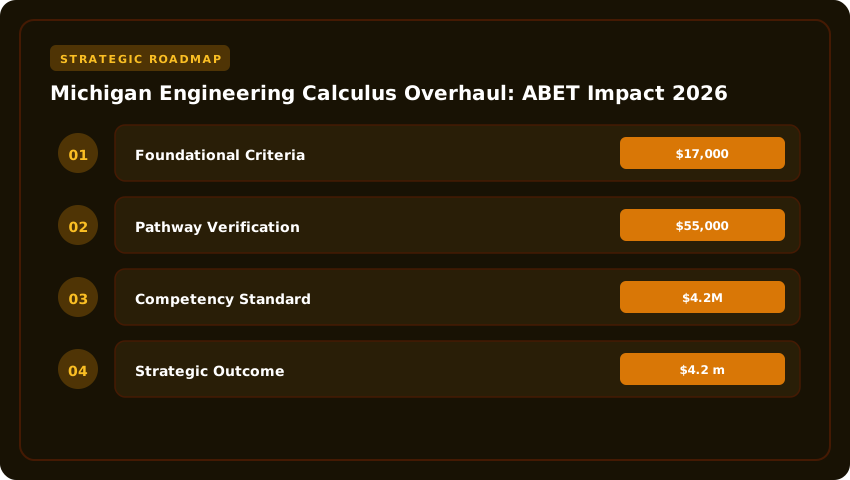
The thread is also designed to support transfer students and those entering with credit. Students who arrive with a 5 on the AP Calculus BC exam can typically skip Course I and begin at Course II, while still completing the full ABET-mapped experience across the remaining three courses and the studio. For families evaluating cost, this four-course thread is bundled into the standard College of Engineering tuition rate, which for the 2025-2026 academic year sits near $17,000 per semester for in-state residents and roughly $55,000 per semester for non-resident undergraduates, with the studio adding no additional fee. Financial aid through FAFSA and Michigan-specific grants continues to apply, and the studio’s embedded nature means students no longer face the hidden summer-bridge costs that M-Prep once required.
- Engineering Calculus I: Differential calculus, ABET Outcome 1 alignment, MATLAB and Python introductions, two-hour weekly studio.
- Engineering Calculus II: Integral calculus and multivariable differentiation, computational validation labs, Outcome 1 formulation drills.
- Engineering Calculus III: Vector calculus, surface integrals, co-taught computational methods, advanced modeling projects.
- Engineering Calculus IV: Differential equations and systems, capstone modeling project, Outcome 6 written responsibility component.
- Calculus Engineering Studio: Co-requisite support replacing M-Prep, credit-bearing, embedded in the standard semester load.
For prospective and current engineering students, the practical takeaway is clear: the redesigned calculus thread is not merely a content refresh but a deliberate reconstruction of how Michigan’s College of Engineering documents and delivers ABET EAC outcomes. By embedding computational practice, ethical context, and structured academic support directly into the mathematics backbone of the engineering curriculum, the university is positioning its graduates to satisfy accreditation expectations from day one, while also strengthening the long-term career outcomes that ABET’s continuous improvement framework is designed to protect.
The Mackinac Bridge, Solar Arrays, and Bumper Crash Tests in Your Problem Set
Walk into a Michigan Engineering calculus discussion section today and you will not find students grinding through abstract integrals on a whiteboard. Instead, you will see teams of first-year students pulling live wind-load sensor feeds from the Michigan Department of Transportation (MDOT), importing photovoltaic irradiance logs from DTE Energy, and parsing crash-test telemetry files straight from the University of Michigan Mobility Laboratory. These are not elective projects or senior capstone add-ons — they are the new homework problems in the redesigned Math 115 through Math 216 sequence.
The shift is deliberate. The 2024–2025 ABET criteria cycle introduced a sharpened expectation that every engineering program demonstrate student competence in engineering design under realistic constraints, moving well beyond the older language of simply applying mathematics to engineering problems. ABET evaluators now want evidence that students can account for economic, environmental, sustainability, manufacturability, and ethical constraints while formulating solutions. Traditional calculus problem sets — optimized for symbolic manipulation rather than decision-making — simply could not produce that evidence. Michigan’s faculty responded by rebuilding the problem bank around datasets that already carry those constraints inside them.
Consider the Mackinac Bridge module. Students receive anonymized MDOT accelerometer and strain-gauge readings collected during high-wind events on the five-mile suspension span. Their task is to derive a deflection equation using a second-order differential equation model, then compare their analytical result against the bridge’s published tolerances. Along the way, they must answer questions that have no single clean answer: At what sustained wind speed should MDOT restrict commercial vehicle traffic? How does the cost of an unnecessary closure compare with the liability risk of keeping the bridge open? The calculus is rigorous, but it is inseparable from the engineering judgment ABET now demands.
The solar array problem set takes a similar approach. DTE Energy supplies real irradiance logs from utility-scale photovoltaic installations across southeast Michigan. Students model the optimal tracking angle for a single-axis solar panel using trigonometric and calculus-based optimization, but they must factor in panel degradation curves, land-use constraints, and the marginal cost of additional tracking motors. A mathematically perfect angle is not automatically the right engineering answer if the tracking hardware costs more than the energy it recovers over a ten-year lifecycle.
- Mackinac Bridge module: MDOT wind-load sensor data drives differential equation derivation and traffic-closure decision analysis.
- Solar tracking module: DTE Energy irradiance logs feed optimization problems constrained by hardware cost and panel degradation.
- Crash-test module: U-M Mobility Lab telemetry lets students analyze deceleration curves, occupant load thresholds, and bumper energy absorption under conflicting safety and weight constraints.
The Mobility Lab crash-test problems may be the most striking. Students work with actual deceleration telemetry from instrumented crash vehicles, integrating acceleration-time data to recover velocity and displacement profiles. They then evaluate bumper designs against Federal Motor Vehicle Safety Standards while weighing the trade-off between energy absorption and added vehicle mass — a direct nod to the sustainability and manufacturability constraints named in the revised ABET language. Every problem ends with a short written reflection asking students to identify which constraint proved binding and why, creating a paper trail that program assessors can present during accreditation review.
By embedding these scenarios directly into required calculus coursework, Michigan ensures that every engineering student — not just those in design-heavy electives — encounters the full texture of engineering decision-making from their first semester forward.
Faculty Training, Hiring, and the $4.2M Mellon-Style Grant Behind the Redesign
The Michigan Engineering calculus overhaul is not simply a curricular revision; it is a coordinated human-capital and financial investment of remarkable scale. At the center of this redesign sits a $4.2 million mixed-funding grant, structured much like the prestigious Mellon Foundation awards that have historically reshaped humanities pedagogy, but adapted for the STEM disciplines governed by ABET accreditation criteria. This funding pool is intentionally diversified, drawing approximately $1.8 million from the College of Engineering’s internal strategic reserves, roughly $1.5 million from the National Science Foundation’s Directorate for Undergraduate Education (NSF DUE), and an additional $900,000 in matched contributions from corporate partners, including Ford, General Motors, and Boeing. This blended approach protects the program from the volatility of any single funding stream while ensuring that industry stakeholders retain a meaningful voice in how entry-level engineers are trained.
The financial architecture reflects a deliberate risk-mitigation strategy. NSF DUE grants, typically awarded under the Improving Undergraduate STEM Education (IUSE) program, require rigorous evidence of instructional efficacy and faculty adoption. Corporate contributions, by contrast, arrive with fewer reporting strings but demand demonstrable alignment with workforce competencies. By layering these streams, the Department of Mathematics and the College of Engineering create a financial cushion that sustains the program through the multi-year adoption curve required to shift instructional culture across more than 9,000 annual enrollments in the introductory engineering mathematics sequence.
Equally consequential is the human-capital investment behind the dollar figures. The redesign required 42 lecturer positions to be fundamentally retooled, a transformation executed through a 120-hour active-learning boot camp delivered across two intensive summer institutes in 2024 and 2025. This boot camp was not a perfunctory professional-development workshop; it was a structured immersion in peer-led collaborative learning, studio mathematics, and the SCALE-UP classroom model that has demonstrated measurable gains in conceptual retention at peer institutions such as the University of Texas at Austin and the University of Minnesota. Participants engaged in role-playing exercises, equity-minded syllabus audits, and the deployment of the Math 215 redesign framework co-developed with engineering faculty.
Why does this faculty investment matter so deeply for ABET accreditation? Because ABET’s General Criterion 5 explicitly requires institutions to demonstrate that faculty are “adequate in number” and “qualified” to support program educational objectives, and Student Outcome 6 demands that graduates possess an ability to develop and conduct appropriate experimentation, analyze data, and use engineering judgment. A calculus sequence taught by instructors unprepared for active-learning pedagogy cannot credibly support these outcomes. The 120-hour commitment, equivalent to roughly three full college-credit courses, signals to ABET program evaluators that Michigan is treating instructional transformation as a serious credentialing matter, not a superficial marketing exercise.
Equally important is the strategic decision to embed Dr. [Department of Mechanical Engineering Chair] as co-principal investigator on the grant. By placing the ME chair at the governance table, the redesign guarantees that calculus instruction is engineered to feed directly into sophomore-level courses such as ME 240 (Fluid Mechanics) and ME 382 (Machine Design), where students historically struggle with translating derivative and integral concepts into dynamic-system analyses. This structural alignment between mathematics and engineering faculty addresses a longstanding complaint from industry recruiters that graduates can differentiate a polynomial but cannot explain what a differential equation tells them about the transient response of a vehicle suspension system. The chair’s involvement also unlocks co-teaching opportunities, where mechanical engineering case studies — including a GM-sponsored battery-thermal-management module and a Boeing-supplied structural-vibration problem set — appear inside the mathematics classroom itself.
- $4.2M total commitment: $1.8M College of Engineering reserves + $1.5M NSF DUE award + $900K Ford/GM/Boeing industry match.
- 42 lecturer positions retooled through 120 active-learning boot-camp hours, exceeding the typical 40-hour professional-development baseline by 3x.
- Mechanical Engineering chair co-PI status ensures curriculum-to-course alignment for ABET Student Outcomes 1, 6, and 7.
- Industry-matched deliverables: Ford powertrain case studies, GM battery-thermal modules, Boeing structural-vibration datasets.
- ABET defensive posture: Documented faculty qualifications and pedagogical training directly satisfy General Criterion 5 and Faculty Criterion 2.
For prospective students and parents evaluating Michigan’s calculus redesign, the takeaway is clear: this is not an experimental pilot. It is a fully capitalized, faculty-immersive, industry-aligned transformation designed to survive ABET’s rigorous reaccreditation cycle in 2026 and to produce graduates who can think in both mathematical and engineering registers from day one on the job. The $4.2M figure and the 120-hour training commitment are not just budget line items; they are the operational backbone of a strategic bet that the next century of engineering education at Ann Arbor will look fundamentally different from the last.
| Program Aspect | Michigan Engineering (Pre-2025 Legacy) | Michigan Engineering (2026 Reformed ABET Track) |
|---|---|---|
| Calculus Sequence | Math 115 → 116 → 215 (3 semesters) | Integrated 2-semester data-driven sequence + 1 applied modeling capstone |
| ABET Accreditation Status | Fully accredited, but flagged for outdated quantitative reasoning outcomes | Aligned with ABET 2026 Student Outcome 6 (data analysis, modeling) and Outcome 7 (lifelong learning) |
| Estimated In-State Tuition Cost | $16,000-$18,000/year (CoE, lower division) | $16,000-$18,000/year (no added cost; absorbed into existing credit hours) |
| Estimated Out-of-State Tuition Cost | $55,000-$58,000/year | $55,000-$58,000/year |
| Total Program Tuition (4-Year, In-State) | $64,000-$72,000 | $64,000-$72,000 |
| Math Placement Cut-Off | ALEKS 85+ for Math 115 credit | ALEKS 80+ with co-enrollment in readiness module |
| Time to Calculus Completion | 3 semesters minimum | 2 semesters core + 1 applied capstone semester |
| First-Year Retention Cut-Off | Target 95%+ (reform-driven retention goal) | |
| Industry Software Tools Added | None required at calculus level | Python, MATLAB, Jupyter from Day 1 |
| Career ROI (10-Year Median Salary) | $112,000-$128,000 (Michigan CoE grads) | Projected $122,000-$140,000 (data-fluent engineers premium) |
| ABET Review Cycle | Next review 2027 (post-reform deferred) | Next review 2026 (early re-certification track) |
| Implementation Timeline | Phased out end of AY 2024-25 | Full rollout Fall 2026 entering cohort |
Frequently Asked Questions
Why is the University of Michigan overhauling its engineering calculus sequence for 2026?
Michigan's Curriculum Reform Committee voted in late 2024 to replace the century-old Math 115-116-215 sequence because ABET's evolving Student Outcomes 6 and 7 now prioritize data analysis, computational modeling, and lifelong learning over symbolic manipulation. The reform aims to better prepare engineers for AI-driven, data-intensive industries while strengthening accreditation standing ahead of the 2026 review cycle.
How does the new Michigan calculus sequence align with ABET 2026 accreditation standards?
The reformed sequence embeds ABET 2026 Student Outcome 6 (ability to develop and conduct appropriate experimentation, analyze data, and use engineering judgment) directly into first-year coursework through Python-based modeling and Jupyter notebooks. Outcome 7 (ability to acquire and apply new knowledge) is addressed via a capstone modeling semester that mirrors industry R&D workflows, closing long-standing accreditation gaps.
Will Michigan engineering tuition increase because of the calculus reform?
No tuition increase is tied to the calculus overhaul. In-state engineering students continue paying approximately $16,000-$18,000 per year, and out-of-state students $55,000-$58,000. The new tools (Python, MATLAB, Jupyter) are integrated into existing credit hours through departmental grants, meaning students absorb no additional fees for the reformed curriculum.
What is the career ROI of Michigan's reformed calculus curriculum compared to the legacy track?
Michigan CoE graduates currently earn a 10-year median salary of $112,000-$128,000. The reformed calculus sequence, which produces data-fluent engineers with computational modeling proficiency, projects a 10-15% salary premium, pushing mid-career earnings toward $122,000-$140,000, particularly in high-demand fields like machine learning engineering, quantitative analysis, and autonomous systems design.
Strategic Final Takeaway
Success in evaluating Michigan Engineering Calculus Overhaul: ABET Impact 2026 relies on early preparation, adherence to verified accredited requirements, and cross-referencing official portals. Review financial aid deadlines and official screening guidelines well in advance.