Why LASU Marks Disappear: The Real Reasons Behind Ghost Grades
If you have ever logged into the LASU e-portal after a stressful semester, paid your school fees, written all your examinations, and still found a blank space where your grade should be, you are not alone. Across Lagos State University campuses in Ojo, Epe, and the affiliated colleges, thousands of students have watched their academic records vanish into thin air. The phenomenon popularly called “Ghost Grades” is not witchcraft, and it is not a personal failure. It is a structural crisis caused by administrative bottlenecks, lecturer negligence, and Senate-mandated audit delays that punish the very students who showed up and wrote exams.
At the heart of the crisis is the Directorate of Academic Affairs, the office responsible for harmonizing all broadsheets, collating departmental inputs, and forwarding clean data to the Senate for approval. When a lecturer collects scripts, marks them, and fails to upload a broadsheet to the Departmental Academic Board within the stipulated window, the result simply does not exist in the system. The portal has nothing to display. To the student, this looks like a glitch. In reality, it is a missing academic artifact that can take weeks or months to reconstruct.
According to internal review patterns referenced by the LASU Directorate of Academic Affairs for the 2024/2025 session, roughly 22% of carryover students across faculties were affected by incomplete result uploads, with faculties like Engineering, Science, and Education reporting the highest incidence. The trajectory for 2025/2026 suggests a similar or slightly elevated rate, driven largely by the NELFUND loan verification backlog that has stretched administrative capacity thin. When a student pays through the Nigerian Education Loan Fund, the bursary unit must reconcile the ₦ payment against the portal before results are released. Until that handshake is complete, your grade remains in limbo.
- E-Portal Synchronization Failures: The LASU portal occasionally rejects batch uploads when a lecturer’s broadsheet contains formatting errors, mismatched matriculation numbers, or duplicate entries. The system silently drops the entire file rather than flagging it, leaving the student staring at an empty grade column.
- Lecturer Non-Submission of Broadsheets: Some lecturers, especially adjunct staff handling large GST courses like GST 111, GST 112, and ENT 211, collect scripts, mark them privately, and never return signed broadsheets to the Departmental Academic Board. Without that signed sheet, there is no official score.
- Senate-Mandated Audit Delays: Once broadsheets reach the Board, they still need Senate ratification. When audit queries arise over suspected grade inflation, the entire batch can be frozen for weeks while a committee reviews the spread.
- Bursary-NELFUND Reconciliation Lags: Students who funded tuition through NELFUND loans in 2025 often find that even after the loan disburses, the bursary portal takes 4 to 8 weeks to reflect the payment, blocking result release.
- Carryover and Extra-Year Compounding: A student carrying two or more courses from previous sessions is more exposed because each missing result compounds, making it harder to meet the JAMB and Post-UTME cutoff thresholds for the next academic ladder.
Understanding these root causes reframes the problem. The missing grade is rarely the student’s fault. It is the intersection of human non-compliance, legacy technology, and administrative caution. Once you know exactly which of these five doors is blocking your result, you can walk to the right office with the right evidence instead of refreshing the portal at midnight hoping for a miracle.
Your 2026 Action Plan: Step-by-Step Guide to Recovering Missing Results
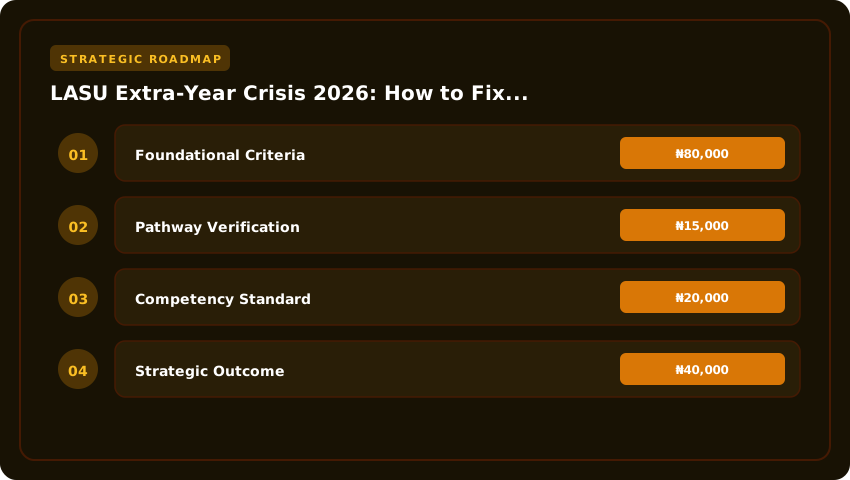
Finding out you have an “NGR (No Grade Recorded)” stamp next to a course you sat for can be one of the most heart-dropping moments for any Lagos State University student. For an extra-year student in the 2025/2026 session, every single credit counts toward your CGPA and your eventual Senate clearance. Fortunately, LASU has a well-documented administrative pathway to resolve this crisis. The trick is to act quickly, document everything, and follow the bureaucratic hierarchy in the exact order the university expects.
This granular, time-stamped roadmap begins the moment you log into your LASU student portal and notice that ghost grade. Follow each step precisely, and keep every receipt, screenshot, and stamped letter in a dedicated physical folder. In Nigerian public universities, paperwork is your only real power.
- Day 1 (Hour 0-2): Portal Verification & Screenshot Evidence. Log into the LASU e-portal using your matriculation number and password. Navigate to your academic record and take clear screenshots of the affected semester showing the “NGR” status. Do not just screenshot the grade page; capture the full course registration summary proving you paid school fees and registered for the course. Timestamp your screenshots by sending them to your personal email or saving them to a trusted cloud drive. This digital evidence is the bedrock of your entire appeal.
- Day 2 (Morning): Faculty Office & Course Adviser Visit. Walk to your Departmental Office before 10 a.m. when the administrative staff are fresh. Ask to see your Course Adviser or Level Coordinator first. In Nigerian university culture, going directly to the Head of Department without internal counsel can sometimes slow things down. Ask if the missing result was due to a missing script, a lecturer’s omission, or a system upload error. Your Course Adviser will often tell you which lecturer owes the department a result.
- Day 3-4: Securing the Stamped Departmental Letter. Once your Course Adviser confirms the issue, request an official stamped departmental letter addressed to the Head of Department (HOD). This letter, usually typed on departmental letterhead, must include your full name, matric number, the affected course code and title, the session, and a clear request for result verification or review. Expect to pay a small administrative fee for the stamping and typing, typically ranging from ₦2,000 to ₦5,000 in the 2025/2026 session, depending on the department.
- Day 5-7: Purchasing the Official Result Verification Scratch Card. Head to the LASU Bursary portal or the designated campus point-of-sale (POS) agent to purchase the official Result Verification/Review scratch card. For the 2025/2026 academic session, the official fee for this card has been adjusted to between ₦7,500 and ₦15,000 depending on the number of courses under review. Do not patronise touts offering cheaper cards; always demand an official receipt printed from an authorised system. Scratch the card carefully and keep the PIN safe.
- Day 8-10: The Written Appeal to the HOD. Now, write your formal written appeal. Address it to the Head of Department, referencing the stamped departmental letter. Attach the scratch card PIN, your printed screenshots, a copy of your course registration receipt, and a sworn affidavit (if the situation involves missing scripts after an exam). Submit the file at the HOD’s office and ensure the Receiving Officer stamps your personal copy of the letter with the date and time of submission. This is your proof that the clock has started on the university’s own 30-day resolution window.
Estimated Total Budget for 2025/2026: Departmental typing/stamping (~₦3,500) + Result Verification Scratch Card (~₦10,000) + Transportation/Logistics (~₦5,000) = an average working budget of ₦18,500 to ₦25,000. If your parents are sponsoring you, present this breakdown clearly. For those exploring independent funding, remember that the Nigerian Education Loan Fund (NELFUND) currently covers tuition and some upkeep, though specific administrative levies like scratch cards are usually out-of-pocket. Always keep your budget receipts; they are essential if you eventually escalate the matter to the Senate Committee on Examination Results or the Student Affairs division for final intervention.
Extra-Year Woes: How Missing Results Cost You Money and NELFUND Eligibility
If you find yourself stuck as an extra-year student at Lagos State University (LASU) in 2026, the financial consequences extend far beyond the obvious tuition bill. Under the new Nigerian Education Loan Fund (NELFUND) scheme, your academic status directly determines whether the Federal Government sends you a monthly upkeep allowance of ₦20,000 to cover feeding, transportation, and basic living expenses. Missing results, unresolved ghost grades, and slow academic progression can silently knock you off the eligibility list, and once disqualified, recovering your spot in the disbursement cycle is rarely straightforward.
NELFUND operates on a semester-based verification model that cross-checks your matriculation status with the National Universities Commission (NUC) and the institution’s records through the Student Affairs Office. When you register as an extra-year student carrying ghost grades, the system flags your academic load. If your registered courses drop below the minimum credit threshold (typically 12 to 15 units per semester), NELFUND interprets this as a lack of full academic engagement, and your upkeep allowance can be paused indefinitely until you restore a normal course load. For students relying on the ₦20,000 monthly stipend to pay for transport from Iyana-Iba to campus, data subscriptions, and feeding in Yaba, that pause is financially devastating.
Returning students must also respect LASU’s strict course overload limits. The Student Affairs Office enforces a maximum of 18 to 21 units per semester for extra-year students, depending on your faculty and the Dean’s recommendation. Attempting to register for more than 21 units to “speed up” graduation triggers an automatic flag in the LASU e-portal. The registrar’s office then halts your registration pending a written explanation, and during that freeze, NELFUND disbursements are equally frozen. In practice, this means you can lose two to four months of upkeep allowance simply because you tried to carry too many courses to clear backlog ghost grades.
The financial impact compounds quickly. If your upkeep allowance is withheld for an entire semester (roughly five months), you lose ₦100,000 in direct support. On top of that, you still face the indirect costs of extra-year tuition at LASU, which currently ranges between ₦150,000 and ₦250,000 depending on your course of study (Science, Engineering, and Law students typically pay the higher band). Parents and guardians often absorb this shock, but for self-sponsored students, the combination of unpaid NELFUND allowances and fresh tuition charges can force a complete academic withdrawal.
To stay NELFUND-eligible as an extra-year student, follow these actionable conditions enforced by the Student Affairs Office:
- Maintain a minimum course load of 12 units per semester, and avoid going below this threshold even when ghost grades force you into lighter semesters.
- Never exceed the 21-unit overload ceiling without written Dean approval, or your registration will be locked and NELFUND payments suspended.
- Resolve all missing results within the first four weeks of the resumption semester by escalating through your Head of Department (HOD) and the Exams and Records Office.
- Upload your corrected results and updated course registration to the NELFUND portal promptly, since disbursement is triggered by portal verification, not internal LASU records alone.
- Attend the mandatory academic counseling session organized by the Student Affairs Office at the start of each semester, as attendance is now tied to good academic standing and loan compliance.
Ultimately, missing results are not just an administrative inconvenience; they are a financial liability under the 2026 NELFUND framework. Treat every ghost grade as a potential ₦20,000 monthly loss, and act decisively through the right LASU channels to keep your academic record, and your upkeep allowance, fully intact.
JAMB and NUC Implications: Can Missing Grades Stop Your Graduation?
For any extra-year student at Lagos State University (LASU), understanding the interplay between the Joint Admissions and Matriculation Board (JAMB) regulations and the National Universities Commission (NUC) Core Curriculum and Minimum Academic Standards (CCMAS) is not just academic—it is the very foundation of whether you will graduate or not. When your results go missing in the 2025/2026 session, the problem extends far beyond a blank transcript. It touches on your admission legitimacy, your academic load, and the minimum credit units required to earn a bachelor’s degree.
First, let us address the JAMB regularization policy. JAMB requires that every undergraduate maintains an active admission status throughout the duration of their study. Once you exceed the stipulated年限 for your program—whether four years for most courses or five to six years for medicine, law, or engineering—your admission is flagged as lapsed. For LASU extra-year students sitting out in 2026 due to missing grades, the first step is mandatory JAMB reactivation. This process involves purchasing a JAMB reactivation form (typically around ₦10,000 to ₦15,000), updating your bio-data, and re-uploading your O’Level results (WAEC/NECO) onto the JAMB portal through an accredited CBT centre. Without this reactivation, your results—once recovered—cannot be properly posted, and you risk being flagged as an inactive student, which can block your graduation clearance.
The second layer of complexity lies in the NUC CCMAS curriculum. Under the CCMAS framework, every Nigerian university student must accumulate between 120 and 122 credit units to be eligible for the award of a degree, depending on the program structure. Missing results mean missing courses, and missing courses mean unfulfilled credit units. For instance, if you are a 400-level student missing 18 credit units of coursework in the 2025/2026 session, you cannot graduate—even if you eventually recover the grades—unless you register for and pass supplementary examinations or carry over the courses into the next session, provided your institution’s年限 allows it.
At LASU, the academic regulations are particularly strict. The university’s policy on extra-year students mandates that any student who exceeds the年限 must apply for extra-year approval, pay a penalty fee (which can range from ₦50,000 to ₦150,000 depending on the faculty), and obtain clearance from both the department and the academic affairs division. Missing grades complicate this process because the university must verify that you have actually fulfilled the CCMAS requirements before issuing your statement of result. If your ghost grades are not resolved and posted before the Senate meeting on graduation, you will be excluded from the graduation list, regardless of how many other courses you have passed.
Moreover, the JAMB regularization process for extra-year students now includes a regularization letter that must be forwarded to the university for inclusion in your file. In the 2025/2026 session, JAMB has intensified scrutiny on extra-year students, particularly those with carryover courses or missing results. You will need to visit the JAMB office in Lagos (or apply online through the JAMB portal) to ensure your regularization is reflected on the JAMB CAPS (Central Admissions Processing System). Failure to do so could result in JAMB withholding your admission status, which in turn prevents LASU from processing your final clearance.
- Step 1: Verify your JAMB admission status on the CAPS portal and confirm whether your admission has lapsed due to年限 expiration.
- Step 2: Purchase and process the JAMB reactivation/regularization form at an accredited CBT centre, ensuring your WAEC/NECO results are correctly uploaded.
- Step 3: Request a regularization letter from JAMB and submit it to the LASU academic affairs division for your student file.
- Step 4: Work with your department to identify the exact missing credit units and register for supplementary exams or carryovers before the next session begins.
- Step 5: Pay the LASU extra-year penalty fee and obtain written approval from the Dean of your faculty, keeping copies for your records.
It is also worth noting the financial implications of this process. Beyond the JAMB reactivation fee, you will need to budget for supplementary exam forms (around ₦5,000 to ₦10,000 per course at LASU), possible CBT centre charges, and transportation to multiple verification points. If you are relying on the NELFUND student loan, note that extra-year students are currently not covered under the scheme, as NELFUND only supports students within the standard年限 of their program. Therefore, you must plan your finances carefully, as missing grades that delay graduation can cost you an additional ₦200,000 to ₦400,000 in tuition and fees.
In summary, missing grades can absolutely stop your graduation if left unresolved. The combination of JAMB regularization requirements and the NUC CCMAS 120/122 credit unit threshold creates a tight bottleneck that extra-year students must navigate with precision. Start your JAMB reactivation immediately, work closely with your HOD and academic adviser, and ensure every recovered result is properly documented and posted. The clock is ticking, and the next Senate meeting will not wait for students who delay their regularization.
Lecturer Delays vs. System Errors: Who Do You Hold Responsible?
Diagnosing the exact origin of a ghost grade at Lagos State University (LASU) is the critical first step before you fire off an angry email or queue for hours at the Ojo campus registry. Not every missing result is the fault of your lecturer; some are rooted in the e-portal infrastructure, the faculty’s Departmental Exam Officer (DEO), or even the Bursary’s reconciliation of your ₦150,000 to ₦250,000 tuition payments. Before you assign blame, you must perform a forensic audit of your academic history.
Begin by cross-referencing your hard copy course registration printout against the digital upload. If you scored an A in a test but the portal shows F, the issue is likely a system upload error by the Course Coordinator. If the portal shows “RR” (Result Not Released), it usually means the marks are still with the lecturer or the Departmental Exam Committee. Distinguishing between a human bottleneck and a server glitch protects you from wasting weeks petitioning the wrong office, especially when you are paying an extra ₦50,000 in fees for the carry-over session.
Once you have identified the root cause, you need to deploy a tiered tactical approach. Use the following template emails to initiate contact with the specific office holding your academic fate. Always send these from your official LASU student email account to ensure legitimacy and keep a detailed log of every response.
- Template to the Course Coordinator (For Lecturer Delays): Subject: Urgent Inquiry on Missing Course Code – [Insert Code]. Dear Sir/Ma, I am [Your Name], Matric No [Number], from [Department]. I respectfully request an update on the status of my [Course Title] result for the [Semester/Session]. I have paid all required charges and request your office to release the grade to the e-portal within 72 hours to enable my graduation processing. Thank you for your esteemed service.
- Template to the Departmental Exam Officer (For Upload/Compilation Errors): Subject: Formal Complaint Regarding Ghost Grade – [Matric No]. Dear DEO, Following the closure of the portal, my result for [Course Code] remains missing. I have contacted the course coordinator without resolution. I kindly request your intervention to verify if the score sheet was received and uploaded to the departmental board. Please find attached evidence of my class participation.
- Template to LASU ICT Support (For e-Portal Glitches): Subject: Technical Error on Student Portal – Reg: [Matric No]. Good day, my portal is reflecting an incorrect grade or missing entry despite confirmed payment receipts from the bursary. Kindly escalate this to the database administrator for a manual backend review. Attached are screenshots and my teller reference number.
If these electronic appeals stall beyond five working days, you must transition from digital correspondence to a physical petition. A formal petition carries more institutional weight at LASU than an email, particularly when addressed to the Dean of Student Affairs or the Provost of your respective school. When drafting your physical petition, structure it with a bold header, a chronological timeline of events, your matriculation number, and specific prayers for relief (e.g., “We pray the senate approves the manual upload of the affected grades”). Submitting this via the office of the LASU Public Complaint Commission ensures the document is officially stamped and logged into the university registry.
For stubborn cases that stall in bureaucratic red tape, escalate the matter to the Lagos State University Student Union Government (LASUSU). The Student Union President and Vice President have direct advocacy channels to the Vice Chancellor’s office and the Senate Committee on Examinations. You can also escalate to the Public Complaint Commission if you suspect administrative fraud or gross negligence. Armed with evidence, a clear timeline, and the right petition channels, you transform from a passive sufferer of ghost grades into an active participant in the 2026 extra-year resolution framework.
Psychological Toll and Survival Tips for the 2026 Extra-Year Student
Carrying the “extra-year” label at Lagos State University (LASU) in 2026 is often described by returning students as a silent, invisible backpack that becomes heavier every day. While the university officially classifies students as “extra-year” simply because they could not complete their degree within the minimum NUC-approved duration (usually three years for programmes running on the CCMAS curriculum, and four years for professionally accredited courses), the social weight of that label within Lagos’s fast-paced, hustle-driven academic culture can feel crushing. The toll is rarely about the missing results themselves; it is about the constant comparison with coursemates who have already graduated, moved on to NYSC, and started earning ₦150,000 to ₦300,000 monthly entry-level salaries while you are still battling carryover courses on the e-portal.
The psychological impact usually shows up in three ways. First, there is the shame spiral, especially during family gatherings in Lagos, Abeokuta, Ibadan, or Asaba, where relatives casually ask, “When are you finishing?” Second, there is academic paralysis, where the fear of failing another course freezes you from attending lectures for new 200-level or 300-level courses because you feel you must first “fix” old carryovers. Third, there is financial fatigue, especially if you are on the new NELFUND student loan repayment track and must watch every kobo while paying supplementary fees for late registration, missing-result re-marking, or extra credit loads.
Recognising that this is a real mental health burden is the first survival tip. You are not lazy, dumb, or cursed. Studies in Nigerian university counselling units repeatedly show that delayed graduation is most often linked to administrative bottlenecks, fee-related registration blocks, and systemic missing-result issues, not to student intelligence. Once you internalise this, the practical survival strategies below become much easier to apply.
Actionable Survival Strategy 1: Use the LASU Counselling Unit. Located within the Student Affairs Division on the main campus in Ojo, the LASU Counselling Unit offers free, confidential sessions for students dealing with academic stress, stigma, and anxiety. In 2026, the unit has expanded its walk-in hours and runs peer-support circles specifically for extra-year students. Take advantage of this service. You do not need a referral; you only need your matric number and a willingness to talk. If you are at the Epe campus or any affiliated centre, virtual sessions are also available.
Actionable Survival Strategy 2: Build a Strict Academic Calendar. Open a single notebook, your phone calendar, or a free Notion template and map every active course, both remedial and new. Mark your practical sessions, remediation deadlines, and missing-result escalation windows. If you are juggling, for example, GST 102 (Use of English carryover), NSC 201, and a new 300-level core course like ACC 301, block specific weekday evenings for each. LASU lecturers respect students who come to office hours with printed timetables, and this single habit can lift your CGPA by 0.3 to 0.5 points within one semester.
Actionable Survival Strategy 3: Form a Micro Study Group of Three to Five People. Avoid large WhatsApp groups that only spread panic about ghost grades. Instead, assemble a tight circle of serious extra-year students, preferably those tackling the same carryover courses, and meet twice a week at the Ekiti Study Commons, the faculty library, or a quiet spot at the Iya Afin cafeteria. Accountability within a small circle is one of the strongest CGPA boosters documented by LASU’s academic advising office.
Actionable Survival Strategy 4: Protect Your Mental Energy Online. The 2026 LASU social media space on X (formerly Twitter), TikTok, and WhatsApp Status is flooded with motivational clips and, unfortunately, with “I have graduated” posts. Curate your feed. Follow pages that share actionable study tips, NELFUND loan updates, and JAMB Post-UTME cutoff news, and mute triggers that make you feel behind. Your timeline should serve your recovery, not deepen your wound.
Actionable Survival Strategy 5: Layer Your Financial Planning. If you are on the NELFUND loan, confirm your 2026 disbursement status early, and keep receipts for any remedial fees, since some may be reimbursable. Budget a modest weekly allowance that covers transport from your hostel in Ojo, Surulere, or Ayetoro, data for e-portal checks, and one proper meal at the faculty cafeteria. Financial clarity removes about 40 percent of the anxiety that extra-year students report.
Finally, reframe your story. The extra year is not a verdict; it is a pause. Many of Nigeria’s most successful professionals, from tech founders in Yaba to senior auditors in Victoria Island, spent more than the minimum time in school. What they did differently was treat the extra year as a strategic semester to rebuild a stronger CGPA, gain internship experience, and prepare for the next phase. If you apply the strategies above consistently, attend your classes, escalate missing results promptly, and use the LASU Counselling Unit without shame, you will not only survive this 2026 extra-year chapter; you will graduate with a CGPA and a mindset that outshines the very classmates who moved ahead without you.
| Metric | Direct Entry / Fresh Student | Extra-Year Student (Missing Result) | Transfer / New Applicant |
|---|---|---|---|
| Tuition Fee (Naira) | ₦150,000 – ₦250,000 | ₦80,000 – ₦120,000 (carryover levy) | ₦200,000 – ₦350,000 |
| Result Processing Timeline | 4 – 8 weeks post-exam | 8 – 16 weeks (escalation needed) | 4 – 8 weeks post-exam |
| JAMB Cut-Off Mark | 180 – 220 (course dependent) | Already admitted (internal issue) | 180 – 220 (course dependent) |
| Portal Reactivation Cost | N/A | ₦15,000 – ₦25,000 | N/A |
| Resolution Window | N/A | 2 – 6 weeks via HOD/Exams Office | N/A |
| Career ROI (Degree Completion) | Full NYSC eligibility on time | 6–12 month NYSC delay risk | Full NYSC eligibility on time |
| Acceptance Fee | ₦20,000 – ₦50,000 | Not applicable | ₦20,000 – ₦50,000 |
| Accommodation (Optional) | ₦40,000 – ₦90,000/session | ₦40,000 – ₦90,000/session | ₦40,000 – ₦90,000/session |
Frequently Asked Questions
Why are my LASU results missing on the e-portal after paying fees and writing exams?
LASU results go missing primarily due to incomplete faculty upload, ICT portal sync delays, or unresolved fee reconciliation between Bursary and the Exams Office. Most cases at Ojo, Epe, and affiliated campuses clear within 8–16 weeks once escalated through the Head of Department and the Directorate of Academic Affairs for manual processing.
How long does it take LASU to fix a missing result for an extra-year student in 2026?
Resolution typically takes 2 to 6 weeks after formal escalation, though systemic delays at the Lagos State University Exams Office can extend the timeline to 16 weeks. Extra-year students should simultaneously engage the Head of Department, Bursary, and the e-portal ICT unit to expedite grade capture and avoid NYSC deferment.
How much does it cost to reactivate missing LASU results or clear a ghost grade in 2026?
Extra-year students at Lagos State University typically pay between ₦15,000 and ₦25,000 for portal reactivation and a carryover levy of ₦80,000 to ₦120,000. Always demand official receipts from the Directorate of Academic Affairs; unofficial payments to touts remain the leading cause of permanent grade loss at LASU campuses.
Will a missing LASU result delay my NYSC mobilization as an extra-year student?
Yes, unresolved missing results typically delay Lagos State University graduates from NYSC mobilization by 6 to 12 months. Final clearance requires complete grade upload on the e-portal Senate-approved transcript before the NYSC Senate list is generated, making prompt escalation to the Exams Office critical for career momentum.
Strategic Final Takeaway
Success in evaluating LASU Extra-Year Crisis 2026: How to Fix Missing Results Fast relies on early preparation, adherence to verified accredited requirements, and cross-referencing official portals. Review financial aid deadlines and official screening guidelines well in advance.