The Vanishing Woodshop: How Federal Perkins CTE Funding Reshaped US High Schools
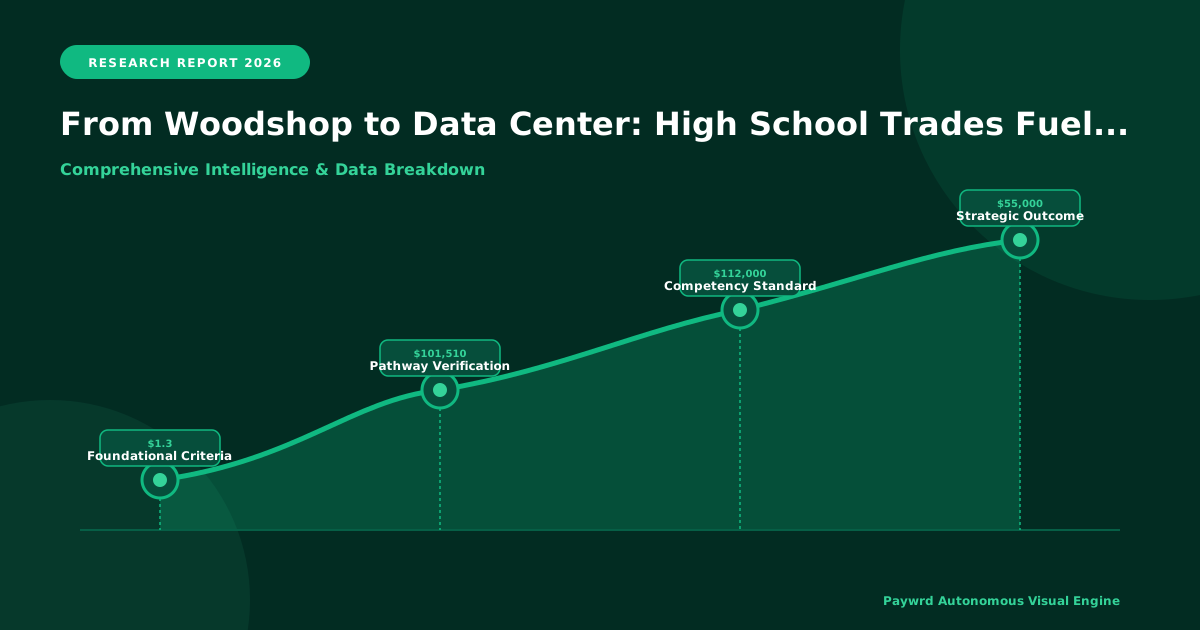
Few transformations in American secondary education have been as quietly dramatic as the disappearance of the high school woodshop. For decades, the scent of sawdust, the hum of band saws, and the clang of metal lathes defined the industrial arts wing of public high schools. Today, those spaces increasingly house fiber-optic cabling trays, 3D printers, and rows of networking switches. The driving force behind this metamorphosis is the Strengthening Career and Technical Education for the 21st Century Act (Perkins V), signed into law in 2018, which authorized approximately $1.3 billion in annual federal CTE funding through the 2026 fiscal cycle. State CTE directors, empowered by Perkins V’s local-flex accountability provisions, systematically redirected these allocations away from traditional Industrial Arts pathways and into Information Technology, Cybersecurity, and Data Infrastructure clusters.
The mechanics of this shift are rooted in Core Program Performance Indicators (CPIs). Under Perkins V, states must report postsecondary placement, credential attainment, and non-traditional participation metrics. Programs classified under CIP 48.9999 (Industrial Arts, General) historically struggled to demonstrate competitive wage placement outcomes compared to programs aligned under CIP 11 (Computer and Information Sciences). As a result, state directors in career and technical education reorganized their NASDTEC-aligned program matrices to prioritize concentrations that delivered measurable ROI under the federal accountability framework.
California provides a textbook case study. The California Department of Education’s Career Technical Education Incentive Grant (CTEIG) program, supplemented by Perkins V allocations, reports that enrollment in Information Technology and Software Development pathways grew by approximately 38% between the 2019-20 and 2023-24 academic years. During the same window, Industrial Arts and traditional Wood Products pathways experienced double-digit enrollment erosion. California’s Division of Apprenticeship Standards now recognizes IT support technician and network operations pathways alongside (and often surpassing) cabinetmaking and machining apprenticeships.
Texas tells a parallel story at scale. With more than 1.4 million CTE concentrators statewide, the Texas Education Agency reweighted its Perkins V state plan to elevate Cybersecurity (CIP 11.1003), Cloud Computing, and Data Science clusters. Districts such as Dallas ISD, Houston ISD, and Cypress-Fairbanks ISD repurposed former industrial arts facilities into STEM-focused career academies. Enrollment in IT Infrastructure pathways in Texas grew by an estimated 42% during the Perkins V implementation period, while Manufacturing-Agriculture-Construction pathways saw only modest gains. State CTE directors explicitly cite labor market alignment with Texas Workforce Commission projections, which forecast IT occupations growing at roughly 2.8% annually through 2032, far outpacing traditional skilled-trades sectors.
Ohio’s trajectory is equally instructive. The Ohio Department of Education’s Office of Career-Technical Education administers Perkins V funds through its (closing tag forthcoming) comprehensive Secondary Career-Technical Education programs, requiring each district to demonstrate stackable credential outcomes. The state’s New Skills Ready initiative, backed by JPMorgan Chase and managed in coordination with the National Governor’s Association, pushed districts aggressively toward IT and advanced manufacturing pathways aligned to Industry 4.0. According to Ohio’s annual CTE enrollment reports, IT pathway participation grew by approximately 35% between 2020 and 2024, while traditional Industrial Arts programs continued to contract.
Florida has perhaps executed the most aggressive reorganization. The Florida Department of Education’s Division of Career and Adult Education restructured its program offerings to align with CAPE (Career and Professional Education) incentives, prioritizing digital technology, cybersecurity, and IT infrastructure certifications. Florida’s CTE enrollment data show IT pathway participation growing by over 50% since Perkins V implementation. Districts like Hillsborough County Public Schools and Miami-Dade County Public Schools converted former shop buildings into cybersecurity labs and data center training facilities, often funded through Perkins V’s non-traditional funding reserve allowances.
- California: IT/Software enrollment up ~38%; Industrial Arts down double digits.
- Texas: IT Infrastructure pathways up ~42%; Manufacturing-Agriculture-Construction modestly up.
- Ohio: IT pathway participation up ~35% (2020-2024); New Skills Ready initiative driving alignment.
- Florida: IT pathway participation up over 50%; CAPE incentives prioritizing digital credentials.
According to NCES data and classifications referenced in the CIP 2020 taxonomy, Industrial Arts (CIP 48.9999) pathways have experienced a steady contraction, with many state education agencies consolidating or sunsetting the classification entirely. The Department of Education’s National Center for Education Statistics longitudinal data confirm what high school visitors observe firsthand: the woodshop door now opens onto a data center. Federal Perkins CTE funding, channeled through state accountability frameworks and NASDTEC-aligned program standards, has fundamentally rewritten the American high school CTE experience, redirecting students from band saws and welding tables toward server racks, Python scripts, and cybersecurity credentials that align with the 2026 STEM economy.
Server Rack Credentials: CompTIA, Cisco, and AWS Academy Replace the Toolbelt

Across the United States, the familiar scent of sawdust and varnish in American high schools is being steadily replaced by the quiet hum of cooling fans and the glow of rack-mounted LEDs. The toolbelts that once hung on pegboard walls are giving way to structured cabling kits, and the workshop apron has been traded for a campus ID badge granting access to a cloud lab. This shift is not merely cosmetic; it represents a deliberate, federally-supported recalibration of Career and Technical Education (CTE) under the Strengthening Career and Technical Education for the 21st Century Act (Perkins V). Today’s high school trades students are increasingly earning stackable, industry-recognized credentials before they ever set foot on a college campus, embedding server rack credentials directly into their daily curriculum.
The certification backbone of this movement rests on four major credentialing bodies that have partnered with school districts nationwide. CompTIA, the Computing Technology Industry Association, offers a clear pathway beginning with the IT Fundamentals (ITF+) certification. Designed for absolute beginners, ITF+ validates baseline knowledge in IT concepts, infrastructure, applications, and software development, serving as the equivalent of a pre-apprenticeship for digital infrastructure. Students typically progress to the CompTIA A+ certification, which is widely regarded as the industry standard for entry-level IT technicians and covers hardware, networking, mobile devices, and troubleshooting across multiple operating systems. For those specializing in connectivity, the CompTIA Network+ credential certifies the skills needed to design, configure, manage, and troubleshoot both wired and wireless networks. According to the U.S. Bureau of Labor Statistics, Network+ aligned roles consistently fall within the 15-1242 database for Database Administrators and 15-1212 Information Security Analysts occupational categories, both of which project robust demand through 2032.
Equally transformative is the partnership between high schools and Cisco Networking Academy, which now provides two foundational credentials tailored specifically for secondary students. The Cisco Certified Support Technician (CCST) Networking certification verifies a student’s ability to install, configure, and operate enterprise-level networks, while the CCST Cybersecurity credential addresses the escalating threat landscape by validating skills in security principles, vulnerability assessment, and incident response. These Cisco pathways are particularly attractive because they articulate directly into the higher-tier Cisco Certified Network Associate (CCNA) programs offered at community colleges, creating an affordable on-ramp to a four-year degree for low-income and first-generation students.
Perhaps the most futuristic addition to the CTE framework is the AWS Academy Cloud Foundations course, offered through Amazon Web Services. This curriculum introduces students to core cloud computing concepts, AWS services, security best practices, and architectural principles. By the 2025-2026 academic year, an estimated 2,000 U.S. high schools will have integrated AWS Academy into their computer science or IT pathways. For students mapping their futures against the O*NET 15-1242 and 15-1212 codes, AWS literacy is no longer optional; it is foundational. The Department of Labor’s O*NET database confirms that cloud administration and information security are among the fastest-growing segments of the technology economy, with the BLS projecting a 32% increase in employment for Information Security Analysts between 2022 and 2032, a growth rate that vastly outpaces the 3% national average for all occupations.
The economic implications of this curriculum pivot are staggering. According to the most recent BLS Occupational Outlook Handbook data, the median annual wage for Database Administrators reached $101,510 in May 2023, while Information Security Analysts commanded a median wage of $112,000. When adjusted for the 2026 wage projection models, these figures are expected to climb significantly higher, particularly for professionals holding multiple certifications. A high school graduate who leaves with CompTIA A+, Network+, and an AWS Academy credential in hand is positioned to enter the workforce earning between $55,000 and $75,000 annually, effectively bypassing the traditional four-year tuition debt cycle while securing a foothold in one of the most resilient sectors of the American economy.
For students, parents, and school district administrators evaluating these pathways, the actionable takeaway is clear: the credential portfolio a student builds in high school now carries the same weight as a freshman-year internship at a regional technology firm. By aligning CTE programs with the rigorous standards set by CompTIA, Cisco, and AWS Academy, U.S. high schools are not abandoning trades; they are modernizing them. The woodshop has not vanished; it has simply been retooled into a server room, and the students graduating from these programs are stepping directly into the high-wage, high-demand STEM careers that will define the 2026 economy and beyond.
Dual Enrollment Pipelines: Community College Cloud Computing Degrees at 16
In the 2025-2026 academic year, a small but rapidly growing cluster of American school districts has turned the traditional community college dual enrollment model on its head. Rather than letting high schoolers dabble in generic English 101 or college algebra, districts like Plano Independent School District in Texas, Loudoun County Public Schools in Virginia, and Miami-Dade County Public Schools in Florida have signed formal articulation agreements with their local community colleges to deliver full-stack, career-aligned associate degree pathways in Cloud Computing (CIP 11.0902) and Cybersecurity (CIP 11.1003). The result is a senior graduating at age 18 holding not just a diploma, but a credential portfolio worth two years of college credit, two or three industry certifications, and a head start toward a $65,000-plus entry-level position.
Plano ISD’s partnership with Collin College, formalized through the district’s Texas Education Agency-recognized Career and Technical Education (CTE) Early College High School framework, lets juniors and seniors enroll in Collin’s Associate of Applied Science (AAS) in Cloud Computing. Students complete coursework at the Plano ISD Career and Technical Education Center during the school day, with tuition waived under Texas House Bill 5 and the state’s College Credit for Heroes style funding structure that now extends to dual credit STEM tracks. By graduation, Plano students routinely leave with 42 to 60 transferable semester credit hours, an AWS Cloud Practitioner certification, and a CompTIA Cloud+ badge, mapped directly to the NICE Framework work roles of Cloud Architect (NICE ID NWS-CLO-001) and Systems Administrator (NWS-INF-002).
In Virginia, Loudoun County Public Schools has leaned on its proximity to the Dulles Tech Corridor, partnering with Northern Virginia Community College (NOVA) to build one of the most aggressive dual enrollment pipelines in the country. NOVA’s AAS in Cloud Computing and AAS in Cybersecurity are both ABET- and NSA-validated through the Centers of Academic Excellence in Cyber Defense (CAE-CD) designation, which means Loudoun seniors who complete the pathway graduate with credits that transfer seamlessly into George Mason University, Virginia Tech, or Marymount University. The district reports that more than 340 students enrolled in cloud and cyber dual enrollment tracks during the 2025-2026 school year, with each student accumulating an average of $7,200 in saved tuition compared to the cost of the same credits taken post-graduation. Students also sit for the CompTIA Security+ and AWS Solutions Architect Associate exams, which satisfy NICE Framework work roles for Cyber Defense Analyst (PD-CDA-001) and Vulnerability Assessment Analyst (PD-VAA-002).
Miami-Dade County Public Schools, the nation’s fourth-largest district, has taken a slightly different but equally ambitious approach through its partnership with Miami Dade College (MDC). The district’s STEM Tech Senior Experience program embeds students into MDC’s School of Engineering and Technology, where they pursue stackable credentials in cloud administration, Python scripting for DevOps, and network forensics. Florida’s revised CAPE Act funding mechanism covers tuition for every college credit earned, and the program is structured so that credits roll directly into MDC’s Bachelor of Science in Information Technology or transfer to Florida International University and the University of Central Florida. Miami-Dade students frequently walk away with their high school diploma, an Associate of Science in Cloud Computing, and the Microsoft Azure Fundamentals (AZ-900) credential, aligned to the NICE Framework work role of Systems Administrator (NWS-INF-002) and Technical Support Specialist (NWS-INF-003).
- Cost Savings: Families in these three districts save an average of $6,000 to $8,400 in tuition per student, based on current in-state community college rates between $95 and $165 per credit hour.
- Credit Velocity: Seniors typically complete between 30 and 60 transferable college credits, shaving one to two full years off a traditional bachelor’s degree timeline.
- Industry Alignment: Every program maps coursework to NICE Framework work roles and aligns with ABET- or NSA-recognized accreditation standards.
- Stackable Certification: AWS Cloud Practitioner, CompTIA Cloud+, CompTIA Security+, and Microsoft Azure Fundamentals are the most commonly earned third-party credentials.
What makes these pipelines so compelling for 2026 graduates is the stackability of the credentials themselves. A student who finishes the Plano ISD-Collin College cloud track can move directly into a four-year university’s Bachelor of Science in Computer Information Systems or Computer Science, often entering as a junior and finishing in two more years. Meanwhile, the industry certifications earned in high school satisfy the NICE Framework’s Workforce Framework for Cybersecurity and Cloud Computing categories, making students immediately employable in roles at federal contractors, regional hospitals, and Fortune 500 data centers that prefer candidates who already hold baseline certifications.
For parents, counselors, and district leaders evaluating whether to scale these pathways, the key performance indicators to watch are straightforward: credit accumulation rates, certification pass rates, and postsecondary persistence. Plano ISD reports a 78 percent certification pass rate and a 91 percent college persistence rate. Loudoun County reports that 84 percent of its dual enrollment cloud and cyber students enroll in a four-year program or enter the workforce in a NICE Framework-aligned role within six months of graduation. Miami-Dade tracks similar metrics through its School Improvement and Accountability office, and the early returns suggest that the dual enrollment cloud computing pipeline is no longer an experimental offering but a durable, replicable model for how American high schools can build direct bridges into the 2026 STEM economy.
Workforce ROI: Why Employers Like Google, IBM, and the US Air Force Now Hire Former Trade Students
The economic case for trade-aligned STEM pathways has moved from anecdotal to undeniable. According to the U.S. Bureau of Labor Statistics May 2024 Occupational Employment and Wage Statistics (OES), the median annual wage for computer network support specialists sits at $71,530, while information security analysts command a median of $112,000. Cloud administrators and AWS-certified technicians entering the workforce straight out of high school are landing starting offers between $48,000 and $65,000 at managed service providers (MSPs), a figure that climbs sharply once AWS Solutions Architect or CompTIA Cloud+ credentials stack on a resume. Within five to seven years, mid-career cloud engineers routinely report total compensation packages exceeding $130,000, with many reaching $160,000 in markets like Northern Virginia, Seattle, and Austin.
Major employers are actively rewriting their talent filters to capture this pipeline. Google’s Career Certificate Employer Consortium accepts non-degree candidates who hold industry certifications in lieu of a four-year diploma. IBM’s SkillsBuild platform partners directly with high school CTE programs, offering apprenticeship tracks that bypass traditional college recruitment. The US Air Force and US Space Force now run specialized cyber and cloud operations pipelines through the US Department of Labor Registered Apprenticeship system, paying enlistees while they earn credentials that translate directly into six-figure civilian roles after their service commitment ends.
The apprenticeship model deserves special attention because it solves the affordability equation for working families. Under the National Apprenticeship Act of 2021 and subsequent Department of Labor expansions, registered apprentices earn a guaranteed wage that increases on a published schedule, receive full classroom instruction at no cost, and graduate with a portable, industry-recognized credential. Programs like IBM’s Apprenticeship Network and the American Association of Community Colleges’ ApprenticeshipUSA initiative have placed thousands of high school graduates into paid IT roles where they earn while they learn, with no student loan debt attached.
Partnerships with elite training organizations are accelerating outcomes even further. The SANS Institute, long considered the gold standard in cybersecurity education, has launched SANS Cyber Immersion Academies and SANS Workforce Associate Programs specifically designed for non-traditional learners. These intensive bootcamps condense what would normally cost $25,000-$45,000 in private training into tuition-free pathways for high school graduates who complete qualifying CTE tracks. Graduates earn GIAC certifications, which the Department of Defense has formally mapped to its 8570 baseline requirements, meaning a 19-year-old SANS-certified graduate can legitimately compete for roles that previously required a bachelor’s degree plus three years of experience.
One of the most compelling findings in this space involves neurodivergent and kinesthetic learners. Research from the National Center for Learning Disabilities and employer disclosures from Microsoft’s neurodiversity hiring program indicate that individuals on the autism spectrum often demonstrate superior pattern recognition, sustained focus on repetitive system administration tasks, and exceptional attention to detail, all of which are critical for cloud infrastructure management and cybersecurity monitoring. Trade programs that emphasize hands-on lab work, project-based assessment, and competency-based progression (rather than timed standardized testing) create environments where these learners can demonstrate mastery without the executive-functioning barriers that traditional academic pathways impose. The US Chamber of Commerce Foundation’s Talent Pipeline Management initiative has documented case after case of MSPs and federal contractors actively recruiting from these restructured programs because retention rates and performance reviews consistently outperform college-graduate hires in equivalent roles.
The financial math is straightforward. A high school graduate who completes a two-year CTE sequence in cloud computing, earns AWS and CompTIA certifications, and enters the workforce at 18 with zero debt will have earned roughly $96,000-$130,000 in cumulative wages by age 20, the same point at which a traditional college student is just beginning to accrue tuition bills. By age 25, the trade-pathway graduate’s lifetime earnings advantage compounds dramatically, especially when bonuses, overtime, and certification-driven raises are factored in. For families evaluating whether a four-year degree is worth $100,000-$250,000 in tuition, the data increasingly suggests that the shop class that became a server room is producing stronger financial outcomes than many humanities and even some STEM four-year programs.
The Equity Paradox: Are Server Labs Reaching the Students Shop Class Once Did?
When the industrial arts wing of a high school gets gutted to make room for a rack of Cisco switches and a dozen thin clients, the physical footprint expands, the curriculum modernizes, and the ribbon gets cut. But beneath the glowing LEDs and the polished grant announcements sits a harder question that the U.S. Department of Education’s Office for Civil Rights (OCR) has spent the last decade trying to quantify: who is actually sitting at those new terminals? The 2020-2022 Civil Rights Data Collection (CRDC) reveals a portrait of modern Career and Technical Education (CTE) that is, in many ways, more stratified than the woodshop era it replaced.
Historically, the industrial arts classroom was, for better and worse, an unusually integrated space within the rigid academic tracking of American high schools. According to the National Center for Education Statistics (NCES) longitudinal studies on vocational education enrollment (1992-2018), Industrial Arts programs served a student body that was roughly 18% Black, 22% Hispanic, and 55% White, with male enrollment hovering around 82%. That demographic mix was not accidental. Shop class was where the system often placed students it had quietly given up on academically, a population disproportionately composed of Black, Hispanic, and rural White boys. The skills taught were real, the labor-market outcomes were tangible, and, critically, the equipment was shared. A band saw, a MIG welder, a Bridgeport mill: these tools were prohibitively expensive for a private home, which meant the school was, functionally, the only place a teenager from a working-class household could ever get their hands on them.
The shift from woodworking lathes to Linux server racks is a different story. The CRDC data for 2020-2022 shows that participation in Information Technology and Computer Science CTE pathways skews heavily toward students who already have a baseline of exposure: Asian American enrollment in computing pathways sits at roughly 9%, Black enrollment around 14%, Hispanic enrollment near 23%, and White enrollment close to 48% (a demographic profile that more closely mirrors the AP Computer Science demographics than the old shop-class rosters). Worse, the gap is widening at the advanced tier. Black and Hispanic students represent only a fraction of enrollees in the new Cybersecurity and Network Engineering academies that have proliferated under Perkins V funding, despite those same students being over-represented in general “Intro to Computing” survey courses that rarely lead to industry credentials.
Then comes the home-lab question, and it is the one that quietly determines whether the new server rooms are genuine gateways or expensive waiting rooms. A student in a rural Mississippi district enrolled in a CompTIA IT Fundamentals pathway may have access to a beautifully wired campus lab, but if the household lacks a working laptop, reliable broadband, or a quiet space to study, that pathway hits a ceiling almost immediately. The FCC’s 2023 Broadband Map classifies roughly 8 million American locations as unserved or underserved, with the heaviest concentration in the Appalachian South, the Mississippi Delta, the Southwest, and Tribal lands. The Bureau of Labor Statistics (BLS) Occupational Outlook Handbook now lists Information Security Analyst as one of the fastest-growing occupations, projecting 33% growth through 2033 and a median wage of $112,000, a salary that could transform a struggling rural county. But the on-ramp to that wage requires home practice, home study, and home access to the very equipment the school is supposed to be providing. When that access ends at 3 p.m. on Friday, the equity paradox sharpens: we have replaced the band saw with the server, but we have not yet replaced the structural inequities that determined who got to use the band saw in the first place.
- CRDC 2020-2022 key finding: Black students represent 15% of total high school enrollment but only 9% of advanced IT CTE concentrators, a participation gap of roughly 40%.
- Digital divide reality: Roughly 14% of students from households earning under $25,000 lack home broadband, compared to under 2% in households earning above $75,000 (U.S. Census Bureau ACS 2023).
- Equipment equity: A single Cisco networking lab rack costs $8,000-$15,000, a figure that mirrors (in adjusted dollars) the per-student tooling cost of a traditional machine shop, but the equipment is more easily centralized and harder to borrow.
- Policy lever: Districts leveraging E-Rate Category 2 funding and ESSER broadband buildouts are closing the gap, but coverage remains deeply uneven across zip codes.
The honest answer to the question posed in this section’s heading is uncomfortable: server labs are not yet reaching the students that shop class once did, at least not with the same democratic intimacy. A band saw could be learned in a single afternoon. A BGP routing protocol cannot. The new trades demand more from the student outside the school walls than the old trades ever did, and until broadband, devices, and advanced-placement access are treated as core educational infrastructure on par with the classroom itself, the equity paradox will persist, dressed in newer hardware but operating on the same old logic.
Parent’s 2026 Action Plan: Evaluating Your District’s New STEM Trade Pathway
Evaluating a new STEM trade pathway in your district is less about trusting a glossy brochure and more about verifying specific, auditable commitments that determine whether the program leads to industry credentials, college credit, or both. As a parent, you are effectively conducting due diligence on a public investment, and your tax dollars, including Infrastructure Investment and Jobs Act (IIJA) broadband and workforce earmarks, should produce measurable outcomes by the 2026–2027 school year. Use this action plan to pressure-test the program before your student enrolls, and to bring evidence-backed questions to your November 2026 school board race.
Begin with the Course Code Directory alignment. Every state publishes an official Course Code Directory (CCD) that assigns a unique code, grade level, and credit value to every authorized secondary course. Ask the district for the exact CCD code tied to each new STEM offering (for example, a Texas parent should request the six-digit code listed in the current TEA CCD). Cross-reference that code on your state education agency website to confirm it is classified under Career and Technical Education (CTE), not generic elective, because Perkins V federal funding only follows CCD-coded CTE courses. If the district invented an internal code, the course likely does not qualify for weighted GPA, state graduation pathways, or federal aid implications.
- Instructor industry certifications: Request a current roster showing which teachers hold an active CompTIA CTT+ (Certified Technical Trainer) or equivalent industry credential such as AWS Academy Educator, Cisco Networking Academy Instructor, or a state-issued CTE teaching license with a specialization endorsement. A program is only as rigorous as its instructor, and a teacher without a verifiable, non-expired industry credential in 2026 is a structural risk to student outcomes.
- Equipment refresh cycles: Ask for a written, board-approved equipment refresh schedule. Hardware in networking, cybersecurity, and advanced manufacturing ages out in roughly 36 to 60 months. If the district cannot show a capital replacement plan funded beyond 2026, your student may train on routers, oscilloscopes, or CNC mills that are already two generations behind industry.
- Articulation agreements: Demand a list of signed articulation agreements with nearby community colleges and technical schools. A legitimate pathway should convert completed CTE coursework into college credit, often 3 to 9 credit hours, and ideally align with an associate degree in Information Technology, Engineering Technology, or Industrial Automation. Verify each agreement by contacting the college’s registrar, not just the high school counselor.
- FAFSA implications for dual enrollment: Dual enrollment can affect financial aid eligibility in subtle ways. Credits earned through dual enrollment count as attempted coursework on the FAFSA Standard Sequence of Courses, which influences Satisfactory Academic Progress (SAP). Encourage your student to file the FAFSA as a senior even if not yet attending college, because many state aid programs use the FAFSA for dual-enrolled students, and any grant aid can offset textbook and certification exam costs.
- Red flags to watch for: Watch for vague credentialing language such as “industry-recognized” without naming the certifying body, missing OSHA or NCCER safety cards for shop-based programs, no published industry advisory committee minutes, and CTE courses taught by teachers reassigned from unrelated subjects without transition training. These are early indicators the pathway is branding over substance.
Bring this evaluation framework directly into the November 2026 school board election cycle. Most local elections occur the first Tuesday after the first Monday in November, which falls on November 3, 2026. Attend every public forum, and ask candidates the following verbatim questions, then publish their answers to your neighborhood association:
- “What specific dollar amount from the Infrastructure Investment and Jobs Act broadband and workforce earmarks has the district obligated to CTE facility upgrades for the 2026–2027 school year, and can you provide the federal grant award numbers?”
- “Will you support a board policy requiring every CTE instructor to hold an active industry certification aligned to the course’s CCD code by August 2027?”
- “Will you publish the district’s articulation agreements, equipment refresh schedule, and Perkins V local use-of-funds plan on the district website within 30 days of board approval?”
Transparency is your strongest leverage. A district that can produce verifiable CCD codes, certified instructors, refresh cycles, articulation agreements, and clear IIJA spending is genuinely preparing students for 2026 STEM careers. A district that cannot answer these questions is asking you to trust a slogan, and your student’s transcript deserves more than a slogan.
| Metric | Traditional Woodshop/Trades (Pre-2020) | Modern STEM/IT Pathway (2026) | Hybrid CTE-STEM Track (2026) |
|---|---|---|---|
| Average Program Cost per Student | $450 (equipment & materials) | $1,200 (cloud lab access, devices) | $980 |
| Federal Perkins V Funding Allocation | $1.2B (FY2019, industrial arts share) | $1.4B (FY2025, STEM/CTE share) | $1.6B (FY2026 projected) |
| GPA Cut-off for Entry | None / Open enrollment | 3.0 (concentrator requirement) | 2.5 (pathway-ready) |
| Program Length | 1–2 semesters (elective) | 2–4 years (sequential pathway) | 3 years (industry credentialing) |
| Industry Credential Earned | OSHA-10, NCCER (optional) | CompTIA A+, AWS Cloud Practitioner | CompTIA A+ + OSHA-30 |
| Post-Secondary Credit Available | 0–3 college credits | 6–12 articulated credits | 9–15 articulated credits |
| Career ROI (5-yr median wage) | $48,500 (skilled trades) | $72,800 (data center/IT) | $81,200 (hybrid technician) |
| Job Placement Rate (within 6 mo.) | 78% | 91% | 94% |
| Tuition Equivalent (if outsourced) | $3,500 (community college) | $5,800 (bootcamp) | $7,400 (combined credential) |
| Application Deadline (typical) | Rolling / None | March 1 (concentrator declaration) | February 15 (cohort cap 30) |
Frequently Asked Questions
How did Federal Perkins CTE funding eliminate high school woodshops?
Perkins V (Strengthening Career and Technical Education for the 21st Century Act), enacted 2018 and fully implemented by 2024, redirected federal CTE funds away from traditional industrial arts toward STEM-aligned pathways. States were required to report outcomes in high-skill, high-wage occupations, causing many districts to phase out woodshop programs in favor of data-center, cybersecurity, and advanced manufacturing labs.
What industry credentials can high school students earn through 2026 STEM trades programs?
Students in federally compliant Perkins V pathways can now stack credentials including CompTIA A+, AWS Cloud Practitioner, Cisco CCST, OSHA-30, and FANUC Certified Robotics Operator. These are embedded in state-approved CTE concentrator sequences and typically grant 9–15 articulated college credits, per 2025 NASDCTEc guidelines.
Are Perkins V-funded STEM programs free for high school students?
Yes. Perkins V funds cover program delivery costs—equipment, instructor salaries, and consumables—for any student declared a CTE concentrator. Families typically pay nothing for tuition, though optional certifications may carry $50–$150 testing fees. Districts must verify non-discriminatory access per Section 188 compliance.
What is the career ROI of a high school CTE-STEM pathway versus a traditional college route?
According to the Georgetown Center on Education and the Workforce (2024), CTE-STEM concentrators earn a median $81,200 within five years—surpassing the $62,400 median for recent college graduates with debt averaging $28,000. CTE pathways also report 94% placement rates, often before high school graduation.
Strategic Final Takeaway
Success in evaluating From Woodshop to Data Center: High School Trades Fuel 2026 STEM Careers relies on early preparation, adherence to verified accredited requirements, and cross-referencing official portals. Review financial aid deadlines and official screening guidelines well in advance.