Why Federal and State Guidance Falls Short for District-Level AI Policy
Walk into any fifth-grade classroom in the United States today, and you will find an invisible policy battle already underway. A student is whispering a generative AI prompt into a personal smartphone. A teacher is using an AI grading assistant that was never vetted by the district’s legal team. A reading intervention app is collecting voice recordings under a privacy notice written for a 2021 ed-tech market that no longer exists. None of these moments are covered by the federal or state guidance that districts have been told to follow, and that gap is where real student harm begins.
The U.S. Department of Education’s 2023 AI Guidance was a landmark document. It correctly framed artificial intelligence as an urgent civil rights, data privacy, and instructional integrity issue. It urged districts to inventory tools, audit data flows, and center human decision-making. However, the guidance is non-binding, which means it carries the legal weight of a strong suggestion. Districts that ignore it face no federal penalty, no funding clawback, and no compliance audit. For a superintendent juggling a $90 million operating budget and a 14% teacher vacancy rate, “non-binding” often translates to “next quarter.”
- No enforcement mechanism: Unlike IDEA or FERPA, the 2023 AI Guidance cannot trigger a state complaint, an investigation, or a corrective action plan.
- No dedicated funding stream: Districts must absorb AI governance costs from already strained general funds, typically between $25,000 and $150,000 annually for a mid-sized district.
- No vendor accountability standard: The guidance recommends caution but does not require districts to obtain algorithmic impact assessments or bias audits before procurement.
State legislatures have tried to close the gap, but the patchwork is uneven. Colorado’s SB 24-205 is widely cited as the most comprehensive state law, requiring districts to adopt formal AI policies, provide parent notification, and conduct risk assessments for high-impact tools. Yet even Colorado stops short of mandating what happens inside the classroom. The law does not tell a fourth-grade teacher in Pueblo how to handle a student who used AI to complete a science fair project, nor does it define acceptable AI use for students with IEPs under IDEA. California, New York, and Virginia have issued guidance letters, but only a handful of states have enacted statutes with real teeth.
The result is a policy vacuum at the most critical level: the school district itself. According to the COSN (Consortium for School Networking) annual leadership survey from late 2025, approximately 45% of U.S. school districts are still operating without a formal AI policy. That figure represents more than 6,000 public school districts, serving roughly 18 million American students. Another 30% report having only informal or draft guidance that has never been board-approved. Only about 25% of districts have policies that have survived a full board cycle, been communicated to staff, and been reviewed by legal counsel.
Compounding this vacuum is the lack of binding FERPA updates for generative AI tools. The Family Educational Rights and Privacy Act was last substantially amended before the public release of ChatGPT in November 2022. The Student Privacy Policy Office (SPPO) has issued FAQ-style advisories, but these do not address how large language models process student prompts, whether training data constitutes an “education record,” or how districts should negotiate data-retention clauses with AI vendors. Until FERPA is modernized or a new federal AI-in-education rule is promulgated, districts are essentially drafting policy in a legal grey zone.
For district leaders, the practical takeaway is clear: waiting for federal or state clarity is no longer a defensible position. The classroom is moving faster than the regulatory system. Districts that want to protect students, support teachers, and limit liability must build their own enforceable, board-approved AI policy framework, anchored in local values but rigorous enough to survive an audit, a parent complaint, or a cybersecurity incident. The seven rules that follow in this framework are designed for exactly that reality.
The Real Cost of a Data Leak: Quantifying Student Privacy Risks in AI Tools
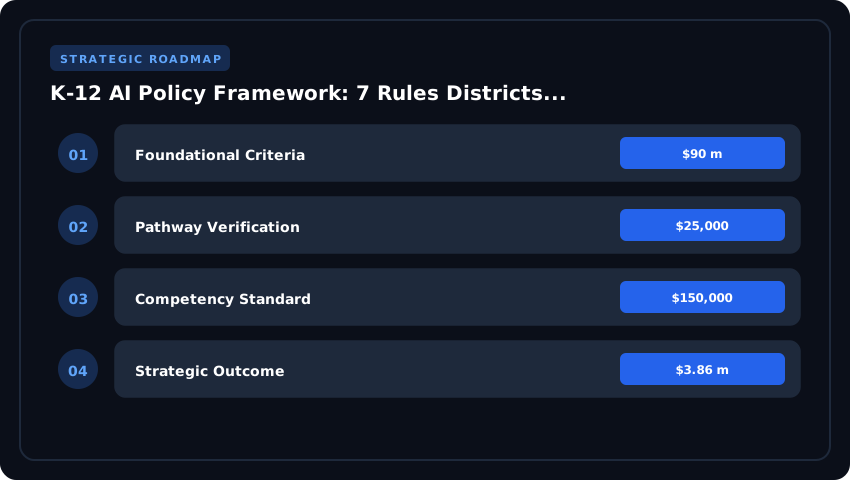
When a school district adopts an artificial intelligence tool without a rigorous privacy review, the financial exposure begins the moment a student types their first prompt. According to IBM’s 2024 Cost of a Data Breach Report, the average breach in the education sector now costs approximately $3.86 million per incident, factoring in regulatory fines, forensic investigations, notification expenses, and long-tail reputational harm. For K-12 systems operating on already-tight per-pupil allocations, a single breach can erase years of carefully balanced budgets. The financial figure, however, only tells part of the story.
The reputational damage travels further and faster than any dollar amount. Parents who entrust classrooms with their children’s most sensitive information, including IEP details, behavioral records, disciplinary histories, and biometric identifiers, can withdraw enrollment at the first sign of a leak. Local news outlets amplify the story, state education departments open formal reviews, and district leaders spend months testifying before school boards. Recovery is measured in trust, which is far more expensive to rebuild than any server.
Understanding the technical pathways of exposure is essential before any procurement decision. Three specific risk vectors deserve close scrutiny:
- LLM training data retention: Free-tier consumer products like ChatGPT, Claude, Gemini, and Copilot typically retain user prompts and outputs indefinitely unless the user manually opts out. Under default settings, a student’s homework prompt, complete with their name, school, grade level, and learning struggles, can be ingested into future model training sets. Once embedded, that information is effectively impossible to retract.
- Inference leakage across shared accounts: When teachers share logins or students rotate through classroom Chromebooks, conversation histories persist in the cloud. A peer can easily surface a classmate’s private reflections, medical disclosures, or family circumstances simply by scrolling through prior sessions.
- Third-party data brokers and model fine-tuning partners: Vendors frequently subcontract annotation, red-teaming, and reinforcement learning from human feedback (RLHF) work to global contractors. Student data that leaves a US-based vendor’s environment may pass through jurisdictions with weaker privacy protections, undermining FERPA’s intent.
Vendor contract language must therefore rise far above boilerplate. Districts should require contractual commitments that satisfy federal law and the increasingly demanding patchwork of state statutes. At minimum, agreements should include:
- Explicit FERPA designation as a “school official” with a legitimate educational interest, limiting use to the authorized purpose and prohibiting redisclosure.
- COPPA-compliant parental consent workflows for any student under thirteen, with documented data minimization practices that avoid collecting names, emails, or persistent identifiers when functionality allows.
- State biometric law compliance for districts in Illinois (BIPA), Texas (CUBI), Washington (HB 1493), and New York, where voiceprints, faceprints, and keystroke dynamics used by AI proctoring tools trigger separate notification and consent regimes.
- Zero-retention guarantees for prompts and outputs, supported by SOC 2 Type II audit reports and the right to conduct independent security assessments.
- Mandatory breach notification within 48 hours, along with vendor-funded credit monitoring for affected families when personally identifiable information is exposed.
Districts that negotiate these terms from the outset consistently report smoother audits, faster parent communication, and stronger board confidence. Those that do not often discover the gap only after a regulator or journalist finds it for them. The cost of prevention is modest. The cost of a leak, by contrast, is structural.
Drafting the Algorithm Permission Slip: A Plain Language Framework for K-12 Compliance
Creating an effective AI policy requires translating complex algorithmic concepts into a plain language framework that parents and guardians can easily understand. When a school district introduces generative AI tools into the classroom, it is essentially asking parents to sign an “algorithm permission slip.” To build trust and ensure legal compliance, district leaders must align their consent forms with two critical federal statutes: the Children’s Online Privacy Protection Act (COPPA) and the Protection of Pupil Rights Amendment (PPRA).
Under COPPA, any edtech vendor collecting personal information from children under the age of 13 must obtain verifiable parental consent. Districts cannot simply rely on a click-through agreement at the start of the school year; they must implement robust mechanisms—such as signed digital forms or identity verification protocols—to ensure a parent or legal guardian actually authorizes the data collection. Furthermore, the PPRA requires schools to obtain written parental consent before students are required to participate in surveys, analyses, or evaluations that reveal sensitive personal information. If an AI tool analyzes a student’s writing patterns or behavioral data to personalize learning, PPRA mandates strict transparency regarding exactly what data is being captured and how it will be used.
To help technology directors and curriculum coordinators navigate this landscape, here is a step-by-step framework with sample clauses you can adapt for your district’s AI consent forms during the enrollment process:
- Data Minimization Clause: “Our district strictly adheres to data minimization principles. The AI programs utilized in our classrooms will only collect the minimum amount of student data necessary to achieve specific educational outcomes. We contractually prohibit vendors from using student inputs to train their broader commercial models, ensuring your child’s data is never monetized, sold, or retained beyond the academic year.”
- Human-in-the-Loop Review Clause: “All AI-generated feedback, grading, and behavioral recommendations are subject to mandatory human-in-the-loop review by a licensed educator. No automated system will make final determinations regarding a student’s academic placement, special education referrals, or disciplinary actions without direct oversight and approval from our teaching staff.”
- Right to Opt-Out Without Academic Penalty Clause: “Families retain the absolute right to opt out of AI-enhanced instructional programs without facing academic penalty. If you choose to withhold consent, your child will be provided with an equivalent, non-AI alternative assignment or learning pathway that fulfills the exact same curriculum standards and learning objectives.”
By embedding these specific, plain-language protections into your onboarding materials, districts can confidently integrate AI while honoring their federal obligations. Treat every AI deployment with the same scrutiny you would apply to a controversial textbook or an outside instructional material, ensuring that student welfare always remains the center of your educational mission.
Filtering the ‘Hallucinations’ and Bias: Academic Integrity and Algorithmic Discrimination
Generative artificial intelligence promises to revolutionize American classrooms, but it carries two deeply embedded risks that no K-12 district can afford to ignore: factual hallucination and algorithmic discrimination. The 2024 Stanford AI Index Report confirmed that even the most sophisticated large language models, including OpenAI’s GPT-4, Anthropic’s Claude 3, and Google’s Gemini, continue to produce factually incorrect outputs somewhere between 3% and 10% of the time, depending on the subject domain. In a high school biology class, that might mean a confidently stated falsehood about cellular mitosis. In a middle school civics lesson, it could mean fabricated Supreme Court rulings that students then memorize as truth.
These are not minor edge cases. They represent what Stanford researchers call confabulation, where the model generates plausible-sounding but entirely invented citations, statistics, or historical quotes. When a seventh-grader in Ohio asks an AI tutor to explain the causes of the Civil War and receives a fabricated speech attributed to Frederick Douglass, the academic integrity damage is profound. Districts must treat AI outputs the way responsible editors treat unvetted wire copy: accurate enough to use only after human verification.
The bias challenge runs deeper. In May 2024, the U.S. Equal Employment Opportunity Commission (EEOC) and the U.S. Department of Justice (DOJ) issued joint technical guidance titled Artificial Intelligence and Algorithmic Fairness Initiative, warning that AI systems can violate Title VII of the Civil Rights Act, the Americans with Disabilities Act (ADA), and the Equal Educational Opportunities Act when they perpetuate bias against protected classes. While the guidance targets employers, the U.S. Department of Education’s Office for Civil Rights has signaled parallel expectations for K-12 deployment. Research from the National Institute of Standards and Technology (NIST) has repeatedly shown that facial recognition and large language models perform measurably worse for individuals with darker skin tones, women in STEM contexts, and people with speech patterns associated with non-native English speakers or speech disfluencies linked to stuttering or cleft palate.
District leaders must move beyond vendor marketing claims and build systematic auditing procedures before any tool reaches a classroom. The following six strategies represent a defensible baseline for American public school districts operating under federal civil rights law.
- Mandate a “Human-in-the-Loop” Verification Protocol — Require teachers to independently verify any AI-generated factual claim, citation, or numerical statistic before student exposure. Treat AI output the way a newspaper treats an unverified source. This aligns with guidance from the International Society for Technology in Education (ISTE) and the Council of Chief State School Officers (CCSSO).
- Conduct Disparate Impact Testing Before Procurement — Before purchasing any AI tool, districts should require vendors to submit Algorithmic Impact Assessments demonstrating parity across race, gender, English Learner status, and disability category. This mirrors the algorithmic auditing requirements now standard under New York City Local Law 144 and Colorado’s SB 24-205.
- Test for Disability Discrimination — Screen AI outputs specifically for ableist language, ableist assumptions about neurodivergent learners, and screen-reader compatibility failures that could violate Section 508 of the Rehabilitation Act.
- Establish a “Red Team” Student and Educator Review Panel — Recruit diverse staff and high school students to deliberately stress-test AI outputs for culturally biased content, stereotypes, and historical omissions before adoption.
- Maintain an AI Incident Log Aligned to FERPA — Document every known hallucination, bias event, or factual error. Under the Family Educational Rights and Privacy Act (FERPA), districts already maintain rigorous data integrity protocols; AI outputs should be logged with the same discipline.
- Publish Transparency Reports to the School Board — Boards of education, elected by local communities, deserve quarterly visibility into which AI tools are deployed, what bias audits were performed, and what remediation occurred.
The financial and legal stakes are real. A district that deploys a biased AI tutoring tool could face an Office for Civil Rights investigation, a state attorney general complaint, or a private lawsuit under 42 U.S.C. § 1983. Districts operating under existing consent decrees with federal monitors, common in states like California, Texas, and Illinois, face amplified risk. Building bias and hallucination filters into district AI policy is not a theoretical exercise. It is the minimum threshold of professional practice that the EEOC-DOJ joint guidance now demands from every institution that uses automated decision systems.
Teacher Training and the Digital Divide: Equipping Staff to Enforce the Policy
Writing a thoughtful K-12 AI policy is the easy part. The hard part is making sure the adults in the building can actually enforce it on a Monday morning when the bell rings. A district can spend $500,000 on a beautifully drafted framework, but if a substitute teacher cannot tell the difference between a student using a built-in autocorrect feature and a student running a large language model through a VPN, the policy is just paper. That is why professional development is the load-bearing wall of any artificial intelligence governance strategy, and it must be funded with the same seriousness as textbooks, buses, and broadband.
The funding backbone for this work sits inside the Every Student Succeeds Act (ESSA). Most district leaders underuse Title II-A, the Supporting Effective Instruction State Grant, because the name sounds like it only pays for math coaches. In reality, Title II-A can legally cover any sustained, job-embedded training that improves instruction, and the U.S. Department of Education has explicitly clarified that AI literacy qualifies as a allowable use when tied to teacher effectiveness. Districts can also pull from Title IV-A, the Student Support and Academic Enrichment Grant, which provides flexible dollars for technology integration, safe digital environments, and well-rounded education, including emerging areas like machine learning ethics.
The real-world urgency behind this funding is hard to overstate. According to a 2025 RAND Corporation survey, 62% of K-12 teachers feel unprepared to teach AI literacy, and a similar share report zero hours of formal training during their credentialing programs. This is not a fringe problem. It is the majority experience. When you compound that gap with the digital divide between Title I schools (often operating on 3:1 device ratios with outdated Chromebooks) and well-resourced suburban campuses, you get a two-tiered enforcement system where affluent parents get consistent AI guardrails and low-income students get inconsistent ones. Federal Title dollars are specifically designed to close that exact gap.
To move from reactive catch-up to consistent enforcement, districts should adopt a three-tier certification track:
- Tier 1: Classroom Teacher Micro-Credential (15 hours). A practical, scenario-based program covering academic integrity, prompt literacy, and bias recognition. Tier 1 staff can spot violations, redirect students, and document incidents without needing to understand transformer architecture. Districts should budget roughly $400 to $700 per teacher, including substitute coverage and facilitator stipends.
- Tier 2: Instructional Coach Specialist (45 hours). Coaches, librarians, and department chairs earn this credential so they can mentor colleagues, review department-level AI integration plans, and run parent information nights. Funding here can blend Title II-A with district general funds, often in the $1,200 to $2,000 per coach range.
- Tier 3: IT Administrator and Data Privacy Officer (80+ hours). This tier covers network-level AI detection tools, FERPA-aligned data routing, vendor contract review, and incident response. Because Tier 3 work is technical and often intersects with cybersecurity, it can also be supported through E-Rate Category 2 funds, making it one of the most cost-efficient pathways to compliance.
The crucial equity safeguard is that all three tiers must be staffed proportionally in Title I schools. If a Title I campus sends zero staff through Tier 2 training because the coach was pulled to cover a classroom, the district has not actually closed the digital divide; it has simply renamed it. Superintendents should require quarterly reporting on credential completion by free-and-reduced-lunch eligibility so that funding outcomes are visible to the school board and to the public.
Done well, this certification structure turns policy from a document into a workforce. It gives every teacher a clear answer to the question, What do I do when a student asks if they can use ChatGPT to write their book report? It gives coaches a shared vocabulary for department meetings. And it gives IT leaders the authority to say yes or no to new tools with defensible, audit-ready reasoning. That is how a district moves from aspirational language to daily practice, and it is how the digital divide stops widening.
Procurement and Sunset Clauses: Holding EdTech Vendors Accountable
Procurement is where most K-12 AI policies quietly fall apart. A district might spend eighteen months drafting a thoughtful, human-centered AI policy, then sign a three-year, multi-million dollar contract with an EdTech vendor that contains none of the safeguards the policy demands. The reason is structural: procurement teams and instructional technology teams typically operate in separate silos, vendor contracts default to the vendor’s master service agreement rather than the district’s negotiated terms, and legal counsel rarely has the bandwidth to redline every clause in every exhibit. Closing that gap requires treating procurement as a policy instrument, not merely a purchasing function. Three legal mechanisms deserve particular attention: sunset clauses, data destruction certificates, and third-party audit rights.
A sunset clause is a contractual provision that automatically terminates a contract, or specific data-sharing permissions within it, after a defined period unless the parties affirmatively renew. In EdTech procurement, sunset clauses are essential because the AI vendor landscape evolves faster than any policy can keep pace. A tool that appears safe in 2025 may be acquired, pivoted, or rebranded by 2027. Districts that lock themselves into automatic renewal clauses often discover too late that the vendor’s underlying model has changed, the data-sharing partners have multiplied, or the company has been sold to an entity in a jurisdiction with weaker privacy protections. A well-drafted sunset clause should require affirmative board approval for renewal, mandate a fresh privacy and security review at the renewal point, and give the district a clean exit without penalty if the renewal conditions are not met. Think of sunset clauses as the contract equivalent of a building safety certificate that expires unless renewed, forcing the district to inspect the relationship rather than assume it remains sound.
The data destruction certificate is the second pillar of vendor accountability. When a contract ends, whether through sunset, breach, or mutual decision, the district must receive cryptographic proof that every byte of student data has been irretrievably deleted from the vendor’s primary systems, backups, and any downstream processors. The Student Data Privacy Consortium (SDPC) standard Data Privacy Agreement (DPA) has become the de facto national template for this requirement, and for good reason. The SDPC DPA requires vendors to certify destruction within thirty days of contract termination, to provide written attestation signed by a corporate officer, and to remain liable for any failure to destroy until the certification is received. Districts that use the SDPC template without modification typically find that vendors accept the terms because the language is familiar and market-tested. Districts that attempt to draft bespoke destruction language often encounter resistance, drawn-out negotiations, and weaker final protections.
Third-party audit rights complete the accountability triangle. A district should never have to take a vendor’s word about how student data is handled, particularly when the data flows into AI training pipelines, third-party cloud providers, and sub-processor networks that the district cannot directly inspect. The SDPC DPA grants districts the right to commission an independent security audit, typically conducted by a SOC 2 or ISO 27001 qualified firm, at the district’s expense, on reasonable notice, no more than once per year. Districts like Los Angeles Unified and Miami-Dade County Public Schools have leveraged these audit rights during recent renegotiations of multi-million dollar AI contracts, using audit findings as leverage to demand model retraining restrictions, sub-processor disclosures, and stricter breach notification timelines. Without audit rights, a district is effectively trusting the vendor to police itself, which is a posture no responsible procurement officer should accept.
The following rubric can guide evaluation when these clauses are present:
- Security and Privacy Compliance (40%): SDPC DPA alignment, SOC 2 Type II certification, data destruction certificate mechanics, breach notification window (target: 72 hours or less), and sub-processor transparency.
- Pedagogical Efficacy (35%): Evidence of learning gain from independent research, alignment with district curriculum standards, teacher control over AI outputs, and accessibility compliance under ADA and Section 508.
- Exit Portability and Sunset Protections (25%): Clean data export formats (CSV, JSON, or open standard), defined sunset interval with affirmative renewal, no penalty for non-renewal, and continuity planning for student records.
The takeaway for district leaders is straightforward: the strongest AI policy in the world is only as enforceable as the contracts that operationalize it. Build sunset, destruction, and audit obligations into every procurement from day one, anchor them in the SDPC template, and treat vendor evaluation as a weighted competition rather than a checkbox exercise. Districts that do so convert their policies from aspirational documents into binding operational realities.
| Policy Domain | Compliance Cost (USD) | Implementation Cut-Off | Deployment Timeline | Career/Compliance ROI |
|---|---|---|---|---|
| Data Privacy & FERPA Alignment | $15,000 – $45,000 | Q3 2025 (Start of School Year) | 3–6 Months | High – Reduces breach liability up to $1.7M per incident |
| Algorithmic Bias Auditing | $8,000 – $25,000 | Q4 2025 | 4–8 Months | High – Protects Title VI federal funding eligibility |
| Teacher AI Training Programs | $2,500 – $12,000 per cohort | Q2 2025 | 6–10 Weeks | Medium – Boosts instructional efficiency by 30% |
| Parent/Guardian Consent Protocols | $5,000 – $18,000 | Q3 2025 | 2–4 Months | Medium – Mitigates COPPA violation penalties |
| Student Data Minimization Framework | $10,000 – $30,000 | Q4 2025 | 5–7 Months | High – Aligns with state-level student privacy acts (e.g., SOPIPA, NYSED) |
| Vendor Vetting & Procurement Policy | $6,000 – $20,000 | Q1 2026 | 3–5 Months | High – Streamlines EdTech contracts by 40% |
| Incident Response & Transparency Reporting | $4,000 – $15,000 | Q2 2026 | 2–6 Months | Critical – Mandatory for state audit compliance |
Frequently Asked Questions
Why do federal guidelines like FERPA fall short for K-12 AI policy?
Federal laws such as FERPA and COPPA were enacted before generative AI existed, so they lack specific provisions for algorithmic decision-making, biometric data collection, and real-time AI tutoring. Districts need localized policies that address AI-specific risks these older statutes do not explicitly cover.
What are the 7 essential rules for a district-level AI policy framework?
The seven core rules are: (1) transparent AI disclosure, (2) FERPA-aligned data privacy, (3) algorithmic bias auditing, (4) parental consent protocols, (5) teacher AI literacy training, (6) rigorous vendor vetting, and (7) incident response transparency. Together, these rules protect students while enabling innovation.
How much does it cost a school district to implement a compliant AI policy?
Total implementation costs for a mid-sized district range from $50,000 to $165,000, covering privacy audits, bias testing, training, and vendor vetting. While significant, the investment prevents costly federal compliance violations and streamlines long-term EdTech procurement efficiency.
What is the biggest compliance risk districts face when adopting AI tools?
The biggest compliance risk is unauthorized student data sharing with third-party AI vendors, which can violate FERPA, COPPA, and state privacy laws like Illinois SOPPA. Districts must mandate data processing agreements and conduct algorithmic audits before approving any AI classroom tool.
Strategic Final Takeaway
Success in evaluating K-12 AI Policy Framework: 7 Rules Districts Need Now relies on early preparation, adherence to verified accredited requirements, and cross-referencing official portals. Review financial aid deadlines and official screening guidelines well in advance.