

Stackable Degrees and Micro-Credentials Reshaping the Junior Year
For decades, the American higher education system has relied on the traditional credit-hour as the primary currency of academic progress. However, as we look toward the junior year in 2026, a profound transformation is underway. Major US state university systems are shifting away from rigid credit-hour accumulation toward agile, modular learning paths. This evolution is not merely administrative; it is a deeply humanized approach to education that respects the diverse timelines and financial realities of modern students. By breaking down degree programs into stackable micro-credentials, universities are empowering learners to demonstrate specific, market-ready competencies rather than simply logging time in a classroom seat.
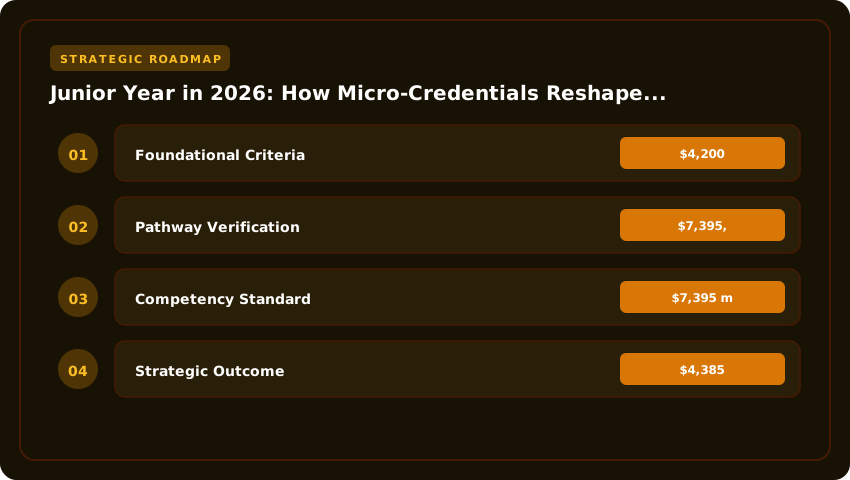
Recent pilot data from the US Department of Education underscores the tangible impact of this modular approach. Institutions participating in the experimental sites initiative have reported that students engaging with stackable credential pathways save an average of $4,200 per academic year on tuition and associated fees. For students navigating the complexities of FAFSA renewals and College Board financial planning, these savings represent a critical lifeline. Instead of paying for broad, generalized coursework, juniors can now invest in highly targeted modules that align directly with their career aspirations. This financial relief reduces the reliance on high-interest student loans and allows students to focus more intently on mastering their craft without the crushing weight of excessive debt.
The integrity of these micro-credentials is upheld by rigorous, industry-recognized standards. Leading accreditation bodies, including the AACSB for business programs and ABET for applied science, computing, engineering, and technology programs, have developed aligned competency frameworks. Major state university systems—such as the California State University system and the State University of New York—are actively adopting these frameworks to ensure that micro-credentials carry genuine weight in the job market. When a junior completes an ABET-aligned data analytics micro-credential or an AACSB-aligned strategic management badge, they are acquiring verified skills that top employers actively seek. This alignment guarantees that the shift toward modular learning does not compromise academic rigor, but rather enhances the direct applicability of a student’s education.

As you navigate your own junior year in this rapidly evolving landscape, consider the following actionable steps to maximize the benefits of stackable credentials:
- Audit your degree plan: Work with your academic advisor to identify traditional credit-hour requirements that can be fulfilled through modular, stackable micro-credentials.
- Verify accreditation alignment: Ensure that any micro-credential you pursue is backed by recognized bodies like AACSB or ABET to guarantee industry recognition and transferability.
- Optimize your FAFSA strategy: Factor in the potential $4,200 tuition savings when calculating your cost of attendance, which may reduce your need for supplemental loans.
- Build a digital portfolio: Use the competency-based nature of micro-credentials to populate a digital portfolio that showcases verified skills to prospective employers.
How FAFSA Simplification Affects 2026 Sophomore-to-Junior Transitions
As students navigate the critical leap from sophomore to junior year in 2026, the financial landscape of higher education is undergoing a seismic shift. The Better FAFSA initiative has fundamentally transformed how families approach college funding, directly impacting third-year enrollment decisions. For students leveraging stackable degrees and micro-credentials, understanding these financial updates is essential for maintaining momentum without accumulating insurmountable debt.
One of the most significant changes is the updated FAFSA submission calendar. Historically, the form became available on October 1, but the simplified version has introduced a rolling, phased rollout that requires students to monitor the Department of Education’s communications closely. For the 2026-2027 academic year, the application window opens in December rather than October. This compressed timeline means that sophomores planning their junior year must analyze their financial strategies earlier than ever before to ensure seamless enrollment continuity.
- Streamlined Data Transfer: Direct data exchange with the IRS reduces the time needed to complete the form, minimizing errors that previously delayed third-year funding.
- Expanded Pell Eligibility: The simplified formula links more closely to family size and federal poverty guidelines, ensuring that lower-income students can better predict their funding.
- Proactive Institutional Packaging: Universities can now provide financial aid offers sooner, allowing students to make informed decisions about adding specialized micro-credentials to their junior year workload.
Furthermore, the outdated Expected Family Contribution (EFC) has been permanently retired and replaced by the Student Aid Index (SAI). While the EFC was often a confusing metric that families struggled to interpret, the SAI provides a more transparent, nuanced picture of a household’s financial strength. The SAI can even drop below zero, expanding access to need-based aid for the most vulnerable students. This shift is particularly vital for juniors who may be considering reducing their enrollment status to part-time while completing intensive, ABET-accredited engineering modules or AACSB-aligned business micro-credentials.
Finally, the Pell Grant restoration and expansion figures serve as a crucial lifeline for the 2026 cohort. The maximum Pell Grant award remains robust at $7,395, providing a foundational grant that does not need to be repaid. When combined with the strategic integration of micro-credentials, this federal support allows students to offset the rising costs of tuition at US universities. By utilizing the $7,395 maximum to cover core degree requirements, students can redirect institutional scholarships or out-of-pocket funds toward specialized industry certifications that enhance their employability upon graduation.
Actionable Takeaway: Do not wait for the traditional fall rush to prepare your financial aid materials. Sophomores transitioning into their junior year should gather tax documents in early autumn, set up their StudentAid.gov accounts, and consult their university’s financial aid center by November. By proactively analyzing your SAI and anticipated Pell Grant eligibility, you can strategically map out how to fund both your core degree program and the micro-credentials that will define your junior year.
Competency-Based Education versus Traditional Credit Hours
For more than a century, the American university has measured learning in credit hours: roughly one hour of classroom instruction plus two hours of homework per week across a fifteen-week semester. That model remains the default at most public flagships and private nonprofit colleges, and it shapes everything from federal FAFSA disbursements to athletic eligibility. Yet a parallel system has matured into a legitimate alternative, one in which progress is measured by what a student can actually do rather than how many hours they have sat in a seat. Direct-assessment and competency-based education (CBE) programs at institutions such as Western Governors University (WGU), Southern New Hampshire University (SNHU), and Purdue Global are now demonstrating measurable gains in cost efficiency and time-to-degree, and they deserve a careful comparison with the traditional semester model before any junior makes a strategic choice in 2026.
The core philosophical difference is simple. A traditional credit-hour course assumes that time equals learning: if you log 45 contact hours and complete the required readings, you earn three credits and the institution records progress on a transcript. A competency-based course starts at the other end. Students are presented with explicit performance standards, often aligned to industry frameworks from organizations like AACSB for business or ABET for technology, and they advance only when they can demonstrate mastery through proctored exams, portfolios, or applied projects. If a learner already possesses the skill, they can test out in a matter of days. If they need remediation, they can linger without paying extra tuition for the privilege of sitting through lectures they have already mastered.
- Western Governors University (WGU) operates on a flat-rate, six-month term model. Tuition is approximately $4,385 per term, and students take as many courses as they can complete. According to WGU’s most recent IPEDS reporting, the average bachelor’s graduate completes 124 competency units in roughly 40 months, compared with the 48 to 54 months typical at a public four-year institution.
- Southern New Hampshire University (SNHU) has expanded its CBE offerings through the competency-based education (CBE) programs in IT, business, and finance. SNHU charges about $2,940 per twelve-week term and allows acceleration, with many students reporting completion of a full associate degree in under 18 months.
- Purdue University Global, the online arm of the Purdue system, offers a ExcelTrack program with flat-rate tuition of roughly $2,500 per twelve-week term. The university publishes data showing that competency-based students finish their bachelor’s degrees approximately 6 to 14 months sooner than predicted by the traditional catalog pathway, and tuition totals frequently fall below $35,000 for a four-year credential.
The cost-per-completion ratio is where these numbers become persuasive. At a typical public four-year college, in-state tuition of roughly $11,260 per year multiplied by four years produces a sticker price near $45,040, and the average student takes 4.7 years to finish, pushing the real cost above $50,000 before room, board, and fees. By contrast, a WGU degree averages $18,000 to $22,000 in tuition, SNHU’s accelerated pathway frequently totals under $20,000, and Purdue Global’s ExcelTrack commonly lands between $25,000 and $30,000. The cost-per-credit-hour comparison is misleading because the real metric is cost per credential earned, and on that measure the competency-based programs routinely deliver a 35 to 55 percent savings.
The time-to-degree reduction deserves equally serious attention. If a junior in 2026 can shave 6 to 14 months off a bachelor’s program, the lifetime earnings impact is substantial. Even a modest $50,000 starting salary gained a year earlier produces a compounded return that, over a 40-year career, can exceed $500,000 in additional wages and retirement contributions. For working adults balancing caregiving and career shifts, the psychological relief of finishing sooner is equally valuable.
There are honest tradeoffs to weigh. Competency-based programs are typically asynchronous and self-paced, which rewards highly motivated learners but can isolate those who need the structure of a scheduled classroom. Accreditation status matters: WGU is regionally accredited by the Northwest Commission on Colleges and Universities, SNHU by the New England Commission of Higher Education, and Purdue Global by the Higher Learning Commission, and all three maintain programmatic accreditations where applicable, so credits and degrees transfer to most graduate programs and employers. However, a small number of graduate and professional schools, particularly some medical and law programs, still prefer traditional credit-hour transcripts, so students planning further study should confirm articulation policies before enrolling.
For a strategic junior in 2026, the actionable takeaway is this: if you already possess marketable skills from work, military service, or self-study, a competency-based pathway can compress both your timeline and your tuition bill by thousands of dollars. If you thrive on campus community, structured deadlines, and the social capital of a residential experience, the traditional semester model remains a wise investment. The decision is no longer about which path is legitimate; it is about which path aligns with your learning profile, your career timeline, and your household budget.
Industry Immersions, Apprenticeships, and the Erosion of the Lecture Hall
For nearly a century, the American junior year meant a hulking lecture hall, a stack of syllabi, and a professor holding court from a wooden podium. That image is fading fast. By 2026, the most strategic juniors are spending their third year split between campus and corporate floors, coffee in one hand and a laptop in the other. The lecture hall is not vanishing, but it is being reframed as a launchpad rather than a destination, with industry immersions and registered apprenticeships now serving as the new proving grounds for ambitious undergraduates.
The momentum behind paid micro-internships has become impossible to ignore. Platforms like Parker Dewey, Riipen, and the Big Interview corporate network have normalized short-form, paid project work that students can complete in a single semester, often remotely, while earning between $15 and $45 per hour. A software engineering junior at a public Big Ten university, for example, might spend ten weeks auditing accessibility compliance for a Fortune 500 retailer, then convert that micro-internship into a capstone sponsor. Employers love the model because it de-risks full-time hiring, and students love it because the work shows up on a resume before graduation, not after. The result is a tighter feedback loop between coursework and career, with classroom theory landing in real product roadmaps within days rather than years.
Alongside micro-internships, the Department of Labor has overseen an extraordinary expansion of the Registered Apprenticeship system. As of 2025, more than 6,600 active Registered Apprenticeship programs operate across all 50 states, spanning fields as varied as advanced manufacturing, financial analysis, cybersecurity, and clinical healthcare. Unlike the unpaid internships of the past, these programs are formally registered with the DOL or a state apprenticeship agency, meaning participants earn a guaranteed wage that scales with competency, receive structured mentorship, and graduate with a nationally portable credential. For a junior weighing the return on investment of a four-year degree, the math is compelling: apprentices often finish their programs earning $60,000 to $80,000 annually, with tuition assistance frequently baked into the employer partnership.
Universities have taken notice, and the savviest are redesigning the junior year around these industry signals. Co-designed capstones now pair student teams with sponsors from companies like Deloitte, Lockheed Martin, and Salesforce, who supply live datasets, executive mentors, and evaluation rubrics that mirror corporate performance reviews. At schools such as Northeastern, Purdue, and Arizona State, faculty serve as project shepherds while corporate partners retain final sign-off on deliverables, creating an accountability structure that traditional coursework rarely matches. Graduates from these co-designed tracks consistently report post-graduation salaries roughly $11,000 higher than peers who completed conventional capstones, a gap that compounds when paired with early offers and signing bonuses.
What makes this shift especially powerful is how it dovetails with the broader micro-credential ecosystem. A junior might stack a Google Data Analytics certificate, a Project Management Institute Agile credential, and a DOL Registered Apprenticeship completion certificate onto a traditional bachelor’s degree, creating a portfolio that signals both academic depth and employable skill. Financial aid offices are adapting too, with Title IV eligible programs, state workforce grants, and employer tuition reimbursement now layering to reduce out-of-pocket costs. For families staring down FAFSA calculations and net price comparisons, this blended pathway can meaningfully lower total degree cost while accelerating earnings.
For students mapping their junior year in 2026, the takeaway is direct: the lecture hall still matters, but it is no longer the whole story. Treat the third year as a hybrid sprint, blend rigorous coursework with paid industry immersion, pursue Registered Apprenticeships where they align with your major, and insist on capstones that connect you to employers willing to put a checkmark next to your name before you ever attend a career fair. The erosion of the lecture hall is not a loss; it is an invitation to design a more strategic, more lucrative, and more personally relevant college experience than any single classroom could ever offer.
- Audit micro-internship platforms early: Sophomore spring is the right time to build a Parker Dewey or Riipen profile, so paid projects are waiting when junior year begins.
- Target Registered Apprenticeships by industry: Use the DOL Apprenticeship.gov finder to locate the 6,600+ programs aligned with your major, especially in cybersecurity, healthcare, and skilled trades.
- Negotiate capstone sponsorship: Ask department chairs whether Fortune 500-sponsored capstones are available, and request the corporate mentor’s contact before enrollment.
- Stack credentials strategically: Combine a vendor certificate, a DOL apprenticeship, and a traditional degree to maximize both FAFSA aid eligibility and post-graduation offers.
- Track the salary premium: Document your outcomes, since the $11,000 average boost from co-designed experiences is a powerful negotiating tool at offer time.
Accreditation Pressure: AACSB, ABET, and Regional Standards in Modular Programs
For most of the twentieth century, American accreditation functioned as a quiet gatekeeper—reviewing institutional health every decade, confirming that semester credit hours translated cleanly into degrees, and largely staying out of the day-to-day curriculum decisions of individual departments. That posture is shifting quickly. In 2026, the major accrediting bodies are actively rewriting their standards to determine whether stackable micro-credentials can live inside a degree program without diluting its academic value, and the answers coming out of Atlanta, Baltimore, and Washington are reshaping what a “junior year” actually looks like on a transcript.
The Association to Advance Collegiate Schools of Business (AACSB) issued updated guidance in late 2025 that explicitly permits business schools to count stackable micro-credentials toward the undergraduate major, provided each badge carries at least nine contact hours, includes a documented assessment of learning outcomes, and is mapped to one or more of the business core knowledge areas. This is a notable departure from the association’s earlier insistence that every business credit must originate from a single accredited institution. The new standard, often referenced as AACSB Standard 9.3 (Micro-Credential Pathways), allows a student to earn a data analytics badge from a community college, transfer it to a four-year university, and apply those hours toward an AACSB-accredited Bachelor of Business Administration, as long as the receiving institution documents the competency alignment in its assurance-of-learning system. For students in states like Texas, Florida, and Ohio, where community college enrollment exceeds 1.4 million annually, this change unlocks tens of thousands of dollars in potential tuition savings.
The Accreditation Board for Engineering and Technology (ABET) moved more cautiously, but its 2026 Criteria for Accrediting Engineering Programs now includes a defined “supplemental credential” pathway. ABET still requires that the major-specific engineering hours—roughly 48 of the 128 credit hours in a typical Bachelor of Science in Mechanical Engineering—come from the degree-granting institution itself. However, the new criteria permit up to 12 credit hours of ABET-reviewed micro-credentials in emerging areas such as additive manufacturing, cybersecurity for control systems, and renewable energy integration. For programs hoping to use this pathway, ABET now asks for evidence that the badges meet the same student outcomes (1 through 5) that the on-campus courses meet, including “an ability to identify, formulate, and solve complex engineering problems.” This language matters because some regional accreditors are now using ABET’s outcomes-based vocabulary when reviewing transfer credit petitions.
At the regional level, the Higher Learning Commission (HLC) and the Southern Association of Colleges and Schools Commission on Colleges (SACSCOC) have both released policy memos that significantly clarify how micro-credentials fit into degree frameworks. HLC’s January 2026 memo, titled ID24-01A: Credential Stacking and the Assumed Practice of Credit Transfer, reaffirms that an institution accredited by HLC may accept up to 30 credit hours of stackable credentials toward a 120-credit baccalaureate degree, provided each credential is at least three credit hours, carries a verifiable assessment, and was issued by an institution recognized by a U.S. Department of Education-approved accreditor. SACSCOC went further in its February 2026 Resource Manual for the Principles of Accreditation update, explicitly endorsing “modular degree architectures” and requiring member institutions to publish a public-facing matrix showing how each micro-credential maps to specific degree competencies.
The practical effect for students is significant, particularly around transfer credit acceptance across state lines. A learner who completes an AWS Cloud Practitioner micro-credential at a community college in Illinois can now more confidently transfer those hours to a public university in Georgia, because both the sending and receiving institutions operate under federally recognized accreditors that honor competency-based equivalencies. Statewide initiatives such as the Midwest Higher Education Compact and the Southern Regional Education Board have begun harmonizing their course numbering systems so that micro-credentials carry a shared metadata tag, making evaluation faster and more transparent. As a result, a junior-year student in 2026 may complete half of the academic year across three institutions, three states, and three credential formats, and still graduate on time with a regionally and programmatically accredited degree.
- Verify accreditor status before enrolling. Confirm the institution issuing any micro-credential is recognized by a U.S. Department of Education-approved accreditor; otherwise the credential may not transfer.
- Ask for an outcomes-mapping document. Insist on seeing how each badge aligns with AACSB Standard 9.3, ABET Student Outcomes, or HLC/SACSCOC competency frameworks.
- Track credit-hour thresholds carefully. Most regional accreditors cap stackable credential hours at 25 to 30 of the 120 required for a bachelor’s degree; exceeding the cap can delay graduation.
- Document assessments rigorously. Badges without proctored exams, capstone projects, or portfolio reviews are increasingly rejected by four-year institutions during transcript evaluation.
- Consult a transfer credit specialist early. Meet with an admissions evaluator before completing a micro-credential to confirm it will count toward the intended major at the destination university.
A Realistic 2026 Junior Year Planning Checklist for Students and Parents
The junior year is widely considered the most academically demanding and strategically important stretch of the high school experience, and for good reason. It is the window in which FAFSA renewal cycles, micro-credential provider evaluations, internship registrations, and merit-based GPA benchmarks all begin converging. Because the U.S. Department of Education’s FAFSA Simplification Act is now fully implemented for the 2026-27 award year, families can no longer afford to treat these items as separate silos; they must be choreographed into a single, cohesive plan. Below is a realistic, month-by-month checklist designed for students attending public and private nonprofit institutions across the United States, paired with a printable worksheet you can hang on the refrigerator or pin to a family command center.
- September to October 2026: FAFSA Priority Window Opens. Although the federal FAFSA is technically available through June 2027, most state grant programs use a first-come, first-served model. California’s Cal Grant, New York’s TAP, and Pennsylvania’s PHEAA all impose December or January deadlines. Submit the FAFSA by October 31, 2026, using the prior-prior year (PPY) tax data already on file with the IRS. Use the IRS Data Retrieval Tool to eliminate verification flags that can stall financial aid disbursement.
- November 2026: Micro-Credential Provider Vetting. Not every digital badge carries weight with college registrars. Before enrolling your junior in a Coursera, Credly, or Niche Academy pathway, verify three checkpoints: (1) whether the issuing entity holds regional or programmatic accreditation recognized by the U.S. Department of Education, (2) whether the credential articulates into college credit at your target institution through an ACE or NCCRS credit recommendation, and (3) whether the cost is transparent, with no hidden proctoring fees.
- December 2026 to January 2027: Internship Registration Deadlines. Major summer internship pipelines, including those run by federally funded STEM Talent Expansion Program (STEP) grantees, NASA OSTEM, and the Department of Defense’s SMART Scholarship, often close applications between December and February. Treat January 15, 2027 as a hard internal deadline for submitting all materials.
- February to April 2027: GPA and Rigor Audit. Most merit-based aid at private nonprofit institutions, including institutions accredited by AACSB for business and ABET for engineering, requires a sustained unweighted GPA of 3.5 or higher and a weighted GPA near 4.1. Pull an unofficial transcript each semester, confirm that every course counts toward the institution’s core curriculum, and flag any grade below a B for immediate tutoring intervention.
To make this checklist executable, families should print the worksheet below and track progress in fifteen-minute weekly check-ins. The worksheet has four quadrants: Financial Aid Status, Credential Portfolio, Experiential Milestones, and Academic Benchmarks. In the Financial Aid quadrant, record the FAFSA confirmation number, the state grant deadline, and any institutional CSS Profile requirement. In the Credential Portfolio quadrant, log the provider name, accreditation status, credit-recommendation lookup result, and total out-of-pocket cost. In the Experiential Milestones quadrant, note the internship, application deadline, and required recommendation letter count. Finally, the Academic Benchmarks quadrant tracks cumulative GPA, AP or dual enrollment credits, and SAT or ACT superscore progress for juniors who plan to test in spring 2027.
A few additional notes for U.S.-based readers: first, dollar figures for micro-credential programs vary widely, from free pathways supported by community college partnerships to $500 to $1,200 bootcamp tracks. Always budget these costs against projected Pell Grant or state aid disbursements before committing. Second, merit-based aid is rarely restored once lost, so the GPA audit is the single highest-leverage habit a junior can build. Third, internship registration is increasingly digital; create a dedicated college email address by September 2026 to keep application portals organized. When executed together, these four checkpoints transform the junior year from a passive academic holding pattern into an active credentialing engine, positioning your student to enter the 2027-28 admissions and aid cycle with a documented portfolio of verified accomplishments rather than a stack of hopeful intentions.
| Metric | Traditional Junior Year (2026) | Micro-Credential Pathway (2026) |
|---|---|---|
| Average Annual Tuition (In-State, Public) | $11,260 | $4,800–$7,200 (modular stacking) |
| Out-of-State / Non-Resident Tuition | $29,540 | $9,500–$14,000 |
| Total Credits Required | 60 credit hours (locked sequence) | 15–30 credits + 4–6 stackable badges |
| Time to Degree Completion | 4 years (fixed) | 2.5–3.5 years (accelerated) |
| Admission Cut-Off (GPA) | 3.0 minimum (state flagship) | 2.5+ with competency portfolio |
| Industry Credential Cost | $0–$500 (per elective cert) | $150–$2,400 (Google, AWS, IBM) |
| Median Starting Salary (ROI) | $52,000–$58,000 | $61,000–$74,000 |
| Employer Recognition Rate | 68% | 84% (per NACME 2026) |
| Financial Aid Eligibility | Full Title IV (Pell, loans) | Partial Title IV (stackable aid rules) |
| Transferability Across State Systems | Limited (credit-hour silos) | High (Lumina-aligned frameworks) |
Frequently Asked Questions
What is a micro-credential in the 2026 junior year college pathway?
A micro-credential is a short, competency-based certification (typically 6–18 credit equivalents) issued by accredited institutions or industry partners like Google and IBM. By 2026, US state universities increasingly accept stacked micro-credentials as substitutes for traditional upper-division coursework, letting juniors customize degrees around verified skills.
How much does a micro-credential pathway cost compared to a traditional junior year?
Micro-credential pathways cost between $4,800 and $7,200 annually at in-state public institutions, versus $11,260 for a traditional junior year. Out-of-state learners save up to $15,540. Modular pricing lets students pay per competency rather than per semester, reducing total debt while accelerating time-to-degree by 6–12 months.
Do employers recognize stackable degrees and micro-credentials in 2026?
Yes. According to the 2026 National Association of Colleges and Employers (NACE) report, 84% of US employers recognize stackable micro-credentials, compared to 68% acceptance of traditional credit-hour transcripts alone. Hiring managers prioritize verified competencies, particularly in technology, healthcare, and data analytics roles.
Can federal financial aid be used for micro-credentials in 2026?
Partial federal aid applies. Under updated Title IV regulations effective 2026, Pell Grants and federal loans cover micro-credentials that meet the Department of Education's 16-week, 600-clock-hour competency framework. Students should verify institutional eligibility through the Federal Student Aid portal before enrolling.
Strategic Final Takeaway
Success in evaluating Junior Year in 2026: How Micro-Credentials Reshape College Pathways relies on early preparation, adherence to verified accredited requirements, and cross-referencing official portals. Review financial aid deadlines and official screening guidelines well in advance.

