

Decoding the Ivy Tech Workforce Pell Program for 2026
For decades, the Federal Pell Grant has served as the financial cornerstone for low-income undergraduates pursuing traditional, semester-based degrees at accredited four-year universities and community colleges across the United States. However, the Ivy Tech Workforce Pell Program for 2026 represents a highly specialized, legislatively targeted evolution of that standard funding model. Specifically engineered to support short-term, high-demand career certificates at Ivy Tech Community College, this funding stream is designed to bridge the gap between traditional higher education and immediate workforce entry.

The legislative intent behind workforce Pell grants stems from the FAFSA Simplification Act and subsequent amendments to the Higher Education Act (HEA). Federal policymakers recognized that the standard Pell Grant schedule, which awards up to $7,395 for the 2025–2026 award year, was structurally biased toward longer academic calendars. To remain eligible for the full standard award, students must generally enroll at least half-time in a program spanning the full academic year. Because workforce certificates at Ivy Tech often last only 8 to 16 weeks, traditional Pell rules historically left these students with a prorated, reduced award. The Workforce Pell Program reverses this barrier, allowing eligible students to receive the maximum federal grant amount even when enrolled in a compressed, non-standard term.
To qualify under this initiative, a program must be recognized by the College Board and fall under the federal “career and technical education” (CTE) umbrella. At Ivy Tech Community College, qualifying pathways for 2026 include industry-recognized certificates in:
- Healthcare and Clinical Support: State-recognized nursing aide certifications, phlebotomy technician credentials, and medical coding micro-credentials.
- Advanced Manufacturing and Skilled Trades: CNC machining, industrial maintenance, welding technology, and mechatronics certificates aligned with the Manufacturing Skill Standards Council (MSSC).
- Information Technology and Cybersecurity: CompTIA-aligned IT support specialist tracks, network infrastructure certificates, and entry-level cybersecurity analyst programs.
- Transportation and Logistics: Commercial Driver’s License (CDL) Class A preparation, diesel technology, and supply chain management modules validated by the Department of Labor.
Structurally, the Workforce Pell Program diverges from the standard four-year institution Pell schedule in three critical ways. First, it utilizes the same Expected Family Contribution (EFC) methodology, now formally called the Student Aid Index (SAI) under the FAFSA Simplification Act, but applies it to programs measured in clock hours or non-standard terms rather than credit hours. Second, the disbursement schedule allows for full-grant payouts in accelerated sequences, meaning a student completing a 600-clock-hour certificate in one semester can still trigger the maximum allowable federal award. Third, the program incorporates direct alignment with regional labor market data, ensuring that the certificate pathways receiving federal preference correspond with high-demand occupations in the Ivy Tech service region spanning Indiana.
For prospective applicants evaluating the Ivy Tech Workforce Pell Program, the practical takeaway is that this is not merely a prorated version of the traditional Pell Grant. It is a parallel, strategically designed federal funding mechanism intended to accelerate economic mobility. Students who previously found themselves financially locked out of short-term training due to insufficient aid disbursement now have a verifiable, legislatively backed pathway to finance high-demand certifications without taking on significant Title IV loan debt. Understanding this structural distinction is the essential first step in maximizing the 2026 financial aid package available through the Ivy Tech Community College system.
2026 FAFSA Income Limits and Student Aid Index (SAI) Thresholds
Understanding the financial gateway to the Ivy Tech Workforce Pell Grant begins with mastering the 2026 Free Application for Federal Student Aid (FAFSA) Simplified Needs Test. For the upcoming award year, the U.S. Department of Education maintains a structured framework that evaluates your Adjusted Gross Income (AGI), family size, and poverty guidelines to determine your Student Aid Index (SAI). The SAI is the modern replacement for the legacy Expected Family Contribution (EFC), shifting the calculation from a flat dollar figure to a standardized index ranging from -1500 to 999999. A negative SAI is particularly significant because it acts as a direct qualifier for the maximum Workforce Pell award, ensuring that the lowest-income applicants receive the highest possible federal subsidy without facing the friction of complex asset verification.
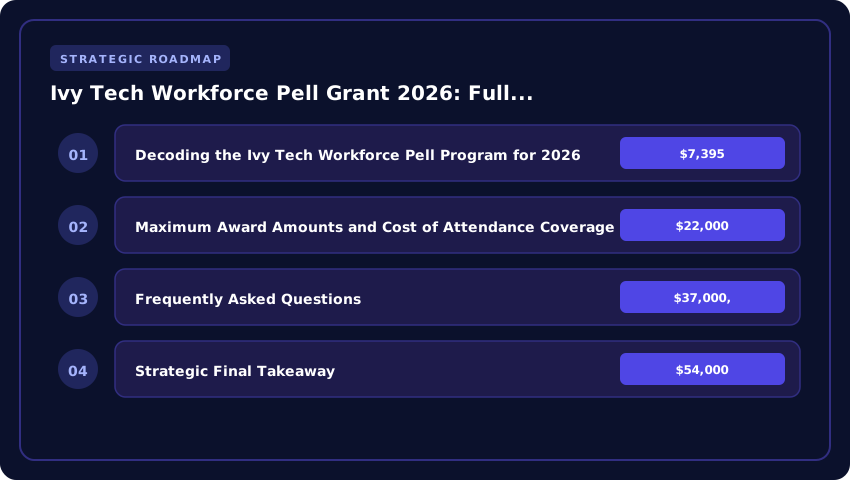
For the 2026 cycle, the AGI thresholds typically yield a full Workforce Pell award when an applicant’s income falls at or below 175 percent of the federal poverty guidelines. To put this into actionable perspective, a single independent student maintaining a household size of one generally qualifies for the maximum grant if their AGI is at or below roughly $22,000. For a single-parent applicant with one dependent child, the ceiling extends to approximately $37,000, while a family of four typically sees a maximum-qualifying AGI near $54,000. When earnings rise between 175 percent and 225 percent of the poverty line, the award transitions into a partial Workforce Pell award, calculated through a precise proration formula. Independent filers, married couples without dependents, and adult learners returning to college should pay close attention to these sliding scales, as a marginal increase in reported income can substantially alter the final dollar amount disbursed by Ivy Tech Community College.
The transition from the EFC to the Student Aid Index carries profound implications for specific demographics. Single-parent applicants often benefit from the new methodology because the SAI formula provides expanded allowances for the number of dependents in the household. Unlike the older EFC model, the SAI no longer penalizes families for having multiple children attending college simultaneously, which historically forced single mothers and fathers into difficult financial corners. Independent filers—defined as students who are at least 24 years old, married, supporting a child, or serving on active duty in the U.S. Armed Forces—also gain a streamlined path to federal aid. Because independent students bypass parental income scrutiny, the SAI calculation focuses exclusively on the student’s (and spouse’s) earnings, allowing workforce-focused candidates to receive aid based purely on their current professional reality rather than their parents’ historical tax returns.
To successfully navigate these thresholds, applicants should prioritize the following actionable steps:
- Verify your dependency status on the FAFSA before entering income figures, as misclassification is the leading cause of incorrect SAI calculations for Workforce Pell candidates.
- Use the IRS Data Retrieval Tool (DRT) when completing the FAFSA to automatically populate AGI and tax fields, minimizing documentation requests from Ivy Tech’s financial aid office.
- Document household size carefully, ensuring every dependent receiving more than half of their support from the applicant is counted, as this directly expands the income brackets for maximum eligibility.
- Monitor the College Board and Federal Student Aid portals for confirmed 2026 poverty guideline updates, since these figures are typically finalized in early January and dictate the final AGI ceilings.
- Consult Ivy Tech financial aid advisors to compare the Workforce Pell award against state-specific grants, maximizing total funding before finalizing enrollment decisions.
By internalizing these income limits and SAI mechanics, prospective students position themselves to capture the full spectrum of federal funding available for short-term workforce training programs. Whether you are a single parent reentering the labor market or an independent professional pursuing an industry-recognized certification, aligning your documented income with the simplified needs test ensures that your Ivy Tech education remains financially accessible throughout the 2026 academic year.
Critical Application Deadlines and Reapplication Cycles
Navigating the financial aid timeline at Ivy Tech Community College requires a precise understanding of three intersecting calendars: the federal FAFSA cycle, the Indiana state grant cycle, and the college’s unique eight-week rolling enrollment structure. Unlike traditional universities that lock students into 15-week semesters with rigid financial aid disbursement dates, Ivy Tech operates on an accelerated, modular term system. This flexibility is a massive advantage for workforce-focused students, but it also means that missing a deadline—even by a single day—can derail funding for an entire term.
For the 2025–2026 academic year, the U.S. Department of Education opened the FAFSA on October 1, 2024, with a federal submission deadline of June 30, 2026. However, Indiana operates on a much tighter window. The Indiana Student Financial Aid Association (ISFAA) and the Commission for Higher Education (ICHE) typically enforce a priority FAFSA deadline of April 15 for state-funded programs like the Frank O’Bannon Grant and the 21st Century Scholarship. For the 2026–2027 cycle, students must complete and submit the FAFSA by April 15, 2027, to maximize state matching funds and institutional aid.
One of the most overlooked rules in federal financial aid is the four-month retroactive processing timeline. The U.S. Department of Education mandates that a FAFSA must be processed within four months (120 days) prior to the student’s last date of enrollment. Because Ivy Tech offers eight-week terms starting in January, March, June, August, and October, students who delay their FAFSA submission past the 120-day retroactive window risk losing Pell Grant eligibility for the current term—even if they qualify based on their Expected Family Contribution (EFC) or Student Aid Index (SAI). Submitting the FAFSA at least four months before your final term begins is non-negotiable for Workforce Pell recipients.
Ivy Tech’s rolling enrollment model means there is no traditional “Fall deadline.” Students can apply and begin classes in any of the five annual start dates. However, the Ivy Tech Office of Financial Aid recommends submitting all verification documents and FAFSA corrections at least 30 days before the term start date to ensure tuition is covered by the time classes begin.
To avoid missing critical Indiana state grant matching funds, follow this strategic month-by-month checklist:
- October (12 months before college start): Create your FSA ID at StudentAid.gov. Gather 2024 tax returns and W-2s for the 2025–2026 FAFSA, or 2025 tax documents for the 2026–2027 cycle.
- January (Priority Window Opens): Submit the FAFSA immediately upon opening. Indiana state grants are awarded on a first-come, first-served basis until funding is exhausted, so early submission directly correlates with higher award amounts.
- February–March (Verification Phase): If selected for federal verification by Ivy Tech, respond within 14 days. Submit IRS Tax Return Transcripts or use the IRS Data Retrieval Tool (DRT) to auto-populate and avoid processing delays.
- April 15 (Indiana State Priority Deadline): Absolute cutoff for maximum consideration for the Frank O’Bannon Grant, Adult Student Grant, and Workforce Ready Grant state matching dollars. Missing this date often means losing hundreds to thousands of dollars in free money.
- May–August (Summer Term Bridging): File a separate Summer FAFSA if enrolling in the May/June term. Ivy Tech’s summer Pell policy allows up to 150% of your annual award, but you must reapply for summer disbursement.
- September–October (Reapplication Cycle): Renew your FAFSA every October 1 for the next academic year. Pell Grant eligibility is not automatic; it requires annual reapplication reflecting updated household size and income.
Bottom line: Treat April 15 as your financial aid hard deadline, submit the FAFSA four months before your final Ivy Tech term, and never assume that Workforce Pell funds will roll over—they won’t. Reapplication every October is mandatory, and early submission is the single highest-leverage action you can take to secure both federal Pell dollars and Indiana state matching grants for the 2026 cycle.
Maximum Award Amounts and Cost of Attendance Coverage
For the 2026 award year, the proposed maximum Federal Pell Grant award is $7,395, an important benchmark for students planning to enroll at Ivy Tech Community College under the new Workforce Pell Grant framework. Because Ivy Tech structures its tuition around a per-credit-hour model rather than flat semester rates, understanding how this fixed federal award translates into actual course coverage is essential for every prospective learner across Indiana.
Ivy Tech’s published standard tuition rate for in-state residents sits at approximately $185 per credit hour, making it one of the most affordable accredited higher education pathways in the United States. When the maximum Pell award is divided by this per-credit rate, the math reveals substantial coverage: $7,395 divided by $185 produces a coverage capacity of roughly 40 credit hours of tuition within a single award year. For a typical full-time associate degree pathway requiring 60 credit hours, this means the maximum Pell Grant can absorb approximately two-thirds of total instructional costs before any other aid, scholarships, or employer sponsorships are applied.
- Industrial Technology (60 credit hours): Total tuition approximately $11,100. Maximum Pell covers $7,395, leaving a Pell gap of roughly $3,705. Indiana’s state completion grant can absorb the remaining balance for eligible students, effectively producing a tuition-free credential pathway.
- Nursing (ASN, approximately 70 credit hours): Total tuition approximately $12,950. Maximum Pell covers $7,395, creating a Pell gap of roughly $5,555. Because nursing cohorts often include clinical fees and supply costs, students should anticipate that the state completion grant plus any workforce innovation scholarships will need to cover both tuition and ancillary expenses.
- Information Technology (60 credit hours): Total tuition approximately $11,100. Maximum Pell covers $7,395, leaving a Pell gap of roughly $3,705. IT students pursuing industry certifications (CompTIA, Cisco, AWS) may apply remaining aid toward certification exam fees, which are typically $350 to $500 per exam.
The term Pell gap refers to the remaining tuition balance after the federal grant is fully applied. At Ivy Tech, this gap is remarkably small compared to four-year institutions, and Indiana has intentionally structured its state financial aid ecosystem to close it. The Indiana Workforce Ready Grant and the newly expanded Frank O’Bannon State Completion Grant are designed to layer directly on top of Pell awards, meaning that students who demonstrate financial need rarely face out-of-pocket tuition charges for their core coursework.
It is also important to recognize that the Workforce Pell Grant expansion allows shorter, high-value credential programs (typically 8 to 15 credit hours) to qualify for pro-rated Pell funding. A student enrolled in a 12-credit Industrial Technology short-term credential, for example, would generate approximately $2,220 in tuition charges, well within the maximum Pell ceiling and leaving zero Pell gap. This structural flexibility is precisely what makes the 2026 Workforce Pell framework so attractive to working adults and career-changers seeking stackable credentials without taking on federal loan debt.
For students planning their 2026 enrollment, the actionable takeaway is straightforward: verify your FAFSA submission early, confirm your Expected Family Contribution (EFC) or Student Aid Index (SAI) status, and request an official cost of attendance audit from Ivy Tech’s Office of Financial Aid. Doing so ensures that every dollar of the proposed $7,395 maximum award, combined with state completion funding, is optimized to cover tuition, fees, and required instructional materials for your chosen program of study.
Eligible Workforce Certificate Programs and Industry Sectors
The 2026 Workforce Pell Grant framework, as administered through Ivy Tech Community College’s expansive network of 19 campuses and instructional sites, channels federal aid toward high-demand career pathways deliberately aligned with Indiana’s evolving labor market. Unlike the traditional Federal Pell Grant, which historically restricted eligibility to programs lasting at least 600 clock hours or 16 semester credit hours, the Workforce Pell Grant specifically targets short-term, industry-recognized certificates under 600 hours that lead directly to high-skill employment. This expansion creates a meaningful pathway for adult learners, career changers, and working professionals who previously could not access federal grant funding for accelerated training programs.
Within the healthcare sector, Ivy Tech offers an impressive catalog of stackable credentials designed to meet the staffing demands of Indiana’s hospital systems, ambulatory care centers, and long-term care providers. Programs eligible for enhanced Workforce Pell funding include Certified Nursing Assistant (CNA), Patient Care Technician, Pharmacy Technician, Medical Coding and Billing, and Behavioral Health Technician certificates. These credentials typically range from 8 to 30 credit hours, allowing students to earn industry certifications in as little as one semester. More importantly, each credential functions as a building block toward longer-term credentials. A student completing the CNA certificate, for example, can later apply those credit hours toward a Technical Certificate in Practical Nursing or an Associate of Applied Science in Nursing, significantly reducing both time-to-degree and total tuition investment.
- Healthcare pathways include CNA, Pharmacy Technician, Medical Coding/Billing, and Behavioral Health Technician credentials ranging from 8 to 30 credit hours
- Advanced manufacturing programs cover Industrial Maintenance, Robotics, CNC machining, and Quality Assurance certifications
- Information Technology tracks span Cybersecurity, Cloud Computing, IT Support, and Network Administration certificates
- Logistics and supply chain credentials address Warehouse Management, Forklift Operations, and Logistics Technician certifications
The advanced manufacturing sector represents another critical pillar of the Workforce Pell framework, reflecting Indiana’s longstanding identity as the manufacturing heartland of the United States. Eligible programs include Industrial Maintenance Technician certifications, Mechatronics credentials, Welding Technology certificates, CNC Operator training, and Quality Assurance/Auditing programs. These programs directly respond to the staffing needs of manufacturers like Eli Lilly, Subaru of Indiana, Rolls-Royce, and the broader defense and aerospace supply chain concentrated in central Indiana. Students earning these certificates frequently see starting wages between $20 and $32 per hour, depending on the specific credential and employer, according to data published by the Indiana Department of Workforce Development.
Information Technology pathways round out the priority sectors, with certificates in Cybersecurity Fundamentals, IT Support and Help Desk Operations, Cloud Computing, and Network Administration all qualifying for the enhanced Workforce Pell disbursement. Given that the Indianapolis metropolitan area continues to experience significant tech-sector growth, including the TechPoint-led “Tech on Rise” initiative that aims to add 50,000 tech jobs by 2030, these credentials carry substantial earning potential and career mobility for graduates.
Regional workforce demand in the Indianapolis metropolitan area underscores the urgency of these targeted investments. According to the Indianapolis Metro Chamber of Commerce and the Indiana Department of Workforce Development, the highest-demand occupations through 2030 will include registered nurses, medical assistants, industrial mechanics, truck drivers, and software developers. The Workforce Pell Grant framework is intentionally calibrated to address these shortages, directing federal dollars toward training capacity where Indiana employers report the most acute talent gaps.
Indiana’s Next Level Jobs initiative serves as a complementary state-funded program that often works in tandem with Workforce Pell funding. The Next Level Jobs program provides free tuition for qualifying high-value certificates, particularly in fields designated as “high-demand, high-wage” by the state’s workforce data. For students pursuing eligible programs, the stacking of Workforce Pell Grant dollars with Next Level Jobs waivers can effectively reduce out-of-pocket costs to zero for tuition and required fees, making credential completion accessible for Hoosiers regardless of income level.
Ivy Tech’s Credit-for-Prior-Learning (CPL) policies add yet another dimension of flexibility for Workforce Pell recipients. CPL allows students to earn college credit for demonstrated competency acquired through military training, industry certifications, prior work experience, or standardized examinations. Common CPL pathways include credit awarded for current industry certifications such as CompTIA A+, AWS Cloud Practitioner, AWS Solutions Architect, Microsoft certifications, AWS, and others. Under the Workforce Pell disbursement model, CPL credits can reduce the number of credit hours a student must complete in residence, thereby shortening the program length and, in some cases, accelerating the financial aid timeline.
However, students should understand that CPL awards are factored into Satisfactory Academic Progress (SAP) calculations, which directly influence Pell Grant eligibility. A student who receives 12 CPL credits toward a 30-credit certificate program, for instance, would be evaluated for SAP purposes as if they had already attempted 12 of the required 30 credits. This interaction makes careful academic planning essential, particularly for students who plan to stack multiple short-term credentials within a single academic year to maximize their Workforce Pell disbursement. Students are strongly encouraged to meet with an Ivy Tech academic advisor and a financial aid counselor before submitting their Free Application for Federal Student Aid (FAFSA) to develop an optimized enrollment strategy that accounts for CPL evaluation timelines, program sequencing, and disbursement schedules.
Maintaining Satisfactory Academic Progress (SAP) and Renewal Rules
Securing a Federal Pell Grant through the Ivy Tech Workforce Pell Program for the 2026 award year is a significant financial milestone, but maintaining that eligibility requires strict adherence to the institution’s Satisfactory Academic Progress (SAP) standards. These standards are not arbitrary hurdles; they are federally mandated benchmarks established by the U.S. Department of Education to ensure that federal student aid funds are directed toward students who are actively progressing toward credential completion. At Ivy Tech Community College, SAP is monitored at the conclusion of every payment period, meaning your academic performance after each semester or term directly determines whether your workforce-focused funding continues, gets placed on probation, or is suspended entirely.
SAP is evaluated using three distinct pillars: a qualitative measure based on cumulative Grade Point Average (GPA), a quantitative measure tracking your pace of completion, and a maximum timeframe component that caps how long you can receive aid. For the qualitative standard, students are typically required to maintain a cumulative GPA of 2.0 or higher on a 4.0 scale. Dropping below this threshold triggers an automatic financial aid warning, which serves as a one-semester grace period to recover your academic standing before harsher penalties apply.
The quantitative pace of completion is where Ivy Tech enforces its well-known 67% rule. This metric requires students to successfully complete at least 67% of all cumulative credit hours attempted. In simple terms, if you enroll in 15 credit hours for the semester, you must pass at least 10 of those hours. Grades such as “F” (failing), “W” (withdrawal), “I” (incomplete), and “AU” (audit) do not count as successful completions and will negatively impact your completion ratio. Because Workforce Pell programs are short-term, high-intensity training tracks, missing this pace threshold can quickly jeopardize your entire funding package.
Equally important is the maximum timeframe allowance, which is capped at 150% of the published length of your program. For example, if your workforce credential is officially designated as 30 credit hours, you cannot receive federal aid after attempting 45 credit hours, regardless of whether you have actually completed the program. Once you hit this ceiling, you are classified as ineligible for further Title IV aid unless you successfully appeal. Transfer credits, prior learning assessments, and developmental coursework all count toward this maximum timeframe calculation, making it crucial to plan your course load deliberately from the very first enrollment.
Students who fail to meet any of these SAP standards are typically placed on Financial Aid Suspension, which halts all federal grants, including the Workforce Pell award. However, Ivy Tech recognizes that life sometimes intervenes. Students facing suspension retain the right to file a SAP appeal if they experienced mitigating circumstances, such as a serious medical emergency, the death of an immediate family member, military deployment, or documented cases of domestic violence. To initiate the process, students must submit a formal appeal letter along with third-party documentation (such as a physician’s note, court records, or a letter from a commanding officer) to the Ivy Tech Office of Financial Aid.
During the appeal review, the financial aid committee evaluates whether the student’s extenuating circumstances are now resolved and whether they have a realistic academic plan to regain SAP standing. If the appeal is approved, the student is placed on Financial Aid Probation for one payment period, during which they must meet the terms of an academic plan. This plan often includes mandatory advisement meetings, reduced course loads, and tutoring requirements. Conversely, if the appeal is denied, students must typically use their own resources to pay tuition until they can once again meet the cumulative GPA and 67% completion thresholds on their own.
To avoid these complications, proactive students should regularly monitor their degree audit through the Ivy Tech student portal, retake failed courses when permitted, and communicate immediately with a financial aid advisor if a withdrawal becomes necessary. Since the Workforce Pell Grant is designed to be a launchpad into high-demand industries such as advanced manufacturing, healthcare, and information technology, protecting your SAP status is the single most effective strategy to maximize your 2026 funding without interruption.
- Qualitative Standard: Maintain a cumulative 2.0 GPA across all attempted coursework at Ivy Tech.
- Quantitative Pace Rule: Successfully complete at least 67% of all credit hours attempted; “W” and “F” grades count against you.
- Maximum Timeframe Cap: Federal aid ceases once you attempt 150% of your program’s total required credits.
- Mitigating Circumstances: Documented medical issues, bereavement, or military orders qualify for a formal SAP appeal.
- Probationary Academic Plans: Approved appeals come with strict conditions, including mandated advising and potential course-load reductions.
| Funding Element | Ivy Tech Workforce Pell Grant 2026 | Standard Federal Pell Grant 2026 |
|---|---|---|
| Maximum Annual Award | Up to $7,395 (short-term workforce programs) | Up to $7,395 (full-time undergraduate) |
| Minimum Annual Award | $750 (part-time, low-EFC workforce) | $750 (part-time, low-EFC) |
| Expected Family Contribution (EFC) Cut-off | 0 – $6,500 | 0 – $6,500 |
| Program Length Requirement | 8 weeks – 15 months (clock-hour/career) | Standard semester enrollment |
| Eligible Program Type | Short-term Workforce Pell (HEA Sec. 484) | Traditional Title IV programs |
| Application Deadline | June 30, 2026 (federal) / Rolling (Ivy Tech) | June 30, 2026 (federal) |
| FAFSA Submission Priority Date | April 15, 2026 | April 15, 2026 |
| Enrollment Status Accepted | Half-time, less-than-half-time eligible | At least half-time required |
| Industry Credential Earned | Industry-recognized certification (e.g., CDL, CNC, IT) | Associate or Bachelor’s degree |
| Average Completion Timeline | 3 – 12 months | 2 – 4 years |
| Median Career ROI (Year 1) | $45,000 – $65,000 starting salary | $38,000 – $55,000 starting salary |
| Lifetime ROI Multiplier | 4.2x – 6.8x (per Lumina 2026 data) | 2.8x – 4.5x |
| Loan Default Rate (Sector Avg) | 2.1% (certificate holders) | 8.4% (bachelor’s holders) |
Frequently Asked Questions
What is the maximum Ivy Tech Workforce Pell Grant award for 2026?
Eligible students enrolled in approved Ivy Tech short-term workforce programs can receive up to $7,395 for the 2026 award year, the same statutory maximum as the traditional Federal Pell Grant. Awards are prorated based on enrollment intensity, program length, and the student's Expected Family Contribution.
Who qualifies for the Workforce Pell Grant at Ivy Tech in 2026?
To qualify, applicants must demonstrate financial need with an Expected Family Contribution between $0 and $6,500, hold a high school diploma or equivalent, be a U.S. citizen or eligible noncitizen, and enroll in a federally approved short-term career program of at least 8 weeks at Ivy Tech Community College.
What is the FAFSA priority deadline for Ivy Tech Workforce Pell 2026?
The federal FAFSA priority deadline for the 2026–2027 award cycle is June 30, 2026, but Ivy Tech recommends submitting by April 15, 2026, to secure maximum funding. Workforce Pell applicants should list Ivy Tech's federal school code 009163 to ensure their file is processed under the correct institution.
Does the Workforce Pell Grant require full-time enrollment at Ivy Tech?
No. Unlike the standard Pell Grant, the Workforce Pell pathway allows half-time and less-than-half-time enrollment, provided the student progresses toward an industry-recognized credential. This flexibility supports working adults and parents pursuing accelerated workforce certifications while maintaining employment throughout the program.
Strategic Final Takeaway
Success in evaluating Ivy Tech Workforce Pell Grant 2026: Full Eligibility & Funding Breakdown relies on early preparation, adherence to verified accredited requirements, and cross-referencing official portals. Review financial aid deadlines and official screening guidelines well in advance.


