Why Commercial Truck Accident Claims Differ From Standard Car Wreck Lawsuits
A collision with an 80,000-pound commercial tractor-trailer is legally and factually distinct from a fender-bender between two passenger vehicles. The disparity begins with the federal regulatory architecture governing interstate carriers. The Federal Motor Carrier Safety Administration (FMCSA) imposes rules that simply do not apply to everyday drivers, and these rules create immediate avenues of liability that experienced attorneys exploit when building a claim.
Chief among those rules is the Hours of Service (HOS) regulation, codified at 49 CFR §395. Under HOS, a property-carrying driver may drive a maximum of 11 hours after 10 consecutive hours off duty, and cannot drive beyond the 14th consecutive hour after coming on duty. Fatigue is a documented contributor in roughly 13 percent of fatal large-truck crashes according to FMCSA analyses, and proving a violation can transform a routine negligence case into a punitive-damages case against both the driver and the motor carrier.
The second layer of federal scrutiny involves Electronic Logging Devices (ELDs). Since the December 2017 ELD mandate, virtually all commercial trucks operating in interstate commerce must generate automated, tamper-resistant records of duty status. These digital logs create a timestamped audit trail that is far more difficult to falsify than the paper logbooks of two decades ago, yet violations still occur through malfunctioning devices, unassigned driving time, and editing loopholes. A skilled commercial truck accident attorney will send a litigation hold letter within days to preserve these records before they cycle out of cloud storage.

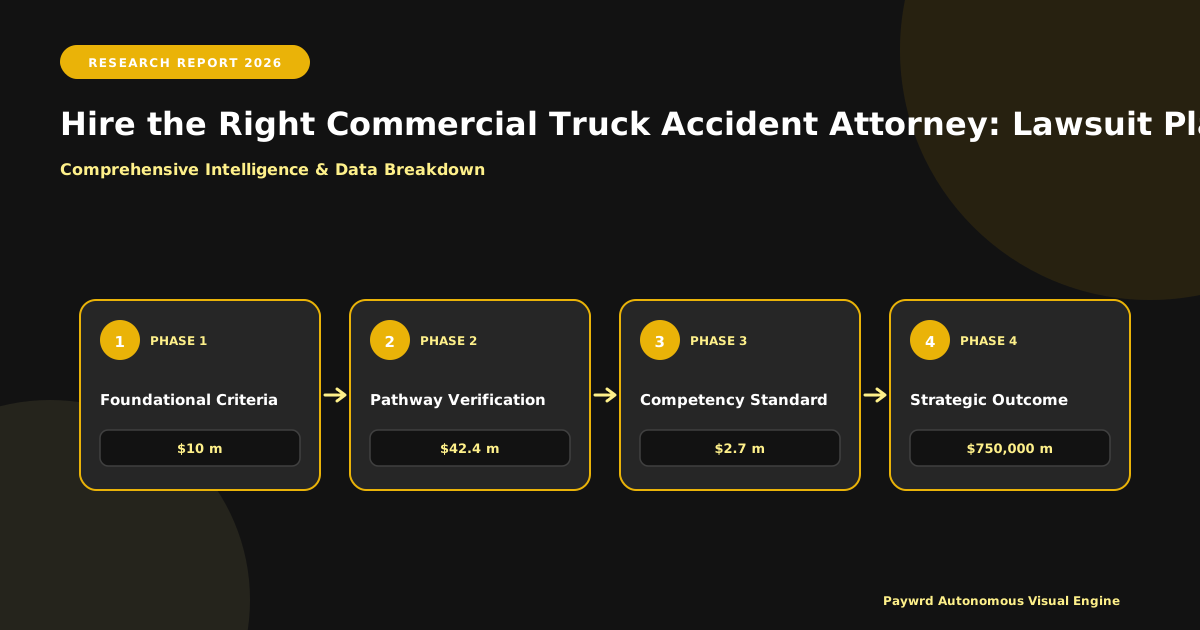
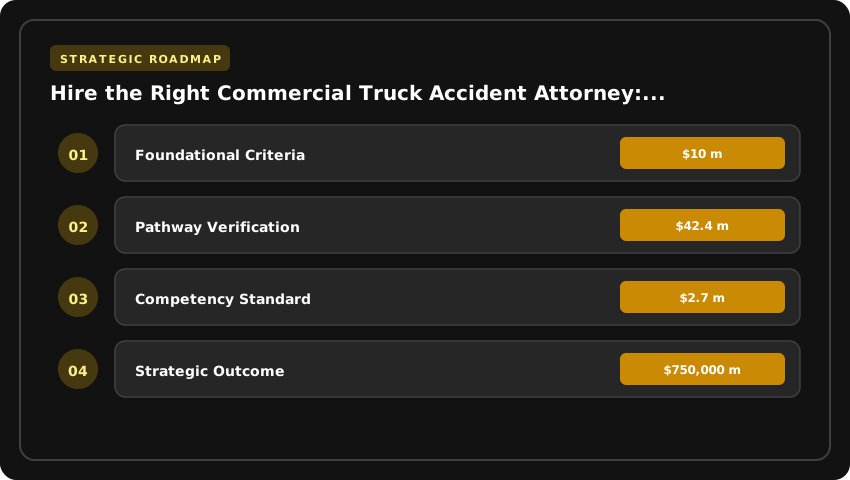
The third distinction is the nuclear verdict phenomenon. According to the American Transportation Research Institute’s 2024 report, the average nuclear verdict (a jury award exceeding $10 million) in trucking cases climbed to $42.4 million, while the average compensatory verdict in severe trucking cases reached roughly $2.7 million in 2023. Plaintiffs’ verdicts at this scale are reshaping how defense counsel value cases during settlement conferences, often producing seven-figure pre-trial resolutions that would be unheard of in a comparable passenger-vehicle claim.
Black box data, formally known as the Engine Control Module (ECM) or Event Data Recorder (EDR), adds a fourth layer of complexity. These devices can capture vehicle speed, throttle position, brake application, and even hard-braking events in the seconds preceding impact. Combined with forward-facing dashcam footage and the truck’s GPS trajectory, the data set often rivals what is available after a commercial aviation incident. Attorneys who fail to spoliation-letter the carrier risk losing the single most persuasive piece of evidence at trial.
Facing these high-stakes exposures, trucking-company insurers deploy rapid-response legal teams, sometimes arriving at the crash scene within hours. Teams from national defense firms such as Morgan & Morgan’s commercial litigation arm, Wilson Elser, or national carrier captive counsel like Great West Casualty’s in-house staff typically appear before injured plaintiffs have even selected a lawyer. Their objective is dual: to control the narrative, photograph the scene favorably, and secure driver statements before the trucker consults independent counsel. Families approached by these adjusters should politely decline recorded statements and route all inquiries through retained counsel.
The final structural difference is the vicarious-liability doctrine applied under the federal Federal Tort Claims Act framework and state-law agency principles. Because most commercial drivers are employees of motor carriers operating under FMCSA authority, the carrier is typically jointly liable for the driver’s negligence. That joint exposure means there are usually two or three insurance towers available, including primary commercial auto liability ($750,000 minimum, often $1 million to $5 million), excess umbrella coverage, and occasionally cargo or MCS-90 endorsement layers. Identifying every available coverage source is the difference between a capped settlement and a full recovery.
- FMCSA Hours of Service: 11-hour driving limit, 14-hour on-duty window, 10 consecutive off-duty hours before restart.
- ELD Mandate: Requires tamper-resistant digital logs; preserve via litigation hold before 6-month retention window expires.
- Nuclear Verdict Data: Average severe-case verdict near $2.7M (2023); top 10 percent average exceeds $42M, signaling aggressive jury trends.
- Black Box / ECM Evidence: Captures speed, braking, throttle, and GPS data; recoverable via spoliation letter and Rule 34 production requests.
- Rapid-Response Insurer Teams: Arrive within hours; never give recorded statements without your own attorney present.
- Layered Insurance Coverage: Primary commercial auto, excess umbrella, and MCS-90 endorsement collectively often exceed $10 million in viable claims.
Understanding these six pillars reframes the litigation landscape. A standard car-wreck playbook (photographs, police report, insurance negotiation) will underperform catastrophically against a well-funded defense team that controls the electronic evidence from day one. The next sections detail exactly how to level that playing field.
Evaluating a Truck Accident Attorney: The 7-Point Vetting Framework
Selecting the right commercial truck accident attorney is the single most consequential decision a plaintiff makes after a catastrophic collision with an 18-wheeler, tanker, or freight hauler. Because trucking defendants typically deploy insurance carriers with seven-figure defense budgets, your counsel must bring more than passion; they must bring resources, credentials, and a verifiable record. The following seven-point framework distills the criteria that experienced plaintiff’s firms use when evaluating lateral hires or referring high-stakes trucking cases to outside co-counsel. Treat this checklist as a non-negotiable screening protocol before signing any contingency agreement.
- Point 1: Documented Trucking-Specific Litigation Track Record. Ask for a docket-by-docket summary of verdicts and settlements in matters involving Federal Motor Carrier Safety Administration (FMCSA) regulations, hours-of-service violations, electronic logging device (ELD) data, and black-box preservation. A firm that has successfully litigated against carriers such as ABF Freight, J.B. Hunt, Schneider, or Werner Enterprises understands the aggressive defense tactics, spoliation battles, and Motive/Geotab telematics discovery unique to commercial defendants. Request anonymized case studies with gross recovery figures, not merely marketing anecdotes.
- Point 2: Trial Experience Versus Settlement Volume. A high settlement count can be misleading. Insurers maintain internal “watch lists” of firms that rarely try cases, allowing adjusters to lowball offers with confidence. Confirm the attorney has tried at least ten trucking cases to verdict within the past five years, including wrongful-death and catastrophic-injury matters. Published verdict reports from state courts, the Elite Lawyer directory, or LawDragon roundtables are credible corroboration. Trial readiness changes the settlement calculus, frequently unlocking 20–40% higher pre-trial resolutions.
- Point 3: Bar Admissions in Federal and State Courts. Many commercial trucking cases are removed to U.S. District Court under diversity jurisdiction once the carrier defendant is diverse from the plaintiff. Your attorney must therefore hold active admission to the relevant state bar and the federal district court where removal is anticipated. Cross-admission to adjacent federal circuits (for example, the Fifth, Eighth, or Ninth Circuit on appeal) signals a nationally scalable litigation practice. Verify good-standing status through the state bar registry and PACER federal filing access.
- Point 4: Peer-Reviewed Credentials (AVVO, Super Lawyers, Martindale-Hubbell). Independent rating platforms serve as a quick proxy for peer respect. On Avvo, target attorneys rated 8.0 or higher; on Super Lawyers, look for repeated inclusion in the Transportation or Personal Injury categories rather than a single “Rising Stars” appearance. A Martindale-Hubbell AV Preeminent rating reflects the highest peer and judicial approval. Credentials do not replace results, but they provide a baseline of professional legitimacy that filters out volume-driven settlement mills.
- Point 5: Contingency Fee Structure Aligned With Industry Norms (33%–40%). Standard plaintiff-side contingency fees in commercial trucking cases range from 33% pre-settlement to 40% post-trial or after filing a lawsuit. Be cautious of firms quoting flat 25% rates; such pricing is rarely sustainable for cases requiring six-figure expert depositions, accident reconstructionists, and life-care economists. Equally important, scrutinize the cost-advancement clause. Reputable firms front litigation expenses (filing fees, expert retainers, deposition transcripts) and recover them only from a successful recovery, never demanding out-of-pocket payments from the client during the case.
- Point 6: Case Funding and Litigation Infrastructure. Trucking litigation routinely exceeds $75,000 in out-of-pocket expenses before trial. Verify the firm maintains a litigation fund, lines of credit with case-funding partners such as Burford Capital, or a hybrid portfolio of pre-settlement advances. A firm that pauses discovery to wait for client expense contributions is a red flag for operational fragility. Inquire about in-house paralegal ratios, e-discovery platforms, and access to board-certified accident-reconstruction experts.
- Point 7: Client Communication Protocols and Reporting Cadence. Demand a written communication plan: scheduled status updates every 30–45 days, secure client portals for document review, and a designated case manager rather than a rotating associate. Catastrophic-injury cases often last 18–36 months; clarity and responsiveness prevent the anxiety that leads to premature, unfavorable settlements.
Actionable next step: compile a one-page comparison matrix of two or three attorneys scoring each of the seven criteria on a 1–5 scale. Pair the matrix with a 15-minute intake call to test responsiveness, then schedule a free consultation with the strongest candidate before committing to a retainer. Treat the consultation as a two-way interview: the attorney evaluates your case, and you evaluate their preparation, empathy, and strategic clarity.
The Hidden Economics Behind Contingency Fees and Litigation Funding
Behind every televised jingle about “you pay nothing unless we win” lies a sophisticated financial engine that most clients never see. Commercial truck accident plaintiffs are typically represented on a contingency fee arrangement, meaning the attorney advances every dollar of out-of-pocket case costs, from accident reconstruction experts and biomechanical engineers to medical illustrators, deposition transcripts, and jury-focused focus groups, then recoups those expenditures only after a settlement or verdict lands. For a routine trucking case, expert deposits alone can run $50,000; a multi-defendant bellwether trial with FMCSA regulatory experts, trucking safety consultants, and trucking-company telematics forensics regularly climbs past $150,000, and catastrophic injury or wrongful-death matters involving spinal cord trauma or traumatic brain injury often push total case costs into the $200,000 to $250,000 corridor before discovery even closes.
- Case-cost absorption: Plaintiff firms typically fund 18 to 36 months of litigation expenses without reimbursement, exposing the practice to real downside risk if a jury returns a defense verdict.
- Contingency splits: Standard contingency fees in trucking litigation range from 33 1/3% on pre-suit settlement to 40% or higher if the matter proceeds through trial, structured to compensate the firm for both capital risk and lost opportunity cost.
- Net recovery economics: On a $3 million verdict with $220,000 in costs and a 40% fee, the client still nets roughly $1.58 million, while the firm recoups its cost base plus a return comparable to a high-yield risk-adjusted investment.
The deeper capital story, however, is mass tort advertising, which functions less like traditional legal marketing and more like a venture-backed acquisition funnel. Plaintiff firms measure every TV rotation, pre-roll video, and bilingual radio buy against a hard Cost Per Signed Case (CPA) benchmark. Industry analysts tracking truck accident and catastrophic injury verticals report average CPA figures between $2,500 and $5,500 per retained client, with premium metropolitan markets (Houston, Chicago, Atlanta, Los Angeles) clearing $6,000 to $8,000 once competitive bidding for the same limited inventory of qualified claimants compresses efficiency. When a single seven-figure jury verdict can generate $2 million in gross fee revenue, a $5,000 acquisition cost is rational, even aggressive, capital deployment rather than discretionary overhead.
This is precisely why high-performing plaintiff firms routinely spend $1 million to $5 million annually on television advertising alone, and why the most recognizable commercial truck accident brands operate as quasi-litigation hedge funds. Cash flow is managed through a combination of revolving lines of credit, law-firm-specific litigation lenders, and structured legal finance vehicles that purchase a contractual slice of future contingency receivables at a discount, often 15% to 25%, in exchange for immediate working capital. That same financing pipeline funds expert witnesses, supports satellite intake centers across state lines, and keeps the 24/7 bilingual call centers staffed by trained intake paralegals who screen for statute of limitations exposure, jurisdictional venue quality, and liability clarity.
- TV placement math: A 30-second prime-time spot on a major regional network can cost $15,000 to $50,000 per airing, meaning a sustained year-long presence requires sustained capital, not a marketing budget afterthought.
- Litigation funding recourse: Outside funders price deals on docket venue, defendant solvency, expected time to resolution, and documented liability strength, so a clean liability against a Fortune 500 carrier with strong insurance towers commands far better terms than a comparative-fault passenger-vehicle case.
- Client takeaway: When a firm invests heavily in your case and heavily in advertising, your matter is being underwritten by sophisticated capital, which usually translates into deeper expert engagement, but always demands a careful read of the engagement letter’s expense-reimbursement clause and the precise point at which case costs begin accruing against your recovery.
Step-by-Step Lawsuit Timeline: From Crash Scene to Verdict or Settlement
Navigating a commercial truck accident lawsuit requires understanding that the clock starts ticking the moment steel meets steel on the highway. Unlike standard car wreck cases that often resolve within 12 to 18 months, commercial vehicle litigation routinely spans two to four years due to the federal regulatory overlay, multi-party defendants, and the sheer volume of discoverable data. Below is a chronological playbook that mirrors what experienced attorneys follow when steering a case from the chaotic crash scene to a final verdict or settlement conference.
- Hours 0–48: Crash Scene and FMCSA Mandatory Drug and Alcohol Testing. Under 49 CFR § 382.303, employers must test every CDL driver involved in a fatal crash within 8 hours, and drivers in crashes requiring medical treatment away from the scene within 32 hours. Your attorney should immediately send a litigation hold request to the motor carrier’s safety director to lock down the testing results, the chain-of-custody documentation, and the medical review officer’s report. Failure to test, or a tampered sample, creates a powerful negligence inference at trial.
- Days 1–14: Spoliation Letters to Preserve Evidence. A formal spoliation letter is mailed to the trucking company, its insurer, third-party logistics broker, and any telematics provider (e.g., Geotab, Samsara). The letter demands preservation of electronic logging device (ELD) data, engine control module downloads, dashcam footage, driver qualification files, hours-of-service logs, maintenance records, and post-crash repair estimates. Federal Rules of Civil Procedure Rule 37(e) gives courts teeth to sanction defendants who destroy electronically stored information, including adverse inference instructions to the jury.
- Months 1–3: Investigation, Expert Retention, and Filing Strategy. Accident reconstructionists, biomechanical engineers, and trucking-safety experts are retained on a contingency basis. Counsel evaluates whether to file in state court (often favorable for higher jury verdicts and plaintiff-friendly procedural rules) or federal court (preferred when diversity jurisdiction provides removal protection and streamlined discovery deadlines). The venue decision affects deposition scope, motion practice speed, and ultimately the settlement leverage ratio.
- Months 3–6: Statute of Limitations Check and Complaint Filing. Statutes of limitations vary dramatically by state, ranging from 2 years in California, Kentucky, and Tennessee to 6 years in Maine and Minnesota for personal injury claims. Federal claims under the Motor Carrier Act and certain FELA-adjacent theories may carry their own deadlines. Missing the limitations bar is a permanent jurisdictional defense, so your attorney will calendar the earliest applicable date and file well before it.
- Months 6–18: Discovery Phase. This is the data-rich heart of the case. Interrogatories, requests for production, and depositions of the driver, safety manager, fleet mechanic, and corporate representative under Federal Rule of Civil Procedure 30(b)(6) are standard. Expect to exchange driver qualification files, ELD data, prior crash histories, and insurance policy limits. Defense depositions of treating physicians and the plaintiff typically occur during months 12–18.
- Months 18–30: Mediation and Settlement Negotiations. Approximately 90% of commercial truck cases resolve before trial. Mediation, often required by local rule of civil procedure, involves a neutral third-party mediator who shuttles between counsel with blind-demand negotiating ranges. Insurers evaluate liability strength, comparative fault apportionment, and venue verdict data when reserving authority. Average trucking settlement values cluster between $850,000 and $2.4 million nationally, with outlier verdicts above $10 million reported in plaintiff-favored venues.
- Months 30–48: Trial Verdict Probability Distribution. If mediation fails, the case proceeds to jury selection, opening statements, and trial. Industry actuarial data suggest roughly 60% plaintiff verdict probability when liability is clearly established by ELD or FMCSA violations, dropping to 35–40% in comparative negligence jurisdictions where the plaintiff shares fault. Defense verdicts occur in about 20–25% of tried cases, while mistrials and hung juries account for the remainder, often triggering post-trial settlement discussions.
The practical takeaway for injured claimants is that early evidence preservation, aggressive compliance with statutory deadlines, and strategic venue selection determine whether a case settles for its true economic value or requires a multi-year trial commitment. Free consultation intake calls with experienced commercial trucking attorneys typically include a preliminary statute-of-limitations analysis, jurisdiction comparison, and an evidence-preservation checklist that can be mailed to the carrier within 48 hours.
Free Consultation Red Flags: Spotting High-Volume Settlement Mills vs. Trial-Ready Firms
The phrase “free consultation” appears on virtually every personal injury website in the United States, from solo practitioners in small counties to national brands spending millions on television advertising. After a catastrophic collision with a commercial tractor-trailer, that thirty-minute phone call becomes the most consequential conversation you will have before deciding who protects your family, your medical future, and your right to fair compensation. Unfortunately, that conversation is also where many trucking victims are quietly steered into settlement-mill representation, a business model engineered to resolve claims quickly, cheaply, and predictably for the firm rather than for the injured plaintiff. Learning to recognize the warning signs during the consultation itself is one of the most valuable skills a claimant can develop.
The first red flag is paralegal-led intake. When you call a legitimate trial-ready firm, an attorney or a senior case manager with years of specialized experience usually conducts the initial screening. When the first person to discuss your case is an intake paralegal reading from a script, gathering your Social Security number, your insurance details, and the names of every treating physician within the first five minutes, the firm is almost certainly prioritizing volume over substance. Trucking cases involve federal regulations, electronic logging devices, hours-of-service compliance, and complex spoliation arguments. A non-lawyer gathering facts in a fifteen-minute call cannot meaningfully evaluate whether your claim has merit, what expert witnesses may be required, or whether the carrier’s insurance policy limits are adequate.
The second warning sign is 1-800 branding paired with national television campaigns. Billboards and primetime slots cost real money, often seven figures per market, and that overhead is recovered by closing cases fast. A firm spending $3 million annually on advertising must generate an enormous caseload just to break even. Mass-market branding rarely correlates with the kind of individualized attention, expert engagement, and courtroom preparation that high-value trucking litigation demands. Ask directly how many billboards the firm maintains, how many of its active cases involve commercial motor carriers, and what percentage of the attorney’s weekly hours are spent on marketing versus trial preparation.
Closely related is the presence of non-attorney case managers functioning as the primary point of contact throughout the life of your case. While paralegals and case managers are essential members of any well-run legal team, they should never substitute for attorney-led strategy. If the lawyer you met during the consultation is rarely available, if depositions are scheduled by support staff without attorney oversight, and if all settlement decisions are filtered through a non-lawyer, your case is being managed like an assembly-line file rather than a courtroom-ready claim.
Perhaps the most disqualifying red flag is any guarantee of outcome. No ethical attorney can promise a specific dollar amount, a verdict, or a particular timeline. Statements such as “we will get you $250,000” or “this case will settle within ninety days” violate professional conduct rules in every U.S. jurisdiction and signal a marketing-first operation. Reputable firms discuss ranges, explain the variables that affect valuation (policy limits, comparative fault, venue, injury severity), and are candid about the risks of trial.
The single most revealing question you can ask during a free consultation is this: “How many trucking cases have you tried to verdict in the last five years?” A settlement mill will typically stumble, deflect, or cite aggregate firm statistics that include cases settled on the courthouse steps. A genuine trial lawyer will name the jurisdictions, describe the verdicts, and explain the post-trial appellate history. Trial experience is the most reliable proxy for credibility with insurance carriers, with defense counsel, and with the court itself. Carriers such as Progressive, GEICO, Liberty Mutual, and the specialized commercial underwriters at Great West Casualty or National Interstate track which plaintiff firms actually try cases, and they reserve their lowest offers for those who do not.
Additional questions to put on your consultation checklist include: Who will be the attorney of record on my file? What is your firm’s annual spend on expert witnesses, accident reconstructionists, and biomechanical engineers? Have you successfully preserved electronic logging device data through spoliation motions? What is your firm’s policy on litigating through verdict versus recommending settlement? Honest answers reveal whether the firm is genuinely trial-ready or simply trial-adjacent.
The financial and human stakes in a commercial truck case are simply too high to entrust to a high-volume operation. A plaintiff with a traumatic brain injury, a spinal cord injury, or a wrongful death claim may be negotiating against a carrier with $1 million to $10 million in available coverage, defense firms like Williams & Connelly or Bowman and Brooke, and a team of accident reconstruction experts. Leveling that playing field requires a law firm that invests in people, in experts, and in the courtroom, not in toll-free numbers and thirty-second advertisements.
- Red Flag Checklist: Paralegal-led intake, 1-800 branding with TV ad spend above $1 million, non-attorney case managers directing strategy, guaranteed outcomes, and inability to cite recent trucking verdicts.
- Positive Indicators: Attorney-led consultations, published verdicts in trucking cases, dedicated trucking practice group, in-house investigator capacity, and active membership in organizations such as the American Association for Justice Trucking Litigation Group or the Interstate Trucking Litigation section.
- Decision Rule: If the firm cannot name a single trucking verdict within the past five years, continue your search. Trial readiness is not a slogan; it is a track record.
Maximizing Settlement Value: Evidence, Expert Witnesses, and Damages Calculation
The single largest leverage point in a commercial truck accident lawsuit is the depth, quality, and admissibility of the evidence used to calculate damages. Insurance carriers defending against a trucking claim understand that jurors in US tort proceedings are deeply moved by well-documented, expert-quantified losses. When a plaintiff’s legal team pairs contemporaneous black-box data and Federal Motor Carrier Safety Administration (FMCSA) regulation violations with credentialed expert testimony, the defense is rarely willing to roll the dice at trial. Instead, the carrier typically escalates settlement offers toward the upper bounds of policy limits, often in the seven-figure range for cases involving catastrophic injury. The key is knowing what to collect, who to hire, and how to convert raw documentation into a persuasive damages narrative that resonates with adjusters, mediators, and jurors alike.
Start with the evidence that proves the trucking company’s negligence. Every commercial carrier must maintain a Commercial Driver’s License (CDL) qualification file for each driver, including employment history, medical examiner certificates, road test results, and annual reviews of driving records as mandated under 49 CFR 391.51. Plaintiffs’ counsel routinely uncover disqualifying violations such as missing or expired medical certificates, failure to conduct required annual reviews, or undisclosed prior accidents. These file violations, when paired with hours-of-service logs pulled from the Electronic Logging Device (ELD), can demonstrate that the carrier knowingly put an unqualified or fatigued driver behind the wheel of an 80,000-pound vehicle. Additionally, dashcam footage, event data recorder downloads, and maintenance logs frequently reveal ignored brake warnings, tire tread deficiencies, or skipped pre-trip inspections.
Once liability evidence is secured, the second pillar of settlement maximization is engaging the right expert witnesses. Accident reconstruction experts typically charge between $300 and $500 per hour, with total case involvement ranging from $7,500 to $25,000 depending on deposition and trial testimony needs. These specialists use physics, vehicle telemetry, and 3D modeling to establish speed, reaction times, line of sight, and point of impact, often producing demonstrative exhibits that juries find compelling. Life care planners, usually registered nurses or rehabilitation specialists, project future costs for surgeries, prescriptions, in-home care, mobility equipment, and accessibility modifications, frequently identifying lifetime medical expenses between $2 million and $10 million for spinal cord or traumatic brain injury survivors. Vocational economists calculate lost earning capacity by analyzing the plaintiff’s pre-injury wage trajectory, fringe benefits, and work-life expectancy, then discounting those projections to present-day value using accepted economic methodologies recognized under US tort law.
Damages calculation in a truck accident case divides into two distinct categories, each requiring different proof strategies. Economic damages are mathematically verifiable losses, including past and future medical bills, lost wages, diminished earning capacity, rehabilitation costs, and property damage. These figures are supported by billing records, employer documentation, tax returns, and expert projections. Non-economic damages, by contrast, compensate for subjective harms such as physical pain, emotional distress, loss of enjoyment of life, and loss of consortium. While harder to quantify, US jurisdictions generally permit testimony from the plaintiff, family members, and treating physicians to establish the human cost of the injury. In states that apply comparative fault rules, the plaintiff’s recoverable damages are reduced by their percentage of fault, making precise liability proof even more critical.
- Build the liability file first: Demand preservation letters immediately, secure the CDL qualification file under 49 CFR 391.51, and obtain ELD data within days of the collision.
- Match experts to damages: Reconstructionists for liability, life care planners for medical futures, vocational economists for lost earning capacity, and economists for household services valuation.
- Verify hourly rates and credentials: Expect accident reconstruction experts at $300 to $500 per hour; confirm each expert’s willingness to testify at trial, which dramatically increases settlement leverage.
- Document every dollar of economic loss: Compile medical billing ledgers, pharmacy receipts, mileage logs for treatment travel, and pay stubs covering at least two years pre-injury.
- Humanize the non-economic side: Use day-in-the-life videos, journal entries, and caregiver testimony to translate abstract suffering into a story jurors can emotionally grasp.
The final piece of a high-value settlement strategy is timing and presentation. Once the evidence and expert reports are fully developed, plaintiffs’ counsel typically prepare a comprehensive demand package, often a 30- to 50-page exhibit-rich document, that walks the insurance adjuster through liability proof, damages methodology, and comparable verdicts. This package serves as the centerpiece during mediation and, if needed, as the foundation for opening statements at trial. By combining regulatory violation evidence, credentialed expert analysis, and a clean separation of economic versus non-economic damages, experienced commercial truck accident attorneys routinely achieve settlements that far exceed what unrepresented claimants or general practice firms can secure, often recovering the full available policy limits for catastrophically injured clients.
Strategic Final Takeaway
Success in evaluating Hire the Right Commercial Truck Accident Attorney: Lawsuit Playbook & Free Consult relies on early preparation, adherence to verified accredited requirements, and cross-referencing official portals. Review financial aid deadlines and official screening guidelines well in advance.