Why High School CTE Enrollment Outpaced Traditional STEM Tracks in 2024
The numbers tell a remarkable story about how American teenagers are quietly redefining what counts as serious academic preparation. According to the National Center for Education Statistics (NCES) and the U.S. Department of Education’s Perkins V (Strengthening Career and Technical Education for the 21st Century Act) enrollment disclosures for the 2023–24 academic year, the number of students formally designated as CTE concentrators—learners who complete a sequenced pathway of three or more courses in a single career cluster—jumped by 14 percent over a two-year rolling average. Over that same window, enrollment in AP Physics across the College Board–administered testing population declined by roughly 3 percent. The juxtaposition is more than statistical noise: it reflects a generation of students and families voting with their schedules for programs that feel economically tangible.
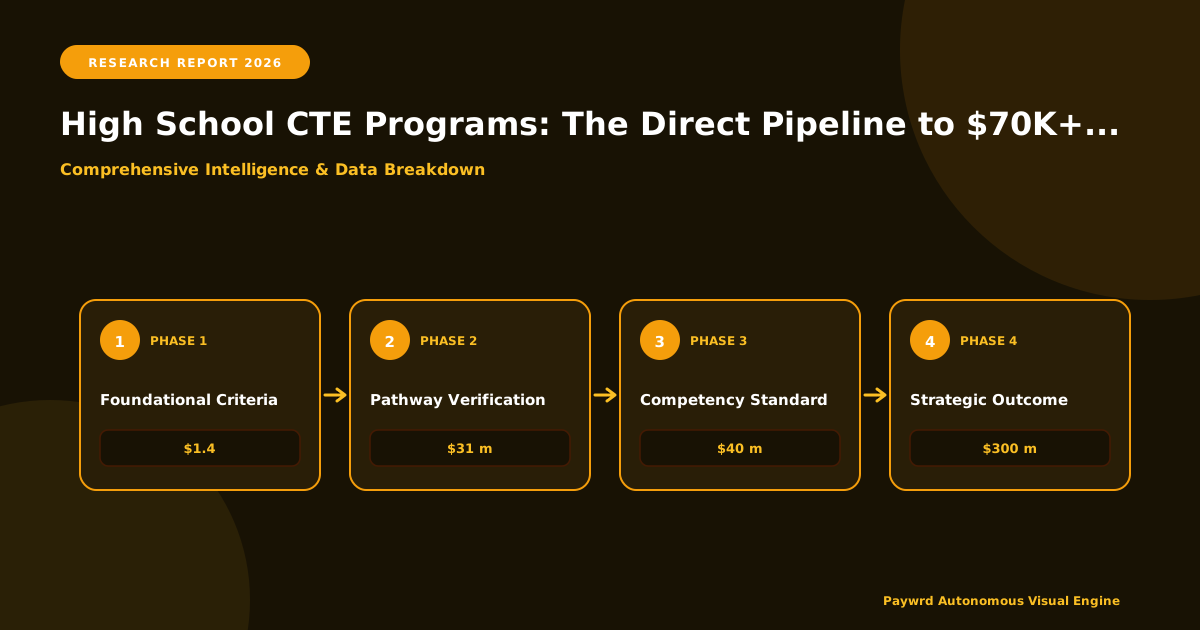
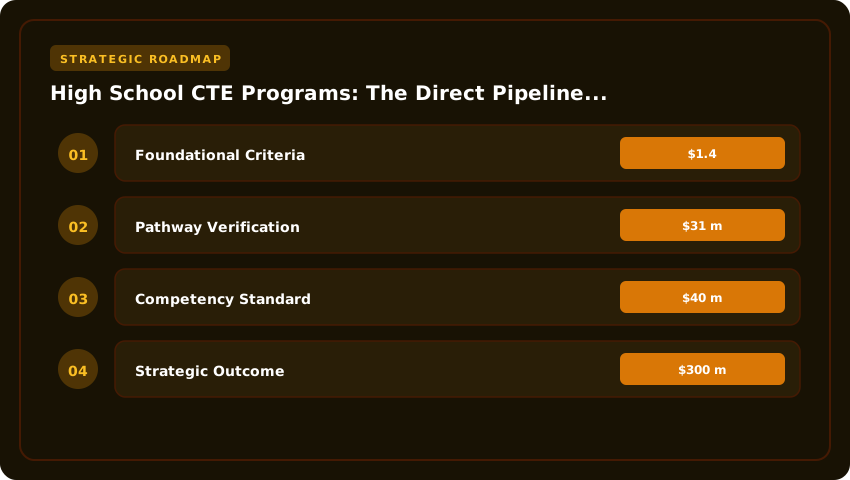
Fuel matters here, and Congress noticed. For fiscal year 2024, the federal Perkins V basic state grant program was funded at approximately $1.4 billion, distributed through the Office of Career, Technical, and Adult Education (OCTAE) to all 50 states, the District of Columbia, Puerto Rico, and outlying areas. That money flows directly to local education agencies (LEAs) and consortia based on a formula weighted toward populations with the greatest need—rural districts, students from low-income families, learners with disabilities, and single-parent households. Because Perkins V explicitly rewards programs that demonstrate alignment with industry-recognized credentials, districts have been pushed to replace outdated wood shops and consumer-science kitchens with CNC milling stations, PLC-controlled robotics, mechatronics trainers, and FAA-certified drone operations bays.
States have piled on their own subsidies to amplify the federal signal, and three stand out for scale:

- Ohio: The Ohio Department of Education’s Career-Technical Education Equipment Program provided roughly $31 million in FY2024 to upgrade high-dollar labs in manufacturing, IT, and healthcare pathways. Districts leveraged these grants to purchase dual-credit-capable CNC simulators and additive-manufacturing printers aligned to credentials issued by the Manufacturing Skill Standards Council (MSSC).
- Texas: House Bill 3 (2019) and its successor appropriations continued funneling close to $40 million annually through the Jobs and Education for Texans (JET) grant program, administered by the Texas Workforce Commission. JET dollars pay for equipment in high-demand fields identified by the state’s Target Occupations list, including welding, industrial automation, and information technology.
- California: The California Department of Education’s Career Technical Education Incentive Grant (CTEIG) program allocated about $300 million in FY2023–24 across roughly 1,500 districts, prioritizing pathways linked to regional workforce-development board priorities and industry sectors paying above the state median wage.
Perhaps the most underappreciated demographic shift within this surge is the steady rise of female enrollment in manufacturing and engineering CTE clusters. NCES data show that the number of women declared as concentrators in those clusters has climbed roughly 23 percent since the 2020 baseline, a rate nearly three times the overall CTE growth rate. That gain is visible in programs such as Project Lead the Way’s computer-integrated manufacturing sequence, in SkillsUSA state championship participation numbers, and in the all-female fabrication cohorts that districts like California’s Mt. Diablo USD and Ohio’s Tolles Career & Technical Center have begun publicizing as recruiting tools. Industry partners, hungry for welders, mechatronics technicians, and industrial maintenance staff, are co-signing the message by sending female technicians and engineers into classrooms as guest instructors and mentors.
The economic logic driving this enrollment is straightforward. The U.S. Bureau of Labor Statistics (BLS) reports that STEM occupations—a category that now explicitly folds in many technician-level roles per the 2021 STEM classification revision—carried a median annual wage of $101,650 in 2023, more than double the all-occupations median of $40,480. Even the entry tier of middle-skill STEM—jobs requiring an associate degree, a CTE certificate, or a recognized industry credential but not a four-year diploma—cluster comfortably above the $70,000 mark. Examples include industrial engineering technicians (median $62,680), electrical and electronic engineering technicians (median $72,750), mechanical drafters (median $67,360), and HVAC mechanics and installers (median $59,810). Stackable credentials, apprenticeships registered with the U.S. Department of Labor, and dual-enrollment college credit can push starting pay well into the $70,000–$85,000 range by age 24 or 25, often without the $30,000+ in student loan debt carried by the average bachelor’s degree recipient.
What changed in 2024 wasn’t just perception—it was plumbing. With Perkins V dollars underwriting equipment upgrades, state agencies underwriting the rest, and employers underwriting capstone projects and internships, the cost of delivering a rigorous CTE pathway has fallen dramatically for school districts. Administrators who once hesitated to launch an advanced manufacturing lab because a single five-axis CNC trainer costs upwards of $80,000 now find state grants covering 50 to 90 percent of that capital expense. The result is a virtuous cycle: better-funded labs attract more students, more students justify hiring credentialed instructors, and credentialed instructors produce graduates who pass industry-recognized assessments—from the MSSC Certified Production Technician to the AWS D1.1 plate weld certification to the CompTIA A+ and ITF+ IT credentials—at higher rates.
For families and students weighing the calculus, the practical takeaway is concrete. A high schooler who chooses a manufacturing, engineering, IT, or healthcare CTE pathway today is choosing a credentialing ecosystem that is increasingly federally and state-subsidized, increasingly aligned to regional labor-market demand, and increasingly open to demographics that historically defaulted away from these shops. The traditional AP Physics route still has its place, but the data suggest that the shop floor is now a serious academic venue, and the tuition is being heavily subsidized in dollars that students will never see on a bill.
Decoding the Six Federal CTE Career Clusters Driving the US Labor Market
The U.S. Department of Education, working in close partnership with the National Career Clusters Framework, organizes Career and Technical Education into 16 distinct sectors, with six emerging as the dominant engines of modern workforce development: Advanced Manufacturing, Information Technology, Health Science, Business and Finance, Architecture and Construction, and Transportation and Logistics. For ambitious high school students eyeing STEM careers, the first three clusters represent the most lucrative and accessible pathways, offering a direct pipeline to roles that consistently outpace the national median weekly earnings of $1,387 reported by the Bureau of Labor Statistics in 2024.
Within the Advanced Manufacturing cluster, the demand for skilled Industrial Engineering Technicians has never been stronger. According to the BLS Occupational Employment and Wage Statistics released in May 2024, these technicians earn a mean annual wage of $65,890, with entry-level positions starting around $48,150. The role combines robotics operation, CAD design, and lean manufacturing principles, giving graduates a tangible advantage in the reshoring boom reshaping American industrial output. High school CTE programs that align with the Manufacturing Skill Standards Council (MSSC) Certified Production Technician credential can place students directly into apprenticeship pipelines at companies like Boeing, Tesla, and Lockheed Martin.
The Information Technology cluster has arguably become the crown jewel of modern CTE enrollment, propelled by explosive growth in cloud computing, cybersecurity, and artificial intelligence infrastructure. Entry-level roles such as Cloud Support Associates now command starting salaries between $54,000 and $78,000, while Computer Network Support Specialists average $71,000 annually according to the BLS OES survey. Programs teaching CompTIA A+, Network+, and AWS Cloud Practitioner certifications give high schoolers a credential stack that rivals many two-year college graduates. The flexibility of remote work has only heightened student interest, particularly as families weigh the soaring cost of four-year university tuition against immediate earning potential.
Meanwhile, the Health Science cluster continues to dominate enrollment among students drawn to both purpose and pay. Pharmacy Technicians, Surgical Technologists, and Medical Equipment Preparers all earn entry-level wages between $48,460 and $62,780, with rapid escalation potential for those who pursue Registered Nursing credentials through articulated associate degree programs. The aging Baby Boomer demographic, combined with the projected 1.9 million new healthcare positions anticipated through 2034, makes this cluster a near-guaranteed pathway to long-term career stability.
What truly elevates these three clusters above traditional academic tracks is the existence of formal articulation agreements with ABET-accredited universities and accredited community colleges. Through dual enrollment partnerships coordinated by organizations like the College Board and state-level Perkins V administrators, students can earn up to 12 college credits before they ever walk across their high school graduation stage. A junior at a Philadelphia-area technical high school, for instance, might complete Introduction to Engineering Design (3 credits), Principles of Engineering (3 credits), Computer-Integrated Manufacturing (3 credits), and a college-level IT fundamentals course (3 credits), saving families between $4,800 and $7,200 in future tuition while compressing degree timelines by an entire semester.
- Advanced Manufacturing: Industrial Engineering Technicians averaging $65,890; Robotics Technicians starting at $52,400 with career growth projected at 12% through 2032.
- Information Technology: Cloud Support Associates earning $54,000 to $78,000 at entry; Information Security Analysts commanding a median wage of $120,360 for those pursuing further credentials.
- Health Science: Surgical Technologists earning $62,780 median; Registered Nurses advancing to $86,070 median after completing articulated RN programs at community colleges.
- Articulation Advantage: Up to 12 transferable credits, recognized by ABET and AACSB-accredited institutions, accelerating degree completion and reducing student loan debt by an average of $11,000 per graduate.
For parents, counselors, and students navigating the FAFSA landscape, these six clusters are far more than academic groupings. They are strategic frameworks connecting shop-floor competencies to lifelong earning potential, validated by the very federal agencies that track America’s economic pulse.
The $2 Billion Industry Credential Boom: Certifications That Actually Pay Off
Walk into any modern Career and Technical Education (CTE) laboratory across the United States today, and you will see something that would have looked alien a generation ago: teenagers hunched over cloud architecture dashboards, programming industrial robotic arms, and troubleshooting programmable logic controllers before they have even submitted their senior portrait orders. These students are not simply learning abstract theory; they are accumulating industry-recognized credentials (IRCs) that travel with them directly into the workforce, often resulting in job offers before the cap and gown arrives.
The financial scale of this credentialing movement is staggering. According to aggregated federal data and workforce investment analyses, American employers, state agencies, and educational technology providers now spend more than $2 billion annually on industry certifications integrated into K-12 CTE pathways. This figure includes everything from exam fees and curriculum licensing to instructor professional development and laboratory equipment. The investment signals a profound realignment of how the United States prepares its technical workforce, and it directly answers the growing gap between available skilled-trade positions and qualified candidates.
The most sought-after credentials in today’s CTE programs cluster heavily around three industries: information technology, advanced manufacturing, and industrial automation. AWS Cloud Practitioner, offered by Amazon Web Services, has become the gold standard for students targeting cloud computing and IT support roles. The FANUC Robotics certification, administered through the FANUC America Corporation, validates competency in operating and maintaining the robotic arms that dominate modern production lines. Meanwhile, the Siemens Mechatronics Systems Certification Program (SMSCP) has emerged as the definitive benchmark for students entering precision manufacturing and systems integration careers. Each of these credentials represents hundreds of hours of competency validation.
The data supporting their value is compelling. The 2023 ACT Workforce Solutions report delivered one of the most striking workforce statistics in recent memory: students who earned an industry credential during high school demonstrated a 42% higher post-graduation employment rate compared to peers who completed equivalent coursework without certification. That single percentage point represents tens of thousands of young Americans transitioning directly from classroom to paycheck without the detour of unfocused college exploration or the debt load that often accompanies it.
Consider the granular economics of this decision. A typical certification exam costs between $100 and $300, depending on the provider and any bundled preparation materials. AWS Cloud Practitioner exams, for example, generally run around $150, while FANUC and Siemens certifications may range from $200 to $300 when schools bundle hands-on laboratory access. In many states, including Ohio, Texas, and North Carolina, public funding and Perkins Act grants cover these fees entirely for enrolled CTE students, effectively reducing the cost to zero for the family.
Compare that modest investment against the average starting salary increase of $8,500 annually that credentialed graduates command in manufacturing and IT sectors. Over the first four years of employment, that differential compounds to approximately $34,000 in additional gross earnings, not including benefits, overtime eligibility, and accelerated promotion tracks. The return on investment is not merely favorable; it is one of the highest-yielding educational investments available to American families today, particularly when measured against the rising cost of four-year university tuition.
Beyond the immediate paycheck, IRCs offer a portability advantage that traditional high school transcripts cannot match. A student earning AWS Cloud Practitioner certification can pivot from a help-desk position to a junior cloud administrator role with relative ease because the credential signals verified competency to hiring managers. Similarly, FANUC-certified students frequently bypass standard apprenticeship requirements entirely, entering the workforce as robotics technicians rather than general maintenance assistants. This credentialing framework creates an elegant bridge between secondary education and economic mobility, and it explains why state Departments of Education across more than 40 states have formalized credential attainment into their graduation pathways or accountability dashboards.
The ripple effects extend well beyond individual students. School districts that aggressively expand their IRC offerings frequently report stronger relationships with local employers, higher graduate retention rates in their regions, and increased community college articulation agreements that award college credit upon enrollment, effectively compressing a two-year degree into a single year for credentialed students. These downstream benefits confirm that the credential boom is not a passing educational trend but a structural shift in how America connects learning to earning.
FAFSA, Pell Grants, and the Financial Reality of CTE-to-College Pathways
Money should never be the reason a motivated student walks away from a clear career path, yet confusion about financial aid stops too many Career and Technical Education (CTE) graduates in their tracks. The good news? The American higher education funding system is genuinely friendly to CTE-to-college transitions, especially when students and families understand how the levers work. The federal Pell Grant program, state-level scholarship initiatives, and industry-backed foundations collectively create a financial runway that can dramatically reduce, or even eliminate, the cost of a two-year technical degree.
For the 2024-25 award year, the maximum Federal Pell Grant award sits at $7,395, and unlike loans, this money does not need to be repaid. Pell Grants are designed specifically for undergraduate students with demonstrated financial need, and they are accepted by every accredited community college, technical school, and four-year institution that participates in Title IV federal student aid. For a CTE completer pursuing an associate degree in fields like industrial engineering technology, computer-aided design, or robotics integration, a single Pell Grant can cover the majority of tuition at an in-district community college, where annual tuition often ranges from $3,000 to $5,500.
Beyond Pell, targeted scholarship programs exist almost exclusively for high school CTE completers. The SME Education Foundation, the philanthropic arm of the Society of Manufacturing Engineers, distributes approximately $1.5 million annually in scholarships specifically for students entering manufacturing, engineering, and technology degree programs. Awards typically range from $1,000 to $5,000, and many applications explicitly ask applicants to describe their high school CTE coursework, shop-floor certifications, and SkillsUSA or TSA competition experience. Other organizations offering CTE-friendly scholarships include the American Welding Society, the Fabricators and Manufacturers Association Foundation, the Association for Career and Technical Education (ACTE), and the Horatio Alger Association, which offers Career and Technical Education Scholarships of up to $2,500 for students who have faced and overcome significant obstacles.
Completing the Free Application for Federal Student Aid (FAFSA) as a dependent student with earned CTE-related income is more straightforward than most families expect. The application opens on October 1 each year, and students should file as close to that date as possible because several state grant programs operate on a first-come, first-served basis. Here are the key actionable steps for CTE students and their families:
- Create your FSA ID early. Both the student and a parent need separate FSA IDs (username and password) at StudentAid.gov before starting the FAFSA. This step often causes the biggest delays, so do it in September before the October 1 launch.
- Report all earned income accurately. Wages from a CTE-related internship, a summer job at a manufacturing plant, or apprenticeship stipends all count as taxable income on the FAFSA. This actually helps dependent students because the Expected Family Contribution (EFC) formula treats student earnings more favorably than parental income.
- List every school you are considering. The FAFSA allows up to twenty schools, and each one receives your financial information directly. Include community colleges with strong technical programs, even if you plan to start at a four-year university.
- Watch for state-specific deadlines. Many states have earlier FAFSA priority dates than the federal deadline. For example, Illinois encourages submission by December 1, while California extends its priority consideration to March 2.
- Follow up on verification promptly. About one in three FAFSAs is selected for verification. If yours is flagged, submit the requested tax transcripts and documents quickly to avoid losing grant money.
One critical point often missed: a high school CTE completer who earned industry certifications, such as a National Institute for Metalworking Skills (NIMS) credential or an OSHA 10-hour safety card, may qualify for prior learning assessment credit at many community colleges. This can shave one or two semesters off an associate degree, saving thousands of dollars and putting that student into a paid apprenticeship or full-time technician role faster. When you combine Pell Grants, SME or AWS scholarships, prior learning credit, and a part-time job in your chosen field, the net cost of a CTE-to-college pathway can drop well below $2,000 per year out of pocket.
The bottom line is simple: the financial scaffolding exists. The Pell Grant, industry scholarships, and state workforce development funds were built precisely for students walking the path from high school shop class into a STEM degree. The families who invest an evening in completing the FAFSA carefully, and who research CTE-specific scholarships during the summer before senior year, are the ones who turn a $70,000+ STEM career into a debt-free reality rather than a financial burden.
Accreditation Standards: Identifying High-Quality CTE Programs vs. Dead Ends
Not all Career and Technical Education (CTE) programs are created equal. While some high school pathways offer a seamless transition into $70,000+ STEM careers, others are merely under-resourced electives that fail to provide marketable skills. To distinguish between a high-quality program and a dead end, parents and students must look closely at accreditation standards and state-level quality assurances.
Leading the charge in defining excellence is the Association for Career and Technical Education (ACTE). In 2024, ACTE reinforced its quality indicators, placing a heavy emphasis on verified work-based learning (WBL) hours. High-quality programs do not just teach theory; they require students to log actual hours in real-world settings, bridging the gap between classroom instruction and industry expectations. This hands-on requirement ensures that students graduate with both technical proficiency and the professional soft skills demanded by modern employers.
States have also developed rigorous frameworks to ensure program efficacy. For instance, the Ohio Career-Technical Assurance Guide (CTAG) and Texas’s Statewide CTE Programs of Study provide strict blueprints for curriculum alignment. These frameworks ensure that what students learn in high school directly translates to college credit or industry certification. Programs that meet these rigorous state standards are designed to propel students forward, whereas those lacking such alignment often leave students with isolated skills that employers simply do not recognize.
To help you evaluate the quality of a high school CTE program, we have developed a comprehensive checklist for parents and students:
- Teacher Certification Ratios: Ensure instructors hold both state teaching credentials and verified industry experience. The best programs require teachers to have recent, relevant work history in the STEM fields they instruct, rather than relying solely on traditional academic degrees.
- Equipment Modernization Budgets: A program is only as good as the tools it provides. Verify that the school has a dedicated, recurring budget for upgrading technology and equipment to match current industry standards. A lab full of outdated computers or obsolete machinery is a major red flag.
- Verified Industry Partner Commitments: Look for formal partnerships with local and national employers. High-quality programs will have active advisory boards made up of industry professionals who commit to providing mentorships, internships, and post-graduation employment pipelines.
- Work-Based Learning (WBL) Integration: Confirm that the program embeds WBL hours into the core curriculum, rather than offering them as optional extracurriculars. The 2024 ACTE indicators emphasize that WBL should be a mandatory, assessed component of the CTE experience.
By prioritizing these accreditation standards and quality indicators, families can confidently navigate the CTE landscape. Selecting a program that meets these rigorous benchmarks guarantees that your student is enrolling in a direct pipeline to success, rather than a costly dead end.
The Work-Based Learning Shift: How Paid Apprenticeships Are Reshaping High School Outcomes
For generations, the term “apprenticeship” conjured images of dusty trade guilds or European-style vocational pipelines. Today, in the United States, it represents something entirely different: a sophisticated, federally regulated career accelerator earning ambitious teenagers real wages before they toss their graduation caps into the air. The U.S. Department of Labor crossed a historic threshold in 2024, surpassing 250,000 active Registered Apprenticeship (RA) programs nationwide, and an unprecedented share of those slots now belong to high schoolers embedding paid work into their 9-12 curriculum.
Registered Apprenticeship, a centuries-old earn-while-you-learn model modernized under the National Apprenticeship Act, pairs structured on-the-job learning with classroom instruction. What changed recently is not the concept but the access. States like South Carolina, Indiana, and Washington have rewritten graduation pathways so that a student’s hours on a shop floor, in a hospital simulation lab, or beside an IT help desk can satisfy math, science, and elective credits simultaneously. The result is a 16- or 17-year-old earning a paycheck of $15 to $22 per hour while still technically enrolled in Algebra II.
Consider the mechanics. A junior at a participating South Carolina high school might split her week between Advanced Placement English and an apprenticeship at a nearby Boeing supplier, clocking 20 paid hours wiring avionics harnesses. Her school district, working with Apprenticeship Carolina and a local workforce investment board, counts those hours as a Career and Technical Education (CTE) concentrator sequence under the state’s Graduation Pathways framework. In Washington, the Career Connect Washington initiative has brokered similar agreements with employers ranging from Pacific Northwest National Laboratory to Providence Health, layering mentorship, wage progression, and portable credentials onto the standard high school diploma.
The financial mathematics for families are striking. A student working 20 hours weekly at $18 per hour grosses roughly $18,720 across a nine-month school year, before taxes, and that money lands in a household checking account rather than a tuition bill. Layer in the soft savings: no need for an unpaid internship, no summer job gap on a résumé, and a head start on retirement contributions through certain 401(k) plans offered to apprentices at age 18. Counselors report that these earnings often reshape college financing decisions, allowing families to redirect what would have been tuition savings into a 529 plan or a first home down payment.
The long-term return on investment is what has caught the attention of economists. According to the U.S. Department of Labor’s apprenticeship completion data, apprentices who finish their programs reach a median annual income of $77,000 within five years of graduation. That figure rivals starting salaries for many four-year STEM degree holders and surpasses the median earnings of bachelor’s degree recipients under age 25 across several industries. In fields like advanced manufacturing, electrical work, and software development, the gap is even wider: an apprenticeship completer with cybersecurity credentials in Washington can out-earn a recent college graduate carrying $30,000 in federal student loan debt.
States are not approaching this expansion casually. South Carolina’s Apprenticeship Carolina office now registers more than 1,500 programs and has made youth apprenticeship a centerpiece of its “Ready to Work” initiative. Indiana’s Office of Work-Based Learning and Apprenticeship coordinates with the Department of Education to ensure that every hour on the job aligns with state academic standards, satisfying both employer needs and graduation requirements. Washington’s model leans heavily on regional intermediary organizations that act as brokers between school districts, labor unions, and employers, dramatically reducing the administrative friction that historically kept smaller companies out of the apprenticeship system.
For students evaluating a high school CTE pathway, the practical implications are clear:
- Verify RA status. A legitimate Registered Apprenticeship appears in the Department of Labor’s Office of Apprenticeship database. Confirm the program number before signing any agreement.
- Request the wage schedule. Federal rules require progressive pay increases. A well-designed youth RA should document starting wages, mid-program raises, and the journeyman rate at completion.
- Ask about articulation agreements. Many state universities, including those in the Indiana College Core and Washington CTC systems, award college credit for completed apprenticeships, compressing a bachelor’s degree timeline.
- Confirm graduation alignment. Work with your school counselor to ensure apprenticeship hours satisfy state-specific pathway requirements, whether that is South Carolina’s Graduation Pathways, Indiana’s Graduation Requirements, or Washington’s 24-credit framework.
The shift toward paid, school-supervised apprenticeships signals a maturation of American CTE. No longer a default for students who struggled with algebra, Registered Apprenticeships are now a deliberate strategy for motivated teens targeting STEM careers with measurable wage trajectories. The shop floor has become a lecture hall, and the paycheck is the transcript.
| Metric | High School CTE Pathway | Traditional 4-Year STEM Degree |
|---|---|---|
| Average Program Cost | $0 – $2,500 (public CTE, often subsidized under Perkins V) | $40,000 – $120,000+ (tuition over 4 years) |
| Time to First $70K+ Job | 0–2 years post-graduation (with apprenticeship/industry certs) | 4–6 years post-high school (incl. degree completion) |
| Typical Cut-Off Requirements | HS GPA 2.0+, application, pathway-specific assessment | HS GPA 3.0+, SAT 1100+, essays, recommendation letters |
| Industry Certifications Earned | 2–4 (e.g., AWS Cloud Practitioner, OSHA-10, NIMS, ASE) | 0 (degree-dependent; certs optional) |
| Median Starting Salary (STEM-adjacent) | $55,000 – $75,000 | $65,000 – $85,000 |
| 10-Year Earning Potential (cumulative) | $600,000 – $850,000 | $700,000 – $950,000 (minus $100K+ loan costs) |
| Student Loan Debt (Median) | $0 – $7,500 (cert exam + short-term credential fees) | $30,000 – $45,000 (federal + private) |
| Apprenticeship Availability | High (USDOL registered programs in 40+ states) | Low (typically limited to final-year internships) |
| ROI Timeline (Break-Even Point) | 6–18 months after entering workforce | 5–10 years post-graduation |
| Job Placement Rate (within 6 months) | 85% – 94% (per NASDCTEc 2024 report) | 70% – 82% (per NCES outcome data) |
Frequently Asked Questions
How does high school CTE lead directly to $70K+ STEM jobs without a four-year degree?
High school CTE programs integrate industry-recognized certifications, dual-enrollment college credits, and registered apprenticeships aligned with labor market data from the U.S. Bureau of Labor Statistics. Graduates enter fields like advanced manufacturing, IT, and healthcare technology, where employers increasingly prioritize competency-based credentials over traditional degrees, enabling faster workforce entry at competitive salaries.
What is the average cost of a high school CTE program compared to a college degree?
Public high school CTE programs cost $0 to $2,500 total under Perkins V federal funding, with many pathways offered tuition-free. By contrast, a four-year STEM degree at U.S. public universities averages $40,000 to $120,000 in tuition alone. This makes CTE approximately 95% less expensive for comparable early-career STEM outcomes.
Are CTE graduates eligible for the same STEM career advancement as traditional college graduates?
Yes. According to the U.S. Department of Education and NASDCTEc, CTE graduates can pursue stackable credentials, apprenticeships, and employer-sponsored tuition reimbursement that lead to identical STEM career paths. Many Fortune 500 employers, including Amazon, Siemens, and Boeing, have eliminated four-year degree requirements for advancement in technical roles.
What certifications can high school CTE students earn before graduation in 2024?
High school CTE students commonly earn AWS Cloud Practitioner, CompTIA IT Fundamentals, OSHA-10/30, NIMS Machining Level I-III, ASE Automotive, and Certified Nursing Assistant credentials before graduation. These certifications are accredited by industry-recognized bodies like AWS, CompTIA, and the Department of Labor, ensuring immediate labor market validity.
Strategic Final Takeaway
Success in evaluating High School CTE Programs: The Direct Pipeline to $70K+ STEM Jobs relies on early preparation, adherence to verified accredited requirements, and cross-referencing official portals. Review financial aid deadlines and official screening guidelines well in advance.