What the 2026 TechRise DTI Masterclass Actually Covers for Nigerian Learners
The curriculum is not a random collection of tutorials; it is a structured pathway mapped directly to the Global Digital Skills Gap report and the hiring realities of platforms like Deel, Toptal, and Upwork. For a Nigerian learner in Lagos, Abuja, or Port Harcourt, this means every module is designed to produce a portfolio piece that justifies a USD-denominated rate. The program splits into five core pillars, each demanding roughly 40–60 hours of guided practice.
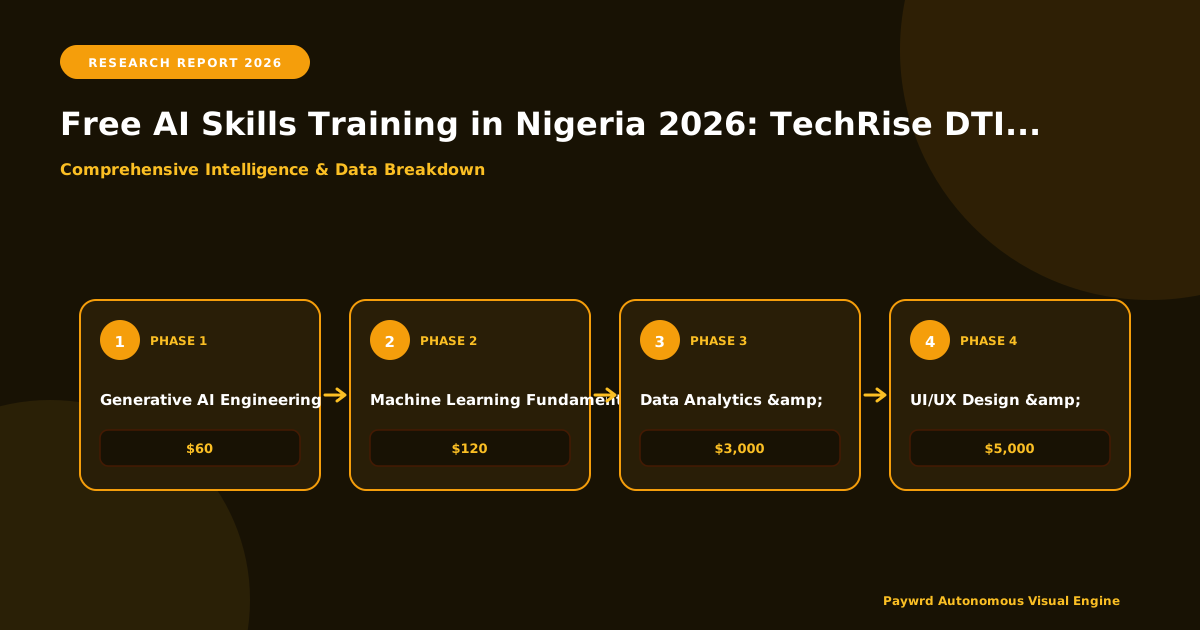
1. Generative AI Engineering & Prompt Architecture
This goes beyond “how to use ChatGPT.” You will learn Retrieval-Augmented Generation (RAG) implementation using LangChain and LlamaIndex, vector database management (Pinecone, Weaviate), and prompt optimization for production-grade reliability. The capstone requires building a context-aware AI assistant that ingests proprietary PDF data—a direct deliverable for companies hiring AI Automation Specialists on Toptal at $60–$120/hr. We cover cost optimization for API calls, a critical skill when billing international clients who track token usage closely.
2. Machine Learning Fundamentals for Production
Forget theoretical math-heavy courses. This module focuses on the MLOps lifecycle: data cleaning with Pandas/Polars, model training with Scikit-Learn and XGBoost, experiment tracking via MLflow, and deployment using Docker and FastAPI on AWS/GCP free tiers. The project deliverable is a containerized API endpoint that predicts customer churn or loan default risk—exactly the prototype Fintechs in Yaba and Nairobi pay contractors $3,000–$5,000 to build. Understanding model drift monitoring makes you indispensable for long-term retainers.
3. Data Analytics & Business Intelligence
This pillar targets the high-volume Upwork market for Data Analysts and BI Developers. You will master advanced SQL (Window Functions, CTEs), Python for exploratory data analysis (EDA), and dashboarding in Power BI and Tableau Public. The curriculum emphasizes “data storytelling”—translating raw CSV exports into executive-ready insights. Nigerian freelancers often fail here by sending raw charts; this module teaches you to build narrative dashboards that command $500–$1,500 per project on fixed-price contracts.
4. UI/UX Design & Product Design Strategy
Aligned with the Product Design track, this covers the Double Diamond process, Figma design systems (auto-layout, variables, component libraries), usability testing protocols, and developer handoff using Zeplin/Figma Dev Mode. Crucially, it includes Design for AI Interfaces—conversational UI patterns and trust calibration for LLM outputs. The output is a full case study: a mobile fintech app prototype solving a specific Nigerian problem (e.g., agent banking reconciliation) but designed to global accessibility standards (WCAG 2.1 AA). This portfolio piece is your ticket to Deel full-time roles paying ₦5M–₦12M monthly equivalent.
5. Freelance Business Operations & Global Compliance
Unique to TechRise DTI, this non-technical module teaches Nigerian-specific incorporation (CAC registration for IT companies), Domiciliary account setup (GTBank, Zenith, Geegpay, Grey), invoice generation compliant with IR35 and US 1099 rules, and contract negotiation using the Freelance Contract Template vetted by Nigerian tech lawyers. You learn to price using Value-Based Pricing models rather than hourly rates, moving you from “cheap labor” to “strategic partner” status on global platforms.
- Actionable Takeaway: Treat the capstone projects as live client work. Host the ML API on Railway/Render, publish the Power BI dashboard to the web, and deploy the Figma prototype as a clickable link—these live URLs are your proof-of-work for Toptal screening.
- Local Context: The curriculum includes datasets from NBS (National Bureau of Statistics) and CBN statistical bulletins, ensuring your portfolio speaks the language of the Nigerian market while meeting global standards.
Eligibility Criteria and JAMB UTME Considerations for 2026 Applicants

The TechRise DTI Masterclass is deliberately designed with low barriers to entry, reflecting the Federal Ministry of Communications, Innovation and Digital Economy’s mandate to democratize access to Artificial Intelligence education. For the 2026 cohort, the primary eligibility criteria center on three pillars: age, educational status, and hardware access. Applicants must be Nigerian citizens or legal residents aged between 18 and 35 years old at the time of application. This age bracket aligns perfectly with the National Youth Policy and captures the critical demographic of fresh graduates, NYSC corps members, and early-career professionals seeking to pivot into tech.
Regarding educational background, the program adopts an inclusive skills-first approach rather than a rigid certificate-gating mechanism. You do not need a university degree to apply. Holders of WAEC, NECO, or NABTEB certificates with a minimum of five credits (including Mathematics and English) are fully eligible. This opens the door for talented secondary school leavers who may not have secured university admission yet. Crucially, HND holders from accredited polytechnics and B.Sc. graduates from NUC-recognized universities are equally welcome, regardless of class of degree. The program values demonstrable aptitude and commitment over academic pedigree.
A frequent question from the 2026 pipeline concerns JAMB UTME candidates and NYSC members. If you are currently registered for the 2026 UTME or awaiting results, you are encouraged to apply. The Masterclass schedule is designed to be flexible—largely asynchronous with weekend live sessions—so it does not clash with JAMB exams, Post-UTME screenings, or the NYSC orientation camp and primary assignment schedules. Many NYSC corps members in the 2024 and 2025 cohorts successfully completed the track while serving, using their Community Development Service (CDS) hours to collaborate on capstone projects. However, you must have a functional laptop (minimum 8GB RAM, 256GB SSD, Core i5/AMD Ryzen 5 or equivalent) and reliable internet access; smartphones are insufficient for the heavy model training and IDE workloads involved.
How does this compare to NUC CCMAS-accredited short courses at federal universities? University short courses (often run by Centres for Continuing Education) carry formal academic credit, are mapped to the Core Curriculum Minimum Academic Standards, and typically cost between ₦150,000 and ₦400,000 per module. They require strict admission processing and physical attendance. In contrast, the TechRise DTI Masterclass is tuition-free (₦0), industry-certified (Google, Microsoft, Meta badges), and fully remote. While it does not confer a university transcript credit, it offers a globally recognized competency credential that employers in the Nigerian tech ecosystem—from Flutterwave to Interswitch—often weight more heavily than a generic university certificate for AI/ML engineering roles. Choose the university route if you need academic progression; choose TechRise if you need immediate, job-ready AI fluency at zero cost.
- Age: 18–35 years (inclusive).
- Education: WAEC/NECO/NABTEB (5 Credits), OND, HND, B.Sc., or higher.
- Status: JAMBites, Undergraduates, NYSC Corps Members, Graduates, Career Switchers.
- Hardware: Personal Laptop (8GB+ RAM, SSD) + Stable Internet.
- Cost: ₦0 (Fully Funded by FGN/Partners).
NELFUND Student Loan Compatibility and Hidden Costs to Watch
The TechRise DTI Masterclass markets itself as a tuition‑free pathway to AI and digital skills, but prospective learners often wonder whether the newly launched NELFUND student‑loan scheme can be tapped to offset any ancillary expenses. As of the 2026 funding window, NELFUND’s eligibility criteria are narrowly focused on accredited tertiary‑institution programmes that lead to a recognised diploma, degree, or professional certification. Because the TechRise DTI Masterclass is delivered through a private‑sector partnership and awards a industry‑endorsed certificate rather than a formal academic qualification, it does not currently appear on the NELFUND‑approved programme list. Consequently, you cannot directly use a NELFUND loan to cover the masterclass’s advertised “zero‑tuition” fee.
That said, NELFUND does provide a living‑expenses stipend for borrowers who are enrolled in approved full‑time courses. If you secure admission into a NELFUND‑recognised diploma or degree programme that incorporates the TechRise DTI curriculum as an elective or supplementary module, you may be able to allocate a portion of your loan disbursement toward related costs such as data bundles, transportation, or meals. In practice, this requires coordinating with your institution’s financial‑aid office to confirm that the masterclass counts as an approved extracurricular activity under the loan’s terms.
Even when tuition is waived, participants inevitably encounter several hidden costs that can add up quickly, especially for those travelling from outside the major hub cities. Below is a realistic breakdown of the most common expense categories you should budget for:
- Transport to training centres – Lagos, Abuja, and Port Harcourt host the primary in‑person workshops. A round‑trip bus fare from neighbouring states typically ranges from ₦2,500 to ₦5,000, while domestic flights can start at ₦15,000 (economy) and rise sharply during peak periods. If you plan to attend multiple sessions, consider purchasing a monthly inter‑state transport pass or car‑pooling with fellow learners to cut costs by 30‑40%.
- Feeding and daily sustenance – Meals served at the venues are modest, averaging ₦1,500–₦3,000 per plate. For a full‑day workshop (two meals plus snacks), allocate roughly ₦4,500–₦9,000 per day. Over a two‑week intensive block, this translates to ₦63,000–₦126,000. Preparing packed meals or buying from local food stalls can reduce the daily spend to about ₦2,000–₦3,000.
- Data and connectivity – Reliable internet is essential for accessing the DTI learning platform, completing assignments, and participating in live Q&A sessions. MTN and Airtel both offer 5G router plans that start at ₦12,000 for 50 GB valid 30 days, scaling up to ₦25,000 for 150 GB. If you already have a smartphone hotspot, a 10 GB monthly bundle (≈₦4,500) may suffice for light usage, but heavy video‑streaming sessions will quickly exhaust that allowance.
- Miscellaneous fees – Occasionally, the masterclass charges a nominal registration fee (₦1,000–₦2,000) for access to proprietary software licences or certification printing. Budgeting an extra ₦5,000–₦10,000 for unforeseen expenses such as printing materials, USB drives, or emergency data top‑ups is prudent.
Actionable takeaway: Before committing, verify whether your current or intended academic programme is NELFUND‑eligible and discuss with your loan officer the possibility of earmarking a portion of the disbursement for approved auxiliary costs. Simultaneously, draft a realistic monthly budget that incorporates transport, feeding, and data expenses based on your location and travel frequency. By anticipating these hidden costs and exploring cost‑saving strategies—such as group travel, home‑cooked meals, and selecting the most efficient data plan—you can fully benefit from the TechRise DTI Masterclass without encountering unpleasant financial surprises.
Step-by-Step Application Process and Required Documents
Navigating the TechRise DTI Masterclass portal requires a methodical approach, especially when the application window coincides with the peak UTME registration rush in April and May. Based on the 2024 and 2025 cohort patterns, the portal typically opens for a strict three-week window, and the final 48 hours always experience severe latency due to last-minute traffic spikes. We strongly advise submitting your application within the first five business days to avoid the “portal timeout” errors that locked out thousands of eligible candidates last year.
Begin by visiting the official dti.gov.ng/techrise subdomain—bookmark this exact URL to avoid phishing clones that proliferate on WhatsApp broadcast lists. Click “New Application” and select the AI & Machine Learning Track. You will immediately encounter the mandatory identity verification gateway. This is where most applicants stall: the system performs a real-time BVN lookup against the NIMC database. Ensure the phone number linked to your BVN is active and within reach, as a One-Time Password (OTP) will be sent there. If your BVN details (name arrangement, date of birth) conflict with your NIN slip, the portal will hard-reject the submission. Resolve any discrepancies at your bank or an NIMC enrollment centre before starting the form.
Once identity is confirmed, the document upload module activates. Prepare the following digital assets beforehand as PDF or JPEG files not exceeding 500KB each:
- Passport Photograph: White background, 35mm x 45mm dimensions, recent (not older than 6 months), ears visible, no glasses or headgear (unless for religious/medical reasons). The portal’s facial recognition API rejects selfies, cropped group photos, or images with shadows.
- NIN Slip: Clear scan of the front page showing your 11-digit number and QR code.
- Highest Academic Certificate: WAEC/NECO result (original or statement of result), OND, HND, or Degree certificate. Final-year students may upload a signed Letter of Attestation from their Head of Department on institutional letterhead.
- NYSC Discharge/Exemption Certificate: Mandatory for graduates; corps members should upload their Call-up Letter or State Code Letter.
- Curriculum Vitae: Maximum two pages, highlighting any prior tech exposure, ICT certifications, or relevant projects.
After upload, you proceed to the Competency Assessment—a 40-minute timed test covering logical reasoning, basic Python syntax, and data interpretation. You cannot pause this timer. Based on past cutoffs, a score above 65% places you in the “Auto-Shortlist” band; scores between 50–64% enter a manual review queue where your CV and motivation statement carry significant weight. Upon submission, you receive an ARN (format: TR/2026/AI/XXXXXX). Screenshot this immediately; the confirmation email occasionally lands in spam or delays by 24 hours during high traffic. Shortlist notifications historically drop three weeks post-deadline, typically via SMS and the portal dashboard simultaneously.
How to Turn TechRise Certification Into Real Income Before Graduation
The certificate is a milestone, but the portfolio pays the bills. In the Nigerian tech ecosystem, employers and international clients care less about where you studied and more about what you can ship. The 2026 TechRise DTI Masterclass is designed with this reality in mind; every capstone project is a potential case study. Take the example of Chinedu, a 300-level Computer Science student from Yaba. Within 60 days of completing the Generative AI track, he packaged his capstone—a RAG-based customer support bot for Nigerian fintechs—into a Fiverr gig priced at $150 per setup. He closed three clients in his first month, earning roughly ₦225,000 while still writing his semester exams. His secret? He didn’t wait for a “job.” He treated his homework like a product.
To replicate this, you need a deliberate monetization stack. Start with your Fiverr or Upwork profile: use a professional headshot (smartphone portrait mode works), a headline that screams outcome (“I Build AI Chatbots That Reduce Support Tickets by 40%”), and a portfolio PDF linking directly to your TechRise GitHub repos. For cold outreach, ditch generic templates. Use this high-converting cold email structure:
- Subject: Idea for [Company Name]'s Customer Onboarding
- Hook: “I noticed your support team handles 200+ tickets daily on Twitter/X.”
- Value: “I recently built an AI agent (TechRise Capstone) that resolves Tier-1 queries instantly. Happy to share a 2-min Loom demo.”
- Low-friction CTA: “Worth a quick chat Thursday 10 AM?”
Once the client says “yes,” the payment infrastructure must be frictionless. For dollar payouts, Grey and Chipper Cash are the current gold standards for Nigerian freelancers. Grey gives you a virtual US bank account (Routing + Account number) to receive Stripe/Upwork payouts directly, converting to Naira at near-parallel market rates. Chipper Cash offers a similar USD virtual card for subscriptions (ChatGPT Plus, Midjourney) and easy withdrawal to your local bank. For local clients or hybrid deals, Paystack payment links let you invoice in Naira via card or transfer, settling to your account in T+1. Pro tip: Open your Grey account before you land the first gig; KYC verification takes 24–48 hours, and you don’t want to delay a $500 invoice because your BVN selfie failed.
Finally, treat your NYSC year or final year not as a waiting room, but as a runway. Dedicate 10 hours weekly to client work, 5 hours to upskilling (the TechRise alumni network runs weekly “Build-in-Public” sessions), and 5 hours to networking on LinkedIn and X (formerly Twitter). Document every win. That Yaba freelancer? He leveraged his first three Fiverr reviews to negotiate a ₦350,000/month remote internship with a Lagos AI startup before his convocation. The certification opened the door; the portfolio kept it open.
Common Mistakes That Get Nigerian Applicants Rejected
Every year, thousands of hopefuls apply for the TechRise DTI Masterclass, yet a sizable chunk never makes it past the first screening. The selection committee is transparent about the red flags that trigger automatic disqualification, and understanding them can save you weeks of wasted effort.
- Incomplete application forms – Missing a single mandatory field, such as your NIN, JAMB registration number, or a valid phone number, flags the system instantly. Double‑check every dropdown, upload, and checkbox before you hit submit.
- Fake or altered certificates – The verification engine cross‑references WAEC, NECO, and university transcripts with the official databases. Submitting a forged WAEC result or a photoshopped degree certificate leads to an immediate ban and a permanent record on the NUC portal.
- Multiple account creation – Some applicants try to game the quota by registering with different emails or phone numbers. The platform’s fraud detection links BVN, NIN, and device fingerprints; duplicate profiles are merged and the primary account is disqualified.
- Missing the cohort‑specific deadline – Each intake (January, May, September) has a hard cut‑off date published on the DTI website and the NELFUND portal. Late submissions, even by a few minutes, are not entertained because the curriculum schedule is locked to partner labs and industry mentors.
Beyond the technical checklist, the Statement of Purpose (SoP) is your chance to stand out. The reviewers read hundreds of 200‑word essays, so yours must be concise, authentic, and rooted in Nigerian realities. Start with a clear problem statement: for example, “In Lagos, traffic congestion costs commuters an average of 30 hours per month, inflating fuel expenses and reducing productivity.” Follow with a specific AI‑driven solution you want to prototype during the masterclass—perhaps a lightweight reinforcement‑learning model that optimizes danfo routing using real‑time GPS data from the Lagos State Traffic Management Authority. Mention any local data sources you can access (e.g., open‑data portals from NBS or the Federal Ministry of Communications) and how the TechRise curriculum’s modules on edge AI and MLOps will help you deploy the model on low‑cost Raspberry Pi devices at bus stops. Close by linking the project to a measurable impact: “A 15 % reduction in average wait time would save commuters ₦2.3 billion annually and create a template for other megacities like Kano and Port Harcourt.”
Keep the language plain, avoid buzzwords, and proofread for grammar—typos signal carelessness. A well‑crafted SoP that ties AI to a tangible Naija challenge not only passes the automated keyword filter but also convinces the human panel that you are a problem‑solver worth investing in.
| Metric | TechRise DTI Masterclass (2026) | Paid Nigerian Bootcamps (e.g., Utiva, AltSchool, Decagon) | Global MOOCs (Coursera, edX, DeepLearning.AI) |
|---|---|---|---|
| Tuition Cost (NGN) | ₦0 (Fully Funded by DTI/FG) | ₦350,000 – ₦2,500,000+ | ₦50,000 – ₦300,000 (Certification fees) |
| Admission Cut-off / Barrier | Basic Digital Literacy; Nigerian Citizenship; NYSC/Student/Graduate status | Entrance Exams (Logic/English); Technical Interviews; Upfront Deposit | Open Enrollment; No prerequisites for most specializations |
| Program Timeline | 12–16 Weeks (Intensive Hybrid) | 6–12 Months (Full-time/Part-time) | Self-paced (3–9 Months typical completion) |
| Curriculum Focus | Applied GenAI, Prompt Engineering, ML Ops, Freelance Readiness (Upwork/Toptal/Deel aligned) | Full-Stack Dev, Data Science, Cloud; Career Services included | Academic Theory, Specialized Certificates (TensorFlow, PyTorch, LLMs) |
| Mentorship & Community | Industry Practitioners; Peer Cohorts (Lagos, Abuja, PH Hubs) | Dedicated Career Coaches; Alumni Network; Hiring Partner Days | Forum Support (Peer/TA); Limited Live Sessions |
| Certification Recognition | Federal Government (DTI) Certificate; Industry Project Portfolio | Industry-Recognized Diploma; Strong Local Employer Signaling | University/Big Tech Branded Certificates (Google, IBM, DeepLearning.AI) |
| Career ROI (Immediate) | High: Zero Debt, Freelance Income Focus, Global Remote Pipeline Access | Medium-High: Placement Rates 60-80% within 6mo; Income Share Agreements common | Variable: Portfolio Dependent; No Direct Placement; Strong for Upskilling |
| Hidden Costs | Data/Internet (₦15k–₦30k/mo); Laptop; Transport to Hubs | Laptop; Data; Living Expenses (if relocating); ISA Repayments | Subscription Fees; Exam Proctoring; Cloud Compute Credits (GPU) |
Frequently Asked Questions
Is the TechRise DTI Masterclass completely free for Nigerians in 2026?
Yes, the 2026 TechRise DTI Masterclass is fully funded by the Federal Ministry of Communications, Innovation and Digital Economy via the Digital Technology Institute (DTI). There are zero tuition fees. Participants only cover personal logistics like internet data (est. ₦15k–₦30k monthly) and transport to physical hubs in Lagos, Abuja, or Port Harcourt.
What are the eligibility requirements for the 2026 TechRise DTI AI program?
Applicants must be Nigerian citizens with basic computer literacy. The program targets NYSC corps members, recent graduates, and early-career professionals. No prior coding degree is required, but applicants must pass a basic digital aptitude assessment during the online registration phase on the official DTI portal.
Which specific AI skills does the TechRise DTI 2026 curriculum cover for freelancing?
The curriculum prioritizes Applied Generative AI, Advanced Prompt Engineering, LLM Fine-tuning basics, MLOps fundamentals, and AI Agent building. It is explicitly mapped to high-demand gigs on Upwork, Toptal, and Deel, focusing on practical project delivery, client communication workflows, and portfolio development for immediate remote income generation.
Does the TechRise DTI Masterclass provide a recognized certificate and job placement?
Graduates receive a Federal Government-endorsed DTI certificate recognized by NITDA. While direct job placement is not guaranteed, the program includes a mandatory 'Freelance Readiness' module, profile optimization for Toptal/Upwork, and access to the DTI Talent Portal connecting alumni with government and private sector digital projects.
Strategic Final Takeaway
Success in evaluating Free AI Skills Training in Nigeria 2026: TechRise DTI Masterclass relies on early preparation, adherence to verified accredited requirements, and cross-referencing official portals. Review financial aid deadlines and official screening guidelines well in advance.