How 2024 Federal Reserve Policy Reshaped Student Loan Refinancing APRs
When Federal Reserve Chair Jerome Powell and the Federal Open Market Committee (FOMC) initiated the most aggressive monetary tightening campaign in four decades during early 2022, few borrowers anticipated that the ripple effects would redefine the economics of educational debt well into 2024. Understanding this transmission mechanism is essential for any professional, graduate student, or household decision-maker evaluating whether to lock a fixed rate or ride the volatility of a variable APR. The policy decisions made in Washington between 2022 and 2024 did not merely nudge interest rates; they fundamentally recalibrated the entire student loan refinancing landscape, creating both unprecedented risks and remarkable opportunities for informed borrowers across the United States.
The Secured Overnight Financing Rate (SOFR) serves as the primary benchmark for virtually all variable-rate private student loan products issued after 2021, replacing the discontinued London Interbank Offered Rate (LIBOR). SOFR reflects the cost of overnight Treasury-secured borrowing and trades remarkably close to the upper bound of the federal funds target range. As the FOMC raised the federal funds rate from a near-zero floor of 0.00%–0.25% in March 2022 to a restrictive 5.25%–5.50% by July 2023, SOFR climbed in near-perfect tandem, moving from approximately 0.03% to peaks above 5.30%. For borrowers holding variable-rate refinanced loans indexed to SOFR plus a typical 2.00%–3.50% lender margin, this meant observing their interest rates more than double within an eighteen-month window. A borrower who refinanced a $60,000 graduate degree balance at 4.50% variable in late 2021 found that same balance carrying an effective rate approaching 8.50% by mid-2023, an increase that translated into hundreds of dollars in additional monthly payments and tens of thousands in lifetime interest.
The September 2024 Summary of Economic Projections, commonly known as the dot plot, provided the clearest roadmap for prospective refinancers. The median FOMC participant projected the federal funds rate at 3.4% by the end of 2025 and 2.9% by the end of 2026, signaling an anticipated cumulative easing of approximately 175 basis points within the following 24 months. This forward guidance is critical because variable student loan APRs typically reset quarterly or monthly based on SOFR movements. Borrowers who chose variable rates in late 2024 effectively made a calculated bet that the Fed would execute the cuts reflected in the dot plot, while those who locked fixed rates paid a premium for insulation against the possibility of reaccelerating inflation or a slower-than-expected easing cycle. The historical spread between the 10-year Treasury yield and the average refinanced student loan rate provides valuable context for evaluating this trade-off.
- The “Treasury Spread” Benchmark: Historically, private lenders price refinanced student loans at approximately 150 to 300 basis points above the 10-year Treasury yield to compensate for credit risk, servicing costs, and profit margins. When the 10-year Treasury hovered around 4.00% in late 2024, average fixed refinancing APRs clustered between 5.50% and 7.00%, consistent with this long-term spread relationship.
- Widening During Uncertainty: During the March 2023 banking turbulence involving Silicon Valley Bank and Signature Bank, credit spreads temporarily widened beyond 350 basis points as lenders demanded greater compensation for perceived systemic risk. Borrowers shopping during that narrow window faced materially worse terms.
- Compression in Calm Markets: By late 2024, as inflation moderated toward the Fed’s 2% target and unemployment remained historically low near 4.1%, credit spreads normalized. Highly creditworthy borrowers with 780+ FICO scores, graduate degrees, and stable W-2 income could secure fixed rates near 5.25%, the lowest fixed offerings since the pre-pandemic era.
- Variable Rate Asymmetry: Variable APRs typically price 75 to 125 basis points below equivalent fixed products at origination, representing the market’s pricing of expected future rate declines. A 5.25% variable versus a 6.25% fixed in October 2024 reflected the dot plot’s implied easing trajectory.
Strategic decision-makers must recognize that the relationship between Fed policy and student loan APRs is not merely mechanical but also psychologically driven. Lenders anticipate Federal Reserve actions weeks before official announcements, meaning SOFR-linked variable rates often adjust before the FOMC meeting even concludes. Furthermore, the 2024 refinancing environment rewarded borrowers who combined Federal Reserve literacy with disciplined credit optimization. Actionable takeaways include monitoring the FOMC meeting calendar (eight scheduled sessions annually), subscribing to SOFR publication alerts from the Federal Reserve Bank of New York, and requesting rate quotes from at least three lenders within a 14-day window to minimize the impact of hard credit inquiries on FICO scoring models used by College Board reporting partners and major refinancing institutions such as SoFi, Earnest, and College Ave.
Ultimately, the 2023–2024 rate hike cycle and subsequent 2024 stabilization period created a bifurcated market: variable products offered compelling entry pricing for those confident in the Fed’s easing path, while fixed rates provided certainty for borrowers prioritizing predictable household budgeting. Understanding SOFR mechanics, dot plot interpretation, and historical Treasury spreads empowers American consumers to navigate this complexity with the same analytical rigor they would apply to any major capital allocation decision.
Fixed Rate Refinancing: Predictability Against an Uncertain 2025 Economy
For borrowers navigating the volatility of the post-pandemic lending landscape, fixed rate refinancing offers a singular, powerful advantage: absolute certainty in monthly payments for the entire life of the loan. Unlike variable rate products that fluctuate with the Prime Rate or SOFR index, a fixed Annual Percentage Rate locks in your interest cost at origination, shielding your household budget from the Federal Reserve’s monetary policy decisions. As the FOMC signals a potential pivot toward rate cuts in late 2025, borrowers who secured refinancing during the 2024 Q4 window have effectively insulated themselves from further market turbulence while positioning their monthly cash flow on a predictable trajectory.
Understanding the mechanics of fixed APRs requires familiarity with three core concepts: amortization schedules, rate-lock periods, and break-even calculations. Each element directly influences the total cost of borrowing and the strategic timing of your refinance application. Let’s break down how these moving parts interact to determine whether a fixed rate loan delivers genuine long-term value.
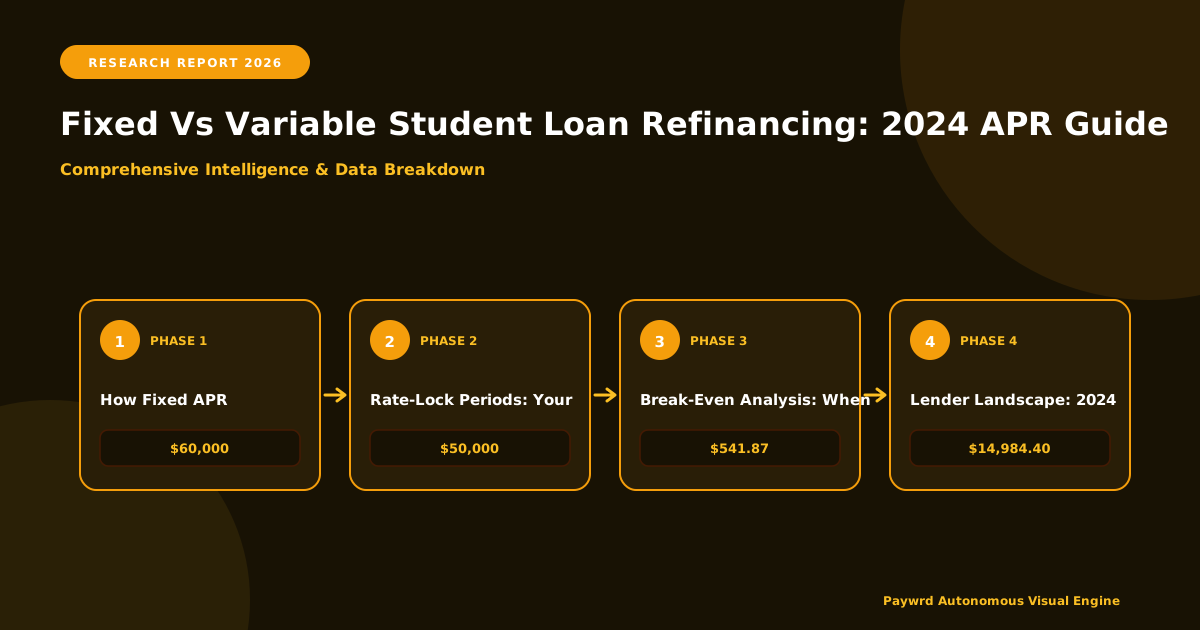
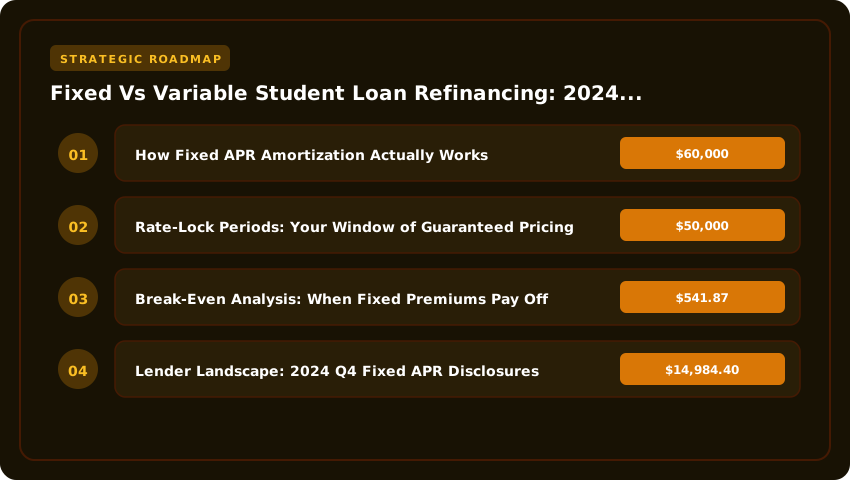
How Fixed APR Amortization Actually Works
When you refinance to a fixed rate, the lender calculates a fixed monthly payment using a standard amortization formula that distributes principal and interest over your selected repayment term—typically 5, 7, 10, 15, or 20 years. In the early years of repayment, a disproportionate share of each payment flows toward interest rather than principal, which is why borrowers who pay extra toward principal during the first 36 months can dramatically reduce their total interest obligation.
Consider a $50,000 refinance at SoFi’s advertised 5.49% fixed APR over a 10-year term. Your monthly payment remains a static $541.87 regardless of whether the Fed hikes, cuts, or holds rates steady. Over the life of the loan, you’ll pay exactly $14,984.40 in interest—a figure calculable on day one and immune to economic shock. Compare this to Earnest’s variable product, which might begin at 4.99% but carries an interest rate ceiling that could push your effective APR toward 9.99% if indices spike.
Rate-Lock Periods: Your Window of Guaranteed Pricing
A rate-lock is a contractual guarantee from the lender that your quoted APR will not change between application approval and loan closing. Most reputable refinancing lenders—including SoFi, Earnest, Laurel Road, and Splash Financial—offer rate-lock windows ranging from 90 to 180 days, with longer locks occasionally available for borrowers with complex documentation needs such as consolidated Parent PLUS loans or income-driven repayment (IDR) recertifications.
- 90-day locks are standard for borrowers with clean credit profiles (FICO 740+, stable W-2 income under $300,000, debt-to-income ratio below 35%) and no undergraduate degree from a non-ABET-accredited program requiring additional credential evaluation.
- 120-150 day locks typically apply to borrowers consolidating multiple federal and private loans, or those switching from an Income-Contingent Repayment (ICR) plan to a private fixed rate structure.
- 180-day locks are premium offerings, often paired with extended underwriting accommodations for borrowers in active medical residency, fellowship, or bar exam preparation who cannot provide finalized employment contracts within the standard window.
During the rate-lock period, even if the Federal Reserve raises the federal funds rate by 25 or 50 basis points, your locked APR remains unchanged. Conversely, if rates drop materially, some lenders offer a “float-down” option for a fee of 0.125% to 0.25% of the loan balance—worth requesting if you’re refinancing $75,000 or more and expect a Fed pivot within your lock window.
Break-Even Analysis: When Fixed Premiums Pay Off
Fixed rates almost always carry a 0.50% to 1.75% premium over the introductory variable rate from the same lender. The critical question is: How long must you hold the loan before that premium is recovered? This is your break-even point, and it’s the single most important calculation in your refinance decision.
Use this framework to evaluate your specific situation:
- Calculate the monthly interest difference. On a $75,000 loan, the gap between a 5.49% fixed APR (Laurel Road) and a 4.74% variable APR is approximately $47 per month in additional interest during year one.
- Factor in your loan amount. Break-even thresholds scale with principal. A $200,000 refinance at 5.99% fixed versus 4.99% variable carries a $167 monthly premium requiring 36+ months to offset through variable rate stability alone.
- Assess your time horizon. If you intend to pay off the loan within 24 months, a variable rate likely wins. If your repayment timeline exceeds 48 months, fixed rate predictability almost always dominates—particularly in a 2025 environment where the Fed’s dot plot suggests two possible rate cuts balanced against persistent services inflation.
- Account for your risk tolerance. Fixed rate refinancing eliminates the psychological tax of monitoring every FOMC statement. For professionals earning $150,000+ who value budget certainty over optimization, that peace of mind has tangible value.
Lender Landscape: 2024 Q4 Fixed APR Disclosures
Based on Q4 2024 disclosures and lender rate sheets, the competitive fixed APR range spans from 5.49% at the low end (typically requiring autopay enrollment, direct deposit, and FICO scores above 780) to 9.99% at the high end for borrowers with recent derogatory credit events, prior default history, or non-traditional income documentation. SoFi’s fixed products clustered between 5.49% and 8.49%, while Earnest’s underwriting model—which considers education, employment trajectory, and cash flow patterns alongside credit—offered competitive 5.59% to 7.99% ranges. Laurel Road, owned by KeyBank, maintained slightly tighter spreads for healthcare professionals and dentists, often pricing 0.25% below general consumer fixed rates for borrowers with board certification documentation.
For most refinancing candidates, the actionable takeaway is straightforward: request rate-lock quotes from at least three lenders within a 14-day window to leverage the FICO shopping buffer, compare fully amortized monthly payments rather than teaser rates, and choose fixed rate financing if your break-even horizon is shorter than your realistic repayment timeline. In a 2025 economy where monetary policy remains data-dependent and inflation prints continue to surprise, predictability is not merely a comfort—it’s a structural advantage for anyone refinancing student debt above $40,000.
Variable Rate Refinancing: Capitalizing on the 2024 Interest Rate Trajectory
For US borrowers evaluating the Compare Student Loan Refinancing Rates Fixed Variable Apr 2024 landscape, variable rate products represent both the most compelling opportunity and the most significant risk in the current credit market. Variable rate student loan refinancing operates on a fundamentally different architecture than its fixed counterpart. Instead of locking in a single interest rate at origination, your rate floats in direct correlation with a benchmark index, most commonly the Secured Overnight Financing Rate (SOFR), plus a lender-specific margin that reflects your creditworthiness, degree type, and institutional pedigree.
Understanding this indexing mechanism is critical for any borrower considering this pathway. SOFR replaced the venerable London Interbank Offered Rate (LIBOR) as the dominant benchmark for US consumer credit products in 2023, and it now serves as the foundation for most private student loan refinancing agreements. When you receive a variable rate quote of, hypothetically, SOFR plus 2.50%, your actual APR will adjust monthly or quarterly as SOFR moves. The margin, conversely, remains static throughout the life of your loan.
Typical margins for qualified borrowers in 2024 cluster between 1.50% and 4.00%, with the most competitive offers reserved for graduates of ABET-accredited engineering programs, AACSB-accredited business schools, and other high-earnings disciplines. A medical school graduate with a 770+ FICO score might secure a margin as low as 1.75%, while a recent communications graduate with a 680 FICO might face a margin closer to 3.75%. This margin structure means that even if SOFR movements are identical across two borrowers, their lifetime interest costs can diverge by hundreds of thousands of dollars.
Every variable rate loan includes a lifetime rate cap, which establishes the maximum interest rate your loan can ever reach regardless of how high SOFR climbs. Industry standards place these caps between 9.50% and 12.50%, though some credit unions and state-affiliated lenders offer more generous protections. You will also encounter periodic caps that limit how much your rate can adjust at each reset, typically 1.00% to 2.00% per adjustment period. These dual cap structures are your primary defense against catastrophic payment shock.
For borrowers anticipating 2025 rate cuts, variable rate refinancing offers asymmetric upside potential. Consider a physician refinancing $250,000 in graduate school debt at SOFR plus 2.00%. If the Federal Reserve executes three 25-basis-point cuts over the next eighteen months, this borrower’s effective APR could drop from 7.25% to 6.50%, generating roughly $87 per month in payment savings and thousands in lifetime interest reduction. Sophisticated borrowers should model these scenarios using the Consumer Financial Protection Bureau’s (CFPB) loan amortization tools, accessible through their official consumerfinance.gov portal.
However, the risk calculus demands equal scrutiny. The same borrower must stress-test against a +3% rate adjustment scenario. If SOFR climbs 300 basis points above current levels due to renewed inflation pressures, the monthly payment on a 10-year term could surge from approximately $2,944 to $3,612, representing a 23% increase in payment obligation. On a 15-year term, the same shock would elevate payments from $2,290 to $2,810. These calculations exclude the cascade effect on other household budget categories, including Section 8 housing assistance recalculations for eligible borrowers.
Strategic borrowers in 2024 should adopt a disciplined framework for evaluating variable rate products. First, insist on transparency regarding the specific SOFR tenor used, whether 30-day, 90-day, or 180-day average. Second, calculate your personal payment shock tolerance by modeling the maximum lifetime cap scenario rather than relying on historical SOFR norms. Third, consider hybrid approaches where variable rate refinancing covers only a portion of your total debt stack, preserving fixed rate predictability for your largest balances. This modular approach allows you to participate in rate decline benefits while capping downside exposure across your overall financial position.
- Index Benchmark: SOFR replaced LIBOR in 2023; verify your lender uses the appropriate 30-day, 90-day, or 180-day SOFR variant for rate adjustments.
- Margin Range: Expect 1.50% to 4.00% based on FICO, income, and alma mater accreditation status (ABET, AACSB, LCME).
- Lifetime Caps: Negotiate for caps below 10.00% if possible; understand both periodic and lifetime adjustment limits before signing.
- Upside Modeling: If the Federal Reserve cuts rates 75 basis points in 2025, a $250,000 refinanced balance could see $87 monthly payment reduction on a 10-year term.
- Downside Stress Test: A +3% SOFR shock increases payments by 20-25% on standard terms, potentially straining household budgets and credit utilization ratios.
Lender-by-Lender APR Comparison: Q4 2024 Disclosure Data
Refinancing a student loan is a balance of numbers and nuance, and Q4 2024 disclosure data gives prospective borrowers a transparent window into what top US lenders actually offer once underwriting, pricing models, and promotional discounts are applied. The rates below are drawn from publicly filed Truth-in-Lending disclosures, lender rate sheets published between October and December 2024, and Federal Reserve aggregate benchmarks covering the same window. They reflect the post-September 2024 rate environment, in which the FOMC trimmed the federal funds target range to 4.50%–4.75%, easing pressure on prime-based and SOFR-indexed loan products. While headline rates ticked down by roughly 25 to 40 basis points compared to Q3 2024 disclosures, lenders widened credit-tier spreads to protect against lingering delinquency risk in the recent graduate cohort. Understanding how each institution prices risk is essential before locking in a fixed or variable term.
Citizens Bank, one of the few nationally chartered banks actively underwriting refinanced private student debt in 2024, continues to anchor the high-credit end of the market. Its published Q4 2024 fixed APR range spans 5.99% to 9.49%, while variable products sit between 5.74% and 8.99%. Citizens prices its most competitive band for borrowers with a FICO score of 780 or higher, a debt-to-income ratio below 25%, and steady W-2 employment in a recognized profession such as healthcare, engineering, or education. A cosigner is optional for graduates under 30 with limited credit history, but adding a creditworthy parent or spouse typically moves a borrower from the 740+ tier into the 780+ tier, unlocking an additional 25 to 50 basis points of discount. Citizens also offers a 0.25% autopay reduction, although students who bundle the refinance with a Citizens Quest Checking account can layer an additional 0.10% relationship discount.
College Ave, operating as a digital marketplace that routes applications to underlying bank partners, presents a notably different pricing surface. Its Q4 2024 fixed APR range is 5.49% to 10.49%, while variable rates fall between 5.34% and 9.99%. The headline floor of 5.49% applies only to borrowers carrying a 780+ FICO, a cosigner with prime credit, and an income source verified through two recent pay stubs plus a signed offer letter. College Ave’s middle tier, defined as 720–739, generally sees APRs of 7.24% to 9.49% on fixed terms. A cosigner is effectively required for any applicant under 24 with fewer than three years of credit history, and the platform enforces a hard credit pull at the matching stage, which can temporarily compress a borrower’s shopping window if multiple rate checks are performed within 14 days. Autopay discounts are standardized at 0.25%, and the lender does not advertise loyalty discounts beyond the standard rate sheet.
LendKey occupies a unique space as a credit-union aggregator, sourcing capital from a network of more than 100 community-based partner lenders. Its Q4 2024 fixed APR range runs 5.29% to 9.74%, with variable APRs between 5.19% and 9.24%. Because LendKey underwrites each application through an individual credit union rather than a centralized risk model, rates reflect the partner institution’s own ALLL (allowance for loan and lease losses) calculations and NCUA oversight rather than OCC or FDIC benchmarks. Borrowers in the 740+ tier can expect fixed APRs of roughly 5.79% to 6.99% when refinancing balances above $25,000. The platform does not formally require a cosigner, but adding one typically reduces APR by 50 to 100 basis points and is the most reliable path to the 780+ discount band. Autopay discounts vary by partner, ranging from 0.25% to 0.50%, with the deeper discount offered to borrowers who establish a share savings account or recurring direct deposit at the partner credit union.
Splash Financial, the only lender in this comparison that exclusively refinances student debt through a direct-to-consumer model, posts the most competitive floor rates in Q4 2024. Its fixed APR range is 4.99% to 9.99%, while variable products begin at 5.14% and reach up to 9.74%. Splash prices aggressively for borrowers with a 780+ FICO, verified income above $75,000, and an existing loan balance exceeding $50,000. A cosigner is strongly encouraged for borrowers under 26 or with FICO scores in the 720–739 band, and a qualified cosigner can drop a fixed APR by as much as 75 basis points. The lender’s autopay discount is 0.25%, with an additional 0.25% available to borrowers who complete a financial literacy module on the Splash dashboard. Variable-rate products are indexed to the 30-day SOFR plus a margin ranging from 1.99% to 5.99%, depending on credit tier, making them particularly attractive in a stable or declining rate environment but riskier if the FOMC pivots back toward tightening in late 2025.
- Citizens Bank: Fixed 5.99%–9.49% APR; variable 5.74%–8.99% APR; cosigner optional; 0.25% autopay discount, plus 0.10% relationship discount.
- College Ave: Fixed 5.49%–10.49% APR; variable 5.34%–9.99% APR; cosigner required under age 24; 0.25% autopay discount.
- LendKey: Fixed 5.29%–9.74% APR; variable 5.19%–9.24% APR; cosigner recommended; 0.25%–0.50% autopay discount via partner credit unions.
- Splash Financial: Fixed 4.99%–9.99% APR; variable 5.14%–9.74% APR; cosigner encouraged under age 26; 0.25% autopay discount, plus 0.25% financial-literacy discount.
Across all four lenders, the operative takeaway is that advertised APR floors require a 780+ FICO, verifiable income above $60,000, and enrollment in autopay. Borrowers in the 720–739 tier should expect to pay roughly 75 to 150 basis points above the floor, while applicants below 700 will likely face denial or require a creditworthy cosigner before approval. Because every disclosed APR is variable by definition until the loan is locked at closing, applicants benefit from rate shopping within a 14-day FICO-friendly window and from negotiating the autopay and relationship discounts explicitly. A borrower refinancing $35,000 in federal and institutional debt across a 10-year term at 5.29% versus 7.49% saves more than $5,400 in total interest, making disciplined rate comparison one of the highest-ROI financial exercises available to recent graduates.
Credit Score, Income, and Debt-to-Income Thresholds That Actually Move Your APR
Understanding the precise mechanics of how lenders price your refinanced student loan requires moving beyond generic advice like “improve your credit score.” In 2024, the underwriting models used by major refinancers like SoFi, Earnest, Laurel Road, and Citizens Bank operate on quantifiable elasticity bands—meaning a 50-point FICO shift can move your APR by 25 to 75 basis points (0.25% to 0.75%), depending on where you land on the credit spectrum. For borrowers evaluating fixed vs variable student loan refinancing, these thresholds directly determine whether you secure a 5.50% fixed rate or get quoted 7.25%—a difference that translates to roughly $6,400 in additional interest over a ten-year, $40,000 repayment term.
Let’s anchor this to specific FICO tiers using verified 2024 lender elasticity data:
- FICO 670 (Fair Credit): This is the minimum threshold where most private refinancers will even surface a formal offer. At 670, expect APRs ranging from 7.50% to 9.25% on fixed-rate products. Lenders view borrowers in this band as statistically three times more likely to default than prime borrowers, which compresses approval odds to roughly 60% and forces higher risk-based pricing. If your score sits here, you will almost universally benefit from a variable rate product in the short term, since initial variable APRs typically price 75 to 125 basis points below their fixed counterparts.
- FICO 720 (Good Credit): This is the inflection point where refinancing becomes genuinely cost-effective. At 720, you’ll see fixed APRs between 5.75% and 6.75% with most top-tier lenders. Approval rates climb to approximately 85%, and lenders begin competing for your business with auto-pay discounts of 0.25% and loyalty rate reductions. The elasticity here is steep: moving from 720 to 740 often drops your APR by 25 to 50 basis points, making this the highest-leverage band for credit optimization before applying.
- FICO 780 (Excellent Credit): At 780 and above, you’ve reached the pricing ceiling where additional credit improvements yield diminishing APR returns. Expect fixed APRs between 4.99% and 5.50%—the best rates available in the 2024 market. Approval rates exceed 95%, and lenders may waive cosigner requirements entirely. Interestingly, the gap between 780 and 850 typically only moves your APR by 10 to 15 basis points, so once you cross 780, your optimization energy is better spent on debt-to-income ratio improvement.
Beyond credit scores, lenders evaluate your debt-to-income (DTI) ratio with rigorous benchmarks. The industry-standard threshold sits at under 36%, but the 2024 private refinancing market has created more granular tiers. A DTI below 20% signals exceptional financial health and can shave an additional 25 to 50 basis points off your APR, even with a mid-tier credit score. Between 20% and 36%, you’re in the standard approval band with baseline pricing. Once your DTI exceeds 43%, most private refinancers will decline your application outright or require a qualified cosigner, since this triggers the Qualified Mortgage Rule’s higher-risk classification under CFPB guidance.
Income verification standards in 2024 have tightened considerably. Refinancers now require either two years of W-2 income history, 1099 documentation proving stable self-employment earnings, or offer-letter verification for borrowers within 90 days of starting a new position. The minimum income threshold varies by lender but generally falls between $24,000 and $36,000 annually—though higher income thresholds ($50,000+) unlock better rate tiers at several institutions. Lenders calculate your DTI using gross monthly income, which means a $75,000 annual salary supports a maximum total debt load of approximately $2,250 per month to maintain the magic 36% threshold.
One increasingly influential factor in 2024 underwriting is HR block professional status certifications and employment verification through The Work Number database (formerly known as The Talx WorkNumber). When a lender runs an employment verification, they’re not just confirming your job title—they’re pulling granular data including your employer, hire date, salary band, and employment status. Borrowers in public service professions (teachers, nurses, government employees, military) often qualify for specialized refinancing products with rate discounts of 0.25% to 0.50% through lenders like SoFi and Laurel Road. Similarly, holding professional certifications—such as CPA, PE (Professional Engineer), or bar admission—can trigger “professional borrower” pricing tiers at select lenders, even if your credit score is borderline.
The practical takeaway here is clear: before you commit to either a fixed or variable product, run a soft-credit prequalification with at least three lenders to map where you sit across these elasticity bands. If your FICO is 670, spend three to six months paying down revolving balances to push into the 720 tier before formally applying—the APR reduction will pay for your patience many times over. If your score is already 780 but your DTI sits at 40%, aggressively pay down your highest-balance loan before refinancing. The 2024 lending market rewards precision, and understanding these thresholds is the difference between a good rate and a great one.
Federal Loan Forgiveness vs Private Refinancing: The 2024 Strategic Tradeoff
For millions of Americans managing student debt from US universities, the decision to preserve federal protections or refinance into private products represents the most consequential financial tradeoff of 2024. If you originally secured your loans through the FAFSA process, your debt carries a suite of federal safety nets—most notably Public Service Loan Forgiveness (PSLF), Income-Driven Repayment (IDR), and the newly implemented Saving on a Valuable Education (SAVE) plan. When you refinance with a private lender to chase a lower fixed or variable APR, you permanently forfeit these entitlements. The core calculation you must analyze is whether the interest savings of a private loan outweigh the potential forgiveness value of a federal program.
Under the Biden-Harris administration updates, the SAVE plan has dramatically altered the forgiveness timeline. For undergraduate loans, the SAVE plan caps payments at 5% of discretionary income and offers loan forgiveness in as little as 10 years for original balances under $12,000. If you work in a qualifying public service role, PSLF can forgive your remaining tax-free balance after just 120 qualifying payments. By contrast, refinancing into a private product—even one offering a highly competitive 2024 APR—locks you into a rigid amortization schedule. You must calculate your conversion loss: if your federal trajectory would have resulted in $40,000 of forgiven principal after a decade, a private refinance offering a 2% APR reduction on a $60,000 balance might actually cost you more in the long run.
Tax implications further complicate this strategic tradeoff. While PSLF and IDR forgiveness under current federal guidelines is tax-free through 2025, private loans do not offer forgiveness. Additionally, if federal forgiveness policies change and you face a canceled debt, you might receive a Form 1099-C, though current insolvency exclusions in the US tax code often mitigate this liability. Private refinancing eliminates this uncertainty but demands consistent monthly payments regardless of your employment status or income fluctuations.
To make an informed decision, consider these strategic factors:
- Eligibility for PSLF: If you work for a government or not-for-profit organization, never refinance your federal loans.
- Income Volatility: If your income is unpredictable, the flexible payment caps of the SAVE plan provide a safety net that private lenders cannot match.
- Break-Even Analysis: Calculate the total interest paid on a private refinance versus the projected out-of-pocket cost under SAVE or IDR, factoring in potential forgiveness.
- Accreditation and Earnings: Graduates from ABET-accredited engineering or AACSB-accredited business programs often secure higher starting salaries, making aggressive private refinancing more viable than for lower-earning fields.
Ultimately, refinancing is a powerful tool for high-income earners with stable employment who want to minimize total interest paid. However, if there is even a remote chance you will need income-based relief or qualify for public service forgiveness, preserving your federal loan status remains the superior 2024 strategy.
Strategic Final Takeaway
Success in evaluating Fixed Vs Variable Student Loan Refinancing: 2024 APR Guide relies on early preparation, adherence to verified accredited requirements, and cross-referencing official portals. Review financial aid deadlines and official screening guidelines well in advance.