Decoding CCDF: The Federal Engine Behind State Childcare Subsidies
If you have ever wondered why your colleague in another state pays $50 a week for the same center-based care that costs you $200 after subsidies, the answer lives in the architecture of the Child Care and Development Fund (CCDF). Authorized under the Child Care and Development Block Grant (CCDBG) Act, CCDF is the primary federal funding stream dedicated to helping low-income working families access childcare. For Fiscal Year 2024, Congress appropriated roughly $12.5 billion in discretionary and mandatory funds combined—a historic high driven by pandemic-era supplemental spending that has since normalized.
Here is the critical structural reality: CCDF operates as a block grant, not an entitlement like Medicaid or SNAP. The U.S. Department of Health and Human Services (HHS) sends a lump sum to states, territories, and tribes based on a formula weighing population, poverty rates, and per-capita income. Once those dollars hit the state treasury, the federal government sets the floor—mandating health and safety standards, background checks, and a 12-month eligibility redetermination window—but the ceiling is almost entirely state-driven.
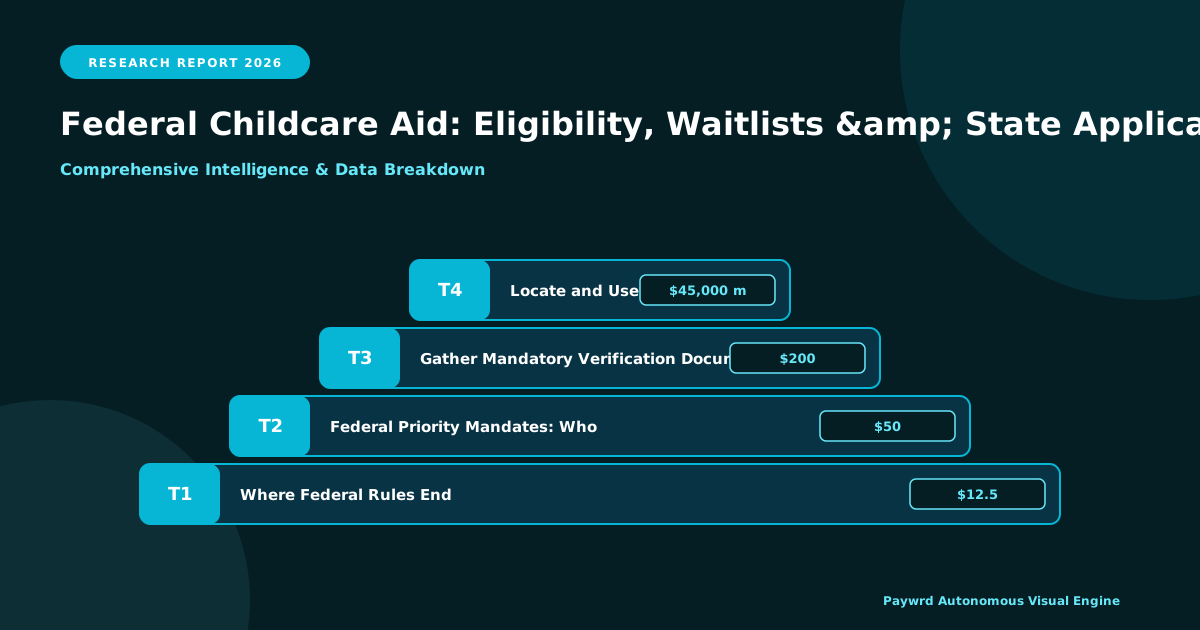
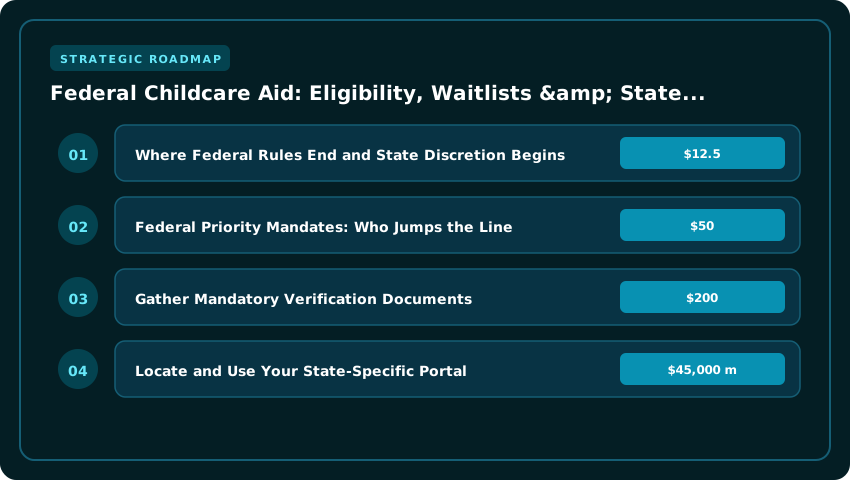
Where Federal Rules End and State Discretion Begins
This federal-state tension creates the drastic jurisdictional variance you see on the ground. Consider these three levers that states control almost entirely:
- Income Eligibility Thresholds: Federal law caps eligibility at 85% of State Median Income (SMI). However, states routinely set entry thresholds far lower—often at 150% or 185% of the Federal Poverty Level (FPL)—to stretch limited dollars. A family earning $45,000 might qualify in Vermont (approx. 60% SMI) but be denied in Texas (approx. 40% SMI).
- Provider Reimbursement Rates: The feds recommend states pay providers at the 75th percentile of the current Market Rate Survey (MRS) to ensure equal access. As of 2023, only a handful of states—like Washington and New Mexico—actually meet that benchmark. Most reimburse at the 25th to 50th percentile, forcing providers to either absorb the loss or charge parents the difference via “co-pays” that can exceed $300/month.
- Waitlist Management: Because funding is capped, states are not required to serve every eligible family. When demand outstrips the block grant, states implement waitlists or freeze intake. In 2022, over 20 states maintained active waitlists or frozen intake policies, leaving tens of thousands of eligible children unserved.
The 2014 Reauthorization and the 2023 Funding Floor Shift
The CCDBG Act of 2014 was the first major reauthorization in 18 years. It pivoted the program from a simple work-support voucher to a two-generation strategy, mandating annual inspections, comprehensive background checks, and the 12-month eligibility continuity mentioned earlier. While these quality improvements were necessary, they increased administrative costs per slot without a proportional funding increase, inadvertently tightening capacity.
Fast forward to the FY 2023 and 2024 appropriations cycles. Congress responded to the “childcare cliff” (the expiration of $24 billion in American Rescue Plan stabilization funds) by boosting the discretionary CCDF baseline to approximately $8.7 billion annually. This raised the “funding floor” for every state, allowing many to finally raise reimbursement rates toward the 75th percentile and chip away at waitlists. However, because the mandatory funding portion (roughly $3.5 billion) requires a state maintenance-of-effort and matching contribution, states with tighter budgets—often those with the highest poverty rates—struggle to draw down their full federal match, perpetuating the equity gap.
Understanding this machinery is step one. The block grant structure means your eligibility, your co-pay, and your wait time are ultimately decided in your state capital, not Washington. The next section breaks down exactly how to navigate your specific state’s rulebook.
Income Thresholds & Activity Requirements: Qualifying While Upskilling
The single biggest misconception among working learners is that earning a degree automatically disqualifies you from the Child Care and Development Fund (CCDF). In reality, the statute explicitly treats accredited training programs as an “approved activity” on par with employment. However, the devil lives in the state-level definitions of State Median Income (SMI) ceilings and how your financial aid package hits the income ledger.
Navigating the SMI Ceiling: Initial vs. Continuing Eligibility
Federal law sets a hard ceiling: states cannot serve families earning above 85% of SMI. But most states set their entry thresholds significantly lower—often between 150% and 200% of the Federal Poverty Level (FPL)—to manage waitlists. Here is where the “cliff effect” bites: you might qualify to enter the program at 185% FPL, but many states allow you to stay (continuing eligibility) up to the federal max of 85% SMI. For a family of three in Texas (2024 SMI approx. $86,000), that continuing ceiling is roughly $73,000 annually. In Massachusetts (SMI approx. $135,000), that ceiling jumps to $114,000. Always verify your specific state’s “Entry” vs. “Exit” thresholds on the Lead Agency website; they are rarely the same number.
Defining “Approved Activity”: Where Your Coursework Counts
To satisfy the work requirement, your activity must fit the state’s approved list. Federal rules mandate inclusion of:
- Employment: W-2 wages or verifiable self-employment income.
- Job Search: Typically capped at a strict window (often 30–90 days lifetime or per spell).
- Accredited Education & Training: This is your lever. Programs must generally be accredited by a body recognized by the U.S. Department of Education (e.g., regional accreditors like HLC, MSCHE, or programmatic ones like ABET for engineering, AACSB for business, PMI for project management). Non-credit bootcamps often fail this test unless they sit inside a WIOA-approved Eligible Training Provider List (ETPL).
Critically, states define “participation” differently. Some count scheduled class hours; others demand documented study time (e.g., 2 hours of study per 1 credit hour). If you are in a 12-credit semester, you may need to log 36 weekly activity hours to meet a full-time requirement. Ask your caseworker for the specific “Activity Verification Form” used for students—it is often distinct from the employer verification form.
Pell Grants, WIOA Funds, and the Income Calculation Trap
This is the most expensive error I see: assuming Pell Grants or Workforce Innovation and Opportunity Act (WIOA) training stipends are “free money” invisible to CCDF. Under federal statute (45 CFR 98.20), educational assistance (grants, scholarships, fellowships) is generally excluded from countable income only to the extent it covers tuition, fees, books, and supplies. Any refund issued to you for living expenses (room, board, transport) counts as unearned income and pushes you toward that SMI ceiling.
Similarly, WIOA supportive service payments (transportation, childcare stipends paid directly to you) often count as income. However, WIOA funds paid directly to the training provider or childcare center are typically excluded. Strategy: Request that any workforce funding be structured as direct institutional payments rather than student refunds. It preserves your CCDF eligibility and keeps your co-pay (usually a sliding fee scale based on countable income) manageable.
Navigating State Waitlist Realities: Priority Groups & Bypass Strategies
Because the CCDF block grant delegates administration to states, your zip code effectively determines your wait time. While the federal government mandates certain priority populations, the operational reality varies wildly. In California, the Alternative Payment Program often reports waits of 12 to 24 months for non-priority families in counties like Los Angeles and San Diego. Texas Workforce Commission data frequently shows 6 to 18 month queues in metro areas such as Harris and Dallas counties, though rural boards sometimes clear lists faster. Florida’s School Readiness Program typically cites 3 to 12 months, but Miami-Dade and Broward consistently push the upper bound. New York is the outlier: New York City guarantees a seat for eligible low-income families under local law, effectively eliminating the wait for residents, while upstate counties like Erie or Monroe often run 9 to 15 month backlogs.
Federal Priority Mandates: Who Jumps the Line
Federal law (45 CFR § 98.44) requires states to prioritize three specific groups, and understanding these categories is your strongest leverage. First, families receiving Temporary Assistance for Needy Families (TANF) cash assistance—or those transitioning off TANF within the last 12 months—receive statutory preference. Second, children experiencing homelessness (as defined by the McKinney-Vento Act) must be enrolled immediately, often without the standard documentation hurdles. Third, children with special needs or disabilities—verified through an IFSP, IEP, or physician’s statement—are legally entitled to priority access and higher reimbursement rates for inclusive care. If you qualify, do not check the general box; submit the specific verification paperwork (TANF award letter, McKinney-Vento liaison letter, or IEP) with your initial application to trigger the mandatory expedited track.
Leveraging Workforce Development Boards for Expedited Access
One of the most underutilized “bypass strategies” involves your Local Workforce Development Board (LWDB). Under the Workforce Innovation and Opportunity Act (WIOA), these boards control training funds and supportive services budgets that include childcare vouchers distinct from the standard CCDF waitlist. If you are enrolled in a WIOA-approved training program (think CDL, CNA, IT certifications, or apprenticeships), your case manager can authorize immediate childcare funding as a “supportive service” to ensure program completion. This route often bypasses the standard income-eligible waitlist entirely because the funding stream is tied to workforce outcomes, not general subsidy slots.
- Action Step: Contact your nearest American Job Center and ask for the “WIOA Supportive Services Coordinator”—not the general front desk.
- Documentation: Have your training program acceptance letter and class schedule ready; boards move fast when they see a start date.
- Stacking: You can often use WIOA vouchers for immediate care while simultaneously sitting on the standard CCDF waitlist for long-term stability.
Treating the waitlist as a passive queue is a strategic error. By aligning your application with federal priority categories or workforce training pathways, you convert a bureaucratic bottleneck into a navigable process with defined entry points.
Step-by-Step Application Protocol: From Documentation to Provider Payment
Applying for CCDF‑backed childcare assistance can feel like navigating a maze, but a clear, tactical checklist turns confusion into confidence. Follow these steps to submit a complete application the first time and avoid costly processing delays.
1. Gather Mandatory Verification Documents
- Pay stubs – Most states require the last two consecutive pay stubs (or equivalent self‑employment income statements) to calculate household income against the state‑specific eligibility threshold.
- Class or training schedules – If you are pursuing upskilling, provide a current enrollment letter or course syllabus that shows the program’s hours and start/end dates. Many states accept proof of enrollment in an Ivy League extension course, a PMI‑certified project‑management bootcamp, or any program accredited by ABET (engineering) or AACSB (business) as qualifying activity.
- Citizenship or immigration proof – A U.S. passport, birth certificate, naturalization certificate, or permanent resident card satisfies the federal requirement that at least one parent be a citizen or qualified non‑citizen.
- Identification for all children – Social Security numbers or Medicaid numbers for each child needing care.
- Provider information – Name, address, and license number of the chosen childcare provider (see Step 3).
Tip: Scan each document as a PDF and name files clearly (e.g., “PayStub_Jan2025.pdf”) before uploading to the state portal; this reduces the chance of missing‑file notices.
2. Locate and Use Your State‑Specific Portal
Because CCDF is a $12.5 billion block grant administered by the U.S. Department of Education in partnership with state agencies, each state runs its own online gateway. Below are three common examples:
- COMPASS (Pennsylvania) – Access via compass.state.pa.us. After creating an account, select “Child Care Works” and follow the prompts to upload documents.
- MyBenefits (Georgia) – Found at mybenefits.ga.gov. The “Childcare and Parent Services” (CAPS) section lets you enter income data directly from pay stubs.
- AccessNYC (New York City) – Visit access.nyc.gov, choose “Child Care Assistance,” and use the built‑in eligibility calculator.
If your state uses a different system, search “[State name] childcare subsidy portal” or call the local Department of Human Services office for the exact URL.
3. Choose a Provider and Understand Copayment Formulas
- Licensed vs. license‑exempt – Licensed centers meet state health, safety, and staff‑training standards; license‑exempt providers (often relatives, faith‑based programs, or small home‑based settings) may still qualify if they meet basic CCDF health‑and‑safety requirements. Verify the provider’s status on your state’s childcare licensing website before listing them.
- Copayment calculation – Most states apply a sliding‑scale formula: Copayment = (Monthly Income – Income Threshold) × State‑Specific Percentage. For example, in Massachusetts a family earning $3,200/month with a $2,000 threshold and a 10 % rate would pay $120/month. Always request the provider’s rate sheet and confirm that the state’s subsidy covers the remainder.
4. Submit, Track, and Follow Up
After uploading all documents, you will receive a confirmation number. Save it. Most portals display a status dashboard: “Received,” “Under Review,” “Additional Information Needed,” or “Approved.” If the status lingers beyond the state’s published processing time (typically 15–30 business days), contact the caseworker line listed on the portal and reference your confirmation number.
By assembling the correct paperwork, using the right state portal, confirming provider eligibility, and understanding how copayments are derived, you position yourself for a smooth, first‑try approval—freeing you to focus on your career upskilling and your child’s early learning.
Leveraging Employer & Workforce Partnerships for Faster Access
Most professionals treating upskilling as a solo mission overlook the most powerful accelerant available: their employer’s balance sheet and federal workforce dollars. If you are pursuing a certification, degree, or license to boost your earnings, childcare isn’t a personal problem—it’s a workforce development line item. The smartest candidates stack three distinct funding streams—Employer-Sponsored Dependent Care Assistance Plans (DCAP), Child Care and Development Fund (CCDF) subsidies, and Workforce Innovation and Opportunity Act (WIOA) supportive services—to drive out-of-pocket costs toward zero.
Stacking DCAP with CCDF: The Pre-Tax Advantage
Your company’s DCAP (often called a Dependent Care FSA) lets you set aside up to $5,000 pre-tax annually ($2,500 if married filing separately) for qualified care expenses. Here is the strategic nuance HR rarely explains: DCAP funds reduce your Adjusted Gross Income (AGI). Since CCDF eligibility in most states is calculated against AGI or State Median Income (SMI), maximizing your DCAP contribution can actually lower your countable income, potentially qualifying you for a higher state subsidy tier or pushing you off a waitlist faster. You cannot “double-dip” the exact same expense—you cannot claim the $5,000 DCAP reimbursement and the Child and Dependent Care Tax Credit (CDCTC) on the same dollars—but you can use DCAP for the first $5,000 and claim the CDCTC on additional expenses up to the federal cap ($3,000 for one child, $6,000 for two+). Coordinate this with your provider’s billing cycle: ask them to invoice monthly so DCAP reimbursements hit your bank account before the CCDF co-pay is due.
WIOA Supportive Services: The Hidden Training Budget
If your upskilling path involves a program on the Eligible Training Provider List (ETPL)—think CompTIA, PMP, CNC machining, or an accelerated BSN—you may qualify for WIOA “Supportive Services” funding through your local American Job Center. Unlike CCDF, which is strictly income-based, WIOA supportive services (childcare, transportation, books, tools) are need-based relative to your training plan. A dislocated worker or low-income adult enrolled in a high-demand credential program can often access childcare vouchers that bypass the standard CCDF waitlist entirely because the funding bucket is tied to the training slot, not the general population pool. Ask your case manager specifically for “Supportive Service Authorization for Childcare” under WIOA Section 134(d)(2).
Corporate HR Advocacy: Templates That Work
Don’t wait for the benefits portal to update. Forward this concise script to your HR Business Partner or Benefits Lead to unlock institutional support:
- Subject: DCAP/WIOA Coordination Request for [Your Name] – [Program Name/Cohort]
- Ask 1: Confirm current DCAP enrollment and project year-end balance. Request mid-year election change capability if I enroll in a qualified training program (IRS Notice 2021-26 allows changes for “cost changes” or “coverage changes”).
- Ask 2: Request a “Letter of Training Necessity” on company letterhead stating the credential aligns with my role/career path. This letter is mandatory for WIOA supportive service approval at the American Job Center.
- Ask 3: Inquire if the firm participates in the Employer Childcare Tax Credit (IRS Form 8882) (25% of qualified facility expenditures, up to $150k/yr). If they don’t, note that sponsoring my slot at a near-site center generates a federal credit for them while solving my access issue.
When you frame childcare as a prerequisite for the ROI on their tuition reimbursement, you shift the conversation from “personal favor” to “talent retention strategy.” That is how you skip the line.
Maintaining Compliance: Recertification & Reporting Changes Without Losing Slots
Securing a subsidy slot feels like crossing a finish line, but for career-transitioning parents, it is actually the starting gun. The Child Care and Development Fund (CCDF) requires states to conduct redetermination at least every 12 months, yet the operational reality varies wildly. Missing a deadline or failing to report a schedule shift doesn’t just pause your benefit—it often forces you to the back of a waitlist that stretches 12 to 18 months in high-demand states like California or New York. Treat your case file like a professional certification: it requires active maintenance.
Redetermination Cycles: The Clock Starts Now
Federal rules set a 12-month baseline for eligibility periods, but states retain the authority to shorten that window. While most states have adopted the full 12-month cycle to align with CCDF reauthorization goals, several—including Hawaii and New Hampshire—historically utilized 6-month cycles for specific populations or temporary assistance categories. If you are enrolled in a short-term credential program (under 12 months), a 6-month redetermination cycle creates a dangerous midpoint cliff. Mark your calendar 30 days prior to your anniversary date; caseworkers rarely chase you down. Submit your renewal packet—pay stubs, class schedules, verification of work hours—via your state’s portal (like CCMS in Texas or COMPASS in Pennsylvania) the moment the window opens.
Reporting Changes: What Triggers a Review
You are legally obligated to report specific changes within 10 to 30 days depending on your state’s administrative code. For upskilling parents, three triggers demand immediate action:
- Income Fluctuations: A raise, a new part-time gig, or spouse’s overtime can push you over the 85% State Median Income (SMI) ceiling. Conversely, a reduction in hours might qualify you for a lower co-pay tier—report it to save cash.
- Schedule Changes: Switching from night classes to a daytime clinical rotation alters your “need for care” calculation. Your authorized hours must mirror your actual activity schedule.
- Program Completion: Graduation ends your “student” eligibility category. You typically have a narrow window (often 30–90 days) to transition to “employment” verification before the case closes.
Grace Periods: Your Safety Net for Transitions
Federal law mandates a minimum 3-month job-search grace period if you lose employment, but states define “job loss” differently. Voluntary resignation to finish a capstone project? That may not qualify. However, academic breaks (summer/winter intersessions) are increasingly protected. States like Illinois and Washington explicitly allow continuity of care during scheduled school breaks without re-verifying work hours, provided you submit next semester’s enrollment proof. Always request a “continuity of care” notation in your file during these gaps; it prevents the system from auto-generating a termination notice while you are between semesters or job offers.
Pro tip: Establish a direct line with your eligibility specialist. A quick email confirming “I am still enrolled, here is my new schedule” creates a paper trail that protects your slot far better than assuming the system auto-updates.
State-by-State Portal Directory: Direct Links to Lead Agencies
Because CCDF operates as a block grant, there is no single federal application portal—your entry point is always the Lead Agency designated by your state or territory. Below is the definitive directory to jumpstart your application today. Bookmark this page; you will likely need to reference your agency’s specific “Provider Search” tool and “Family Portal” login repeatedly throughout the eligibility determination process.
Primary State & Territory Lead Agency Portals
The table below links directly to the official CCDF subsidy application or family portal for all 50 states, the District of Columbia, and major U.S. territories. If a link routes to a generic department homepage, look for tabs labeled “Child Care Assistance,” “Subsidy Program,” or “Family Resources.”
- Alabama: Department of Human Resources (DHR) – Child Care Subsidy Portal
- Alaska: Department of Health – Child Care Assistance Program
- Arizona: Department of Economic Security (DES) – Child Care Administration
- Arkansas: Department of Education – Child Care Assistance
- California: Department of Social Services (CDSS) – Child Care & Development (Apply via local Alternative Payment Program agency)
- Colorado: Department of Early Childhood (CDEC) – CCCAP Application
- Connecticut: Office of Early Childhood – Care 4 Kids
- Delaware: Department of Health & Social Services – Purchase of Care
- District of Columbia: OSSE – Child Care Subsidy Program
- Florida: Department of Education/Division of Early Learning – School Readiness Program
- Georgia: DECAL – CAPS Program
- Hawaii: Department of Human Services – Child Care Connection Hawaii
- Idaho: Department of Health & Welfare – ICCP Program
- Illinois: Department of Human Services (IDHS) – Child Care Assistance Program (CCAP)
- Indiana: Family & Social Services Administration (FSSA) – CCDF Voucher Program
- Iowa: Department of Health & Human Services – Child Care Assistance (CCA)
- Kansas: Department for Children & Families – Child Care Subsidy
- Kentucky: Cabinet for Health & Family Services – Child Care Assistance Program (CCAP)
- Louisiana: Department of Education – CCAP
- Maine: Department of Health & Human Services – Child Care Subsidy Program
- Maryland: State Department of Education – Child Care Scholarship
- Massachusetts: Department of Early Education & Care (EEC) – Financial Assistance
- Michigan: Department of Lifelong Education, Advancement, and Potential (MiLEAP) – Child Development and Care (CDC)
- Minnesota: Department of Human Services – Child Care Assistance Program (CCAP)
- Mississippi: Department of Human Services – Child Care Payment Program
- Missouri: Department of Elementary & Secondary Education – Child Care Subsidy Program
- Montana: Department of Public Health & Human Services – Best Beginnings Scholarship
- Nebraska: Department of Health & Human Services – Child Care Subsidy
- Nevada: Division of Welfare & Supportive Services – Child Care Assistance
- New Hampshire: Department of Health & Human Services – Child Care Scholarship
- New Jersey: Department of Human Services – Child Care Assistance Program
- New Mexico: Early Childhood Education & Care Dept (ECECD) – Child Care Assistance
- New York: Office of Children & Family Services (OCFS) – Child Care Assistance Program (Apply via local DSS)
- North Carolina: Department of Health & Human Services – Subsidized Child Care (County DSS administers)
- North Dakota: Department of Health & Human Services – <a href="https://www.hhs.nd.gov/
| State / Criteria | Income Eligibility Limit (% of SMI) | Avg. Monthly Co-Pay (Family of 3) | Waitlist Status (2024) | Provider Reimbursement Rate (% of Market Rate) | Application Portal Type |
|---|---|---|---|---|---|
| Federal Baseline (CCDF) | 85% State Median Income (SMI) | Sliding scale; capped at 7% income | N/A (State administered) | Recommended: 75th Percentile | Varies by State |
| California | 85% SMI (~$9,300/mo) | $0 – $500+ | Managed via Local R&Rs; fluctuating | 85th Percentile (2024 update) | MyChildCarePlan.org / County |
| Texas | 85% SMI (~$6,800/mo) | $0 – $300+ | Active waitlists in major metros (TWC) | ~60-75th Percentile | Texas Workforce Commission |
| New York | 85% SMI (~$9,800/mo) | $0 – $400+ | NYC: Priority groups only; Upstate: Open | 80th Percentile (NYC) | MyBenefits / OCFS / NYC ACS |
| Florida | 85% SMI (~$6,500/mo) | $0 – $250+ | School Readiness waitlists common | ~50-65th Percentile | Family Portal (OEL) |
| Illinois | 85% SMI (~$8,200/mo) | $0 – $350+ | CCAP: Generally open; priority tiers | 75th Percentile | ABE / IDHS Portal |
Frequently Asked Questions
What is the income limit for federal childcare assistance (CCDF) in 2024?
The federal CCDF income ceiling is 85% of State Median Income (SMI), but states set lower limits. For a family of three in 2024, this ranges from ~$5,500/month in Mississippi to ~$9,800/month in Massachusetts. Most states operate near 60-85% SMI; check your state's specific CCDF plan for exact thresholds.
How long are childcare subsidy waitlists in major US states?
Waitlist duration varies wildly by state and county. Texas and Florida often report 6-18+ month waits for 'School Readiness' or TWC programs. California uses localized Resource & Referral agencies with fluctuating lists. New York City prioritizes specific categories (e.g., homeless, CPS), while Illinois CCAP generally maintains open enrollment with priority tiers.
Can I use CCDF subsidies for any daycare provider?
No. Providers must be licensed, license-exempt (meeting health/safety standards), or regulated by the state. They must sign a provider agreement accepting the state's reimbursement rate, which is often below market price. Parents pay the difference if the provider charges above the state rate, plus the mandatory family co-pay.
What is the maximum family co-pay for CCDF childcare assistance?
Federal law caps family co-payments at 7% of household income. However, actual amounts use sliding fee scales based on family size and income. A family at 50% SMI might pay $0-$50/month, while a family at 80% SMI could pay $300-$500/month. States cannot charge co-pays for families at or below 100% Federal Poverty Level.
How do I apply for CCDF childcare subsidies in my state?
Applications are state-specific, not federal. Start at ChildCare.gov's state directory. Most states (e.g., TX, FL, IL) use centralized online portals (Texas Workforce Commission, Florida OEL, Illinois ABE). California and New York delegate to county/local agencies. Required docs: proof of income, work/school schedule, residency, and child citizenship/immigration status.
Strategic Final Takeaway
When evaluating Federal Childcare Assistance Program Eligibility And Waitlist Application By State, base your decisions on accredited institutional standards, measurable return on investment (ROI), and up-to-date official guidelines. Always verify specific dates and requirements through official regulatory portals.