The Licensure Ceiling: Why an Associate Degree Alone Won’t Sustain Your ECE Career
You have earned your Associate of Applied Science (AAS) in Early Childhood Education. You are in the classroom, managing ratios, writing lesson plans, and building the foundational relationships that shape young lives. You are a professional. But if you plan to stay in this field for the next decade, there is a hard structural reality you need to confront: the licensure ceiling is real, it is rising, and it is directly tied to your earning potential.
The data tells a stark story. According to recent Bureau of Labor Statistics (BLS) occupational employment data and state-level workforce registries, the median annual wage for a lead teacher holding only an associate degree hovers around $32,000 to $35,000 in many Southern and Midwestern states. Contrast that with a lead teacher holding a Bachelor of Science in Early Childhood Education and a state teaching license: that median jumps to $48,000 to $55,000, with public school pre-K placements in states like New York, New Jersey, and California frequently exceeding $65,000. That is not a marginal difference; it is a $15,000 to $30,000 annual gap that compounds into hundreds of thousands of dollars in lost lifetime earnings and retirement contributions.
This wage gap is not arbitrary—it is policy-driven. The most immediate catalyst is the Head Start reauthorization. The Office of Head Start (OHS) has mandated that by 2026, at least 50 percent of all Head Start lead teachers nationwide must hold a bachelor’s degree in ECE or a related field, with the remaining staff required to be actively enrolled in a bachelor’s program. For the thousands of community-based organizations (CBOs) that rely on Head Start funding, this is not a suggestion; it is a condition of their grant. If you are an associate-degree holder in a Head Start classroom right now, your program director is likely already mapping out your tuition reimbursement pathway or looking for a replacement who already holds the credential.
Simultaneously, state-funded pre-K expansion is raising the floor for classroom leadership. Universal Pre-K (UPK) initiatives in states like Colorado, Michigan, Illinois, and Alabama now explicitly require lead teachers in state-funded slots to hold a state-issued teaching license (Birth–Grade 3 or Pre-K–Grade 3)—a credential that legally requires a bachelor’s degree from an CAEP-accredited or regionally accredited educator preparation program (EPP). An associate degree, even from an NAEYC-accredited community college program, does not qualify you for that license. You can be the most gifted teacher in the building, but without the bachelor’s and the license, you are legally barred from leading the highest-paying, most stable classrooms in your state.
The actionable takeaway is clear: treat your associate degree as the launchpad, not the destination. Here is your immediate roadmap:
- Audit your credits now: Log into your community college portal and run a degree audit against the articulation agreement with your target four-year public university. Ensure every general education credit (English Comp, College Algebra, Lab Science, History) transfers 1:1 so you enter as a true junior.
- Target “2+2” pathways: Prioritize state universities with formal 2+2 articulation agreements (e.g., Maricopa Community Colleges → Arizona State University; Ivy Tech → Indiana University). These guarantee admission and prevent credit leakage.
- Leverage T.E.A.C.H. Scholarships: Apply for your state’s T.E.A.C.H. Early Childhood® Scholarship immediately. These cover 80–90% of tuition, provide travel stipends, and—critically—offer a raise or bonus upon degree completion funded by your employer.
- Verify licensure alignment: Confirm the bachelor’s program leads directly to initial state licensure. Some “Child Development” bachelor’s degrees are non-licensure tracks; they will not unlock the public pre-K salary schedule.
The ceiling is made of policy, not ability. You have the skills; now you need the credential that the funding streams legally require. Start the transfer application this semester.
Articulation Agreements Decoded: Transferring Community College Credits to a Four-Year University
An articulation agreement is a formal, binding contract between a community college and a four-year university that guarantees specific courses, or blocks of courses, will transfer smoothly toward a bachelor’s degree. In the Early Childhood Education (ECE) landscape, where practitioners often begin their academic journey at a two-year institution, these agreements are the single most important navigational tool you will use. Without an articulation agreement, you risk accumulating credits that look impressive on a transcript but do not actually count toward the degree program you intend to pursue. With one, you can follow a predictable 2+2 pathway: two years of lower-division coursework at a community college, followed by two years of upper-division coursework at a university, graduating with a Bachelor of Science in Early Childhood Education ready for state licensure.
The concept of “transferable credit blocks” is central to how these agreements function in practice. Most public university systems in the United States will accept roughly 60 semester credits—the equivalent of an Associate of Arts (AA) or Associate of Science (AS) degree—from a regionally accredited community college toward the freshman and sophomore requirements of a bachelor’s program. Once you complete that 60-credit block, you theoretically arrive at the university as a junior, with your general education core, introductory language coursework, and foundational ECE classes already checked off. The key word here is “theoretically.” In reality, not every credit transfers equally, and not every articulation agreement is created with the same level of precision.
This is where the Common Course Numbering System (commonly abbreviated as CCNS) becomes critical, particularly for prospective ECE students in states with large public university networks. A Common Course Numbering System assigns a single, shared identifier to equivalent courses across all public institutions in a state. For example, a course titled “Introduction to Early Childhood Education” might be designated as “ECE 1010” at every community college in the state, and a receiving university knows immediately that ECE 1010 satisfies the introductory major requirement, regardless of which community college you attended. Florida pioneered this approach with its statewide numbering system, and it has dramatically reduced the friction of credit transfer for thousands of education majors moving from the Florida College System into one of the State University System institutions.
To verify that your specific coursework aligns with a university’s ECE bachelor’s requirements, you need to take three concrete steps before you enroll in your first community college class. First, request the official articulation agreement document from your community college’s advising office or transfer center. These are typically posted publicly as PDFs and are updated annually. Second, cross-reference your planned courses against the university’s transfer credit database, such as Florida’s shines.org platform, Washington’s watechtrans.org, or North Carolina’s transferarticulation.nc.gov. Third, speak directly with an academic advisor at the receiving university, not just your community college advisor, to confirm how your credits will apply toward degree progression and any subsequent state teaching licensure requirements.
Several states have emerged as national leaders in articulation framework design, and ECE students in those states enjoy the most predictable transfer pathways. Florida offers what is arguably the most comprehensive system, with guaranteed admission pathways for Associate of Arts graduates into specific state university bachelor’s programs, provided students maintain a minimum 2.0 GPA and complete their general education core. North Carolina has built a remarkably transparent system through the Comprehensive Articulation Agreement (CAA), which governs transfers between all 58 community colleges and all 16 public universities in the University of North Carolina system. Washington State has invested heavily in its Transfer Pathways initiative, including dedicated Early Childhood Education transfer guides that map every required course from participating community colleges directly to Washington State University, Western Washington University, and Central Washington University ECE programs.
Beyond these flagship states, Texas (through the Texas Common Course Numbering System), Virginia (through the Virginia Education Wizard and VCCS-to-UVA transfer guarantees), and Illinois (through the iTransfer system) all offer robust frameworks. Even if you are studying in a state without a centralized transfer system, individual universities often maintain program-specific articulation agreements worth investigating.
As you evaluate any articulation agreement, watch for these essential components:
- Guaranteed Admission Clauses – Does the agreement assure admission to the university, or merely guarantee credit acceptance? These are two very different promises.
- Course-by-Course Equivalency Tables – A high-quality agreement will list the exact community college courses and their four-year university equivalents.
- GPA Thresholds for Transfer – Most ECE programs require a minimum 2.5 or 3.0 GPA in major coursework to be admitted into the professional teacher preparation sequence at the university level.
- Licensure Pathway Alignment – The bachelor’s degree you transfer into must satisfy your state’s Department of Education requirements for an initial teaching license or ECE credential. Confirm this alignment before you commit.
- Reverse Transfer Options – Some agreements allow you to “reverse transfer” upper-division university credits back to your community college to complete an associate degree along the way.
When you verify that your community college coursework aligns with a four-year ECE program, you are not just protecting tuition dollars (community college tuition often runs $100-$150 per credit hour compared to $300-$500+ at a state university). You are protecting your time, your career trajectory, and ultimately your standing in the classroom. The most successful 2+2 transfer students treat the articulation agreement as a contract they study line by line, revisit annually with their advisor, and use as a roadmap rather than a suggestion.
Funding the Leap: FAFSA, TEACH Grants, and Employer Tuition Reimbursement
Transitioning from an Associate of Applied Science (AAS) to a Bachelor of Science in Early Childhood Education represents one of the most strategic career investments a working educator can make, but the cost-of-attendance figures at four-year institutions often feel prohibitive to teacher aides earning between $18,000 and $26,000 annually. Fortunately, the financial aid ecosystem for transfer students pursuing state licensure has matured considerably, layering federal grants, state-specific scholarship programs, and employer benefits into a manageable funding stack. Understanding how to sequence these resources can reduce out-of-pocket expenses to near zero while preserving your monthly cash flow during a degree completion program.
Your first action item should be completing the Free Application for Federal Student Aid (FAFSA) through the official studentaid.gov portal, ideally within two weeks of returning to enrollment. Transfer students with an AAS degree qualify for the maximum Federal Pell Grant of $7,395 for the 2024-25 award year, provided your Expected Family Contribution (EFC) falls within the qualifying range, which for independent filers typically means an adjusted gross income below approximately $30,000. Because community college credits transfer at a higher rate when articulation agreements are pre-established, verify with your target university’s financial aid office that your AAS coursework satisfies their general education and lower-division ECE core requirements before committing to a program; this protects you from losing eligibility for state grants that mandate full-time enrollment.
The federal Teacher Education Assistance for College and Higher Education (TEACH) Grant offers $4,000 per academic year to candidates completing a baccalaureate in a high-need field, and Early Childhood Education qualifies under most program designations. This grant converts into an interest-bearing loan at 9.05% if you fail to complete four years of qualifying service at a Title I school or designated low-income elementary program within eight years of licensure, so treat the obligation seriously. To remain in good standing, you must submit annual certification through the TEACH Grant Counseling portal confirming your employment status, and many grant recipients benefit from setting calendar reminders well before the October 31 deadline each year.
- State Early Childhood Scholarship Programs: Approximately 28 states, including Georgia’s CAPS scholarship, Iowa’s Early Childhood Education Scholars Program, and New Mexico’s Child Development Permit stipend, offer tuition assistance specifically targeting ECE practitioners pursuing a bachelor’s. Award values range from $1,500 to $7,500 annually, and many programs waive tuition at in-state public universities entirely if you commit to teaching in a publicly funded preschool for three to five years post-graduation.
- Head Start Employee Benefits: As a federally funded grantee program, Head Start agencies frequently operate their own tuition assistance initiatives aligned with the Head Start Act workforce requirements. Full-time aides can typically negotiate $2,500 to $5,250 per year in employer-sponsored tuition reimbursement, especially when pursuing a degree that supports the agency’s effort to meet the 50% bachelor’s-degree threshold mandated for lead teachers by 2030.
- Private Childcare Chains and Child Care Aware Partnerships: Large operators like Bright Horizons, KinderCare, and Primrose Schools maintain dedicated tuition reimbursement frameworks, often partnering with online competency-based programs such as Western Governors University or Purdue Global. These partnerships frequently cap employer contributions at $5,250 annually, the federal tax-free educational assistance limit, and may include prepaid textbook stipends.
- AmeriCorps and Public Service Loan Forgiveness (PSLF): Working aides who transition into nonprofit preschool settings may pursue AmeriCorps State and National awards, which provide a $7,395 Segal Education Award upon completion of a 1,700-hour term, usable toward outstanding federal student loans or future tuition expenses. After ten years of qualifying employment at a 501(c)(3) childcare organization, remaining federal loan balances can be forgiven through PSLF.
Approaching your employer for tuition reimbursement requires strategic preparation, as most program directors and HR representatives respond favorably when you present a clear alignment between your degree completion and the program’s accreditation or quality rating goals. Draft a one-page proposal outlining how your planned coursework supports your classroom’s Curriculum Framework implementation, how your continued enrollment will not disrupt daily ratios, and how the agency benefits from retaining an experienced aide rather than recruiting a replacement. Reference specific cost savings: replacing a trained employee typically costs 50% to 150% of their annual salary in recruitment, onboarding, and lost productivity, making tuition assistance a high-return retention tool for administrators managing tight operating budgets.
For maximum efficiency, stack your aid in the following order: Pell Grant funds are disbursed first and reduce tuition dollar-for-dollar, followed by the TEACH Grant or state scholarship, and finally your employer reimbursement, which often arrives as a direct tuition payment or reimbursement check after grades post. Maintain detailed records of all awards, employer correspondence, and service obligations in a dedicated digital folder, as audit requirements for TEACH Grant compliance and state scholarship renewals can extend up to seven years after program completion. By layering these resources, working aides across the United States routinely complete a bachelor’s degree in Early Childhood Education for less than $1,000 in total out-of-pocket expenses, transforming licensure from a financial barrier into a fully achievable professional milestone.
State Licensure Requirements: Praxis Exams, Student Teaching, and Background Checks
Securing an Early Childhood Education (ECE) teaching license in the United States is rarely a one-size-fits-all process. While the National Association of State Directors of Teacher Education and Certification (NASDTEC) creates an interstate agreement that makes cross-state mobility smoother, each state department of education still sets its own testing benchmarks, practicum duration, and clearance rules. If you are completing an Associate of Applied Science (AAS) at a community college and planning to transfer into a bachelor’s completion program, you must map this licensure pipeline before you enroll in your final practicum course, because a single missed fingerprinting appointment or outdated Praxis Core score can delay your certificate by an entire academic year.
The first checkpoint in nearly every state is the Praxis Early Childhood Education test. ETS offers two computer-delivered versions of this exam: the Praxis 5025 (Early Childhood Education, content-focused for the Pre-K through Grade 3 band) and the Praxis 5027 (Early Childhood Education, which bundles content with constructed-response items). Both exams cost roughly $130-$156 per attempt (ETS adjusts fees annually), run about two and a half hours, and require a scaled score between 156 and 160 depending on the state’s passing standard. For example, Texas uses a 163 cut score for 5025, while California accepts 160. You should register for the Praxis at least 60-90 days before your student-teaching semester, as score reports can take 16-21 business days to arrive and state-level verifications often add another two weeks.
The second checkpoint is the student teaching (clinical practice) requirement. Most states require between 12 and 16 weeks of full-time, supervised clinical experience in a state-approved Pre-K or primary classroom. Texas, through the State Board for Educator Certification (SBEC), mandates a minimum of 14 weeks (around 560 clock hours). New York’s Office of Teaching Initiatives typically requires 14 weeks for an Initial Childhood Education certificate, while California requires a 600-hour practicum spread across two settings (often a public elementary site and a private Pre-K). Georgia’s Professional Standards Commission asks for a minimum of 12 weeks. In every case, your cooperating teacher and university supervisor must hold valid state credentials, and you must complete the practicum during the final semester of your degree—not during summer-only sessions—because most state licensure officers will reject abbreviated timelines.
The third checkpoint is the fingerprinting and background check. All four states now use Livescan digital fingerprinting or vendor-managed systems such as Identogo (used by Texas) and Fieldprint (used by Florida and recognized by several other states). You should expect to pay between $45 and $65 for the service, plus a separate $40-$50 processing fee for the state and FBI criminal-history review. Turnaround times run from 48 hours (for candidates with a clean record) to six weeks (for those with out-of-state residency history). If you have lived in another state within the past five years, plan to submit out-of-state background clearance letters as well; Texas, for instance, will not issue an intern certificate until it has reviewed both your FBI report and any prior state seal of conduct.
The fourth checkpoint is any state-specific pedagogy or foundations of reading exam. Even after you pass the Praxis 5025 or 5027, several states layer an additional exam on top. Texas requires the Praxis 2935 (Science of Teaching Reading) or the ILTS-based reading endorsement if you will teach K-3. New York requires the Educating All Students (EAS) and edTPA portfolio for initial certification. Georgia may require the GACE Early Childhood Education exams (Test I and Test II) instead of the Praxis, particularly for candidates completing their degree in-state. Budget an additional $130-$300 for these supplementary exams.
Finally, when you eventually move between states, the NASDTEC Interstate Agreement generally allows you to transfer an existing, valid license if your original state’s program was regionally or NCATE-accredited and your Praxis scores meet the new state’s cut scores. However, a handful of states—including California—require a fresh fingerprint clearance even for reciprocity applicants, and New York will issue only a three-year Initial certificate (with a one-year extension available) before you must complete a master’s degree or a state-approved Professional certificate program.
- Actionable Takeaway #1: Schedule your Praxis 5025 or 5027 at least 90 days before student teaching to avoid score-report delays that can derail your practicum placement.
- Actionable Takeaway #2: Confirm whether your target state (especially New York or Georgia) requires an extra pedagogy exam; budget an additional $130-$300 for it.
- Actionable Takeaway #3: Complete fingerprinting the semester before student teaching, and keep your Identogo/Fieldprint TCN number on file—most universities need it to approve your field placement.
- Actionable Takeaway #4: If you anticipate moving across state lines, choose a community college with a state-aligned articulation agreement so your AAS coursework will transfer seamlessly into a bachelor’s completion program in your destination state.
Accreditation as a Filter: Choosing NAEYC-Accredited and CAEP-Recognized Programs
Before you commit a single dollar to tuition, a federal financial aid application, or a semester of clinical practicum hours, you need to understand one absolute truth in the Early Childhood Education field: accreditation is not a marketing badge; it is a legal gatekeeper. Every US state licensure board, every public school district, and every reputable Head Start grantee uses accreditation status as the first filter when evaluating your transcript. If your degree comes from a program that lacks NAEYC higher education accreditation or CAEP recognition, you may find yourself graduating with a diploma that cannot be used to satisfy state coursework requirements, apply for a Professional Educator License, or transfer into a bachelor’s completion pathway.
The National Association for the Education of Young Children (NAEYC) is the profession’s primary specialized accreditor for associate, bachelor’s, and master’s degree programs in early childhood. Its standards evaluate whether a program prepares candidates in eight key areas: child development, curriculum, assessment, family and community relationships, professionalism, and the all-important clinical field experiences. When you enroll in an NAEYC-accredited community college or four-year program, you are guaranteed that your coursework has been peer-reviewed against the field’s most rigorous expectations. Employers recognize this distinction because NAEYC accreditation signals that a graduate has completed embedded practicum hours, a child development associate-equivalent foundation, and observation-based assessment training before ever stepping into a paid classroom role.
For students whose career goal is public school PreK-3 teaching licensure, the second filter is CAEP, the Council for the Accreditation of Educator Preparation. CAEP recognition is the national seal of approval for any educator preparation program that leads to state licensure or certification. In 2026, virtually every state department of education uses CAEP or its affiliated state-level accreditor as a condition for approving a program’s graduates for the teaching license examination. If you are pursuing an Associate of Applied Science in Teaching with a transfer intent toward a Bachelor of Science in Education, you must verify that the receiving institution holds CAEP recognition, or your credits may not satisfy the educator preparation framework your state requires.
- Verify NAEYC status directly through the NAEYC Accredited Program Search tool before submitting your enrollment deposit.
- Confirm CAEP recognition for any program that advertises eligibility for the state teaching license, including the Praxis or edTPA assessment pathway.
- Cross-reference your state board: visit your state’s department of education website and locate the list of approved educator preparation programs. A program must appear on both the national CAEP roster and your state’s approved list to qualify you for licensure testing.
- Request a licensure review in writing from the institution’s certification officer. Reputable programs publish a state-by-state reciprocity map; if the advisor cannot produce one, treat that as a red flag.
Now, an essential warning. The 2026 online learning market is saturated with non-accredited ECE degree mills that advertise completion in as little as 12 to 18 months, tuition under $10,000, and “no practicum required.” These offers are dangerous. State licensure boards routinely reject transcripts from unaccredited institutions, even when the institution holds a general business accreditation from a non-recognized body. You will lose your Federal Pell Grant eligibility, your community college transfer credit, and potentially thousands of dollars in tuition that no accredited institution will accept as transfer credit. In short: a fast-track degree from an unaccredited provider can add two to four years to your true timeline, not save time.
Your filter is simple. If the program is not NAEYC-accredited or CAEP-recognized, and it is not listed on your state’s approved educator preparation roster, do not enroll. This single rule will protect your financial aid, your career timeline, and your eligibility for the state license that anchors long-term earning potential in the ECE profession. Before signing any enrollment agreement, verify accreditation status, request written confirmation of licensure eligibility, and confirm that the program qualifies for Federal Student Aid through a valid FAFSA-approved OPE-ID. These three checks turn accreditation from a confusing acronym into a practical decision-making tool that will serve you for decades.
Beyond Licensure: Salary Trajectories, Specialization Add-Ons, and Career Mobility
Securing state licensure marks a profound professional milestone, but the financial and vocational journey of an Early Childhood Education (ECE) professional truly begins the moment you step into a compensated role. For graduates holding an Associate of Applied Science (AAS) or a Bachelor of Science in Education, the United States labor market offers a remarkably clear trajectory for salary growth, heavily influenced by your chosen educational setting, geographic region, and commitment to ongoing professional development. Understanding these economic pathways allows you to view your degree not as a final destination, but as a strategic launchpad for a resilient, multi-decade career serving young learners and their families.
Entry-level compensation varies significantly by age group served and institutional funding structures. Public pre-kindergarten teachers, often employed through state-funded programs like Head Start or state pre-K initiatives, typically command starting salaries between $45,000 and $58,000 annually. These roles require strict adherence to state-mandated curriculum frameworks and often involve collaboration with public school districts. Elementary school kindergarten teachers, who generally must hold a bachelor’s degree and state teaching certification, earn a notably higher bracket of $58,000 to $72,000 per year. This reflects the increased regulatory weight of K-3 public education, including standardized assessment preparation and integration with broader elementary school faculty. At the administrative tier, ECE curriculum coordinators—supervising instructional quality across multiple classrooms or centers—see starting salaries ranging from $62,000 to $85,000, with the upper end typically requiring five or more years of demonstrated classroom success and a master’s degree.
Beyond base compensation, high-value specialization endorsements represent the most immediate mechanism for accelerating your earnings. Most state departments of education and large childcare employers offer stipend programs or step increases for teachers who complete targeted credentialing. Adding an English as a Second Language (ESL) or bilingual education endorsement can increase your annual salary by $3,000 to $5,000, reflecting acute nationwide demand for educators equipped to support dual-language learners in early childhood settings. Similarly, a Special Education endorsement—often pursued through an additional 18 to 24 credit hours at a accredited institution—can boost earnings by $5,000 to $8,000, particularly in inclusive public school classrooms where Individualized Education Programs (IEPs) require specialized expertise. Perhaps the fastest-growing premium comes from STEM for Early Learners certifications, which equip teachers to deliver rigorous, inquiry-based science, technology, engineering, and mathematics instruction aligned with Next Generation Science Standards. Districts and private ECE networks are increasingly offering $4,000 to $7,000 annual supplements for verified STEM pedagogy credentials, recognizing that early math and science fluency are powerful predictors of later academic achievement.
Long-term career mobility follows a well-established ladder from instructional practice to educational leadership. After three to five years of distinguished classroom teaching, motivated educators commonly transition into roles such as lead teacher, mentor coach, or instructional specialist. The next rung—program director or center director—requires not only advanced credentials but also demonstrated proficiency in staff supervision, family engagement, and budget management. Many ECE professionals accelerate this transition by pursuing a master’s degree in Educational Leadership or Curriculum and Instruction, often subsidized by their employer. Crucially, obtaining National Board Certification through the National Board for Professional Teaching Standards (NBPTS) serves as a powerful accelerant. While the process is rigorous—requiring portfolio submission and assessment center exercises—National Board Certified Teachers (NBCTs) frequently receive an additional $5,000 to $10,000 annual stipend in participating states, plus enhanced portability when relocating across state lines. For ECE professionals eyeing district-level administration or policy advocacy, this certification signals a standard of practice that transcends any single state’s licensure requirements.
- Public Pre-K Teacher: $45,000–$58,000 entry-level; strong foundation in state-funded early learning initiatives.
- Kindergarten Teacher: $58,000–$72,000 entry-level; requires bachelor’s degree and state teaching license.
- ECE Curriculum Coordinator: $62,000–$85,000 entry-level; supervisory role requiring 5+ years experience and often a master’s degree.
- ESL/Bilingual Endorsement: Adds $3,000–$5,000 annually; high demand in diverse urban and suburban districts.
- Special Education Endorsement: Adds $5,000–$8,000 annually; essential for inclusive classrooms and IEP implementation.
- STEM for Early Learners Certification: Adds $4,000–$7,000 annually; aligns with Next Generation Science Standards.
- National Board Certification: Adds $5,000–$10,000 annually in participating states; enhances career portability and leadership prospects.
| Credential Tier | Estimated Total Cost (USD) | Typical Timeline | State Cut-Off / Credential Requirement | 10-Year Career ROI Outlook |
|---|---|---|---|---|
| Certificate / CDA | $3,000 – $6,500 | 6 – 12 months | Entry-level; limited to assistant roles in most states | Low wage ceiling (~$28K/yr); high turnover risk |
| Associate of Applied Science (AAS) — Community College | $8,000 – $22,000 (in-state) | 2 years (60 credit hrs) | Lead Teacher qualified in 40+ states; required for state-funded Pre-K | Mid-range ceiling (~$35K/yr); plateau without bachelor’s |
| Bachelor’s in ECE (Transfer Track) | $32,000 – $55,000 (public, in-state total) | 4 years total (2+2 articulation) | Director I/II credential in most states; Head Start required | Strong growth (~$48K–$60K/yr); admin eligibility |
| State Licensure / Director Endorsement | $500 – $2,400 (exam + fees) | 3 – 9 months post-bachelor’s | Required for licensed child care center leadership (all 50 states) | High ROI; unlocks $65K+ admin roles |
| M.Ed. in ECE Leadership (Optional) | $18,000 – $35,000 | 18 – 24 months | Required for higher-ed faculty, state specialist roles | Premium ceiling ($75K+); policy/consulting access |
Frequently Asked Questions
Why won't an Associate degree alone sustain an ECE career long-term?
An AAS qualifies you as a lead teacher in most states, but it caps your role at classroom instruction. State licensing rules for center directors, Head Start mandates, and state-funded Pre-K program contracts all require a bachelor's degree. Without it, salary growth is limited and administrative advancement is blocked.
How much does an Associate degree in Early Childhood Education cost at a US community college in 2026?
In 2026, in-district community college tuition for an AAS in Early Childhood Education averages $8,000–$22,000 over two years, based on College Board and IPEDS benchmarks. Out-of-state and private two-year programs can reach $35,000. Textbook, supplies, and background-check fees typically add $1,200–$2,000.
What is the fastest pathway from community college to state ECE licensure?
The fastest route is a 2+2 articulation: complete an AAS at a community college (2 years), transfer all credits to an accredited four-year institution under an articulation agreement (2 years), then pass your state's ECE director or lead-teacher exam. Total timeline: approximately 4 years plus 3–9 months for licensure.
Do all 50 US states require a bachelor's degree to become a licensed ECE program director?
Yes. According to the National Association for the Education of Young Children and state child care licensing regulations, every US state requires at least a bachelor's degree in ECE or a related field with specified early childhood coursework for full program director licensure, effective 2026.
Strategic Final Takeaway
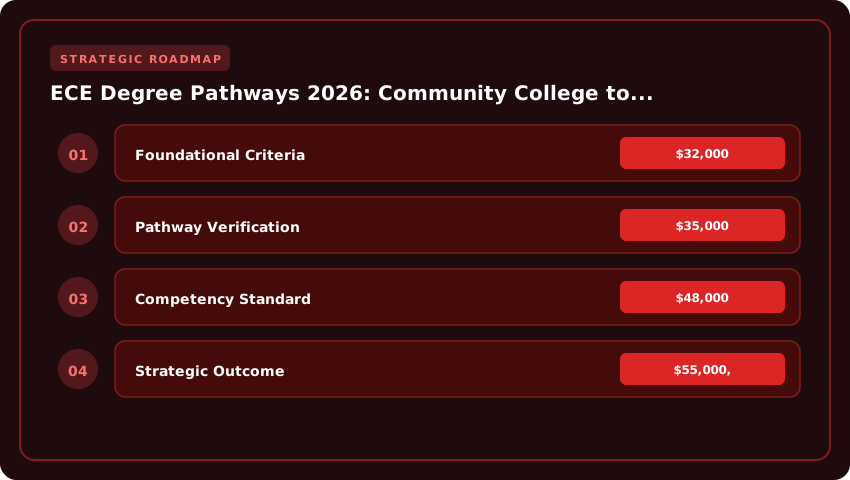
Success in evaluating ECE Degree Pathways 2026: Community College to State Licensure relies on early preparation, adherence to verified accredited requirements, and cross-referencing official portals. Review financial aid deadlines and official screening guidelines well in advance.