The Credential Ceiling: Why the Associate Degree Stalls ECE Wages
For many passionate educators, an associate degree in early childhood education (ECE) represents a vital first step into the classroom. However, as you analyze your long-term career trajectory, you will inevitably encounter what industry professionals call the “credential ceiling.” While a two-year degree equips you with foundational pedagogical skills, it frequently halts wage growth and restricts access to leadership positions. Understanding this ceiling is the first actionable step toward maximizing your earning potential and impact in the American education system.
According to the U.S. Bureau of Labor Statistics (BLS), the wage gap between associate and bachelor’s degree holders in preschool education is stark. While the median annual wage for preschool teachers hovers around $35,000, those holding a bachelor’s degree and working within public school districts often earn starting salaries between $45,000 and $50,000. This represents a premium of nearly 30 percent. More importantly, this wage gap compounds over a career, significantly impacting retirement contributions and lifetime earnings. By transferring to a four-year program, you aren’t just buying a piece of paper; you are unlocking a tangible, lifelong financial return on investment.
Beyond base salary, federal regulations have established strict degree mandates that further limit associate degree holders. The Head Start Act, specifically Section 648A, mandates that at least 50 percent of Head Start teachers nationwide must hold a baccalaureate or advanced degree in early childhood education or a closely related field. If you aspire to be a lead teacher in a Head Start program, an associate degree simply will not suffice. This federal benchmark has effectively redefined the baseline qualification for high-stakes, federally funded early learning centers.
Similarly, the Child Development Associate (CDA) credential, while immensely valuable for entry-level positions and assistant teaching roles, carries distinct limitations. Many professionals assume a CDA is a substitute for a degree, but it is fundamentally a competency-based certification, not an academic credential. In the vast majority of U.S. states, public pre-K lead roles require state teaching licensure, which strictly mandates a bachelor’s degree from an accredited institution. The CDA will help you get your foot in the door, but it will not grant you the keys to the lead teacher’s classroom.
- Wage Stagnation: Associate degree holders often cap out at lower salary schedules in public school districts, limiting lifetime earning potential.
- Federal Mandates: Head Start Act Section 648A requires a bachelor’s degree for half of all lead teachers, heavily favoring four-year graduates for advanced roles.
- Licensure Barriers: A CDA does not equate to state teaching licensure, which is a strict requirement for public pre-K programs across the country.
To break through this ceiling, community college students must proactively plan their transfer pathway. Start by reviewing articulation agreements between your local community college and state universities to ensure your credits will transfer seamlessly into a bachelor’s program. Remember to file your FAFSA early to capture federal and state grants that make this academic transition financially viable. Your dedication to young learners deserves a career path with upward mobility, and a bachelor’s degree is the essential key to unlocking it.
Mapping the Transfer Pipeline: Articulation Agreements & NAEYC Accreditation
Transfer success begins with a verified 2+2 articulation agreement between your community college and the four‑year institution you plan to attend. These agreements guarantee that the first two years of coursework — typically 60 semester credits — will satisfy the lower‑division requirements of a bachelor’s program in early childhood education. To confirm an agreement, start at the community college’s transfer center website and search for “articulation agreements” or “transfer pathways.” Most colleges publish a searchable database that lists partner universities, the specific associate degree (e.g., Associate of Applied Science in Early Childhood Education), and the corresponding bachelor’s major. Cross‑reference this list with the university’s own transfer admissions page; the university should display a matching “transfer guide” that maps each community‑college course to a university course code.
Next, verify that both institutions hold regional accreditation recognized by the U.S. Department of Education. Regional accreditation ensures that credits are eligible for federal financial aid, including FAFSA, and that the degree will be accepted by state licensing boards. In addition, prioritize programs accredited by the National Association for the Education of Young Children (NAEYC). NAEYC accreditation signals that the curriculum meets rigorous standards for child development theory, family engagement, and supervised field experience. When both the associate and bachelor’s programs are NAEYC‑accredited, the practicum hours you complete at the community college are far more likely to transfer intact, preserving the 300‑plus clock hours many states require for licensure.
Practical steps to protect your credits and practicum portfolio:
- Request an official degree audit from your community college advisor that lists every course, credit value, and NAEYC competency alignment.
- Obtain a written confirmation from the four‑year institution’s registrar that each listed course satisfies a specific bachelor’s requirement.
- Keep a detailed practicum log — dates, setting, age group, supervisor signature — in a digital portfolio; many NAEYC‑accredited programs accept this log for direct credit transfer.
- Confirm that the university’s field‑placement office will honor your prior practicum site or will help you secure a comparable placement without repeating hours.
- Check the College Board’s Transfer Credit Evaluator tool for any additional course‑equivalency data, especially for general‑education requirements such as English composition or mathematics.
Finally, budget for any potential credit gaps. If a course does not transfer, you may need to enroll in a summer session at the university, which can cost $400–$800 per credit hour at public institutions. Planning ahead — ideally during your first semester at the community college — lets you select electives that are pre‑approved for transfer, minimizing unexpected tuition expenses and keeping your path to a bachelor’s degree on schedule.
Funding the Gap: T.E.A.C.H. Scholarships, FAFSA Independence & Employer Aid
Closing the financial distance between an associate degree and a bachelor’s degree in Early Childhood Education (ECE) requires more than simply enrolling in classes; it demands a strategic, multi-layered approach to funding. For working educators, returning students, and Head Start employees, understanding how to leverage specialized scholarship programs, federal financial aid rules, and employer-sponsored benefits can mean the difference between stalled credentials and a completed four-year degree. This section provides an in-depth roadmap to navigating three primary funding pillars: the T.E.A.C.H. Early Childhood Scholarship Program, FAFSA dependency overrides for adult learners, and Head Start professional development allocations.
The T.E.A.C.H. (Teacher Education And Compensation Helps) Early Childhood Scholarship remains one of the most robust state-funded pipelines for ECE professionals. Operating in over 30 states and territories through Child Care Services Association (CCSA) partnerships, T.E.A.C.H. addresses the historical underfunding of early educators by absorbing the majority of tuition costs while incentivizing retention. To qualify, candidates typically must work a minimum of 20 hours per week in a licensed child care program, earn less than a state-specific wage ceiling (often around $25–$30 hourly or equivalent annual salary), and commit to remaining at their sponsoring employer for a designated period—usually six months to one year per semester funded.
- Tuition Coverage: T.E.A.C.H. scholarships generally cover 80% to 95% of tuition and mandatory fees at regionally accredited partner institutions, including community colleges and state universities offering bachelor’s completion programs. Books and course materials are often reimbursed separately, with caps ranging from $200 to $500 per semester depending on the state.
- Compensation Rewards: Scholars receive a contractual raise or bonus upon completing each semester—commonly $400 to $1,500 per contract period—designed to immediately translate academic advancement into higher wages.
- Release Time: Recognizing the reality of working adults, many T.E.A.C.H. contracts include paid or unpaid release time. Sponsors (employers) may receive reimbursement subsidies to provide three to six hours of paid release per week, allowing candidates to attend classes, study, or complete practicum requirements without sacrificing income.
- Application Cycles: Deadlines vary by state but generally fall in late spring, summer, and early fall. Candidates should verify their state’s T.E.A.C.H. office—often housed within the Department of Human Services or a designated commission—for exact requirements.
For adult learners over 24, FAFSA independence status is a significant financial advantage. Unlike dependent students, independent applicants are not required to report parental income or assets, dramatically lowering Expected Family Contribution (EFC) calculations and often qualifying students for the maximum Pell Grant—currently set at $7,395 for the 2025–2026 award year. To qualify as independent under federal criteria, students must meet at least one condition: be 24 years or older, be married, have dependents, be a veteran, or be an orphan or ward of the court. Critically, graduate students working toward a bachelor’s degree (such as those completing a Bachelor of Science in Early Education) are also considered independent, opening Pell eligibility during their final two years.
- FAFSA Strategy Tips: Submit the FAFSA as early as October 1 of the preceding year to maximize state grant and institutional aid pools.
- Untaxed Income Reporting: Report child support received and retirement plan contributions correctly—errors can inadvertently reduce aid eligibility.
- Professional Judgment: If unusual circumstances (such as recent job loss or divorce) affect financial capacity, contact the university’s financial aid office to request a professional judgment review.
Finally, Head Start employees have access to dedicated professional development funds that can substantially offset bachelor’s completion costs. The Head Start Act mandates that programs allocate a minimum of 1% of their total annual budget to staff training and development, and many grantees exceed this threshold. These funds can be applied to tuition reimbursement, conference attendance, and credentialing fees. Employees should consult their Human Resources coordinator or the program’s Education Services Manager to identify available allocations, as funds often operate on a first-come, first-served basis each fiscal year.
By strategically combining T.E.A.C.H. scholarships, maximizing FAFSA independence benefits, and tapping into Head Start professional development budgets, ECE professionals can dramatically reduce out-of-pocket expenses while accelerating their journey from associate to bachelor’s degree.
State Certification Maze: Licensure Pathways for Public Pre-K vs. Head Start
Navigating the licensure landscape after your bachelor’s completion feels less like a straight line and more like a patchwork quilt—every state stitches its own rules, and the federal government adds a distinct federal panel. If you are targeting a public school Pre-K classroom, you are chasing a state-issued teaching license. If your heart is set on Head Start, you are aligning with federal performance standards. Understanding the friction between these two systems is the single most strategic move you can make during your junior and senior years.
In the public school arena, the credential is typically a Birth–Kindergarten (B–K), Birth–Grade 2 (B–2), or Pre-K–3 (P–3) endorsement attached to a standard teaching license. These are gatekept by state departments of education and almost universally require a regionally accredited bachelor’s degree, a state-approved educator preparation program (EPP), passing scores on Praxis or state-specific exams (like the edTPA or California Teaching Performance Assessment), and a full background clearance. The associate-to-bachelor’s transfer pathway works beautifully here if your community college holds an articulation agreement with a four-year EPP that leads directly to licensure. Without that alignment, you risk graduating with a degree that qualifies you for nothing more than a paraprofessional role.
Consider the heavy hitters: California operates the Child Development Permit matrix rather than a traditional teaching credential for most Pre-K roles. A “Master Teacher” or “Site Supervisor” permit requires specific unit counts in ECE/CD core areas plus general education—requirements that map neatly onto an Associate Degree for Transfer (ADT) but diverge sharply from a standard B–K license. New York demands the B–2 Certification, which mandates a master’s degree for professional certification within five years of initial issuance. Texas offers an EC–6 Core Subjects certification that covers Pre-K, but the Pre-K specific endorsement requires additional coursework in early literacy and math. You must audit your bachelor’s elective slots against your target state’s transcript analysis worksheet, not just your university’s graduation checklist.
Head Start plays by a different rulebook: the Head Start Program Performance Standards (HSPPS) under 45 CFR §1302.91. For a Lead Teacher role, the federal floor is a bachelor’s degree in ECE or a related field with equivalent coursework. Crucially, “related field” is defined by the Office of Head Start (OHS) as a degree with at least 30 semester credits in ECE topics—child development, curriculum, family engagement, and assessment. A generic Elementary Education bachelor’s often falls short unless you strategically pack those 30 credits into your electives. Unlike public schools, Head Start does not require a state teaching license, though most grantees strongly prefer candidates who hold one because it simplifies their compliance audits.
- Action Item: Download the Head Start Early Childhood Learning & Knowledge Center (ECLKC) credential verification checklist and cross-walk it against your bachelor’s degree audit sheet right now.
- Action Item: Identify the “State Approved Program” list on your target state’s Department of Education website; only degrees from these providers guarantee licensure eligibility.
- Action Item: If you plan to move states, prioritize a bachelor’s program accredited by CAEP (Council for the Accreditation of Educator Preparation) or NAEYC—these national seals smooth reciprocity significantly.
The bottom line: Public Pre-K demands the license; Head Start demands the competencies. A well-chosen bachelor’s completion program delivers both, but only if you treat your elective credits as strategic currency rather than filler.
Online vs. Hybrid Bachelor’s Completion: Evaluating ROI for Working Educators
For the working early childhood educator, the decision between a fully online bachelor’s completion program and a hybrid model is rarely just about preference—it is a calculation of opportunity cost. You are likely weighing the ability to keep your current classroom position against the rigor of upper-division coursework and the non-negotiable requirement of supervised clinical experience. Understanding the true Return on Investment (ROI) requires looking past the marketed tuition-per-credit rate to the total cost of attendance, timeline flexibility, and the hidden logistics of student teaching.
Completion Timelines: The “Part-Time Penalty” vs. Cohort Momentum
Fully online programs—such as those offered by UMass Global, Walden University, and major state systems like Penn State World Campus or Arizona State University Online—are engineered for asynchronous momentum. Most advertise a 18-to-24-month completion track for students transferring a full Associate of Arts (AA) or Associate of Science (AS) degree (roughly 60 credits). However, the reality for a full-time teacher is often a “part-time penalty.” Taking one or two courses per term to maintain work-life balance frequently stretches the timeline to 3 to 3.5 years, increasing total tuition due to annual rate hikes and extending the period before you qualify for the bachelor’s-level salary lane.
Hybrid programs, commonly found at regional state universities (e.g., California State University campuses or SUNY institutions), often operate on a cohort model. You move through a locked sequence of courses with the same peers, typically meeting one evening per week or one Saturday per month. While less flexible day-to-day, the cohort structure creates accountability that drives higher on-time graduation rates. If your goal is to hit the salary schedule bump in two years, the hybrid cohort’s rigid structure often delivers a faster, more predictable ROI than the “go at your own pace” online model.
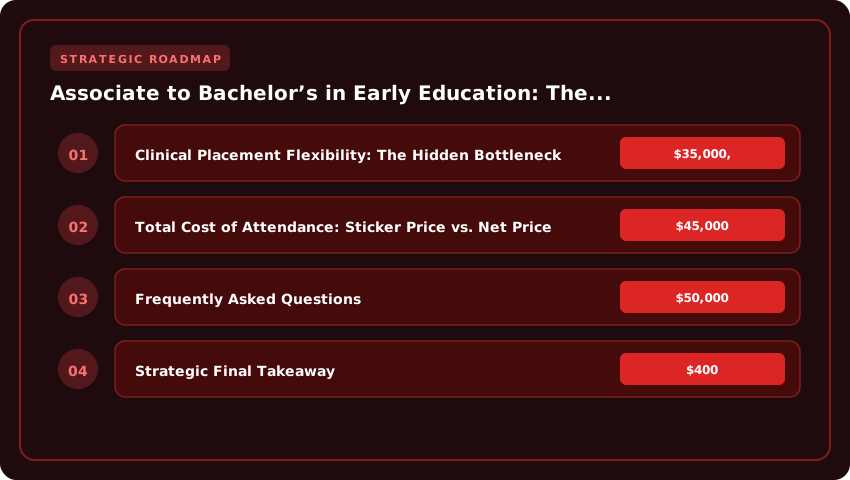
Clinical Placement Flexibility: The Hidden Bottleneck
This is the single most overlooked factor in ROI calculations. Every CAEP-accredited or state-approved ECE bachelor’s program requires supervised fieldwork (student teaching/practicum), typically 300–600 hours.
- Fully Online Programs: Institutions like Walden or UMass Global often allow you to complete placements in your current classroom (“job-embedded” practicum), provided your center meets accreditation standards (NAEYC/Head Start) and you have a qualified mentor teacher on-site. This eliminates the need for unpaid leave—a massive financial win. Verify this policy in writing before enrolling; some states (like New York or Illinois) restrict job-embedded placements for initial licensure.
- Hybrid/On-Campus Models: Traditional programs frequently require placement in a partner district school or a university-affiliated lab school. This often forces working educators to take unpaid leave (FMLA) or use vacation time for 8–16 weeks. The lost wages ($15,000–$25,000+ for a semester) often dwarf the tuition difference between a state university ($12k–$18k total) and a private online provider ($30k–$40k total).
Total Cost of Attendance: Sticker Price vs. Net Price
Do not compare sticker prices. Calculate the Net Cost of Degree: (Tuition + Fees + Books + Lost Wages from Clinicals) – (Employer Tuition Assistance + TEACH Grant + Pell Grant).
- State University Systems (Hybrid/Online): ~$300–$500/credit (in-state). Total tuition ~$12,000–$18,000. High value if you avoid lost wages via job-embedded placement.
- Private Non-Profit Online (e.g., UMass Global): ~$500–$600/credit. Total tuition ~$18,000–$22,000. Strong military/employer partnerships often lower net cost.
- For-Profit Online (e.g., Walden, Capella): ~$400–$550/credit + residency fees. Total tuition ~$25,000–$35,000. Flexible transfer credit acceptance can shorten time-to-degree, potentially offsetting higher per-credit cost.
Actionable Takeaway: Request a “Clinical Placement Guarantee Letter” from admissions before committing. If a program cannot guarantee you can student-teach in your current paid position (or a paid residency), factor 12–16 weeks of lost income into your ROI spreadsheet. For most working educators, a state university hybrid program with a job-embedded practicum agreement offers the highest financial ROI; a top-tier online program is the superior choice only if your schedule demands total asynchronicity and your employer supports the placement.
Career Trajectory & Salary Outcomes: From Lead Teacher to Director Credentials
Completing your bachelor’s degree fundamentally restructures your five-year earnings potential, especially when paired with state director credentials and nonprofit employment that qualifies for federal loan forgiveness. According to the U.S. Bureau of Labor Statistics Occupational Employment and Wage Statistics (OEWS) data, kindergarten and elementary teachers holding a bachelor’s degree earn a national mean annual wage of approximately $67,000, while preschool teachers with a bachelor’s credential average $46,000 to $50,000 depending on metropolitan area. Lead teachers with an associate degree typically cap out near $36,000 to $39,000, meaning the bachelor’s credential alone can unlock a $10,000 to $15,000 annual differential that compounds significantly over a five-year horizon.
Projecting conservatively, if you start your post-bachelor’s career at $48,000 and absorb standard 2.5 percent annual cost-of-living adjustments plus a typical 3 percent merit raise, your five-year cumulative earnings approach $255,000. Add the variable of a Child Development Associate (CDA) credential plus a state-recognized director credential, and your ceiling expands into the $60,000 to $72,000 band within five years as you transition from lead teacher to assistant director or program coordinator. Center directors overseeing licensed programs in metropolitan statistical areas like Boston, San Francisco, or Washington, D.C. routinely command salaries between $72,000 and $95,000, according to OEWS figures for education administrators in childcare settings.
- Year 1 baseline (bachelor’s + state teaching license): $46,000–$50,000 lead teacher, public or accredited private center
- Year 2–3 (CDA renewal + AIM4Excellence modules): $52,000–$58,000 with team-lead or curriculum coordinator responsibility
- Year 4–5 (state director credential + 3+ years supervisory experience): $62,000–$75,000 assistant director, $72,000–$95,000 full program director
- Public Service Loan Forgiveness (PSLF) trajectory: After 120 qualifying monthly payments while employed full-time at a 501(c)(3) nonprofit center or public school, remaining federal Direct Loan balances are forgiven tax-free
The Administrator/Director credential stack begins with foundational leadership coursework through AIM4Excellence, a nationally recognized program aligned with the National Association for the Education of Young Children (NAEYC) director competencies. AIM4Excellence coursework typically costs between $1,200 and $2,400 and covers organizational management, financial planning, staff supervision, and accreditation preparation. Most states additionally require a state-specific director credential, often 30 to 45 credit hours beyond the bachelor’s degree, which may be embedded in your degree completion program at accredited institutions like University of Cincinnati Online, Ashford University, or National University. These programs hold regional accreditation through agencies recognized by the Council for Higher Education Accreditation (CHEA) and often align with the National Council for Accreditation of Teacher Education (NCATE) or Council for the Accreditation of Educator Preparation (CAEP) standards.
The PSLF opportunity is particularly powerful for ECE professionals because the majority of high-quality early childhood centers operate as 501(c)(3) nonprofits, including programs affiliated with Head Start, Parents as Teachers, YMCA early learning initiatives, and faith-based or community-based providers. To maximize PSLF eligibility, file the Employment Certification Form (ECF) annually through the Federal Student Aid portal, confirm your employer’s status using the IRS Tax Exempt Organization Search tool, and consolidate any older Federal Family Education Loan (FFEL) Program loans into Direct Loans before your 120th qualifying payment. Income-Driven Repayment plans such as SAVE (Saving on a Valuable Education) or PAYE (Pay As You Earn) keep monthly payments manageable while you accumulate qualifying service, and any forgiveness balance after 120 payments remains free of federal income tax under current Internal Revenue Code Section 108(f) treatment.
Combining bachelor’s completion, state director credentials, and a deliberate nonprofit career path allows you to project a realistic $260,000 to $320,000 cumulative earnings window over five years, with the added possibility of six-figure debt forgiveness through PSLF. The strategic decision to pursue accredited, nonprofit-aligned employment transforms the traditional ECE wage narrative into a financially sustainable long-term career.
| Credential Path | Total Tuition Cost (USD) | Completion Timeline | Median Annual Salary (US) | Career ROI (10-Year) | State Certification Eligibility |
|---|---|---|---|---|---|
| Associate in ECE (Standalone) | $8,000 – $18,000 | 2 years | $31,000 – $38,000 | Low (credential ceiling) | Lead Teacher (varies by state) |
| Associate + Non-Transfer Bachelor’s Completion | $25,000 – $45,000 | 4 – 5 years | $42,000 – $50,000 | Moderate | Lead Teacher + Curriculum Coordinator |
| Associate-to-Bachelor’s Articulation (Transfer Path) | $32,000 – $55,000 | 2 + 2 years | $48,000 – $60,000 | High (recommended) | State Lead Teacher + Admin Eligible |
| Traditional On-Campus Bachelor’s in ECE | $55,000 – $110,000 | 4 years | $48,000 – $60,000 | Moderate (higher upfront cost) | State Lead Teacher + Admin Eligible |
| Online Bachelor’s Completion (Post-Associate) | $18,000 – $30,000 | 1.5 – 2 years | $45,000 – $55,000 | High (flexible) | State Lead Teacher (with practicum) |
| Master’s in Early Childhood Education | $20,000 – $40,000 (post-bachelor’s) | 2 years additional | $58,000 – $75,000 | Very High (long-term) | Director / Principal / Specialist |
Frequently Asked Questions
How long does it take to transfer from an associate to a bachelor's degree in early childhood education in the US?
The standard articulation pathway follows a 2+2 model: students complete a two-year associate degree in early childhood education at a community college, then transfer to a four-year institution to finish the remaining 60–70 credit hours, typically requiring an additional two years of full-time study.
Do all community college ECE associate degrees transfer to a bachelor's program?
Not automatically. Transferability depends on whether the associate degree is part of a signed articulation agreement with a receiving university and whether coursework aligns with state-approved early childhood education frameworks, including practicum hours and child development competencies.
Is a bachelor's degree in early childhood education required to become a certified lead teacher in the US?
In most US states, a bachelor's degree in early childhood education or a related field, combined with a state-approved teacher preparation program and practicum, is the minimum credential required for lead teacher certification in public pre-K and Head Start settings.
What is the salary difference between an associate degree and a bachelor's degree in early childhood education?
According to the US Bureau of Labor Statistics, workers with an associate degree in early childhood education earn a median of $31,000–$38,000 annually, while those with a bachelor's degree earn $48,000–$60,000, representing a 30–55% wage increase over the associate credential.
Strategic Final Takeaway
Success in evaluating Associate to Bachelor’s in Early Education: The US Transfer & Certification Roadmap relies on early preparation, adherence to verified accredited requirements, and cross-referencing official portals. Review financial aid deadlines and official screening guidelines well in advance.