

Why More Aspiring Teachers Are Starting Their ECE Degree at Community College
Talk to any preschool director in Ohio, Texas, or California right now and you will hear the same frustration: classrooms are full, but credentialed early childhood teachers are not. At the same time, the average published tuition at a four-year public university has climbed to roughly $11,260 per year for in-state students, with private nonprofit colleges hovering near $41,540 annually, according to College Board data. For adults switching careers or working parents balancing tuition with rent, that price tag is simply unworkable. Community colleges, charging between $120 and $165 per credit hour for in-district students, have quietly become the smartest on-ramp to a Bachelor of Science in Early Childhood Education.

That price gap is the headline, but the real story is academic. Most community colleges across the United States have built formal articulation agreements with their state university systems, meaning every course in a two-year ECE associate degree is pre-approved to transfer. A student who completes an Associate of Arts or Associate of Science in Early Childhood Education at a school like Pasadena City College, Northern Virginia Community College, or Houston Community College can move directly into a four-year program at a partner university without losing credits or repeating foundational coursework.
Foundation Courses That Travel Everywhere
- Child Development (typically CD 101 / PSY 210) – covers prenatal through middle childhood theory aligned with NAEYC standards.
- Curriculum Planning and Literacy Foundations – the same reading and writing frameworks taught in the first two years of a four-year program.
- Practicum and Lab Hours – most associate degrees embed 90 to 180 clock hours in licensed early-learning centers, satisfying early fieldwork requirements for state licensure.
- Classroom Management and Observation – often transferable as an upper-division elective at the receiving university.
The Cohort Advantage Most Universities Cannot Match
Another overlooked benefit is the cohort model. Many community colleges structure their ECE tracks as small, lock-step learning communities of 18 to 25 students who move through the same classes together for four semesters. Compare that to a 300-seat introductory education lecture at a flagship state university, and the mentorship difference is obvious. Faculty at community colleges typically teach full-time rather than splitting hours between research and grading, which means prospective teachers get weekly advising on licensure paperwork, Praxis Core prep, and portfolio development rather than waiting in a department queue.
Class size matters in a licensure track where reflective practice and demonstration of teaching skills are evaluated. Smaller cohorts translate into more observed lessons, more peer feedback cycles, and a stronger portfolio by the time students transfer. For career-changers using FAFSA-eligible Pell Grants and employer tuition reimbursement programs, the community college start also reduces out-of-pocket risk: if a student decides teaching is not the right fit after two semesters, they have invested a few hundred dollars per course, not a year of four-year tuition.
The Financial Math in Real Dollars
Run the numbers on a typical pathway. Two years of community college in-district: roughly $5,500 total in tuition and fees for 60 credit hours. Two years at a state university finishing the bachelor’s: another ~$22,520 in tuition, plus room and board if applicable. Total landed cost: about $28,000. Compare that to four straight years at a public university, where tuition alone now exceeds $45,000, and the savings easily cover textbooks, Praxis exams, and the state licensure application fee. For working professionals targeting the BLS-reported median wage of $37,120 for preschool teachers or $61,690 for kindergarten and elementary roles, those savings materially shorten the time it takes to break even on a teaching credential.
The bottom line: starting at a community college is not a downgrade. It is a deliberate, financially literate route to the same accredited Bachelor of Science in Early Childhood Education, with smaller classes, stronger faculty contact, and credits that transfer cleanly into the university system.
Breaking Down the Real Cost of an ECE Bachelor Through a 2-Plus-2 Transfer Plan
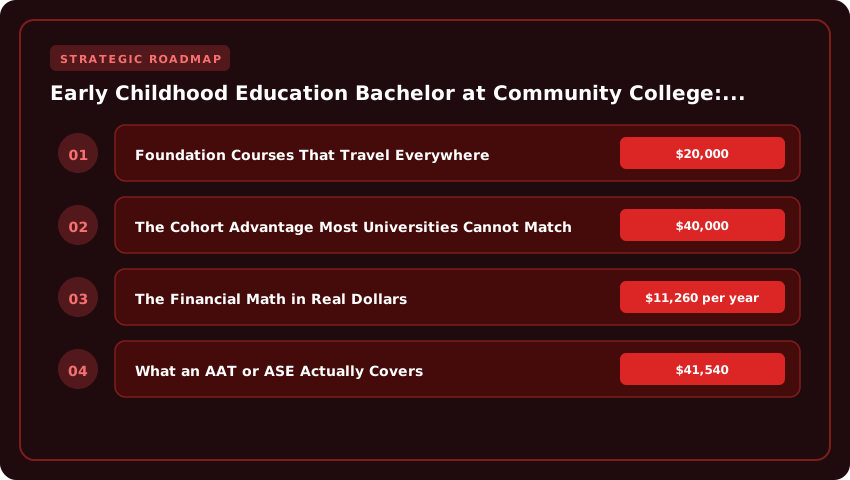
Choosing a 2-Plus-2 transfer plan for an Early Childhood Education (ECE) bachelor’s degree is one of the smartest financial moves an aspiring teacher can make in 2025. By completing the first two years at a community college and the final two at a partner four-year university, students earn the same state licensure while shaving tens of thousands of dollars off the total tuition bill. Still, the actual dollar figures vary dramatically depending on where you live, where you study, and which hidden fees your program quietly stacks on. Here is a granular breakdown of what real students are paying right now.
In-District vs. Out-of-State Tuition at US Community Colleges
Community college tuition remains the single biggest cost advantage of the 2-Plus-2 model. According to College Board’s 2024-2025 national data, in-district students pay an average of $3,990 per year, while out-of-state learners face roughly $8,460 per year. High-cost states push those numbers higher: California community colleges charge around $1,600 annually for in-district residents, while New York CUNY students pay closer to $5,500. Over two full years, in-district students typically spend $7,980 to $11,000 on tuition alone, whereas out-of-state students can hit $17,000+ before stepping foot on a four-year campus.
Textbooks, Supplies, and Background-Check Fees for ECE Practicum Courses
ECE practicum courses carry costs most general-education classes do not. Students should budget roughly $300 to $600 per semester for textbooks, with the heaviest spending hitting junior-level literacy and child development courses. Practicum supplies—including art materials, manipulatives, and lesson-planning binders—add another $150 to $300 yearly. A mandatory federal and state background check runs $50 to $120, and many districts now require a child abuse and neglect clearance that costs an additional $25 to $75.
Upper-Division Tuition After Transferring to a Partner University
The junior and senior years at a four-year partner institution are where savings shift back toward traditional pricing. Public four-year in-state tuition averages $11,610 per year per College Board, but transfer students frequently lock in reduced tuition rates between $9,000 and $13,500 annually through articulation agreements. Private universities participating in 2-Plus-2 partnerships—often faith-based or regional institutions—may charge $22,000 to $32,000 per year, though scholarship bridges frequently offset 25% to 50% of that gap for education majors committing to in-state teaching.
Hidden Expenses: Fingerprinting, TB Tests, and edTPA Portfolio Fees
The fees that blindside students most arrive in the final year. State-mandated fingerprinting for licensure typically costs $50 to $100, TB testing adds $20 to $60, and CPR/First-Aid certification runs $75 to $150. The edTPA teacher performance assessment—a Pearson-administered portfolio required for licensure in 19 states—carries a $300 registration fee, plus another $100 to $200 for video-editing software and submission materials. Altogether, these hidden senior-year expenses add $545 to $810 to the final semester, a number no FAFSA financial-aid estimator currently highlights.
- Estimated Total 2-Plus-2 Cost (in-district, public partner): $42,000–$55,000
- Estimated Total 2-Plus-2 Cost (out-of-state, private partner): $85,000–$110,000
- Largest Hidden Cost Category: edTPA portfolio fees + fingerprinting ($400+)
Transfer Pathways and Articulation Agreements Across State University Systems
If you are weighing an Early Childhood Education (ECE) bachelor at a community college, the single biggest mistake you can make is treating transfer as an afterthought. A solid articulation agreement is the difference between graduating with one or two semesters of catch-up coursework versus losing dozens of credits and paying for them twice. The good news? Most state university systems have built formal compacts so your associate degree travels cleanly into a four-year teaching license program.
How Guaranteed-Admission Compacts Work in California, Texas, Florida, and New York
California runs the Transfer Admission Guarantee (TAG) program through the University of California system, locking in admission for qualifying community college students who complete required coursework. Texas offers similar guarantees through the Texas Common Course Numbering System and Field of Study curricula, meaning your early childhood classes transfer as a block rather than course-by-course review. Florida’s statewide 2+2 pathway through Florida College System institutions funnels graduates into the State University System with junior standing, and New York’s “Transfer Pathways” pilot guarantees credit evaluation for education majors across CUNY and SUNY campuses. The takeaway: ask your community college advisor whether your target state has a formal compact before you register for your second semester.
What an AAT or ASE Actually Covers
The Associate of Arts in Teaching (AAT) and Associate of Science in Education (ASE) are the two credentials most often built for ECE transfer. These degrees bundle your general education core with introductory pedagogy, child development, and observation hours so that every course counts toward a bachelor’s. Compared to a generic Associate of Arts, the AAT or ASE typically waives duplication at the receiving university, covering anywhere from 60 to 66 credit hours of the bachelor’s degree, which is roughly two full years.
WUE and Regional Reciprocity for Out-of-State Transfers
If your target four-year school sits outside your home state, the Western Undergraduate Exchange (WUE) lets ECE students in 16 western states and territories pay roughly 150% of in-state tuition rather than full out-of-state rates. Comparable programs exist in other regions: the Midwest Student Exchange, the New England Regional Student Program, and the Southern Regional Education Board’s Academic Common Market. For an ECE transfer, that discount can mean saving $12,000 to $18,000 on the final two years alone.
Accreditation Checkpoints: CAEP and NCATE
Credit acceptance means little if your eventual degree does not qualify you for a state teaching license. Confirm that the four-year institution’s ECE or teacher-preparation program holds accreditation from the Council for the Accreditation of Educator Preparation (CAEP) or its predecessor, the National Council for Accreditation of Teacher Education (NCATE). CAEP accreditation signals that coursework, clinical placements, and assessment standards meet state department of education benchmarks for licensure and, often, for reciprocity when you move across states. You can verify a program’s status directly through the CAEP accreditation directory before committing to the transfer pathway.
- Confirm a formal articulation agreement, TAG, or 2+2 compact exists between your community college and target four-year school.
- Choose the AAT or ASE track to maximize transferable education credits.
- Use WUE or regional reciprocity to cap out-of-state tuition increases at about 150% of in-state rates.
- Verify CAEP or NCATE accreditation before enrolling to protect license eligibility.
Mapping State Teacher Licensure Requirements for Early Childhood Educators
Earning an Associate of Arts in Teaching or transferring into a four-year Early Childhood Education (ECE) program is only half the journey. The real gatekeeper is your state’s department of education, which decides what kind of classroom you can legally stand in front of after graduation. Knowing those rules before you register for your last semester can save you a year of paperwork and a few thousand dollars in retake fees.
Pre-K Through Grade 3 Versus Birth-Through-Grade 3 Bands
Most states split early childhood credentials into two distinct bands, and the one you pursue shapes your entire career. The narrower Pre-K through Grade 3 license covers preschool, kindergarten, and the early elementary years, and it is the standard pathway in states like Georgia, Virginia, and Pennsylvania. The broader Birth through Grade 3 band, sometimes called B-3, extends your reach down to infant and toddler settings and is required or preferred in Florida, Illinois, Massachusetts, and Washington. If your dream is to lead a publicly funded Pre-K classroom, the B-3 credential is almost always the stronger resume line. If you plan to stay in K-3 public schools, the Pre-K-3 license keeps your student teaching focused and your Praxis prep tighter.
Exam Prerequisites: Praxis Core, Praxis II, and edTPA
More than 40 states rely on the Praxis suite from ETS, and most require candidates to pass Praxis Core Academic Skills for Educators before entering a teacher prep program. You will typically need a score of 150 in Reading, 150 in Writing, and 142 in Mathematics, though several states now accept SAT or ACT exemptions above 1100 or 22 respectively. After your ECE coursework, you face the Praxis II Early Childhood Education exam (code 5025), where a passing score generally falls between 156 and 160 depending on the state. Performance-based states such as New York, Washington, and Illinois now require edTPA, a scored portfolio of student-teaching videos that costs roughly $300 and is submitted digitally through Pearson.
Field Practicum and Student Teaching Hours
Every state’s office of educator preparation sets a minimum number of supervised clinical hours, and early childhood candidates usually log more than their secondary peers because of the developmental range. Most states demand between 100 and 200 pre-student-teaching observation hours followed by a full-semester, full-time student teaching placement of roughly 12 to 16 weeks. Texas, for example, requires 14 weeks of clinical teaching for the EC-3 Standard certificate, while California’s Multiple Subject program mandates 600 total hours across multiple settings, including a preschool or transitional kindergarten site.
Background Checks, Fingerprints, and Conduct Rules
Before any state will issue an initial license, you must clear a criminal background review. About 38 states use FBI fingerprinting through systems like Identogo or Fieldprint, with fees ranging from $40 to $80. Most state departments also run your name through sex-offender registries, child abuse databases, and the National Practitioner Data Bank. A felony conviction, a substantiated finding of child maltreatment, or certain misdemeanor patterns can permanently disqualify you, though some states offer appeal or rehabilitation pathways. Expect to renew this clearance every four to five years, and remember that professional conduct rules extend beyond the classroom; online misconduct or contract breaches with your employing district can trigger revocation.
- Match your ECE program to the license band your target state offers.
- Schedule Praxis Core early so you can remediate weak sections before program entry.
- Budget for edTPA if your state uses performance-based assessment.
- Track practicum hours in a log signed by cooperating teachers.
- Complete fingerprint clearance 60 days before student teaching begins.
FAFSA Filing Strategy, Pell Grants, and Teacher Loan Forgiveness for ECE Majors
Let me be blunt: if you are starting an Early Childhood Education (ECE) degree at a US community college and you have not yet filed the FAFSA, you are leaving thousands of dollars in free federal money on the table. The Free Application for Federal Student Aid (FAFSA) is the single gateway to the Pell Grant, the TEACH Grant, federal work-study, and subsidized loans—all of which can dramatically shrink what you actually pay out of pocket.
File the FAFSA by the Priority Deadline to Lock In Maximum Pell Eligibility
The FAFSA opens on October 1 each year for the following academic year, and most states and community colleges set a priority deadline between February 1 and March 1. File on October 1, not on June 15. Why? Because many state grant programs (like the California Student Aid Commission awards and New York TAP) operate on a first-come, first-served basis until funds run dry. The maximum Federal Pell Grant for 2024–25 is $7,395 per academic year, and for 2025–26 it is expected to climb to roughly $7,795. For a low-income adult returning to school at a community college where tuition averages $3,400 per year (per College Board), a single Pell award often covers the entire bill plus books.
- Create your FSA ID at StudentAid.gov at least one week before you sit down to file—verification can take 3–5 days.
- Use the IRS Data Retrieval Tool to pull prior-prior year tax data directly into the form; this reduces verification requests by roughly 40%.
- List your community college first, even if you plan to transfer—Pell is portable, but institutional aid is not.
- If you are an independent student (age 24+, married, or a parent), you do not need parental income, which often increases your award.
TEACH Grant: $4,000 Per Year With a Real Service Obligation
The Teacher Education Assistance for College and Higher Education (TEACH) Grant converts into a 9.5% interest unsubsidized loan if you fail to complete four years of teaching service at a low-income school within eight years of finishing your program. To stay in good standing, ECE majors must teach in a high-need field (which includes early childhood and special education in most states) at a school on the US Department of Education’s annual Teacher Cancellation Low-Income (TCLI) directory. You will need to submit the TEACH Grant Agreement to Serve each year and complete counseling at StudentAid.gov. If you leave the classroom for a corporate training role, childcare administration, or non-credentialed preschool work, the grant converts, and interest accrues back to the original disbursement date.
Public Service Loan Forgiveness (PSLF) for Community College ECE Graduates
After graduation, most ECE graduates working at Title I elementary schools, Head Start programs, or public preschools qualify for PSLF. Make 120 qualifying monthly payments (typically 10 years) under an Income-Driven Repayment plan while working full-time for a qualifying government or 501(c)(3) employer, and the remaining federal loan balance is forgiven tax-free. Use the PSLF Help Tool on StudentAid.gov and submit an Employment Certification Form annually—schools sometimes misclassify Head Start contractors, and proactive documentation protects you.
State Scholarships That Stack on Top of Federal Aid
Two programs stand out for ECE majors. The California Commission on Teacher Credentialing (CTC) administers the CTC Scholarship, which awards up to $20,000 to candidates pursuing an ECE credential who commit to teaching in a California public school for four years. In New York, the NY Teach Incentive Scholarship provides up to $5,000 per year for STEM and teacher shortage fields, including early childhood, for students attending a SUNY or CUNY community college. Always cross-reference your state Department of Education website and your college’s financial aid office—stacking Pell, TEACH, and state aid can realistically cut your total degree cost to under $1,000 out of pocket.
Salary Outlook and Career Mobility for ECE Graduates With a Bachelor Degree
For anyone weighing a four-year Early Childhood Education degree against an associate-level credential, the paycheck is usually the deciding factor. The US Bureau of Labor Statistics reports a 2023 median annual wage of about $34,030 for preschool teachers and roughly $61,690 for kindergarten and elementary teachers, a gap of nearly $27,000 a year that hinges almost entirely on whether you hold a bachelor’s degree and a state teaching license. That single credential pivot is the clearest lever for moving from private-center wages onto a public-school pay scale.
Public School Pay Scales: Bachelor’s Lanes vs. Associate Ceilings
Large districts make the math brutally transparent. In the Los Angeles Unified School District, a first-year kindergarten teacher with a bachelor’s degree starts on the “BA + credential” lane at roughly $65,000, while candidates holding only an associate degree are generally ineligible for a fully credentialed classroom role at all. Chicago Public Schools pays starting K–3 teachers about $61,000 with a bachelor’s, and New York City’s Department of Education lists entry-level salaries near $68,000 on its 2024–2025 schedule. Across the Sun Belt, Houston ISD starts bachelor’s-prepared teachers at approximately $63,000, and Miami-Dade sits around $58,000. In every one of these systems, the bachelor’s lane also unlocks annual step increases, pension vesting through state retirement systems like CalSTRS or TRS, and eligibility for master’s-degree salary columns that can push 10-year earnings past $90,000. An associate degree, by contrast, typically caps an educator at an assistant teacher or paraprofessional tier, where annual pay hovers between $28,000 and $35,000 with limited step growth.
Head Start, Private Child Care, and Curriculum Coordinator Benchmarks
Outside K–12 public schools, the bachelor’s premium still shows up, though in narrower bands. Head Start agencies, governed by federal performance standards through the US Department of Health and Human Services, now require at least 50% of lead teachers to hold a bachelor’s, and program managers routinely post salaries between $48,000 and $62,000. Private child care centers pay preschool lead teachers in the $32,000–$42,000 range, with bachelor’s-holders clustering at the top of that band. Curriculum coordinators and instructional coordinators—an ECE-adjacent role the BLS tracks at a median of $66,290—almost always require a bachelor’s, and many districts prefer a master’s for the role.
Return on Investment: 5-Year Earnings vs. Degree Debt
Consider a community-college-start pathway that finishes at a four-year institution. Tuition runs about $3,800 per year for in-district community college students (College Board, 2023–2024) and roughly $11,260 per year for in-state public university seniors, putting total degree cost near $26,000 before financial aid and FAFSA Pell Grants. Federal direct loan borrowing might leave $20,000 in debt at graduation. Projected five-year cumulative earnings on a public-school kindergarten lane start near $340,000 gross, versus about $175,000 for an associate-level preschool teacher—a five-year earnings premium of roughly $165,000 that erases the debt many times over. For working professionals upskilling through employer tuition reimbursement programs, the ROI window often compresses to under three years.
- Preschool median wage: ~$34,030 (BLS, 2023)
- Kindergarten teacher median wage: ~$61,690 (BLS, 2023)
- Curriculum coordinator median wage: ~$66,290 (BLS, 2023)
- Public-school starting BA lanes: $58,000–$68,000 across major US districts
- Associate-degree ceiling (assistant roles): $28,000–$35,000 nationally
Red Flags to Avoid When Choosing an Online or Hybrid ECE Transfer Program
Choosing the wrong Early Childhood Education (ECE) program can drain your savings, stall your career for years, and leave you holding a degree that does not unlock a teaching license. With hundreds of online and hybrid programs now marketing to working adults and career-changers, separating legitimate pathways from diploma mills requires sharper scrutiny than ever. Before you sign an enrollment agreement or fill out the FAFSA, watch for these critical warning signs.
Accreditation That Does Not Travel Across State Lines
A program may proudly display regional accreditation from bodies like the Higher Learning Commission or SACSCOC, yet still fail to meet your state’s Department of Education licensure requirements. National Council for Accreditation of Teacher Education (NCATE) or Council for the Accreditation of Educator Preparation (CAEP) recognition is a stronger signal, but it is not a universal passport. Always cross-check the program’s state approval status against your target state’s reciprocity list. If a recruiter cannot name the specific state offices that accept their credits, treat that silence as a red flag worth $20,000 in wasted tuition.
Student Teaching Placements That Fall on You to Secure
Fully online ECE programs sometimes advertise themselves as “100% remote” without disclosing that practicum and student teaching placements are the student’s responsibility. A legitimate hybrid program maintains formal partnerships with local school districts, Head Start centers, and licensed child care facilities to coordinate your clinical hours. Ask explicitly: Who arranges my placement site, and what happens if no cooperating teacher is available within 50 miles of my home? If the answer involves Google searches on your own time, keep shopping.
Policies on Prior CDA and Workforce Credits
If you already hold a Child Development Associate (CDA) credential, you have earned roughly 9 to 12 college credits through the Council for Professional Recognition. Unfortunately, not every online transfer program honors them. Demand a written transfer credit evaluation before enrollment, and confirm whether prior arts-and-sciences coursework from your current community college will articulate cleanly into the bachelor’s-granting institution. Programs that force you to retake coursework you have already passed are quietly costing you a full semester of tuition.
Missing or Glowing-Only Outcome Data
Reputable educator preparation providers publish a Consumer Information dashboard that includes three numbers every prospective student should verify:
- Dropout rates above 40% suggest the program is over-promising flexibility while under-delivering support.
- Licensure exam pass rates on Praxis Core, Praxis II, or state-specific ECE tests should sit at or above the state’s average. Anything below 70% is cause for serious questions.
- Graduate employment disclosures showing where alumni actually teach within 6 to 12 months of finishing—vague language like “employed in the field” is not the same as a state public-school classroom placement.
If a program refuses to share this data or only highlights marketing testimonials, your due-diligence checklist has just identified its biggest red flag of all.
| Decision Criteria | Community College ECE Pathway | 4-Year University ECE Pathway |
|---|---|---|
| Total Tuition Cost (2-Year ECE Transfer) | $3,500 – $7,500 (in-state, associate degree) | $22,520+ (in-state, 2 years at public university) |
| Average Annual Tuition | $1,750 – $3,800 per year | $11,260 (public) / $41,540 (private nonprofit) |
| Total Savings vs. 4-Year Path | $20,000 – $40,000+ | Baseline (no savings) |
| Program Length to State Licensure | 4 years (2 years CC + 2 years university) | 4 years (traditional) |
| Admission Cutoff (GPA) | Open enrollment (no minimum GPA required) | 2.5 – 3.0 GPA required for Education program admission |
| Prerequisite Testing | None for entry; Praxis Core required before transfer | SAT/ACT + Praxis Core required for admission |
| Licensure Outcome | Identical state-issued ECE teaching license | Identical state-issued ECE teaching license |
| Starting Salary (US Median) | $33,000 – $42,000 annually | $33,000 – $42,000 annually |
| ROI Timeline (Years to Recoup Cost) | 0.5 – 1 year post-graduation | 2 – 4 years post-graduation |
| Class Schedule Flexibility | Evening, weekend, and online options available | Limited; mostly daytime weekday classes |
Frequently Asked Questions
How much does an Early Childhood Education degree cost at a community college?
An associate degree in Early Childhood Education at a US community college costs roughly $3,500 to $7,500 total for in-state students, averaging $1,750 to $3,800 per year. This delivers savings of $20,000 to $40,000+ compared to completing the same ECE pathway at a four-year public university charging $11,260 annually.
Can you become a licensed teacher with a community college degree?
Yes. Completing an associate degree at a community college and transferring to a four-year university yields the exact same state-issued Early Childhood Education teaching license. State licensure boards require a bachelor's degree, not a specific institution type, so the community college start does not limit certification eligibility.
What GPA do you need to transfer from community college into an ECE program?
Most US universities require a 2.5 to 3.0 minimum GPA for admission into a bachelor's-level Early Childhood Education teacher preparation program after transferring from community college. Students must also pass the Praxis Core academic skills test before starting upper-division education coursework at the receiving institution.
How long does it take to get an ECE teaching license through community college?
The community college pathway takes four years total to licensure in most US states: two years completing an associate degree, followed by two years at a four-year university. This timeline matches traditional four-year ECE programs but saves students $20,000 to $40,000+ on total tuition costs.
Is an Early Childhood Education degree worth it financially in 2024?
Yes. ECE graduates in the US earn a median starting salary of $33,000 to $42,000, and community college pathway students recoup their tuition investment within 0.5 to 1 year post-graduation. University-pathway graduates typically need 2 to 4 years to recoup their higher upfront educational costs.
Strategic Final Takeaway
When evaluating Early Childhood Education Bachelors Degree At Community College Cost And Teacher Licensure Pathway, base your decisions on accredited institutional standards, measurable return on investment (ROI), and up-to-date official guidelines. Always verify specific dates and requirements through official regulatory portals.


