
Which States Allow Community Colleges to Award ECE Bachelor’s Degrees
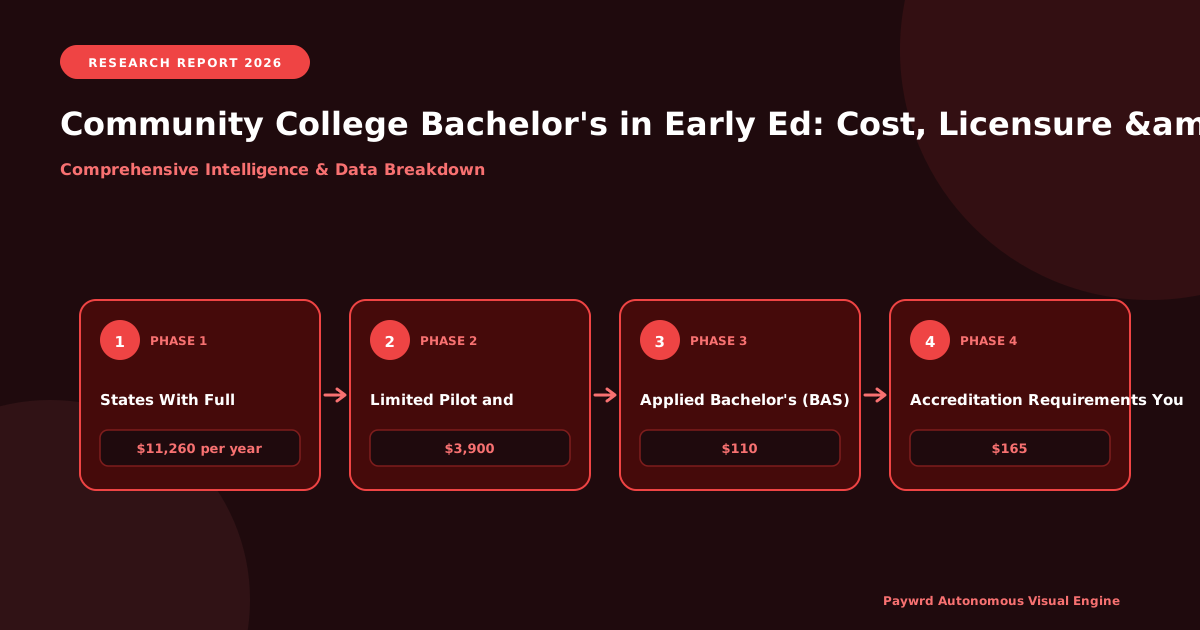
Across the United States, the traditional college route for earning a Bachelor of Arts or Bachelor of Science in Early Childhood Education has long run through state universities and private institutions. However, a quiet shift has been underway since the early 2010s. Policymakers and workforce advocates began recognizing that many working preschool teachers, Head Start educators, and paraprofessionals needed a more affordable, accessible route to a four-year credential. The average tuition at a public four-year university runs roughly $11,260 per year for in-state students, according to College Board data, while community college tuition averages closer to $3,900. That price gap is exactly why community college bachelor’s (CCB) programs in ECE matter.

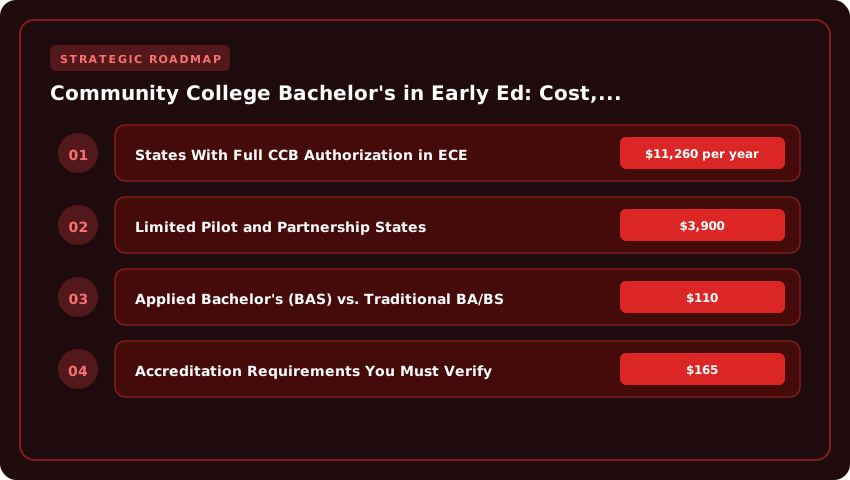
States With Full CCB Authorization in ECE
Four states currently lead the nation in authorizing community colleges to award applied bachelor’s degrees in Early Childhood Education:
- Washington – Home to one of the oldest programs through Pierce College and others, awarding the Bachelor of Applied Science (BAS) in Early Childhood Education.
- Colorado – Offers BAS tracks at multiple community colleges, including Front Range Community College and Pickens Technical College.
- Florida – Several state colleges, such as Miami Dade College, offer Bachelor of Science degrees in Early Childhood Education under Florida’s CCB framework.
- Texas – Lone Star College and others confer the Bachelor of Applied Science with ECE concentrations under Senate Bill 2118.
Limited Pilot and Partnership States
California does not yet allow community colleges to independently confer bachelor’s degrees statewide, but a pilot program under former Governor Jerry Brown (and extended since) allows select districts like San Francisco and Foothill to offer ECE upper-division coursework. Students typically complete general education at the community college and finish the final two years through a partner California State University campus, earning a traditional BA or BS rather than a BAS.
Applied Bachelor’s (BAS) vs. Traditional BA/BS
The key difference is academic focus. A BAS in Early Childhood Education emphasizes practical teaching skills, leadership in childcare settings, and applied research. A traditional BA or BS leans more heavily on theory, liberal arts coursework, and is often the preferred credential if you plan to pursue a Master of Education or state teaching license for public K-3 classrooms. Many BAS programs are designed for career-changers already working in Head Start or private preschool programs.
Accreditation Requirements You Must Verify
Before enrolling, confirm the program holds regional accreditation from one of the seven U.S. Department of Education-recognized accreditors. Additionally, look for programs recognized by the National Association for the Education of Young Children (NAEYC) or accredited by the Council for the Accreditation of Educator Preparation (CAEP). These endorsements are often required for state teaching licensure reciprocity and for transferring credits toward a master’s degree at an institution accredited by a body such as ABET, AACSB, or PMI-affiliated educator bodies.
If your state is not on the list above, do not lose hope. Many community colleges partner with regional universities to create 2+2 transfer pathways. Check your state’s Department of Education website or your college’s academic advisor for the most current articulation agreements, especially if you plan to use federal FAFSA financial aid to fund the full four-year degree.
Total Cost Breakdown: Tuition, Fees & Hidden Expenses vs. University Routes
Let’s talk brass tacks. The sticker price of a bachelor’s degree is the easiest number to find, but the real cost—the one that determines whether you start your teaching career with manageable payments or a financial anchor—hides in the per-credit differentials and the nickel-and-dime fees that four-year universities rarely advertise upfront. If you are weighing a community college baccalaureate (CCB) against a traditional state university pathway in Early Childhood Education, the math is starkly in the college’s favor, provided your state authorizes the degree.
Per-Credit Tuition: The Upper-Division Discount
Most students enter these programs with an associate degree, meaning they only pay for upper-division (300/400-level) credits. This is where the savings compound. Based on current IPEDS data and state system reports:
- Community College Baccalaureate (e.g., WA, FL, CO, TX): Upper-division tuition typically runs $110–$165 per credit for in-district residents. A standard 60-credit completion degree totals roughly $6,600–$9,900 in pure tuition.
- State University (Non-Flagship): Upper-division resident rates average $300–$450 per credit. That same 60-credit block costs $18,000–$27,000.
- State Flagship University: Rates often exceed $500–$650 per credit, pushing the two-year completion cost toward $30,000–$39,000 before fees.
That is a potential $12,000 to $30,000 tuition gap for the exact same credential—often taught by the same adjunct faculty who teach at the nearby university.
Fee Structures: The “Hidden” Line Items
Tuition is only the cover charge. ECE programs carry specific programmatic fees that scale differently at each institution type:
- Background Checks & Fingerprinting: Required for every field placement. Community colleges often bundle this into a $50–$75 annual “program fee.” Universities frequently charge per placement ($40–$60 each) plus a separate college-of-education technology fee.
- Lab & Practicum Fees: CCBs typically charge a flat $100–$200 per semester for lab access and supervising teacher stipends. University lab fees can hit $300–$500 per course for “clinical experience” modules.
- Portfolio Assessment (edTPA/Praxis): The national portfolio assessment (edTPA) costs $300 nationally. Some CCBs (like several in Washington State) build prep workshops and submission support into tuition. Many universities treat this as a separate, unfunded mandate.
- Student Fees: Universities levy mandatory fees for recreation centers, student unions, and athletics—often $1,000–$1,500/year. Commuter-focused community colleges usually charge $100–$300/year for technology and student services.
ROI Calculation: Debt-to-Income Reality Check
Here is where the rubber meets the road. The Bureau of Labor Statistics (BLS) May 2023 data puts the national median wage for Preschool Teachers at $37,130 and Kindergarten Teachers at $62,690. However, state variance is massive.
- Washington State (CCB Leader): Kindergarten median $78,540. A $9,000 CCB debt yields a 0.11 Debt-to-Income (DTI) ratio—exceptional.
- Florida (CCB Leader): Kindergarten median $55,960. A $8,500 CCB debt yields a 0.15 DTI ratio.
- National University Route: Assuming $25,000 debt (conservative) against a national Preschool median ($37,130) produces a 0.67 DTI ratio. That crosses the threshold where income-driven repayment plans become necessary just to survive.
If you finance a university degree on preschool wages, you are effectively subsidizing the university’s overhead with your first decade of earnings. The CCB route keeps your DTI ratio well below the 0.36 “healthy” benchmark used by financial aid officers, meaning you can actually afford rent, a car payment, and your FAFSA renewal without choosing between them. That isn’t just affordability; that is career sustainability.
Navigating the ‘2+2’ Articulation vs. Direct-Entry Bachelor’s Models
For the working paraprofessional or career-changer, the structural choice between a traditional 2+2 articulation pathway and a direct-entry cohort model often dictates total cost, time-to-license, and workplace flexibility. Understanding the mechanical differences protects your transcript—and your wallet.
How AAS-to-BAS Articulation Preserves Technical Credits
The classic 2+2 model relies on an Associate of Applied Science (AAS) in Early Childhood Education feeding into a Bachelor of Applied Science (BAS) or a BA/BS completion program. The critical variable is the articulation agreement. In states like Washington and Colorado, system-wide agreements guarantee that your 60–65 technical credits—practicum hours, child development cores, and curriculum planning—transfer as a block into the junior year. Without a signed agreement, receiving institutions often reclassify technical credits as “free electives,” forcing you to retake foundational pedagogy courses at $400–$700 per credit at the university rate. Always request the Course Equivalency Guide before enrolling in the associate program; verbal assurances from advisors do not bind the registrar.
Direct-Entry Junior-Year Admission: The Gatekeepers
Direct-entry BAS programs—common in Florida’s state college system and emerging Texas pilots—admit you as a junior into a locked-step cohort. This eliminates transfer shock but raises the admission bar. Typical non-negotiables include:
- Cumulative GPA: Usually 2.5–2.75 on the associate transcript; competitive cohorts often require 3.0+.
- Praxis Core or State Basic Skills Exam: Passing scores in Reading, Writing, and Mathematics are mandatory before the first semester in most licensure-track BAS degrees.
- Professional Portfolio: Documented practicum logs (often 200+ verified hours), philosophy statements, and lesson plans aligned to NAEYC standards.
- Background Clearance: Fingerprint-based FBI/DOJ clearance valid for the program duration.
Miss one benchmark, and you sit out a cohort cycle—often a full year.
The Out-of-State and Private University Credit-Loss Trap
The highest financial risk occurs when you earn an AAS in one state but pursue the bachelor’s at a private university or out-of-state public. Private colleges (even non-profits) rarely honor statewide articulation compacts. They evaluate credits course-by-course, frequently rejecting vocational coursework like “ECE 105: Infant/Toddler Care Routines” because it lacks a direct liberal-arts equivalent. The result? You enter as a sophomore despite holding an associate degree, adding $15,000–$25,000 in redundant tuition and a year of lost earnings. If relocation is possible, prioritize regionally accredited BAS programs with NAEYC accreditation and explicit interstate reciprocity language in their transfer policy.
Decision Matrix: Choose the 2+2 if you need to spread costs, maintain full-time work during the associate phase, or live in a state with guaranteed block transfer. Choose direct-entry if you already hold the credits, need the cohort structure for accountability, and can clear the Praxis/Portfolio hurdles immediately. In either scenario, verify the exact licensure endorsement the degree confers—Birth–K, PreK–3, or PreK–6—before you sign the enrollment agreement.
State Teacher Certification Pathway: From CCB Degree to Initial License
Earning a Community College Bachelor’s (CCB) in Early Childhood Education is only the first checkpoint on your journey to a state-issued teaching license. The next step involves mapping every course you completed back to a specific endorsement code, passing a battery of standardized exams, and completing a student teaching placement that actually works around your current job. Done correctly, this process turns a two-year-plus degree into a PreK-3 classroom of your own within roughly one additional year.
Mapping Coursework to State Endorsement Codes
Every state Department of Education publishes an endorsement checklist, and these codes dictate which subject areas you are legally authorized to teach. For Early Childhood, the most common endorsements you will encounter include Birth through Kindergarten (Birth-K), PreK-3, and PreK-4. A CCB program aligned with Washington State’s Early Childhood Education endorsement, for example, will cover specific competencies in child development, family engagement, and assessment. When reviewing your transcript, your university’s certification officer will match courses such as ECE 2, ECE 3, and ECE 4 directly to these state codes. If even one required competency area is missing, you will be flagged for a remediation course before the state will issue the credential.
Mandatory Exams: Praxis, edTPA, and State-Specific Assessments
Most states require at least one standardized exam before issuing an initial teaching certificate, and the specific test depends entirely on where you plan to teach. If you are pursuing licensure through a Washington or Colorado program, you will likely sit for the Praxis 5025 (Early Childhood Education) or Praxis 5028 (Education of Young Children), both administered by ETS with a typical registration cost between $120 and $160. Florida candidates take the FTCE (Florida Teacher Certification Examinations), while Texas requires the TExES suite, and California uses the CBEST and CSET series.
Beyond subject-matter tests, many states now require a performance-based assessment such as the edTPA, which costs approximately $300 and involves submitting video recordings, lesson plans, and student work samples from your student teaching placement. Passing scores vary, so verify the cut scores with your state’s Department of Education website before you register.
Student Teaching Logistics for Working Paraprofessionals
For currently employed teaching assistants, the traditional full-time, unpaid student teaching semester can feel financially impossible. Recognizing this barrier, several states now permit job-embedded student teaching, where you complete your clinical hours in your own classroom under the supervision of a mentor teacher and university supervisor. Washington State’s alternative route and Florida’s Professional Educator Competency-based pathway both allow this arrangement, meaning you keep your salary, benefits, and seniority while completing licensure requirements. Check with your district’s human resources office and the certification office at your awarding community college to confirm that your current placement qualifies before you enroll.
Leveraging Federal Aid & Workforce Grants for Upper-Division Credits
Securing a Bachelor of Applied Science in Early Childhood Education (ECE) at a community college does not automatically mean taking on a mountain of student loan debt. For working professionals and returning adults, the smartest play is stacking federal grants with state workforce dollars to cover those final upper-division credits. Navigating the financial aid system strategically can save a single student anywhere from $10,000 to $25,000 over a four-year span, money that stays in your household instead of accruing interest with a private lender.
FAFSA Dependency Overrides and Pell Grant Limits
The first hurdle for any nontraditional student is the Free Application for Federal Student Aid (FAFSA). If you are over 24, married, or have dependents, you automatically file as an independent student, which unlocks significantly higher Pell Grant thresholds. However, if you fall outside these categories, you can request a dependency override for extenuating circumstances like parental abandonment, abusive households, or being a former foster care youth. As of the 2024-2025 award year, the maximum Pell Grant sits at $7,395 per academic year. Critically, returning adults need to monitor their Pell Grant Lifetime Eligibility Used (LEU). The U.S. Department of Education caps this benefit at 600%. Because a bachelor’s degree typically requires 120 credits, and an associate degree eats up roughly 40% of that cap, transferring into an upper-division program means you must carefully calculate your remaining eligibility to avoid an unexpected aid gap.
TEACH Grant Service Obligations
For those committed to working in high-need schools, the Teacher Education Assistance for College and Higher Education (TEACH) Grant converts up to $4,000 per year into free tuition money. This grant is specifically designed for educators, making it highly applicable to an ECE bachelor’s program. The catch is severe: you must teach for four complete academic years within an eight-year window in a low-income school district serving high-need fields like Early Childhood Education. If you fail to meet these obligations, the grant retroactively converts into an unsubsidized Direct Loan with accrued interest dating back to the disbursement date. For working adults pivoting from a Child Development Associate (CDA) credential, this risk is real because career changes happen. Weigh this carefully before signing the Agreement to Serve.
State Workforce Grants and T.E.A.C.H. Scholarships
Beyond federal aid, state-administered workforce dollars are the secret weapon for paying off those junior and senior level courses.
- Workforce Innovation and Opportunity Act (WIOA): Administered through your local American Job Center, WIOA funds can cover tuition, required textbooks, and even childcare while you attend classes. Because ECE is a recognized high-demand occupation in nearly every state labor market, you typically qualify if you meet income or reemployment criteria.
- Child Care Development Fund (CCDF) Scholarships: If you currently work in a licensed childcare center, your state subsidy agency can often pay your tuition directly in exchange for a retention commitment. These scholarships frequently apply specifically to upper-division coursework required for state licensure.
- T.E.A.C.H. Early Childhood® Scholarship Program: Operating in over 20 states, this national model pays for college credit hours, provides a textbook stipend, and even offers paid release time to attend class. It is specifically geared toward early childhood educators seeking bachelor’s degrees, making it arguably the best stackable grant available for this exact career path.
Career Ceiling Analysis: Public School vs. Private Center Leadership Roles
Earning a Bachelor of Applied Science (BAS) in Early Childhood Education from a community college opens doors, but the professional ceiling you eventually hit depends heavily on whether you aim for the public school system or a private early learning center. Understanding these divergent trajectories early can save you from credential regret five to ten years down the road.
Salary Differential: Public Elementary vs. Private Childcare Leadership
According to the U.S. Bureau of Labor Statistics (BLS), public elementary kindergarten and early elementary teachers earn a median annual wage of roughly $61,690, with top earners in high-cost metro districts pushing past $99,000. Public school roles also come with predictable step-and-lane salary scales, defined pension contributions, and comprehensive health benefits negotiated through collective bargaining.
By contrast, childcare center directors and Head Start program managers typically earn between $48,000 and $62,000 annually, according to BLS data for preschool and childcare center directors. Head Start compensation is federally subsidized, meaning directors often sit at the lower end of that scale, around $50,000, while upscale private centers in affluent suburbs may exceed $75,000. The gap widens further when you factor in retirement matching, paid planning time, and summer stipends that public teachers receive as a matter of contract.
Advancement Barriers and the Master’s Degree Hurdle
If your ultimate goal is a principal or district administrator seat, a BAS alone will not clear the licensure threshold. Nearly every U.S. state requires a master’s degree, an additional administrative credential, and a multi-year teaching residency before you can sit for the school leader license exam. A community college BAS gives you a strong K-3 teaching foundation, but budget an additional 18 to 24 months and roughly $15,000 to $25,000 for a Master of Education in Educational Leadership.
In private childcare, however, the master’s hurdle is softer. Many large national chains like Bright Horizons or KinderCare promote from within based on demonstrated operational results, enrollment growth, and accreditation outcomes, rather than formal graduate credentials. This makes the BAS a faster return on investment for entrepreneurs eyeing center ownership or regional management.
Union Membership and Tenure Track Access
Here lies the starkest divide. Public school teachers enjoy access to collective bargaining units, tenure protections after a probationary period, and grievance procedures. A regionally accredited BAS from a community college is generally accepted by state Departments of Education for alternative-route licensure, but acceptance varies. Verify with your state’s Office of Educator Effectiveness before enrolling to ensure your degree translates into a pension-eligible public sector role. Private center leadership carries no union shield, no tenure guarantee, and no statutory due process, meaning employment shifts with enrollment cycles and ownership decisions.
Bottom line: choose the BAS if private sector agility and faster leadership entry appeal to you. Plan for a master’s if public sector pension security and administrative ascent are the endgame.
| State | Pathway Type | Approx. Total Tuition Cost | Typical Duration | Licensure/Credential Outcome |
|---|---|---|---|---|
| Washington | Direct Community College BAE | $30,000–$35,000 | 4 years (full-time) | Residency Teacher Certificate (Early Childhood) |
| Colorado | Direct Community College BAE | $28,000–$32,000 | 4 years (full-time) | Initial Early Childhood Educator License |
| Florida | Direct Community College BAE (Limited) | $20,000–$25,000 | 2+2 transfer model | Professional Educator Certificate (Pre-K/Primary) |
| Texas | Pilot/Partnership Programs | $25,000–$30,000 | 4 years (hybrid) | EC–Grade 6 Standard Certificate |
| California | Pilot Baccalaureate Model | $22,000–$28,000 | 4 years (pilot sites only) | Child Development Permit + ECE Specialist |
Frequently Asked Questions
Can you get a bachelor's degree in early childhood education at a community college?
Yes, but only in limited states. Washington, Colorado, and select Florida colleges confer direct Bachelor of Applied Science degrees in Early Childhood Education (ECE). Most other states require a 2+2 transfer pathway or restrict enrollment to specific pilot campuses under state authorization rules.
How much does a community college bachelor's in early childhood education cost?
Tuition typically ranges from $20,000 to $35,000 total, depending on the state. Florida programs average $20,000–$25,000, while Washington and Colorado programs average $28,000–$35,000. These figures reflect in-state tuition and exclude textbooks, fees, and certification exam costs.
Which states allow community colleges to award a bachelor's in early childhood education?
As of 2024, Washington, Colorado, Florida, Hawaii, and Vermont permit community colleges to confer bachelor's degrees in Early Childhood Education. California and Texas operate limited pilot programs. Most other US states still require transfer to a four-year university for the baccalaureate.
Is a community college ECE bachelor's degree accepted for state teaching licensure?
Yes, when the program holds state accreditation and aligns with the state's educator preparation standards. Graduates from approved Washington, Colorado, and Florida programs qualify for initial teaching certificates in early childhood or Pre-K–Grade 3 settings, identical to university-based pathway graduates.
What is the salary outlook for early childhood education graduates in the US?
According to the US Bureau of Labor Statistics, preschool teachers earned a median annual salary of $34,710 in 2023, while kindergarten teachers averaged approximately $60,000. Holding a bachelor's degree typically qualifies educators for higher-paid lead teacher and public school positions across most states.
Strategic Final Takeaway
When evaluating Early Childhood Education Bachelor Degree At Community College Cost And State Teacher Certification Pathway, base your decisions on accredited institutional standards, measurable return on investment (ROI), and up-to-date official guidelines. Always verify specific dates and requirements through official regulatory portals.


