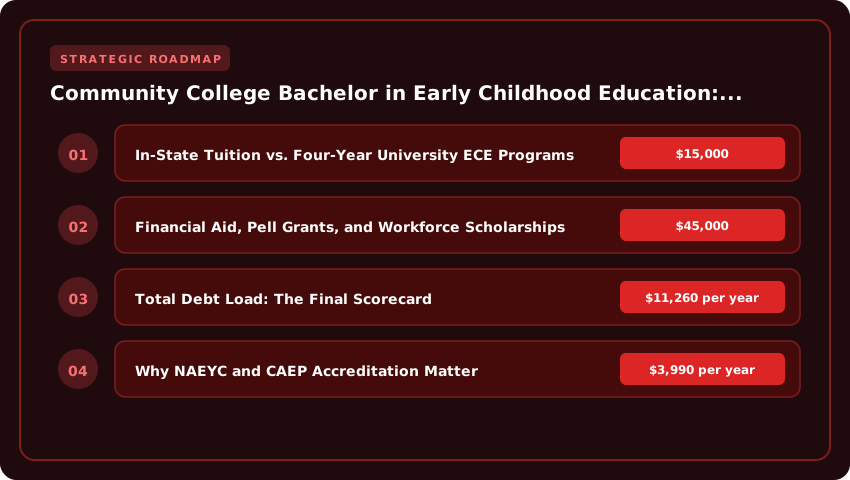
If you are an aspiring preschool teacher weighing the price tag of a four-year degree, the math is painfully clear: traditional universities simply cost more than most working adults can stomach. The average published in-state tuition and fees at a public four-year university now hover around $11,260 per year, according to the College Board, while community college tuition sits at roughly $3,990 per year for in-district students. Multiply that gap by two years of foundational coursework, and you are looking at savings of nearly $15,000 before financial aid even enters the picture.
In-State Tuition vs. Four-Year University ECE Programs
Most Bachelor of Science in Early Childhood Education programs require between 120 and 130 credit hours. Roughly 60 of those credits, covering general education plus core early-childhood foundations like child development, curriculum planning, and observation practicums, can be completed at a community college for a fraction of the cost. Out-of-state students save even more, often avoiding the $30,000+ non-resident surcharge that flagship state universities levy on transfers.
Hidden Transfer Agreements That Guarantee Junior-Year Admission
What many prospective students overlook is the network of articulation agreements quietly maintained between two-year and four-year institutions. These are not informal handshakes; they are binding pathways that guarantee admission to partner state schools once the associate degree is conferred. Programs tagged with the “Transfer 2+2” or “Guaranteed Admission” designation mean your credits travel with you, your GPA requirements are pre-negotiated, and you skip the competitive re-application cycle that catches independent transfers off guard.
Financial Aid, Pell Grants, and Workforce Scholarships
Community college ECE students frequently qualify for the maximum Federal Pell Grant ($7,395 for 2024-25), since the income thresholds are more forgiving for part-time and working learners. Layer on top of that the TEACH Grant (up to $4,000 annually for future teachers in high-need fields), state-level childcare workforce scholarships, and employer tuition-reimbursement programs from Head Start and licensed daycare centers. This stacked-aid model often reduces net out-of-pocket cost to under $500 per semester at the community-college stage.
Total Debt Load: The Final Scorecard
Direct-enroll university students graduate with an average federal loan balance of $28,950, per the US Department of Education. By contrast, students who complete the associate-to-bachelor pathway consistently report starting balances closer to $12,000-$18,000, and many finish completely debt-free thanks to Pell stacking and part-time enrollment. For an ECE major entering a field where starting preschool teacher salaries average $36,290 (BLS), that debt differential is the difference between a comfortable first year and years of loan repayment.
- Tuition Gap: ~$7,270 saved per year by starting at community college.
- Credit Portability: Articulation agreements protect your 60+ transfer credits.
- Aid Stacking: Pell + TEACH + workforce scholarships can erase tuition at the two-year stage.
- Debt Outcome: 40-50% lower federal loan balance versus direct-enroll peers.
Accreditation and State Licensure Pathways for an Associate-to-Bachelor ECE Track
Choosing the right community college for an Early Childhood Education (ECE) bachelor track is less about campus amenities and more about whether the program is recognized by the gatekeepers who issue your state license. In the United States, three layers of approval ultimately determine whether your credits and clinical hours transfer cleanly: national programmatic accreditation, state Department of Education authorization, and articulation agreements with partner four-year universities. Misreading any one of these layers can add a full year or more to your certification timeline.
Why NAEYC and CAEP Accreditation Matter
The National Association for the Education of Young Children (NAEYC) sets the professional standards for associate-level ECE programs, while the Council for the Accreditation of Educator Preparation (CAEP) governs bachelor’s-level educator preparation across the country. When a community college pathway holds NAEYC alignment for the first two years and CAEP recognition for the upper-division coursework, your credits usually articulate without transcript audits. If either seal is missing, state licensing boards often require you to re-take foundational courses, which costs both time and tuition dollars.
State Department of Education Approvals and Reciprocity
Every state Department of Education publishes an approved program list. Graduating from a program on that list typically grants license reciprocity with at least 30 other participating states under the NASDTEC Interstate Agreement. Before enrolling, confirm two things on the state’s educator licensure website: the program code is listed under “Early Childhood Education Birth-Grade 3” or equivalent, and the institution holds regional accreditation recognized by the U.S. Department of Education. Regional accreditation is non-negotiable for Title IV financial aid and for any future transfer to a state university.
Mapping Coursework: CDA, AA, and the Capstone
A well-designed stackable pathway looks like this: the Child Development Associate (CDA) credential validates roughly nine to twelve credits toward an Associate of Arts in Teaching (AAT), which in turn satisfies all lower-division general education requirements. The bachelor’s portion adds upper-division ECE theory, assessment, and a capstone practicum. The capstone is where you synthesize your observation data from the on-campus preschool lab, demonstrating competency across all NAEYC standards.
Clinical Observation Hours and On-Campus Preschool Labs
State licensing tiers require documented clinical experience with children from birth through age eight. Quality community college programs solve this by operating on-campus preschool laboratories where students log supervised hours weekly throughout the associate phase. Look for programs that embed at least 180 documented hours across infant, toddler, and pre-K settings. These hours typically roll forward into the bachelor’s practicum, preventing the costly scenario of repeating field experiences after transfer.
Meeting Lead Teacher Qualifications Under State Licensing Tiers
Most states use a tiered licensing system where a bachelor’s degree satisfies the Lead Teacher or Level III qualification, unlocking higher pay scales (often $4 to $8 more per hour than an associate-level assistant teacher). Holding a CAEP-accredited bachelor’s also clears the educational requirement for the Childhood Education Professional Certificate, which many public school pre-K programs require for lead instructor roles. Without the bachelor’s, you remain capped at assistant or associate-teacher tiers regardless of your years of classroom experience.
- Verify NAEYC alignment for associate coursework and CAEP recognition for the bachelor’s portion.
- Confirm the program appears on your state Department of Education’s approved list for interstate reciprocity.
- Ensure regional accreditation to protect financial aid eligibility and transfer credit.
- Map CDA credit transfer explicitly before enrollment to avoid lost tuition.
- Choose programs with embedded preschool labs to satisfy clinical hours continuously.
Salary Increase Data: How Much More Do Early Childhood Educators Earn With a Bachelor’s?
The financial case for completing an Early Childhood Education (ECE) bachelor’s degree is no longer theoretical. According to the U.S. Bureau of Labor Statistics (BLS), preschool teachers who hold only an associate degree or postsecondary certificate earn a median annual wage of roughly $34,000, while those with a bachelor’s degree in early childhood education or a related field push that figure into the $48,000+ range. That gap of more than $14,000 per year compounds dramatically over a 25-year career, often exceeding $350,000 in cumulative lifetime earnings. For working educators considering a community college-to-university pathway, this is the single most important ROI metric to weigh.
State Pre-K Salary Schedules Reveal the Widest Pay Gaps
Public school Pre-K pay scales vary sharply by state, and they are the clearest evidence that a baccalaureate unlocks real dollar gains. In California, state Pre-K and transitional kindergarten teachers with a bachelor’s and a Multiple Subject Teaching Credential start on district salary schedules at $48,000 to $62,000, compared to the $34,000 ceiling many associate-level preschool teachers encounter in private centers. Texas districts mirror this trend, with bachelor’s-prepared Pre-K teachers in Houston, Dallas, and Austin ISD earning starting salaries of $54,000 to $58,000 on the state minimum salary schedule. New York City Public Schools set the gold standard, with even first-year Pre-K teachers holding a bachelor’s earning $68,000+ on the United Federation of Teachers contract, while their associate-holding counterparts in private nurseries cap out near $36,000. Florida’s VPK program likewise rewards credentialed, bachelor’s-degreed instructors with starting pay between $45,000 and $50,000 in larger metro districts.
Federal Head Start Funding Tied Directly to a Baccalaureate
Under the federal Head Start Act, programs receiving U.S. Department of Health and Human Services funding must ensure that at least 50% of their lead teachers hold a bachelor’s degree in early childhood education or a related field. That mandate directly drives compensation. Head Start agencies operating in competitive metro areas routinely pay bachelor’s-prepared educators $48,000 to $55,000, while teachers with only a Child Development Associate (CDA) credential or associate degree often sit in the $32,000 to $36,000 band. Many agencies also offer annual stipends, tuition reimbursement, and credential bonuses for teachers actively finishing a bachelor’s, making this one of the most reliable employer-sponsored upskilling paths in the U.S. early childhood sector.
Cross-State Salary Schedules Document a $14,000+ Lift
Aggregating public salary schedules from state Departments of Education across the Sun Belt and Northeast confirms a consistent pattern: completing a bachelor’s translates to an annual earnings lift from approximately $34,000 to $48,000+, even after accounting for cost-of-living adjustments. For working adults using a community college associate degree as their launchpad, that documented jump typically arrives within two to four semesters of transferring into a four-year program, accelerating the financial payback on tuition invested through FAFSA-eligible coursework.
- BLS median wage gap: Associate-level preschool teachers earn ~$34,000 vs. ~$48,000+ for bachelor’s-holders.
- California, Texas, Florida Pre-K: Starting salaries of $45,000 to $62,000 with a bachelor’s and state credential.
- New York City UFT contract: First-year Pre-K teachers with a bachelor’s earn $68,000+.
- Head Start Act requirement: 50% of lead teachers must hold a bachelor’s, driving agency pay scales to $48,000-$55,000.
- Lifetime earnings impact: A $14,000+ annual lift compounds to $350,000+ over a 25-year career.
Employer Acceptance: Do Public Schools, Head Start, and Private Preschools Hire Community College Graduates?
If the phrase “community college” makes your stomach tighten during a job interview, take a breath. Employer skepticism toward nontraditional degree paths is real, but it is also far more porous than most candidates assume. Public school districts, Head Start programs, charter schools, and corporate childcare chains each evaluate Early Childhood Education (ECE) applicants through a slightly different lens, and understanding those filters is the fastest way to walk into an interview with confidence instead of apology.
Public School Districts: Accreditation Beats Brand Name
Large public school districts operate under HR policies governed by state departments of education, and those policies almost always reference regional accreditation, not the specific name on the diploma. A Bachelor of Science in Early Childhood Education earned through a state university’s articulation pathway, where the first two years were completed at a community college accredited by the same regional body (such as HLC or SACSCOC), satisfies the licensure requirement in 49 states. The U.S. Department of Education’s recognized accreditor list is what HR officers actually check, not whether you took Intro to Literacy on a leafy quad or at a commuter campus.
- Districts care about: state teaching license eligibility, GPA in the major, passed Praxis or state-specific exams, and a clean background check.
- Districts rarely filter on: whether the lower-division credits were earned at a university.
- Pro tip for interviews: Lead with your state license number and your graduating institution’s regional accreditor rather than explaining the two-plus-two pathway.
Head Start and Nonprofit Early Learning Centers
Head Start programs, governed by the federal Office of Head Start under the Administration for Children and Families, are required to staff classrooms with teachers who hold at minimum a CDA credential, and increasingly a bachelor’s degree. Federal mandates emphasize field experience and demonstrated competency with low-income and dual-language learners. Nonprofit early learning centers (think regional United Way affiliates or local child care nonprofits) value practicum hours and a candidate’s track record with a specific age group far more than the pedigree of the degree-granting institution. If your community college practicum placed you in a Title I preschool where you led parent-teacher conferences and documented developmental milestones, that narrative carries weight in the interview room.
Charter Schools and Corporate Childcare Chains
Charter schools, authorized by state boards but operationally independent, tend to follow public-school licensure rules for credentialed teaching positions. Corporate childcare employers (KinderCare, Primrose Schools, Bright Horizons) operate under a different model: they typically do not require a state teaching license, instead prioritizing curriculum fidelity, classroom management training, and advancement potential within their own corporate ladder. For these employers, a bachelor’s degree is a checkbox for management-track roles, and they care deeply about transferable skills, bilingual ability, and customer-facing communication. A community college graduate who can point to 500 documented practicum hours and a manager recommendation often interviews as strongly as a graduate of a private university.
How References and Practum Performance Offset the “Origin Question”
When a recruiter does probe where you completed your lower-division coursework, the answer is simple: frame it as a strategic financial decision, not a fallback. Pair that framing with two strong professional references, ideally a cooperating teacher from your practicum and a center director who can speak to your reliability. Practicum performance transcripts, lesson plan portfolios, and observations from university supervisors become the equalizer that shifts the conversation from “where” you studied to “how well” you teach.
Bottom line for the skeptical job seeker: employers hire candidates who can lead a classroom on day one. Your degree’s issuing institution matters far less than your license status, your references, and the story you tell about why you chose the smartest, most affordable path to the same credential.
Career Advancement Doors That Open Only With the Completed Bachelor’s Degree
For many educators climbing the ladder in early childhood settings, the leap from an associate degree or Child Development Associate (CDA) credential to a Bachelor of Science in Early Childhood Education is the moment a career stops feeling like a series of part-time gigs and starts looking like a profession. Completing those final two years at a partnering four-year state university does more than add letters after your name. It unlocks promotion tracks, salary tiers, and graduate-level opportunities that hiring committees and state licensing boards typically reserve for candidates who hold the full baccalaureate.
Eligibility for Instructional Coordinator, Curriculum Specialist, and Program Director Roles
School districts, Head Start grantees, and private early learning networks almost always write the minimum qualification for upper-level positions as “bachelor’s degree in early childhood education, child development, or a closely related field.” Once that box is checked, you move from being evaluated on classroom warmth to being evaluated on leadership capacity. Instructional coordinators and curriculum specialists in particular often need a state-approved ECE bachelor’s to even sit at the interview table, and program director postings for multi-site preschool organizations frequently add three to five years of supervisory experience on top of the degree requirement.
Pay Scale Jump from Lead Teacher to Assistant Principal or Site Supervisor
The salary mathematics here is striking. According to the US Bureau of Labor Statistics, preschool special education teachers and kindergarten teachers with a bachelor’s earn a median annual wage near $67,000, while childcare center directors report a median of $56,000 that climbs into the $80,000–$95,000 range once you add supervisory responsibility. Lead teachers in Head Start programs who finish their bachelor’s typically step onto the public school pay scale, where the entry-level step is paired with a defined annual raise schedule and pension eligibility through the state retirement system. That predictable escalation is exactly what most working educators crave after years of flat hourly wages.
Pathway into Early Childhood Special Education With an Additional State Endorsement
A completed bachelor’s is the prerequisite for almost every state-issued special education endorsement. If you have ever wanted to work with preschool-age children diagnosed with autism spectrum disorder, speech delays, or developmental disabilities, the bachelor’s in ECE gives you the foundational coursework in child development, assessment, and family systems that your state department of education expects before it will issue the Early Childhood Special Education (ECSE) add-on credential. That endorsement alone often triggers a $3,000 to $8,000 stipend on top of base pay in states facing special education shortages, including California, Texas, and Florida.
Graduate School Admission Leverage for M.Ed. and Administrative Credentials
Graduate admissions committees at colleges accredited by CAEP, AACTE, and regional accreditors look very differently at applicants holding a regionally accredited bachelor’s versus an associate plus a stack of professional development certificates. M.Ed. programs in Curriculum and Instruction, Educational Leadership, and Early Childhood Administration generally require a 3.0 GPA from a four-year institution, supervised practicum hours, and a state teaching license. Finishing the bachelor’s clears every one of those gates, shortening the runway to a master’s credential by at least two years and putting administrative licenses such as the Principalship or the PK-3 Program Specialist within realistic reach before your tenth year in the field.
- Instructional coordinator and program director postings list the bachelor’s as a non-negotiable minimum.
- Public school salary schedules reward the bachelor’s with defined step increases and pension access.
- Early childhood special education endorsements require a state-approved baccalaureate foundation.
- M.Ed. and administrative credential programs prefer applicants holding the completed four-year degree.
Pitfalls to Avoid When Transferring From a Community College to a Four-Year ECE Program
The community college to four-year university pipeline looks straightforward on paper, but the administrative reality is anything but. Working preschool teachers and career-changers routinely lose semesters, dollars, and hard-won practicum hours because they underestimate how rigid transfer rules can be. Before you commit to a two-year ECE associate degree as a launchpad, map out these four traps that derail otherwise motivated students.
Credits That Fail to Transfer Because of Non-Aligned General Education Electives
Articulation agreements sound bulletproof, yet they almost always hinge on the exact course codes you complete, not just the subject area. A “Philosophy of Human Nature” elective that satisfies your AA degree may satisfy zero credits at the receiving university’s general education core. Every state system handles this differently, so a course that transfers cleanly into a California State University (CSU) campus can be rejected by a University of Florida (UF) program with no warning. The fix is aggressive: demand a course-by-course transfer evaluation from the four-year institution before you enroll in your final community college semester, and save every syllabus as documentation.
- Request an official “Transfer Credit Evaluation” from the receiving university registrar at least 12 months before graduation.
- Cross-reference every general education elective against the receiving school’s Equivalent Course List, not just the state articulation database.
- Keep digital copies of every course syllabus, as several universities require these for petitions.
Wasted Tuition on Lower-Division Coursework That Exceeds the 60-Credit Transfer Cap
Most state universities cap community college transfers at 60 credits, the threshold for junior standing in a standard 120-credit bachelor’s program. Pile on extra credits to chase a third associate degree or unrelated electives, and you are paying tuition the receiving school simply refuses to accept. At an average in-state community college rate of roughly $135 per credit hour, every wasted credit above 60 costs you about $540 with no return. Working ECE professionals often overshoot this cap while chasing a Child Development Associate (CDA) certificate, stacking coursework the university will not count toward graduation requirements.
Loss of Practicum Hours When Switching Institutions With Different Competency Rubrics
Early Childhood Education programs require documented practicum hours tied to specific developmental milestones and assessment rubrics. A community college evaluating students on the Council for the Accreditation of Educator Preparation (CAEP) standards may track hours differently than a four-year program aligned with National Association for the Education of Young Children (NAEYC) competencies. Switching schools mid-stream can force you to repeat observation cycles, often unpaid and outside contracted work hours. Verify rubric alignment early by requesting the practicum handbook from the receiving school, and ask whether partial hours can be grandfathered with portfolio evidence.
State-Specific Rules on Continuous Enrollment That Delay Financial Aid Eligibility
Federal Student Aid (FAFSA) satisfactory academic progress (SAP) rules require continuous enrollment or a documented appeal, but state-level teaching grants and scholarship programs layer in additional requirements. Many states demand enrollment within a specific window after community college graduation, often 12 months, or you forfeit priority funding. Florida’s Teacher Scholarship, Texas’s T-STEM program, and California’s Cal Grant B all impose their own continuous-enrollment thresholds that can quietly expire during a gap year. File your FAFSA renewal on October 1, confirm enrollment deferment status with the receiving school’s financial aid office, and document any planned breaks with a formal leave-of absence petition.
Each of these pitfalls shares a common thread: they are solved with documentation, not guesswork. Treat the transfer process like an audit, and you protect both your wallet and your graduation timeline.
Choosing the Right Community College: 7 Questions to Ask Before Enrolling
Walking into an enrollment office without a checklist is the fastest way to lose $1,000 in hidden fees or waste two years on credits that never transfer. Before you sign anything, pull out a notebook and grill your advisor with these seven questions. Every answer should come with paperwork you can take home, not vague promises.
1. Does the College Hold Regional Accreditation and a Signed Articulation Agreement With a State University?
If the school lacks regional accreditation from bodies like the Higher Learning Commission or SACSCOC, your credits are worthless everywhere else, and FAFSA aid may not even release funds. Equally important is a signed articulation agreement with your state’s public university system, which legally guarantees your junior-year entry. No articulation document on file? Walk away.
2. What Percentage of Credits Are Guaranteed to Transfer Under the Universal Transfer Compact?
Many states now enforce a universal transfer compact covering the entire general-education core, typically 60 credit hours. Ask the registrar to show you the exact transferability rate for ECE-specific coursework, because pedagogy and practicum classes often fall outside the compact. You want a written guarantee that at least 45 of your 60 credits will land cleanly on your bachelor’s transcript.
3. Are There Cohort Models, Hybrid Online Classes, or Evening Cohorts for Working Adults?
A traditional 9 a.m. Monday-through-Wednesday schedule will kill your paycheck if you are already working in a daycare center. Ask whether the college runs a lockstep cohort that starts each fall, whether core classes are offered in 8-week hybrid blocks, and whether evening or Saturday sections exist. The best programs let you finish two classes per term while keeping your 40-hour work week intact.
4. What Is the Job Placement Rate of Graduates Into Lead Teacher Roles Within Six Months?
A credible program tracks outcomes. Demand the placement rate specifically for graduates landing lead teacher positions (not just any early childhood job) within 180 days of finishing. Anything above 70% signals that local districts and Head Start programs actually value the credential. If the school cannot produce this data, their career services office is essentially decorative.
5. Does Tuition Include the Associate Credential Exam, Fingerprinting, and Background Check Fees?
The money pits of ECE programs are the add-ons. The CDA exam costs roughly $425, state fingerprinting runs between $50 and $100, and background checks add another $30 to $60. Confirm these fees are bundled into your tuition or covered by a grant. If they are not, you can easily add $600 to your out-of-pocket cost before your first day of student teaching.
6. Is There an Embedded Apprenticeship With Local School Districts for Paid Classroom Hours?
An apprenticeship model, often registered with the US Department of Labor, lets you earn a paycheck while completing practicum requirements. Ask whether the college has partnered with Title I districts, Head Start grantees, or state Pre-K programs to place apprentices. Paid classroom hours also satisfy state competency requirements for the Child Development Associate (CDA) and many state licensure pathways, effectively shortening your time to certification.
7. What Is the Net Price After Pell, State Grant, and T.E.A.C.H. Early Childhood Scholarship Aid?
Sticker price means nothing. Run the net-price calculator on the college website, then layer in your expected Pell Grant (currently up to $7,395 per year), your state need-based grant, and the T.E.A.C.H. Early Childhood scholarship, which reimburses tuition for working teachers in participating states. A program that looks like a $4,200 annual tuition can realistically drop to under $500 out of pocket once these funds stack.
| Decision Criterion | Community College ECE Bachelor’s Path (2+2 Articulation) | Traditional Public 4-Year University (ECE B.S./B.A.) | Private/For-Profit 4-Year ECE Program |
|---|---|---|---|
| Estimated Total 4-Year Tuition (USD) | $20,000 – $40,000 | $40,000 – $80,000 (In-State) | $80,000 – $160,000 |
| Average Annual Cost (Tuition + Fees) | $5,000 – $10,000/year | $10,000 – $20,000/year | $20,000 – $40,000/year |
| Admission Requirements (Year 1) | Open enrollment / High school diploma / GED | High school diploma + GPA cutoff (2.5-3.5) + SAT/ACT | High school diploma + Application fee + Rolling admission |
| Articulation / Transfer Credit | Guaranteed junior-year seat via state articulation agreement (60 credits transferable) | Standard transfer credit evaluation (loss of 6-15 credits typical) | Limited or no transfer credits accepted |
| Time to Completion | 4 years (2 at CC + 2 at university) | 4 years (on-campus) | 4 years (accelerated options in 2.5-3 years) |
| Embedded Credentials Earned | CDA (Child Development Associate) + State Teaching License eligibility | State Teaching License eligibility + Optional CDA | State Teaching License eligibility |
| Starting Salary Potential (US Avg.) | $38,000 – $48,000/yr (Preschool Lead Teacher) | $42,000 – $52,000/yr (Public K-3 Teacher with license) | $42,000 – $52,000/yr (Public K-3 Teacher with license) |
| Top 10% Salary Ceiling (US) | $68,000/yr (Center Director / ECE Specialist) | $82,000/yr (Master’s + 10 yrs experience) | $82,000/yr (Master’s + 10 yrs experience) |
| Prerequisites / Prior Credits Needed | None (foundational gen-eds satisfy licensure) | None (courses built into degree plan) | None (but program-specific orientation required) |
| Class Schedule Flexibility | Evening, weekend, online, hybrid (built for working adults) | Mostly daytime; limited evening options | Evening/online widely available |
| Return on Investment (ROI) Timeline | ~2 years post-graduation (vs. for-profit break-even at 5+ yrs) | ~3 years post-graduation | 5-7 years post-graduation (highest student debt) |
| Federal Financial Aid Eligibility (FAFSA) | Yes (Pell Grant + state aid + TEACH Grant) | Yes (Pell + TEACH Grant + university scholarships) | Yes (but higher net price after aid) |
| Student Loan Debt at Graduation (Median) | $12,000 – $22,000 | $25,000 – $40,000 | $50,000 – $100,000+ |
Frequently Asked Questions
How much money can you save by starting an Early Childhood Education bachelor's degree at a community college?
US students who complete the first two years of an Early Childhood Education bachelor's at a community college save between $15,000 and $45,000 in total tuition over four years compared to enrolling directly at a public four-year state university. Average community college tuition runs $5,000-$10,000 annually versus $10,000-$20,000 at four-year schools, and articulation agreements guarantee that all 60 credits transfer toward a bachelor's degree.
What is a 2+2 articulation agreement for an Early Childhood Education degree?
A 2+2 articulation agreement is a formal partnership between a US community college and a four-year state university guaranteeing that students who complete an Associate of Arts or Associate of Science in Early Childhood Education will be admitted with junior standing. Every credit from the first two years transfers automatically, eliminating credit loss and ensuring a seamless path to a bachelor's degree and state teaching license.
Can you earn a Child Development Associate (CDA) credential while completing a community college ECE bachelor's degree?
Yes. Most US community college Early Childhood Education programs embed the Child Development Associate (CDA) credential requirements directly into their associate degree coursework. Students typically earn the CDA at the end of their second year, allowing working preschool teachers to gain a nationally recognized credential, a salary increase, and immediate classroom advancement while continuing toward a bachelor's degree.
What salary can an Early Childhood Education bachelor's degree holder expect in the United States?
Early Childhood Education bachelor's degree holders in the United States earn an average starting salary of $42,000 to $52,000 annually as licensed public preschool or kindergarten teachers, compared to $38,000 to $48,000 for preschool lead teachers without a license. With ten years of experience plus a master's degree, top earners reach $82,000 per year in roles such as ECE program director or curriculum specialist.
Are community college Early Childhood Education credits accepted by all four-year universities for transfer?
Credits are guaranteed to transfer only when an articulation agreement exists between the specific community college and the receiving four-year state university. In the US, regional accreditation and participation in statewide transfer guarantee programs (such as the Transfer Articulation Policy in the State University of New York system) ensure that accredited associate degrees satisfy all general education requirements before junior year.
Strategic Final Takeaway
When evaluating Community College Bachelors Degree Early Childhood Education Licensure Salary Increase Employer Acceptance, base your decisions on accredited institutional standards, measurable return on investment (ROI), and up-to-date official guidelines. Always verify specific dates and requirements through official regulatory portals.