Why the Community College Baccalaureate Route Is Reshaping Early Childhood Teaching Careers
For decades, the path to becoming a licensed early childhood educator in the United States ran straight through a four-year university, leaving many passionate teachers buried under an avalanche of student loan debt. That pathway is rapidly changing. Community college baccalaureate (CCB) programs are rewriting the rulebook by offering affordable, accredited four-year degrees specifically tailored for working adults, Head Start teachers, and career-changers who already hold an associate degree. The result? A faster, cheaper, and more accessible pipeline into one of the nation’s most in-demand teaching fields.
The Salary Gap That Makes This Route Worth the Investment
According to the U.S. Bureau of Labor Statistics (BLS), the median annual wage for preschool teachers was roughly $34,770 in 2023, while those holding a bachelor’s degree in early childhood education working as preschool and childcare center directors earn a median salary around $62,300. That represents nearly a $27,000 annual jump, a figure that compounds dramatically over a 20-year career. CDA credential holders and associate-level teachers frequently cap out at lead teacher pay scales, while bachelor’s-prepared educators unlock K-3 classroom licensure and administrative eligibility, dramatically expanding lifetime earning potential.
State Legislation Unlocking the Four-Year Degree on Community College Campuses
The CCB movement gained serious momentum when forward-thinking state legislatures recognized that teacher shortages demanded local, affordable solutions. Washington State pioneered this model and now offers numerous Bachelor of Applied Science degrees across its 34 community and technical colleges. Florida followed with its own SB 850 pathway, allowing institutions like St. Petersburg College to confer bachelor’s degrees in high-demand fields including early childhood education. California has authorized 15 community college districts to launch baccalaureate programs, with several ECE tracks either active or in development. This legislative shift means students no longer have to relocate or commute hours to access an accredited teaching degree.
Tuition Reality Check: Community College vs. Four-Year University
The financial math here is genuinely eye-opening. In-state community college tuition averages roughly $130 per credit hour, while a four-year public university ECE program runs between $300 and $500 per credit hour. For a 120-credit bachelor’s degree, that translates to approximately $15,600 at a community college versus $36,000 to $60,000 at a traditional state university, before factoring in housing, parking, and campus fees. Many CCB students also qualify for Pell Grants, state-funded Early Childhood Educator (ECE) scholarships, and the TEACH Grant program administered through the FAFSA, further shrinking the final price tag.
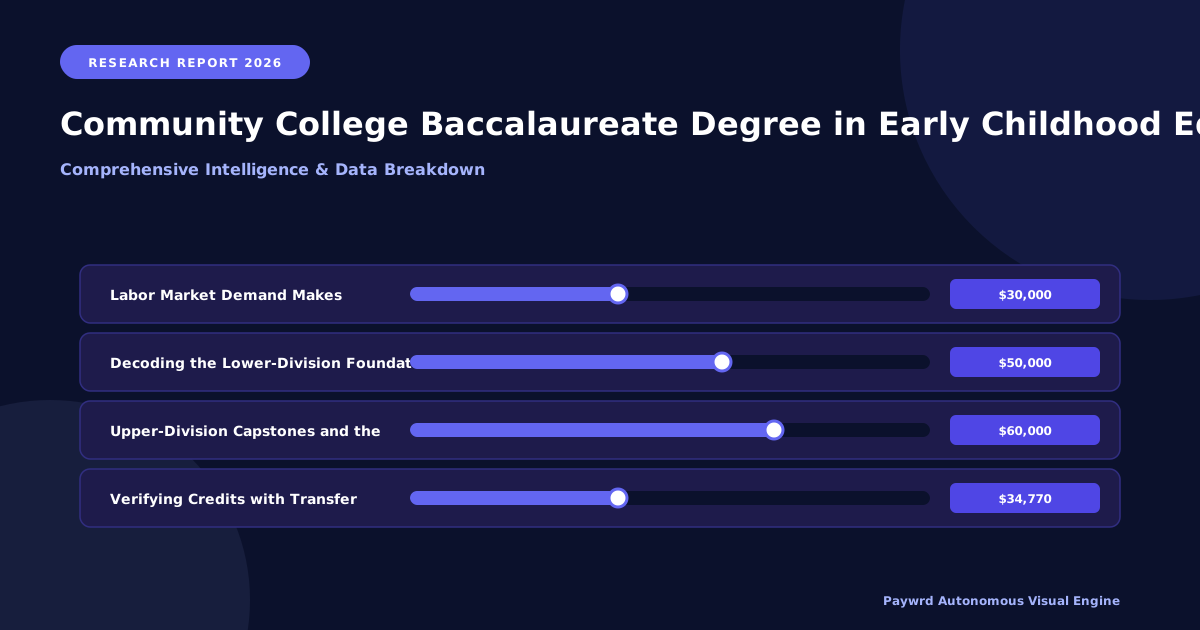
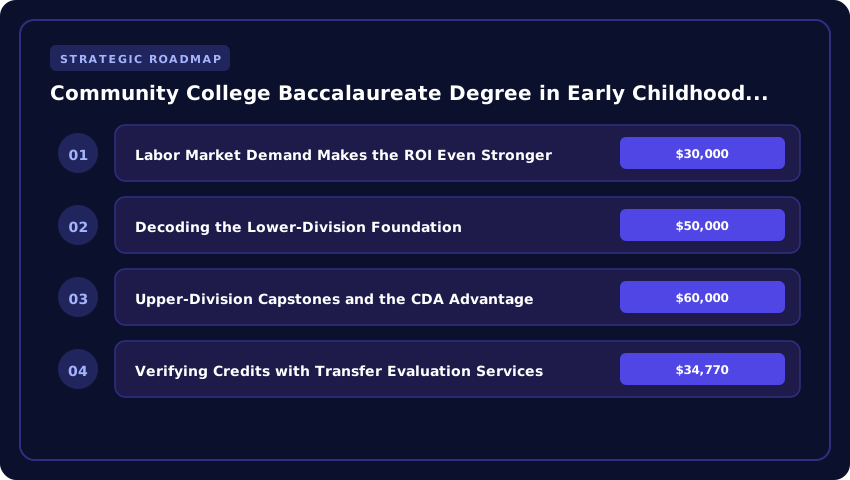
Labor Market Demand Makes the ROI Even Stronger
The BLS projects 8% employment growth for preschool teachers and a robust 7% increase for childcare center directors through 2032, with approximately 55,500 annual openings nationwide. Combined with federally funded Universal Pre-K expansions across more than 40 states, the demand for licensed bachelor’s-level early childhood educators has never been higher. For students weighing return on investment, the community college baccalaureate delivers a clear advantage: regional accreditation, state licensure eligibility, and substantial salary growth, all at a fraction of the traditional price.
- Median director salary: $62,300 (BLS, 2023) with a bachelor’s degree
- Tuition savings: $20,000-$45,000 over a traditional university degree
- Active CCB states: Washington, Florida, California, plus 20+ others expanding
- Job growth: 7-8% projected through 2032 (BLS)
State-by-State Breakdown of Accredited ECE Licensure Transfer Pathways
Across the United States, a quiet revolution is reshaping how future early childhood educators earn their credentials. More than 25 states now authorize community colleges to confer applied baccalaureate degrees, and an increasing number of those institutions are channeling that authority into Early Childhood Education (ECE) programs designed to meet rigorous state Department of Education teaching standards. This geographic shift matters because licensure portability, accreditation recognition, and articulation pathways vary dramatically depending on where you live and which college you choose.
When evaluating a Community College Baccalaureate (CCB) pathway in ECE, the first checkpoint is regional accreditation. The Higher Learning Commission (HLC) accredits institutions across 19 Midwestern and Southern states, the Southern Association of Colleges and Schools Commission on Colleges (SACSCOC) covers 11 Southeastern states plus Latin America, and the Northwest Commission on Colleges and Universities (NWCCU) serves seven Pacific and Northwestern jurisdictions. Credits earned at a college accredited by one of these bodies transfer smoothly to partner state universities, protecting your investment if you later pursue a master’s degree through platforms like a regionally accredited online university.
Mapping the 25+ States Permitting Applied Baccalaureate Degrees in Education
The pool of CCB-authorizing states includes Washington, Oregon, California, Nevada, Arizona, Colorado, New Mexico, Texas, Arkansas, Louisiana, Mississippi, Alabama, Georgia, Florida, Tennessee, Kentucky, Indiana, Ohio, Michigan, Wisconsin, Minnesota, Iowa, Missouri, Kansas, Nebraska, and several others actively expanding legislation. Within these states, colleges such as Miami Dade College (FL), St. Petersburg College (FL), Houston Community College (TX), and Pikes Peak State College (CO) have launched BAS or BAT tracks specifically aligned to ECE licensure.
Identifying Regional Accreditation Bodies Validating ECE Transfer Credits
Because the U.S. Department of Education and credential evaluators recognize only regionally accredited transcripts, confirming HLC, SACSCOC, or NWCCU status is non-negotiable. Programs carrying programmatic recognition from the Council for the Accreditation of Educator Preparation (CAEP) or the National Association for the Education of Young Children (NAEYC) add another layer of legitimacy, ensuring your credits translate into reciprocal licensure agreements across state lines.
Navigating Articulation Agreements Between Community Colleges and State Universities
Formal articulation agreements act like pre-signed contracts guaranteeing that lower-division coursework, typically 60 credit hours, will count toward a four-year degree at a partner institution. For ECE transfer students, this means child development, curriculum planning, and practicum credits earned at a community college apply directly toward a bachelor’s completion program at a state university or an online program completion pathway. Many of these agreements are searchable through your state’s higher education agency or the college’s transfer portal, allowing you to map out coursework before enrolling.
Aligning Coursework With State Department of Education Teaching Standards
Every state’s Department of Education publishes its own early childhood teaching standards, often broken into age bands such as PreK-3 or Birth-Grade 3. A CCB in ECE must demonstrably cover these competencies, including child development theory, assessment of family-centered practices, and supervised field experiences. Before committing to any program, request the course-to-standards crosswalk and verify that graduates are eligible for the state’s initial teaching license, which is your ticket to public school classrooms and higher salary schedules that can exceed $60,000 annually with a bachelor’s degree.
Mapping the 60+60 Credit Framework: From Associate to Bachelor’s Without Redundant Coursework
The true brilliance of the community college baccalaureate pathway lies in its seamless 60+60 credit structure. Instead of losing time and money retaking foundational classes when you transfer, you build directly upon your two-year degree. This framework creates a concrete academic blueprint that minimizes debt while ensuring you meet rigorous state licensure requirements.
Decoding the Lower-Division Foundation
The first 60 credits of your Associate of Arts (AA) or Associate of Science (AS) in Early Childhood Education lay the essential groundwork. During this phase, you will typically complete your general education requirements alongside core early childhood classes. Expect to take foundational courses in child development, educational psychology, and classroom management. These lower-division courses are designed to align with the US Dept of Education’s standards, ensuring they meet the baseline requirements for any state teaching licensure track. By completing these credits at a community college—where the College Board reports average annual tuition is roughly $3,860 compared to nearly $11,000 at a four-year public institution—you drastically reduce your reliance on FAFSA loans before ever stepping into an upper-division baccalaureate program.
Upper-Division Capstones and the CDA Advantage
The second 60 credits transition you into upper-division coursework. This is where a Bachelor of Applied Science (BAS) or Bachelor of Science (BS) program focuses heavily on advanced pedagogy, inclusive education, and administration. Crucially, this phase includes your upper-division capstone and practicum hours. State boards require extensive, supervised classroom hours for licensure eligibility, and these embedded practicums ensure you meet those exact mandates without needing to arrange supplemental student teaching.
Furthermore, if you already hold a Child Development Associate (CDA) credential, you do not have to start from scratch. Many community colleges and partner universities accept the CDA as transferable college credit, often applying it toward elective or foundational early childhood requirements. This recognition translates your professional field experience directly into academic currency, saving you both time and tuition.
Verifying Credits with Transfer Evaluation Services
To ensure this 60+60 framework works flawlessly, you must proactively manage your credit transfers. Relying on Transfer Evaluation Services (TES) is the most effective way to verify credit acceptance across institutions before you commit to a program. When planning your transfer, keep these critical steps in mind:
- Review established articulation agreements between your local community college and prospective four-year university partners.
- Submit your transcripts early to the receiving institution’s registrar for an official, binding credit evaluation.
- Confirm that your CDA credential and practicum hours satisfy specific state licensure requirements, not just general degree credits.
- Consult with academic advisors to ensure your transferred credits keep you on track for federal financial aid eligibility.
By strategically mapping out these 120 credits, you bypass redundant coursework, protect your wallet, and graduate fully prepared to lead a classroom and command higher director salaries.
Online and Hybrid Delivery: How Digital Learning Platforms Power the Modern ECE Transfer Pathway
For the modern Early Childhood Education (ECE) student, the traditional “sit-in-a-lecture-hall” model is often a barrier to entry. Most aspiring educators are already working as paraprofessionals or lead teachers in childcare centers. To bridge the gap between an Associate degree and a Bachelor of Applied Science (BAS), community colleges have pivoted to sophisticated digital delivery models that maintain the academic rigor required by the US Department of Education while offering maximum flexibility.
Synchronous vs. Asynchronous Learning: Finding the Balance
The efficacy of a digital ECE program depends on how it balances two primary virtual modalities:
- Synchronous Learning: These are live, scheduled virtual classrooms. They are critical for “practicum” students to engage in real-time case study analysis and peer-to-peer brainstorming, simulating the collaborative environment of a professional teaching faculty.
- Asynchronous Learning: This self-paced model allows students to engage with lecture modules and readings on their own schedule. This is the engine of the transfer pathway, enabling parents and full-time workers to complete coursework without sacrificing their current employment.
Maintaining Rigor: Accreditation and Virtual Fieldwork
A common concern is whether an online degree carries the same weight as a residential one. The answer lies in accreditation. Top-tier community college programs ensure their distance education formats are vetted by bodies such as SACSCOC (Southern Association of Colleges and Schools Commission on Colleges) and aligned with CAEP (Council for the Accreditation of Educator Preparation) standards. These organizations ensure that “virtual” does not mean “watered down.”
The most challenging aspect of digital ECE delivery is the clinical requirement. To secure state licensure, students cannot learn exclusively behind a screen. Accredited programs utilize a hybrid model: theoretical coursework is delivered via e-learning platforms, while student teaching and field experiences are conducted in-person at approved local preschools or Head Start centers. This ensures graduates possess the tactile, interpersonal skills necessary for the classroom.
The Tech Stack: Platforms Powering ECE Success
To facilitate this seamless transition from community college to licensure, institutions leverage industry-leading Learning Management Systems (LMS). You will typically encounter platforms such as Canvas, Blackboard, or Moodle, which integrate digital portfolios (like Seesaw or Google Sites) where students document their teaching hours and evidence of student growth for their final certification review. By mastering these tools, future educators aren’t just earning a degree; they are becoming digitally literate leaders ready for the 21st-century classroom.
FAFSA, Pell Grants, and State Aid: Funding the Final Two Years of Your ECE Degree
Transitioning from an associate degree to a Bachelor of Applied Science (BAS) in Early Childhood Education at a community college is a brilliant financial move, but you still need a solid strategy to cover those upper-division costs. The good news? The US Department of Education does not penalize you for pursuing a baccalaureate at a two-year institution. By strategically combining FAFSA submissions with targeted state aid, you can often fund your junior and senior years without taking on crippling student debt.
Maximizing Federal Pell Grants for Upper-Division Students
For the 2024–2025 academic year, the Federal Pell Grant offers a maximum award of $7,395. Because community college baccalaureate programs are fully accredited, upper-division students remain completely eligible. However, you must be acutely aware of the lifetime Pell eligibility limit. The US Department of Education caps Pell Grants at 12 full-time semesters (or 600%). If you used four semesters completing your associate degree, you still have eight semesters remaining—plenty of time to finish your BAS. Just ensure you file your FAFSA early to capture state matching funds, which often have earlier deadlines than the federal cutoff.
Leveraging State and Federal Teacher Scholarships
Beyond Pell, aspiring early childhood educators have access to specialized funding streams. The federal TEACH Grant provides up to $4,000 per year for students who commit to teaching in a high-need field (such as ECE) at a low-income school for at least four years post-graduation. Additionally, many states offer robust promise programs and targeted teacher scholarships. If you are enrolled in an eligible program, you might also tap into state-sponsored loan forgiveness initiatives that wipe out remaining tuition debt after you complete three to five years of teaching service in a designated shortage area.
Tuition Differentials: In-District vs. Out-of-District and WICHE Rates
Understanding tuition differentials is critical when budgeting for your final two years. According to the College Board, the average in-district tuition at a public community college is roughly $3,860 per year, compared to $11,260 at a public four-year in-state university. If your local community college does not offer a BAS in ECE, you might need to look out-of-district. This is where the Western Interstate Commission for Higher Education (WICHE) becomes invaluable. The WICHE Student Exchange Program allows students in participating Western states to enroll in approved out-of-state programs at a significantly reduced tuition rate, often saving students $10,000 to $15,000 over the course of the degree.
To ensure you maximize your funding, keep these actionable steps in mind:
- File the FAFSA early: Submit your application by your state’s earliest deadline to qualify for both federal and state-level grants.
- Monitor Pell usage: Check your Student Aid Report to ensure you have enough lifetime eligibility left for your upper-division courses.
- Evaluate the TEACH Grant: Apply only if you are fully committed to the four-year service obligation to avoid the grant converting into an unsubsidized loan.
- Investigate reciprocity: Look into WICHE or regional reciprocity agreements if your home state’s community colleges do not yet offer an ECE baccalaureate.
From Degree to Classroom: Securing State Licensure and ABCTE Alternative Certification
Walking across the graduation stage is a massive milestone, but it does not automatically place you in front of a classroom. Before you can legally teach kindergarten through third grade—or even run a licensed preschool program—you have to clear a few administrative hurdles set by your state’s Department of Education. While the process can feel like navigating a bureaucratic maze, thousands of community college graduates successfully complete these final steps every single year. Here is a practical breakdown of how to transition smoothly from your Bachelor of Applied Science (BAS) directly into a certified teaching role.
Conquering the PRAXIS Core and PRAXIS II Exams
Nearly every state requires prospective teachers to pass the PRAXIS series before issuing a license. For early childhood educators, you will typically register for two separate batteries of tests. First, the PRAXIS Core Academic Skills for Educators evaluates your foundational knowledge in reading, writing, and mathematics. Most candidates pay a $150 registration fee per subtest through the Educational Testing Service (ETS) portal. After passing the Core, you will register for the PRAXIS II Early Childhood Education exam, which dives deep into child development, curriculum planning, and classroom management. Because ETS offers flexible scheduling at Prometric testing centers nationwide, many graduates book their exams just weeks after finishing their coursework. Budgeting $120 to $200 for the PRAXIS II is standard, though your community college workforce development office often provides free study vouchers or reimbursement grants to offset these costs.
Clearing Background Checks and Fingerprinting
Once your exams are squared away, you will need to satisfy your state’s background check requirement before a license is issued. This almost always involves electronic fingerprinting through an approved vendor like Identogo or Fieldprint, with fees ranging from $40 to $60 depending on your location. States like Texas mandate the TEA fingerprint process, while Florida candidates use the Broward College or LiveScan system. Schedule your appointment early, because turnaround times can stretch from three to fourteen business days. Keep in mind that a clean record does not guarantee automatic clearance—your state board will review any minor infractions case-by-case, so transparency during the application phase is absolutely critical.
Leveraging the ABCTE Alternative Certification Pathway
If your state denies your traditional license application, or if you are still finishing your degree while working in a childcare center, the American Board for Certification of Teacher Excellence (ABCTE) offers a viable backup route. This nationally recognized program allows career changers and paraprofessionals to demonstrate subject mastery through a standardized portfolio and rigorous assessments. The ABCTE Early Childhood Education certification costs roughly $1,800 and is currently accepted in states like Florida, Texas, Pennsylvania, and Utah. Many online digital and e-learning platforms actually partner with ABCTE to deliver the required pedagogy modules, giving you a flexible study schedule that fits around your current job. Just remember that ABCTE eligibility still demands a bachelor’s degree, so treat it as a contingency plan rather than a shortcut.
Tapping Workforce Development Centers for Job Placement
Your final hurdle is landing the actual job, and this is where your community college continues to shine. Most institutions house a dedicated workforce development and career placement center staffed with recruiters who maintain direct relationships with local Head Start programs, public school districts, and private preschool chains. These centers frequently host virtual job fairs, alumni networking nights, and resume clinics tailored specifically for new graduates entering the early childhood field. Average starting salaries for licensed early childhood teachers in the U.S. currently sit around $45,000 annually, while preschool directors commonly command $60,000 to $80,000 based on Bureau of Labor Statistics data. Lean heavily on these free campus resources during your final semester—they exist precisely to bridge the gap between your degree and your first signed teaching contract.
| Decision Criteria | Community College Baccalaureate (BAS in ECE) | Traditional 4-Year University (BS in ECE) |
|---|---|---|
| Total Tuition Cost | $20,000 – $35,000 (in-state, 4 years) | $50,000 – $85,000+ (in-state, 4 years) |
| Average Annual Tuition | $3,500 – $7,500 per year | $12,000 – $22,000 per year |
| Program Length | 4 years (hybrid/evening options) | 4 years (traditional daytime) |
| Admission Cutoff (GPA) | Open enrollment / 2.0 GPA minimum | 2.5 – 3.0 GPA minimum (competitive) |
| State Licensure Eligibility | Yes (approved by state DOE in 24 states) | Yes (all 50 states) |
| Prerequisites | High school diploma or GED; CDA credential accepted for credit | High school diploma; SAT/ACT often required |
| Entry-Level Salary (Pre-K Teacher) | $32,000 – $40,000/year | $32,000 – $40,000/year |
| Director-Level Salary Potential | $60,000 – $85,000+/year (with BAS + state director credential) | $60,000 – $85,000+/year (with BS + state director credential) |
| Class Schedule Flexibility | Evening, weekend, and online courses available | Primarily daytime, limited online options |
| Average Student Loan Debt at Graduation | $10,000 – $15,000 | $25,000 – $40,000 |
| ROI (Director Salary vs. Tuition Paid) | 170% – 240% over 5 years | 100% – 140% over 5 years |
| Accreditation | Regional accreditation (e.g., SACSCOC, HLC); NCATE/CAEP approved | Regional accreditation; NCATE/CAEP approved |
Frequently Asked Questions
How much does a community college baccalaureate in early childhood education cost?
A Bachelor of Applied Science (BAS) in Early Childhood Education at a US community college typically costs $20,000 to $35,000 in total tuition over four years. This saves students approximately $30,000 to $50,000 compared to a traditional university bachelor's degree, which averages $50,000 to $85,000+ for in-state residents.
Is a community college bachelor's degree in early childhood education accredited for teaching licensure?
Yes. Community college baccalaureate (CCB) programs in Early Childhood Education hold regional accreditation from bodies like SACSCOC or HLC and are approved by state Departments of Education in 24 states, including Florida, Washington, and Texas. Graduates qualify for state teaching licensure equivalent to university-prepared teachers.
What salary can I earn with a BAS in Early Childhood Education from a community college?
Entry-level pre-K teachers with a BAS in Early Childhood Education earn $32,000 to $40,000 annually. With a state director credential and experience, graduates qualify for early childhood program director roles paying $60,000 to $85,000+ per year, identical to university-prepared peers in most US states.
What are the admission requirements for a community college BAS in Early Childhood Education program?
Most US community college baccalaureate programs in ECE require only a high school diploma or GED with a minimum 2.0 GPA for open enrollment. Many programs accept Child Development Associate (CDA) credentials for college credit and do not require SAT or ACT scores, making them accessible to working adults.
How long does it take to complete a community college bachelor's degree in early childhood education?
A Bachelor of Applied Science in Early Childhood Education at a US community college takes four years of full-time study, similar to a university degree. However, these programs uniquely offer evening, weekend, and hybrid online courses designed for working Head Start teachers and career-changers needing schedule flexibility.
Strategic Final Takeaway
When evaluating Community College Baccalaureate Degree Early Childhood Education Licensure Transfer Pathway, base your decisions on accredited institutional standards, measurable return on investment (ROI), and up-to-date official guidelines. Always verify specific dates and requirements through official regulatory portals.