Decoding the 2026 Coding Bootcamp ROI Equation for US Professionals
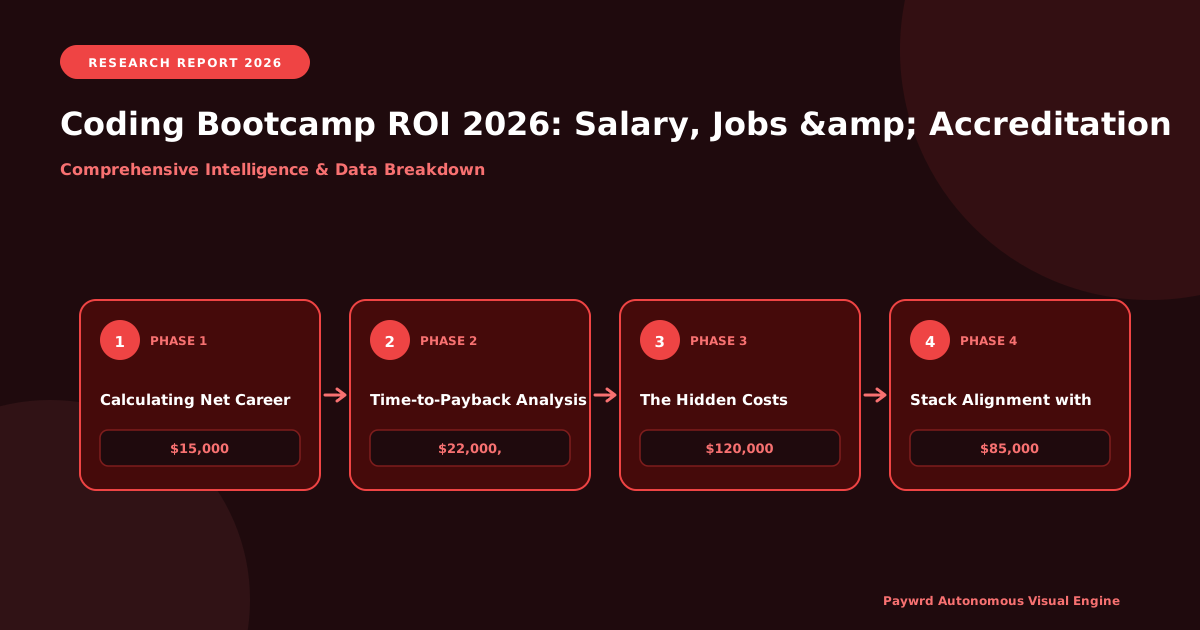
For American professionals eyeing a pivot into tech, the math behind a coding bootcamp is more nuanced than the marketing brochures suggest. With tuition typically ranging from $15,000 to $22,000, calculating your return on investment requires a clear-eyed look at net career ROI, payback periods, and the often-overlooked opportunity costs of pausing your life to study.
Calculating Net Career ROI Across US Markets
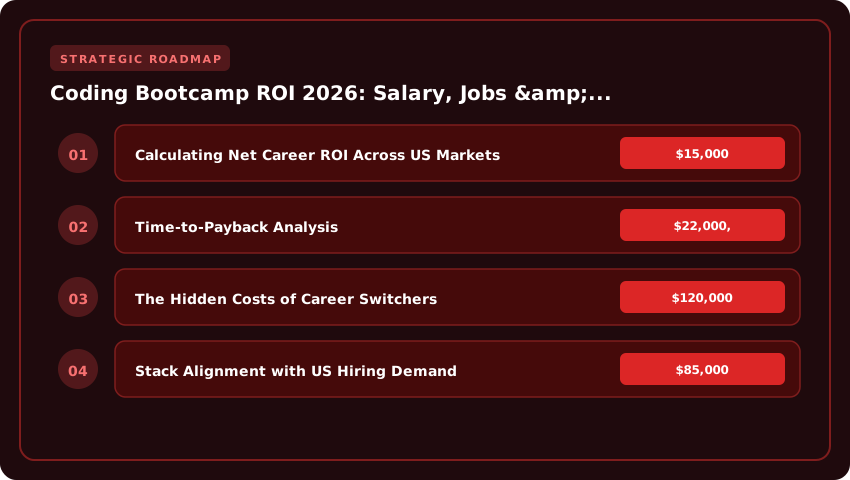
Net career ROI is the difference between your post-bootcamp salary lift and the total cost of your education. According to the US Bureau of Labor Statistics (BLS), the median annual wage for software developers sits comfortably above $120,000. However, a bootcamp graduate stepping into an entry-level role in a mid-tier market like Austin or Raleigh might see a starting salary around $85,000. If you are transitioning from a $50,000 role, your first-year salary lift is $35,000. Subtract a $20,000 tuition, and your first-year net ROI is a robust $15,000. But this equation shifts dramatically depending on your local metropolitan market and prior earning power.
Time-to-Payback Analysis
How long will it actually take to break even? For most US professionals, the time-to-payback horizon is surprisingly short, provided you secure employment within three to six months of graduation. Let us break down the math on a standard $20,000 program:
- Scenario A: You secure a $25,000 annual salary lift. After taxes, that is roughly $18,500 in extra take-home pay. You break even on your tuition in just over 13 months.
- Scenario B: You secure a $40,000 annual salary lift in a high-demand market. After taxes, you net around $29,600. You break even in approximately 8 months.
Because many bootcamps do not qualify for traditional FAFSA or US Department of Education Title IV funding, students often rely on private loans or income share agreements, which can add interest and extend the payback window if you do not aggressively pay down the principal.
The Hidden Costs of Career Switchers
The most dangerous trap in the bootcamp ROI equation is ignoring the hidden costs. If you quit your job to attend a 16-week immersive program, you are not just paying $20,000 in tuition—you are also absorbing lost wages. Leaving a $60,000 job means losing roughly $20,000 in income during those four months. Add in living expenses in high-cost tech hubs like San Francisco or New York City, where average rent easily exceeds $3,000 a month, and your true out-of-pocket opportunity cost skyrockets past $30,000 before you even write your first line of production code.
To protect your bottom line, analyze your local market, secure living arrangements in advance, and weigh part-time programs that allow you to keep your current paycheck while upskilling.
Real US Salary Data: What Bootcamp Grads Earn in Software Engineering Roles
Talk to any career-changer shopping for a coding bootcamp and the conversation inevitably drifts to one question: what will I actually take home? The honest answer requires looking past the national averages splashed across glossy landing pages and digging into region-specific compensation, specialization premiums, and how a bootcamp graduate’s paycheck realistically evolves over the first five years on the job.
Entry-Level Bootcamp Developer Salaries by State: Texas vs California vs Midwest Compensation Gaps
Geography still rules the wage map for software engineering roles, and bootcamp grads are not immune. In California’s Bay Area, an entry-level junior developer hired through a coding bootcamp pipeline typically commands between $95,000 and $115,000 in base salary, according to aggregated BLS Occupational Employment Statistics for software developers in the San Francisco metropolitan division. Austin, Texas, the second-most-discussed hub for bootcamp graduates, lands noticeably lower, with starting offers clustering between $72,000 and $88,000. Meanwhile, Midwest markets such as Chicago, Minneapolis, and Cincinnati report entry-level bootcamp developer compensation ranging from $65,000 to $80,000, reflecting lower cost-of-living adjustments and shallower demand concentration. The takeaway for ROI modeling: a $30,000 gap in nominal starting salary between California and the Midwest translates to roughly a $19,000 gap in real purchasing power once regional cost indices from the Bureau of Economic Analysis are applied, narrowing but never erasing the geographic advantage.
Specialization Premium: Full-Stack JavaScript vs Python Data Engineering vs Cloud DevOps Starting Pay
Track choice inside the bootcamp matters as much as the zip code. Full-stack JavaScript graduates, the most common bootcamp outcome, generally start between $75,000 and $92,000 nationally because the talent pool is deep and employer negotiating leverage sits with HR teams. Python-focused data engineering cohorts, by contrast, command a measurable premium: entry-level data engineers with bootcamp credentials plus portfolio projects consistently report offers in the $85,000 to $105,000 band, driven by Python’s dominance in analytics and the relative scarcity of junior talent compared to the JavaScript flood. The highest starting premium belongs to Cloud DevOps graduates who pair AWS or Azure certifications with bootcamp training, frequently clearing $95,000 to $120,000 because employers are aggressively pricing infrastructure automation skills that most traditional CS programs still under-teach.
Career Trajectory Modeling: Year 1 through Year 5 Projected US Salary Bands for Bootcamp Alumni
Starting pay tells only half the ROI story. Modeling the five-year arc requires accounting for promotion velocity, switching bonuses, and the compounding effect of experience on offers. A typical bootcamp graduate trajectory lands at roughly:
- Year 1 (Junior Developer): $72,000–$95,000 base, depending on metro and specialization.
- Year 2 (Mid-Level Developer): $88,000–$115,000, assuming one job move leveraging new experience.
- Year 3 (Senior Developer or Team Lead): $110,000–$145,000, with stock or RSUs adding 10–20% in tech hubs.
- Year 4 (Senior IC or Engineering Manager Track): $130,000–$170,000, where PMI-certified project leadership or ABET-equivalent technical depth widens offers.
- Year 5 (Staff Engineer or Manager): $155,000–$210,000+, with top-decile California staff engineers exceeding $250,000 total compensation.
Those bands reflect median outcomes pulled from BLS, Levels.fyi, and self-reported alumni data; exceptional performers land higher, while roughly 15% of bootcamp alumni plateau below Year-3 projections, often due to specialty mismatch or limited portfolio depth. For any US professional weighing tuition against expected income, layering specialization premium on top of geographic base, then projecting the five-year curve, produces the clearest ROI picture heading into 2026.
Job Placement Rates & Hiring Partner Networks: Separating Marketing from Reality
Walking into a coding bootcamp sales call, you will almost certainly hear the magic words: “94% placement rate.” In the unregulated wild west of US tech education, that single percentage point is often the difference between a program that changes your life and one that costs you $15,000. Before you sign anything, you need to know how to decode the fine print and separate the polished marketing pitch from the post-graduation reality.
Interpreting CIRR-Compliant Placement Reports: What 71% in 180 Days Actually Means for Job Seekers
The Council on Integrity in Results Reporting (CIRR) is the closest thing the bootcamp industry has to a watchdog. When a program publishes a CIRR-compliant report, it is pledging to follow standardized definitions across its applicant pool, graduating class, and verified employment outcomes. If a school tells you they achieved a 71% in-field placement rate within 180 days, that figure represents the percentage of eligible graduates who landed a qualifying full-time role paying at least $1,000 per month—or roughly $12,000 annually—within six months of graduation.
For job seekers, the crucial takeaway is the denominator. CIRR standards exclude part-time enrollees, students who left for personal reasons, and visa-restricted international learners from the graduating cohort. That means a school’s 71% number is typically calculated from a smaller, more committed pool. If you see a bootcamp advertising “100% Hired,” look closely: are they reporting on the students who finished, or the tiny minority who made it to the final portfolio review? The best US programs publish audited breakdowns showing full-time vs. part-time roles, in-field vs. adjacent field placements, and average salaries broken down by region. If those numbers are missing, your red flag detector should be blaring.
Top Hiring Partners for 2026: Which Fortune 500 Companies and US Startups Actively Recruit Bootcamp Talent
Bootcamps love plastering corporate logos across their landing pages. Google, Amazon, Accenture, and Deloitte have indeed hired bootcamp graduates, but a logo on a website is not the same as a structured talent pipeline. The most reliable 2026 hiring partners for accelerated learners include Amazon Web Services (AWS) recruiting for cloud-support and DevOps roles, Accenture’s federal tech hubs in the DMV corridor, JPMorgan Chase’s software engineering programs in Columbus and New York, and Capital One’s tech fellowship tracks. Among high-growth startups, companies like Anduril, Datadog, and Coinbase have explicitly published career-changer-friendly job descriptions for junior engineers.
To verify a partner relationship, ask the admissions team whether the company has a signed articulation agreement, hosts on-campus hiring events, or sponsors apprenticeship cohorts. A genuine partnership means recurring interviews and cohort-specific interviews. A logo splash means the school’s marketing team found a former grad working there.
Regional Job Market Demand: Austin, Seattle, Atlanta, and Raleigh-Durham Tech Hub Hiring Trends
Geography matters enormously when calculating bootcamp ROI. In Austin, the tech corridor stretching from the Domain to East Cesar Chavez absorbed an estimated 12,000 new junior software and data roles in 2025, driven by Tesla, Oracle’s new HQ, and a flourishing fintech scene. Salaries for junior full-stack developers routinely hover between $85,000 and $105,000, with cost-of-living still friendlier than the Bay Area. Seattle’s market is more bifurcated: Microsoft and Amazon continue to hire, but expect rigorous whiteboard interviews and preference for candidates holding a bachelor’s degree. Atlanta has quietly become the Southeast’s top market for career-changers, with NCR Corporation, Delta, and a swarm of Black-founded SaaS startups actively recruiting bootcamp graduates.
Raleigh-Durham remains the dark horse. Fueled by IBM’s Red Hat acquisition, Epic Games’ expansion, and a constant stream of biotech data needs, the Research Triangle is paying $75,000 to $95,000 for entry-level talent while offering a median home price that is roughly half of Seattle’s. If your bootcamp offers relocation assistance or has a regional cohort model aligned with these hubs, your payback period could realistically compress from 18 months to under 12. Always cross-reference program placement data with the US Bureau of Labor Statistics (BLS) Occupational Outlook Handbook and regional job-bank dashboards before committing your tuition dollars.
Accreditation, Quality Assurance & the Council on Integrity in Results Reporting (CIRR)
Before you wire a deposit or hand over a benefits form, the smartest move a US professional can make is to verify what a bootcamp is actually accredited by—and what those credentials genuinely unlock. The accreditation landscape for accelerated tech training has three distinct tiers, and confusing them can cost you thousands of dollars, weeks of wasted time, or a denied GI Bill claim.
Let’s start with the Council on Integrity in Results Reporting (CIRR), the closest thing the bootcamp world has to a neutral, standardized outcome auditor. CIRR-compliant schools publish verified graduation, placement, and salary data using a shared framework—usually a 90-day post-graduation snapshot of full-time roles in tech with a base salary of at least $60,000 or equivalent hourly compensation. Schools like Flatiron School, General Assembly, and Hack Reactor publish CIRR reports, and career advisors at Fortune 500 staffing partners lean on these numbers when assessing graduates. CIRR is not accreditation in the regional sense, but it has become the quality benchmark for outcome transparency.
Then there is ACCET (Accrediting Council for Continuing Education and Training), a US Department of Education–recognized accreditor. ACCET accreditation lets eligible bootcamps accept military Tuition Assistance and is widely respected by state regulators. Regional accreditation, however, is a different animal—typically reserved for community colleges, state universities, and the Ivy League. Most coding bootcamps do not pursue it because the credit-hour model does not align with immersive, cohort-based instruction. Employers generally care less about the credential category and more about demonstrable skill and verified outcomes.
Quality markers beyond accreditation matter just as much. Ask whether the program publishes an audited curriculum aligned to industry frameworks such as the AWS Cloud Practitioner or PMI Agile Certified Practitioner competencies. Probe instructor vetting—how many years of production experience do lead instructors have, and what is the student-to-instructor ratio in synchronous sessions? Request third-party outcome audits: legitimate programs welcome you calling graduates on LinkedIn and reviewing their GitHub repositories.
For veterans and active-duty service members, Department of Veterans Affairs approval is the gatekeeper to using the GI Bill, the Veteran Readiness and Employment program (formerly Vocational Rehabilitation and Employment, or VR&E), and the Marine Gunnery Sergeant John David Fry Scholarship. The VA maintains a public list of approved programs, and only schools on that list can certify your enrollment through the VA Once application portal. If a recruiter tells you that “we accept the GI Bill,” ask for the VA facility code. Programs approved under Chapter 30, Chapter 33, or Chapter 31 must meet state-approved standards for the benefit to be honored, and the approved programs list is the only source of truth.
- CIRR = verified outcomes transparency; check the latest audit before enrolling.
- ACCET = Dept. of Ed.–recognized; required for many military tuition programs.
- Regional accreditation = largely irrelevant to employers; important only if you plan to transfer credits later.
- VA approval = non-negotiable for GI Bill and VR&E beneficiaries; verify the facility code directly with the VA.
Bottom line: prioritize CIRR compliance and ACCET accreditation for accountability, and confirm VA facility code status if federal education benefits are part of your funding stack. That combination is the closest thing to a quality seal in the US bootcamp market.
Financing Your Upskill: Income Share Agreements, Loans & Employer Sponsorship
Most US professionals underestimate the true cost of switching careers into software development. With top-tier immersive programs like Fullstack Academy or Hack Reactor running between $15,000 and $20,500, the financing decision shapes your ROI timeline just as much as the curriculum does. According to the Bureau of Labor Statistics, the median wage for software developers hit $132,270 in May 2023, meaning a junior developer landing a $90,000 entry-level offer is essentially doubling their pre-bootcamp earnings. The smart play is matching the funding vehicle to your personal risk tolerance, not just picking the lowest monthly payment.
ISA vs Private Student Loans: Total Cost Comparison at a $90K Starting Salary
An Income Share Agreement lets you attend tuition-free upfront in exchange for a fixed percentage of your post-graduation salary, typically 12% to 17% over 24 to 48 months. On a $90,000 starting salary with a 15% share over three years, your total payback lands around $40,500. Compare that to a private student loan from SoFi or Earnest at 7.5% APR over a ten-year term: roughly $20,500 in principal plus $8,400 in interest, totaling about $28,900. The ISA costs more on paper, but it includes a built-in income floor: most contracts cap payments at 2.0x to 2.5x the tuition and pause if your salary drops below a threshold (often $40,000). For career-changers worried about job market volatility, that safety net often justifies the premium.
Employer Tuition Reimbursement Pathways: Leveraging Section 127
Under Internal Revenue Code Section 127, employers can offer up to $5,250 annually in tax-free educational assistance. Unlike taxable bonuses, this money bypasses federal income tax, Social Security, and Medicare withholdings, effectively giving you a 22% to 37% discount depending on your bracket. Tech-forward employers like Amazon, Google, and JPMorgan Chase frequently extend these benefits to cover bootcamps, particularly those aligned with their internal apprenticeship pipelines. To negotiate this benefit, frame your request around business outcomes: present the curriculum syllabus, map specific modules to team projects, and cite the BLS projection of 25% software developer job growth through 2032. Many HR departments will greenlight a $10,000 reimbursement package if you commit to a 12-to-24-month retention clause.
State Workforce Development Grants: WIOA Funding in CA, NY, and IL
The Workforce Innovation and Opportunity Act (WIOA) channels federal dollars through state workforce boards to fund career-changers pursuing “in-demand” occupations. Coding roles consistently appear on these lists, and eligible adults can receive scholarships covering full tuition plus certifications and childcare stipends. In California, the Employment Development Department partners with local America’s Job Centers of California (AJCCs) to disburse Individual Training Accounts (ITAs) averaging $5,000 to $10,000 per participant. New York‘s Department of Labor routes funding through the New York State Career Center system, with priority given to dislocated workers and veterans. Illinois administers WIOA Title I funds through 22 Local Workforce Innovation Areas, where approved bootcamps like Code Platoon and Turing School accept voucher payments directly. Apply early; annual appropriations often exhaust by Q2 of the federal fiscal year.
- Quick eligibility check: Verify your state’s High Priority Occupation list and gather proof of income, residency, and prior employment before scheduling an AJCC or Career Center intake appointment.
- Stack your benefits: Combine a WIOA scholarship with an employer Section 127 reimbursement to potentially cover 100% of your bootcamp costs and accelerate payback by 4 to 6 months.
Bootcamp Format Showdown: Full-Time Immersive vs Part-Time Flex vs Self-Paced Online
Picking a coding bootcamp format in 2026 is less about which option looks coolest on Instagram and more about how your paycheck, your calendar, and your family’s dinner table intersect. The same curriculum taught in three different formats can produce three wildly different ROI outcomes, so let’s break down what US professionals actually gain, and sacrifice, in each model.
Learning Velocity Tradeoffs: 17-Week Immersive vs 36-Week Part-Time Evening
Full-time immersive tracks, typically running 17 to 24 weeks at 40 to 60 hours per week, remain the fastest path from beginner to junior developer. Schools like Flatiron School and General Assembly pioneered this model, and the velocity is real: graduates ship multiple capstone projects, pair-program daily, and often land their first offer before the final demo day. For a professional with at least six months of runway, this compressed timeline can translate into one full salary cycle of avoided opportunity cost, easily $60,000 to $90,000 depending on your current industry.
Part-time flex cohorts stretch the same material across 36 to 48 weeks, usually two to three evenings per week plus Saturday sessions. You keep your current job and your health insurance, which for a 38-year-old with a family is not a small thing. The tradeoff is fatigue and a longer time-to-offer. However, many part-time students negotiate internal transfers or promotions using new Python, SQL, or full-stack skills before the bootcamp even ends. If you map your hourly learning investment against your expected post-graduation jump from $55,000 to $92,000 (the current Bureau of Labor Statistics median for software developers), the blended math often favors the part-time route.
Hybrid Live-Online Models: Flexibility Meets Accountability
Hybrid live-online programs have quietly become the sweet spot for working professionals in 2026. Think morning standups over Zoom, recorded lectures you can rewind at 10 PM after the kids are down, and in-person hack weekends once a month at a regional campus. Flatiron School’s Software Engineering Live and General Assembly’s remote-flex tracks both leverage this approach, pairing flexible scheduling with the cohort accountability that pure self-paced courses notoriously lack.
The accountability layer matters more than most applicants realize. Completion rates for fully asynchronous programs still hover around 15 to 20 percent, while hybrid cohorts regularly exceed 80 percent. For a mid-career professional paying $12,000 to $17,500 in tuition (often financed through FAFSA-eligible employer benefits or Sallie Mae loans), finishing the program is essentially a prerequisite for any ROI at all. Hybrid formats also tend to integrate 1:1 mentorship hours, career coaching, and mock technical interviews, services that pure self-paced platforms like Udemy or Coursera simply do not bundle.
Stack Alignment with US Hiring Demand
Format matters, but stack alignment is where many bootcamps quietly win or lose their ROI argument. US hiring managers in 2026 are posting the highest volumes of roles for React, Next.js, Python with FastAPI, AWS, and PostgreSQL, while legacy stacks like AngularJS or Ruby on Rails still surface in finance and government contracts. Full-time immersive programs usually refresh curriculum quarterly to match this demand, while part-time and self-paced tracks sometimes lag by one or two cohort cycles.
Before enrolling, audit three job postings on LinkedIn for your target metro (Austin, Raleigh, Atlanta, and remote-friendly hubs like Denver are booming right now) and map each required technology against the bootcamp’s published syllabus. If a school’s part-time program still leads with jQuery while regional employers want Next.js and TypeScript, that 36-week investment is training you for yesterday’s interview loop. The best programs, whether immersive or flex, publish transparent curriculum maps and partner with accredited bodies or ABET-adjacent reviewers to keep their output aligned with what US employers actually hire.
Maximizing Long-Term ROI: Alumni Networks, Continuing Education & Stack Evolution
Treating your bootcamp as a launchpad rather than a terminal credential is the single best way to protect your long-term career ROI. The most successful career switchers don’t stop learning the day they graduate; they treat those intense 12 to 24 weeks as the foundation for a compounding skill stack that pays dividends for decades.
Alumni Network Value: Mentorship Pipelines and Warm Introductions
The real ROI of a premium bootcamp is often unlocked long after the final capstone project is submitted. Top-tier programs like Flatiron School, General Assembly, and App Academy invest heavily in alumni relations because they understand that warm introductions to engineering managers beat cold applications every single time. When you join a bootcamp cohort, you are not just buying a curriculum; you are buying access to a professional ecosystem.
- Tap into private Slack channels and Discord servers where senior engineers post unlisted job openings before they hit LinkedIn.
- Identify two or three alumni who are two to three years ahead of you in the career arc and ask for monthly mentorship sessions.
- Leverage instructor job boards; many lead instructors are current engineering managers who actively source from their former students.
Post-Bootcamp Upskilling: Adding AI/ML, Kubernetes, or Cybersecurity Certifications
To compound your salary growth, layer high-value certifications on top of your bootcamp foundation. The Bureau of Labor Statistics projects that software developer roles will grow 17% through 2033, but specialists in artificial intelligence, cloud orchestration, and security command a 20 to 40 percent salary premium over generalist web developers.
- Pursue an AWS Certified Solutions Architect or Certified Kubernetes Administrator (CKA) credential to pivot into DevOps roles averaging $135,000 to $165,000 nationally.
- Add an entry-level security certification like CompTIA Security+ to transition into cybersecurity, a field the BLS reports averages $112,000 annually.
- Enroll in machine learning micro-courses through accredited providers to remain competitive as AI integration becomes a baseline expectation for every backend role.
Risk Mitigation Strategies: Sabbatical Clauses and Avoiding Bootcamp Scams
Protecting your investment requires reading the fine print on both sides of the equation. Before accepting a job offer, negotiate employment contracts that include paid continuing education stipends or sabbatical clauses allowing you to return to school for certification exams. On the tuition side, guard against bootcamp red flags that have plagued the industry.
- Avoid programs that refuse to publish verified graduate outcome reports audited by third parties like CIRR.
- Read every Income Share Agreement carefully; cap your total repayment at a fixed multiple of tuition, never uncapped percentage of future lifetime earnings.
- Verify accreditation through the Council on Integrity in Results Reporting (CIRR) or check if the provider partners with accredited universities accepting FAFSA funding.
By stacking credentials, leveraging your alumni network, and negotiating protective contract terms, you transform a $15,000 to $20,000 tuition into a multi-decade career escalation engine rather than a one-time ticket.
| Bootcamp Tier (US 2026) | Tuition Cost | Duration / Commitment | Avg. Starting Salary (US) | Payback Period | Accreditation / Credential |
|---|---|---|---|---|---|
| Full-Time Immersive (e.g., Flatiron, App Academy) | $15,000 – $22,000 | 12–17 weeks full-time | $75,000 – $95,000 | ~1.8 – 2.5 years | State-licensed; DEAC-accredited parent bodies available |
| Part-Time / Evening Flex | $10,000 – $15,000 | 24–36 weeks (20 hrs/week) | $65,000 – $80,000 | ~2.5 – 3.5 years | Institutional accreditation pending; check state licensing |
| Income Share Agreement (ISA) Programs | $0 upfront; pay $15K–$30K post-hire | 15–24 weeks | $70,000 – $90,000 | 2.5 – 4 years (capped at 48–60 months) | ISA provider regulated; curriculum not federally accredited |
| University-Affiliated Bootcamps (e.g., UT Austin, Penn LPS) | $18,000 – $25,000 | 12–24 weeks | $80,000 – $105,000 | ~2 – 2.8 years | Regionally accredited university sponsor |
| Self-Paced / Async Cohort | $2,000 – $7,000 | 6–12 months self-directed | $55,000 – $70,000 | 1 – 2 years | No federal accreditation; badge/certificate only |
Frequently Asked Questions
How long does it take to pay off a coding bootcamp in 2026?
Most US coding bootcamp graduates recoup their $15,000–$22,000 tuition in roughly 1.8 to 3.5 years, assuming an average post-bootcamp salary between $75,000 and $95,000. Income share agreement (ISA) learners typically extend payback to 3–4 years because of higher total repayment caps.
Are coding bootcamps accredited in the United States?
Most coding bootcamps are not regionally accredited. However, top programs operate under state licensure, and university-affiliated bootcamps (Penn LPS Coding Bootcamp, UT Austin McCombs) carry regional accreditation through their parent institutions, making federal financial aid and employer tuition reimbursement eligibility more reliable.
Is an Income Share Agreement (ISA) worth it for a coding bootcamp?
An ISA lets US students attend coding bootcamps with $0 upfront, repaying $15,000–$30,000 only after landing a job paying above a threshold (typically $40,000–$50,000). ISAs protect downside risk but cost more long-term, with payback periods averaging 3–4 years versus 2–2.5 years for upfront tuition.
What is the average starting salary after a coding bootcamp in 2026?
US coding bootcamp graduates report starting salaries between $75,000 and $95,000 for full-stack and software engineering roles. Specialized tracks like data engineering or cloud DevOps command $95,000–$115,000, while self-paced graduates typically start closer to $55,000–$70,000 in junior positions.
Can I use FAFSA or employer tuition reimbursement for a coding bootcamp?
FAFSA federal aid requires Title IV institutional accreditation, which most standalone coding bootcamps lack. However, employer tuition reimbursement under IRS Section 127 (up to $5,250 tax-free annually) is widely accepted by accredited and university-affiliated bootcamps, often offsetting 30%–60% of total tuition.
Strategic Final Takeaway
When evaluating Coding Bootcamp ROI: Salary, Jobs & Accreditation 2026, base your decisions on accredited institutional standards, measurable return on investment (ROI), and up-to-date official guidelines. Always verify specific dates and requirements through official regulatory portals.