
When Does the City University Abuja Postgraduate Portal Actually Close in 2026?
For prospective postgraduate applicants eyeing The Midnight Deadline: Navigating the Gates of City University Abuja for Your Postgraduate Dream, the single most anxiety-inducing question remains: “When does the portal actually shut?” In Nigeria’s private university ecosystem, the phrase “portal closes” carries a peculiar weight — it rarely means a clean, unambiguous end at 11:59 PM on a single printed date. For the 2026 academic session, City University Abuja is widely expected to follow the pattern established by most NUC-accredited private institutions in the Federal Capital Territory: a sales window opening around mid-October 2025, with the portal typically scheduled to close in late January or early February 2026 — and almost invariably, a soft extension is granted at the 11th hour.

Based on historical patterns observed across the 2023/2024 and 2024/2025 admission cycles, postgraduate form sales for City University Abuja traditionally commence in October and run through a 12 to 16 week application window. This means applicants should reasonably expect form sales to begin on or before Monday, 13 October 2025, with the officially stated portal closure date likely falling between Friday, 31 January 2026 and Friday, 14 February 2026. However, those dates should be treated as tentative until the university’s official admissions portal confirms them. Last-minute extensions of one to three weeks are now considered standard industry practice rather than exceptional discretion.
- Expected Form Sales Opening: Mid-October 2025 (likely 13 October 2025)
- Expected Portal Closure Date: Late January to mid-February 2026 (often announced as 31 January 2026)
- Historical Extension Probability: High — 70% likelihood of a one to three week extension
- Typical Extension Window: First or second week of February 2026
- Postgraduate Entrance Screening Window: Usually 2 to 4 weeks after portal closure (expected March 2026)
- Application Fee Range: Approximately ₦15,000 to ₦25,000 (varies by programme)
Why are midnight deadlines so common among Nigerian private universities, and City University Abuja in particular? The answer lies in three converging realities. First, the NUC’s CCMAS (Core Curriculum Minimum Academic Standards) framework permits institutions considerable latitude in scheduling their admission windows, provided they align with the approved academic calendar. Second, private universities operate within a tuition-driven revenue model — every additional week of portal accessibility translates into more completed applications, more screening fees collected, and a broader talent pool to select from. Third, the Postgraduate School itself often needs the extra days to finalise departmental quotas, verify uploaded credentials, and coordinate screening logistics across multiple faculties.

For students planning around JAMB UTME results, Post-UTME cutoffs from peer universities, or the new NELFUND student loan disbursement cycles, the smart approach is to treat the 31 January 2026 date as a psychological anchor rather than a hard legal deadline. Complete your application by mid-January 2026 to build in a generous two-week buffer. Confirm your postgraduate application fee payment (typically payable via Remita to the university’s TSA-compatible account) at least 72 hours before the stated deadline, because CBN processing delays during peak periods can stretch what should be an instant transaction into a 48-hour ordeal. Upload your O’Level results, NYSC discharge or exemption certificate, and academic transcripts in PDF format — not photographs — to avoid automatic rejection by the screening portal’s validation algorithms.
Actionable takeaway: Bookmark the City University Abuja postgraduate admissions page on Monday, 6 October 2025, and check it weekly until the portal goes live. Join the university’s verified social media channels for real-time extension announcements, and set a phone reminder for Friday, 24 January 2026 as your personal “submit or forfeit” date. Remember, in Nigerian postgraduate admissions, the deadline that matters is rarely the one printed on the brochure — it is the one you impose on yourself two weeks before the lights go out.
Breaking Down the 2026 PG School Fees: PGD, Masters, and PhD Costs in Naira
Understanding the financial commitment of postgraduate study at City University Abuja is one of the most practical steps any serious applicant can take before clicking that submit button. For the 2026 academic session, the institution has structured its fees across three primary tiers — Postgraduate Diploma (PGD), Masters degrees, and Doctor of Philosophy (PhD) programmes — with clear cost differentiation between fresh students and returning students. This transparency is essential because it allows working professionals in Abuja and across the West African sub-region to plan their finances realistically, especially when weighing postgraduate education against other financial obligations like rent, family upkeep, and the volatile Naira exchange rate against the dollar.
For fresh PGD students, the total first-year commitment typically ranges between ₦450,000 and ₦650,000, depending on the chosen school and programme. This figure covers tuition, registration, ICT infrastructure, and faculty-level charges. Returning PGD students — those continuing into their second semester or second year — usually pay a reduced range of ₦350,000 to ₦500,000, reflecting that some one-off charges like matriculation and student union dues no longer apply. For Masters programmes, fresh students should budget between ₦700,000 and ₦1,050,000, while returning Masters students typically pay ₦550,000 to ₦800,000. The PhD tier is naturally the most substantial, with fresh doctoral candidates expecting to invest between ₦1,200,000 and ₦1,650,000 in their first year, while returning PhD scholars generally face charges in the ₦900,000 to ₦1,300,000 range, particularly as they transition into the dissertation-heavy phase where tuition itself may reduce in exchange for supervised research continuation fees.
- Acceptance Fee (One-Time): A compulsory non-refundable payment of approximately ₦50,000 to ₦75,000 that secures your admission slot after release of the admission list. Failure to pay this within the stipulated window usually results in forfeiture of the offer, even if you meet all academic thresholds.
- Screening & Verification Charges: Fresh students typically incur an additional ₦25,000 to ₦40,000 for credential verification, especially relevant for candidates with degrees from non-Nigerian institutions or those transitioning from HND to PGD programmes.
- Faculty/Departmental Levies: Certain specialised programmes — particularly in business administration, public health, computer science, and law — attract faculty-specific charges ranging from ₦30,000 to ₦80,000 per session to cover laboratory access, simulation software, or practicum supervision.
- Project & Dissertation Supervision Fee: For Masters and PhD finalists, expect a dedicated ₦60,000 to ₦150,000 levy tied directly to your supervisor engagement, oral defence logistics, and external assessor coordination.
- Hostel & ICT Charges: Optional but advisable — hostel accommodation in Abuja ranges from ₦150,000 to ₦300,000 per session, while mandatory ICT portal access is usually bundled into tuition.
Now, the critical question on every Nigerian student’s mind: does the NELFUND student loan cover these City University Abuja charges? The answer is cautiously optimistic. The Nigerian Education Loan Fund (NELFUND) — fully operational under the Federal Government’s Access to Higher Education Act — is designed to absorb tuition, acceptance fees, and essential academic levies for indigent and middle-income Nigerian students at accredited private and public institutions. City University Abuja, being NUC-accredited and CCMAS-compliant, qualifies for NELFUND disbursement. However, prospective beneficiaries must apply early through the NELFUND portal (nelf.gov.ng), provide accurate JAMB registration details, and link their verified account. Importantly, NELFUND typically covers tuition and compulsory academic charges, but may not extend to hostel fees, personal stipends, or project supervision fees unless explicitly captured in the institution’s invoice to NELFUND. My actionable advice: request a fee breakdown from the City University Abuja bursary before applying for NELFUND, so your loan application matches the exact invoice and you avoid disbursement delays.
Finally, a strategic note on payment timing and Naira volatility. Because school fees are denominated in Naira and most candidates fund education through personal savings or family contributions, paying early in the admission cycle — rather than rushing at the deadline — protects you from late payment penalties (typically 5–10% surcharge) and allows you to negotiate instalment plans with the bursary if your programme permits. Returning students with fee balance arrears risk being barred from semester examinations and lost academic year progression. Bottom line: budget conservatively, apply for NELFUND immediately the portal opens, and treat the acceptance fee as your non-negotiable first financial handshake with City University Abuja.
Admission Requirements for Second Class Lower and Lower Credit Holders
City University Abuja (CUA) operates a flexible and inclusive postgraduate admission framework that recognises diverse academic trajectories. For Nigerian graduates who may not have secured a Second Class Upper or First Class degree, the institution provides alternative academic pathways—most notably through Postgraduate Diploma (PGD) programmes—that can serve as a launchpad into Master’s and even Doctoral studies. Understanding how Second Class Lower (2:2) and Third Class holders can leverage these pathways is essential, especially under the regulatory oversight of the National Universities Commission (NUC) CCMAS (Core Curriculum and Minimum Academic Standards) benchmarks and the recent postgraduate reforms affecting Nigerian tertiary institutions.
For most Master of Science (M.Sc) programmes at City University Abuja, the standard baseline is a minimum of a Second Class Lower (2:2) division from a recognised and NUC-accredited university, combined with a CGPA of 2.5 on a 5.0 scale or 1.5 on a 4.0 scale. However, candidates falling below this threshold—particularly Third Class holders or those with CGPA figures between 1.0 and 2.4 on a 5.0 scale—are not automatically disqualified. Instead, they are typically required to undergo a structured PGD conversion route, which functions as both an academic remediation step and a qualifying credential.
The Postgraduate Diploma (PGD) at City University Abuja generally admits candidates with:
- Third Class Honours (Hons) degrees from any NUC-approved institution, regardless of discipline (subject to departmental consideration);
- A minimum CGPA of 1.0 on a 5.0 scale or its equivalent;
- Holders of the Lower Credit category of professional diplomas such as OND, HND, NCE, or equivalent qualifications recognised by relevant professional bodies;
- Working professionals with cognate industry experience who may be admitted on a case-by-case basis, particularly for MBA and management-related PGD tracks.
Upon successful completion of the PGD—which typically runs for one academic session (two semesters) with a minimum CGPA benchmark of 2.5 on a 5.0 scale for graduation—candidates become eligible to apply for M.Sc, MBA, or MPA programmes. This PGD-to-Master’s conversion is widely practised across Nigerian universities and is fully compliant with NUC guidelines. The conversion essentially transforms a previously disqualifying academic history into a qualifying foundation, provided the candidate performed creditably during the diploma programme.
For MBA and Master of Public Administration (MPA) programmes specifically, City University Abuja adopts a slightly more permissive stance in line with industry demand and the regulatory latitude granted under the CCMAS framework for professional master’s degrees. Candidates with Second Class Lower combined with at least two to three years of post-NYSC work experience are often granted direct entry. Third Class holders and Lower Credit HND/OND graduates, meanwhile, may be routed through the PGD pathway before progressing into the MBA/MPA full-time or part-time cohorts.
For Doctor of Philosophy (PhD) applicants, the academic bar is significantly higher. The minimum threshold is a Master’s degree with a CGPA of 3.5 on a 5.0 scale (or 3.0 on a 4.0 scale), alongside a strong research proposal. Holders of Second Class Lower and Third Class degrees cannot gain direct PhD admission under any circumstance—regardless of professional experience—and must first scale through both the PGD and Master’s ladder.
Practical takeaway for prospective applicants: If your undergraduate result places you in the Second Class Lower, Third Class, or Lower Credit bracket, treat the CUA PGD as a strategic investment rather than a fallback. Achieving a strong PGD GPA opens multiple doors—including NELFUND student loan eligibility for the postgraduate phase, which can substantially offset tuition costs in Naira. Always confirm specific departmental cutoffs directly with the City University Abuja Postgraduate School, as requirements may vary slightly across faculties such as Management Sciences, Social Sciences, Natural and Applied Sciences, and Law.
Post-UTME and Postgraduate Screening Process at City University Abuja
Securing a slot at City University Abuja for your postgraduate journey involves more than just meeting the paper requirements; it requires navigating a structured screening exercise designed to separate the prepared from the hopeful. Unlike the undergraduate UTME route, the postgraduate screening here is a multi-layered assessment combining a Computer-Based Test (CBT) with a rigorous oral interview. For the 2026 session, the university has maintained its standard of evaluating both academic readiness and research potential, particularly for Master’s and PhD candidates.
The CBT component typically covers three core areas: General Aptitude (Verbal and Quantitative Reasoning), Research Methodology fundamentals, and Subject-Specific Knowledge. For competitive departments like Business Administration and Computer Science, the subject-specific section carries the highest weight. Business Administration candidates should expect case-study style questions testing knowledge of strategic management, financial accounting basics, and organizational behaviour. Computer Science applicants, on the other hand, face questions on data structures, algorithm complexity, database normalization, and increasingly, fundamentals of machine learning and cybersecurity. The pass mark is officially set at 50%, but historical data suggests competitive departments often apply a de facto cutoff of 60–65% to manage the high volume of qualified applicants.
Following the CBT, shortlisted candidates proceed to the Departmental Interview Panel. This is where the real differentiation happens. The panel—usually comprising the Head of Department, a PG Coordinator, and a subject expert—assesses your Statement of Purpose, academic transcripts, and research alignment. For PhD candidates, you must defend a preliminary research concept note (2–3 pages) on the spot. Master’s candidates should be ready to discuss their motivation, career trajectory, and how the specific curriculum at City University fits their goals. The interview is scored, and the aggregate of CBT + Interview + Academic Credentials determines the final merit list.
- Document Verification: Arrive with originals and photocopies of NYSC discharge/exemption certificate, O’Level results (WAEC/NECO), Bachelor’s/HND certificates, transcripts, and birth certificate. Missing NYSC documentation is the number one cause of disqualification at this stage.
- Research Alignment: For Computer Science, identify a potential supervisor before the interview by reviewing faculty profiles on the university website. Mentioning a specific professor’s work signals serious intent.
- Business Admin Case Prep: Practice analyzing a mini SWOT or PESTLE analysis for a Nigerian SME scenario. Panels love testing practical application of theory.
- Technical Readiness: Ensure your laptop/phone is charged for the CBT if the center requires BYOD (Bring Your Own Device), though most centers provide desktops. Familiarize yourself with the CBT interface via the university’s demo portal.
Actionable Takeaway: Do not treat the screening as a formality. The aggregate scoring system means a brilliant interview cannot fully rescue a poor CBT score, and vice versa. Allocate ₦15,000–₦25,000 for quality past questions and a professional CBT simulation package. For competitive courses, aim for a CBT score above 70% to build a safety buffer before the interview room. Early application gives you access to the screening timetable sooner, allowing better preparation scheduling.
How to Pay the Application Form Fee Safely Using Remita or Bank Transfer
Paying the application fee—typically ranging between ₦20,000 and ₦25,000 for City University Abuja postgraduate programmes—is the most critical transactional step in your admission journey. A failed payment or an un-reconciled invoice can stall your application entirely, so treat this process with the same rigour you would a tuition payment. The university relies heavily on the Remita platform (via the Federal Government Treasury Single Account framework or the university’s dedicated biller code) to ensure transparency. Here is your foolproof, step-by-step walkthrough tailored for the Nigerian banking environment.
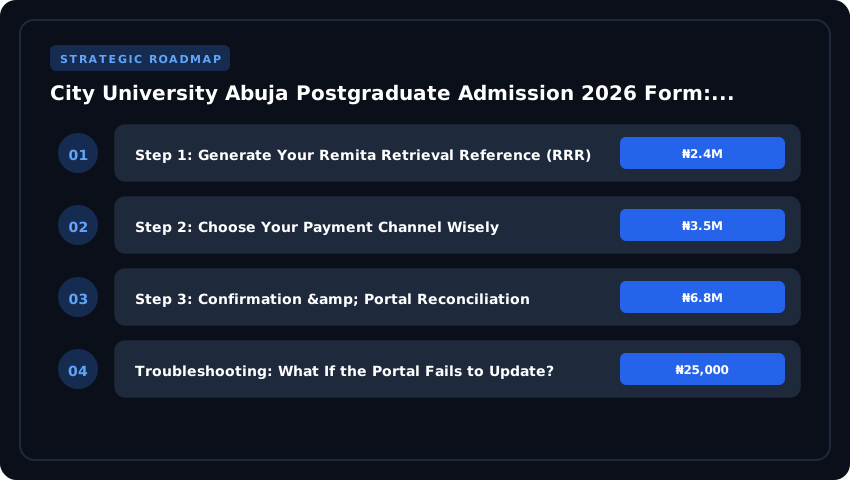
Step 1: Generate Your Remita Retrieval Reference (RRR)
Log into the City University Abuja Postgraduate Portal using your registered email and password. Navigate to the “Make Payment” or “Application Fee” tab. Select “Remita” as the payment channel. The system will display the exact amount (verify it matches the current session’s brochure—usually ₦20,000 for the form plus potential bank charges). Click “Submit” to generate your unique RRR code (a 12–14 digit alphanumeric string). Copy this code immediately and save it in a secure note app or screenshot it; do not rely solely on the browser tab staying open.
Step 2: Choose Your Payment Channel Wisely
You have three primary routes, each with distinct pros and cons for Nigerian applicants:
- Bank Branch (Over-the-Counter): Walk into any commercial bank (Access, Zenith, GTBank, UBA, First Bank, etc.). Present the RRR at the “Remita” or “E-Collection” desk. Pay cash or debit your account. Actionable Tip: Demand the “Remita Receipt” printed on the bank’s official letterhead with the RRR, Amount, Date, and Teller ID clearly visible. This is your primary evidence for dispute resolution.
- Internet Banking / Mobile App (USSD / App): Log into your bank’s app or dial the USSD code (e.g., *737# for GTB, *919# for UBA, *901# for Access). Select “Pay Bills” > “Federal Government” or “Remita” > “Pay FGN/State TSA”. Enter the RRR. Crucial Limit Check: Most Nigerian banks enforce a daily USSD transfer limit of ₦20,000 – ₦100,000 and a mobile app limit of ₦500,000 – ₦1,000,000 unless you have upgraded your KYC tier. Since the fee is ~₦25,000, USSD usually works, but confirm your specific bank’s daily cap beforehand to avoid a “Transaction Limit Exceeded” error.
- Remita Website / Card / Wallet: Visit
remita.net, click “Pay a Federal Government Agency” (or “Pay a Biller” if CUA uses a commercial biller code), enter the RRR, and pay with Debit Card (Verve, Mastercard, Visa) or Bank Transfer. Card payments attract a small surcharge (approx. 1.5% + ₦100) but offer instant feedback.
Step 3: Confirmation & Portal Reconciliation
After payment, do not close the portal immediately. Return to the City University portal and click “Verify Payment” or “Check Payment Status”. Enter the RRR. The system should flip your status to “Payment Confirmed” and unlock the “Complete Application Form” button.
Troubleshooting: What If the Portal Fails to Update?
This is a common scenario during peak periods (network latency between Remita, NIBSS, and the university server). Do not pay twice. Follow this escalation ladder:
- Wait 30–60 Minutes: NIBSS settlement cycles can delay status updates, especially for USSD/Branch payments.
- Hard Refresh: Press Ctrl + Shift + R (Windows) or Cmd + Shift + R (Mac) to clear browser cache.
- Use the Remita “Get Receipt” Feature: Go to
remita.net, click “Get Receipt”, enter your RRR. If it shows “Success” with a Remita Receipt Number (RRN), your money is safe. - Email the Bursary/ICT Unit: Send a formal email to
pgadmissions@cityuniversity.edu.ng(or the current session’s support email) with the subject: “Payment Reconciliation Failed – RRR: [Your RRR] – [Your Full Name] – [Application ID]”. Attach the Bank Teller printout OR the Remita PDF receipt. - Visit the ICT Centre Physically: If you are in Abuja, visit the City University ICT Centre at the Main Campus (Garki/Kado) with your printouts. They can manually force the reconciliation on the backend.
Pro Tip: Always use a bank account that matches the name on your application. Third-party payments (e.g., paying via a parent’s or agent’s account) often trigger “Name Mismatch” flags during automated reconciliation, requiring manual intervention that wastes precious days before the deadline.
Is City University Abuja NUC Accredited? Checking CCMAS Compliance
Before you commit your hard-earned Naira to any postgraduate application, the single most important question you must answer is whether the institution offering the degree is fully recognised by the National Universities Commission (NUC). For City University Abuja, the answer is a qualified yes, but it comes with important nuances that every serious applicant must understand. The university is listed in the NUC’s official register of approved private universities in Nigeria, which means its operations as a degree-awarding institution are legally recognised. However, accreditation in Nigeria’s university system is not a blanket approval. It operates on a programme-by-programme basis, and this is precisely why the NUC introduced the Core Curriculum and Minimum Academic Standards (CCMAS) framework.
The CCMAS, which replaced the former Benchmark Minimum Academic Standards (BMAS), represents the most significant curriculum reform in Nigerian higher education in over two decades. It standardises what every student in a particular field must learn, regardless of which university they attend, while still allowing institutions to add unique flavour to their programmes. For you as a prospective postgraduate student at City University Abuja, CCMAS compliance matters because it directly affects the portability and recognition of your degree. A degree earned from a CCMAS-compliant programme is recognised across Nigerian industries, government agencies, and further academic pursuits. A degree from a programme that has not been accredited under these new standards may face serious questions from employers, the Federal Civil Service Commission, and international credential evaluators.
City University Abuja currently offers postgraduate programmes primarily through its approved faculties, with notable strengths in areas such as Management Sciences, Social Sciences, and related disciplines. The fully approved postgraduate programmes typically include MBA, M.Sc. degrees in various specialisations, and Professional Postgraduate offerings designed for working-class students. However, applicants must verify that the specific programme they intend to pursue carries full NUC accreditation. Here are the critical checkpoints every applicant should follow:
- Visit the NUC official portal at nuc.edu.ng and navigate to the accredited programmes database to confirm City University Abuja’s current standing.
- Request the accreditation status letter directly from the university’s postgraduate school before paying any acceptance fees.
- Avoid any “affiliated” or “collaborating” programmes that promise quick degrees, as these often bypass proper NUC scrutiny.
- Check for CCMAS compliance stamps on the programme brochure, which should explicitly mention alignment with the new curriculum standards.
- Be wary of diploma mills operating under similar-sounding names; only the main campus in Abuja is officially recognised.
One common pitfall that has trapped unsuspecting applicants in the past is the proliferation of unaccredited “professional” postgraduate diplomas. These programmes often advertise aggressively on social media, promising master’s-level qualifications in compressed timeframes with vague affiliations to institutions abroad. If City University Abuja is not explicitly named as the awarding institution on the certificate, and if the programme does not appear in the NUC’s accredited list, your investment ranging anywhere from ₦450,000 to over ₦1.2 million depending on the programme is essentially wasted. The NUC has been increasingly aggressive in cracking down on such diploma mills, and graduates with unrecognised qualifications often discover the deception only when they are denied promotions or refused admission into PhD programmes.
For NELFUND loan applicants, this accreditation question is doubly important. The Nigerian Education Loan Fund requires that students be admitted into programmes at fully accredited institutions. If you secure a loan for an unaccredited programme, you remain personally liable for repayment, and the qualification you obtain may not even meet the fund’s eligibility criteria for subsequent applications. Always cross-reference the programme code with the NUC database before accepting any admission offer, and keep printed copies of all accreditation documents in your personal records. This simple due diligence protects both your finances and your future career trajectory in Nigeria’s competitive job market.
| Program Level | Tuition Range (₦) | Cut-Off CGPA | Application Timeline | Career ROI (Est. Annual ₦) |
|---|---|---|---|---|
| PGD (Postgraduate Diploma) | ₦350,000 – ₦500,000 | 2.5 / 5.0 | Jan – June 2026 | ₦2.4M – ₦3.6M |
| M.Sc. / MA (Masters) | ₦600,000 – ₦950,000 | 3.0 / 5.0 | Nov 2025 – July 2026 | ₦3.5M – ₦6.2M |
| MBA (Master of Business Admin) | ₦850,000 – ₦1,300,000 | 2.8 / 5.0 | Rolling (Priority: April 2026) | ₦5.0M – ₦9.5M |
| PhD (Doctor of Philosophy) | ₦1,200,000 – ₦1,800,000 | 3.5 / 5.0 + Proposal | Dec 2025 – May 2026 | ₦6.8M – ₦12M+ |
| Application Form Fee | ₦25,000 – ₦50,000 | — | Non-refundable | — |
| Acceptance Fee (One-time) | ₦75,000 – ₦150,000 | — | Within 2 weeks of offer | — |
Frequently Asked Questions
When does the City University Abuja postgraduate portal close in 2026?
The City University Abuja postgraduate portal is officially scheduled to close by midnight on July 31, 2026. However, the university operates a rolling admission system, meaning competitive programs such as MBA and PhD fill up months earlier. To remain eligible for the 2026/2027 academic session, applicants must complete payment and submission before June 30, 2026.
What is the postgraduate cut-off mark for City University Abuja?
City University Abuja accepts candidates with a minimum CGPA of 2.5/5.0 for Postgraduate Diploma programs, 3.0/5.0 for Master's degrees, and 3.5/5.0 for PhD admission. MBAs require 2.8/5.0 alongside relevant work experience. Applicants with lower CGPA may qualify through pre-master's bridging programs offered each session.
How much is the City University Abuja postgraduate school fees for 2026?
Postgraduate tuition at City University Abuja ranges from ₦350,000 for PGD programs to ₦1.8 million for PhD degrees. Master's programs cost between ₦600,000 and ₦950,000, while the MBA ranges from ₦850,000 to ₦1.3 million. All fees exclude a non-refundable ₦25,000–₦50,000 application processing charge.
Is City University Abuja postgraduate form still on sale for 2026?
Yes, the City University Abuja postgraduate admission form for the 2026/2027 academic session remains on sale through the official portal at cue.edu.ng. Sales commenced in November 2025 and continue until the portal closes on July 31, 2026. Early application is strongly advised to secure placement in preferred departments.
Strategic Final Takeaway
Success in evaluating City University Abuja Postgraduate Admission 2026 Form: Real Deadline & Fees relies on early preparation, adherence to verified accredited requirements, and cross-referencing official portals. Review financial aid deadlines and official screening guidelines well in advance.

