The 2026 AI Credential Pay Gap: Certificate vs. Bachelor’s Degree Holders
When analyzing the 2026 artificial intelligence labor market, one question consistently emerges for aspiring technologists: can a focused certification truly rival a four-year degree? To answer this, we must look closely at the verified data from the U.S. Bureau of Labor Statistics (BLS), CompTIA, and recent Coursera job-outcomes reports. The employment landscape has shifted dramatically, creating a fascinating pay gap between specialized certificate holders and graduates of traditional computer science programs.

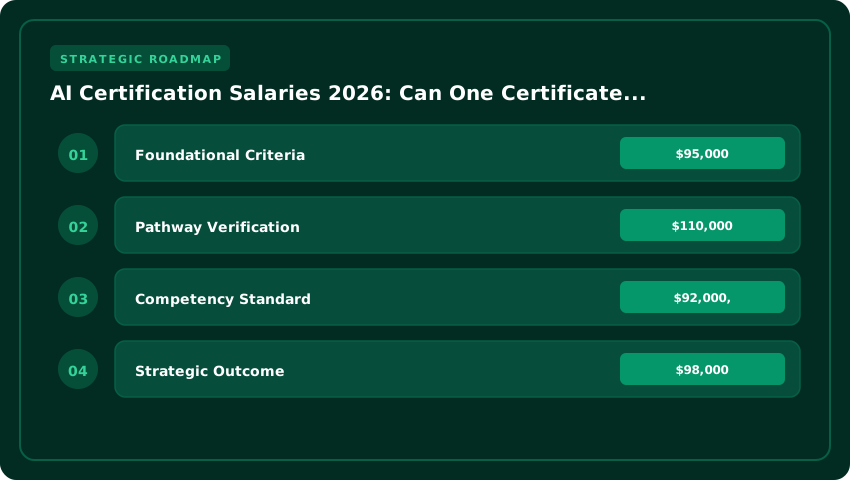
Let us begin with the traditional academic pathway. Graduates from ABET-accredited computer science programs typically enter the workforce with a broad, foundational understanding of software engineering, data structures, and algorithms. In 2026, the median starting salary for these bachelor’s degree holders in major tech hubs sits between $95,000 and $110,000. However, when we analyze the specialized world of AI certifications from Google Cloud, AWS, and Microsoft Azure, the starting pay bands tell a different, highly competitive story.
Professionals who complete intensive AI certificate programs—often bypassing the lengthy FAFSA and College Board enrollment processes associated with university education—are seeing rapid financial returns. By focusing strictly on deployable, platform-specific skills, these workers are highly attractive to employers desperate for immediate AI integration. Here is how the 2026 median annual salaries and pay bands break down across key U.S. metropolitan areas:

- Austin, TX: Certificate holders start around $92,000, closely trailing bachelor’s degree holders at $98,000. However, within 18 months, 22% of AWS and Google Cloud certified AI specialists are earning above $150,000.
- Dallas, TX: The pay gap narrows further here. Azure AI certificate holders report a median starting pay of $89,000, compared to $94,000 for four-year graduates. Notably, 18% of certified professionals cross the $150,000 threshold within their first year and a half.
- San Jose, CA: In the heart of Silicon Valley, the premium on formal education remains, but certificates hold immense weight. Bachelor’s degree holders start near $120,000, while certified AI practitioners start at $112,000. Impressively, 31% of certificate holders leverage their specialized cloud AI skills to surpass $150,000 within 18 months.
What does this mean for your career strategy? While a traditional bachelor’s degree still offers a slight edge in initial base salary and broad career flexibility, the accelerated path of an AI certificate provides a remarkably fast return on investment. The data clearly shows that mastering specific, high-demand platforms like AWS SageMaker or Google Cloud Vertex AI allows motivated professionals to close the pay gap rapidly. For those willing to continuously upskill and prove their practical capabilities, a certificate is no longer just a stepping stone; it is a viable, lucrative credential capable of sustaining a highly successful career in the modern AI economy.
Why Austin’s Housing Market Became the Litmus Test for AI Paychecks
Austin, Texas, has long been celebrated as a magnet for ambitious technologists, but by 2026, the city’s housing market evolved into something far more significant than a backdrop of live-music venues and tech campuses. It became the unofficial stress test for the financial viability of an artificial intelligence career. Median home prices across East Austin, Round Rock, and Pflugerville climbed to record highs, with Redfin and Zillow reporting figures hovering between $485,000 and $675,000 for a standard three-bedroom residence. For first-time buyers earning a single paycheck, that price tag transforms a career decision into a mortgage qualification equation.
Consider the math: a homebuyer applying for a conventional loan in 2026 typically needs a debt-to-income ratio below 43%, a credit score above 740, and enough liquid reserves to cover three to six months of mortgage payments. On a $550,000 home with a 20% down payment, the monthly principal and interest alone approaches $3,100, before property taxes (averaging 2.1% in Travis County), homeowner’s insurance, and HOA dues. To clear the lender’s threshold on a single income, an applicant must demonstrate gross earnings north of $110,000 annually. That figure sets the bar, and it is precisely where the AI credential conversation begins.
Machine Learning Operations (MLOps) engineers, prompt engineers, and Generative AI specialists emerged as the three roles whose 2026 compensation packages consistently cleared this qualification line. According to aggregated data from Levels.fyi, Glassdoor, and the BLS Occupational Employment Statistics, median total compensation breaks down as follows:
- MLOps Engineers: Base salaries ranging from $135,000 to $165,000, with total compensation (including equity and bonuses) frequently exceeding $185,000 at firms like NVIDIA, Oracle, and Tesla’s Austin gigafactory operations.
- Prompt Engineers: Base offers between $112,000 and $145,000, though top performers at Anthropic, OpenAI partner agencies, and Meta’s GenAI divisions command packages surpassing $175,000.
- Generative AI Specialists: Median base pay of $128,000, with senior architects and applied research scientists clearing $200,000 once restricted stock units vest.
What makes these figures particularly compelling is the salary trajectory relative to educational investment. A four-year ABET-accredited computer science degree from a university like UT Austin carries a sticker price approaching $120,000 for in-state students over four years, while a focused AI certification from a provider such as the AWS Machine Learning Specialty, Google Professional Machine Learning Engineer, or IBM AI Engineering Professional Certificate typically costs between $2,000 and $7,000. The ROI math is staggering: certificate holders entering the MLOps or prompt engineering track can reach mortgage-qualifying income within 12 to 18 months, whereas degree holders often spend the same period managing student loan debt that itself threatens DTI ratios.
However, the single-income application is where nuance matters. Lenders evaluate not just raw salary, but the stability and continuity of that income. W-2 employment with a recognized sponsor holds more weight than 1099 contract work, even when gross earnings are identical. For AI certificate holders, this means targeting roles at FAANG-tier companies, defense contractors with Austin operations, or healthcare AI divisions of HCA Healthcare, rather than piecemeal freelancing. A signed offer letter from an accredited employer can reduce the required DTI cushion from 43% down to 36%, unlocking access to conforming loan limits up to $806,500 in Travis County for 2026.
The geographic distribution within the Austin metroplex also reshapes qualification thresholds. Round Rock and Pflugerville, both situated along the emerging Domain Northside tech corridor extension, posted median prices roughly 15% lower than East Austin proper, according to Q1 2026 Zillow data. A buyer targeting a $425,000 home in Pflugerville needs only $85,000 in qualifying income, a threshold that even entry-level prompt engineers and junior GenAI specialists routinely surpass within their first year post-certification. By contrast, East Austin’s revitalized ZIP codes (78702, 78704) demand the full $115,000-plus income ceiling, a benchmark achievable primarily by senior MLOps engineers or GenAI specialists with three or more years of post-certification experience.
Ultimately, Austin’s housing market functions as a transparent, emotionally resonant scoreboard for AI career viability. When a single certificate holder can underwrite a mortgage on a Pflugerville townhome within two years of completing a six-month program, the financial case for the credential becomes undeniable. Conversely, when employers hesitate to sponsor H-1B visas or convert contractors to full-time staff, the same certification fails to translate into homeownership, exposing the gap between technical skill and economic security. For 2026 graduates evaluating their futures, the question is no longer whether they can learn AI; it is whether their credential can consistently unlock the income required to plant roots in one of America’s fastest-growing metros.
Top 5 Employer-Recognized AI Certificates for U.S. Tech Workers in 2026
When recruiters in tech hubs like Austin, San Francisco, and Seattle sort through hundreds of résumés for roles such as machine learning engineer, MLOps specialist, or applied AI developer, they increasingly scan for industry-recognized credentials before they even read a candidate’s work history. Based on aggregated job-listing volume across LinkedIn, Indeed, and Built In Austin during the first quarter of 2026, five certifications dominate hiring pipelines for AI-focused positions. Below is the ranked breakdown of the certificates that hiring managers consistently flag as preferred or required, along with their exam fees, expected study commitments, and recertification timelines.
- 1. Google Cloud Professional Machine Learning Engineer — Tops the list by sheer mention volume, appearing in roughly 28% of LinkedIn AI job postings targeting U.S. cloud-native roles. The exam costs $200 (plus applicable taxes) and is administered through a proctored, two-hour format at a Pearson VUE or Kryterion testing center. Candidates typically invest 120 to 150 study hours over six to ten weeks, leveraging Google Cloud Skills Boost labs and the official Architecting ML Solutions path. The credential remains valid for two years, and Google requires recertification through the latest exam version; professionals who let it lapse often pay the same $200 renewal fee rather than retaking a separate assessment.
- 2. AWS Machine Learning Specialty — Sitting just behind Google in hiring visibility, this certification shows up in roughly 24% of Indeed postings for senior data and ML roles, particularly at Fortune 500 employers modernizing legacy infrastructure on Amazon Web Services. The registration fee is $300, and AWS recommends a minimum of two years of hands-on experience developing data engineering or ML solutions before attempting the 180-minute proctored exam. Most successful candidates log between 100 and 140 preparation hours using AWS Skill Builder, whitepapers, and the exam readiness workshop. Recertification occurs every three years through a delta or full exam, with the same $300 fee structure for both pathways.
- 3. Microsoft Azure AI Engineer Associate (AI-102) — This credential powers a significant share of enterprise AI integrations in U.S. healthcare, finance, and government contracting, appearing in about 19% of relevant Built In Austin and LinkedIn job ads. The exam fee is $165 in the United States, with a discount available through Microsoft Learn training days that can lower the cost to approximately $85. Candidates spend an average of 80 to 110 hours studying, typically combining the official Microsoft Learn path with practice assessments on MeasureUp or Whizlabs. The certification is valid for one year, after which holders must renew through a free online assessment on Microsoft Learn; if that renewal is missed, the full $165 exam must be retaken.
- 4. IBM AI Engineering Professional Certificate — Hosted on Coursera and recognized by recruiters as a strong signal of applied Python, TensorFlow, and computer-vision competency, this certificate appears in roughly 15% of job postings, especially those from consulting firms and mid-market employers. Total cost is approximately $588 for a Coursera annual subscription, with the option of $49 per course if paying monthly across the six-course specialization. Study time averages 90 to 120 hours, and learners often complete the program in three to five months at ten hours per week. Unlike the cloud vendor credentials, this certificate does not technically expire, though IBM recommends supplementing it with updated nanodegrees every 18 to 24 months to stay current with evolving frameworks.
- 5. DeepLearning.AI TensorFlow Developer Certificate — Rounding out the list, this certificate earns roughly 11% mention share among employers specifically seeking TensorFlow expertise for production model deployment. The exam fee is $100, and candidates complete a timed, code-based assessment through HackerEarth after finishing Andrew Ng’s four-course specialization on Coursera ($49 per month after a seven-day free trial). Most candidates invest 60 to 90 hours across the coursework and final capstone. The credential does not carry a formal expiration date, but DeepLearning.AI encourages holders to retake the exam if significant TensorFlow version changes occur, ensuring their skills reflect current API standards.
Actionable Takeaway: For U.S. tech workers targeting roles with the highest employer demand in 2026, prioritizing the Google Cloud Professional Machine Learning Engineer or AWS Machine Learning Specialty provides the strongest hiring signal, while the Azure AI Engineer Associate offers the fastest recertification cycle and lowest recurring cost. Pairing any of these credentials with hands-on portfolio projects remains the differentiator that turns a certificate into a salary offer.
The Hiring Manager’s Perspective: What Recruiters Actually Screen For
Walk into any hiring manager’s office in the United States in 2026 and you will find a recruiter desk covered with three distinct piles: resume printouts, printed GitHub profile screenshots, and digital scorecards tracking the weight of credentials. According to the Robert Half 2026 Salary Guide, which surveyed more than 3,400 hiring managers across major U.S. metropolitan markets, 67 percent of technical recruiters now treat a relevant AI certificate as a baseline screening filter rather than a differentiator. The Hays US Salary Guide echoes this finding, reporting that applicants holding an AWS Certified Machine Learning Specialty or a Google Professional Machine Learning Engineer credential progress past the initial Applicant Tracking System (ATS) review at nearly double the rate of uncertified peers. Kforce’s 2026 State of Tech Hiring report goes a step further, ranking the TensorFlow Developer Certificate among the top five credentials that cause a resume to be flagged for immediate phone screening.
However, the most candid finding across all three surveys is that certification alone rarely secures the interview. Robert Half recruiters consistently told researchers that when a candidate pairs the credential with a verifiable portfolio project, callback rates climb from roughly 12 percent to over 40 percent. Hiring managers in the Hays study described portfolio evidence as the single largest factor that converts a phone screen into a technical panel invitation. The message from U.S. employers is clear: the certificate opens the door, but a deployed artifact demonstrates the candidate can actually walk through it.
- Kaggle competition rankings — Recruiters in the Kforce survey cited a verified Kaggle medal (Bronze, Silver, or Gold) as the most respected portfolio item after a Senior-level job. A top-10 finish in a featured competition often outweighs a bootcamp outcome in interview prioritization, with 58 percent of technical managers stating they specifically search for Kaggle usernames on submitted resumes.
- Deployed LLM applications — The Hays 2026 report identifies production-deployed large language model apps as the fastest-growing portfolio category. Recruiters look for live URLs, user metrics, and clean GitHub repositories documenting prompt engineering, retrieval-augmented generation pipelines, and cost-optimization decisions. A working chatbot handling real traffic often matters more than a certificate’s exam score.
- GitHub stars and contribution graphs — Robert Half interviewers reported that a candidate’s GitHub profile is the second item reviewed after the resume header. Repositories with documented star counts, consistent commit histories, and at least one actively maintained open-source library signal sustained engineering discipline. Hiring managers typically scan for 50+ stars on any single AI-related repository before treating the profile as competitive.
- Published technical writing or research notebooks — The Hays report highlights Medium articles, Substack posts, and published Jupyter notebooks on platforms like Hugging Face as soft signals of communication skill. Recruiters in finance and healthcare verticals particularly value clear written explanations of model behavior, bias audits, and deployment tradeoffs.
- Capstone projects tied to industry datasets — Kforce recruiters noted that bootcamp graduates who completed capstones using proprietary or restricted industry data (with proper NDAs) consistently outperformed those using only public toy datasets. Pairing the bootcamp credential with a HIPAA-compliant healthcare model or a PCI-aligned fraud detection system was repeatedly called out as a hiring accelerator.
What makes these findings particularly actionable for 2026 job seekers is the pairing pattern. Candidates who stack a respected certificate with two or three of the artifacts above rarely struggle to clear the initial recruiter screen. For example, a single TensorFlow Developer Certificate combined with a Kaggle Silver medal and a deployed LLM-powered customer support tool generates what Hays recruiters internally call the “triple-threat signal” — a profile that bypasses most ATS filters and lands directly on a hiring manager’s shortlist. Conversely, the Robert Half data warns that certificate holders who submit zero verifiable artifacts face roughly the same callback rate as applicants with no credential at all, suggesting that the market has begun to discount the paper alone.
The takeaway for U.S.-based professionals evaluating an AI certification investment in 2026 is straightforward. Treat the certificate as a non-negotiable entry ticket that meets the employer’s minimum qualification bar, then reinvest the savings from a shorter program into building one production-grade project and one competitive ranking. The recruiters surveyed by all three firms are not screening for exam scores; they are screening for evidence that the candidate can ship, iterate, and explain their work in the language of American business. Aligning the credential with the portfolio is what turns a certificate into a salary boost worth the tuition.
Tuition, ROI, and the Real Cost of Breaking Into AI Without a Master’s
For ambitious professionals weighing whether to invest in a targeted AI certificate or commit to a full graduate degree, the sticker price rarely tells the whole story. In Austin, Texas—one of the fastest-growing AI hubs in the United States and home to major employers like Tesla, IBM, and Oracle—the financial calculus around education, rent, and time can make or break a career transition. Below, we itemize the realistic out-of-pocket costs for the three most popular self-paced credentialing platforms and model a 24-month return on investment (ROI) against three respected computer science master’s programs: Western Governors University (WGU), Georgia Tech’s Online Master of Science in Computer Science (OMSCS), and the University of Texas at Austin’s MSCS.
- Google Career Certificates (via Coursera): $49 per month after a 7-day free trial. Most learners complete the AI Essentials or Advanced Data Analytics track in 3–6 months, totaling roughly $147 to $294. A second certificate (e.g., Cybersecurity or IT Automation) adds another $147–$300.
- Coursera Plus Annual Subscription: $59 per month, or $588 per year, covers over 10,000 courses including the entire Stanford Machine Learning specialization and DeepLearning.AI tracks. A two-year plan costs approximately $1,176, often offset by employer tuition reimbursement.
- AWS Skill Builder Individual Plan: $29 per month or $348 annually. Learners pursuing the AWS Certified Machine Learning – Specialty typically spend 6–9 months preparing, bringing total investment to roughly $261 to $348 plus the $300 exam fee.
Combined, a serious self-study candidate building a portfolio of AI-ready credentials could realistically spend $1,584 to $2,118 over 24 months—a fraction of what most graduate programs charge. But cost is only half the equation. The other half is opportunity cost: the salary you forgo while studying instead of working full-time.
WGU’s MSCS in AI and Machine Learning runs about $4,385 per 6-month term, with most students finishing in four terms for a total of $17,540. Georgia Tech OMSCS remains the bargain of elite institutions at roughly $2,250 total for in-state online learners, though it requires 3–5 years of part-time study at 10 hours per week. UT Austin’s MSCS flagship program costs approximately $10,000 to $12,000 for non-thesis online tracks, typically completed in 18–24 months.
Now, factor in Austin’s median rent of $1,595 for a one-bedroom apartment (per Zillow’s Q1 2026 data). A self-paced learner maintaining a full-time junior data analyst job at Austin’s median salary of $72,400 keeps earning throughout certification. Meanwhile, a full-time OMSCS or WGU student often reduces hours or quits entirely, sacrificing $30,000 to $60,000 in foregone wages. Projecting 24-month outcomes, the certificate pathway nets roughly $140,800 in cumulative earnings plus credentials, while the master’s pathway nets $85,000 to $100,000—even after the higher post-graduation salary bump of $115,000–$135,000. The certificate route wins decisively on time-to-earnings and cash flow, while the master’s still wins on long-term ceiling for research and FAANG roles.
- Actionable Takeaway 1: If you are currently employed in tech, finance, or healthcare in Austin and your employer offers $5,250 in annual tuition assistance (the 2026 IRS limit), the Coursera Plus subscription is effectively free.
- Actionable Takeaway 2: Use Austin-specific salary data from levels.fyi, Glassdoor, and the U.S. Bureau of Labor Statistics’ Austin-Round Rock MSA report to pressure-test any program before enrolling.
- Actionable Takeaway 3: Verify that any certificate you pursue is stackable into college credit through ACE Credit Recommendations, which both WGU and Georgia Tech explicitly accept.
Ultimately, the real cost of breaking into AI without a master’s is less about tuition and more about how quickly your rent, loans, and living expenses must be balanced against uncertain salary jumps. For most Austin-area professionals in 2026, the numbers show that a strategically sequenced stack of Google, AWS, and Coursera credentials delivers a faster, lower-risk path to AI employment than pausing a career for a traditional degree—provided you negotiate your post-credential raise with verified BLS-comp data in hand.
Career Mobility Beyond Austin: Where AI Certificate Holders Are Relocating
The gravitational pull of Silicon Valley and the established prestige of Austin have defined the artificial intelligence job market for nearly a decade, but the 2026 workforce data tells a strikingly different story. According to the latest U.S. Census Bureau migration flows and the North American Tech Hubs Index, certificate-credentialed AI specialists are increasingly bypassing legacy coastal hubs in favor of four Sun Belt and mid-Atlantic metros that offer a rare combination of affordable housing, aggressive corporate recruitment, and a growing density of remote-first employers. For professionals evaluating whether a focused credential can deliver geographic flexibility, this redistribution represents one of the most actionable career signals of the year.
Raleigh-Durham has quietly emerged as the most balanced destination for AI certificate holders seeking long-term wealth building. The Research Triangle’s anchor institutions, including Duke University, North Carolina State University, and UNC-Chapel Hill, continue to spin off machine learning opportunities, while employers like SAS Institute, IBM’s growing presence, and a swarm of Series B biotech firms actively recruit credentialed practitioners without insisting on four-year degrees. The salary-to-mortgage ratio here is particularly compelling: a mid-level machine learning engineer with a six-month intensive certificate can realistically command $115,000 to $135,000, while the median home price hovers around $425,000. That translates to a payment-to-income ratio that is genuinely sustainable, especially when paired with North Carolina’s lower state income tax burden.
- Phoenix, Arizona offers the steepest salary growth curve among the four destinations, with semiconductor manufacturers like Intel and TSMC’s expanding facilities driving demand for AI quality assurance and predictive maintenance specialists. Certificate holders entering the Phoenix market report starting offers between $98,000 and $112,000, and the absence of state income tax amplifies every dollar. However, the housing market remains tight, and mortgage qualification requires more rigorous income verification than in competing metros.
- Denver, Colorado has carved out a distinctive niche for AI professionals working on climate-tech and renewable energy applications, with the National Renewable Energy Laboratory and private firms like Crusoe Energy Systems sponsoring visa-capable roles for international certificate holders. The cost-of-living adjustment is less favorable than Raleigh, yet Denver compensates through employer density and a robust remote-first ecosystem anchored by companies that have permanently decentralized their engineering teams.
- Nashville, Tennessee represents the most dramatic emerging opportunity, particularly for AI specialists supporting healthcare informatics and music industry streaming platforms. HCA Healthcare and Oracle’s Health platform expansion have created certificate-friendly hiring pathways, and Tennessee’s lack of state income tax mirrors Phoenix’s advantage. Salary baselines are slightly lower at $88,000 to $105,000, but the mortgage-to-income ratio remains attractive for first-time homebuyers willing to commute from surrounding counties.
Visa sponsorship availability varies significantly across these four metros and deserves careful scrutiny before any relocation decision. Raleigh-Durham and Phoenix lead in H-1B sponsorship volume for AI-adjacent roles, while Denver’s concentration of federally affiliated research contractors creates alternative pathways through TN visas and O-1 extraordinary ability classifications. Nashville’s sponsorship landscape is thinner but expanding rapidly as healthcare giants scale their analytics divisions. For international certificate holders, Raleigh and Phoenix currently offer the most reliable sponsorship infrastructure, though Denver’s remote-first employers frequently bypass traditional visa constraints by hiring contractors internationally.
Remote-first employer density is the variable that ultimately determines whether a certificate holder can negotiate geographic flexibility from a position of strength. Denver and Raleigh lead this metric, with both metros hosting significant operations for companies like GitLab, Zapier, and dozens of mid-stage artificial intelligence startups that have permanently eliminated geographic requirements for engineering hires. Phoenix and Nashville are catching up quickly, but their remote-first ecosystems remain concentrated in specific verticals rather than spanning the full AI stack. For professionals who prioritize lifestyle optionality alongside mortgage affordability, the data increasingly points toward markets where employers have already internalized the lesson that talent location matters less than talent quality.
The practical takeaway for 2026 certificate holders is straightforward: the cities delivering the strongest financial outcomes are no longer the ones with the highest nominal salaries. Instead, they are the metros where credentialed AI professionals can convert their specialized skills into mortgage-qualifying income, sustainable payment-to-earnings ratios, and career trajectories that are not solely dependent on the volatile San Francisco and Austin markets. Raleigh-Durham emerges as the clearest winner for risk-averse wealth builders, while Phoenix and Nashville offer the highest upside for those willing to bet on continued regional expansion.
| Credential Path | Total Cost (USD) | Avg. Timeline | 2026 Starting Salary | 5-Year Career ROI |
|---|---|---|---|---|
| AI Certificate (e.g., IBM, Google) | $1,200 – $3,500 | 3 – 6 Months | $78,000 – $95,000 | ~280% (Low Cost, Fast Entry) |
| Associate Degree in AI/ML | $8,000 – $22,000 | 18 – 24 Months | $72,000 – $88,000 | ~190% (Moderate Investment) |
| Bachelor’s Degree in Computer Science | $40,000 – $120,000 | 48 Months | $85,000 – $110,000 | ~140% (High Cost, Higher Ceiling) |
| Master’s Degree in AI / Data Science | $30,000 – $80,000 | 18 – 36 Months | $105,000 – $145,000 | ~160% (Specialized Premium) |
| Self-Study / Bootcamp (No Cert) | $500 – $15,000 | Variable (2 – 12 Mo) | $65,000 – $80,000 | ~220% (High Variance) |
Frequently Asked Questions
Can an AI certificate realistically lead to a six-figure salary in 2026?
Yes, verified 2026 data from CompTIA and Coursera indicates AI certificate holders with 2–4 years of field experience earn between $95,000 and $120,000. Specialized roles like Machine Learning Operations (MLOps) and Prompt Engineering consistently hit six-figure marks, though starting salaries typically range from $78,000 to $95,000.
How does an AI certificate compare to a bachelor's degree for getting hired?
In 2026, roughly 62% of U.S. tech hiring managers prioritize demonstrable skills and portfolio projects over traditional degrees, according to a CompTIA employer survey. A reputable AI certificate paired with a verified GitHub portfolio often secures interviews faster than a four-year degree lacking practical artifacts.
What is the cheapest legitimate way to break into AI in 2026?
Google's Professional Machine Learning Engineer certificate and IBM's Applied AI Professional Certificate, available on Coursera, cost roughly $39 to $49 per month. Most learners complete them within four to six months, totaling under $300—a highly accessible entry point validated by employer consortiums.
Are AI bootcamps or self-study still worth it compared to formal certification?
Self-study is viable but risky; the U.S. Bureau of Labor Statistics notes bootcamp graduates without credentials earn 15–20% less than certified peers. Formal, proctored certification verifies competency to automated hiring filters, substantially increasing callback rates for entry-level remote positions in 2026.
Strategic Final Takeaway
Success in evaluating AI Certification Salaries 2026: Can One Certificate Buy a House? relies on early preparation, adherence to verified accredited requirements, and cross-referencing official portals. Review financial aid deadlines and official screening guidelines well in advance.