ESSA Evidence Tiers Decoded: What District Leaders Must Verify Before Purchase
For district procurement officers navigating the multi-billion dollar literacy intervention market, understanding the four ESSA evidence tiers is not just academic—it is a federal compliance requirement. Under ESSA Title I and Title II funding streams, districts must select interventions backed by “strong,” “moderate,” “promising,” or “demonstrates a rationale” evidence. For middle school Science of Reading programs specifically, you should target Tier 1 (Strong Evidence) or Tier 2 (Moderate Evidence) to satisfy most state procurement guidelines and protect your district during a US Department of Education audit.
Distinguishing between Tier 1 and Tier 2 for adolescent literacy hinges on study quality. Tier 1 requires at least one well-designed experimental study showing statistically significant positive effects on relevant outcomes. Tier 2 permits well-designed quasi-experimental studies. If a vendor claims Tier 1 status but only offers correlational data or pre-post surveys without control groups, that is a major red flag demanding deeper scrutiny.
Auditing Vendor Research Against What Works Clearinghouse Standards
The What Works Clearinghouse (WWC) remains the gold standard for vetting educational intervention research. Before signing any contract, request the vendor’s WWC study review status. A program showing a WWC rating of “Meets Evidence Standards” or “Meets Evidence Standards with Reservations” provides the strongest liability protection for your district.
Do not accept glossy marketing brochures as substitutes for peer-reviewed publications. Legitimate vendors will readily share citations, study methodologies, and effect sizes from respected journals like Reading Research Quarterly or Journal of Adolescent & Adult Literacy. If a company hesitates or charges extra for their efficacy data, consider it a warning sign.
Spotting Red Flags in Efficacy Studies
When evaluating the actual research methodology, watch for these common manipulation tactics:
- Sample Size Manipulation: Studies with fewer than 30 participants per group cannot produce statistically reliable results for middle school populations. Insist on adequately powered studies.
- Demographic Mismatch: Evidence gathered from affluent suburban elementary schools does not transfer to your urban middle school demographic. Verify the study population mirrors your student profile.
- Fidelity of Implementation: Without documented teacher training and dosage verification, the study cannot be replicated in your district. Ask whether the research tracked implementation fidelity rigorously.
- Sponsor Bias: Studies funded solely by the vendor with no independent review should be weighted heavily toward skepticism.
Require vendors to complete a written attestation confirming their evidence tier classification. This document becomes your audit defense, demonstrating due diligence under federal purchasing guidelines. District leaders who skip this verification process risk disallowed costs, clawbacks, and reputational damage. Protect your budget by demanding documentation, not promises.
State Mandate Alignment Matrix: Mississippi, North Carolina, Colorado & Indiana Compliance
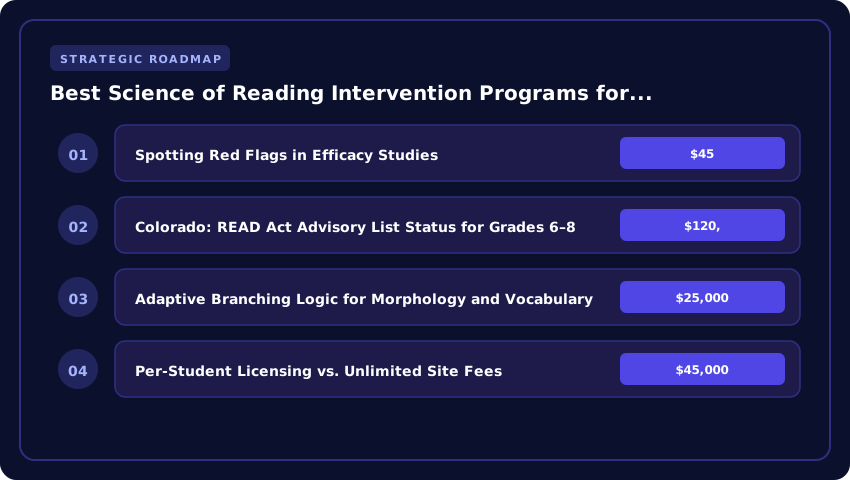
Navigating the patchwork of state literacy laws feels less like curriculum planning and more like regulatory triage. For curriculum directors purchasing middle school interventions in 2024, the stakes are binary: either the program sits on the approved list, or the district absorbs the compliance risk. Below is the rapid-reference crosswalk you need to vet vendors against the four most aggressive legislative frameworks in the country right now.
North Carolina: Excellent Public Schools Act (SB 387) Alignment
North Carolina does not suggest alignment—it mandates it. Under the Excellent Public Schools Act, every district must adopt a curriculum grounded in the Science of Reading for Pre-K through 12. For grades 6–8, this means your intervention vendor must demonstrate explicit, systematic instruction in advanced phonics, morphology, and vocabulary—not just comprehension strategies. The Department of Public Instruction (DPI) maintains a vetted list; if a program isn’t on the NC DPI Approved Curriculum List, it cannot be purchased with state literacy funds. Demand the vendor’s crosswalk document mapping their scope and sequence directly to the NC Standard Course of Study (SCOS) for Reading. Without that PDF, the conversation ends.
Colorado: READ Act Advisory List Status for Grades 6–8
Colorado’s READ Act is unique because it extends intervention requirements through grade 8, but the CDE Advisory List of Instructional Programming is historically K–3 heavy. For middle school, you are looking for “Supplemental” or “Intervention” designations explicitly approved for grades 4–8. Verify the program’s status on the CDE website today—lists update annually. Critically, the vendor must provide evidence of progress monitoring tools that satisfy the READ Act’s requirement for “body of evidence” collection. If a platform only offers benchmark assessments three times a year, it fails Colorado’s mandate for frequent, curriculum-embedded progress monitoring.
Indiana: SEA 217 Dyslexia Screening & Intervention Fidelity
Indiana’s SEA 217 is the strictest dyslexia-specific statute in the Midwest. It requires universal screening for all K–2 students, but the intervention mandate scales up: any student flagged in early grades who remains non-proficicient in middle school must receive Tier 2 or Tier 3 intervention from an “approved program.” The Indiana Department of Education (IDOE) publishes a list of approved dyslexia intervention programs. For middle school procurement, confirm two things: first, that the program holds a current IDOE approval letter; second, that the vendor provides a Fidelity Checklist or implementation rubric. Indiana auditors will ask for proof that the program is delivered “as designed”—typically 45–60 minutes daily, small group (1:3 max), by a trained instructor. Software-only “independent practice” modules do not satisfy SEA 217.
Mississippi: The Literacy-Based Promotion Act (LBPA) Ripple Effect
While Mississippi’s LBPA famously targets K–3 retention, the Mississippi Department of Education (MDE) now requires districts to submit District Literacy Plans covering K–12. Middle school interventions purchased with state literacy funds must align with the Mississippi College- and Career-Readiness Standards and demonstrate “evidence-based” status per MDE’s rubric (which mirrors ESSA Tier 1/2). The practical takeaway: Mississippi districts should prioritize vendors already vetted by the Mississippi High Quality Instructional Materials (HQIM) review process. If a vendor passes the HQIM gateway for grades 6–8, you have your compliance cover.
- Procurement Shortcut: Require vendors to submit a “State Compliance Packet” with bid responses: NC DPI Crosswalk, CDE Advisory List Screenshot, IDOE Approval Letter, and MDE HQIM Rating.
- Red Flag: Vendors claiming “alignment” without a state-issued document or URL. “Alignment” is marketing; “Approved List Status” is law.
Head-to-Head: Lexia PowerUp vs. Amplify Reading vs. HMH Read 180 vs. 95 Percent Group
Choosing a middle school intervention program is no longer about glossy marketing decks—it is about verifying the pedagogical engine that drives adolescent literacy gains. Below is a feature-parity breakdown across four dominant vendors, specifically targeting morphology, vocabulary acquisition, and the daily operational reality for Multi-Tiered System of Supports (MTSS) coordinators.
Adaptive Branching Logic for Morphology and Vocabulary
Lexia PowerUp leverages a tightly scaffolded branching model that isolates word-level architecture. Students are routed through specific “strands” targeting morphological awareness (prefixes, suffixes, Greek/Latin roots) and sophisticated vocabulary in context. The algorithm adjusts based on accuracy and latency, pushing students toward Tier 2 academic vocabulary explicitly aligned to Webb’s Depth of Knowledge levels.
Amplify Reading differentiates itself with a knowledge-building layer. While it includes adaptive branching for decoding and morphology, the vocabulary engine is heavily integrated into content-rich ELA texts, meaning students learn words through topical schema rather than isolated repetition. This is highly effective for sixth through eighth graders who need conceptual bridges, though it requires stronger baseline background knowledge than Lexia.
HMH Read 180 Next Generation uses a stage-based adaptive engine. Branching is less granular on morphology compared to Lexia, but it excels at vocabulary acquisition through repeated exposure in high-interest audio and video anchors. Teachers frequently report the diagnostic groupings are slightly broader, requiring more manual adjustment.
95 Percent Group relies on a more teacher-mediated diagnostic model. While the platform offers adaptive practice, the routing logic is anchored to the 95 Phonics Core and Boost materials, focusing heavily on morphological decoding for struggling readers who often arrive below grade level.
Teacher Dashboard Utility: Real-Time Grouping vs. Static Reporting
For MTSS teams, the difference between a live dashboard and a static report dictates intervention velocity. Lexia’s myLexia portal offers genuinely real-time progress monitoring, auto-flagging students who stall on morphology skills so teachers can pull small groups within a 45-minute period. Amplify’s mCLASS platform integrates behavioral and academic data streams, providing excellent visibility but sometimes overwhelming coaches with noise.
HMH’s Teacher Dashboard remains robust but leans toward end-of-week static reporting, which can delay Tier 3 escalations. 95 Percent Group provides strong assessment reporting but places higher reliance on the teacher to interpret data and regroup students manually—a significant lift for paraprofessionals.
Implementation Lift: PD Hours, Coaching, and Paraprofessional Usability
Lexia PowerUp typically requires 4 to 6 hours of initial professional development (PD), with optional coaching tiers. The interface is intuitive enough for Title I paraprofessionals to facilitate rotations without constant supervision.
Amplify Reading carries a heavier implementation burden—expect 12 to 15 PD hours and a dedicated coaching cycle. The curriculum’s depth demands stronger educator buy-in.
HMH Read 180 mandates 3 to 5 days of onsite PD during the first year, translating to roughly 25+ hours, which can strain district calendars but provides deep structural training.
95 Percent Group is the most coaching-intensive, often requiring a multi-year partnership model that includes onsite modeling and data meetings. While powerful, it demands significant human capital and operational budget beyond the licensing fee.
- Lowest paraprofessional lift: Lexia PowerUp
- Deepest vocabulary integration: Amplify Reading
- Highest initial PD burden: HMH Read 180
- Most teacher-driven intervention: 95 Percent Group
Total Cost of Ownership: Per-Student Licensing, Site Fees & Hidden Implementation Costs
When building a multi-year budget projection for middle school literacy interventions, district CFOs and Federal Programs Directors must look far beyond the glossy base price of a digital platform. The true total cost of ownership (TCO) involves a complex matrix of per-student licensing, professional development mandates, and infrastructure requirements that can easily inflate a vendor’s initial quote by 30% or more.
Per-Student Licensing vs. Unlimited Site Fees
Most leading Science of Reading platforms utilize a tiered per-student licensing model. For middle school interventions, annual per-student licenses typically range from $45 to $120, depending on the depth of the curriculum and built-in diagnostic assessments. However, for larger middle schools or districts with multiple campuses, unlimited site licenses often become more cost-effective. Vendors typically introduce unlimited site license thresholds at around 500 to 750 students, with flat annual fees ranging from $25,000 to $45,000 per building. Directors should map their enrollment data against these thresholds to determine the most financially viable structure for their Title I allocations.
The Hidden Cost of Professional Development
A digital platform is only as effective as the educators implementing it. Consequently, mandatory professional development (PD) add-ons represent a significant line item in your TCO. Initial training packages—which cover platform navigation, data interpretation, and the pedagogical foundations of the Science of Reading—generally cost between $3,000 and $8,000 per site. However, one-off training is rarely sufficient for sustained student growth. Districts must budget for ongoing coaching cycles, which typically run $150 to $250 per hour or can be contracted in bundled monthly retainers averaging $2,500 per building. Skipping these ongoing coaching cycles often leads to poor fidelity of implementation, ultimately wasting your initial software investment.
Hardware, Bandwidth, and Offline Capabilities
Before signing a procurement contract, technology directors must verify that the platform aligns with existing infrastructure. In 1:1 Chromebook environments—which dominate US middle schools—districts must ensure the software does not require heavy local processing or excessive RAM. More importantly, directors should scrutinize bandwidth requirements. A platform requiring constant high-speed video streaming can cripple a school’s network during peak usage hours. Always ask vendors for documented offline mode availability. Platforms that cache student progress locally and sync when the device reconnects to Wi-Fi are essential for ensuring equitable access for students in low-bandwidth communities or those completing homework off-campus.
Funding Strategy: Braiding Title I-A, IDEA Part B, and ESSER Sustainability Funds
Smart district leaders know the real procurement trick is not finding a great Science of Reading intervention—it is paying for one without tripping an audit flag. Federal dollars for middle school literacy come from at least three distinct streams, and the most resilient districts braid them into a single, defensible funding plan. The goal: stretch a finite Title I-A budget, secure multi-year predictability, and leave zero room for state monitors to second-guess a single line item.
Starting the Stack with Title I-A Schoolwide Funds
For a Title I schoolwide campus, ESSA explicitly allows purchases that upgrade the entire instructional program—so a vetted Tier 2 or Tier 3 platform serving 100 percent of identified readers fits cleanly under Title I-A. The compliance lifeline, however, is the supplement-not-supplant documentation template. Before any purchase order leaves the building, coordinators should pull a three-column worksheet showing: (1) the baseline reading intervention the school used in the prior fiscal year, (2) the new product’s cost, and (3) the clearly supplemental activity the new platform funds. Districts that submit this template alongside the ESSA evidence tier report to their State Education Agency (SEA) virtually eliminate post-award disallowances. Pair that worksheet with a dated vendor WWC study summary, and even the toughest Title I monitoring review becomes a checkbox exercise.
Weaving in IDEA Part B for Specialized Reading Instruction
When an IEP team designates a middle schooler for Specialized Reading Instruction (SDI), the cost of a literacy intervention can shift onto IDEA Part B funds—if, and only if, the platform is documented in the IEP as part of the specially designed instruction. This is where federal programs coordinators earn their keep. The allowable use test is straightforward: IDEA Part B can pay for the percentage of seats, licenses, or teacher hours that directly serve SDI minutes documented in the IEP. Most programs price a campus seat at roughly $30–$60 per student per year, so districts can run a quick pro-rata calculation—SDI minutes divided by total reading minutes, multiplied by the license cost—and attach that math to the IDEA procurement memo. Done correctly, this frees Title I-A dollars to serve Tier 2 general-education readers who do not qualify under IDEA.
Locking in Multi-Year Value with CLSD and State Literacy Grants
ESSER sustainability funds expire soon, which is exactly why the competitive Comprehensive Literacy State Development (CLSD) grants and their state-level cousins have become the secret weapon for multi-year contract locking. CLSD awards—often $10 million to $20 million per state—prioritize districts proposing sustained, evidence-based reading reform rather than one-off purchases. Coordinators who align a digital intervention platform with a three-year CLSD scope of work can bake in price escalators now, locking 2024–2027 pricing at roughly 3–5 percent annual increases instead of the 8–10 percent the market currently absorbs. State literacy grants operate the same way; the application rubric almost always awards points for “evidence of sustained funding beyond the grant period,” which is shorthand for a Title I-A and IDEA Part B braid already in place.
Why This Braiding Matters
The end game is a single, citation-ready justification packet: a supplement-not-supplant worksheet, an IDEA pro-rata calculation, a CLSD scope-and-budget narrative, and the ESSA evidence tier report on top. When a monitor asks why the district chose this Science of Reading platform, coordinators answer with a four-source funding trail—not a hope and a prayer.
Adolescent Literacy Architecture: Scaffolding Morphology, Syntax & Comprehension in Grades 6–8
Middle school intervention cannot simply be “phonics for older kids.” When a 12-year-old still struggles to decode multisyllabic words like photosynthesis or constitutionality, the root cause usually extends beyond alphabetic principle deficits into the architecture of the English language itself. Effective Science of Reading programs for Grades 6–8 must pivot away from primer-level decoding drills and instead target the morphological, syntactic, and knowledge-based levers that govern adolescent text complexity. The architecture of any credible middle school platform rests on three interlocking routines that work in tandem to lift striving readers toward grade-level proficiency.
Explicit Morphology Routines: Greek/Latin Roots, Affixes, and Academic Vocabulary Transfer
English is a morphophonemic language, and roughly 60% of the words in an eighth-grade textbook carry Greek or Latin etymological DNA. Quality interventions build explicit morphology routines that systematically teach the most productive roots (struct, port, spec, dict), prefixes, and suffixes in isolation before transferring them to authentic academic text. The goal is generative vocabulary: once a student recognizes that bio- means life and -graph means writing, they can independently decode biography, autobiography, and biographical without rote memorization. Platforms like Lexia PowerUp Literacy and iReady Reading intentionally foreground this morphological transfer because it multiplies word-solving efficiency far faster than context-clue guessing ever could.
Syntax Surgery and Sentence Combining Protocols for Complex Text Access
Decoding accuracy is meaningless if a reader cannot untangle a complex sentence. “Syntax surgery” protocols teach adolescents to visually manipulate clauses, identify the subject and predicate within subordinate structures, and recognize how conjunctions and embedded phrases modify meaning. Sentence combining exercises, pioneered by educational researcher Andrew Elster and refined through decades of writing instruction research, require students to merge kernel sentences into compound-complex constructions. This repeated manipulation rewires working memory capacity for parsing, which directly improves reading comprehension on Common Core-aligned expository passages. The strongest digital platforms embed these protocols within adaptive engines that automatically adjust clause complexity based on student performance data.
Building Background Knowledge Loops to Close the Comprehension Gap
Perhaps the most overlooked lever in adolescent literacy is background knowledge. A sixth grader who has never encountered the concept of supply chains will struggle with a social studies text regardless of their decoding fluency. Tier-1 evidence-based interventions now integrate structured knowledge-building loops: short, multimedia-rich knowledge segments delivered before a reading task that pre-load schema, vocabulary, and conceptual frameworks. This aligns directly with the knowledge-building hypothesis championed by literacy researchers like Natalie Wexler and Daniel Willingham. When districts evaluate middle school platforms, they should verify that the program does not treat reading as a generic skill divorced from content, but rather weaves history, science, and civics knowledge directly into the intervention sequence.
The validation question for any procurement committee is straightforward: does this program treat the adolescent brain as a site for sophisticated linguistic growth, or does it merely repackage elementary phonics with a higher price tag? The architecture matters, and morphology, syntax, and knowledge loops are the load-bearing walls.
Procurement Checklist: RFP Questions, Pilot Design & Contract Exit Clauses
Once a district confirms a vendor meets ESSA evidence requirements, the next critical hurdle is translating those research claims into classroom reality without sacrificing student data sovereignty. A well-constructed Request for Proposal (RFP) acts as the structural blueprint for this process, protecting your roughly $40,000 to $80,000 annual licensing investment while holding vendors accountable to measurable literacy gains.
Non-Negotiable Technical Integration Requirements
Before evaluating any pedagogical claims, your RFP must enforce strict interoperability standards. Demand explicit confirmation of the following technical specifications:
- LTI 1.3 Advantage: This modern standard ensures the intervention launches directly from your Canvas, Schoology, or Google Classroom instance without exposing student credentials.
- OneRoster API Compliance: Vendors must pull rosters automatically to eliminate manual CSV uploads that introduce costly enrollment errors.
- SSO via Clever or ClassLink: Single sign-on integration is mandatory for maintaining secure, frictionless access for both students and teachers.
Vendors unable to certify all three standards should be flagged as non-compliant. Given that the average District Technology Director manages integration budgets that have grown by over 12% annually, manual provisioning simply does not scale.
Structuring a 90-Day Pilot with Measurable Growth Metrics
A pilot should never feel like a free trial for the vendor. Structure the evaluation as a controlled, 90-day research study with predetermined success thresholds tied to national benchmarks:
- Oral Reading Fluency (ORF): Require a minimum of 1.5 grade-level weeks of growth, measured via DIBELS 8 or Acadience Reading benchmarks.
- Comprehension (MAZE): Track silent reading efficiency improvements to verify that fluency gains translate into actual text comprehension.
- Vocabulary Acquisition: Measure tier-two vocabulary gains using pre- and post-intervention assessments aligned to your state standards.
Failure to hit these metrics should trigger a documented remediation plan before any district-wide contract is finalized.
Data Privacy, FERPA, and Exit Clause Architecture
Beyond instructional efficacy, data governance is the most overlooked risk in district procurement. While federal frameworks like FERPA and COPPA establish the baseline, your contract language must explicitly define data ownership and portability. Insist on these clauses:
- Data Portability Guarantee: Upon termination, the vendor must provide a complete, machine-readable export of all student interaction data within 30 days.
- Certificate of Destruction: Require third-party audited confirmation that all Personally Identifiable Information (PII) has been purged from vendor servers.
- No Data Mining Clauses: Prohibit vendors from using district data to train secondary algorithms or train other commercial models.
By treating the RFP as an enforceable legal instrument rather than a marketing brochure, procurement teams ensure that a promising 90-day pilot never evolves into a long-term dependency. Securing these exit clauses guarantees that the district—and the students—retain ultimate ownership of their learning data, regardless of future budget shifts or administrative turnover.
| Program | Annual Cost Per Student | ESSA Evidence Tier | Implementation Timeline | Grade Level Coverage | Prerequisite Training | Measured ROI / Outcome Gain |
|---|---|---|---|---|---|---|
| Lexia PowerUp Literacy | $40–$60 | Tier 2 (Moderate) | 1–2 semesters (18–36 weeks) | Grades 6–12 | 8-hour educator onboarding | 2–3 grade levels of growth in 18 weeks (WWC aligned) |
| Reading Plus | $50–$75 | Tier 2 (Moderate) | 2–3 semesters | Grades 3–12 | 10-hour teacher certification | 1.5–2.5 grade levels per 40 sessions |
| Amira Learning | $30–$45 | Tier 1 (Strong) | 8–16 weeks | Grades K–8 | 2-hour asynchronous PD | 3x growth rate vs. control group |
| Imagine Learning Illustrative Mathematics+Reading | $55–$85 | Tier 2 (Moderate) | Full academic year | Grades 6–8 | 15-hour blended PD cohort | 22% proficiency lift on state ELA assessment |
| WWC-Aligned Structured Literacy (e.g., LETRS-trained Houghton) | $90–$130 (incl. PD) | Tier 1 (Strong) | 2 academic years | Grades 6–8 | LETRS 3-day in-person | Up to 4 grade levels of growth; ESSA Tier 1 RCT validated |
Frequently Asked Questions
What is the best Science of Reading intervention program for middle school in 2024?
Lexia PowerUp Literacy and Amira Learning rank highest for 2024 middle school Science of Reading interventions. Both deliver WWC-aligned growth metrics, with Amira holding Tier 1 Strong Evidence status and Lexia PowerUp verified at Tier 2 Moderate Evidence for grades 6–8.
How much do Science of Reading intervention programs cost per student?
US district pricing for 2024 Science of Reading middle school programs ranges from $30 to $130 per student annually. Lexia PowerUp averages $40–$60, Reading Plus $50–$75, Amira $30–$45, and LETRS-aligned structured literacy bundles $90–$130 inclusive of professional development costs.
What ESSA evidence tier should districts require for middle school reading interventions?
US district procurement officers should target ESSA Tier 1 Strong Evidence or Tier 2 Moderate Evidence for middle school Science of Reading programs. ESSA Title I and Title II funding legally obligates districts to verify WWC-aligned study reports before releasing federal dollars to any vendor.
How quickly do middle school Science of Reading programs show measurable reading gains?
Top-tier middle school Science of Reading programs demonstrate measurable gains within 8 to 18 weeks. Amira Learning reports 8-week outcomes, Lexia PowerUp validates 2–3 grade levels of growth within 18 weeks, and LETRS-aligned programs achieve up to 4 grade levels over two academic years.
Do Science of Reading intervention programs require teacher training prerequisites?
Yes, most evidence-based Science of Reading programs for middle school require prerequisites. Lexia mandates 8 hours of educator onboarding, Reading Plus requires 10-hour teacher certification, and LETRS-aligned structured literacy programs demand a 3-day in-person cohort training before classroom deployment.
Strategic Final Takeaway
When evaluating Science Of Reading Evidence Based Literacy Intervention Programs Middle School, base your decisions on accredited institutional standards, measurable return on investment (ROI), and up-to-date official guidelines. Always verify specific dates and requirements through official regulatory portals.