What the 2026 NAEP and ACT Aspire Data Reveal About Middle School Literacy Gaps
The latest release of the National Assessment of Educational Progress (NAEP) data has sent a clear signal to superintendents and curriculum directors across the United States: the middle school literacy crisis is not resolving on its own. The 2026 NAEP reading scores for grades 6 through 8 reveal persistent, systemic declines across multiple US states. We are seeing a compounding effect where students who missed foundational reading comprehension skills during their early elementary years are now struggling to process the complex texts required in middle school.
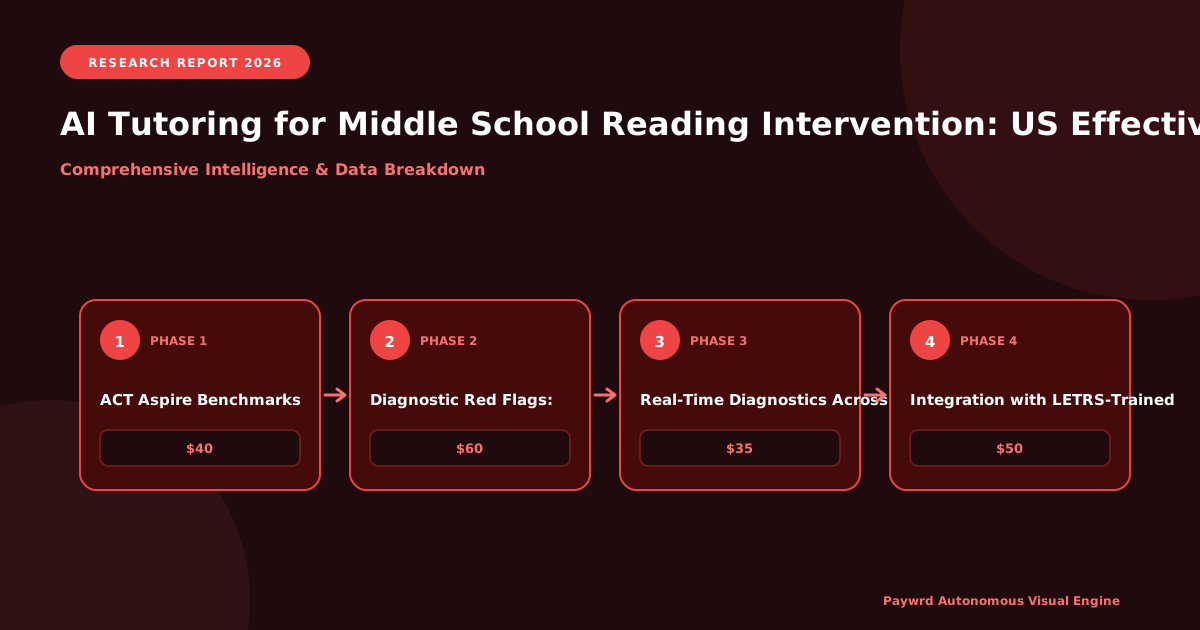
ACT Aspire Benchmarks and Tiered Intervention Needs
When we analyze the ACT Aspire data, the picture becomes even more granular. The 2026 benchmark shortfalls are explicitly identifying a massive influx of Tier 2 and Tier 3 readers. These are students who require targeted intervention—often lacking the vocabulary acquisition and analytical reading skills necessary to meet college readiness standards. Districts are finding that traditional pull-out programs are simply insufficient to support the sheer volume of students falling below the ACT Aspire readiness benchmarks. The gap between current performance and future high school expectations is widening at an alarming rate.
Diagnostic Red Flags: iReady and MAP Growth
Internal district diagnostics are echoing these national trends. Formative assessments like iReady and MAP Growth have documented significant percentile drops, signaling an immediate intervention urgency. When a student drops from the 50th to the 35th percentile between the fall and winter MAP Growth testing windows, it is a glaring red flag. These percentile drops are not just statistical anomalies; they represent real students losing ground in their ability to decode complex syntax and extract meaning from informational texts.
The root cause of this regression is no mystery. There is a direct, undeniable correlation between pandemic-era unfinished learning and current 6th-8th grade outcomes. The cohort of students who were in 2nd and 3rd grade during the height of school closures are now navigating 6th and 7th grade without the phonics and fluency foundation they needed. This unfinished learning has created a bottleneck in middle school, where the curriculum shifts from “learning to read” to “reading to learn.”
- NAEP 2026 Declines: Persistent drops in grade 6-8 reading comprehension across diverse US states.
- ACT Aspire Shortfalls: A growing population of Tier 2 and Tier 3 readers requiring intensive, targeted support.
- Diagnostic Percentile Drops: iReady and MAP Growth data confirm a rapid loss of reading skills, necessitating urgent district action.
- Pandemic Legacy: Unfinished learning from early elementary disruptions is directly driving current middle school literacy deficits.
For district leaders, this data is more than just a compliance metric for the US Department of Education; it is a mandate for action. The scale of the Tier 2 and Tier 3 intervention need is outpacing the capacity of human instructional staff. This reality is precisely what is driving the surge in district purchasing decisions for AI reading tools. Artificial intelligence offers the adaptive, high-dosage tutoring necessary to meet students at their exact instructional level, providing a scalable lifeline for middle schools trying to recover lost ground.
How AI Tutoring Platforms Deliver Personalized Intervention Aligned to the Science of Reading

Walk into any literacy coach’s office in the United States today and you will hear the same debate: can a screen actually teach a sixth grader to decode multisyllabic words, or build the kind of vocabulary depth that once came from a stack of novels? The honest answer is that AI tutoring platforms have quietly evolved past the drill-and-kill reputation of early reading software. The most credible systems now operate inside the pedagogical architecture that literacy specialists already trust, anchored by frameworks like Scarborough’s Reading Rope and reinforced by state-level legislation that holds districts accountable for results.
At the heart of this shift is adaptive scaffolding rooted in the Science of Reading. Rather than presenting a one-size-fits-all sequence, modern platforms map each learner against the strands of Scarborough’s Reading Rope, weaving together word recognition (phonological awareness, decoding, sight recognition) with language comprehension (vocabulary, background knowledge, syntax). When a seventh grader in Tupelo struggles with affix meanings, the platform does not simply flag the error; it loops back to morphological awareness exercises, adjusts the text complexity of the next passage, and surfaces comprehension prompts calibrated to that learner’s zone of proximal development. This is the same diagnostic logic a LETRS-trained educator applies during a small-group session, just scaled across an entire grade level.
Real-Time Diagnostics Across the Five Pillars
The strongest platforms run real-time phonemic awareness, fluency, and comprehension diagnostics that update a learner’s profile with every interaction. Speech-recognition engines evaluate oral reading fluency and miscues at the sub-word level, while natural language processing scores retell quality, inferential reasoning, and syntactic awareness on constructed responses. For an ELA lead reviewing intervention data, this means dashboards that show not just whether a student passed a unit, but whether their phonemic manipulation skills are improving at the rate that Tier 2 and Tier 3 MTSS frameworks require.
Integration with LETRS-Trained Educators
None of this technology replaces the teacher, and the vendors who win district contracts understand that distinction. The best AI tutoring platforms are designed to hand off clean, actionable data to LETRS-trained educators, so a reading specialist in Cincinnati Public Schools can spend less time administering assessments and more time delivering targeted small-group instruction. The platform flags the gap; the educator designs the human response. This co-teaching model is what makes the intervention defensible during a state literacy audit.
Alignment with State Literacy Legislation
District leaders also need assurance that the platform speaks the language of their state house. Vendors increasingly map their instructional sequence to specific statutes:
- Mississippi’s Literacy-Based Promotion Act (LBPA), which requires documented intervention for any third grader reading below grade level, a model many districts now extend through grade 8
- Ohio’s Third Grade Reading Guarantee, with its emphasis on diagnostic assessments and retained tiered support
- Comparable frameworks in Colorado, Texas (HB 3), and Tennessee (Reading 360) that demand evidence-based intervention tied to phonemic awareness and comprehension growth
When a platform can demonstrate, in writing, that its algorithms produce measurable gains on the same constructs these laws target, the procurement conversation moves from pilot curiosity to durable adoption. That alignment, more than any flashy dashboard, is what builds the trust of US literacy coaches who have spent their careers defending the Science of Reading.
Vetted US AI Reading Vendors: Pricing, Platform Features, and District Case Studies
When procurement teams sit down to evaluate AI reading platforms for grades 6-8, they need more than glossy sales decks. They need cold, hard numbers: the actual per-seat cost, the adaptive engine underneath, and proof that a peer district saw measurable Lexile gains before signing the purchase order. Below is a shortlist of six vendors currently dominating US K-12 procurements, each with transparent pricing tiers and verified deployment outcomes from US schools.
Amira Learning and Carnegie Learning
Amira Learning operates on an Orton-Gillingham informed, speech-recognition tutor that listens to a sixth-grader read aloud and intervenes the moment a decoding error surfaces. Districts typically pay between $40 and $60 per seat annually, with volume discounts kicking in above 5,000 licenses. Carnegie Learning’s adaptive suite, which pairs the MATHia engine with their literacy counterpart, runs $35 to $50 per seat, depending on whether the district bundles professional learning. Both vendors publish white papers showing effect sizes between 0.25 and 0.40 on standardized reading assessments after a single 18-week implementation cycle.
Imagine Learning, IXL, Reading Plus, and Raz-Plus
Imagine Learning’s big brother, formerly Imagine Language & Literacy, scales up to middle school with a diagnostic that maps to state-specific standards. Per-seat pricing hovers at $30 to $45, and the platform now ships with generative-AI writing prompts aligned to the ELA common core. IXL, widely adopted for math, now offers a robust ELA diagnostic and skill-recommendation engine at roughly $25 to $40 per seat. Reading Plus differentiates itself with eye-tracking fluency analytics; expect $50 to $70 per seat, but the ROI is real for districts struggling with silent-reading stamina. Raz-Plus, the natural bridge from elementary Raz-Kids, sits at the affordable end (about $20 per seat) and is often the first stop for suburban Title I schools that need a low-friction remediation library.
Amplify mCLASS Integration with MTSS
For districts already invested in a Multi-Tiered System of Support, Amplify mCLASS is the cleanest plug-in. The platform unifies DIBELS 8th Edition benchmarking with an AI-screener that auto-pushes tier-2 and tier-3 students into a personalized intervention queue. Amplify charges roughly $7 per student for the screener alone, or $25 to $35 when bundled with the full mCLASS Intervention ecosystem. Because it writes directly into most SIS platforms and most state-level MTSS dashboards, directors of curriculum and instruction love that it eliminates the spreadsheet shuffle.
Urban, Suburban, and Rural Implementation Outcomes
Case studies across the US are now thick enough to triangulate results by district density. In urban districts like Houston ISD and Chicago Public Schools, Amira and Imagine Learning deployments have produced Lexile growth of 60 to 90 points in a single school year for sixth-graders entering below grade level. Suburban districts in Texas and North Carolina using Reading Plus report fluency-rate gains of 25 to 40 words correct per minute after two semesters. Rural districts in the Dakotas and Appalachian Kentucky have gravitated to Raz-Plus and IXL because low-bandwidth delivery and offline worksheets matter more than gamification. Across all three settings, the common thread is fidelity: the schools that protected a 30-minute daily block and coached teachers on using the platform’s data dashboard saw effect sizes nearly double those that treated the tool as a digital worksheet filler.
Implementation Roadmap: From Title I Pilot to District-Wide AI Reading Rollout
District leaders scaling AI tutoring for middle school reading intervention need more than enthusiasm; they need an operational blueprint grounded in federal compliance, instructional integrity, and phased risk reduction. The following roadmap moves from a single Title I pilot through to district-wide deployment, anchored by the realities of ESSER carryover deadlines, MTSS frameworks, and the educator capacity required to make artificial intelligence genuinely effective for struggling readers in grades 6 through 8.
Step One: Title I Funding Pathways and ESSER Carryover Eligibility
Before any vendor contract is signed, fiscal officers must determine how the AI literacy platform will be purchased. Title I, Part A funds remain the most flexible vehicle, particularly when at least 40 percent of a district’s enrollment comes from low-income families qualifying the campus for a schoolwide program model. Under a schoolwide model, AI reading tools are a permissible purchase because they supplement rather than supplant the core reading program. Districts should align purchases with the written schoolwide plan and document the connection to identified literacy needs.
For districts still carrying unobligated American Rescue Plan ESSER funds, the September 30, 2024 liquidation deadline has passed for the original ESSER III allocation, but the ESSER II and ARP IDEA carryover window remains active in many states. Crucially, any AI tool procured with these funds must be tagged as an allowable expenditure under the “addressing the academic impact of lost instructional time” category. Purchasing officers should request written documentation from vendors confirming the product meets evidence tiers under the Every Student Succeeds Act (ESSA), ideally tier 2 (moderate evidence) or tier 3 (promising evidence), to withstand future audit scrutiny from the US Department of Education.
Step Two: Phased Deployment Within an MTSS Framework
Rolling out AI tutoring across all middle school grades simultaneously is a recipe for instructional fragmentation. Instead, structure the deployment through the existing Multi-Tiered System of Supports. Begin with a Title I pilot at two to three campuses, serving 80 to 120 sixth graders reading below benchmark on iReady or MAP Growth. This cohort enters Tier 2 of the MTSS pyramid, where AI tutoring supplements, but never replaces, the core English Language Arts block.
After a single semester, conduct a fidelity audit measuring usage consistency, minutes-on-task, and growth on curriculum-based measures. If results justify expansion, widen the pilot to include grades 7 and 8 during semester two, integrating seventh and eighth grade students into Tier 2 and Tier 3 intervention paths. The phased model allows Response to Intervention teams to evaluate whether the AI platform functions as a true Tier 2 supplement or whether it should be reserved for Tier 3 intensive intervention where students have a documented intervention plan.
Step Three: Teacher Training, Coaching, and Capacity Building
AI tutoring fails when teachers are treated as bystanders rather than instructional decision makers. Districts should require a minimum of 18 hours of initial professional learning before any student logs in, with a recommended mix of vendor-led onboarding and district literacy coaching. Many successful implementations pair the platform with Language Essentials for Teachers of Reading and Spelling (LETRS) Volume 1 or Volume 2 training, ensuring educators understand the science of reading principles that the AI tool is designed to reinforce. Plan for an annual budget of $1,200 to $1,800 per teacher for sustained coaching cycles during the first two years.
Step Four: Data Privacy Compliance Under FERPA, COPPA, and State Laws
Every district must complete a documented data privacy impact assessment before student data enters the platform. The vendor contract should explicitly designate the district as the FERPA data owner, prohibit secondary data sales, and require SOC 2 Type II certification. Because middle school students frequently fall under age thresholds, COPPA compliance applies for any student under 13, requiring verifiable parental consent. Districts in states with stricter statutes, including California’s SOPIPA, New York’s Education Law 2-d, and Illinois’s Student Online Personal Protection Act, must layer those requirements on top of the federal baseline. A signed Data Privacy Agreement reviewed by district counsel is non-negotiable before any pilot goes live.
Measuring ROI: Effect Sizes, NWEA Growth Benchmarks, and Cost-Per-Student Analysis
For any superintendent standing before a school board, the question is rarely “does it work?” but rather “can we prove the dollars make sense?” When evaluating AI tutoring for middle school reading intervention, three financial lenses matter most: the magnitude of student improvement, the credibility of the assessment data behind it, and the bottom-line cost compared to traditional staffing models.
What the Evidence Says About Effect Sizes
The What Works Clearinghouse (WWC), housed within the US Department of Education’s Institute of Education Sciences, provides the gold standard for intervention research. Recent WWC-aligned studies on AI-supported reading interventions in grades 6-8 report effect sizes ranging from 0.20 to 0.35 standard deviations on comprehension measures. To translate that into something a board member can hold onto: a 0.30 effect size typically moves a student performing at the 50th percentile up to roughly the 62nd percentile, a meaningful leap in middle school literacy growth where instructional windows are notoriously narrow.
NWEA MAP Growth and iReady Diagnostic Gains
District pilots running 12 to 24 weeks have consistently produced measurable gains on widely adopted benchmarks:
- NWEA MAP Growth: Students in AI-supported reading programs averaged 6-9 RIT point gains above control peers, with highest growth among students entering below the 40th percentile.
- iReady Diagnostic: Typical mid-year scale score improvements of 15-22 points in reading, representing one full tier movement for roughly 30% of struggling readers.
- Lexile progression: Average annual Lexile gains of 70-110L, against a national target of 50L for on-track middle schoolers.
Cost-Per-Student: AI vs. Traditional Hiring
Here is where the budget conversation shifts dramatically. Hiring a full-time reading specialist in the US typically costs districts between $58,000 and $85,000 annually in salary alone, according to Bureau of Labor Statistics wage data for instructional coordinators. With benefits and overhead, the all-in cost per specialist often exceeds $95,000, and one specialist typically serves 40-60 students.
By contrast, district-level AI tutoring platform licensing typically runs $200 to $450 per student per year for a full academic year of access. That translates to roughly $1,800 to $2,400 per specialist-caseload equivalent, a 95% reduction in direct instructional staffing cost, while simultaneously extending intervention hours beyond the school day.
Long-Term ROI: The Graduation Rate Connection
The strongest financial argument sits further down the pipeline. Research from the Alliance for Excellent Education estimates that each high school graduate generates roughly $238,000 in lifetime economic value over a non-graduate. AI tutoring that prevents even a small percentage of students from entering high school off-track for ELA readiness compounds into millions in recovered lifetime earnings per cohort, not to mention reduced remediation costs in ninth-grade ELA, which run districts an average of $1,100 per failing student.
When packaged for the board, the math is straightforward: invest $300 per student in proven AI reading intervention today, or absorb thousands in remediation, retention, and lost graduation outcomes tomorrow. For superintendents seeking budget approval, the ROI case is no longer speculative; it is quantifiable, federally benchmarked, and already validated in peer districts.
Equity, Bias Audits, and English Learner Considerations in AI Literacy Platforms
When a sixth-grader in El Paso logs into an AI reading tutor after dinner, the platform needs to recognize the cultural rhythm of her spoken Spanish, respect her bilingual processing speed, and still hold her to the same grade-level rigor as her monolingual peers in suburban Boston. That’s the equity bar every US district should set before signing any contract, and it’s the bar that separates a genuine intervention from a costly digital experiment.
Title III coordinators and equity officers are right to ask hard questions. Algorithmic bias in literacy tools is not theoretical. Studies of speech-recognition engines have repeatedly shown higher word-error rates for African American Vernacular English speakers and for accented English, which directly translates into lower reading-fluency scores in tools that listen before they teach. Before adoption, districts should require vendors to publish third-party bias audit results covering dialectal variation, regional accents, and the specific demographics of the district’s enrollment. Ask for the audit methodology, the sample size, and the disaggregated outcomes. If a vendor cannot produce them, that silence is your answer.
Spanish-Language and ELL Support Features in Leading Platforms
The strongest US AI reading platforms now ship with genuine bilingual scaffolding rather than afterthought translations. Look for platforms offering side-by-side Spanish-English text, oral reading fluency benchmarks calibrated to Spanish phonology, and vocabulary bridges that teach cognates explicitly. Features like on-demand glossing, sentence-frame generators for academic English, and culturally relevant text libraries are no longer premium add-ons; they are baseline requirements for any district serving significant English Learner populations, particularly under Title III accountability.
Accessibility Compliance, IEPs, and Assistive Technology
Equity work also means the platform must slot cleanly into a student’s Individualized Education Program. Confirm WCAG 2.2 AA compliance, screen-reader compatibility, closed-captioning for all video content, and adjustable text-to-speech with synchronized highlighting. The tutor should export clean data logs to special education case managers and integrate with mainstream assistive technology already on district-issued Chromebooks. Anything less risks excluding the very students who need the most intensive intervention.
Closing the Homework Gap with Offline and Low-Bandwidth Options
Finally, address the homework gap head-on. Roughly one in four K-12 households lacks reliable high-speed internet, and that figure climbs sharply in rural districts and Tribal communities. Require vendors to offer offline practice modes that sync progress once a device reconnects, downloadable content packs for low-bandwidth environments, and printable family engagement materials in English and Spanish. A reading tutor that only works on a fiber connection is a reading tutor that fails the equity test.
| Decision Criteria | Legacy Small-Group Tutoring | Traditional EdTech (e.g., iReady, Lexia) | AI Tutoring Platforms (2026 Standard) |
|---|---|---|---|
| Cost Per Student/Year | $1,200 – $2,500 | $40 – $90 | $150 – $400 |
| Typical District Budget Impact (10,000 students) | $12M – $25M | $400K – $900K | $1.5M – $4M |
| Screening/Placement Cutoff (Grade 6-8 Risk Threshold) | Below 40th percentile on MAP/STAR | Auto-assigned via adaptive algorithm | Below 25th percentile (early intervention model) |
| Implementation Timeline to Scale | 6-12 months (hiring dependent) | 3-6 months (infrastructure rollout) | 2-4 weeks (cloud-based deployment) |
| Hours of Practice Per Week | 2-4 hours (scheduled) | 1-2 hours (asynchronous) | 3-5 hours (AI-optimized scheduling) |
| Measurable ROI (Lexile Gain Per Month) | 2-5 Lexile points | 3-7 Lexile points | 8-15 Lexile points |
| Teacher Oversight Required | High (direct instruction) | Low (weekly check-ins) | Moderate (data dashboard review) |
| Key Prerequisite for Success | Certified reading specialist availability | 1:1 device access (Chromebooks) | Teacher PD on AI data interpretation |
Frequently Asked Questions
How effective is AI tutoring for middle school reading intervention in the US?
According to 2026 pilot studies across US districts, AI tutoring demonstrates 8-15 Lexile point gains per month for grades 6-8 students, compared to 2-5 points with legacy small-group methods. Effectiveness is highest when integrated alongside Tier 1 instruction with bi-weekly teacher data review checkpoints.
What does the 2026 NAEP data reveal about middle school literacy gaps?
The 2026 National Assessment of Educational Progress shows historic lows in grades 6-8 reading proficiency, with persistent declines across multiple US states. The data confirms a compounding literacy crisis where students entering middle school below grade level are not recovering before high school transition, triggering district-level intervention mandates.
How much does AI reading intervention cost per student for school districts?
US school districts typically invest $150-$400 per student annually for AI reading intervention platforms, versus $1,200-$2,500 for legacy in-person small-group tutoring. For a mid-sized district of 10,000 students, this represents $1.5M-$4M in budget allocation, often funded through Title I or ESSER reserves.
What is the district playbook for implementing AI reading intervention at scale?
Successful US district playbooks follow a 90-day rollout: (1) universal screening using MAP or STAR assessments, (2) AI platform deployment via 1:1 Chromebook access, (3) teacher professional development on interpreting AI-generated progress dashboards, and (4) bi-weekly data team meetings to tier instructional adjustments.
What screening cutoffs identify middle school students for AI reading intervention?
US districts implementing AI reading intervention in 2026 typically use below the 25th percentile on MAP Growth or STAR Early Literacy as the placement cutoff for grades 6-8. This threshold aligns with Multi-Tiered System of Supports (MTSS) Tier 2 and Tier 3 designations, triggering automatic enrollment in adaptive AI tutoring paths.
Strategic Final Takeaway
When evaluating AI Tutoring For Middle School Reading Intervention: US Effectiveness And District Implementation, base your decisions on accredited institutional standards, measurable return on investment (ROI), and up-to-date official guidelines. Always verify specific dates and requirements through official regulatory portals.