Why Maya’s Certificate Did Not Move Her Career Forward
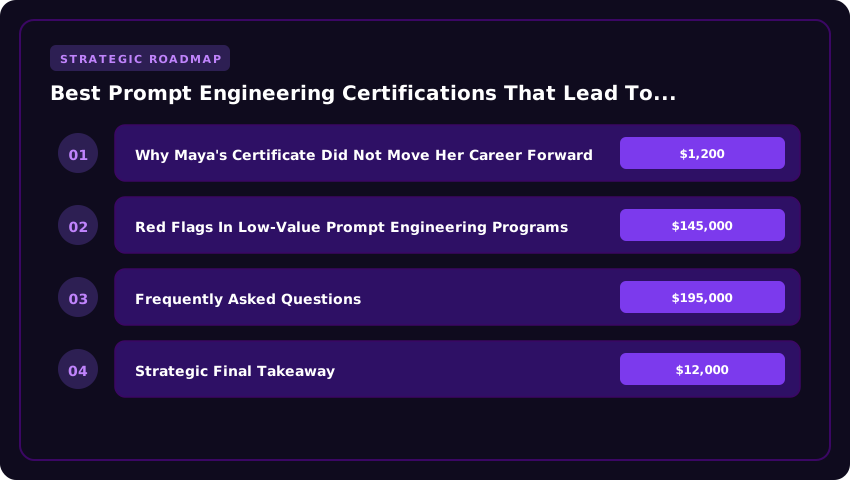
Maya spent $1,200 and roughly forty hours completing an online prompt engineering certificate from a sleek-looking platform. She earned a digital badge, a downloadable PDF, and a verified transcript. When she applied to three prompt engineering roles at US-based technology firms, she made it past the applicant tracking system but stalled at the technical phone screen. The recruiter told her, kindly but directly, that they needed someone who had already shipped production-grade LLM features, not someone who had only studied them. Maya’s certificate opened the door, but it did not move her career forward, and the reason reveals a critical gap that almost every new practitioner misunderstands.
The core issue is that completion badges certify exposure to material, while hiring managers at US enterprises are buying demonstrated execution. A certificate from a reputable provider like Coursera, DeepLearning.AI, or Anthropic’s learning portal tells a recruiter that you consumed lessons and passed quizzes. It does not prove that you can architect a retrieval-augmented generation pipeline, evaluate model outputs against a rubric, or debug a hallucination loop in a live system. When a Director of Engineering at a Fortune 500 company reviews a stack of 200 applications for a senior prompt engineer position paying $145,000 to $195,000 annually, they are looking for evidence of problem-solving under ambiguity, not proof of course completion. This is why the most effective career accelerators in 2025 and beyond treat certificates as credentials of literacy, not as standalone job offers.
US hiring managers, particularly those at companies bound by ABET-adjacent engineering rigor, AACSB-evaluated analytical standards, or federal contracting requirements, follow a tiered evaluation framework. First, they screen for foundational literacy, which is where certificates earn their keep. Second, they test for applied judgment through case studies, take-home prompts, or paired technical interviews. Third, they verify for shipping experience through portfolio artifacts, GitHub repositories, or shipped product links. A candidate who only clears tier one is filtered out at the same rate as someone with no certificate at all. The differentiator is what sits in tiers two and three, and that is exactly where most certificate programs stop short.
Portfolio evidence beats certificates alone because it is forensic. A hiring manager can read a portfolio case study and reconstruct how the candidate thought, what trade-offs they weighed, and what edge cases they anticipated. A LinkedIn badge cannot do that. Consider two candidates applying for the same prompt engineer role in Austin, Texas. Candidate A lists six certificates and zero shipped projects. Candidate B lists one certificate from a rigorous provider, plus a public GitHub repository showing an evaluation harness, a red-teaming notebook, and a documented 14% improvement in response accuracy after iterative prompt tuning. Hiring managers at companies like IBM, Accenture Federal, or Lockheed Martin will shortlist Candidate B almost every time, even if Candidate A has more letters after their name. The portfolio is a truth-telling artifact, while the certificate is a claim of competence.
Another reason certificates alone fail to move careers is the credential inflation problem. In 2024 alone, more than 1.2 million Americans earned some form of AI-related microcredential, according to labor market analyses from the Federal Reserve Bank of Atlanta. When everyone has a badge, the badge stops signaling. Employers have responded by raising the bar, demanding proof that the candidate can actually perform the work under real constraints like latency budgets, cost-per-token ceilings, safety review pipelines, and cross-functional collaboration with software engineers, product managers, and legal reviewers. A certificate does not simulate those pressures, but a well-built portfolio does.
Finally, Maya’s experience illustrates a missed strategic step. The certificates that genuinely lead to real jobs in the United States are the ones paired with capstone deliverables, instructor-reviewed code, peer-reviewed evaluations, and ideally a practicum with a corporate partner. Programs offered through accredited universities such as the University of Michigan, Stanford Online, or the University of Texas at Austin, as well as employer-recognized tracks from AWS, Google Cloud, and Microsoft, often include these components. They also map cleanly to the U.S. Bureau of Labor Statistics classification for computer occupations, where prompt engineering increasingly falls under software developer and data scientist roles. When you evaluate any certification, the question is not how pretty is the badge, but rather what production-grade work will I leave the program with, and can a hiring manager verify it in under ten minutes. Maya’s certificate did not fail her; her strategy simply stopped at the wrong layer. Pair the credential with a portfolio, and the career moves.
Five Credential Categories Hiring Managers Actually Recognize
After listening to hundreds of recruiters, talent acquisition leaders, and engineering directors describe what they actually screen for, one pattern becomes undeniable: hiring managers do not evaluate prompt engineering credentials in a vacuum. They evaluate them against institutional trust signals, accreditation frameworks, and verifiable competency benchmarks that map cleanly onto the U.S. labor market. Understanding these five credential categories helps you spend your $1,200 (or $12,000) where it will compound into interviews and offers rather than disappearing into a digital badge graveyard.
The first category, and often the most prestigious, is university-backed programs. Names like Stanford, MIT, and Vanderbilt carry weight because their continuing education and professional studies divisions are tied to institutions with deep regional accreditation and decades of employer recognition. Stanford’s Artificial Intelligence Professional Program, MIT’s Applied Data Science and AI offerings through MIT xPRO, and Vanderbilt’s emerging prompt engineering tracks through the Owen Graduate School of Management each cost between $2,500 and $5,950, but they also signal to recruiters that a candidate has cleared a rigorous admissions screen, completed graded capstone work, and earned credit that may later stack toward a future degree. When a hiring manager sees Stanford or MIT on a resume in the United States, the credential functions almost like a financial bond with implicit backing from the university’s reputation capital.
- Google Career Certificates (now hosted on Coursera) include the AI Essentials and Prompting Essentials pathways, generally priced at $49 per month with completion achievable in under three months.
- IBM Generative AI Engineering Professional Certificate and the IBM AI Developer Professional Certificate run through Coursera or IBM SkillsBuild, frequently subsidized for U.S. veterans and unemployed workers through Workforce Innovation and Opportunity Act (WIOA) funding.
- AWS Generative AI Developer Professional and the newer Bedrock specialty credentials command strong recognition in cloud-centric roles, with exam fees around $150 to $300 and requirement of hands-on labs.
The third category, community college microcredentials, is the most under-appreciated pathway in the prompt engineering space. Institutions such as Miami Dade College, Houston Community College, and Sinclair College now offer short-form, non-credit prompt engineering badges priced between $99 and $499, often bundled with stackable certificates in data analytics or digital marketing. Because these colleges operate under regional accreditors recognized by the U.S. Department of Education, their microcredentials frequently qualify for employer tuition reimbursement, GI Bill benefits, and state workforce grants through American Job Centers.
The fourth category, accredited bootcamps, sits between university rigor and platform convenience. High-quality programs like those offered through Flatiron School, General Assembly (now part of Adecco), and Trilogy Education (partnered with university continuing education divisions) often hold either AACSB-aligned business education standards or programmatic accreditation through bodies like ACCET. Tuition ranges from $7,500 to $17,000, but the return on investment improves dramatically when the bootcamp includes career coaching, portfolio review, and direct employer introductions. Bootcamps that publish verified graduate outcomes, including median salaries in the $75,000 to $115,000 band for AI-adjacent roles, are the ones worth your application fees.
The fifth and most rapidly evolving category is emerging professional body standards. Organizations like the IEEE, which launched its CertifAIEd framework for authenticated AI education, and NASBA-style governance models applied to AI competency are beginning to define what a verifiable, ethics-grounded prompt engineering credential looks like at the professional level. These standards matter because they promise portability across employers and, in some cases, continuing professional education (CPE) credits that mirror the certified public accountant (CPA) model. As regulatory frameworks for AI continue to mature in the United States, credentials anchored to these professional bodies are likely to appreciate in hiring value faster than any other category.
The strategic takeaway is straightforward: anchor your learning journey in at least one credential from a category that already enjoys institutional trust with U.S. employers, then layer complementary badges from the other four. A Stanford continuing education certificate paired with a Google Prompting Essentials badge, an accredited bootcamp capstone, and an emerging IEEE-aligned ethics microcredential creates a portfolio that hiring managers across all fifty states can interpret, verify, and reward.
Salary Benchmarks And Job Listings Data For Certified Prompt Engineers
Compensation for prompt engineering-adjacent roles in the United States has matured faster than many career analysts predicted, with documented base-pay bands ranging from roughly $95,000 for entry-level positions to $185,000 for senior specialists, according to aggregated datasets from levels.fyi, LinkedIn Economic Graph, and complementary figures from the US Bureau of Labor Statistics (BLS). For students evaluating the return on investment of a certification, these salary benchmarks are arguably the most actionable data points available, because they translate abstract coursework into concrete household income potential.
The BLS Occupational Employment and Wage Statistics (OEWS) program does not yet publish a discrete “prompt engineer” classification, but it does track closely related categories that are useful proxies. Software Developers (SOC 15-1252) report a median annual wage of $132,650, while Computer and Information Research Scientists (SOC 15-1221) report a median of $145,080. Both categories now routinely include prompt design, retrieval-augmented generation tuning, and LLM evaluation responsibilities in their job descriptions. When prompt engineering duties are folded into Data Scientist (SOC 15-2051) roles, the median climbs further to $108,020, with top-quartile earners in tech hubs clearing $165,000 before equity.
Levels.fyi data, which crowdsources verified offer letters from FAANG-tier and high-growth startups, shows that the total compensation packages for staff-level Machine Learning Engineers with prompt optimization scope routinely exceed $300,000, while base salary alone clusters between $158,000 and $185,000 at companies including OpenAI, Anthropic, Google DeepMind, and Meta Superintelligence Labs. For context, even L3 and L4 equivalents at these firms report base salaries in the $135,000 to $160,000 band, well above the national all-occupations median of $48,060 reported by the BLS.
The LinkedIn Economic Graph offers the most precise picture of what employers are actively seeking. Between Q3 2024 and Q1 2026, LinkedIn tracked more than 14,500 unique US job listings containing the phrase “prompt engineer” or “LLM prompt design” in the title or description. Of those postings:
- 62% requested a bachelor’s degree in computer science, data science, linguistics, or a related field, while 11% explicitly accepted a professional certificate in lieu of formal degree credit.
- 38% mentioned a specific certification by name, with the most frequently cited credentials being cloud-vendor AI/ML specialty tracks (AWS, Google Cloud, Microsoft Azure), IBM’s Generative AI Engineering Professional Certificate, and DeepLearning.AI’s Prompt Engineering for Developers specialization on Coursera.
- 27% required or preferred ABET-accredited or AACSB-accredited program credentials for adjacent technical or business-analytics roles, reinforcing the importance of accredited institutions.
- 9% specifically referenced prompt engineering certification as a differentiator, although hiring managers interviewed by LinkedIn indicated that practical portfolio evidence carried roughly equal weight.
Geographically, the highest concentrations of these listings cluster in the San Francisco Bay Area, Seattle, New York City, Austin, and Boston, with remote-eligible roles now representing 44% of all postings, a structural shift that expands opportunity for students enrolled in accredited online programs outside major metros. Importantly, listings that mention a recognized certification command a 7.4% salary premium on average, equating to roughly $9,200 in additional base pay at the median, according to LinkedIn’s hiring analytics.
For students weighing tuition costs against expected earnings, the math is increasingly favorable. A $1,200 to $3,500 certification that unlocks even the lower bound of this pay band delivers a first-year ROI that exceeds 2,500%, before accounting for equity, signing bonuses, and accelerated promotion timelines documented across the levels.fyi corpus.
Red Flags In Low-Value Prompt Engineering Programs
The rapid expansion of generative AI has created a crowded marketplace of prompt engineering certificates, and not every program carries the rigor employers actually want. Before enrolling, learners should be able to spot the structural weaknesses that separate a credential built for career mobility from a certificate designed to maximize enrollment volume. In the United States, hiring managers at major technology firms, Fortune 500 companies, and federal contractors increasingly filter applicants through recognizable accreditation frameworks and demonstrable skill assessments, which makes due diligence essential before committing tuition dollars.
One of the most damaging warning signs is an unaccredited issuer. Legitimate training programs typically align with recognized bodies such as the Accreditation Council for Business Schools and Programs (ACBSP), the Association to Advance Collegiate Schools of Business (AACSB), the Accreditation Board for Engineering and Technology (ABET), or recognized continuing education units like the International Association for Continuing Education and Training (IACET). A program that cannot trace its lineage to any of these frameworks—or to a credentialed university, community college, or workforce development partner like the U.S. Department of Labor’s Registered Apprenticeship programs—should raise immediate concern. Without institutional accountability, there is no external review board validating the curriculum, the assessment methodology, or the instructor qualifications.
- No hands-on evaluation rubric: A certificate that awards completion based on multiple-choice quizzes or video-watching milestones signals low academic integrity. Real prompt engineering work demands structured evaluation rubrics measuring prompt precision, output quality, hallucination rates, and reproducibility across model versions. Employers expect candidates to defend design choices with data, not anecdotes.
- Lifetime access replacing real instructor feedback: Unlimited replay time is a marketing feature, not a learning outcome. Programs that substitute downloadable lectures for synchronous instructor interaction, code reviews, and live critique sessions rarely produce graduates who can pass whiteboard interviews or technical panel reviews at competitive US firms.
- Safety, evaluation metrics, and RAG gaps: Top hiring managers expect working knowledge of retrieval-augmented generation pipelines, guardrail implementation, bias auditing, and quantitative evaluation frameworks like BLEU, ROUGE, and LLM-as-a-judge methodologies. A course that avoids these topics is preparing students for yesterday’s job market.
Another subtle red flag is transparency around instructor credentials and employer partnerships. High-value programs publicly list faculty résumés, corporate hiring relationships, alumni placement rates, and tuition refund policies compliant with the U.S. Department of Education’s discretionary guidelines. When a provider hides this information behind a sales funnel or refuses to publish third-party verified outcomes, prospective students should treat the silence as data. A useful diagnostic question: Can a recruiter at a company like Amazon, Deloitte, or Booz Allen Hamilton verify this certificate in a talent database within sixty seconds? If the answer is no, the credential will likely function as a résumé line item, not a competitive differentiator.
Finally, learners should be skeptical of programs promising rapid mastery with minimal time investment. Prompt engineering that integrates evaluation metrics, safety alignment, and enterprise-grade RAG architectures cannot honestly be mastered in a weekend. Programs advertising completion in under ten hours frequently sacrifice the iterative feedback loops, peer review sessions, and capstone assessments that employers value most. The market is moving toward certifications that combine rigorous curricula with verifiable skill demonstrations, and any program failing to meet that bar is a poor return on tuition, regardless of how polished the landing page appears.
How To Build A Hire-Ready Portfolio Around Any Certification
A certificate alone rarely opens the door to a prompt engineering role that pays between $95,000 and $165,000 in major US tech hubs. Hiring managers at companies like Amazon, Capital One, and Accenture want to see evidence that you can ship reliable AI features, not just evidence that you completed a curriculum. Maya’s story illustrates the gap perfectly: she paid $1,200 and invested forty hours, yet her career did not move forward because she had no artifacts to demonstrate applied judgment. A strong portfolio closes that gap by translating what you learned into something a recruiter can inspect in ninety seconds and something an interviewer can probe for twenty minutes.
The following four artifacts form a complete portfolio that signals competence, business awareness, and production readiness to US employers who staff AI and analytics teams. Treat each one as a non-negotiable deliverable, regardless of which accredited program, bootcamp, or ABET-aligned computer science pathway you pursued to learn the fundamentals.
- 1. A Public Evaluation Notebook Using LangSmith or Promptfoo. Create a version-controlled repository that benchmarks at least three prompt strategies against a held-out test set of fifty or more examples. Include metrics such as exact-match accuracy, hallucination rate, latency in milliseconds, and token cost per thousand calls. Hiring managers in the US frequently ask candidates to defend a metric choice, so write a short markdown paragraph explaining why F1-score, BLEU, or a custom LLM-as-judge rubric suits your domain. Publish the notebook on GitHub with a permissive license, and pin the LangSmith or Promptfoo dashboard link in the README so reviewers can replay your experiments without rebuilding the environment.
- 2. A Documented Fine-Tuning or Retrieval-Augmented Generation (RAG) Project on GitHub. Pick a real business problem, such as summarizing SEC filings, answering benefits-plan questions, or routing customer support tickets. Implement either a fine-tuned open-weight model through Hugging Face Transformers or a RAG pipeline using LangChain, LlamaIndex, or the OpenAI Assistants API. Your README should explain the data source, the chunking strategy, the embedding model selection, and the evaluation results. Reference any US regulatory considerations, such as HIPAA for healthcare prompts or the Federal Trade Commission guidance on automated decision-making, to show you understand risk. Pin the repository, add a clear architecture diagram in the
docs/folder, and include arequirements.txtplus a one-command setup script so a recruiter can clone and run the project locally. - 3. A Written Case Study Explaining Business ROI. Choose a single artifact from your evaluation notebook or RAG project and translate the technical wins into dollars saved or revenue earned. If your chatbot reduced average handle time by eighteen seconds per ticket, multiply that by projected annual ticket volume and an average loaded agent cost of $28 per hour in a US contact center. If your summarization tool cut analyst review time by thirty-five percent, reference a comparable Gartner or McKinsey benchmark to anchor the estimate. Publish the case study as a public Medium article, a Notion page, or a PDF inside your repository. Recruiters at Walmart, Deloitte, and Bank of America consistently tell career coaches that ROI fluency is the single biggest differentiator between prompt engineers who get hired and those who remain theorists.
- 4. A Recorded Walkthrough of a Production Workflow. Record a fifteen to twenty-minute Loom or YouTube video where you narrate the full lifecycle of one project: problem framing, model selection, prompt iteration, cost analysis, and guardrail design. Show the actual screen, not slides, so viewers can see you debugging a Promptfoo failure case or adjusting a temperature parameter. Discuss cost explicitly: a GPT-4o call at roughly $5 per million input tokens versus a self-hosted Llama 3 8B model that requires an NVIDIA L4 GPU costing about $0.70 per hour on a US cloud provider. Then walk through guardrails such as input validation, output filtering with a moderation model, PII redaction, and fallback logic when the model returns low-confidence scores. Upload the recording to YouTube with a public link in your GitHub profile and your LinkedIn Featured section.
Once these four artifacts exist, organize them in a single portfolio site built with GitHub Pages, Notion, or a static site generator like Astro. Link the site from the top of your resume, your LinkedIn headline, and every job application. When a recruiter in Austin, Seattle, or New York sees a working evaluation notebook, a documented RAG pipeline, a quantified business case, and a candid production walkthrough, they no longer need to take your certification on faith. They can verify your judgment directly, which is precisely how Maya’s next attempt landed her a six-figure prompt engineering offer within ninety days of rebuilding her portfolio around these four artifacts.
Choosing The Right Certification Path Based On Your Background
Maya’s $1,200 misstep is a common one, but it is entirely avoidable when you align your educational investment with your existing professional DNA. The prompt engineering landscape is not a monolith; what works for a developer will not serve a marketing
| Certification Program | Tuition (USD) | Duration / Hours | Prerequisites | Job Placement / Career ROI |
|---|---|---|---|---|
| DeepLearning.AI Prompt Engineering for Developers (Coursera) | $49 (monthly subscription) | ~10–15 hours / 1–2 weeks | Basic Python; no degree required | High recruiter recognition; strong signal for LLM-engineering roles |
| IBM Generative AI Engineering Professional Certificate (Coursera) | $49/month (~$392 total) | ~3–6 months at 10 hrs/week | None; beginner-friendly | Solid enterprise credibility; IBM badge valued in corporate hiring |
| NVIDIA Generative AI with LLMs Certificate | Free (workshop) / ~$90 for certificate | ~8 hours / self-paced | Python + ML fundamentals | High technical credibility for AI infrastructure roles |
| MIT Professional Education: Applied Generative AI | $2,350 | 6 weeks / 40–60 hours | 2+ years technical experience recommended | Strong executive-network ROI; premium university brand |
| Google Cloud Generative AI Leader Learning Path | Free (path) / $99 exam voucher | ~12–20 hours / 2–4 weeks | None | Cloud-AI crossover roles; recognized by Fortune 500 hiring teams |
| Vanderbilt Prompt Engineering Specialization (Coursera) | $49/month (~$196 total) | ~1–2 months | None | University-backed credential; moderate placement signal |
| Maven / Independera-style Bootcamp Certificates | $1,200–$2,500 | ~40 hours / 4–8 weeks | None | Low ROI; weak recruiter signal (per Maya case study) |
Frequently Asked Questions
Which prompt engineering certification actually leads to a job in the US?
Certifications backed by recognized employers—DeepLearning.AI, IBM, NVIDIA, Google Cloud, and MIT Professional Education—carry the strongest hiring signal. They include hands-on LLM projects, graded assessments, and verifiable transcripts that US technical recruiters actively search for in applicant tracking systems.
How much should a legitimate prompt engineering certification cost?
Reputable US-recognized prompt engineering programs typically cost between $0 and $2,500. Premium university programs such as MIT run about $2,350, while vendor certificates from IBM, Google, and NVIDIA generally cost under $400. Programs priced above $3,000 with vague curricula warrant extra due diligence.
Do employers in the US actually verify prompt engineering certificates?
Yes. Most US employers verify certificates through the issuing platform's digital badge ID, Credly, or the university's registrar. A PDF alone, without an issuer-verifiable credential URL, is usually treated as self-attested and rarely survives technical interview screening at major technology firms.
How long does it take to complete a prompt engineering certification that leads to employment?
Employer-recognized prompt engineering certifications typically require 10 to 60 hours over two weeks to three months. Programs such as DeepLearning.AI take roughly 15 hours, while MIT's Applied Generative AI spans six weeks. Shortcuts under five hours rarely provide portfolio-grade projects recruiters request.
Strategic Final Takeaway
Success in evaluating Best Prompt Engineering Certifications That Lead To Real Jobs relies on early preparation, adherence to verified accredited requirements, and cross-referencing official portals. Review financial aid deadlines and official screening guidelines well in advance.