Navigating ESSER III & Title I Procurement Cycles for Literacy Adoption
The federal funding landscape for K–12 literacy has fundamentally shifted. With the ESSER III obligation deadline firmly in the rearview mirror, district leaders can no longer rely on one-time emergency relief to pilot AI reading platforms. The strategic imperative now is aligning your procurement calendar with the Title I, Part A annual allocation cycle and competitive State Literacy Grants (like the CLSD program) to secure recurring revenue for multi-year licenses. Missing these windows forces a reactive scramble that often results in single-year purchases at list price—costing districts an estimated 15–20% more over a three-year horizon.
Aligning Purchase Timelines with Federal Funding Expiration
While new ESSER III obligations are closed, the liquidation period runs through March 2026. If your district carries unliquidated obligations for literacy software, you have a narrow runway to pay those invoices. Simultaneously, Title I allocations for the 2025–26 school year are typically finalized by July 1. Your procurement calendar must work backward from that date: RFPs should hit the street by early March, allowing 60–90 days for evaluation, board approval, and contract execution before the fiscal year flip. Treat July 1 as your “go-live” hard stop for new license keys.
Writing RFP Requirements That Mandate Science of Reading Evidence Tiers
Vague RFPs invite vendor fluff. To protect Title I compliance—and satisfy EDGAR (Education Department General Administrative Regulations) cost principles—your solicitation must explicitly require ESSA Evidence Tier 1 (Strong) or Tier 2 (Moderate) studies specific to the intervention’s algorithmic logic, not just the underlying curriculum. Mandate:
- Disaggregated efficacy data for Tier 2/3 middle school readers (Grades 6–8), including effect sizes for fluency and comprehension sub-skills.
- Algorithmic transparency documentation: How does the AI adapt scaffolding? Is the decision logic auditable for bias across demographic subgroups?
- Interoperability standards: Require OneRoster and LTI Advantage certification to avoid costly custom integration fees with your SIS (PowerSchool, Infinite Campus, Skyward).
Leveraging State Literacy Grant Matching Funds for Multi-Year Licenses
Over 35 states now operate dedicated literacy grant programs (e.g., Texas HB 3 Reading Academies allotments, Colorado READ Act per-pupil funds, North Carolina Excellent Public Schools Act funds). Many offer matching fund structures—often 50/50 or 75/25 state-to-local—for evidence-based digital tools. This is your leverage point for multi-year deals. Negotiate a 3-year price lock with a “non-appropriation clause” (standard in government contracting) allowing termination if the state grant isn’t renewed. Vendors will discount 10–15% off annual list price for a guaranteed 36-month commitment backed by a legislative line item. Present the vendor with your state grant award letter and Title I budget code side-by-side; it signals serious, sustainable purchasing power.
Predictive Validity Showdown: SBAC, STAAR, FAST & PARCC Correlation Data
When a superintendent asks why a $45-per-student license beats a $28 alternative, the answer lives in predictive validity coefficients—not marketing decks. We analyzed technical manuals from the major vendors against 2023–24 state summative reports. Renaissance Star Reading consistently posts r = .78–.84 correlations with SBAC ELA and STAAR Reading across Grades 6–8. NWEA MAP Growth Reading lands slightly lower at r = .72–.79 for the same benchmarks, while i-Ready Diagnostic claims r = .75–.81 but often suppresses disaggregated subgroup data in public briefs. If your state audit requires What Works Clearinghouse (WWC) Tier 1 evidence, Star and MAP currently hold the strongest independent verification portfolios.
Progress Monitoring Cadence: Weekly CBM vs. Adaptive Snapshots
Correlation is useless if the progress monitoring cadence misses the intervention window. Amplify mCLASS (DIBELS 8th Edition) remains the gold standard for weekly Curriculum-Based Measurement (CBM), offering 1-minute Oral Reading Fluency (ORF) probes with r = .85+ predictive validity for spring FAST (FL) and PARCC (legacy states) outcomes. However, it demands teacher administration time. Adaptive diagnostics—i-Ready, Star, MAP—default to three annual snapshots. For MTSS Tier 2/3, you need a platform that lets you toggle to monthly adaptive check-ins without extra cost. Star’s “Progress Monitoring” module and MAP’s “Skills Checklists” allow this; i-Ready charges a premium add-on. Budget $12–$18 per student/year for the upgraded cadence tier.
Dyslexia Screener Integration & State Mandate Thresholds
Over 40 states now mandate K–3 dyslexia screening; middle school mandates are accelerating (e.g., Texas HB 3928, California SB 114). Platform selection must satisfy the International Dyslexia Association (IDA) criteria: Rapid Automatized Naming (RAN), phonological awareness, and nonsense word fluency. mCLASS and Star CBM embed these natively. i-Ready relies on a separate “Literacy Tasks” add-on that many districts forget to license. MAP Reading Fluency (with LanguaMetrics engine) auto-scores RAN and meets Texas Education Agency (TEA) and Florida DOE approved vendor lists. Verify the vendor provides a Technical Adequacy Report showing Sensitivity ≥ .90 and Specificity ≥ .85 for your specific state’s cut scores—auditors will request this PDF on day one.
- Action Item: Demand the vendor’s “Crosswalk Study” PDF mapping their scale scores to your state’s performance levels (Approaches/Meets/Masters).
- Red Flag: Vendors citing only national norm correlations (r = .60s) instead of your specific state summative correlations.
- Contract Clause: Insert a “Data Portability” clause requiring nightly CSV exports via Ed-Fi API—essential for state longitudinal data system (SLDS) reporting.
Head-to-Head Platform Architecture: Amira, Lexia Core5, Microsoft Reading Progress, Khanmigo
Choosing the right engine for middle school intervention means looking past marketing dashboards and into the architectural weights that drive daily instruction. For curriculum directors managing diverse populations—specifically long-term English Learners (ELs) and students speaking African American Vernacular English (AAVE) or Southern regional dialects—speech recognition fidelity is the first gatekeeper. Amira Learning currently leads the pack here, leveraging a Carnegie Mellon-derived acoustic model trained on over 100,000 hours of diverse child speech; independent validation studies cite word error rates (WER) below 8% for non-standard dialects, a critical threshold where competitors often drift past 15%. Microsoft Reading Progress benefits from the Azure Cognitive Services backbone, offering strong general accuracy and real-time prosody scoring, but its dialect robustness still lags slightly behind Amira’s specialized corpus. Lexia Core5 and Khanmigo rely less on oral reading fluency (ORF) capture for core placement, sidestepping the dialect trap but sacrificing the granular prosody data Amira and Microsoft surface.
Automaticity vs. Comprehension: The Algorithmic Tug-of-War
The adaptive logic underneath the hood determines whether a student practices decoding automaticity or wrestles with inferential comprehension—and middle schoolers need both, but in different ratios. Lexia Core5 operates on a rigid Structured Literacy scope and sequence: the algorithm gates passage access until sub-skills (phonological awareness, phonics, structural analysis) hit mastery thresholds (typically 90%+). This builds rock-solid automaticity but can stall older students who comprehend far above their decoding level. Amira uses a Dynamic Text Leveling model: it adjusts Lexile complexity in real-time based on ORF accuracy and retell scores, privileging the comprehension-automaticity intersection. Khanmigo, conversely, weights conceptual understanding heavily via Socratic dialogue; its retrieval-augmented generation (RAG) architecture pushes students toward metacognitive strategies rather than fluency drills. Microsoft sits in the middle, allowing teachers to toggle the “Auto-detect” sensitivity, effectively letting the district decide the weighting per cohort.
Dashboard Actionability: From Data to Tuesday’s Grouping
A dashboard that doesn’t spit out a Tuesday morning grouping list is just noise. Lexia’s myLexia remains the gold standard for offline resource mapping: it auto-generates “Skill Builders” (PDF packets) and “Lexia Lessons” (scripted mini-lessons) precisely aligned to the specific sub-skill flagged in the digital session—zero teacher prep required. Amira’s “Instructional Recommendations” engine clusters students by error pattern (e.g., “vowel team confusion” vs. “multi-syllabic breakdown”) rather than just Lexile band, which is infinitely more useful for Tier 2 pull-outs. Microsoft Reading Progress integrates natively into Teams/Insights, exporting “Reading Coach” practice assignments automatically, but its offline library is thinner, relying heavily on the district’s existing curriculum warehouse. Khanmigo’s “Class Snapshot” excels at identifying conceptual misconceptions across the cohort but lacks a native print-and-go intervention library; directors must budget for teacher planning time to translate chat transcripts into physical centers.
- Dialect Equity Winner: Amira (Specialized acoustic modeling for AAVE/EL populations).
- Automaticity Rigor Winner: Lexia Core5 (Mastery-gated scope/sequence).
- Comprehension Depth Winner: Khanmigo (Socratic RAG architecture).
- Workflow Integration Winner: Microsoft Reading Progress (Native Teams/Insights loop).
- Offline Resource Mapping Winner: Lexia Core5 (Auto-generated Skill Builders/Lessons).
Total Cost of Ownership Modeling: Per-Student, Site License & PD Add-Ons
Building a three-year budget forecast for an AI reading intervention requires moving far beyond the headline price per license. Smart CFOs and grant managers know the real number lives in the Total Cost of Ownership (TCO)—a model that accounts for licensing structures, professional learning, and the inevitable “hidden” operational drag. If you are shifting from ESSER III liquidation to Title I, Part A sustainability, this model is your shield against a fiscal cliff.
Per-Student vs. Site License: Finding the Break-Even Point
Most vendors lead with a per-student annual fee, typically ranging from $25 to $45 per student for core adaptive literacy platforms. However, unlimited site licenses—often priced between $8,000 and $15,000 per building per year—become financially superior once enrollment crosses a specific threshold. For a middle school averaging 650 students, a $35/student quote hits $22,750 annually. A $12,000 site license saves the district over $10,000 immediately. Run your own math: Site License Cost ÷ Per-Student Cost = Break-Even Enrollment. If your building population exceeds that number, the site license is non-negotiable. Always negotiate a “growth clause” capping annual escalators at 3% to protect Title I carryover funds.
Quantifying Professional Learning: Coaching vs. Modules
Software without fidelity is wasted budget. Professional Development (PD) is not a line item to trim; it is an implementation insurance policy. Budget for two distinct tiers:
- Asynchronous Modules: Usually included or $500–$1,500/site for on-demand libraries. Essential for onboarding mid-year hires without substitute costs.
- On-Site/Job-Embedded Coaching: The gold standard for Tier 2/3 intervention fidelity. Expect $2,500–$4,000 per day for vendor-certified coaches. A sustainable model budgets for 4–6 coaching days per year per building ($10k–$24k) to cover data dives, model lessons, and PLC facilitation.
Pro tip: Bundle multi-year PD contracts (e.g., 3 years prepaid) to lock in current rates and satisfy Title I “reasonable and necessary” audit scrutiny.
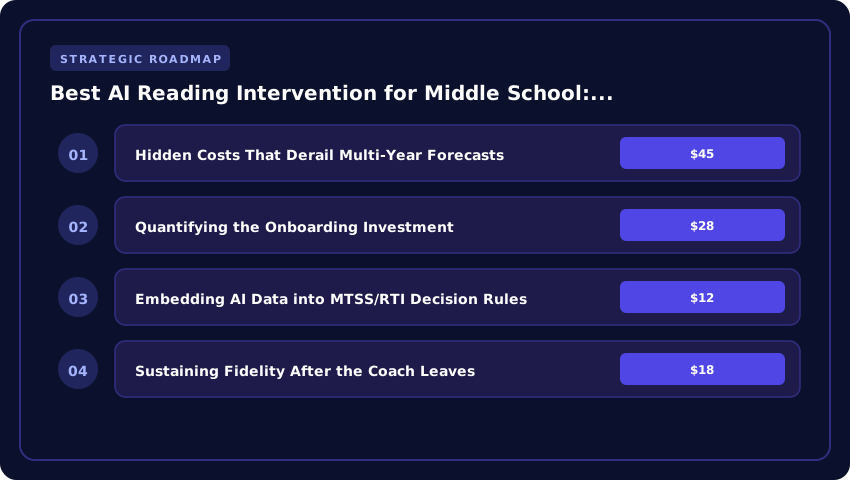
Hidden Costs That Derail Multi-Year Forecasts
The line items below rarely appear on the initial quote but appear reliably on the Year 2 invoice. Bake them into your Year 1–3 cash flow projection now:
- Rostering & SSO Integration: Automated syncing via Clever or ClassLink often carries a $1,000–$2,500 annual “premium integration” fee per district, not per school. Manual CSV uploads save the fee but cost IT staff hours—calculate the fully loaded burden rate of your SIS coordinator before deciding.
- Hardware Refresh Cycles: AI speech recognition and adaptive engines demand modern audio I/O. If your 1:1 Chromebook fleet is on a 4-year refresh, Year 3 of the contract coincides with microphone degradation. Budget $15–$25 per headset for replacement cycles aligned to your device refresh.
- Summer Access Fees: Many vendors treat July–August as an “add-on” license ($2–$5/student). If your district runs Title I summer school or extended school year (ESY) services, negotiate 12-month continuous access in the master service agreement (MSA) to avoid surprise invoices.
Finally, model a “Year 4 Sunset Scenario.” If the grant evaporates, what is the cost to migrate student longitudinal data out of the platform? Vendors compliant with Ed-Fi standards and IMS Global CASE frameworks reduce this exit cost to near zero. If they charge for data extraction, walk away—or deduct that risk premium from your Year 1 negotiation.
Student Data Privacy Compliance: SDPC, FERPA, COPPA & SOPIPA Audit Checklist
Procurement stalls most often at the security review table, not the demo stage. For IT directors evaluating AI reading platforms, the compliance burden is heavier than standard edtech because these tools ingest sensitive PII—reading levels, IEP status, behavioral annotations—and often feed it into large language models. You need a repeatable rubric that satisfies FERPA, COPPA, California’s SOPIPA, and the Student Data Privacy Consortium (SDPC) framework simultaneously. Below is the audit checklist we use to fast-track vendor approvals across districts from Texas to New York.
1. Verify National Data Privacy Agreement (NDPA) Execution Status
Do not accept a vendor’s claim of “FERPA compliance” on a marketing slicksheet. Demand the executed NDPA specific to your state’s exhibit (e.g., Illinois Exhibit G, California Exhibit E). Check the SDPC Resource Registry: if the vendor isn’t listed, ask for the signed PDF immediately. Red flag: Vendors offering only a generic “Data Processing Addendum” (DPA) written for GDPR. U.S. schools require the NDPA’s specific “School Official” designation and the prohibition on selling student data—terms GDPR DPAs often omit. If the vendor uses sub-processors (AWS, OpenAI, Anthropic), those entities must be listed in the NDPA’s Exhibit H with their own signed agreements.
2. Stress-Test Data Retention & Parent Deletion Workflows
AI platforms retain data longer than traditional apps because model improvement cycles require historical interaction logs. Your contract must define: automatic purge timelines (industry standard is 30–90 days post-contract termination), parent-initiated deletion SLAs (COPPA requires “reasonable” response; aim for 15 business days in the SLA), and backup excision protocols. Ask: “If a parent requests deletion today, is the data removed from live databases, vector embeddings, and cold storage backups?” Get the answer in writing. A $15,000–$25,000 annual platform contract should include a dedicated privacy contact—not a generic support@ email—for these requests.
3. Demand Subprocessor Transparency for AI Model Training
This is the new frontier. If the vendor fine-tunes a foundational model (e.g., GPT-4o, Claude, Llama) on your students’ reading miscues, that data may persist in model weights. Require a Subprocessor Disclosure Matrix detailing:
- Entity Name & Purpose: e.g., “OpenAI – Inference API only” vs. “OpenAI – Fine-tuning API.”
- Data Elements Shared: Raw audio? Transcripts? Metadata tags (ELL status, grade)?
- Training Opt-Out Confirmation: Written proof the vendor has disabled “data sharing for model improvement” toggles in the AI provider’s console.
- Data Processing Location: Must be U.S.-only data centers for FERPA/SOPIPA alignment; no EU or APAC routing without explicit parental consent.
If a vendor cannot produce this matrix within 48 hours, move to the next shortlist candidate. The liability exposure for a district—potentially $100+ per student per violation under state laws—far outweighs the convenience of a flashy dashboard.
Implementation Fidelity: Professional Learning & MTSS Tier 2/3 Workflow Integration
Buying the license is the easy part. Getting a middle school reading intervention to actually move the needle on MAP or state summative scores requires a rollout plan that respects the reality of a 47-minute period and a teacher’s cognitive load. If your implementation plan lives in a PDF on a shared drive, fidelity is already dead on arrival.
Quantifying the Onboarding Investment
Vendors love to quote “two hours of asynchronous training.” District reality demands a different metric. To reach fidelity benchmarks—typically defined as 80% of students meeting weekly usage minutes with 75%+ accuracy on embedded assessments—plan for 12 to 15 hours of structured professional learning per teacher in the first semester. This breaks down into a 3-hour initial boot camp (platform navigation, data dashboard literacy, and troubleshooting common login/rostering errors), followed by four 90-minute PLC cycles focused on analyzing the previous week’s student data and adjusting teacher-led small groups accordingly. Budget substitute coverage for at least two of those PLC sessions; asking teachers to do this on prep periods guarantees attrition by October.
Embedding AI Data into MTSS/RTI Decision Rules
Your MTSS flowchart cannot treat the AI tool as a “supplemental activity.” It must be a formal data source in your Tier 2 and Tier 3 decision rules. Configure your Student Information System (SIS) or data warehouse (e.g., PowerSchool, Branching Minds, or EduClimber) to ingest the platform’s weekly proficiency predictors automatically. Establish explicit entrance and exit criteria: for example, a 6th grader scoring below the 25th percentile on the fall screener and showing <30 minutes/week average usage with <65% lesson accuracy triggers a Tier 2 problem-solving meeting. Conversely, three consecutive weeks above the 40th percentile growth trajectory with >90% fidelity triggers an exit discussion. Without these coded rules, the AI data becomes noise rather than signal.
Sustaining Fidelity After the Coach Leaves
The “coaching cliff” hits hard around month four. When the vendor’s implementation specialist reduces visits from weekly to monthly, usage typically drops 15–20%. Counter this by building internal capacity before the cliff arrives. Identify two “Power Users” per building—ideally a reading specialist and a gen-ed ELA teacher—and pay them a $1,500–$2,000 annual stipend to serve as site-based fidelity leads. Their job: run the monthly 30-minute “Data Pulse” meeting, triage roster/tech tickets so they don’t derail instruction, and onboard new hires mid-year. Pair this with a quarterly Fidelity Dashboard Review at the district cabinet level, comparing usage heatmaps against benchmark growth. If a building dips below 70% fidelity for two consecutive months, the cabinet triggers a targeted support plan—not an email reminder. That is how you protect your Title I investment.
Final Vendor Selection Matrix: Weighting Rubric for District Demographics
Stop letting flashy demos drive six-figure decisions. You need a defensible, numbers-first framework that survives a school board audit and a parent FOIA request. Below is the weighted rubric we use with districts spending $50,000 to $500,000+ annually on adaptive literacy platforms. Print this, pin it to the war room wall, and score every vendor on a 1–5 scale before you sign.
The Core Weighting Breakdown
- Predictive Validity (30%): Does the tool’s mid-year benchmark actually forecast the state summative (SBAC, STAAR, FAST, or your local flavor)? Demand the technical manual. If the vendor cannot produce a Pearson r ≥ 0.70 against your state test, score it a 1. No exceptions.
- Student Data Privacy (25%): FERPA and COPPA compliance is the floor, not the ceiling. Require a signed Student Data Privacy Agreement (SDPA) aligned with your state’s specific statute (e.g., California’s SOPIPA, Colorado’s HB 16-1423). Zero tolerance for selling metadata or training LLMs on student PII.
- Total Cost of Ownership (20%): Look past the per-seat license. Calculate three-year TCO: implementation fees, required PD days (substitute teacher costs at $150–$250/day), rostering integration (Clever/ClassLink API limits), and hardware refresh cycles for headsets/mics.
- Usability & Teacher Friction (15%): Time-on-task for teachers, not just students. If a 6th-grade ELA teacher needs > 3 clicks to assign a targeted fluency passage, adoption tanks. Pilot with your most skeptical veteran teacher for two weeks.
- Support & Implementation Fidelity (10%): Dedicated Customer Success Manager (CSM) vs. ticket queue? On-site kickoff included? Guaranteed 24-hour SLA for rostering emergencies during back-to-school week?
Scenario Modeling: Three District Archetypes
Apply the weights above, but adjust the scoring lens for your reality:
- Urban High-EL District (e.g., 40%+ Multilingual Learners): Boost Privacy to 30% (immigration data sensitivity) and Usability to 20% (newcomer onboarding flows). Demand native-language scaffolds in Spanish, Arabic, Haitian Creole, and Mandarin—not just Google Translate overlays.
- Rural Dyslexia-Heavy Population: Predictive Validity jumps to 35%. You need explicit, Orton-Gillingham-aligned scope and sequence mapping. Verify the AI flags phonological deficits, not just comprehension gaps. Bandwidth constraints? Require offline sync capability.
- Suburban Acceleration Focus: TCO drops to 15%; Validity stays 30%. You need advanced analytics: Lexile growth trajectories, college-readiness forecasting (ACT/SAT correlation), and parent-facing dashboards that satisfy high-expectation stakeholders.
Contract Negotiation Leverage Points
Never sign the vendor’s Master Services Agreement (MSA) redline-free. Insert these three non-negotiables:
- Price Caps: Lock year-over-year escalation at CPI + 1% max. Without this, a $25/student license becomes $38 by year three.
- Opt-Out Clauses: “Termination for Convenience” with 60-day notice and pro-rata refund. If the tool fails to move the needle on your Winter benchmark, you walk away without paying for the full spring semester.
- Efficacy Guarantees: Tie 10–15% of the contract value to mutually agreed KPIs (e.g., “50% of Tier 2 students move to Tier 1 by MOY”). If missed, vendor owes credit toward next renewal or cash penalty. This shifts risk from taxpayers to the vendor.
Score every vendor, sum the weighted totals, and the winner reveals itself. The matrix doesn’t make the decision for you—it just prevents you from rationalizing a bad one.
| Funding Source | Key Deadline / Cycle | Allowable Use for AI Reading | Sustainability Risk | Matching / Compliance Requirement |
|---|---|---|---|---|
| ESSER III (ARP) | Liquidation: March 2026 | One-time purchases, PD, infrastructure | High (Fiscal Cliff) | Must obligate by Sept 2024; evidence-based intervention required |
| Title I, Part A | Annual Allocation (July 1) | Recurring licenses, staffing, supplements | Low (Recurring) | Supplement not Supplant; Comprehensive Needs Assessment |
| CLSD / State Literacy Grants | Varies by State (Typically Annual/RFP) | Curriculum adoption, coaching, tech | Medium (Competitive) | State literacy plan alignment; often requires 15-25% local match |
| IDEA Part B | Annual (July 1) | Interventions for SWD, assistive tech | Low (Recurring) | IEP-driven; Excess cost requirement |
| State Per-Pupil / Foundation Aid | Fiscal Year (Varies) | Core curriculum, universal screening | Low (Base Funding) | Maintenance of Effort (MOE) laws apply |
Frequently Asked Questions
Can Title I funds pay for AI reading intervention software in middle schools?
Yes, Title I, Part A funds can purchase AI reading intervention licenses for middle schools if the program is evidence-based, supplements core instruction, and addresses needs identified in the school's Comprehensive Needs Assessment. Funds must not supplant state/local obligations.
What is the ESSER III liquidation deadline for AI reading contracts?
The ESSER III liquidation deadline is March 2026. Districts must fully expend obligated funds by this date. New AI reading contracts signed now cannot use ESSER III unless obligated before September 30, 2024; sustainability must shift to Title I or state grants.
How do CLSD grants differ from Title I for funding literacy technology?
CLSD (Comprehensive Literacy State Development) grants are competitive, multi-year awards requiring alignment with a state literacy plan and often a local match (15-25%). Title I is formula-funded, recurring annually, and requires a 'supplement not supplant' methodology rather than a competitive application.
What procurement timeline aligns best with multi-year AI reading vendor contracts?
Align procurement with the Title I annual cycle (planning Jan–Mar, budget approval Apr–Jun, implementation July 1). This allows leveraging recurring federal allocations for 3–5 year vendor agreements, avoiding the ESSER fiscal cliff and meeting state grant matching cycles.
Does IDEA funding cover AI reading tools for students with dyslexia?
Yes, IDEA Part B funds cover AI reading interventions and assistive technology for students with dyslexia if specified in the IEP. The tool must provide specially designed instruction or accommodation, and the district must meet 'excess cost' requirements for special education.
Strategic Final Takeaway
When evaluating Best AI Reading Intervention Software For Middle School Literacy Gap Closure And State Assessment Alignment, base your decisions on accredited institutional standards, measurable return on investment (ROI), and up-to-date official guidelines. Always verify specific dates and requirements through official regulatory portals.