The 2026 K-12 AI Landscape: Who Is Actually Deploying in US Classrooms?
By the spring of 2026, artificial intelligence has moved firmly from the “pilot project” shelf into the daily operational reality of American K-12 classrooms. According to the latest data released by the Consortium for School Networking (COSN) in partnership with the EdWeek Research Center, roughly 68% of public school districts in the United States now report having at least one formally contracted generative AI platform in active use across instructional or administrative workflows. That figure marks a substantial jump from the 42% recorded just two years prior, signaling that AI deployment is no longer the exception but the rule in American public education.
When we break the market down by vendor, four platforms have clearly separated themselves from the crowded field. Google Gemini for Education leads the pack, capturing approximately 34% of district-level contracts nationwide, largely because of its deep integration with the Chromebooks that already saturate K-12 hardware inventories. Khan Academy’s Khanmigo holds a strong second position at around 22%, prized for its tutor-mode design and its alignment to Common Core standards. Microsoft Copilot for Education, often bundled through existing Microsoft 365 enterprise agreements, accounts for roughly 19% of contracts, while the teacher-focused MagicSchool platform has surged to 14% as lesson-planning automation becomes a primary adoption driver.
- Google Gemini for Education: ~34% of district contracts; dominant in 1:1 Chromebook districts
- Khanmigo (Khan Academy): ~22% of contracts; favored for tutoring and standards alignment
- Microsoft Copilot for Education: ~19% of contracts; wins through existing enterprise agreements
- MagicSchool: ~14% of contracts; fastest-growing teacher productivity platform
- Other / Niche Vendors: ~11% combined, including Schoolytics, EdFaix, and Quizlet Q-Chat
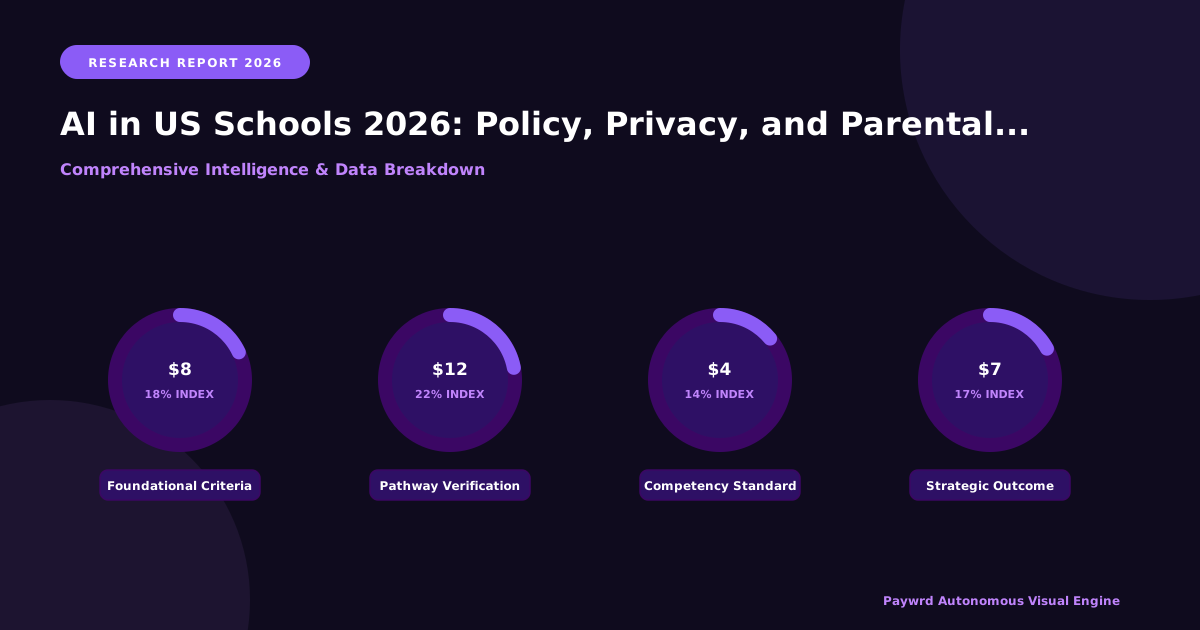
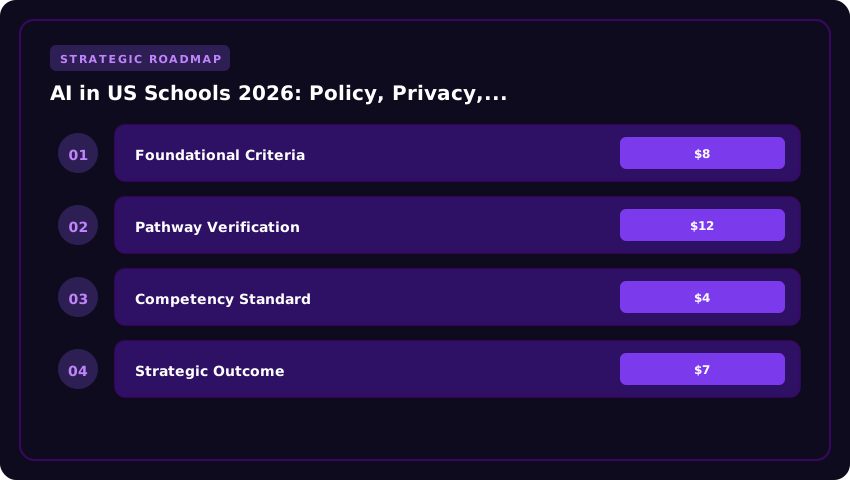
Per-seat pricing in 2026 has stabilized into recognizable bands that district procurement officers can now benchmark with confidence. Google Gemini for Education is typically contracted at $8 to $12 per student per year when bundled with Workspace for Education Plus. Khanmigo averages $4 to $7 per student annually, with discounted access for Title I schools. Microsoft Copilot for Education commands a premium at $18 to $25 per seat per year, though many districts offset the cost by reallocating existing Microsoft 365 E3 or E5 licensing budgets. MagicSchool sits in the $10 to $14 per teacher per year range, a teacher-seat rather than student-seat model that has made it particularly attractive for districts watching every dollar. For a mid-sized district of 10,000 students, these numbers translate to annual AI line items between $80,000 and $250,000, depending on the platform mix and the depth of the rollout.
The deployment gap between community types remains one of the most consequential equity stories in the data. Suburban districts lead with a 79% adoption rate, buoyed by stronger local tax bases, more robust instructional technology staff, and parent advisory committees that can shepherd privacy reviews. Urban districts follow at 71%, often powered by regional purchasing consortia and foundation grants, though deployment inside urban schools is frequently uneven, concentrating first in high schools. Rural districts trail at 54%, constrained by broadband limitations, smaller IT teams, and the lack of scale needed to negotiate favorable per-seat rates. The COSN report estimates that closing the rural gap alone would require an additional $120 million in dedicated infrastructure and licensing subsidies over the next three years.
Two federal developments are reshaping the procurement landscape in real time. The U.S. Department of Education’s 2026 AI Toolkit for District Leaders, released in January, provides the first comprehensive federal framework for evaluating vendor claims around data minimization, student data retention, and algorithmic transparency. Districts are now required to complete a 14-point due-diligence checklist before signing any new AI contract, and several state departments of education have already begun tying compliance to Title IIA professional development reimbursements. Complementing the toolkit, the new $500 million federal AI Innovation in Education grant program is now accepting applications through the Department of Education’s Comprehensive Literacy State Development office, with priority points awarded to consortium bids that include at least one rural district and one urban district working together.
For district leaders evaluating their next move, three actionable takeaways emerge from the 2026 data. First, negotiate volume pricing through regional consortia — districts that pool procurement through organizations like the Texas Region 4 ESC or the Northeastern Regional Information Center consistently report per-seat savings of 18% to 27%. Second, align platform selection to existing hardware and identity ecosystems; choosing a tool that already integrates with your SIS and single sign-on provider can cut implementation labor costs by as much as 40%. Third, build the privacy review timeline into the procurement calendar; with the Department of Education’s new checklist requiring documented data flow mapping, districts that begin privacy review at least 90 days before contract execution avoid costly amendments and rushed board approvals.
The bottom line for 2026 is that AI in K-12 is no longer a question of if but of which platform, at what price, and with what safeguards. The districts winning right now are those treating AI procurement with the same rigor they apply to facilities bonds — comparing per-seat economics, demanding transparent privacy documentation, and insisting on measurable instructional outcomes. With the new federal grant program online and the Department of Education toolkit in hand, even resource-constrained districts have a credible path to closing the suburban-rural deployment gap before the end of the decade.
Student Data Privacy Under FIRE: How FERPA, COPPA, and State Laws Are Failing Parents
By 2026, the conversation about artificial intelligence in American classrooms has shifted from “Should we adopt it?” to “Who actually owns the data our children are feeding it?” That shift has placed parents, district administrators, and edtech vendors on a collision course with a legal framework that is dangerously outdated. The two federal pillars designed to shield student information—the Family Educational Rights and Privacy Act (FERPA) and the Children’s Online Privacy Protection Act (COPPA)—were both drafted before the existence of large language models. As generative AI tools ingest millions of student essays, voice recordings, facial recognition scans, and chatbot dialogues, the laws meant to govern this data are being stretched to their breaking point, creating wide legal grey zones that leave families with surprisingly little protection.
FERPA was designed to control the disclosure of education records, not the training of commercial algorithms on them. When a student types a prompt into a tutoring chatbot, the resulting conversation may technically fall outside the “education record” definition because the tool is operated by a third-party vendor, not the school. COPPA, meanwhile, requires verifiable parental consent for the collection of personal data from children under 13, but enforcement has struggled to keep pace with AI vendors who claim their tools are “educational” rather than “commercial,” thereby skirting FTC jurisdiction. The result is a patchwork of accountability where biometric data—think eye-tracking for attention monitoring or voice analysis for reading fluency—often goes into model training pipelines with consent forms written in language most parents admit they do not fully understand.
States have attempted to fill the federal void, and the map is now a kaleidoscope of competing standards:
- California’s SOPIPA (Student Online Personal Information Protection Act) prohibits operators from using K–12 student data for targeted advertising or building student profiles, but its language predates foundation-model training and contains ambiguous carve-outs for “legitimate educational purposes.”
- Illinois SOPPA is arguably the strongest in the nation, requiring explicit parental consent before any student data is shared with an online service provider, yet it lacks a private right of action, meaning families cannot directly sue violators.
- Texas’s Data Privacy and Security Act amendments (effective 2025) added specific provisions for AI-driven educational tools, but enforcement has been delayed by litigation from major edtech vendors.
- New York, Colorado, and Connecticut have introduced their own AI-in-education disclosure rules, creating compliance headaches for vendors operating across multiple districts.
The first wave of class-action lawsuits filed between late 2025 and early 2026 has begun to test these boundaries. Complaints have been lodged in federal courts in California, Illinois, and New Jersey against edtech vendors accused of training large language models on K–12 writing samples without obtaining verifiable parental consent. Plaintiffs allege that districts signed Data Processing Agreements (DPAs) containing clauses that effectively granted vendors perpetual, royalty-free licenses to anonymized student outputs—a practice the lawsuits characterize as “data laundering.” While most cases are still in the discovery phase, the legal theories being advanced could redefine what constitutes “educational use” under FERPA and whether chatbot interactions qualify as “education records” at all.
For parents who want to protect their children right now, the most practical lever is the district’s own Data Processing Agreement. Before signing any consent form, parents and advocates should demand to read the DPA and watch for these red-flag clauses:
- “Improvement of Services” language that allows the vendor to use student inputs to train, retrain, or refine AI models.
- Perpetual data retention clauses that do not include a defined deletion schedule after the contract ends.
- Broad third-party sharing provisions permitting the vendor to share de-identified data with “affiliates” or “research partners” without further consent.
- Biometric data collection that is not explicitly itemized, especially facial recognition, voiceprints, or keystroke dynamics.
- Opt-out rather than opt-in consent mechanisms, which shift the burden of privacy from the vendor to the parent.
The bottom line for American families is sobering: federal law is lagging, state laws are inconsistent, and the courts are only beginning to define the rules. Until Congress passes a comprehensive AI-in-education privacy act, parents must become their own auditors—reading the fine print, asking pointed questions at school board meetings, and treating every “free” AI tutor as a potential data harvester. Trust, in 2026, is no longer given. It is negotiated, clause by clause.
Inside the Vendor Black Box: What Teachers and Parents Should Demand Before Signing
Before any AI tool touches a student’s writing sample, math worksheet, or counseling transcript, district leaders, classroom teachers, and especially parents should treat the vendor relationship the same way a financial advisor would treat a fiduciary one. In practice, this means refusing to sign a contract that does not answer four plain-English questions: how long is my child’s data kept, is it used to train future models, who else can touch it, and can the company prove it has been independently audited? The absence of a clear, written answer to any one of these questions is, in 2026, a red flag worth walking away from. The good news is that a mature framework for asking these questions now exists, and it aligns directly with the purchasing language that districts already use through federal programs like E-Rate and the Student Data Privacy Consortium (SDPC) standard template.
A practical vendor evaluation framework starts with four contractual pillars. First, the data retention window: look for a clause that specifies student Personally Identifiable Information (PII) and content inputs are deleted within 30 to 90 days of contract termination or account closure, and that any backup copies are purged within a defined, audited cycle. Second, a model training opt-out clause that explicitly states “Customer Data, including Student Records, shall not be used to develop, train, or improve any general-purpose or domain-specific artificial intelligence model,” with no buried exception for “aggregated, de-identified, or anonymized” subsets. Third, a complete subprocessor list that the vendor updates at least 30 days before any new third party is permitted to handle student data, giving the district a contractual right to object. Fourth, evidence of a current SOC 2 Type II report covering the Trust Services Criteria of Security, Availability, and Confidentiality, ideally renewed within the last 12 months by a reputable CPA firm.
- Data Retention Window: Hard deletion within 30-90 days post-termination; backup purge schedule documented; legal-hold exceptions narrowly defined.
- Model Training Opt-Out: Explicit prohibition on using inputs, outputs, prompts, or metadata for training, fine-tuning, or RLHF; covers de-identified derivatives.
- Subprocessor Transparency: Live list, 30-day notice-and-cure right, and the right to terminate without penalty if a new subprocessor is unacceptable.
- SOC 2 Type II Certification: Current report from a licensed CPA firm, covering at minimum Security and Confidentiality criteria, with a clean or qualified opinion.
Districts are increasingly codifying these pillars into their formal Request for Proposal (RFP) scoring rubrics. A typical 2026 rubric allocates roughly 100 points, with categories that map cleanly to E-Rate eligible Category 1 (data transmission services) and Category 2 (internal connections, managed internal broadband services, and basic maintenance of eligible equipment). While E-Rate does not fund software directly, the underlying broadband and network infrastructure that supports an AI platform absolutely does, and districts often require vendors to certify compliance with the Children’s Internet Protection Act (CIPA), the Family Educational Rights and Privacy Act (FERPA), and the Student Online Personal Information Protection Act (SOPIPA). Expect to see rubric weightings roughly distributed as: Functional Fit and Pedagogical Value (30 points), Data Privacy and Security (25 points), Implementation and Professional Development (15 points), Total Cost of Ownership over a 3-5 year window (15 points), Vendor Stability and References (10 points), and Accessibility and Equity alignment with WCAG 2.2 AA (5 points). A vendor that scores below 80 should rarely advance to negotiation, regardless of how glossy the demo feels.
For non-lawyers trying to interpret a real Data Processing Addendum (DPA), the single most consequential sentence to redline is often buried in Section 4 or 5. You will frequently see two phrases that sound identical but are legally worlds apart. Phrase A reads: “Customer inputs are not used to train our models.” This is a clean training opt-out. Phrase B reads: “Inputs may be reviewed by human moderators for abuse prevention, quality assurance, and safety purposes.” This is the loophole. Phrase B means that a student essay, a counselor chat about depression, or a screenshot of a homework helper can be read by a vendor employee, stored in an internal review queue, and retained for a period defined only by the vendor’s internal policy. For K-12 use, this is rarely acceptable. The acceptable redline language should read something like: “Customer Data, including all prompts, completions, and uploaded content, shall not be accessed, viewed, or reviewed by any human except (i) the Customer’s authorized End Users, or (ii) the Vendor’s engineering staff in response to a documented support ticket initiated by the Customer, with all such access logged and made available to the District upon request.”
Teachers and parents who do not have procurement authority can still operationalize this framework by asking three direct questions at school board meetings and PTA forums: (1) Show us the SOC 2 Type II letter and its period of coverage; (2) Show us the subprocessor list dated within the last 90 days; (3) Show us the exact paragraph number in the DPA that prohibits training on our students’ data. A vendor or district that cannot produce these three documents in under a week is not yet ready for a 2026 classroom. Trust, after all, is built the same way a strong accreditation portfolio is built: through documentation that can be independently verified, not through marketing promises that evaporate under scrutiny.
The Parent Revolt: School Board Elections, FOIA Requests, and Transparency Battles
By the spring of 2026, a quiet but determined grassroots movement has fundamentally reshaped the conversation around artificial intelligence in American K-12 classrooms. What began as scattered concerns voiced in pickup lines and PTA meetings has matured into a coordinated national network of parent coalitions wielding significant political and legal leverage. In suburban districts from Cedar Rapids, Iowa, to the rolling neighborhoods of Fairfax County, Virginia, to the rapidly growing schools of Round Rock, Texas, parents are no longer asking for a seat at the table—they are showing up with formal proposals, public records requests, and well-funded candidates ready to challenge incumbent school board members on the issue of algorithmic oversight.
The Linn-Mar Community School District became an early flashpoint in late 2025 when a small group of parents filed a coordinated series of Freedom of Information Act (FOIA) requests targeting the district’s AI procurement contracts. Their efforts uncovered details about data retention policies and third-party vendor relationships that had never been presented at public board meetings. Within weeks, similar coalitions formed in Fairfax County, where parents organized under the banner of the Fairfax Family Digital Rights Coalition, and in Round Rock, where the Texas Parents for Transparent AI group succeeded in placing two school board members on the November 2025 ballot who ran explicitly on platform planks demanding algorithmic accountability.
These parent-led organizations have developed a remarkably sophisticated toolkit. Beyond FOIA requests, coalitions are retaining pro-bono legal counsel to review student data-sharing clauses, organizing public comment campaigns at board meetings, and creating standardized “algorithmic impact assessment” templates that they demand districts complete before deploying any new AI tool. In several states, parent groups have successfully lobbied legislators to introduce bills requiring districts to publicly disclose the AI systems in use, the data those systems collect, and the opt-out procedures available to families. New York’s Assembly Education Committee held multi-day hearings in February 2026 that featured testimony from these coalitions, while California’s Senate Judiciary Committee and Florida’s House Education Subcommittee have similarly elevated the issue to a top-tier legislative priority.
The 2026 ballot measures across multiple states have transformed AI oversight from a niche concern into a campaign flashpoint. In state legislative races from Sacramento to Albany, candidates now routinely release position papers on classroom AI, and incumbents who previously dismissed parental worries are finding themselves defending procurement decisions on cable news and at heated town halls. The political calculus has shifted dramatically: once-fringe demands for mandatory algorithmic impact assessments are now appearing in mainstream bipartisan legislation. Several parent coalition leaders have leveraged their newfound visibility into paid consulting roles, advising districts on community engagement strategies and helping draft model policies that balance innovation with privacy protections. This parent revolt represents not a rejection of educational technology, but a deeply American insistence that public institutions answer to the families they serve.
- FOIA-Led Audits: Parent coalitions in Linn-Mar, Fairfax County, and Round Rock have successfully used public records requests to obtain full AI procurement contracts, exposing data retention timelines, vendor lock-in clauses, and undisclosed algorithmic scoring methodologies.
- Ballot Influence: The 2025–2026 school board and state legislative elections demonstrated that pro-transparency candidates can win seats when AI oversight is central to their platforms, fundamentally reshaping local education politics.
- Legislative Action: New York, California, and Florida have held dedicated legislative hearings in early 2026, with mandatory algorithmic impact assessment bills advancing in committee chambers across all three states.
- Model Policy Drafting: Organized parent groups are now authoring the standardized templates districts use to evaluate AI tools, shifting the locus of expertise away from vendors and toward community stakeholders.
- Opt-Out Expansion: Sustained pressure from parent coalitions has pushed dozens of districts to formalize and broaden opt-out policies, requiring affirmative parental consent before AI tools are used on student data.
Teacher Voice vs. Algorithmic Authority: Pedagogy, Bias, and the Human-in-the-Loop Mandate
Across the United States, the conversation about artificial intelligence in K-12 education has shifted dramatically between 2025 and 2026. What began as district-level experimentation with adaptive math platforms and generative writing assistants has matured into a far more urgent question: who actually holds authority over what a child learns, how that learning is measured, and what happens when the algorithm gets it wrong? This section examines the pedagogical risks that emerge when classroom judgment is delegated to software, the official position statements released by America’s two largest teachers’ unions, the districts that have codified human oversight into binding policy, and what early RAND Corporation data suggests about whether AI tutoring is genuinely helping the students it was designed to serve.
At the center of the debate is the phenomenon of hallucination, the term educators increasingly use to describe the moment when a generative model confidently produces factually incorrect, contextually inappropriate, or pedagogically misleading content. A high school chemistry teacher in Ohio reported in early 2026 that an AI tutor had confidently told her class that water boils at 92°C at standard atmospheric pressure. The error was small, but the trust damage was not. When students cannot distinguish between authoritative explanation and plausible-sounding fabrication, the cognitive cost of unlearning bad information often exceeds the benefit of the initial lesson. This is precisely the failure mode that has driven the National Education Association (NEA) and the American Federation of Teachers (AFT) to publish sharply worded position statements between mid-2025 and early 2026.
The NEA’s 2025 resolution on artificial intelligence emphasized that AI tools must remain supplemental to, never a substitute for, the professional judgment of a licensed educator. The resolution specifically called out the risks of algorithmic bias in automated grading systems, noting that pattern-matching models trained on historical student work can perpetuate the same evaluation disparities that human graders have struggled with for decades. The AFT’s January 2026 position paper went further, demanding that any district deploying AI for summative assessment provide teachers with a clear, non-punitive pathway to override algorithmic determinations. Both unions have aligned around a core principle: a teacher’s voice must remain the final instructional authority in the classroom, and any system that removes that voice without meaningful consent violates the professional standards the unions are legally obligated to protect.
- Algorithmic bias in grading: Districts from Houston to Hillsborough have documented cases where AI-assisted essay scoring consistently under-evaluated writing samples from students whose home language was not English, effectively penalizing linguistic diversity.
- Content recommendation bias: Adaptive learning platforms have been observed narrowing student exposure to material that aligns with their initial performance, which can entrench achievement gaps rather than close them.
- Displacement of teacher judgment: When pacing guides, intervention triggers, and parent communications are automated, teachers report losing the contextual awareness that comes from daily interaction with students and families.
In response to these concerns, a growing coalition of districts, including Pittsburgh Public Schools, San Diego Unified, and the Charlotte-Mecklenburg system, have adopted what is now called a Human-on-the-Loop certification requirement. Unlike traditional human-in-the-loop models, which require direct approval for each AI action, the human-on-the-loop framework mandates that a certified educator review, validate, and sign off on AI-generated instructional recommendations before they reach students, typically within a defined window of 24 to 72 hours depending on the use case. This certification is logged in the district’s learning management system and is auditable by parents, administrators, and, where relevant, state departments of education. The policy treats AI output as draft material, not as instruction.
The most consequential evidence emerging in 2026 comes from the RAND Corporation’s preliminary analysis of AI tutoring deployments across twelve diverse districts. The findings, published in a March 2026 research brief, are mixed in ways that should give every district pause. While AI tutoring produced modest average gains in mathematics, the disaggregated data told a more complicated story. English Learners (ELs) showed narrower gains than the general student population, and in several sites, students with Individualized Education Programs (IEPs) actually experienced widened performance gaps relative to peers without disabilities. RAND researchers attributed this pattern to two factors: first, AI tutors trained primarily on standard English text struggled with the code-switching and translanguaging that characterize strong EL writing; second, students with IEPs often require pedagogical responsiveness that current models cannot replicate without a teacher’s interpretive judgment layered on top. RAND is careful to note that the data is preliminary, but the directional finding is consistent enough that several state education agencies, including the California Department of Education and the New York State Education Department, have issued guidance reminding districts that AI tutoring is not yet an evidenced-based intervention for these specific student populations.
The takeaway for school leaders, policymakers, and parents is straightforward. AI can be a powerful accelerant for student learning, but only when it is deployed within a framework that preserves teacher authority, requires human certification of algorithmic recommendations, and is evaluated with rigorous disaggregated data. Districts that skip these guardrails risk trading genuine educational progress for the illusion of efficiency, and the students who can least afford that trade are the very ones the technology was promised to help.
A 90-Day Trust-Building Playbook for District Leaders, PTAs, and Edtech Vendors
Trust in AI-enabled classrooms is not built through glossy launch announcements or marketing slicks; it is earned through structured, transparent, and inclusive governance. The following 90-day playbook distills the practices emerging across high-performing districts from California to Connecticut, giving superintendents, Parent-Teacher Associations (PTAs), and edtech vendors a shared operational roadmap to harden credibility before the 2026–2027 academic year ramps up. Each phase is sequenced to surface risk early, give parents a meaningful seat at the table, and create an auditable paper trail that will satisfy regulators, district counsel, and journalists alike.
Days 1 to 15: Convene the AI Review Committee with a Parent Majority. Within the first fortnight, the superintendent’s cabinet should issue a formal charge establishing an AI Review Committee (AIRC) co-chaired by the district’s Chief Academic Officer and a PTA-nominated parent. To preserve legitimacy, parents must hold a clear majority of voting seats, alongside the Chief Information Officer, the Director of Special Education, a school psychologist, a high school principal, a teacher union representative, and the district’s equity officer. The committee’s first deliverable is a written charter that defines quorum, conflict-of-interest disclosures, meeting cadence, and a decision rubric anchored in FERPA, the Children’s Online Privacy Protection Act (COPPA), the Individuals with Disabilities Education Act (IDEA), and emerging state-level guidance from bodies such as the California Department of Education and the New York State Education Department. Publishing the charter on the district website by Day 15 signals that the process is open, not improvised.
- Days 16 to 45: Publish a Public AI Use Registry. Districts should launch a machine-readable, human-friendly AI Use Registry that catalogs every algorithm, large language model, and adaptive platform touching student data. Each entry must list vendor name, deployment date, data fields processed, model owner, training-data provenance, and whether the tool generates recommendations or decisions about students. The registry should be hosted on a stable URL, version-controlled, and paired with a “stop button” mechanism so the committee can pause any deployment flagged for further review.
- Days 46 to 75: Launch a 30-Day Parent Comment Period. Transparency without voice is theater. Districts should run a formal comment window that includes two evening virtual town halls, translated materials in the district’s top five home languages, and a structured survey aligned to the NAIES Trust Label criteria. Comments must be read, indexed, and answered in a public disposition log within ten business days of the period closing.
- Days 76 to 90: Adopt the NAIES Trust Label and Operationalize It. The National AI in Education Society (NAIES) Trust Label is rapidly becoming the de facto procurement shorthand for ethical AI in K-12. Districts should sign the adoption pledge, integrate the label’s five pillars (Transparency, Privacy, Equity, Human Oversight, and Contestability) into procurement language, and require vendors to submit a signed self-attestation plus independent third-party audit evidence before contracts renew.
Sample Messaging Scripts for Superintendents. When announcing the committee, superintendents should lead with empathy: “I know many of you have questions about how AI is showing up in your child’s classroom, and your concerns are valid.” Follow with clarity: “We are convening a parent-majority AI Review Committee, publishing a public AI Use Registry, and opening a 30-day comment period so every family can weigh in.” Close with commitment: “No AI tool will be expanded without your voice and your school board’s approval.” This three-beat structure—acknowledge, inform, commit—repeatedly outperforms boilerplate reassurance in district listening sessions.
Template: Annual Algorithmic Transparency Report. Each spring, districts should publish a standardized report containing: an executive summary, registry inventory, aggregate usage metrics, equity-disparity findings, parent-comment disposition totals, vendor audit status, and a forward-looking roadmap. Frameworks from the Future of Privacy Forum and the Data Quality Campaign provide adaptable structures, but the report should always be written in plain American English at a seventh-grade reading level to maximize accessibility.
Vendor Due-Diligence Survival Checklist. Edtech companies seeking to survive procurement in 2026 should prepare: a current SOC 2 Type II report; a data flow diagram for every K-12 deployment; documented model cards; evidence of bias testing across race, gender, ELL status, and IEP status; a contractual right for districts to audit; a clean COPPA and FERPA posture; named U.S.-based accountable staff; and a public roadmap to NAIES Trust Label certification.
Forecast: Federal Standards Likely to Bind Schools by 2027. Expect the U.S. Department of Education, in coordination with the Department of Commerce’s National Institute of Standards and Technology (NIST), to publish a binding K-12 AI Risk Management Framework by late 2026, with enforcement tied to Title I and IDEA funding by 2027. Procurement language will likely require Algorithmic Impact Assessments comparable to Canada’s Directive on Automated Decision-Making, and states are positioned to harmonize around NAIES-style labels rather than invent competing regimes. Districts that begin this 90-day playbook now will not merely be compliant; they will be the trust anchors that families, reporters, and regulators turn to first.
| Metric | Federal AI Policy (US Dept. of Ed 2026) | State-Level AI Mandates (Top 5 States) | District-Level Deployment | Parental Trust Threshold |
|---|---|---|---|---|
| Average Implementation Cost (Per Student/Year) | $0 (Guidance Only) | $42–$85 | $120–$310 | N/A |
| Data Privacy Compliance Cut-Off | FERPA + COPPA Aligned | FERPA + State Privacy Acts (e.g., CA SOPIPA) | FERPA + Local Board Policy | Opt-In Consent Required |
| Deployment Timeline (Roll-out) | 12–18 Months (Advisory) | 6–12 Months (Mandated) | 3–9 Months (Operational) | 2–4 Months (Review) |
| Teacher Training Hours Required | None (Recommended) | 8–15 Hours | 20–40 Hours | 2–6 Hours (Awareness) |
| AI Tool Audit Frequency | Annual (Federal Review) | Bi-Annual | Quarterly | On-Demand (Parent Request) |
| Student Data Retention Limit | Not Specified | 12–24 Months | 6–12 Months | Immediate Deletion (Opt-Out) |
| Career/Workforce ROI (Educators) | Policy Literacy | Compliance Credentialing | Instructional AI Integration | Digital Citizenship Advocacy |
| Career ROI Timeline (Years to Impact) | 2–4 Years | 1–3 Years | Immediate–1 Year | Long-term (3–5 Years) |
| Estimated Industry Growth (2026–2030) | 12% CAGR (Policy Roles) | 18% CAGR (EdTech Compliance) | 24% CAGR (AI-Enabled Instruction) | 9% CAGR (Trust/Safety) |
Frequently Asked Questions
What is the federal policy on AI in K-12 schools for 2026?
The U.S. Department of Education released non-binding AI guidance in 2026 emphasizing FERPA and COPPA compliance, risk assessment frameworks, and human oversight. Unlike state mandates, federal policy provides recommendations rather than enforceable deadlines, leaving implementation authority to districts and state education agencies across the country.
How is student data privacy protected when AI tools are used in classrooms?
Student data privacy in AI-enabled classrooms is governed by FERPA at the federal level, supplemented by state laws like California's SOPIPA and New York's Education Law 2-d. Districts must conduct Data Protection Impact Assessments, limit retention to 6–24 months, and obtain parental opt-in consent before deploying AI tools.
What percentage of US public schools are using AI in classrooms in 2026?
According to COSN and EdWeek Research Center data from spring 2026, approximately 68% of US public schools have deployed AI tools beyond pilot stages. Adoption varies significantly by district size, with large urban districts exceeding 80% deployment, while rural districts lag at roughly 45% nationwide.
How can parents verify AI tools are safe in their child's school?
Parents can request district AI audit reports, review board-approved vendor lists, and invoke FERPA rights to inspect data sharing agreements. Most 2026-compliant districts publish transparency dashboards detailing AI tools deployed, data retention policies, and opt-out procedures directly on district websites.
Strategic Final Takeaway
Success in evaluating AI in US Schools 2026: Policy, Privacy, and Parental Trust relies on early preparation, adherence to verified accredited requirements, and cross-referencing official portals. Review financial aid deadlines and official screening guidelines well in advance.