
Tuition Reality Check: 2026 AI Degree vs. Bootcamp Pricing
When prospective students and career changers ask whether they should pursue a formal degree in artificial intelligence or enroll in a coding bootcamp, the first answer almost always comes down to dollars. In 2026, the financial gap between a traditional four-year university program and an accelerated bootcamp is wider than ever, but the value proposition depends heavily on whether you are comparing apples to apples or apples to oranges. Let us break down the real numbers from top US institutions and the broader bootcamp market so you can make an informed decision without romanticizing either path.

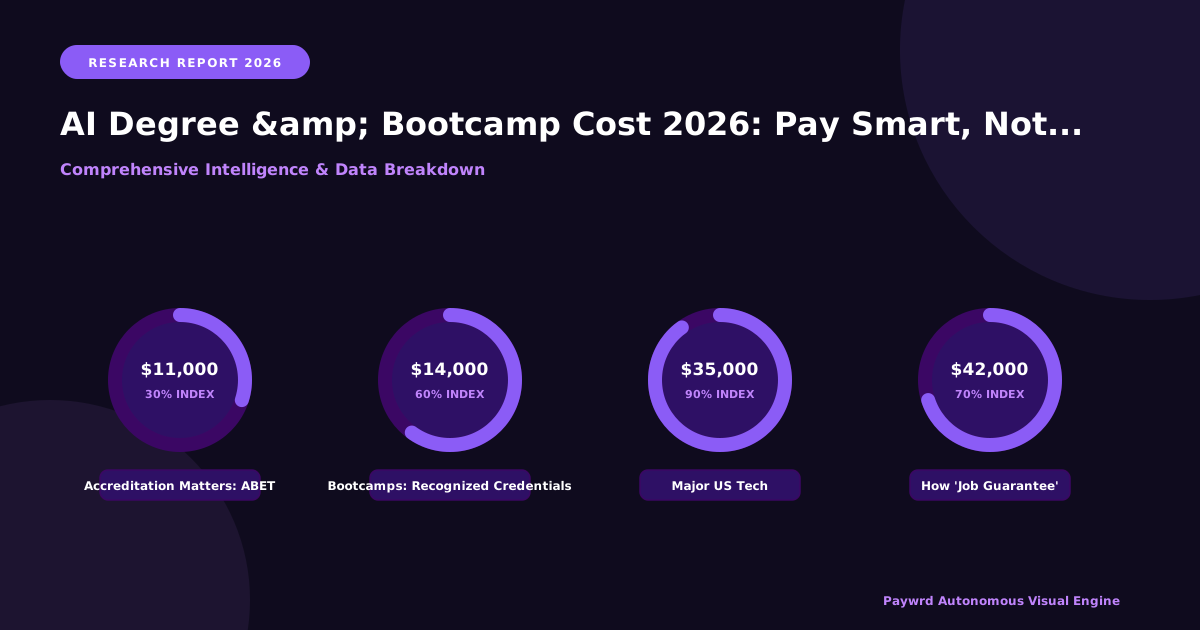
Georgia Tech, one of the most recognized names in computer science and machine learning, continues to deliver exceptional value among public research universities. The Master of Science in Computer Science with a specialization in machine learning carries a total estimated cost between $11,000 and $14,000 for in-state residents over the entire program, thanks to the school’s aggressive online and on-campus tuition structure. Out-of-state learners, however, should budget closer to $35,000 to $42,000 depending on course load and residency status. Georgia Tech’s online OMSCS program has become the benchmark for affordability among elite institutions, particularly for working professionals who need to balance tuition against existing salaries.
Carnegie Mellon University, home to one of the first dedicated AI departments in the country, sits at a very different price point. As a private institution, CMU does not distinguish between in-state and out-of-state tuition, which simplifies budgeting but eliminates the discount option. The Master of Science in Artificial Intelligence and Innovation or the broader MS in Computer Science with an AI concentration costs roughly $60,000 to $70,000 in total tuition, not including living expenses in Pittsburgh. While the price is steep, the brand recognition and the rigorous curriculum often justify the investment for students targeting research roles, Silicon Valley positions, or AI engineering at FAANG-adjacent companies.

The University of Texas at Austin, a flagship public university with a rapidly growing AI portfolio through the Good Systems initiative and its top-ranked computer science department, charges in-state graduate students approximately $10,000 to $13,000 for a master’s degree, while out-of-state and international students face tuition closer to $28,000 to $38,000. UT Austin’s MSAI program has quickly climbed the rankings, making the in-state savings a meaningful advantage for Texas residents and competitive applicants willing to establish residency.
By contrast, the 2026 bootcamp market has matured into a more standardized pricing tier. Most reputable full-time AI and data science bootcamps fall between $15,000 and $22,000, with part-time and self-paced options dropping as low as $7,500 to $12,000. Programs such as Flatiron School, General Assembly, Springboard, and the AI-specific tracks from Galvanize often bundle career coaching, mentorship, and job guarantees into the tuition. When you compare a $18,000 bootcamp to a $40,000 out-of-state public university or a $65,000 private university degree, the bootcamp looks like a bargain on paper. But the calculus changes when you factor in regional cost-of-living adjustments.
Here is what those adjustments look like in practice:
- High cost-of-living metros like San Francisco, Boston, and New York can add $2,500 to $4,500 per month in living expenses during a bootcamp, quickly eroding the tuition savings.
- Mid-tier cities such as Atlanta, Pittsburgh, and Austin typically add $1,400 to $2,200 per month, which is why many bootcamps now offer remote cohorts or hybrid models.
- Low cost-of-living regions in the Midwest and Mountain West allow students to complete a $20,000 bootcamp for a true all-in cost of roughly $26,000 to $30,000, often cheaper than one year at a private university.
Ultimately, the smartest financial move depends on your timeline, your debt tolerance, and your career target. Bootcamps offer speed, lower total tuition, and immediate entry-level access to AI engineering, MLOps, and prompt engineering roles with starting salaries between $85,000 and $115,000. A traditional degree, on the other hand, opens doors to research, government, and senior technical positions that frequently require the credential. The key is to match the investment to the outcome, not the other way around.
FAFSA & Federal Aid: Maximizing Grants for STEM Majors
Pursuing an artificial intelligence degree in 2026 does not have to mean taking on crushing debt, but it does require you to navigate a federal financial aid system that is undergoing its most significant transformation in four decades. The 2026-2027 FAFSA cycle rolls out the most ambitious reform since the form’s original launch, fundamentally rewriting how the Department of Education calculates your Expected Family Contribution (EFC), now rebranded as the Student Aid Index (SAI). If you are planning to enroll in an AI, machine learning, or computer science program starting fall 2026, understanding these changes is not optional. It is the difference between walking away with a degree funded primarily by federal grants and graduating with five-figure private loan debt.
Under the FAFSA Simplification Act, which fully takes effect for the 2026-2027 award year, the formula now uses a simplified need-analysis equation that dramatically reduces the number of household members required to report financial data. Most notably, the new rules eliminate the “family farms” and “small business” asset reporting requirements that historically forced many middle-class families into higher SAI brackets. For students eyeing AI programs, this means that a parent who owns a small consulting firm, an LLC, or even a modest family business with under fifty employees may now shield that asset from the federal aid calculation, potentially qualifying for thousands of dollars in additional need-based aid. Additionally, the new SAI calculation permits a minimum award threshold of negative $1,500, which means the lowest-need students can qualify for the maximum Federal Pell Grant even with some family income on the books.
The Federal Pell Grant itself remains the single most valuable grant available to undergraduate AI students. For the 2026-2027 award year, the maximum Pell Grant award is projected at $7,895, representing a continued upward adjustment from the $7,395 ceiling established for 2024-2025. To qualify for this maximum, a student typically must demonstrate an SAI at or under the minimum threshold, attend full-time, and maintain satisfactory academic progress (SAP) as defined by their institution. Pell Grants carry the enormous advantage of never needing to be repaid, making them the cornerstone of any cost-conscious AI degree strategy. Students in two-year associate programs, four-year bachelor’s tracks, or even accelerated BS-to-MS pathways at accredited institutions can stack Pell funds with state-level grants and institutional scholarships to dramatically reduce out-of-pocket costs.
For graduate-level AI students, the financial aid landscape shifts considerably. The Department of Education does not currently offer a federal Pell Grant for graduate study, but several specialized programs exist specifically for STEM learners. The TEACH Grant program, for example, provides up to $4,000 per year to graduate students who commit to teaching computer science, mathematics, or other high-need STEM subjects in low-altitude serving schools for at least four years after graduation. For AI students specifically, the National Science Foundation’s Graduate Research Fellowship Program (NSF GRFP) remains one of the most prestigious awards available, offering an annual stipend of $37,000 plus tuition coverage for three years of doctoral research in artificial intelligence, computer vision, natural language processing, and related fields. While the NSF GRFP is highly competitive, fewer than 17% of applicants secure the award, it represents one of the few federal pathways to fully funded AI doctoral study.
Perhaps the most overlooked opportunity for graduate AI students lies in properly classifying your program of study using the correct Classification of Instructional Programs (CIP) code on the FAFSA. The Department of Education uses CIP codes to determine eligibility for STEM-designated scholarships, the TEACH Grant, and certain loan forgiveness programs. For AI-specific programs, the relevant code is CIP 11.0102, officially titled “Artificial Intelligence and Robotics.” However, many universities house their AI degrees under related codes: CIP 11.0103 (Information Technology), CIP 11.0104 (Informatics), CIP 11.0701 (Computer Science), or CIP 11.1003 (Computer and Information Systems Security/Information Assurance). When completing the FAFSA, students should verify that their declared program of study aligns with one of these STEM-designated codes, because programs classified under broader categories like business administration (CIP 52.x) or general studies may disqualify you from STEM-specific aid even if the curriculum is heavily technical.
Beyond CIP coding, there are several actionable strategies you can implement immediately to maximize your federal aid eligibility. First, file your FAFSA as early as possible after October 1st, 2026, because several state grant programs operate on a first-come, first-served basis. Second, ensure that you and your parents (if applicable) use the IRS Data Retrieval Tool to auto-populate tax information, which both reduces errors and protects you from being flagged for verification. Third, if you are pursuing an accelerated or dual-degree program, confirm with your financial aid office whether your program carries ABET or AACSB accreditation, as accreditation status can affect eligibility for certain federal loans and institutional matching grants. Finally, always reapply every year. Federal aid is not a one-time award, and small changes in household size, number of enrolled siblings, or marital status can materially shift your SAI and unlock additional Pell or SEOG funding in subsequent years. Treating the FAFSA as an annual financial ritual, rather than a freshman-year checkbox, is the single most important habit for staying funded through graduation.
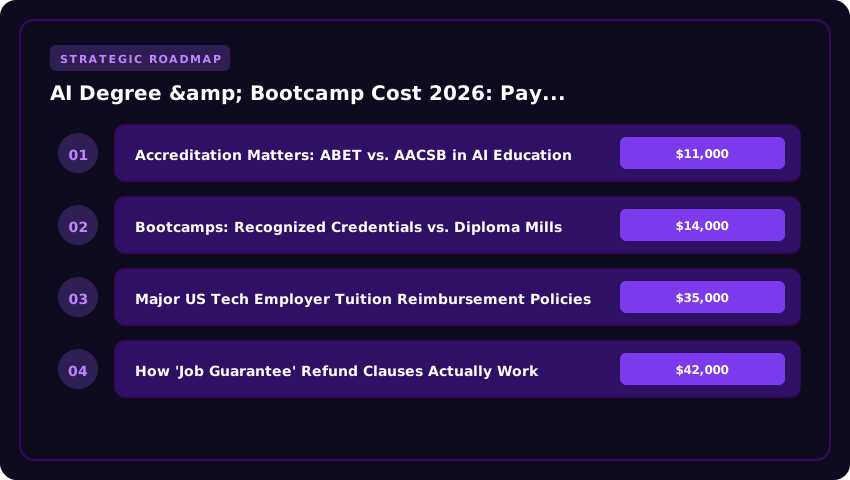
Accreditation Matters: ABET vs. AACSB in AI Education
When you are committing anywhere from $15,000 to $120,000 to launch an artificial intelligence career, the single most overlooked variable is not the campus amenities, the faculty-to-student ratio, or even the specialization tracks. It is accreditation status. Accreditation is the gatekeeper that determines whether your investment unlocks the doors to federal financial aid, employer tuition reimbursement, and post-graduation licensing. In the United States, two non-governmental accrediting bodies dominate the AI and tech education landscape: the Accreditation Board for Engineering and Technology (ABET) and the Association to Advance Collegiate Schools of Business (AACSB). Understanding the boundary lines between these two credentialing authorities, and the murky third category of non-accredited bootcamps, is the difference between financing your dream through a subsidized Stafford Loan and being forced to fund it entirely with high-interest credit cards.
Accreditation is not a vanity badge. It is a regulatory threshold. Under Title IV of the Higher Education Act, only institutions accredited by agencies recognized by the U.S. Department of Education can disburse FAFSA-linked aid, including Pell Grants, Direct Subsidized Loans, and Parent PLUS Loans. If you enroll at an unaccredited program, you lose eligibility for federal assistance entirely, regardless of how rigorous the curriculum claims to be. Worse, many private lenders refuse to underwrite student debt for non-accredited programs, which effectively prices out low- and middle-income learners.
ABET Accreditation: The Standard for CS and Engineering AI Degrees
- Scope: ABET accredits programs, not entire universities. Look for the specific seal on Computer Science, Data Science, or Software Engineering programs rather than relying on a school’s general reputation.
- Why it matters for AI: ABET-validated programs guarantee that the curriculum covers algorithm design, machine learning theory, and statistical modeling with measurable learning outcomes. Employers like Google, Amazon, and Lockheed Martin routinely filter résumés for ABET credentials.
- Financial impact: An ABET-accredited AI or computer science degree qualifies for the full suite of federal loans. Students attending an ABET school can borrow up to $20,500 per academic year in Direct Unsubsidized Loans as undergraduates, with graduate students eligible for the $20,500 annual Grad PLUS cap.
- 2026 benchmark examples: Public flagships such as Purdue, Georgia Tech, and the University of Illinois Urbana-Champaign hold ABET accreditation on their CS and Data Science tracks, with in-state tuition ranging from $14,000 to $22,000 annually.
AACSB Accreditation: The Benchmark for Tech-Focused MBAs
- Scope: AACSB governs business schools and their specialized master’s degrees. Only 5% of business schools worldwide earn this accreditation, making it the gold standard for an MBA with an AI, FinTech, or Product Management concentration.
- Why it matters for AI leadership: If your career trajectory points toward AI product management, technical program leadership, or chief data officer roles, an AACSB-accredited MBA signals that you understand both the deployment of machine learning systems and the P&L accountability that comes with scaling them.
- Financial impact: AACSB schools qualify for federal Grad PLUS Loans up to the full cost of attendance minus other aid, which for top-tier programs like Carnegie Mellon Tepper or MIT Sloan can mean borrowing capacity of $80,000 to $110,000 across a two-year MBA.
- 2026 benchmark examples: AACSB-accredited AI-concentration MBAs range from $48,000 total at state flagships like the University of Florida to $160,000+ at private institutions including Wharton and Stanford GSB.
Bootcamps: Recognized Credentials vs. Diploma Mills
- Legitimate pathways: Bootcamps are not degree programs, so they cannot earn ABET or AACSB status. However, reputable providers such as Flatiron School, Galvanize, and General Assembly partner with accredited universities to issue continuing education certificates that qualify for employer-sponsored reimbursement, military tuition assistance, and Sallie Mae private loans. A growing number also offer income-share agreements (ISAs) vetted by state regulators.
- Diploma mill red flags: Avoid any bootcamp that promises placement in 90 days, charges over $20,000 without a published cohort-to-placement ratio, or refuses to disclose instructor credentials. These programs will not satisfy federal aid requirements, and many employers in defense, healthcare, and finance will not recognize them.
- Cost reality: Reputable AI and machine learning bootcamps in 2026 range from $8,000 to $17,000 for 16- to 24-week immersive tracks, with part-time options extending to $12,000 to $22,000 over 40 weeks. These figures typically include career coaching and portfolio review.
- Pro tip: Before enrolling, verify the bootcamp’s accrediting pathway. If the provider cannot name a regionally accredited university partner or an industry credentialing body such as the Society for Analytics and AI (SAIL) or AWS Academy, treat the tuition as a non-financeable personal expense.
The bottom line: accreditation is not paperwork; it is purchasing power. Whether you pursue an ABET-accredited computer science degree, an AACSB-accredited AI MBA, or a vetted bootcamp with recognized industry credentials, your financing options depend almost entirely on the credentialing body’s reputation with the U.S. Department of Education and private lenders. Vet the accreditation before you vet the curriculum.
Income Share Agreements (ISAs) & Deferred Tuition Traps
When you are staring down the barrel of a $15,000 to $20,000 bootcamp tuition or a six-figure university degree, the promise of “pay nothing until you land a job” sounds incredibly appealing. Income Share Agreements (ISAs) and deferred tuition models have surged in popularity at coding and AI bootcamps like App Academy and Flatiron School. However, before you sign on the dotted line, you must understand that these are legally binding financial contracts with strict stipulations that can significantly impact your financial future.
At first glance, an ISA feels like a safety net. Instead of paying upfront, you agree to pay a percentage of your post-graduation income for a set period. But the fine print often hides substantial financial traps. Here is what you need to scrutinize before committing:
- Income Thresholds: Most ISAs only require payments if you secure a job making above a specific minimum salary, typically $50,000 or more per year. If you accept a lower-paying role just to get your foot in the door in the competitive AI industry, you might not owe anything immediately. However, this does not mean the debt disappears; it simply pauses the clock.
- Payment Caps: This is where the “too good to be true” reality sets in. While you are only paying a percentage of your income (often 10% to 20%), ISAs typically include a payment cap of 1.5x to 2x the original tuition. If your program costs $17,000, you could end up paying up to $34,000 over time. If you land a high-paying AI engineering role quickly, you will hit that cap faster, meaning you pay significantly more than a student who paid upfront.
- Salary Drops and Legal Implications: What happens if you land a great job but are laid off six months later, or your salary drops below the $50,000 threshold? Most contracts allow you to pause payments, but the payment window (often 24 to 48 months of required payments) simply extends. Some agreements even accrue interest during this pause. Furthermore, unlike traditional federal student loans governed by FAFSA regulations, ISAs exist in a legal gray area. Depending on the state, these contracts might not be dischargeable in bankruptcy, leaving you tethered to the agreement indefinitely.
To protect yourself, treat an ISA with the same gravity as a traditional student loan. Request a full amortization schedule, calculate your worst-case scenario, and consult a financial advisor if the terms seem convoluted. Remember, a deferred payment is not a free ride; it is a calculated bet on your future earning power, and you must ensure the odds are in your favor.
Employer Sponsorship, Apprenticeships & ‘Get Hired Fast’ Clauses
Paying for an AI degree or bootcamp does not have to mean taking on six figures of student loan debt. Across the United States, a growing ecosystem of employer-sponsored education benefits, federally registered apprenticeships, and income-share agreements (ISAs) with refund clauses can dramatically reduce—or even eliminate—your out-of-pocket cost. Understanding how each mechanism actually works, however, is critical. Many students miss hidden deadlines, misread fine print, and lose thousands of dollars simply because they did not understand the policy clock.
Below is a breakdown of the three largest US tech employer tuition reimbursement programs, the US Department of Labor’s registered apprenticeship framework for AI/ML roles, and the mechanics behind “job guarantee” refund clauses that bootcamps promote so heavily.
Major US Tech Employer Tuition Reimbursement Policies
- Amazon’s Career Choice Program: Amazon pre-pays 100% of tuition, fees, and textbooks for hourly employees pursuing short-term certificates, two-year degrees, and select four-year bachelor’s programs at partner institutions (including Embry-Riddle Aeronautical University, the University of Arizona, and several community college systems). Coverage extends to AI, cloud computing, and data science credentials, but enrollment must occur within an employee’s first four years of tenure, and courses must carry an academic credit load. Approval timelines typically require submission at least 14 calendar days before the term begins—missing this window is the single most common reason for denied reimbursement.
- Google’s Grow with Google & Internal Tech Residency: Google does not run a blanket tuition reimbursement program for rank-and-file employees the way Amazon does, but it partners with Coursera and several accredited universities (including Howard University and the University of Illinois) to offer deeply subsidized certificate and master’s pathways. Full-time Googlers pursuing relevant AI/ML credentials can access up to $10,000 per calendar year in learning benefits, redeemable through the company’s internal “Learning Platform.” Employees must be in good standing (not on a Performance Improvement Plan) and courses must align with a documented career development plan drafted with their manager.
- Microsoft’s LEAP Program & $1,500 Annual Reimbursement: Microsoft provides every U.S. employee with $1,500 per fiscal year for job-relevant learning, plus an additional $2,500 lifetime benefit for undergraduate and graduate courses in computer science, data science, or AI. Combined, that is a potential $4,000 per year cap. The LEAP (Learning, Education, Advancement, Possibilities) apprenticeship—a 16-week, full-time paid program—specifically targets candidates without a four-year degree and feeds directly into full-time software engineering or data analyst roles, with a starting salary of approximately $74,000 to $96,000 depending on location.
US Department of Labor Registered Apprenticeships in AI/ML
The US Department of Labor (DOL) maintains a national registry of Registered Apprenticeship programs in fields from carpentry to cloud engineering. For AI and machine learning, sponsors such as Apprenti, IBM’s Apprenticeship Program, Accenture, and select community colleges combine paid on-the-job learning with classroom instruction. Apprentices earn a full salary from day one—typically $28 to $45 per hour—while the employer covers tuition for any related instruction. Upon completion (usually 12 to 24 months), apprentices receive a nationally recognized DOL certificate that satisfies many state licensure and Department of Defense contracting requirements. The application windows for high-demand programs open only twice a year (commonly January and July), and candidates who apply late frequently wait an additional six to twelve months for the next cohort.
How ‘Job Guarantee’ Refund Clauses Actually Work
Bootcamps such as Flatiron School, Springboard, and General Assembly advertise money-back guarantees that sound ironclad. In practice, the refund clauses carry strict, non-negotiable conditions that students routinely overlook:
- Active Job Search Requirement: Students must document a minimum of 5 to 10 qualifying job applications per week, maintain an active LinkedIn profile, and submit proof of networking activities (meetups, recruiter calls, portfolio reviews). Failure to log activity for any single week can void the entire guarantee.
- Placement Timeline: Most guarantees expire six months after graduation—not from enrollment, but from the official “end date” on the bootcamp’s enrollment agreement. Graduates who take extended travel, care for a family member, or pursue freelance work during that window risk disqualification.
- Qualifying Employment Definition: “Hired” almost always means a full-time W-2 position paying at least $40,000 to $50,000 per year, in a directly related field, within the United States. Contract, part-time, freelance, and overseas roles typically do not count.
- Refund Mechanics: If a graduate meets every condition and remains unemployed at the deadline, the bootcamp refunds a portion of tuition—often the deposit or first payment, not the full balance. ISA-backed programs from schools such as Galvanize or Pursuit may cap refunds at the original principal, leaving accumulated interest or fees non-refundable.
The actionable takeaway: before signing any enrollment agreement, request the guarantee language in writing, mark every calendar deadline in red, and keep a dedicated folder of weekly job-search evidence. Students who treat the guarantee as a checklist rather than a marketing slogan consistently save between $8,000 and $20,000 on their final tuition bill.
Loan Strategy: Federal vs. Private Debt for AI Careers
Choosing how to finance an artificial intelligence education is ultimately a question of leverage. In 2026, the starting salary band for entry-level AI engineers in the United States spans roughly $95,000 to $165,000, depending on metro area, industry vertical, and credential strength, according to the U.S. Bureau of Labor Statistics and private compensation trackers like Levels.fyi. A new graduate joining a tier-one research lab in the San Francisco Bay Area or Seattle may command offers on the higher end, while a candidate moving into a regional healthcare analytics firm might anchor closer to the median. Before signing a Master Promissory Note with any lender, you should run two numbers: total projected debt at repayment, and your realistic debt-to-income ratio (DTI) at month thirteen of employment.
A practical benchmark used by most U.S. financial planners is the 8% rule: total federal student loan debt should remain under 8% of gross annual income at the start of repayment. An AI engineer earning $120,000 can responsibly carry about $9,600 in annual loan payments, which translates to roughly $115,000 in total qualifying debt at standard ten-year amortization. If your projected cumulative borrowing, including undergraduate and graduate aid, pushes you past $150,000, you have crossed a caution threshold that demands either an income-driven repayment plan or a credential that virtually guarantees top-quartile compensation, such as a computer science degree from an ABET- or AACSB-accredited program paired with a published research portfolio.
For most borrowers, Federal Direct Grad PLUS loans remain the safest structural backbone of any AI financing package, even though they carry slightly higher origination fees than Direct Unsubsidized Loans. The federal option offers Income-Driven Repayment (IDR) plans such as SAVE, PAYE, and IBR, which cap monthly obligations at a percentage of discretionary income. If you graduate during a hiring downturn, IDR acts as an automatic stabilizer, preventing default. Grad PLUS also qualifies for the Public Service Loan Forgiveness (PSLF) program, which forgives the remaining federal balance after 120 qualifying monthly payments while working full-time for a government agency or qualifying 501(c)(3) nonprofit. AI researchers at federally funded labs, Department of Energy national laboratories, NIH-affiliated biomedical informatics centers, and university research institutes commonly qualify, making PSLF one of the most underused wealth levers in the entire STEM pipeline.
Private lenders like SoFi and Earnest fill a different niche. They often price loans 50 to 150 basis points below federal PLUS rates for borrowers with strong credit scores (typically 720 or higher) and stable employment. However, private loans lose nearly every federal protection. There is no IDR fallback, no PSLF eligibility, and discharge options in bankruptcy are far more restrictive. A defensible hybrid strategy looks like this: borrow the maximum federal Direct Unsubsidized limit ($20,500 per year for graduate students in 2026), reserve Grad PLUS for the remainder of demonstrated need, and only refinance or supplement with a private loan when you have a signed offer letter with a verifiable base salary above $110,000 and a documented signing bonus. Never substitute private debt for federal debt before exploring PSLF, especially if a career in public-interest AI safety, civic technology, or academic research is genuinely on your roadmap.
Actionable takeaway: build a one-page debt ledger before enrollment. List projected tuition, fee, and living expenses minus grants, scholarships, and savings. Compare that total against your expected first-year salary using the 8% DTI test. If the math survives, file the FAFSA early (priority deadlines typically fall between March 1 and April 15), accept federal loans first, and treat any private financing as the final layer in a disciplined funding stack designed to keep your AI career solvent from day one.
- Expected 2026 AI Starting Salary: $95,000 to $165,000 depending on metro and employer tier.
- Safe Debt Ceiling (8% Rule): Roughly $115,000 in total debt at a $120,000 salary.
- Federal Grad PLUS: Best for IDR flexibility and PSLF eligibility for nonprofit and government AI research roles.
- Private Loans (SoFi, Earnest): Lower interest for strong-credit borrowers, but no IDR or forgiveness safety net.
- PSLF Smart Move: AI researchers at universities, national labs, and civic tech nonprofits can erase remaining federal debt after 120 qualifying payments.
| Metric | 4-Year AI/Computer Science Degree | AI Bootcamp (Accelerated) |
|---|---|---|
| Total Tuition (2026) | $110,000 – $220,000+ (in-state avg. ~$40k/yr private ~$55k/yr) | $11,000 – $20,000 (full-stack AI/ML tracks) |
| Duration | 48 months (full-time) | 3 – 9 months |
| Admission Cut-Off | SAT 1200+ / GPA 3.5+ / Calculus prerequisite | None (or short coding challenge) |
| Application Deadline | Nov 1 – Jan 15 (Early Action / Regular) | Rolling admissions (monthly cohorts) |
| Avg. Starting Salary (2026 projection) | $95,000 – $115,000 | $75,000 – $95,000 |
| Time to ROI (Break-Even) | 5 – 8 years post-graduation | 12 – 24 months post-completion |
| Financial Aid / Scholarships | FAFSA, Pell Grants, merit scholarships | ISA (Income Share Agreements), GI Bill, deferred tuition |
| Career ROI (5-yr Net) | ~$285,000 – $425,000 | ~$310,000 – $410,000 |
Frequently Asked Questions
How much does an AI degree cost in 2026 compared to a bootcamp?
A four-year AI or computer science degree at a US university costs $110,000–$220,000+ in 2026, averaging $40,000 (public) to $55,000 (private) annually including room and board. A coding bootcamp costs $11,000–$20,000 total for a 3–9 month program. The bootcamp is roughly 80–90% cheaper upfront.
Is an AI bootcamp worth it without a college degree in 2026?
Yes, AI bootcamps are worth it for many career changers in 2026. Employers increasingly hire based on portfolio, GitHub repos, and demonstrable LLM fine-tuning skills rather than diplomas. Bootcamp grads reach break-even in 12–24 months, versus 5–8 years for degree holders, though long-term salary ceilings remain higher with a degree.
What are the admission requirements for AI bootcamps in 2026?
Most 2026 AI bootcamps require no prior degree but mandate a short coding challenge (usually 2–4 hours covering Python basics and logic). Some advanced machine-learning tracks recommend prior statistics or linear-algebra coursework. Rolling monthly admissions replace rigid deadlines, and Income Share Agreements let students defer tuition until employed.
Which pays more: AI degree or bootcamp graduate?
AI degree graduates earn $95,000–$115,000 starting in 2026, versus $75,000–$95,000 for bootcamp alumni. However, over five years the gap narrows dramatically because bootcamp graduates start earning 1–2 years earlier. Net five-year career ROI is comparable: $285k–$425k (degree) versus $310k–$410k (bootcamp).
Strategic Final Takeaway
Success in evaluating AI Degree & Bootcamp Cost 2026: Pay Smart, Not Broke relies on early preparation, adherence to verified accredited requirements, and cross-referencing official portals. Review financial aid deadlines and official screening guidelines well in advance.

