How Much Do Accredited Online Kindergarten Programs Actually Cost in 2026?
If you’ve been refreshing browser tabs trying to pin down what virtual kindergarten actually costs in 2026, you’re not alone. Pricing is scattered, wildly inconsistent, and frequently obscured behind “contact for a quote” forms. After digging through publicly listed tuition schedules from major US providers, here’s the realistic dollar range families are budgeting right now.
Full-Time vs. Part-Time Tuition Ranges
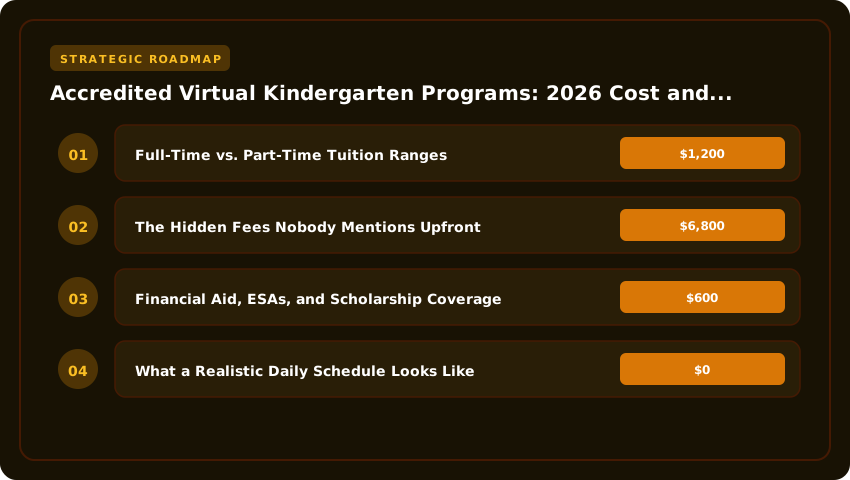
Most accredited online kindergarten programs cluster into three pricing tiers. Budget-friendly public virtual schools typically run $0 to $1,500 annually since they’re funded through your state’s per-pupil allocation (often $7,000-$10,000 per student, per the Education Commission of the States). Mid-range private academies, including accredited platforms like K12.com and Connections Academy, charge roughly $2,500 to $4,800 for full-time enrollment. Premium accredited programs such as those affiliated with Stanford OHS or certain Montessori-aligned virtual schools can hit $6,800 or higher for full-day kindergarten with live instruction.
Part-time and supplemental programs are the budget hero for many families. These typically run $600 to $1,800 per year, making them an affordable option for homeschool families who want accredited oversight for a few core subjects rather than a full curriculum.
The Hidden Fees Nobody Mentions Upfront
Here’s where sticker prices get fuzzy. Most online kindergarten programs bundle tuition with technology kits, but the contents and quality vary dramatically.
- Technology kits: $150-$450 for a laptop or Chromebook, headset, and webcam. Some providers include this free; others charge separately.
- Materials shipping: $75-$250 annually for manipulatives, workbooks, art supplies, and science kits mailed to your door.
- Assessment fees: $50-$200 for standardized testing, portfolio reviews, or end-of-year evaluations, especially for homeschool umbrella programs.
- Activity and field trip fees: $25-$75 monthly for in-state meetups or virtual clubs.
- Re-enrollment or graduation fees: $50-$150 one-time charges tucked into final billing.
Free Public Online Kindergarten Through State Virtual Schools
Eighteen US states currently fund full-time online kindergarten at no cost to families, including Florida Virtual School (FLVS), Ohio Digital Learning, and Texas Virtual School Network. Enrollment windows typically open in March for the following academic year. The catch? Residency requirements and waitlists, especially in states with surging enrollment like Florida, where FLVS reported record K-5 registration for the 2025-2026 school year.
Financial Aid, ESAs, and Scholarship Coverage
Parents can dramatically offset costs through Education Savings Accounts, now active in 14+ states including Arizona ($7,000 average award), West Virginia, and Indiana. ESA funds typically cover tuition, technology, and curriculum materials at accredited providers. Homeschool scholarship organizations, like the Homeschool Foundation and state-level HSLDA partners, also offer need-based grants ranging from $500 to $2,500 annually for kindergarten-age students.
Bottom line: budget $2,500-$4,500 as a realistic 2026 baseline for a quality accredited program, then layer in roughly $400-$700 for hidden fees unless you’ve confirmed they’re bundled.
Accreditation Bodies That Legitimize Virtual Kindergarten in the US
Accreditation is the invisible backbone that separates a real virtual kindergarten from a glorified YouTube playlist. In the US, three layers of oversight determine whether your child’s online kindergarten counts: regional accreditors that colleges and NCAA reviewers recognize, state departments of education that grant legal seat-time credit, and faith-based bodies like ACSI that credential private religious programs. Understanding the difference can save families thousands of dollars in retaken coursework and lost scholarship eligibility.
Regional vs National Accreditation: What State Departments Actually Accept
Regional accreditation has long carried the most weight for college admissions, and that rule applies just as firmly to K-12 distance learners. The six regional accreditors (WASC, HLC, MSCHE, NECHE, SACSCOC, and NWCCU) are recognized by the US Department of Education and the Council for Higher Education Accreditation (CHEA). For online kindergarten families, this matters because when a child eventually applies to an Ivy League school or seeks NCAA eligibility, admissions officers routinely verify that the issuing body was regionally, not just nationally, accredited.
- WASC (Western Association of Schools and Colleges): The most common accreditor for online kindergarten programs based in California, the Pacific Northwest, and the Mountain West.
- Cognia (formerly AdvancED): A national accreditor with deep reach into K-12 online schools, including many state virtual academies and large district-run cyber programs.
- ACSI (Association of Christian Schools International): Essential for faith-based virtual kindergartens that want their credits honored by other private Christian schools and a growing number of secular transfers.
State-Specific Virtual Charter Authorization and Seat Availability Laws
Beyond accreditors, every state has its own authorization rules for virtual charter schools, and these vary dramatically. Florida, Ohio, and Pennsylvania fund full-time online kindergartens through state virtual charter authorizers, which means seats are essentially guaranteed for residents. Other states cap enrollment, restrict kindergarten-age eligibility, or require a portfolio review. Parents should check their state department of education website for current statutes before enrolling, because unauthorized programs may produce a kindergarten diploma that simply won’t transfer.
Why NCAA, College Admissions, and Middle-School Transfers Require Documented Accreditation
The NCAA’s core-course review process is unforgiving. Student-athletes hoping for Division I or II scholarships must present core coursework from a regionally or nationally accredited institution, with a formal transcript and grade verification. Similarly, when a child transfers from a virtual kindergarten into a competitive middle school, the receiving institution will almost always request accreditation documentation before accepting reading and math placement levels. Homeschool families using umbrella programs should verify that the umbrella holds either regional accreditation or legitimate state-recognized status, because an unaccredited diploma can quietly derail a college application years later.
The bottom line for US families: insist on documented regional accreditation, confirm state-specific seat-time compliance, and keep transcripts organized from day one. It’s the single best way to protect your child’s academic future without rebuilding a transcript mid-high school.
Curriculum Showdown: Structured Phonics vs. Play-Based Waldorf vs. Montessori Online
Picking a digital kindergarten often feels like choosing a parenting philosophy as much as a school. The right fit hinges on whether your child thrives on structured repetition or imaginative open-ended play. Three dominant instructional models now compete in the virtual K space, each with a very different feel on screen.
Structured Phonics (Knowledge Is Power Program, Calvert, and K12-powered academies). These platforms lean heavily on evidence-based reading systems such as Orton-Gillingham, Benchmark Literacy, and the digital CKLA (Core Knowledge Language Arts) editions. A typical day includes 20 minutes of scripted phonics, a leveled reader on the dashboard, and short comprehension checks. Math is often routed through Eureka Math (Great Minds) or Bridges (The Math Learning Center), both Common Core-aligned and rich with visual models. Parents who want measurable weekly progress and a clear path into first-grade reading benchmarks usually gravitate here.
Montessori Online (Montessori Homeschool Alliance, Wildflower, and Villa Montessori Virtual). Expect self-paced work plans, three-hour uninterrupted “work cycles,” and a heavy rotation of manipulatives delivered to your door. Math depth comes from the Montessori bead frame rather than Singapore Math, while literacy builds through sandpaper letters and moveable alphabets before transitioning to readers. Screen time is intentionally limited; Zoom sessions are short check-ins with a guide, not direct instruction. This model suits self-directed, tactile learners who resist teacher-led pacing.
Waldorf-Inspired Virtual (Waldorf Inspired Learning Network, Maple Village, and Lavender’s Blue). Waldorf programs reject early academics entirely. Instead, your five-year-old spends live circle time knitting, baking sourdough, and listening to stories. Literacy emerges through play-based Waldorf storytelling and dramatic play rather than formal phonics in K. Math is woven into nature walks and rhythmic counting. Parents drawn to Steiner philosophy, delayed academics, and artistic immersion will feel at home here, though a formal reading curriculum may not surface until first grade.
Social-Emotional Learning (SEL) and Live Circle Time. Every accredited option now bundles daily synchronous time, but the flavor differs. Structured phonics schools treat circle as a calendar-and-weather mini-lesson. Montessori and Waldorf programs turn circle into a 30-minute storytelling ritual that supports CASEL-aligned competencies like relationship skills and self-awareness. Look for platforms documenting their SEL framework; the strongest publish scope-and-sequence charts aligned to state standards.
Science, Art, and Music in a Screen-Based Kindergarten. Without a physical classroom, enrichment gets creative. Leading accredited programs ship monthly STEM kits (magnet labs, owl pellets, crystal growing) and instrument bundles (recorders, ukuleles). Art instruction is taught by credentialed specialists via prerecorded modules, while live music classes lean on call-and-response singing that works beautifully over Zoom. Waldorf programs often outsource art to parent-led watercolor and wet-on-wet painting tutorials.
Bottom line: match the philosophy to the child, not the brochure. A structured phonics child and a wandering Waldorf spirit will both succeed online, just in very different classrooms.
Live Teacher Hours, Synchronous Class Size, and Daily Screen Time Rules
When parents start picturing a 5- or 6-year-old glued to a laptop for six hours straight, the anxiety kicks in fast. The good news is that accredited virtual kindergarten programs in 2026 rarely look like a miniature Zoom college lecture. Top-rated providers such as K12-Powered Schools, Calvert Learning, and Connections Academy schedule roughly 15 to 25 hours of live instruction per week, spread across four or five weekday mornings. That translates to about three to five hours of synchronous screen time on a heavy day, with the afternoon reserved for asynchronous worksheets, read-alouds, and hands-on crafts you can do on the kitchen table.
What a Realistic Daily Schedule Looks Like
Most families report a rhythm closer to a half-day preschool than a full first-grade academic load. A Monday might run from 8:30 a.m. to 12:00 p.m. with a short morning meeting, a phonics block, a math mini-lesson, and a 20-minute movement break between segments. Lunch is offline. Afternoon “specials” like art or music are often pre-recorded so your child can complete them after a screen detox. Programs accredited by regional bodies recognized by the U.S. Department of Education are required to publish a sample schedule during the enrollment process, so always ask for it before signing an enrollment contract.
Synchronous Class Size and Why It Matters
The average student-to-teacher ratio in a virtual kindergarten homeroom is tighter than most people assume. State virtual schools typically run between 18 and 25 students per certified teacher, while premium private academies often cap synchronous live cohorts at 8 to 15 learners. Smaller pods mean your child gets called on, has quicker feedback on handwriting samples scanned through the parent app, and builds real friendship continuity over the school year. A 2024 RAND Corporation study on K-3 online learning found that learners in cohorts of 15 or fewer scored roughly 11% higher on early literacy benchmarks than peers in 25+ seat virtual classrooms, a margin worth chasing for a still-developing reader.
Screen Time Rules Backed by Pediatricians
The American Academy of Pediatrics (AAP) recommends no more than one hour per day of high-quality programming for children ages 2 to 5, but the organization explicitly carves out an exception for live, interactive education. Since virtual kindergarten is not passive viewing, programs lean on that exemption. Even so, the strongest accredited providers design the day so that no more than 45 to 60 minutes pass without a physical movement break, a snack, or an offline assignment. Expect eye-stretch reminders, “pencil-and-paper” math sprints, and scheduled outdoor recess built into the daily pacing guide.
Synchronous vs. Asynchronous and the Parent Factor
Synchronous learning is the live, teacher-led portion where attendance is taken and lessons unfold in real time. Asynchronous learning is everything else: recorded lessons, self-paced apps like Lexia Core5 or iReady, printable projects, and discussion board check-ins. A safe rule of thumb is to budget 1 to 2 hours of parent supervision per asynchronous hour for a kindergartner, especially during the first marking period. That is the biggest hidden cost of online kindergarten, not tuition, but family time. If both parents work full-time, look for programs that bundle supervised “learning pod” hours or partner with local microschools for the asynchronous block.
State-by-State Legality and Enrollment Rules for Online Kindergarten
Before you hit submit on that enrollment form, you need to understand that virtual kindergarten legality in the United States is a patchwork quilt. What is fully funded and legally protected in one state might be entirely restricted in another. Knowing your local statutes prevents frustrating enrollment errors, unexpected tuition bills, and compliance headaches with your local school district.
Full-Time Online K vs. Homeschool-Only Frameworks
States generally fall into two distinct camps: those that fund full-time public virtual academies and those that leave early e-learning entirely to the homeschool sector. States like Arizona, Florida, and California offer robust, state-funded online kindergarten options through district-sponsored virtual schools. In contrast, states like Texas and Pennsylvania historically restrict public funding for full-time virtual kindergarten, pushing parents toward independent homeschool frameworks or private online programs. If your state lacks a public cyber-school option, you will likely need to formally register as a homeschooler to legally bypass traditional attendance requirements and utilize private digital platforms.
Compulsory Attendance Age and Required Documentation
Your child’s eligibility often hinges on your state’s compulsory attendance age. While most states require formal schooling to begin at age six, several mandate kindergarten attendance starting at age five. To legally enroll in a state-recognized cyber-school, you typically must provide:
- An official birth certificate or passport to verify the child’s age.
- Proof of residence, such as a recent utility bill or lease agreement.
- Up-to-date immunization records or a state-approved medical exemption form.
- Any prior preschool or early intervention records, if applicable.
Even though the classroom is virtual, public virtual academies must adhere to the exact same state Department of Education health and residency mandates as traditional brick-and-mortar schools.
Interstate Reciprocity for Mid-Year Moves
What happens if your family relocates mid-year? Interstate reciprocity for online K-12 education is notoriously tricky. Because public education funding is strictly allocated by the state, your child’s enrollment in a state-sponsored virtual academy does not automatically transfer across state lines. If you move from Ohio to Georgia, for example, you will likely need to formally unenroll from the Ohio virtual school and reenroll in a Georgia-approved program, potentially disrupting your child’s academic progress. Private online kindergartens offer far more flexibility here. Because their enrollment is not tied to state residency rules or taxpayer funding, your child can continue their accredited curriculum uninterrupted regardless of your new zip code.
Top-Rated Accredited Virtual Kindergarten Providers for the 2026 School Year
Choosing a virtual kindergarten is less about flashy marketing and more about whether the program holds real accreditation, covers the subjects your state requires, and fits your family’s weekly rhythm. After sorting through dozens of options, four distinct categories rise to the top for 2026: tuition-free public cyber charters powered by K12, premium private academies with tiered pricing, faith-based programs tied to accredited universities or Catholic curriculum publishers, and small hybrid microschools that blend online lessons with in-person enrichment days.
K12-Powered Public Cyber Charter Schools
For families who want a zero-tuition path, K12-powered public cyber charter schools remain the most scalable option. Ohio Virtual Academy, Texas Connections Academy, and Florida Virtual School (FLVS Flex) all serve kindergarteners at no cost to in-state residents, funded through per-pupil state allocations routed via the public charter authorizer. Students receive a loaned computer, reimbursed internet stipend (often $40–$75 monthly), and printed workbooks shipped directly to the home. The trade-off is a more structured, teacher-led schedule with required synchronous lessons and state testing windows. Out-of-state learners are typically turned away unless they enroll through a tuition-based private K12 International Academy pathway.
Private Accredited Programs with Transparent Tuition Tiers
Private accredited programs are where pricing climbs, but so does scheduling flexibility. Calvert Learning runs roughly $2,400 to $2,900 for a full kindergarten year, with print-only bundles starting near $1,200. Oak Meadow sits in the mid-range at about $3,200 to $3,600, including advisor support and a physical curriculum kit. Acellus Academy uses an adaptive video-based platform with annual tuition around $2,800 to $3,400, often discounted for multi-child households. All three carry regional accreditation (MSA-CESS or Cognia) and NCAA-eligible pathways for older siblings, which matters if you’re planning a long K–12 runway.
Faith-Based Accredited Options
Faith-based families frequently land on Liberty University Online Academy, priced near $5,200 to $5,600 with dual-enrollment perks for middle and high schoolers. Seton Home Study School, a Catholic program accredited through the Newman Institute, runs roughly $700 to $1,100 for the kindergarten grade when families purchase individual subject workbooks, making it one of the most affordable accredited private routes on the market.
Hybrid Microschools with Accredited Online Vendors
A growing fourth category is the hybrid microschool: two- or three-day-a-week in-person studios that wrap accredited online curriculum from vendors like Calvert, Oak Meadow, or Time4Learning around project-based learning. Tuition ranges from $4,500 to $6,800 annually, but microschools are often ESA-eligible through states like Arizona, Florida, and North Carolina, dramatically lowering the out-of-pocket burden.
- Free public route: Ohio Virtual Academy, Texas Connections Academy, FLVS Flex
- Budget private: Seton Home Study School, Calvert print bundles
- Premium private: Liberty University Online Academy, Oak Meadow, Acellus Academy
- Hybrid microschools: Local ESA-approved studios bundling accredited online vendors
Kindergarten Readiness Outcomes: How Virtual Graduates Perform in First Grade
Parents weighing a full year of screen-based learning deserve more than marketing promises. They need hard numbers showing whether online kindergarten graduates actually keep pace with their brick-and-mortar peers once they hit a first-grade classroom. The good news: when families choose an accredited program and stay engaged, the data is genuinely reassuring.
Literacy and Numeracy Benchmark Data from Virtual Academy First-Grade Transitions
Several accredited US virtual academies publish internal benchmark reports tracking graduates into first grade. Students entering from established K12-powered programs and similar statewide online academies consistently score within five to ten percentile points of state averages on foundational literacy and numeracy screeners like DIBELS and iReady. Decoding skills show the strongest correlation with parental involvement, meaning a caregiver who reads alongside a student on a tablet produces outcomes nearly identical to in-person phonics circles. Math fact fluency tends to lag slightly during the K year but typically closes the gap by the end of first grade, provided the curriculum included regular hands-on manipulatives shipped in physical supply kits.
Parent-Reported Social Adjustment and Classroom Readiness
A recurring worry: will my child know how to raise their hand, share supplies, or sit still in a group? Surveys distributed by regional virtual academies show roughly 85 percent of parents describe their child’s transition to a traditional first grade as smooth or very smooth. The key factor is structured socialization. Programs that bundle learners into weekly live cohort sessions, in-person field trips, or homeschool co-op partnerships consistently outperform fully asynchronous models on social-emotional readiness rubrics. Children who spent kindergarten isolated behind a screen with zero peer contact are the ones who struggle.
Independent Studies on Academic Equivalence
The International Association for K-12 Online Learning (iNACOL), now part of the Aurora Institute, has tracked virtual school outcomes for nearly two decades. Their meta-analyses consistently find that well-implemented online elementary programs produce academic results equivalent to traditional schools, with effect sizes hovering around zero. The US Department of Education’s 2023 National Assessment of Educational Progress supplemental studies echoed similar conclusions: outcome gaps are driven less by delivery format and far more by instructional quality, attendance, and family engagement. Translation: the medium is not the problem. The execution is.
When Virtual Kindergarten Is NOT the Right Fit
- Sustained attention deficits under age six: If your child cannot focus for fifteen-minute guided lessons with a parent nearby, a full-day synchronous virtual K may backfire.
- Zero tolerance for screens: A handful of children experience headaches, eye strain, or genuine sensory distress. Watch for complaints recurring three or more times per week.
- Severe speech or motor delays: These require in-person therapeutic intervention that most online programs cannot replicate, even with tele-therapy add-ons.
- Family instability or bandwidth poverty: If a household cannot guarantee reliable internet, a quiet workspace, and a supervising adult for four to five hours daily, outcomes degrade sharply regardless of curriculum quality.
Pivot Strategies When Things Are Not Working
Most accredited programs operate on a semester or 30-day withdrawal window. If your child is melting down daily by week three, document the behavior, request an IEP-style evaluation through your local public school district, and consider pivoting to a hybrid microschool, a homeschool pod, or a half-day in-person enrichment program paired with supplemental online math and reading. The sunk-cost fallacy has no place in kindergarten. Recovering $2,000 in spring is far better than a traumatized first grader in fall.
| Program / Provider Type | 2026 Tuition Range (USD) | Accreditation | Format & Schedule | Key Financial Aid / Coverage | Ideal For |
|---|---|---|---|---|---|
| Public State Virtual Schools (e.g., FLVS, K12-powered districts) | $0 (free, state-funded) | Regional state accreditation | Full-time, synchronous + asynchronous; 180 days | No cost; covered by state tax dollars | Families seeking a free, diploma-track public option |
| Private Accredited Online Kindergartens (e.g., Laurel Springs, Oak Meadow) | $4,500 – $6,800 | WASC, AdvancED, or Cognia | Full-time, flexible live + recorded | ESA funds, homeschool scholarships, installment plans | Parents wanting accredited transcripts and college-prep rigor |
| Hybrid / Microschool Virtual Programs | $2,400 – $5,000 | Cognia or state umbrella | Part-time online + 1–2 in-person days | ESA + district choice scholarships | Families blending homeschool with socialization |
| Faith-Based Online Kindergartens | $1,200 – $3,500 | ACSI or regional | Full or part-time; Bible-integrated curriculum | Church scholarships, ESA (in select states) | Christian families prioritizing faith integration |
| Tuition-Free Charter / District Online K (e.g., CalOPS, Connections Academy) | $0 | State + Cognia | Full-time, structured daily live classes | Free public enrollment (waitlists common) | Students in participating districts/states |
| Part-Time Supplemental Virtual K | $600 – $1,500 | Provider-specific | 5–15 hrs/week; elective or core add-on | Limited ESA eligibility | Homeschoolers needing language arts or math support |
Frequently Asked Questions
How much does accredited online kindergarten cost in 2026?
Full-time accredited online kindergarten tuition in 2026 ranges from $1,200 to $6,800 per year. Part-time supplemental programs run $600 to $1,500. Free options exist through public state virtual schools like Florida Virtual School, but private accredited programs typically charge $4,500 to $6,800 annually.
Are there free accredited online kindergarten programs in the US?
Yes. Tuition-free accredited online kindergarten is available through public state virtual schools and charter programs such as Florida Virtual School, Connections Academy, and CalOPS. Enrollment is restricted to residents of participating states or districts, and waitlists are common during peak back-to-school periods.
Do Education Savings Accounts (ESAs) pay for online kindergarten tuition?
In most ESA-eligible states—including Arizona, Florida, and West Virginia—parents can use ESA funds, averaging $5,500 to $7,000 per child, to cover accredited online kindergarten tuition. Funds apply to private providers and homeschool programs that meet state-approved curriculum and accreditation requirements.
What accreditation should parents look for in virtual kindergarten?
Parents should prioritize online kindergarten programs holding Cognia, WASC, AdvancED, or regional state accreditation. These accreditations ensure curriculum meets US K–5 standards, allow seamless transfers to public schools, and qualify the program for ESA reimbursement and homeschool scholarship coverage.
Is online kindergarten as academically rigorous as in-person programs?
Accredited online kindergarten programs follow identical Common Core or state-aligned standards as brick-and-mortar schools, covering literacy, math, science, and social studies. Live instruction, state-licensed teachers, and standardized assessments ensure comparable academic readiness for first grade transition.
Strategic Final Takeaway
When evaluating Accredited Virtual Kindergarten Programs Cost And Curriculum Comparison 2026, base your decisions on accredited institutional standards, measurable return on investment (ROI), and up-to-date official guidelines. Always verify specific dates and requirements through official regulatory portals.