

Federal & State Funding Streams Powering 2026 Paid Pathways
The days of “experience for exposure” are effectively over for federally backed programs. The legislative architecture for 2026 explicitly ties funding to wage outcomes. If a program cannot demonstrate a payroll line item, it increasingly loses access to the three biggest federal levers: Perkins V, WIOA Youth, and state-matched Career Connected Learning appropriations. Understanding these mechanisms is the difference between a student earning a $17/hour advanced manufacturing wage in Indiana and fetching coffee for free in a neighboring district.

Perkins V Reserve Grants: The “10% Lever” for Youth Apprenticeship
Most families know Perkins V funds Career and Technical Education (CTE), but few realize the Reserve Fund (up to 10% of a state’s allocation) is the primary engine for new youth apprenticeship slots. For FY2026, the U.S. Department of Education’s Office of Career, Technical, and Adult Education (OCTAE) has signaled that reserve grant competitions will prioritize “earn-and-learn” models meeting the Registered Apprenticeship standards.
- Action Item: Ask your district CTE director for the “Perkins V Local Application Reserve Narrative.” If it doesn’t list specific employer partners committing to W-2 wages, the district is leaving money on the table.
- Scale: States like Kentucky and Tennessee are directing reserve funds to cover the employer share of apprenticeship wages (often 50% for the first 6 months), effectively de-risking the hire for small businesses.
WIOA Youth Formula Funds: Mandating the Summer Stipend
The Workforce Innovation and Opportunity Act (WIOA) Youth program (Formula Allotment ~$900M nationally) requires a minimum 20% expenditure on work experience. Crucially, the 2024/2025 program guidance from the Employment and Training Administration (ETA) clarified that “work experience” must include wages or stipends tied to academic credit or occupational skills training. Unpaid internships generally do not count toward this 20% threshold anymore.
- The Lever: Local Workforce Development Boards (LWDBs) contract with intermediaries (nonprofits, community colleges) to run “Summer Youth Employment Programs” (SYEP). For 2026, demand proposals that guarantee $15–$18/hour for 120–160 hours—translating to roughly $1,800–$2,900 gross per student.
- Eligibility Hack: WIOA “Out-of-School Youth” (ages 16–24) funding is often easier to access than “In-School” slots. Rising seniors who are credit-deficient or on a 504/IEP plan often qualify for the richer Out-of-School funding stream.
State CCL Powerhouses: WA, CO, & IN Writing the Checks
While federal funds set the floor, three states have built ceilings for 2026 that guarantee paid pathways through dedicated line items:
- Washington (Career Connect Washington): The 2025–27 biennial budget sustains $115M+ for Career Launch endorsements. Programs must pay prevailing wage (often $18–$25/hr in tech/healthcare) to receive state endorsement and tuition coverage at community colleges.
- Colorado (CareerWise Colorado / HB23-1198): The state now reimburses employers up to $4,500 per apprentice for wage subsidies and mentor training. The 2026 target: 2,500 new youth apprentices in financial services, advanced manufacturing, and IT.
- Indiana (Next Level Programs of Study / CSA 5): The Career Scholarship Account (CSA) program provides $5,000/year directly to families (via ESA-style accounts) for 10th–12th graders to pay for earn-and-learn transportation, certification exams, and—critically—wage matching for employers hiring students.
Bottom Line for Counselors: Do not treat “funding” as abstract policy. Treat it as a checklist. For every 2026 placement you advise, ask: Is this slot funded by Perkins Reserve? WIOA Youth? A State CCL Grant? If the answer is “none,” the position is statistically likely to be unpaid. If the answer is “yes,” you have the statutory leverage to demand a pay stub.
Industry-Sector Breakdown: Where the 2026 Slots Actually Exist
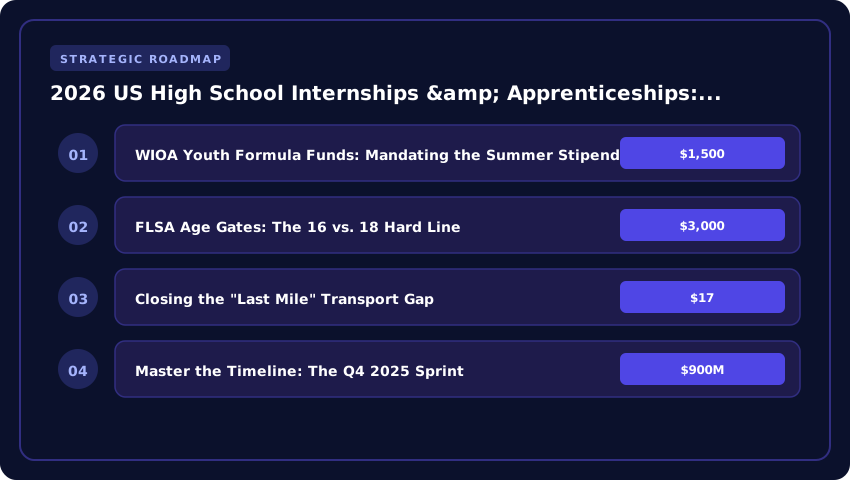
The funding is useless if you don’t know which employers have open requisitions for 16-to-18-year-olds right now. For the Class of 2026 and 2027, four sectors are aggressively scaling Registered Apprenticeship Programs (RAPs) and pre-apprenticeships with portable, nationally recognized credentials. These aren’t shadowing gigs; they are structured earn-and-learn pipelines designed to fill critical labor gaps.
Advanced Manufacturing & Semiconductors: The CHIPS Act Pipeline
The CHIPS and Science Act injected $52.7 billion into domestic semiconductor manufacturing, and the talent pipeline starts in high school. Intel’s Ohio expansion, TSMC in Arizona, and Micron in New York and Idaho have partnered with local community colleges and state workforce boards to launch Semiconductor Technician pre-apprenticeships. Students typically earn $17–$22 per hour while completing OSHA 10, IPC soldering certifications, and college credit toward an AAS in Mechatronics. In Ohio, the “TechCred” program reimburses employers up to $2,000 per credential, making your seat at the table financially attractive to hiring managers. Look for “Advanced Manufacturing Technician” (AMT) tracks aligned with NIMS (National Institute for Metalworking Skills) standards.
Healthcare Pre-Apprenticeships: CNA/MA Pathways with Tuition Waivers
Health systems are desperate for Certified Nursing Assistants (CNAs) and Medical Assistants (MAs), and they are paying for the pipeline. Major employers like HCA Healthcare, Kaiser Permanente, and large regional hospital networks run Department of Labor-registered pre-apprenticeships starting the summer after junior year. The economics are compelling: the employer covers the $1,200–$2,500 tuition for the state-approved CNA course, pays hourly wages ($15–$18/hr) during clinical rotations, and guarantees a full-time CNA slot upon passing the state board exam. Many programs articulate directly into LPN or RN bridge programs with tuition reimbursement benefits kicking in immediately upon hire. Ask your counselor specifically for “WIOA Youth-funded Healthcare Pre-Apprenticeships”—these slots often sit empty because students assume they need prior clinical hours.
Cybersecurity & IT: CompTIA & SOC Analyst Tracks
The NIST NICE Framework now maps entry-level work roles to high school competencies. The hottest ticket for 2026 is the CompTIA Security+ pathway. Employers—including federal contractors (Lockheed, Northrop, Booz Allen) and financial sector firms (JPMorgan Chase, Capital One)—run “Cyber Youth Apprenticeships” where juniors/seniors spend 20 hours/week in a Security Operations Center (SOC) monitoring SIEM alerts. Starting pay averages $18–$24/hour. The credential stack is non-negotiable: Network+ → Security+ → (ISC)² Certified in Cybersecurity (CC). Programs like CYBER.ORG curricula (funded by CISA) are the gold standard for high school articulation. If your school offers a “Cybersecurity Pathway” CTE cluster, demand the Security+ voucher—it retails at $404 but is free via Perkins V reserve grants in most states.
Clean Energy Trades: Solar Installer & EV Tech Registered Apprenticeships
The Inflation Reduction Act (IRA) tax credits (45X, 48C) require prevailing wage and registered apprenticeship utilization for projects to claim the full 30% credit. This creates a regulatory mandate for solar and EV employers to hire apprentices. The Interstate Renewable Energy Council (IREC) and NABCEP (North American Board of Certified Energy Practitioners) manage the credentialing. High school seniors can enter Solar Photovoltaic Installer RAPs at $18–$25/hour with a path to Journeyman Electrician (requiring 8,000 hours). Simultaneously, EV Infrastructure Training Program (EVITP) certifications are becoming mandatory for NEVI-funded charger installation. Unions (IBEW, UA) and non-union contractors (Sunrun, Tesla Energy) both run youth entry points. The credential portability here is absolute: your NABCEP PV Associate credential travels to any state.
Navigating Eligibility: Age, Credits, & Transportation Barriers
Too many qualified students opt out before they ever apply, tripped up by administrative fog rather than ability. For the 2026 cycle, clarity on three specific friction points—federal labor law, transcript coding, and physical logistics—separates the cohort that lands paid roles from the one stuck in unpaid shadowing. Here is your actionable checklist to stop self-disqualifying.
FLSA Age Gates: The 16 vs. 18 Hard Line
The Fair Labor Standards Act (FLSA) draws a bright red line at age 18 for any occupation the Secretary of Labor declares “hazardous” (Hazardous Occupations Orders 1–17). If you turn 18 before your start date, you unlock manufacturing, roofing, excavation, and most commercial driving roles. At 16 or 17, you are legally restricted to office admin, IT support, healthcare clerical, retail, and hospitality—provided you steer clear of power-driven machinery, balers, compactors, and meat slicers. Action item: Before applying, cross-reference the employer’s NAICS code against DOL Fact Sheet #43. If the role sits on the HO list and you are 17, ask the employer if a “Student Learner Exemption” (requiring a signed CTE agreement) applies—many HR teams forget this pathway exists.
Credit Articulation: CTE Concentrator vs. Elective Filler
Not all internship hours land on your transcript the same way. In Texas (TEA) and Indiana (IDOE), a registered apprenticeship aligned to a state-approved Program of Study automatically counts as CTE concentrator credit, boosting your accountability rating and often satisfying the “Postsecondary Readiness” indicator for ESSA. In California and New York, the same hours frequently default to generic “Work Experience Education” elective credit unless a formal Articulation Agreement exists between the district and the community college. Action item: Demand the Course Equivalency Crosswalk from your counselor in writing before day one. If the host employer offers an industry credential (CompTIA A+, AWS Cloud Practitioner, CNA), verify it maps to your state’s Industry-Recognized Credential (IRC) list—that mapping is what converts “seat time” into graduation currency.
Closing the “Last Mile” Transport Gap
Geography kills more placements than GPA. Rural and exurban students often face 20-mile commutes with zero public transit. Leverage these three funded levers for 2026:
- Perkins V Reserve Grants: Districts can allocate up to 15% of their local allocation for “support services,” explicitly including gas cards, rideshare vouchers (Uber/Lyft Business accounts), or district van shuttles. Ask your CTE Director for the “Support Services Line Item” in the current local application.
- WIOA Youth Formula Funds: Your local Workforce Development Board (WDB) holds “Supportive Services” budgets for eligible youth (low-income, foster, justice-involved). These cover $50–$150/week in transport stipends paid directly to the student via prepaid debit card.
- Employer Cost-Share: Under the Registered Apprenticeship model, employers receive $5,000–$8,000 in state tax credits (varies by state) per apprentice; negotiate a $100/month mobility stipend written into the Training Plan Appendix A.
Bottom line: Print this section. Bring it to your counseling appointment. If the adult in the room cannot answer “Which HO Order applies?” or “Where is the Perkins transport line item?”, escalate to the District CTE Director or WDB Youth Coordinator immediately. Administrative confusion is not a valid rejection reason.
Application Intelligence: Deadlines, Interviews & Digital Portfolios
Money allocated means nothing if the application sits in a recruiter’s “no” pile. For the 2026 cycle, the corporate hiring machine starts earlier than most families realize. Competitive cohorts at firms like JPMorgan Chase, Northrop Grumman, and major hospital systems often open their portals in October 2025 for Summer 2026 starts, with hard closes by January. If you are waiting until spring break to polish a resume, you have already missed the window for the highest-paying, most structured apprenticeships.
Master the Timeline: The Q4 2025 Sprint
Treat October through December 2025 as your application season. Federal contractors and Perkins V-funded intermediaries are legally required to report candidate pools early to satisfy compliance audits. Build a master spreadsheet now tracking three columns: Portal Open Date, Hard Deadline, and Funding Source (WIOA Youth, State CCL, Corporate ESG). Prioritize applications tied to specific grant numbers—those reviewers are mandated to fill seats fast. Pro tip: Set a calendar alert for the first Monday of October; that is when the USAJOBS “Pathways Internship” announcements and major state portals like Career Connect Washington or Indiana Career Explorer typically go live.
Beat the ATS: LinkedIn & Portfolio Mechanics for Minors
Applicant Tracking Systems (ATS) do not care about your GPA; they scan for keywords mapped to the job description. Since high schoolers lack corporate titles, you must translate academic projects into competency language.
- Headline Formula: “Aspiring [Target Role] | [Hard Skill] & [Certification] | Summer 2026 Availability.” Example: Aspiring Data Analyst | Python & Tableau Certified | Summer 2026 Availability.
- Skills Section: List exactly 15–20 hard skills pulled verbatim from the top 5 target postings (e.g., “Agile Methodologies,” “SQL,” “OSHA 10”). Endorsements from teachers or CTE instructors carry weight here.
- Digital Portfolio: Host a simple GitHub Pages, Wix, or Google Sites link in your Contact Info. Upload one capstone project per target industry: a clean dataset visualization for tech, a safety audit checklist for manufacturing, a lesson plan for education. Recruiters spend 15 seconds clicking; give them proof, not promises.
STAR Method: Translating “Zero Experience” into “High Potential”
Behavioral interviews terrify teens because they assume “Situation” requires a paycheck. It does not. HR teams at PMI-aligned shops and ABET-accredited employers are trained to evaluate transferable competencies. Structure every answer using STAR (Situation, Task, Action, Result), mining your reality:
- Situation: “Our robotics team lost funding two weeks before regionals.” (Context)
- Task: “I needed to secure $2,000 for parts and travel.” (Ownership)
- Action: “I drafted a sponsorship deck, cold-emailed 15 local engineering firms, and presented to the Rotary Club.” (Initiative & Communication)
- Result: “Raised $3,500; team placed 3rd. Documented the sponsorship process in a handoff guide for next year’s captain.” (Quantified Impact & Systems Thinking)
Practice three STAR stories cold: one leadership, one problem-solving, one failure/learning. When the interviewer asks, “Tell me about a time you struggled,” the student who cites a debugged code repository or a resolved group project conflict sounds like a junior colleague, not a high schooler. That distinction is what unlocks the $3,000 stipend.
Registered Apprenticeship vs. Internship: ROI Comparison for 2026
Choosing between a Registered Apprenticeship Program (RAP) and a traditional internship isn’t just about summer plans—it’s a strategic financial decision with six-figure implications. The Department of Labor (DOL) RAP certification carries legal weight that a standard internship simply cannot match. When you sign a RAP agreement, you lock in a guaranteed wage progression schedule tied to skill mastery, not employer whim. Most 2026 RAPs start at $18–$22 per hour and scale to $30+ by completion, whereas internships average $19.51/hour nationally (per NACE 2024 data) with zero statutory raise guarantees.
The Credentialing Divide: Journeyman Status vs. Resume Lines
A completed RAP awards a nationally recognized Journeyman credential—portable across all 50 states and recognized by the U.S. Department of Veterans Affairs for GI Bill® benefits. This isn’t a certificate of participation; it is a license-equivalent asset in trades like cybersecurity (NICE framework aligned), advanced manufacturing, and healthcare. Internships provide experience, but they rarely articulate into formal credit without a prior articulation agreement. If you pivot from a Google internship to a state university, you negotiate credit. If you pivot from a DOL-certified cybersecurity RAP, the credit transfer is often automatic under statewide articulation pacts.
Stackability: The Community College Accelerator
This is where 2026 changes the game. Under the expanded Workforce Innovation and Opportunity Act (WIOA) guidance and state “Credit for Prior Learning” (CPL) mandates in Colorado, Washington, and Virginia, your RAP hours now stack directly into Associate of Applied Science (AAS) degrees. A typical 2,000-hour RAP year translates to 30–45 semester credits at partner community colleges—effectively knocking out the first year of a degree tuition-free while you earn. The College Board lists average public two-year tuition at $3,990 annually; RAP participants effectively “earn” that value in credit plus roughly $35,000–$45,000 in wages.
Internship Flexibility: The “Major Test Drive” Value
Internships win on optionality. If you are torn between computer science, data analytics, and UX design, a rotational internship lets you test-drive three majors in one summer without the 2,000-hour commitment. For students targeting Ivy League or selective four-year pathways where a specific major declaration isn’t required until sophomore year, this exploratory ROI is high. However, unpaid or low-stipend internships carry an opportunity cost: the Bureau of Labor Statistics (BLS) notes that students working paid roles graduate with 20% less debt.
- RAP ROI: Immediate income + Journeyman credential + Guaranteed college credit (Stackable). Best for decided pathways (Trades, Tech, Healthcare).
- Internship ROI: Career clarity + Network signaling + Low commitment. Best for undecided majors targeting 4-year degrees.
- Hybrid Strategy: Complete a pre-apprenticeship summer (often WIOA-funded) to test fit, then convert to RAP in fall 2026 for wage progression and credit stackability.
Bottom line: If you know the destination, the RAP is the funded highway. If you’re still reading the map, the internship is the test drive—just ensure it’s paid.
Equity Access: Programs Targeting Underserved & Rural Populations 2026
The 2026 cycle marks a decisive shift from rhetoric to infrastructure. Federal agencies and state workforce boards are finally treating broadband deserts and socioeconomic gaps as solvable logistics problems rather than immutable barriers. If you are advising a first-generation student in the Mississippi Delta or a foster youth aging out of the system in Los Angeles County, the playbook has changed: the funding is earmarked, the technology stacks are approved, and the employer incentives are lucrative enough to demand attention.
Virtual & Hybrid Apprenticeships: Solving the “Last Mile” Problem
Rural students have historically been locked out of high-wage apprenticeships because the nearest advanced manufacturing hub or corporate IT department was two hours away. The 2026 U.S. Department of Labor (DOL) Youth Apprenticeship Readiness Grants explicitly prioritize “virtual-first” program design. We are seeing consortia like the Appalachian Regional Commission (ARC) partner with employers such as Lockheed Martin and Amazon Web Services (AWS) to deliver Registered Apprenticeship related technical instruction (RTI) synchronously via low-bandwidth-optimized platforms like Canvas or Google Classroom, while coordinating hands-on competencies at local community colleges or mobile training units.
Crucially, the Broadband Equity, Access, and Deployment (BEAD) Program funds are now being braided with Perkins V Reserve Grants to subsidize student hotspots and device stipends—often $500 to $1,000 per learner—so a student in a “broadband desert” can log 15 hours a week of paid cybersecurity or cloud ops training without leaving home. Counselors should verify if their district has applied for the FCC’s E-Rate Category 2 funding for off-campus equipment; the 2026 window closes in early Q1.
Targeted Cohorts: TRIO, GEAR UP & Foster Youth Pipelines
Generic “open enrollment” internships rarely reach the students who need them most. The 2026 strategy relies on cohort-based recruitment through established federal touchpoints:
- TRIO Talent Search & Upward Bound: Grantees received supplemental Career-Connected Learning (CCL) directives in the FY25 appropriations bill. Programs now embed paid micro-internships (80–120 hours) directly into the summer bridge curriculum, funded by WIOA Youth formula dollars. Stipends typically hit $1,800–$2,500 for a 6-week placement.
- GEAR UP State Grants: States like Washington and Colorado are using GEAR UP matching funds to guarantee “earn-and-learn” slots for entire 11th-grade cohorts in high-demand sectors (healthcare, clean energy). Ask your state GEAR UP director for the Memorandum of Understanding (MOU) list with local employers—these are pre-negotiated slots.
- Foster Youth / Chafee ETV: The John H. Chafee Foster Care Program now allows Education and Training Vouchers (ETV) up to $5,000/year to cover “living expenses during apprenticeship,” not just tuition. In 2026, California’s iFoster and New York’s Fostering College Success Initiative are piloting dedicated “Foster Youth Apprenticeship Navigators” inside American Job Centers to fast-track Work Opportunity Tax Credit (WOTC) certification for employers hiring these youth.
Employer Incentives: The Financial Lever You Must Cite
Employers often cite “risk” or “supervision costs” for hesitating on youth hiring. Your counter-argument in 2026 is a specific tax code: IRS Form 5884 (WOTC). For hiring a qualified TANF recipient, SNAP recipient, or Designated Community Resident (rural) aged 16–24, employers claim 40% of first-year wages up to $6,000 (a $2,400 credit) for 120+ hours, and 50% up to $6,000 ($3,000 credit) for 400+ hours. For Long-Term Unemployment Recipients or Vocational Rehabilitation referrals, the credit jumps to 40% of first $12,000 wages ($4,800 max).
Layer this with state bonuses: Indiana’s Employer Training Grants reimburse up to $5,000 per employee for training costs; Texas Workforce Commission’s Skills for Small Business covers $1,800/trainee; Maryland’s EARN Maryland grants fund industry partnerships that cover 50–100% of wage subsidies for the first six months. When you walk into a meeting with a rural hospital CEO or a suburban tech founder, lead with: “This hire nets you $7,000–$10,000 in combined federal/state incentives before they even hit peak productivity.” That changes the conversation from charity to workforce strategy.
Post-Program Transition: Converting 2026 Experience into Offers & Aid
The finish line of a 2026 internship or apprenticeship isn’t the last day on the job site—it’s the moment that experience translates into tangible college credit, a lower Student Aid Index, and a full-time offer letter. Students who treat their work-based learning as a strategic asset, rather than just a resume line, unlock the highest ROI. The data is clear: apprentices who complete registered programs earn average starting salaries of $80,000 nationally, but the real financial engineering happens in the transition mechanics.
Articulation Agreements: Banking ACE Credit Before Enrollment
Don’t let those 2,000+ on-the-job training hours evaporate. The American Council on Education (ACE) Learning Evaluations program has vetted thousands of apprenticeship curricula—from IBM cybersecurity tracks to Northrop Grumman advanced manufacturing—and assigned them college credit equivalencies. A typical Registered Apprenticeship often articulates to 30 to 45 semester credits, effectively knocking out a full year of general education or major requirements at partner institutions like Arizona State University, Purdue Global, or local community colleges.
Action Item: Before the program ends, demand a formal ACE transcript and verify the receiving college’s articulation agreement. Many state systems—like the Wisconsin Technical College System or SUNY—have blanket agreements guaranteeing transfer. If your employer doesn’t offer ACE-evaluated training, ask HR to submit the curriculum for review; it costs the employer nothing and dramatically increases your retention value.
FAFSA Strategy: Protecting Your Student Aid Index (SAI)
Here is where most families leave money on the table. Apprenticeship wages are taxable income, and they hit the FAFSA two years prior (the “prior-prior” year rule). For the 2026–27 award year, that means 2024 earnings. However, the FAFSA Simplification Act expanded the Income Protection Allowance (IPA). For a dependent student in 2024–25, the IPA is roughly $7,600; earnings above that are assessed at 50% toward the SAI.
- Strategic Deferral: If your apprenticeship offers a tuition stipend under Section 127 (up to $5,250 tax-free annually), ensure it is coded correctly on your W-2 (Box 12, Code T). This money is excluded from both taxable income and the FAFSA calculation entirely.
- Professional Judgment: If a summer 2026 spike pushes your SAI above a Pell Grant threshold ($7,395 max for 2024–25), immediately request a Professional Judgment review from the college financial aid office citing “unusual circumstances” due to one-time apprenticeship earnings.
Employer Tuition Assistance (Section 127) & Retention Bonuses
Section 127 of the Internal Revenue Code is the single most underutilized tool in the high-school-to-career pipeline. Employers can provide up to $5,250 per calendar year in tax-free educational assistance for undergraduate or graduate courses. Crucially, this applies while you are still in high school if you are dually enrolled, or immediately upon graduation.
Negotiate this into your conversion package. A standard “retention bonus” for converting a youth apprentice to a full-time role typically ranges from $2,500 to $10,000. Structure the agreement so the first $5,250 is designated as Section 127 tuition assistance for your freshman fall semester. You avoid income tax; the employer avoids FICA (7.65%). It’s a pure arbitrage win. Pair this with a signed commitment for 12–18 months of employment, and you have effectively financed your first year of college debt-free while securing a salary that likely exceeds $55,000 entry-level benchmarks in tech, logistics, and healthcare.
| Funding Stream / Program | Primary Mechanism | Avg. Student Stipend (Summer 2026) | Key Eligibility / Cutoff | Application Mapping Window | Top Implementing States (2026) |
|---|---|---|---|---|---|
| Perkins V Reserve Grants | Formula + Competitive Reserve; requires paid WBL | $1,500 – $2,500 | CTE Concentrator status; aligned POS | Q4 2025 (Oct–Dec) | National (State administered) |
| WIOA Youth Formula Funds | 75% Out-of-School / 25% In-School Youth; payroll mandatory | $2,000 – $3,000+ | Ages 14–24; Low-income + 1 barrier | Continuous / Program Year Start (July 1) | National (Local Workforce Boards) |
| WA Career Connect Washington | State CCL Appropriation; Career Launch endorsement req. | $2,500 – $3,000 | Registered Apprenticeship / Career Launch | Q4 2025 for Summer 2026 | Washington |
| CO Career Development Success Program | Per-pupil incentive ($1,000) + WBL grant stack | $1,500 – $2,800 | Industry Credential / Apprenticeship completion | Fall 2025 (District opt-in) | Colorado |
| IN Next Level Programs of Study | State tuition support + Employer tax credits (EARN) | $2,000 – $3,000 | NLPS Pathway enrollment; Employer partner | Q4 2025 (Grant cycles vary) | Indiana |
| Unpaid Shadowing / Volunteering | No federal/state funding access (Perkins V/WIOA non-compliant) | $0 | No regulatory barrier; High equity risk | Anytime | Not Recommended for Funded Pathways |
Frequently Asked Questions
What is the average stipend for 2026 high school internships funded by Perkins V?
Perkins V Reserve Grants for 2026 typically fund summer stipends averaging $1,500–$2,500. Amounts vary by state allocation and local CTE program budgets, but federal guidance now explicitly requires a payroll line item for Work-Based Learning (WBL) to access reserve funds.
When should counselors map students to 2026 WIOA Youth funded apprenticeships?
Counselors must map eligible students (ages 14–24, low-income with barriers) to Local Workforce Development Boards in Q4 2025 (October–December). WIOA Youth formula funds operate on a Program Year starting July 1, 2026; early mapping secures limited paid slots averaging $2,000–$3,000.
Which states have dedicated 2026 funding for paid high school career-connected learning?
Washington (Career Connect WA), Colorado (Career Development Success Program), and Indiana (Next Level Programs of Study/EARN) have aggressive 2026 state appropriations. These programs legally prioritize paid apprenticeships over unpaid shadowing, offering stipends typically between $1,500–$3,000 per summer.
Can unpaid internships receive Perkins V or WIOA funding in 2026?
No. For the 2026 cycle, both Perkins V and WIOA Youth formula funds explicitly require paid Work-Based Learning. Programs unable to demonstrate a payroll line item for student wages lose eligibility for these primary federal funding streams, effectively ending federally backed unpaid placements.
How do Indiana EARN tax credits interact with 2026 high school apprenticeships?
Indiana’s EARN (Employer Aid for Refundable Net) tax credits reimburse employers up to 50% of wages for high school apprentices in Next Level Programs of Study. This state lever reduces employer cost, enabling stipends of $2,000–$3,000 for 2026 placements when stacked with Perkins V or state tuition support.
Strategic Final Takeaway
When evaluating Career-connected Learning High School Internships Apprenticeships Programs 2026 United States, base your decisions on accredited institutional standards, measurable return on investment (ROI), and up-to-date official guidelines. Always verify specific dates and requirements through official regulatory portals.

