

Total Cost of Attendance & Funding Stack for 2026
Let’s talk brass tacks. The sticker price on a university website is rarely the number you actually write a check for. For a 2026 Online Master’s in AI, you are looking at a total cost of attendance (COA) that typically lands between $30,000 and $75,000 for the full degree. The variance comes down to three levers: public versus private tuition tiers, credit-hour requirements (usually 30 to 36 credits), and those sneaky line items that don’t show up in the “per credit” marketing copy.

At public institutions like Georgia Tech (OMSCS/AI) or UT Austin, you are looking at roughly $180–$350 per credit hour for in-state residents, often capped at a total program fee near $10,000–$15,000. Private powerhouses—think Johns Hopkins (EP), USC Viterbi, or Duke Pratt—command $1,800–$2,300 per credit hour, pushing raw tuition past $55,000. But tuition is only the cover charge. You must budget for mandatory technology fees ($150–$400 per semester), learning management system access, and—critically for AI—cloud compute credits. While AWS Educate or Azure for Students covers basics, capstone projects training large language models often require personal GPU spend; budget $500–$1,500 for supplemental cloud credits or a local rig (RTX 4090 class hardware). Don’t forget remote proctoring fees ($15–$35 per exam) and potential residency/immersion travel costs if your program requires a campus weekend.
Building Your Funding Stack: Layer by Layer
Smart financing is about stacking non-dilutive capital first. Here is the hierarchy for 2026:
- Layer 1: FAFSA & Federal Aid (The Foundation). File the 2025–26 FAFSA the moment it opens (usually October 2025). As a graduate student, you are “independent,” meaning parental income is irrelevant. You unlock Direct Unsubsidized Loans up to $20,500 annually (fixed rate, origination fee applies). If COA exceeds that, Grad PLUS Loans cover the gap up to the school’s certified COA minus other aid. Pro tip: Verify your program holds Title IV eligibility—most regionally accredited degrees do, but some micro-credential pathways do not.
- Layer 2: Employer Tuition Assistance (The “Free” Money). Under IRS Section 127, employers can provide up to $5,250 per calendar year tax-free for tuition, fees, and books. This is use-it-or-lose-it annually. If your program costs $40,000 over two years, that is $10,500 tax-free. Action item: Confirm your HR policy covers “non-degree seeking” or “certificate” precursors if you start there, and verify the AI curriculum qualifies under their “STEM/Job-Related” clause.
- Layer 3: University-Specific STEM Fellowships & Scholarships. This is where working professionals leave money on the table. Many departments earmark funds specifically for online cohorts.
- Georgia Tech OMSCS/OMSE: GTRI Research Assistantships (rare for fully online, but check semester postings).
- Johns Hopkins EP: Dean’s Fellowship and Whiting School Scholarships for part-time engineers; application often integrates with admission.
- UT Austin (MSAI): Graduate School Fellowships and departmental Machine Learning Lab stipends.
- Drexel / Stevens / Northeastern: Robust Corporate Partner Scholarships—ask your enrollment coach for the “partner list.”
- Layer 4: External & Demographic Awards. Target SWE Scholarships, NSBE, SHPE, AnitaB.org, and the DoD SMART Scholarship (full tuition + stipend + guaranteed job) if you hold a clearance or target defense.
Bottom Line: Model your cash flow in a spreadsheet. Column A: Total COA (Tuition + Fees + Hardware + Living Expense Buffer). Column B: Guaranteed Aid (Employer $5,250/yr + Scholarships). Column C: Federal Loan Gap. If Column C exceeds your post-graduation monthly payment comfort zone (target < 10% of gross income), negotiate a slower pace—most online AI masters allow 3–5 years to finish, letting you spread the employer benefit over more tax years and reduce annual borrowing.
Accreditation Signals: Regional, ABET, and AACSB Distinctions
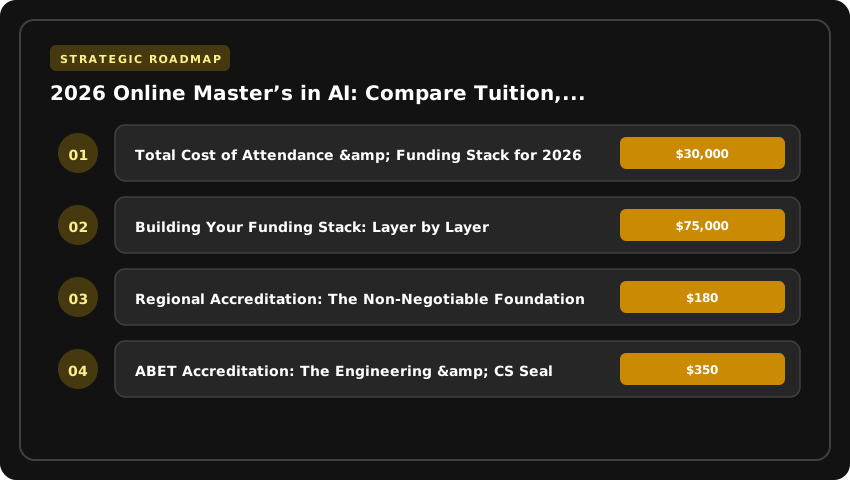
Before you compare a single curriculum line item or calculate your debt-to-income ratio, you must verify the institution’s accreditation status. In the United States, accreditation is the gatekeeper for federal financial aid eligibility, professional licensure pathways, and the vast majority of employer tuition reimbursement programs. If a program lacks the correct recognition, your degree may not qualify for FAFSA funding, your credits likely will not transfer, and your employer’s HR department may legally deny reimbursement. For the 2026 intake, understanding the hierarchy of these signals separates a career accelerator from an expensive certificate.
Regional Accreditation: The Non-Negotiable Foundation
Regional accreditation is the gold standard for institutional legitimacy in the U.S. It is granted by seven recognized agencies—most notably the Higher Learning Commission (HLC) serving the Midwest, the Middle States Commission on Higher Education (MSCHE) covering the Mid-Atlantic, and the WASC Senior College and University Commission (WSCUC) overseeing California, Hawaii, and the Pacific. When a university holds regional accreditation, the entire institution has been vetted for governance, financial stability, faculty qualifications, and student support services.
- Federal Aid Gatekeeper: Only students enrolled at regionally accredited institutions are eligible for federal student loans, Pell Grants, and work-study via the FAFSA.
- Credit Portability: Credits earned at an HLC, MSCHE, or WSCUC school are widely accepted for transfer or doctoral admission elsewhere.
- Employer Baseline: Nearly every Fortune 500 tuition assistance policy explicitly requires “regionally accredited” as the minimum threshold.
Actionable Takeaway: Verify the school’s status on the Database of Accredited Postsecondary Institutions and Programs (DAPIP) or the Council for Higher Education Accreditation (CHEA) directory before applying. Do not rely solely on the program’s marketing page.
ABET Accreditation: The Engineering & CS Seal
For Online Master’s in AI degrees housed within Computer Science, Data Science, or Engineering colleges, ABET (Accreditation Board for Engineering and Technology) programmatic accreditation is the specific quality signal employers and licensing boards trust. While regional accreditation covers the university, ABET accredits the specific degree program. It validates that the curriculum meets rigorous standards for mathematics, science, and engineering design—critical for AI tracks heavy on algorithm development, robotics, or hardware integration.
- Licensure Pathways: If your AI specialization leans toward Professional Engineer (PE) licensure (common in robotics or autonomous systems), an ABET-accredited bachelor’s is typically required; a master’s from an ABET program strengthens the application significantly.
- Defense & Federal Contracting: Roles requiring security clearances or DoD 8570 compliance often mandate ABET credentials.
- Curriculum Rigor: ABET requires documented student outcomes, continuous improvement processes, and faculty currency in emerging tech stacks.
Note: Many top-tier CS departments (e.g., Stanford, MIT, Carnegie Mellon) voluntarily forgo ABET for their graduate programs because their brand supersedes the seal. However, for public universities and online-specific degrees, ABET remains a powerful differentiator.
AACSB Accreditation: The Business Analytics & AI Management Standard
If your target degree is an MBA with an AI concentration, a Master of Science in Business Analytics (MSBA), or an MS in AI Management, you are looking for AACSB International (Association to Advance Collegiate Schools of Business) accreditation. Less than 6% of business schools worldwide hold this distinction. It signals that the program balances technical AI fluency with strategic leadership, ethics, and organizational governance.
- Employer Reimbursement: Corporate tuition plans for leadership tracks frequently require AACSB as a proxy for “rigorous business education.”
- Dual-Degree Viability: AACSB accreditation ensures seamless credit recognition if you later pursue a Ph.D. in Business or a specialized executive certificate.
- Curriculum Relevance: Standards require regular industry advisory board reviews—ensuring your “Generative AI for Business” module isn’t teaching 2022 tooling in 2026.
Synthesizing the Signals for 2026
Your degree hunt will likely present three scenarios. Scenario A: A regionally accredited university (HLC/MSCHE/WSCUC) offering an AI Master’s with no programmatic accreditation. This is standard for many new, agile online degrees; it qualifies for aid and reimbursement but relies on brand reputation for technical validation. Scenario B: Regional + ABET. Target this if you are an engineer seeking PE licensure or defense roles. Scenario C: Regional + AACSB. Target this if you are pivoting to product management, AI strategy, or the C-suite.
Final Check: Cross-reference the program’s CIP code (Classification of Instructional Programs) on the NCES College Navigator. Code 11.0102 (Artificial Intelligence) or 14.0903 (Computer Software Engineering) often maps to ABET eligibility, while 52.1301 (Management Science) maps to AACSB. Align the code with your career vector before you deposit.
Curriculum Architecture: Synchronous Rigor vs. Asynchronous Flexibility
When you are evaluating an online Master’s in AI for 2026, the delivery format is just as critical as the tuition. The synchronous versus asynchronous ratio profoundly impacts your ability to master highly complex, iterative topics. While asynchronous lectures offer the flexibility working professionals crave, advanced concepts like Transformer architectures and Reinforcement Learning from Human Feedback (RLHF) often demand the real-time, interactive troubleshooting that synchronous sessions provide. You need to be able to raise your hand—virtually—when a backpropagation calculation isn’t making sense or when your loss function is behaving unexpectedly.
Top-tier US universities are increasingly adopting a hybrid model to address this. You might watch foundational theory asynchronously, but you will likely attend mandatory live labs for MLOps pipelines, where you are deploying models and monitoring drift in real-time. This structure ensures you aren’t just passively consuming information, but actively building the engineering muscle memory required for production-level AI. A program that leans too heavily on asynchronous delivery for advanced machine learning topics risks leaving you isolated when you hit inevitable technical roadblocks.
Another major architectural decision is the capstone versus thesis route. If your goal is to transition into an applied AI role at a major tech firm, a corporate-sponsored capstone project often yields a higher career ROI. You build a portfolio-ready solution while networking with industry partners, effectively interviewing before you even graduate. Conversely, if you are targeting a PhD or a specialized research lab position, a traditional thesis is non-negotiable. It proves you can conduct novel research, a vital distinction for highly technical roles in AI Safety or advanced Computer Vision.
Let us talk compute power, because you cannot train large-scale models on a standard laptop. When analyzing programs, you must verify if the university provides remote access to dedicated GPU clusters, specifically A100 or H100 infrastructure. Without this institutional access, you will be paying out-of-pocket for AWS or Azure compute, easily adding hundreds or thousands of dollars to your total cost of attendance. A program that seamlessly integrates dedicated GPU access into its lab fees is a massive green flag.
Finally, evaluate the specialization depth. A generic “AI” degree is no longer enough to stand out in the 2026 job market. Look for programs offering dedicated, deep-dive tracks in Generative AI, Computer Vision, or the increasingly vital field of AI Safety. Ensure the curriculum goes beyond surface-level API usage and dives into the mathematical foundations and architectural nuances of these subfields.
- Actionable Takeaway: Choose a program with at least 30% synchronous components for advanced ML topics to ensure you have real-time access to faculty.
- Actionable Takeaway: Verify remote access to A100/H100 GPU clusters to avoid hidden cloud computing costs that can derail your budget.
- Actionable Takeaway: Align your capstone or thesis choice with your ultimate career goal—industry application versus academic research.
Verified Career Outcomes & Employer Partnership Networks
When you are investing $30,000 to $80,000 in a graduate credential, marketing brochures are insufficient; you need audited data. The gold standard for 2026 is CIRR (Council on Integrity in Results Reporting) compliance or an equivalent third-party audit conducted by firms like RTI International or EY-Parthenon. Programs affiliated with ABET-accredited colleges or AACSB-accredited business schools increasingly publish these reports voluntarily to differentiate themselves. Look for the “Student Outcomes Report” link in the footer of the program page—if it is missing, treat the placement claims as anecdotal.
The metric that matters most is the 6-month post-graduation employment rate for graduates actively seeking roles. Top-tier 2026 programs (e.g., Georgia Tech OMSCS AI specialization, UT Austin MSDSO, Johns Hopkins EP) consistently report placement rates between 88% and 94% within this window. However, scrutinize the denominator: does it include students who deferred search for visa sponsorship (CPT/OPT) or those returning to current employers? A “90% employed” figure where 40% stayed with their pre-degree employer signals a different ROI than one where 90% secured new roles with title changes.
Median base salary lifts are the second pillar. For the 2023–2024 graduating classes (the latest verified cycle), median base salaries for AI/ML specializations clustered in the $145,000–$175,000 range, with total compensation (signing bonus, RSUs) frequently breaching $200,000 at FAANG-adjacent firms. DoD contractors (Lockheed Martin, Northrop Grumman, Booz Allen Hamilton) and quantitative finance shops (Two Sigma, Citadel, Jane Street) anchor the upper quartile. Logistics and supply chain giants (Amazon Robotics, UPS Advanced Tech, FedEx Innovation) are the fastest-growing hiring segment, specifically targeting graduates with MLOps and Reinforcement Learning capstones.
Employer Partnership Networks: Beyond the Job Board
Deep partnerships trump generic job boards. Verify if the program maintains curriculum advisory boards staffed by hiring managers from target firms. This ensures your capstone projects solve actual problems these partners face. Key partnership indicators include:
- Guaranteed Capstone Sponsorships: Formal pipelines where NVIDIA, Google DeepMind, or Capital One propose projects and mentor students for 14–16 weeks.
- Security Clearance Pathways: Programs near the DC beltway (e.g., Georgetown, George Mason, UMGC) often maintain Facility Security Clearance (FCL) sponsorship pipelines for DoD/Intelligence Community roles.
- Visa-Ready Employer Pools: Dedicated lists of partners with proven H-1B cap-exempt or O-1 petition track records for international students.
Career Services Architecture for the AI Specialist
Generic resume reviews won’t cut it for a Generative AI Architect track. Demand career centers staffed with dedicated AI industry coaches—former Principal ML Engineers or Research Scientists—who conduct technical mock interviews covering system design for LLMs, RAG evaluation metrics, and GPU cluster optimization. The best 2026 programs offer:
- Virtual Career Fairs with Technical Screening: Not just chat rooms, but integrated CodeSignal or Karat technical assessments scheduled live with partner engineers.
- Alumni Referral Pipelines: Structured “Referral Slack/Discord” channels moderated by alumni relations, where grads 2–5 years out post internal referral links for Staff ML Engineer and Applied Scientist roles. Programs like Stevens Institute of Technology and Northeastern Khoury report 30%+ of hires originate here.
- Portfolio Curation Sprint: A credit-bearing or zero-credit intensive in the final semester focused on publishing a technical blog post, open-source contribution, or model card on Hugging Face reviewed by an industry mentor.
Actionable Takeaway: Request the full CIRR report (not the one-pager) and the employer partner list with contact names for the Industry Advisory Board. Cross-reference the partner list against H-1B Data Hub filings and Levels.fyi compensation data to verify the salary claims independently before you deposit.
Admissions Calculus: Prerequisites, Waivers & Cohort Profiling
Before you draft a single essay, you need to reverse-engineer the admissions rubric. Top-tier online MS in Artificial Intelligence programs—think Georgia Tech OMSCS, UT Austin MSAI, or Johns Hopkins EP—treat prerequisites as non-negotiable gatekeepers, not suggestions. The standard “holy trinity” remains Linear Algebra (matrix decompositions, eigenvalues), Probability & Statistics (Bayesian inference, Markov chains), and fluency in Python or C++. If your undergraduate transcript lacks a calculus-based probability course or a dedicated linear algebra class, you are not “unqualified”—you just have a gap to fill before the deadline.
This is where bridge courses become strategic assets. Programs like UT Austin’s MSAI or CU Boulder’s MS-DS pathway on Coursera allow you to take for-credit “leveling” classes (often Introduction to Linear Algebra or Statistical Inference) before formal matriculation. Ace these with a B+ or higher, and you satisfy the prerequisite and prove you can handle the graduate workload. Pro tip: Complete these through the university’s own continuing education arm rather than a third-party MOOC; admissions committees weight internal grades significantly higher.
The GRE is effectively dead for 2026 intakes at most target schools, but the waiver logic reveals what they actually value. The typical matrix looks like this:
- Automatic Waiver: 3.0–3.25+ undergraduate GPA from an ABET-accredited STEM degree + 2–3 years relevant technical work experience.
- Conditional Waiver: Sub-3.0 GPA offset by 5+ years of direct AI/ML engineering experience (model deployment, MLOps, research publications).
- No Waiver Needed: Programs like Georgia Tech OMSCS never required it; others (e.g., USC Viterbi) made it permanently optional.
Do not treat “optional” as “irrelevant.” If your quantitative coursework is thin (e.g., a Business major with one stats class), a strong GRE Quant score (165+) serves as your de facto prerequisite proof. Submit it.
Increasingly, the technical portfolio is the tiebreaker. A curated GitHub repository demonstrating an end-to-end ML pipeline—data ingestion, feature engineering, model training, containerization (Docker/K8s), and monitoring—carries more weight than a generic letter of recommendation. Active Kaggle profiles (top 10% in competitions) or contributions to open-source libraries (Hugging Face, LangChain, PyTorch) signal “builder” energy that transcripts cannot capture.
Finally, analyze the incoming cohort profile to gauge your peer network ROI. For 2026, expect the median student to carry 4–6 years of professional experience. The split typically lands near 60% “Career Advancers” (current Software Engineers/Data Scientists seeking promotion/architect roles) versus 40% “Career Switchers” (mechanical engineers, physicists, quants, or PMs pivoting into ML). This mix is gold: advancers bring production battle scars; switchers bring domain depth. Ask admissions for the “Class Profile Report”—if they won’t share the percentage of students with prior ML job titles, treat that opacity as a yellow flag.
Building Your Weighted Decision Matrix: The 2026 Selection Framework
Choosing an online Master’s in Artificial Intelligence in 2026 is less about finding the single “best” program and more about finding the program that aligns perfectly with your specific professional trajectory. Because no two online learners are exactly alike, a structured, quantitative approach removes guesswork and centers your final decision in empirical reality rather than marketing copy. Below, you will find a four-step framework for building a personalized weighted decision matrix, followed by three distinct scenario models designed to reflect the most common archetypes enrolling in U.S. programs today.
Step One: Define and Normalize Your Evaluation Criteria. Before you can assign weight to a variable, you must decide which variables matter most. For an online AI master’s, five core criteria consistently rise to the top: Cost (total tuition plus fees, not just per-credit-hour rates); Brand Prestige (AACSB or ABET accreditation, regional reputation, and recruiter recognition); Curriculum Relevance (coverage of generative AI, large language models, MLOps, and ethics); Flexibility (asynchronous vs. synchronous, part-time vs. full-time, and pause policies); and Career Services (dedicated AI industry pipelines, Handshake integrations, and alumni mentorship). Normalize each on a 1 to 10 scale using publicly available data from the NCES College Navigator, College Board BigFuture, and each program’s official curriculum page.
Step Two: Assign Personal Weights. Your weights should total 100 percent. A cost-sensitive applicant might allocate 35 percent to Cost, while a prestige-driven applicant might cap it at 10 percent. A pivoting professional often weights Curriculum Relevance heavily at 30 percent, whereas a PhD-bound researcher may weight Brand Prestige and faculty research output at 40 percent combined. This numerical forcing function prevents emotional anchoring.
Step Three: Score Each Program. Multiply the normalized score of each criterion by its assigned weight, then sum the results to produce a final composite score. Run the calculation for at least five target programs. Programs such as the online Master of Science in Computer Science or Data Science at Georgia Tech, University of Illinois Urbana-Champaign, or Carnegie Mellon should be benchmarked against regional powerhouses like University of Texas at Austin or Purdue University.
Step Four: Stress-Test With Scenarios. A score is only as good as the assumptions behind it. Run sensitivity analyses: what happens if tuition rises 5 percent, or if employer tuition reimbursement caps at $5,250 per year (the current federal limit)? The matrix that wins under multiple economic scenarios is the matrix worth trusting.
Now, let us apply that framework to three archetypes who regularly pursue an online AI master’s.
Scenario Model A: The Internal Promoter. This learner already works in a mid-level data, software, or product role at a U.S. company and wants to be promoted into an AI-focused team lead or architect position. Their matrix typically weights Cost at 30 percent, Flexibility at 25 percent, Curriculum Relevance at 25 percent, Career Services at 10 percent, and Brand Prestige at 10 percent. The Internal Promoter values the ability to keep earning a salary of roughly $95,000 to $140,000 while studying. Their optimal program balances asynchronous coursework with optional weekend residencies, and its curriculum must include applied machine learning, deep learning, and cloud MLOps rather than purely theoretical coursework. Expected ROI: a $25,000 to $45,000 salary bump within 18 to 36 months.
Scenario Model B: The Industry Pivoter. This professional is transitioning from a non-technical field (marketing, finance, mechanical engineering, or the military) into an AI-focused role, such as Machine Learning Engineer or Applied AI Analyst. Their matrix weights Curriculum Relevance at 35 percent, Career Services at 25 percent, Cost at 20 percent, Brand Prestige at 10 percent, and Flexibility at 10 percent. The Industry Pivoter needs structured ramp-up courses in Python, linear algebra, and statistics, plus robust career coaching. Programs with optional bridge semesters, industry practicums, and dedicated technical interview prep deliver the highest composite scores. Expected ROI: a career switch into a $110,000-plus base salary within 12 months of graduation.
Scenario Model C: The PhD-Bound Researcher. This applicant plans to earn a Ph.D. in AI, machine learning, or robotics, and wants a master’s that doubles as a research springboard. Their matrix weights Brand Prestige at 35 percent, Curriculum Relevance at 30 percent, Flexibility at 15 percent, Cost at 10 percent, and Career Services at 10 percent. The PhD-Bound Researcher prioritizes faculty publishing in top-tier venues such as NeurIPS, ICML, or CVPR, and programs offering thesis tracks, remote research assistantships, and co-authorship opportunities. Expected ROI: a stronger Ph.D. application, plus the option to step directly into research engineer roles paying $130,000 to $180,000 if the academic path is delayed.
By quantifying what matters and stress-testing each option under realistic U.S. economic conditions, your weighted decision matrix transforms an emotional purchase into a strategic investment. In the next section, we will layer in the funding stack, FAFSA strategies, and total cost of attendance calculations to ensure your final number reflects the full financial picture.
| Program Tier | Total Tuition Range (2026) | Avg. Completion Time | Typical Admission Cut-offs | Curriculum Focus | Career ROI (Median Salary Lift) | Delivery Format |
|---|---|---|---|---|---|---|
| Elite / Top-Tier (e.g., Stanford, Georgia Tech OMSCS, UT Austin) | $45,000 – $75,000 | 1.5 – 3 Years (Part-time) | GPA: 3.5+ | GRE: Often Waived/Optional | Exp: 2+ yrs preferred | Deep Research, Systems Architecture, ML Theory, Specialized Electives (Robotics, NLP, Vision) | $40k – $65k+ | 95% Placement in FAANG/Research Labs | Async Lectures + Live Recitations + Proctored Exams |
| Mid-Range / High Value (e.g., Johns Hopkins, Drexel, SMU, CU Boulder) | $30,000 – $50,000 | 2 – 3 Years (Part-time) | GPA: 3.0+ | GRE: Rarely Required | Exp: 1+ yr Tech/STEM | Applied ML Ops, Data Engineering, Ethics, Capstone Projects w/ Industry Partners | $25k – $45k | 85% Placement in Senior Eng/Lead Roles | Fully Async / Hybrid Options / Stackable Certs |
| Budget / Public Access (e.g., GA Tech OMSCS, UIC, CSU Fort Collins) | $10,000 – $30,000 | 2 – 4 Years (Self-Paced) | GPA: 3.0+ (Conditional Entry Avail.) | GRE: Not Required | Exp: 0+ yrs (Bridge Courses) | Core CS Fundamentals, Broad ML Survey, Practical Deployment, Cloud Integration | $15k – $35k | 75% Placement / Internal Promotion | MOOC-Style Async / Massive Scale / Low Touch |
Frequently Asked Questions
What is the total cost of a 2026 online Master's in Artificial Intelligence?
The total cost of attendance for a 2026 online Master's in AI typically ranges from $30,000 to $75,000. Elite programs like Georgia Tech OMSCS sit near $10k–$15k, while private universities such as Johns Hopkins or SMU range $45k–$65k. Total cost includes tuition, fees, and required hardware/software stipends.
Are GRE scores required for 2026 online AI master's admissions?
Most 2026 online AI master's programs have permanently waived GRE requirements. Top-tier institutions (Georgia Tech, UT Austin, CU Boulder) evaluate candidates on undergraduate GPA (3.0+ minimum), prerequisite coursework in linear algebra and Python, and professional experience rather than standardized test scores.
What salary increase can I expect after an online Master's in AI?
Graduates typically see a median salary lift of $25,000 to $65,000 annually. Elite program alumni often transition into $180k+ ML Engineering roles at FAANG companies. Mid-tier graduates average $140k–$160k in Applied Scientist or Senior Data Science positions, representing a 30–45% ROI within 18 months post-graduation.
How long does it take to complete an online AI master's degree part-time?
Part-time students typically complete 30–33 credit degrees in 2 to 3 years. Accelerated tracks allow finish in 18 months at 2 courses per semester. Self-paced programs like Georgia Tech OMSCS offer up to 6 years maximum. Curriculum intensity and capstone requirements are primary timeline drivers for working professionals.
Strategic Final Takeaway
Success in evaluating 2026 Online Master’s in AI: Compare Tuition, Curriculum & Career ROI relies on early preparation, adherence to verified accredited requirements, and cross-referencing official portals. Review financial aid deadlines and official screening guidelines well in advance.

