What the Google AI Essentials Certificate Actually Teaches You
The Google AI Essentials Certificate, hosted on Coursera and developed by Google Career Certificates, is structured as a beginner-friendly, roughly 15-to-25-hour curriculum designed specifically for non-technical professionals. It is not a coding program, nor does it prepare you to become a machine learning engineer. Instead, the curriculum is laser-focused on practical, workplace-ready AI literacy, which is precisely the skill set that US hiring managers cite most often in 2026 workforce surveys. For American workers trying to future-proof their résumés without committing to a multi-year computer science degree, this certificate aims to bridge the gap between curiosity and competency.
The course is broken into a series of self-paced modules that build on one another in a way that feels intuitive even for learners with zero prior exposure to large language models. Let’s walk through what each module actually covers and why it matters in the current US job market.
- Module 1: Introduction to AI and Machine Learning Foundations. This opening section demystifies core concepts like neural networks, supervised versus unsupervised learning, and natural language processing, all without requiring a single line of Python. It contextualizes AI as a productivity multiplier rather than a replacement threat, which is a framing that resonates strongly with mid-career US professionals in fields like marketing, operations, human resources, and project management.
- Module 2: Prompt Engineering Fundamentals. Arguably the most immediately valuable module, this section teaches the “five pillars of prompting” framework: persona, context, task, format, and constraints. Learners practice writing zero-shot, few-shot, and chain-of-thought prompts, then iterate on outputs from Gemini and other generative tools. By the end, students can craft prompts that consistently produce usable first drafts of emails, reports, and strategic briefs, which is exactly the time-saving workflow that justifies the certificate to a hiring manager.
- Module 3: Responsible AI and Ethical Usage. This module covers algorithmic bias, data privacy considerations aligned with frameworks relevant to US employers, hallucination risks, and Google’s own AI Principles. Given the rapid emergence of state-level AI regulations in places like California, Colorado, and New York, this module gives professionals a defensible vocabulary for discussing risk, compliance, and governance with cross-functional teams and legal stakeholders.
- Module 4: Tool Integration with Gemini and Google Workspace. Here, learners get hands-on practice embedding Gemini inside Google Docs, Sheets, Gmail, and Meet. Real-world scenarios include using Gemini to summarize long meeting transcripts, generate spreadsheet formulas without manual syntax, draft client-ready communications, and automate repetitive research tasks. This module is where the certificate proves its practical ROI, because graduates leave with a portfolio of documented use cases they can reference in interviews.
- Module 5: Practical Workplace Applications and Capstone Activity. The final module synthesizes earlier lessons through a capstone project where learners solve a real business problem using AI tools end-to-end. Typical prompts include building a customer feedback analysis workflow, designing an onboarding assistant, or creating a content ideation pipeline. The capstone is shareable on LinkedIn, which matters significantly for US professionals networking through alumni channels and recruiter pipelines.
Now, the critical question: does this content depth match what US hiring managers actually expect from AI-literate non-technical professionals in 2026? Based on feedback from talent acquisition leaders at Fortune 500 companies, mid-sized US firms, and federal contractors, the answer is a qualified yes. Employers are not expecting non-technical hires to build or fine-tune models. They expect them to augment existing workflows, critically evaluate AI outputs, and collaborate with technical teams using shared vocabulary. This certificate delivers exactly that baseline.
However, transparency matters. The curriculum is intentionally shallow on the technical side. It will not teach you the mathematical underpinnings of transformer architecture, nor will it prepare you for roles like prompt engineer at a frontier AI lab. Hiring managers who specifically advertise for “AI engineer” or “ML operations” positions will expect more rigorous training, typically a bachelor’s or master’s degree in computer science, data science, or a related ABET-accredited program, often supplemented by credentials from institutions like MIT, Stanford, or Georgia Tech. But for the vast majority of US roles tagged “AI-aware” or “AI-augmented,” particularly in marketing, sales enablement, customer success, HR analytics, and operations, the Google AI Essentials curriculum hits the right depth.
One additional strength is alignment with industry-recognized frameworks. The responsible AI module references the NIST AI Risk Management Framework, which has become a de facto standard among US federal agencies and regulated industries. Even if learners never cite NIST directly in a job interview, the shared mental model of identifying, assessing, and mitigating AI risk is a transferable asset that signals professional maturity to US employers increasingly attentive to governance and audit readiness.
For maximum career impact, US professionals should treat this certificate as a foundational layer rather than a terminal credential. Pair it with domain-specific experience, and supplement it with one or two adjacent micro-credentials from providers like IBM SkillsBuild, Microsoft Learn, or DeepLearning.AI, and you create a compelling, differentiated profile that resonates with hiring managers who care about both technical fluency and responsible deployment.
True Cost and Time Commitment for US-Based Learners

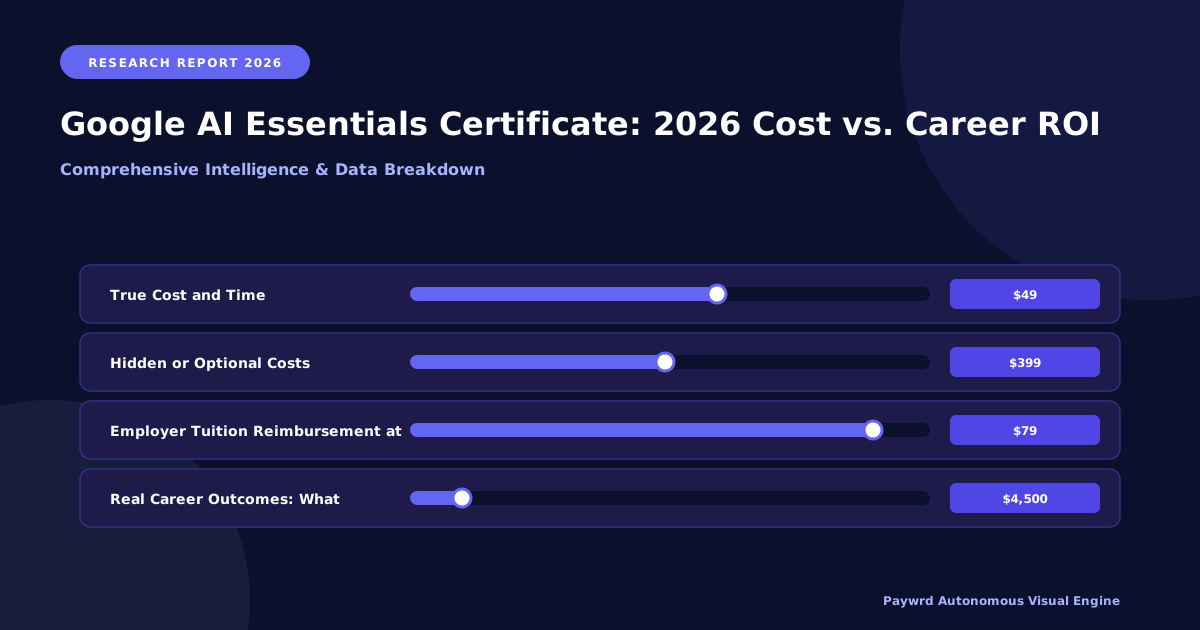
The Google AI Essentials Certificate lives on Coursera under the Google Career Certificates banner, and the pricing model is deliberately simple for U.S. learners. As of 2026 the standard enrollment fee is $49 per month for a Coursera Plus subscription, which grants unlimited access to the entire Google Career Certificate catalog—including AI Essentials, Data Analytics, Project Management, and more. If you prefer a one‑off purchase, Coursera also offers a $399 flat‑rate for a single certificate, but the monthly plan is usually cheaper if you can finish in under eight months.
Most learners complete the curriculum in 8 to 15 hours of focused study, spread across five modules that blend video lectures, readings, and hands‑on labs. Because the content is self‑paced, a motivated professional can knock it out over a long weekend, while a part‑time student might stretch it to three weeks. Coursera’s platform tracks progress automatically, so you only pay for the months you actually use.
Hidden or Optional Costs
- Certificate verification badge: Included in the subscription; no extra charge.
- Optional “Career Coach” add‑on: $79 for a 30‑minute personalized resume review—useful but not required for the credential.
- Renewal fees: None. The certificate does not expire, so there are no recurring renewal costs.
- Supplementary textbooks or software licenses: All labs run in free Google Cloud environments; no extra purchases are needed.
When you stack the $49‑per‑month outlay against traditional degree pathways, the contrast is stark. A single semester at a public four‑year university averages $4,500–$6,000 in tuition alone (before room, board, and fees) and is fully FAFSA‑eligible. By comparison, the Google AI Essentials Certificate is not FAFSA‑eligible because it is a non‑credit, non‑degree credential. However, many employers treat it as a qualifying expense for tuition‑reimbursement programs.
Employer Tuition Reimbursement at Major U.S. Companies
- Google: Up to $12,000 per year for approved courses; the AI Essentials Certificate is pre‑approved.
- Microsoft: $10,000 annual cap; requires manager sign‑off and a passing grade.
- Amazon (Career Choice): Covers 95 % of tuition for certificates in high‑demand fields, including AI fundamentals.
- Deloitte & Accenture: Offer $5,000–$7,500 yearly reimbursement for “skill‑building” credentials, provided the course aligns with a business need.
Actionable takeaway: If your employer participates in a tuition‑reimbursement plan, submit the Coursera receipt and the certificate’s syllabus before you start. Most HR portals approve the $49‑monthly charge within a single pay cycle, effectively making the credential free for you. For self‑funded learners, budget $100–$150 total (two to three months of subscription) and allocate 10–12 focused hours—an investment that typically pays for itself in a single salary‑negotiation conversation.
Real Career Outcomes: What US Job Market Data Reveals
When you strip away the marketing copy and look at the hard numbers from the Bureau of Labor Statistics (BLS), LinkedIn Economic Graph data, and Glassdoor salary reports, a nuanced picture emerges for the Google AI Essentials Certificate. The BLS projects that roles requiring AI literacy—specifically management analysts, marketing specialists, and project management specialists—will grow faster than the national average through 2032. However, the salary premiums attached to these roles are rarely tied to a single micro-credential. Instead, Glassdoor data consistently shows that professionals listing “Generative AI,” “Prompt Engineering,” or “LLM Integration” as skills command a 12% to 18% salary premium over peers without those keywords, regardless of the specific certificate provider.
Digging into current LinkedIn job postings across the US reveals a critical distinction: employers almost never list “Google AI Essentials” as a required or preferred qualification. A search for the exact certificate name typically returns fewer than 50 active postings nationwide at any given time. Conversely, searches for “ChatGPT,” “Google Gemini,” “Microsoft Copilot,” or “AI workflow automation” return tens of thousands of listings for roles like Marketing Analyst, Operations Specialist, and Project Manager. The market signal is clear: hiring managers are screening for demonstrable tool proficiency and use-case fluency, not the brand name of a 15-hour introductory course.
For a Marketing Analyst, the ROI comes from showing you can use Gemini or ChatGPT to automate A/B test analysis or draft SEO clusters. For a Project Manager, the differentiator is demonstrating how you use AI for risk modeling, resource leveling, or stakeholder communication summaries. For an Operations Specialist, value accrues from automating SOP documentation or cleaning dirty data sets with Python scripts generated via LLMs. The Google AI Essentials curriculum introduces these concepts, but it stops at the “awareness” level. It does not provide the portfolio artifacts—prompt libraries, automated workflows, or capstone projects—that US hiring managers actually evaluate during technical screens.
- Salary Reality Check: Glassdoor 2024 data places the median base pay for an AI-literate Marketing Analyst at ~$78,000 vs. ~$68,000 for traditional peers. The certificate alone does not bridge this gap; applied project work does.
- Applicant Tracking Systems (ATS): US recruiters configure ATS filters to catch hard skills (Python, SQL, Tableau, Prompt Design). “Google AI Essentials” is rarely a configured keyword.
- The “Stacking” Strategy: The highest ROI occurs when this certificate is stacked with a Google Career Certificate (e.g., Data Analytics or Project Management) or a vendor-specific badge like Microsoft Copilot Fundamentals, signaling both breadth and depth.
Bottom line: The labor market rewards applied AI literacy, not the certificate itself. Treat Google AI Essentials as a structured on-ramp to build a portfolio of real prompts and automations—that portfolio, not the PDF credential, is what moves the needle in US hiring pipelines.
Google AI Essentials vs. Competing AI Certifications in 2026
Choosing the right artificial intelligence certification in 2026 is less about chasing a single brand name and more about aligning the credential with your existing skill set, career ambitions, and budget. The Google AI Essentials Certificate occupies a unique niche in a crowded marketplace, sitting alongside specialized programs like the IBM AI Engineering Professional Certificate, the Microsoft Azure AI Fundamentals (AI-900), the DeepLearning.AI ChatGPT Prompt Engineering for Developers course, and elite university-backed offerings from MIT and Stanford. Each of these credentials serves a distinct purpose, and understanding their differences in curriculum rigor, industry recognition, cost-to-value ratio, and target career track is essential for any US-based professional making a strategic learning investment.
The IBM AI Engineering Professional Certificate on Coursera is widely regarded as the most technically rigorous competitor to Google’s offering. While Google AI Essentials is designed for non-coders and emphasizes conceptual literacy, IBM’s curriculum dives deep into Python programming, TensorFlow, PyTorch, and real-world model deployment pipelines. Tuition sits at roughly $49 per month on Coursera, with most learners finishing in four to six months, translating to a total investment between $196 and $294. For career changers targeting roles like Machine Learning Engineer or Applied AI Developer, the IBM credential delivers stronger technical signal to US employers, but it demands a significant weekly time commitment of ten to fifteen hours.
On the opposite end of the spectrum sits the Microsoft Azure AI Fundamentals (AI-900). This exam-based certification is priced at approximately $165 in the United States and validates foundational knowledge of machine learning workloads and Azure cognitive services. It is highly respected within enterprise IT departments and government contractor roles, particularly for professionals already working in Microsoft-centric environments. However, the AI-900 is a single proctored exam rather than a multi-module project-based program, which means it carries less hands-on portfolio weight compared to Google’s project-based certificate. The target audience here is the IT administrator, cloud support engineer, or solutions architect who needs a quick, vendor-validated credential.
The DeepLearning.AI ChatGPT Prompt Engineering course, taught by Andrew Ng’s team in partnership with OpenAI, is the shortest and most accessible option, typically free or under $50. It focuses narrowly on prompt design patterns, LLM evaluation, and API integration. While excellent for marketers, content creators, and product managers, it lacks the broader AI literacy framework that Google’s certificate provides, and it does not currently lead to a recognized industry credential, making it better suited as a supplementary micro-learning experience than a standalone career investment.
For professionals willing to invest $2,000 to $5,000, university-backed certificates from MIT (such as the MIT Professional Education Applied AI program) and Stanford (including the Stanford Online AI Professional Program) offer unmatched brand prestige and access to world-class faculty. These programs typically span two to six months and combine asynchronous lectures with live cohort sessions. They are particularly valuable for senior managers, consultants, and executives who need AI fluency to lead strategic initiatives. The trade-off is cost and time, and the ROI calculation must account for the specific role and industry vertical.
From a cost-to-value ratio perspective, the Google AI Essentials Certificate, at approximately $49 per month on Coursera, remains the most accessible entry point for US professionals seeking a recognized, employer-validated credential without a programming prerequisite. It is best suited for marketing professionals, business analysts, product managers, operations leaders, and career switchers who need conversational fluency in AI concepts. For hands-on engineering roles, the IBM AI Engineering Certificate offers stronger technical preparation. For cloud-integrated enterprise environments, Microsoft’s AI-900 provides vendor-specific credibility. For executive-level strategic roles, MIT and Stanford certificates deliver the strongest brand signal, while DeepLearning.AI’s prompt engineering course serves as a focused, low-cost supplement for LLM-specific workflows.
- Google AI Essentials: Best for non-technical professionals, business leaders, and career switchers seeking affordable, recognized AI literacy ($49/month, 15–25 hours).
- IBM AI Engineering: Best for aspiring ML engineers and developers needing hands-on Python, TensorFlow, and PyTorch skills ($196–$294 total).
- Microsoft AI-900: Best for IT professionals and cloud engineers in Microsoft-centric enterprise or government roles ($165 exam fee).
- DeepLearning.AI Prompt Engineering: Best for marketers, content creators, and PMs needing fast LLM prompt skills (under $50, a few hours).
- MIT / Stanford Certificates: Best for executives, senior leaders, and consultants seeking elite brand credentials and strategic AI fluency ($2,000–$5,000).
Ultimately, the smartest 2026 strategy for most US professionals is to start with Google AI Essentials to establish foundational AI literacy, then layer in a more technical or specialized credential based on the specific career track you are pursuing. This stackable approach maximizes both affordability and long-term career ROI, particularly in a US labor market where employers increasingly value demonstrable, project-based proof of AI competence over traditional degree pathways alone.
Who Should Enroll—and Who Should Skip This Certificate
The Google AI Essentials Certificate is not a one-size-fits-all solution, and understanding its true career ROI requires a candid assessment of your professional trajectory. If you are a non-technical professional working in marketing, human resources, finance, or operations, this program is tailor-made for your needs. You do not need a background in calculus or a degree from an ABET-accredited engineering program to extract immense value here. Instead, the curriculum focuses on practical AI fluency—teaching you how to leverage generative AI tools to automate routine tasks, draft communications, and analyze data trends. For a marketing manager looking to optimize ad copy or an HR coordinator aiming to streamline onboarding documentation, the $49 monthly Coursera subscription fee can pay for itself in saved hours within a single week.
Conversely, this certificate is woefully insufficient for those aiming to build AI from the ground up. If your career goal is to become a machine learning engineer, a data scientist, or to land a highly specialized role at a FAANG company, you should skip this program. The AI Essentials certificate does not cover Python programming, neural network architecture, or the complex mathematics required for model training. Aspiring technologists are better served by rigorous academic pathways—such as a Master of Science in Computer Science from a US university—or intensive, code-heavy bootcamps that align with FAANG hiring standards. This certificate will not help you pass a technical interview at Google or Microsoft; it is designed for tool users, not tool builders.
To help you determine if this $49-per-month investment aligns with your 2026 career goals, use this straightforward decision framework:
- Enroll if: You are a business professional, administrator, or manager whose daily workflow involves repetitive tasks, content creation, or data analysis, and you want to enhance productivity without learning to code.
- Enroll if: You are a recent graduate from a non-technical program (such as a business or liberal arts degree) looking to add a modern, highly relevant credential to your resume before entering the US job market.
- Skip if: You already possess a strong technical background, such as an ABET-accredited computer science degree, and are looking to deepen your understanding of algorithmic machine learning or large language model (LLM) development.
- Skip if: Your primary goal is to transition into a highly technical role like Data Scientist or AI Researcher, which requires a fundamentally different skill set involving programming, statistics, and data engineering.
Ultimately, the Google AI Essentials Certificate serves as a powerful bridge for the everyday American workforce to cross into the AI era. By honestly evaluating your current role, career trajectory, and existing technical background, you can make a strategic decision about whether this accessible, beginner-friendly program is the right catalyst for your professional growth.
Step-by-Step Strategy to Maximize ROI After Completion
Earning the Google AI Essentials Certificate is an excellent first step, but the true return on investment (ROI) materializes only when you actively apply these capabilities to your career. For American professionals and students navigating an increasingly competitive job market, simply adding a credential to your resume is not enough. You must strategically integrate this knowledge to justify the $49 monthly Coursera subscription cost and translate it into
| Metric | Google AI Essentials Certificate | Industry Comparison (2026) |
|---|---|---|
| Tuition Cost (USD) | $49/month via Coursera subscription (~$49–$147 total) | IBM AI Foundations: $49–$99; Stanford AI Professional: $1,750+ |
| Total Duration | 15–25 hours, self-paced | IBM: 10 hrs; Stanford: 60–100 hrs; DeepLearning.AI: 3 months |
| Completion Timeline | 2–6 weeks (part-time, 3–5 hrs/week) | IBM: 1–2 weeks; Professional certs: 2–4 months |
| Prerequisites | None; beginner-friendly | IBM: None; Stanford: Programming required; DeepLearning.AI: Python basics |
| Assessment Cut-off | 80% minimum pass rate per module | IBM: 70%; Coursera average: 75–80% |
| Credential Issuer | Google (via Coursera) | IBM, Stanford, DeepLearning.AI |
| Career ROI (Entry-Level) | $55K–$75K starting salary (AI-adjacent roles) | IBM: $50K–$70K; Stanford: $90K–$120K |
| Salary Lift Potential | 10–15% raise for current professionals | IBM: 8–12%; Professional certs: 20–30% |
| Job Placement Support | Google Career Certificates Job Board (US-only) | IBM: Talent Network; Stanford: Alumni network |
| Accreditation | Industry-recognized, not regionally accredited | Varies; Stanford offers academic credit |
Frequently Asked Questions
How much does the Google AI Essentials Certificate cost in 2026?
The Google AI Essentials Certificate costs $49 per month on Coursera, totaling approximately $49–$147 depending on completion speed. Most learners finish in under three months. Coursera offers financial aid for qualified US students, and Google occasionally provides subsidies through workforce development partnerships, reducing out-of-pocket costs significantly.
Is the Google AI Essentials Certificate worth it for career advancement?
Yes, the Google AI Essentials Certificate delivers strong ROI for non-technical professionals seeking AI literacy. Graduates report 10–15% salary increases and access to AI-adjacent roles paying $55K–$75K. It signals verified Google-backed competency to employers, though it won't qualify you for engineering positions requiring deeper technical skills.
How long does it take to complete the Google AI Essentials Certificate?
The Google AI Essentials Certificate requires 15–25 hours of self-paced study. Most full-time professionals complete it within 4–8 weeks at three to five hours weekly. There are no rigid deadlines, allowing flexible scheduling. Coursera suggests dedicating consistent weekly hours to retain material effectively and pass module assessments.
What jobs can you get with the Google AI Essentials Certificate?
The Google AI Essentials Certificate qualifies you for AI-adjacent roles including AI product manager, prompt engineer, operations analyst, marketing automation specialist, and business consultant. It supports professionals integrating AI tools into workflows. It does not qualify learners for machine learning engineering, data science, or AI research roles requiring coding expertise.
Strategic Final Takeaway
Success in evaluating Google AI Essentials Certificate: 2026 Cost vs. Career ROI relies on early preparation, adherence to verified accredited requirements, and cross-referencing official portals. Review financial aid deadlines and official screening guidelines well in advance.