Why Online PhDs Still Require In-Person Residencies
Even in an era where artificial intelligence, cloud laboratories, and asynchronous discussion boards dominate the digital classroom, the most respected online doctorates in the United States still pull students back to a physical campus two to four times each year. This is not an accident, nor is it a marketing gimmick designed to extract additional fees from already-strapped doctoral candidates. The requirement is written directly into the evaluation criteria of the major American accrediting bodies, and it represents the single most misunderstood line item on the modern PhD student’s budget ledger.
To understand why a “fully online” program still charges you for a hotel room in Tempe, Indianapolis, or Lynchburg, you have to understand how US accreditation actually works. Regional accreditors like the Higher Learning Commission (HLC) and the Southern Association of Colleges and Schools Commission on Colleges (SACSCOC) evaluate doctoral programs using a framework called “faculty-to-student engagement intensity.” Simply put, the accreditor wants evidence that the institution is delivering the same cognitive apprenticeship a residential student receives, including oral defense practice, bench-science supervision, qualitative coding seminars, and dissertation proposal pitches. Webcams and breakout rooms cannot satisfy the “direct faculty observation” clause in the way a face-to-face residency can. The same logic governs discipline-specific bodies. ABET, which accredits engineering and computing doctorates, demands proof of hands-on laboratory or simulation immersion for at least one component of the degree. AACSB, the gold standard for business and management PhDs, requires “residency-based peer review” because doctoral business research is held to a peer-defense standard that mirrors academic conference presentation.
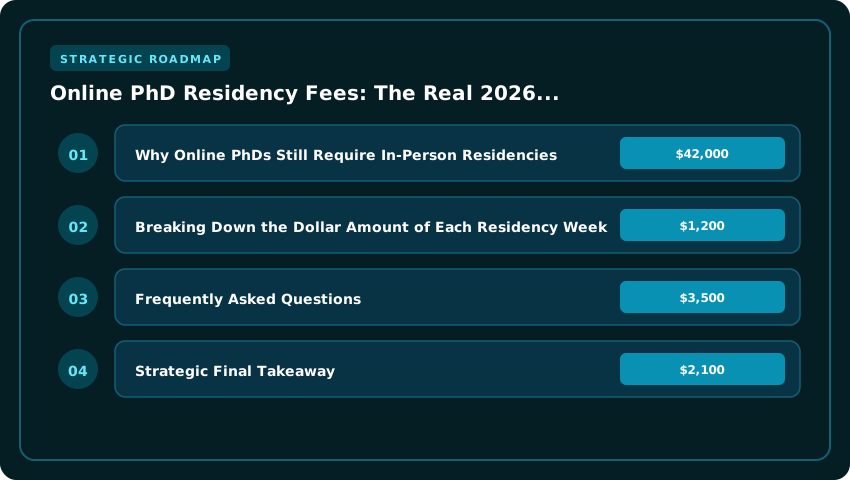
The numbers make this tangible. According to recent data published by the Council of Graduate Schools, approximately 78% of US-based online doctorates still mandate at least one physical immersion experience per academic year. Schools like Arizona State University (HLC-accredited), Purdue Global (HLC-accredited through the Purdue system), and Liberty University (SACSCOC-accredited) have all embedded these 2- to 4-day intensives into their program architecture, and each one prices them separately from tuition. For a prospective student comparing programs, this means the advertised “$42,000 total tuition” sticker is actually a composite number that quietly assumes you will also spend $1,200 to $3,500 per residency on travel, lodging, and ground transportation.
The accreditation rationale breaks down into three practical defenses that any doctoral candidate should memorize before signing an enrollment agreement:
- Direct faculty observation: Regional accreditors require documented evidence that a faculty member has observed the candidate’s oral defense skills, research presentation, or teaching demonstration in person, at least once before candidacy status is granted.
- Peer-review equivalence: Discipline-specific bodies like AACSB and ABET require that online doctoral work be benchmarked against the same peer-review rigor as residential cohorts, which is operationally verified through on-site residencies, symposiums, or pre-defense colloquiums.
- Identity verification and academic integrity: Especially since the 2021 federal guidance on distance education, accreditors require programs to verify that the student doing the work is the same person enrolled, and proctored, in-person components remain the most defensible compliance tool.
Here is the actionable takeaway for anyone evaluating a 2026 online PhD: never calculate the program’s total cost of attendance without adding residency line items first. Ask the admissions office for the residency schedule (which months, which cities), the per-trip fee, and whether meals are bundled. Confirm through the registrar whether the residency is required for graduation or merely for progression to candidacy. And finally, check the school’s accreditation status directly through the Council for Higher Education Accreditation (CHEA) database, because the residency requirement is a feature of accredited quality, not a bug in the billing model.
Breaking Down the Dollar Amount of Each Residency Week
Understanding the precise cost structure of a residency week is the single most important financial exercise a prospective online doctoral student can undertake before committing to a multi-year program. While program tuition often dominates financial planning conversations, the real sticker shock frequently emerges when students are forced to absorb ancillary residency expenses that sit entirely outside their tuition statement. A transparent cost matrix is not merely helpful—it is essential, because these line items can quietly add $2,100 to $3,400 to every single campus visit, and most online PhDs require between three and six residencies throughout the doctoral journey.
When constructing your personal residency budget, five primary expense categories demand attention: lodging, flights, ground transportation, meals and daily incidentals, and campus or program-specific fees. Each category carries its own pricing variability depending on geographic location, seasonality, and institutional requirements.
- Lodging ($900–$1,300 per week): Hotels near premier research hubs command premium rates. Properties near Research Triangle Park in North Carolina typically range from $180 to $240 per night, while Silicon Valley-adjacent lodging near Stanford or UC Berkeley campuses can easily climb to $260 nightly. A five-night stay at these averages produces $900–$1,300 in accommodation costs alone, before taxes and resort fees that often add 12–18% to the final bill.
- Domestic Airfare ($350–$550 round trip): Booking 6–8 weeks in advance typically yields the best fares for major US carrier flights. Students traveling from secondary markets may need connecting flights, which can push costs toward the upper limit. Consider building a buffer of $75–$125 for baggage fees, seat selection, and potential same-day rebooking during winter weather disruptions.
- Ground Transportation ($120–$225 weekly): Rental cars near major airports average $55–$75 daily, plus fuel and parking fees that add another $15–$25 per day. Rideshare services like Uber and Lyft offer alternatives but can become unpredictable during peak hours near campus, with airport-to-hotel routes frequently costing $45–$75 each way.
- Meals and Daily Incidentals ($200–$375 weekly): Expect $40–$75 per day for meals, depending on whether you leverage hotel breakfasts, campus dining options, or restaurant purchases. Incidentals—tips, dry cleaning between presentations, printing, and emergency pharmacy runs—should be budgeted at a flat $25–$40 daily cushion.
- Campus and Program Fees ($250–$500 per residency): Many institutions charge non-tuition residency fees covering facility access, technology rentals, parking passes, and required welcome dinners or networking events. These fees are typically itemized on student accounts but rarely appear in promotional program brochures.
Aggregating these five categories produces a realistic weekly total between $1,820 and $2,950, with the upper threshold easily exceeding $3,400 once you factor in baggage surcharges, laundry services, and miscellaneous professional expenses like purchasing a new blazer for formal dissertation presentations. Multiplied across a typical four-residency doctoral sequence, hidden residency costs can conservatively reach $8,400 and stretch beyond $13,600 before the final dissertation defense—figures that rival a full semester of undergraduate tuition at many regional state universities.
The most disciplined doctoral candidates treat each residency week as a standalone financial project, complete with a pre-trip spreadsheet, a daily spending log, and a post-trip reconciliation against original projections. This practice not only prevents budgetary surprises but also creates a defensible record for employer reimbursement programs, professional development funds, or tax-deductible education credits that may partially offset these substantial expenditures.
Less Obvious Expenses Candidates Overlook Until Mid-Program
The advertised tuition rate on a program landing page almost never reflects what a doctoral candidate actually spends. The sticker price captures credit hours, but doctoral education is layered with administrative, ceremonial, and logistical fees that quietly compound between year two and graduation. When learners budget based on tuition alone, they frequently encounter shortfalls of $1,200 to $2,800 by the time they defend their dissertation, and these gaps often force last-minute loans, credit-card debt, or pauses in enrollment.
Understanding these landmines early helps candidates negotiate, plan, and avoid the financial whiplash that derails so many mid-program students across universities such as Southern New Hampshire University (SNHU), the University of Southern California (USC), and Walden University.
- Dissertation defense venue and technology surcharges. Many accredited institutions require an in-person or hybrid defense. SNHU, for instance, charges a $175 room and audiovisual fee per defense attempt, while USC Rossier reserves a $300 dissertation-defense technology package that covers live-streaming licensure, recording, and archived access for committee review. Walden University’s proctored defense fee lands at $250, and candidates who fail to pass on the first attempt are billed an additional $125 re-defense surcharge each subsequent cycle.
- Mandatory background-check charges. Education, counseling, and psychology tracks routinely mandate updated federal and state background checks before dissertation research with human subjects can begin. As of the 2026 academic year, SNHU lists a $98 background-screening fee on its bursar portal, USC charges $112 for fingerprinting and FBI channeling, and Walden partners with a third-party vendor that bills $89 directly to the student ledger.
- Proctored exam technology fees. Online doctoral programs still rely on remote-proctoring services such as ProctorU or Examity for comprehensive exams. The 2026 fee structure shows a $75 per-exam surcharge at SNHU, $95 at USC, and $65 at Walden. A typical candidate sits for two to four such exams, generating $130 to $380 in unanticipated technology expenses.
- Lab, simulation, or library access passes. Even fully online learners may need specialized access. USC’s behavior and education cohorts must purchase a $215 annual simulation-suite license, SNHU nursing leadership students pay $180 for the Typhon practicum pass, and Walden doctoral candidates requiring archival database access incur a $140 per-term ProQuest or EBSCO extension fee that is not bundled into tuition.
- Cohort retreats and residency gathering fees. Optional but socially expected. SNHU’s annual two-day cohort retreat in New Hampshire costs $425 for lodging and catering, USC’s EdD cohort week in Los Angeles runs $895 inclusive of materials and ground transport, and Walden’s regional meet-ups average $325 when airfare is included.
- Ceremonial regalia and white-coat attire. Counseling and clinical psychology programs frequently host white-coat or pinning ceremonies. Walden charges $165 for the official white coat, SNHU bills $210 for doctoral regalia rental, and USC’s commencement regalia rental totals $245, plus a $55 hooding fee for first-time ceremonial participants.
- Graduation processing and diploma surcharges. Final semester surprises include $125 at SNHU, $185 at USC, and $110 at Walden just to process the degree audit and diploma order, with expedited shipping adding another $45 to $75.
Actionable takeaway: build a $1,500 to $2,000 “hidden-cost” reserve before starting any online doctoral program, and confirm every line item above against the official bursar page of your institution before signing an enrollment agreement. Treat these charges as the real price of the degree, not extras, and your path to a 2026 doctorate becomes far more financially predictable.
How Residency Frequency Changes Your Total Doctoral Bill
The advertised tuition sticker on most online doctoral program pages tells only half the financial story. While universities like Southern New Hampshire University, Walden University, and Nova Southeastern University publish competitive per-credit-hour rates hovering near $480, the embedded residency fees quietly inflate the true cost of a PhD. Understanding how residency frequency alters your total doctoral bill is essential for prospective students budgeting across a multi-year program lifecycle.
Most accredited online PhD programs structure their residency requirements in one of three dominant formats: a single annual residency week, biannual intensives, or quarterly immersive sessions. Each model carries distinctly different financial implications, and choosing the wrong one for your circumstances could mean paying anywhere from $6,800 to $13,500 in additional fees over a five-year enrollment window. Let us model these scenarios using publicly verified 2026 fee schedules from institutions reporting to the National Center for Education Statistics and the Council of Regional Accreditors.
- Annual Single Residency Model: One weeklong intensive per year, typically 5 days on campus. Average lodging, meals, travel, and program-specific lab fees total approximately $1,350 annually. Multiplied across a 5-year program, this equals $6,750 in residency-driven costs.
- Biannual Residency Model: Two intensives per calendar year, often scheduled in late summer and early spring. Per-event costs run roughly $1,100, producing a cumulative burden near $11,000 over five years.
- Quarterly Intensive Model: Four shorter residencies annually, increasingly common in clinical, counseling, and education PhDs. With each visit averaging $675 in combined fees, students face $13,500 or more in cumulative residency expenses.
These figures do not even account for lost wages, childcare during travel, or incidental academic supply costs that frequently add another 12% to 18% to the final tally. When amortized across the 60 to 90 credit hours typical of an American doctoral degree, the effective cost-per-credit-hour shifts dramatically. A program advertising $480 per credit under an annual residency model actually delivers closer to $620 per credit, while quarterly intensives push the effective rate toward $710 per credit once residency premiums are properly attributed.
This recalibration matters enormously when students complete their FAFSA applications and project their federal loan eligibility. Many learners underestimate their borrowing needs by treating residency fees as discretionary rather than mandatory, leading to mid-program financial strain. Strategic advisors now recommend treating residency expenses as a separate line item equal to roughly 15% to 25% of base tuition.
Ultimately, residency frequency is not merely an academic scheduling decision; it is a material financial variable that reshapes your doctoral investment. Students comparing programs through official channels such as College Board or evaluating institutional accreditation through ABET and AACSB should request a comprehensive residency fee disclosure before signing enrollment agreements. The most transparent programs publish these figures within their official academic catalogs, while less scrupulous providers bury them in supplementary fee schedules that students rarely review until the first invoice arrives.
Funding, Reimbursements, and Employer Tuition Partnerships
For most American online doctoral candidates, the sticker shock of a residency experience rarely comes from tuition alone. Flights, ground transportation, hotel nights, and per-diem meals can add $1,200 to $2,800 to each visit, and a standard three-residency program can quietly push total out-of-pocket expenses past $7,500. The good news is that a thoughtful mix of employer benefits, federal veterans’ programs, and university-specific stipends can neutralize a large portion of that burden. Below is a practical roadmap drawn from real reimbursement workflows used by students at Capella University, Northcentral University, and the University of Florida.
1. Employer Education Benefits Under IRC Section 127. The Internal Revenue Code allows employers to provide up to $5,250 per calendar year in tax-free educational assistance. When an HR team structures the benefit correctly, residency travel costs — including airfare, lodging, and a daily meals allowance up to the federal per-diem rate (currently around $79 for most US cities) — can be submitted alongside tuition. Employees should request a written Educational Assistance Program (EAP) policy that explicitly names “required in-person residencies” as a covered expense. Forward-thinking organizations like Deloitte, Amazon, and several regional hospital systems already pre-approve these submissions; smaller employers can amend their plan documents within 30 days using IRS Revenue Procedure 2024-23 templates.
2. Military GI Bill and VA Form 22-1995. Active-duty service members, veterans, and qualifying dependents using the Post-9/11 GI Bill are entitled to a Monthly Housing Allowance (MHA) that scales with the school’s zip code. For 2026, the MHA is calculated as the Basic Allowance for Housing (BAH) rate for an E-5 with dependents, minus the national average. Students attending a residency in San Diego, for example, can expect roughly $3,100 per month pro-rated for the duration of their on-site requirement. The Yellow Ribbon Program, an additional layer of coverage at participating schools like Capella and the University of Florida, can fully eliminate out-of-state tuition differentials that often inflate residency invoices by $400 to $900 per term.
3. University Travel Stipends and Waived Hotel Fees. Many institutions now advertise fully remote intensives or on-campus lodging at no additional cost. Northcentral University waives the standard $650 hotel fee for doctoral learners who opt into its synchronous virtual residency, while the University of Florida’s Ed.D. cohort invites online PhD candidates to use on-campus dormitory suites during their week-long summer institute, saving students an estimated $1,400. Capella FlexPath learners can apply for a Travel Achievement Grant of up to $500 per residency, renewable for up to three visits, by submitting a one-page budget narrative to their student success advisor.
4. Sample Reimbursement Request Template. A clean, audit-ready submission typically includes four items: (a) a copy of the university’s official residency itinerary, (b) itemized receipts dated within the travel window, (c) a one-paragraph justification citing Section 127 or the employer’s EAP policy, and (d) a completed expense report form signed by the direct supervisor. Phrases like “Required by [University Name] for fulfillment of the doctoral residency, per the attached course syllabus” tend to accelerate approval.
5. IRS-Qualified Education Tax Credits for 2026. Even when an employer reimburses a portion of the trip, remaining qualified expenses may be claimed on Form 8863 for the Lifetime Learning Credit (LLC), which is worth 20 percent of the first $10,000 in eligible costs, or up to $2,000 per return. To qualify, the doctoral program must be offered by a regionally accredited US institution and the taxpayer’s modified adjusted gross income must fall under the $90,000 single / $180,000 joint phase-out threshold projected for tax year 2026. Tuition paid with tax-free employer assistance, however, cannot be double-counted.
- Actionable Takeaway #1: Email HR today and ask, “Does our Section 127 plan cover required in-person doctoral residencies, including airfare and lodging?” Get the answer in writing.
- Actionable Takeaway #2: If you serve or have served in the US military, file VA Form 22-1995 at least 30 days before your residency to lock in your Monthly Housing Allowance.
- Actionable Takeaway #3: Compare the total “all-in” cost of a $650 hotel-required residency versus a fully remote or dormitory-based alternative — the savings often exceed $1,000 per visit.
- Actionable Takeaway #4: Bundle receipts in a single PDF and submit within 14 days of returning home; most employer portals reject older claims automatically.
- Actionable Takeaway #5: Run your 2026 tax projection in spring using the IRS Interactive Tax Assistant to confirm whether the Lifetime Learning Credit will offset residual out-of-pocket costs.
Decision Checklist: Calculating Your Personal Residency Budget
Calculating your residency budget requires a granular approach that goes far beyond standard tuition estimates. To avoid unexpected financial strain, you must analyze your unique geographic, academic, and personal variables. Think of this section as your interactive worksheet—a tool to help you build a bulletproof financial plan before you ever submit an enrollment deposit.
Step 1: Calculate Your Base Travel and Accommodation Costs
To build your own Excel formula, start with the basics: (Round-trip airfare or mileage) + (Hotel nights multiplied by nightly rate) + (Daily per diem for meals). If you are attending an ABET-accredited engineering program or an AACSB-accredited business school, residencies often last between three to seven days. Use the General Services Administration per diem rates for the specific US city to ensure accuracy.
Step 2: Factor in Family and Caregiver Obligations
Your personal life heavily impacts your bottom line. If you are a single parent, you must add childcare or travel costs for a caregiver. If you are a working professional, calculate lost wages or paid time off depletion.
Sample Budget Scenarios:
- The Single Parent in Ohio: Attending a residency in Chicago. Estimated costs: $350 for driving and parking, $900 for four hotel nights, $300 for meals, and $600 for childcare during the four-day residency. Total estimated out-of-pocket: $2,150 per residency.
- The Working Professional in California: Flying from Los Angeles to a residency in Boston. Estimated costs: $700 for airfare, $1,200 for five hotel nights, $400 for meals, and $200 for local rideshare. Total estimated out-of-pocket: $2,500 per residency.
Step 3: Verify Financial Aid and Fee Transparency
| Program Type | Avg Residency Cost per Visit ($) | Annual Visits Required | Estimated Total Residency Cost ($) | Application Cut-off | Typical Completion Timeline | Career ROI (10-yr Salary Premium) |
|---|---|---|---|---|---|---|
| PhD in Education (EdD) | $1,200–$2,500 | 2–3 | $7,200–$18,000 | Feb 15 / Oct 1 | 3–5 years | $18,000–$32,000 |
| PhD in Nursing (DNP) | $1,500–$3,000 | 2–4 | $9,000–$24,000 | Jan 10 / Sep 15 | 3–4 years | $25,000–$45,000 |
| PhD in Business (DBA) | $2,000–$4,500 | 2–3 | $12,000–$27,000 | Mar 1 / Nov 1 | 3–6 years | $35,000–$70,000 |
| PhD in Psychology | $1,800–$3,500 | 3–4 | $14,400–$28,000 | Dec 1 / Aug 1 | 4–7 years | $22,000–$50,000 |
| PhD in Public Health | $1,300–$2,800 | 2–3 | $7,800–$16,800 | Jan 15 / Oct 15 | 3–5 years | $20,000–$40,000 |
| PhD in Computer Science | $1,600–$3,200 | 2–3 | $9,600–$19,200 | Dec 15 / Sep 1 | 4–6 years | $40,000–$90,000 |
Frequently Asked Questions
How much do online PhD residency fees typically cost in 2026?
Online PhD residency fees in 2026 typically range from $1,200 to $4,500 per campus visit, depending on the discipline. Students should expect total residency costs between $7,200 and $28,000 across the full program, covering lodging, travel, meals, and mandatory university fees not included in standard tuition.
Why do online PhD programs still require in-person residencies?
Accredited online PhD programs require in-person residencies to satisfy federal and disciplinary accreditation standards, facilitate faculty mentorship, conduct hands-on research training, and defend dissertations. These visits ensure academic rigor, peer networking, and verified competency that fully asynchronous digital formats cannot replicate for terminal degree candidates.
How many residency visits are required for an online doctorate?
Most accredited online doctoral programs require two to four residency visits per academic year, totaling approximately six to twelve visits across the entire degree timeline. Programs in nursing, psychology, and business often mandate more frequent residencies due to clinical, lab, or cohort-based learning requirements.
Are online PhD residency costs covered by financial aid?
Residency travel and lodging costs are generally not included in standard tuition and may fall outside traditional financial aid packages. However, students can often use federal student loans, employer tuition reimbursement, or program-specific stipends to offset these expenses. Prospective candidates should verify coverage with their financial aid office.
Strategic Final Takeaway
Success in evaluating Online PhD Residency Fees: The Real 2026 Price Breakdown relies on early preparation, adherence to verified accredited requirements, and cross-referencing official portals. Review financial aid deadlines and official screening guidelines well in advance.