
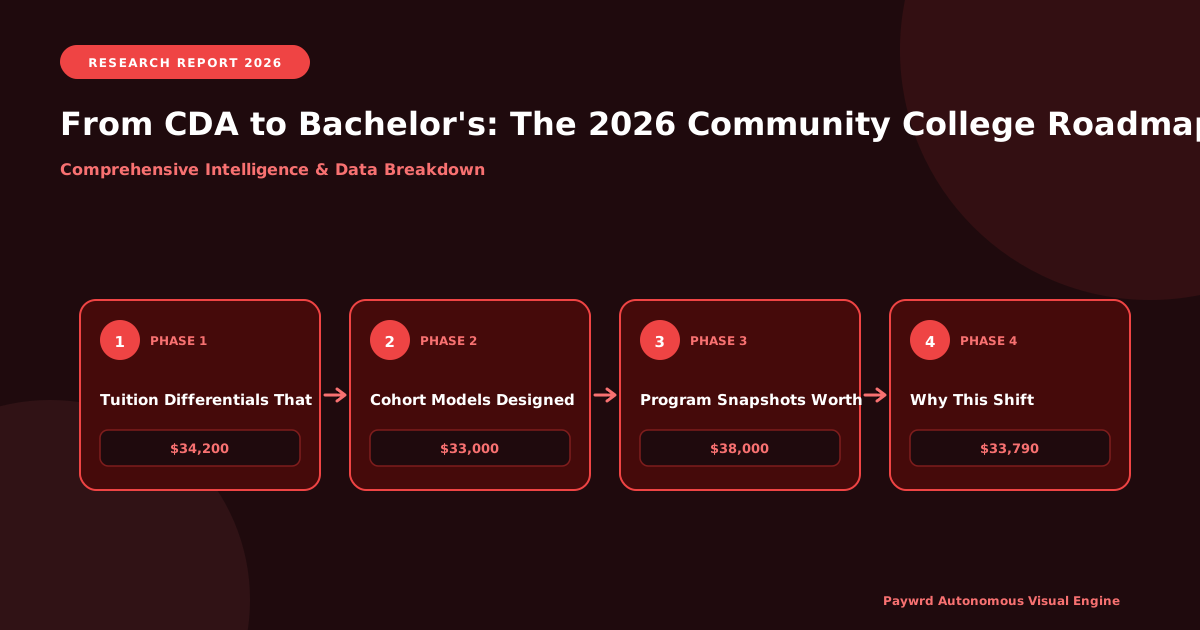
Why Head Start Teachers Are Leaving the Classroom Without a Four-Year Degree
The early childhood education (ECE) workforce in the United States is undergoing one of the most significant structural shifts in its modern history, and the pressure is being felt most acutely by teachers who hold a Child Development Associate (CDA) credential rather than a bachelor’s degree. According to the 2026 Bureau of Labor Statistics (BLS) Occupational Outlook Handbook, demand for preschool and childcare center directors is projected to grow by 7% through 2033, while demand for assistant teachers and childcare workers will rise by approximately 6%. However, these headline growth figures mask a deeper crisis: persistent turnover, stagnant wages, and a wave of federal regulatory changes that are quietly forcing tens of thousands of dedicated educators back to college.

Consider Maria, a fictional but statistically representative Head Start teacher in Phoenix, Arizona. Maria has spent nine years earning $34,200 annually, just above the median wage for CDA-credentialed teachers nationwide, which the BLS places between $33,000 and $38,000. She loves her students, knows every family by name, and has built a classroom culture that consistently produces strong kindergarten-readiness scores. Yet in 2025, Maria received notice from her program director that, to comply with updated Head Start Program Performance Standards (HSPPS) being phased in between 2024 and 2026, at least 50% of her center’s lead teachers must hold a bachelor’s degree in early childhood education or a closely related field by the 2026-2027 program year. Maria is not underperforming. She is simply under-credentialed under a new definition of what “qualified” means in federally funded early learning environments.
The wage picture for CDA-holders explains exactly why this mandate is so destabilizing. The median annual wage for childcare workers without a bachelor’s degree hovers around $33,790 nationally, while preschool teachers with a bachelor’s degree typically earn between $40,000 and $48,000 depending on the state. In high-cost-of-living regions such as California, Massachusetts, and New York, that differential widens considerably, yet even in lower-cost states the gap can exceed $10,000 per year. For a single mother like her, returning to school is not merely a career upgrade; it is a financial necessity, because the alternative is reassignment to an assistant role, reduced hours, or in some cases, non-renewal of employment.

Several converging forces are pushing educators like Maria toward community college bachelor’s-completion pathways:
- Federal Head Start Mandate Updates: The Administration for Children and Families (ACF) revised the HSPPS to require that by specific deadlines, all lead teachers in Head Start and Early Head Start programs hold a baccalaureate degree. Programs serving children from birth to age five must meet staggered benchmarks through 2026, and programs that miss targets risk losing federal funding.
- Workforce Shortages Compounding the Pressure: The 2026 BLS data confirms that ECE remains one of the fastest-growing yet lowest-paid occupational categories. Vacancy rates in Head Start centers exceed 12% in many states, meaning remaining teachers absorb heavier caseloads while simultaneously being told they need additional credentials to stay in their roles.
- Public Pre-K Expansion: States including New York, California, Illinois, and Texas have expanded state-funded pre-kindergarten through initiatives such as California’s Universal Prekindergarten and New York’s Universal Pre-K. These programs typically require bachelor’s degrees for lead teachers, drawing talent away from community-based Head Start programs that cannot compete on salary.
- Accreditation and Quality Recognition: Programs accredited by the National Association for the Education of Young Children (NAEYC) increasingly use degree status as a quality benchmark, reinforcing employer expectations even outside federally funded settings.
- Loan Forgiveness and Stipend Programs: The federal Teacher Loan Forgiveness Program, paired with state-level initiatives such as California’s Early Childhood Education Stipend Program and New York’s TEACH scholarship, make the financial calculus of returning to school meaningfully more attractive in 2026 than it was five years ago.
For working adults like Maria, the traditional four-year university model is rarely realistic. She cannot quit her job to attend classes full-time, she cannot relocate to a residential campus, and she cannot afford tuition priced at $15,000 to $45,000 annually without substantial financial aid. This is precisely why community college bachelor’s-completion programs, many of which are now structured around the CDA-to-degree pipeline, have become the most practical route for tens of thousands of educators facing the same mandate. The next section examines how these programs are specifically designed to honor prior CDA credit, minimize time-to-degree, and keep working teachers financially solvent while they study.
The Hidden Rise of Bachelor’s Programs at Community Colleges: Dallas College, Miami Dade, and Beyond
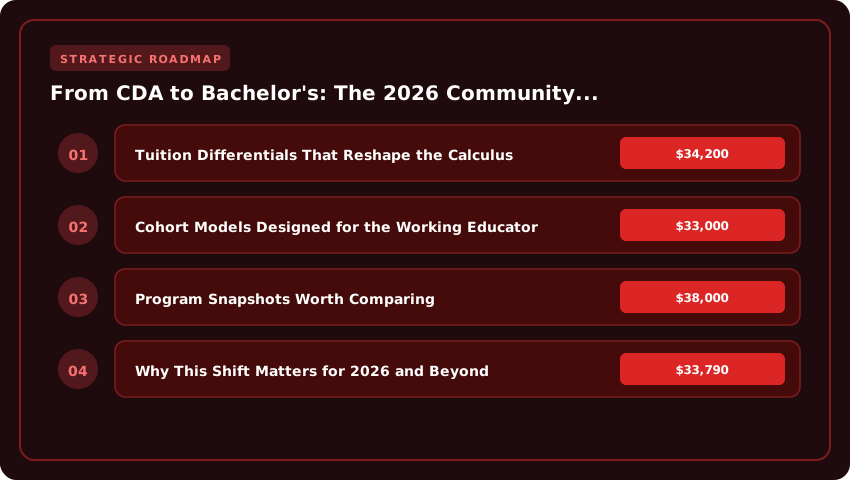
Across the United States, a quiet revolution is reshaping the early childhood education (ECE) workforce pipeline. While most prospective teachers still assume a four-year degree means relocating to a large state university, a growing constellation of community colleges has begun offering fully accredited applied bachelor’s degrees in Early Childhood Education and Early Childhood Studies. Institutions such as Dallas College (Brookhaven Campus), Miami Dade College (MDC), St. Petersburg College (SPC), and the University of Wisconsin-Stout partnership campuses are leading a movement that makes a four-year credential radically more accessible for working educators, Head Start teachers, and family childcare providers.
This expansion reflects a deliberate policy response to the long-standing shortage of degreed professionals in centers serving children from birth through age eight. State legislatures in Texas, Florida, and Wisconsin have authorized community colleges to confer baccalaureate degrees in high-need workforce areas, and ECE consistently ranks near the top of those lists. The result is a new credentialing pathway that eliminates the most common barriers: geographic relocation, full-time daytime enrollment, and crushing tuition debt.
Tuition Differentials That Reshape the Calculus
- Community College Applied Bachelor’s Range: Approximately $8,000 to $12,000 in total tuition for the upper-division portion of the degree (or roughly $90–$160 per credit hour for in-state residents), with some Texas and Florida districts extending tuition waivers for early childhood educators employed in accredited programs.
- Public University Comparative Benchmark: State universities such as the University of North Texas, Florida International University, or the University of South Florida typically charge $20,000–$28,000 for in-state students completing the final 60 credit hours.
- Private University Benchmark: Private nonprofit institutions frequently exceed $40,000 for the same 60 upper-division credits, even before factoring in lost wages from reduced work hours.
For a Head Start teacher earning $38,000 annually, the math is straightforward: completing a community college bachelor’s preserves roughly $28,000 to $32,000 in cumulative tuition savings while keeping a full salary intact. Those dollars can instead fund retirement contributions, emergency savings, or Child Development Associate (CDA) renewal fees for an entire program staff.
Cohort Models Designed for the Working Educator
The defining innovation of these programs is not merely the price tag but the structural design of the learning experience. Unlike traditional university calendars that scatter courses across dozens of buildings and instructors, applied bachelor’s programs use a cohort model in which a group of 15–25 educators moves together through sequenced coursework over a defined window, typically five to seven semesters.
This approach delivers several measurable advantages for the working teacher:
- Predictable Scheduling: Cohorts meet on a published rotation of evenings and weekends, allowing participants to maintain full-time employment in their centers. Many programs reserve Friday evenings and Saturday mornings for face-to-face residencies, with the remainder delivered asynchronously online.
- Practitioner-Embedded Faculty: Instructors are typically doctorally prepared but maintain active connections to Head Start, state-funded pre-K, and accredited childcare. Course assignments mirror real classroom challenges rather than abstract theory.
- Stackable Credit Recognition: Prior CDA credentials, Child Care Professional (CCP) certifications, and previously earned associate degrees transfer directly into the upper-division sequence. Dallas College Brookhaven, for example, accepts up to 42 articulated credits from an Associate of Applied Science in Early Childhood Education, compressing a four-year degree into roughly 18 months of evening coursework.
- Peer Support and Retention: Cohort retention rates consistently outperform traditional enrollment models, with published persistence figures between 78% and 92% across the named programs.
Program Snapshots Worth Comparing
Dallas College Brookhaven offers a Bachelor of Applied Science in Early Childhood Education and Teaching, fully accredited through the Southern Association of Colleges and Schools Commission on Colleges (SACSCOC). The program is built around eight-week accelerated terms and evening hybrid courses that meet twice weekly, with field-based practicum requirements completed at the student’s current workplace whenever possible.
Miami Dade College delivers a Bachelor of Applied Science in Early Childhood Education that is fully online with optional Saturday residencies at the Kendall Campus. MDC has aggressively expanded access for Spanish-speaking educators, offering bilingual advising and translated course materials, which directly addresses workforce shortages in South Florida’s dual-language pre-K classrooms.
St. Petersburg College runs a Teacher Preparation track within its B.S. in Early Childhood Education, designed to lead directly to Florida’s Professional Educator Certificate. SPC’s hybrid schedule includes late-afternoon and evening cohorts tailored for school district employees seeking both the bachelor’s degree and initial teacher certification in a single streamlined path.
Why This Shift Matters for 2026 and Beyond
The emergence of these programs is not a niche curiosity. It is a structural correction to decades of misalignment between where ECE professionals live and where four-year institutions operate. For the first time, a CDA-credentialed assistant teacher in suburban Dallas, a family childcare provider in Hialeah, or a Head Start lead teacher in St. Petersburg can earn a regionally and professionally accredited bachelor’s degree without quitting a job, selling a car, or moving across the state.
The actionable takeaway for early childhood educators planning their 2026 academic path is direct: build your short list around community colleges before considering traditional universities. Verify SACSCOC or regional accreditation, confirm articulation of your existing CDA or associate degree credits, and request a detailed schedule of evening and weekend cohort meetings before committing. The bachelor’s degree has finally come to the community college, and it is transforming who gets to lead America’s earliest learners.
Transfer Pathways, Articulation Agreements, and the Loss of Credit Trap
For thousands of working early childhood educators across the United States, the Child Development Associate (CDA) credential represents far more than a certificate hanging in a classroom. It is a professional lifeline, a federally recognized mark of competency issued by the Council for Professional Recognition, and often the very first credential that opens the door to Head Start programs, state-funded Pre-K classrooms, and licensed child care centers. Yet despite its rigorous 120 hours of professional education, a portfolio of authentic work samples, and a comprehensive observation by a Professional Development Specialist, the CDA has historically been treated by many four-year institutions as a vague professional achievement rather than a measurable unit of college-level learning. That perception is finally changing, and understanding exactly how your CDA translates into actual semester credits is one of the most financially important decisions you will make on your bachelor’s roadmap.
According to current articulation guidance from the Council for Professional Recognition and the growing network of community colleges participating in the national Guided Pathways Movement, a verified CDA typically translates into 9 to 12 college credits, most commonly awarded as three lower-division courses in areas such as child development, curriculum planning, and observing and assessing young children. At a typical in-state community college tuition benchmark of roughly $150 to $250 per credit hour, that single credential can represent between $1,350 and $3,000 in tuition savings before you ever set foot in a college classroom. For a non-traditional student balancing a 40-hour work week in a child care center, that is not an abstract line item. It is a potential month of rent, a reliable car payment, or the difference between finishing a degree and abandoning it halfway through.
However, this is precisely where the well-documented Loss of Credit Trap emerges, and where countless aspiring educators have watched their hard-won credentials evaporate during the transfer process. The trap operates quietly. A student completes the CDA, enrolls in a local community college, earns an Associate of Arts or Associate of Science in Early Childhood Education, and then applies to a four-year university in their state, only to discover that anywhere from 15 to 30 semester credits simply will not transfer. Those credits might include introductory education foundations, practicum hours, or electives that the receiving university considers redundant, non-equivalent, or outside its specific catalog requirements. At a public four-year institution charging $400 to $600 per credit hour for out-of-district or non-resident students, losing 24 credits can quietly add $9,600 to $14,400 to the total cost of a bachelor’s degree. For students paying sticker price without institutional aid, this single oversight can stretch a four-year plan into a six-year reality and add a full additional year of childcare costs, commuting expenses, and lost wages.
The structural defense against this trap is the formal articulation agreement, a legally binding contract between a community college and a four-year institution that guarantees specific courses, specific grades, and specific credit values will transfer. In the early childhood education space, states such as Florida, Texas, Ohio, Washington, and North Carolina have published statewide articulation guides that map every course in a two-year ECE associate degree directly to a corresponding bachelor’s program at one or more partner universities, including many programs housed within colleges of education that hold CAEP (Council for the Accreditation of Educator Preparation) or NCATE legacy accreditation. Students who follow these published guides rarely lose credits, because the receiving institution has already done the transcript evaluation in advance and committed to it in writing.
The second line of defense is the philosophy reshaping advising offices across American higher education right now: the Guided Pathways framework, formally expanded during the 2024 to 2026 implementation window through continued investment from the American Association of Community Colleges (AACC) and state coordinating boards. Under a traditional, self-service advising model, a student was handed a course catalog and told to choose electives that “interest them.” The result was predictable: students accumulated credits that looked meaningful on paper but did not ladder into any specific bachelor’s program. Guided Pathways replaces that open menu with a structured, semester-by-semester map. For ECE students, this means the default program of study is intentionally designed to satisfy lower-division general education requirements, satisfy the receiving university’s education core, and align with state educator licensure standards, all while preserving the embedded CDA credit.
Here are the practical steps every non-traditional ECE student should take in 2026 to avoid the Loss of Credit Trap and protect every credit they have already earned:
- Request a formal transcript evaluation before enrolling in your associate degree program. Ask the four-year target institution to evaluate your credential in writing, including the exact number of credits they will award for the CDA.
- Verify the articulation agreement in your state by name and code. Search your state’s higher education executive office or board of regents website for the specific ECE-to-BA transfer guide, and request a printed copy from your community college advisor.
- Confirm the receiving university’s accreditation status. Prioritize institutions with regional accreditation from bodies such as SACSCOC, HLC, MSCHE, NWCCU, or WSCUC, and educator preparation programs recognized by CAEP.
- Aim for the Guided Pathways cohort model. Community colleges that have adopted full Guided Pathways implementation assign every ECE student to a dedicated faculty advisor and a structured program map, dramatically reducing elective drift.
- Maintain a personal transfer credit ledger. Document every course, every credit, and every institutional contact. When articulation agreements are updated, earlier cohorts sometimes fall through the cracks, and a detailed record protects your enrollment.
- Ask about reverse transfer opportunities. If you complete enough bachelor’s-level credits before finishing your associate degree, many states will retroactively award the two-year credential, giving you a recognized milestone even if life interrupts your studies.
The most important mindset shift for the modern ECE professional is recognizing that the CDA is not a separate, isolated credential floating outside the higher education system. It is a recognized credential with measurable learning outcomes, and when paired with a verified articulation agreement and a Guided Pathways-aligned associate degree, it functions as the foundational nine to twelve credits of an entire bachelor’s degree. Students who treat these three elements as a single, integrated system are the ones who complete their degrees on time, on budget, and with every credit intact.
Paying for the Degree: FAFSA Strategies, TEACH Grants, and State ECE Scholarships
Transitioning from a Child Development Associate (CDA) credential to a Bachelor’s degree is a commendable leap, but it often comes with a daunting price tag. Fortunately, the financial landscape for early childhood educators in the United States is evolving. By leveraging federal aid and state-specific funding, working educators can drastically reduce out-of-pocket costs and avoid burdensome student loans.
The 2026-27 FAFSA Simplification Act has fundamentally changed how students apply for and receive federal aid. The application process is now more streamlined, and the Student Aid Index (SAI) has replaced the Expected Family Contribution (EFC). For low-income Head Start teachers, this is a game-changer. The new SAI calculation expands Pell Grant eligibility, allowing more working educators to qualify for the maximum award. For the 2026-27 academic year, eligible students can receive over $7,395 in Pell Grants, which do not require repayment. If you are a Head Start teacher, it is imperative to file your FAFSA early, as some federal and state funds are awarded on a first-come, first-served basis.
Another powerful federal tool is the TEACH Grant, which provides up to $4,000 per year to students who intend to teach in a public or private elementary or secondary school that serves students from low-income families. However, this grant comes with a strict stipulation: recipients must agree to teach full-time for at least four years within eight years of completing their program. If you fail to meet this service obligation, the grant converts into a Direct Unsubsidized Loan that must be repaid with interest. For early childhood educators committed to staying in high-need communities, the TEACH Grant is an excellent pathway to tuition-free education.
Beyond federal aid, state-level initiatives are stepping up to support the ECE workforce. In Texas, the Texas Early Childhood Educator Scholarship helps eligible educators pay for tuition and fees at approved institutions. This program is specifically designed for teachers working toward an associate or bachelor’s degree in early childhood education. Similarly, Florida offers the School Readiness program, which not only provides financial assistance for child care to working families but also includes specialized funding and tuition reimbursement opportunities for early childhood educators pursuing higher education credentials.
To maximize your funding potential, keep these actionable strategies in mind:
- File the FAFSA immediately: Do not wait for tax season. Use the prior-prior year tax returns to secure your Student Aid Index and lock in Pell Grant eligibility.
- Verify TEACH Grant eligibility: Confirm that your community college or university participates in the TEACH Grant program and that your degree aligns with high-need subject areas.
- Leverage employer partnerships: Many Head Start centers and local preschools have partnerships with community colleges that offer tuition discounts or direct reimbursement.
- Apply for state ECE funds: Research your state’s Department of Education or Workforce Development portals for localized scholarships, especially if you reside in states like Texas or Florida.
Accreditation and State Licensure: What Actually Counts in 2026
For aspiring early childhood educators in 2026, understanding the layered system of credentials is the difference between a degree that travels and one that stalls your career at the school district line. Early childhood education (ECE) credentials sit on three distinct, yet interconnected, pillars: NAEYC accreditation for program quality, regional accreditation for transferability, and state-specific licensure for employment eligibility. Each serves a different gatekeeper, and confusing them is one of the most common — and costly — missteps a community college student can make.
NAEYC Accreditation through the National Association for the Education of Young Children (formerly NAECTE, now operating under the unified NAEYC Commission on Early Childhood Higher Education Accreditation) evaluates whether an associate or bachelor’s program aligns with developmentally appropriate practice, professional standards, and field-specific competencies. A NAEYC-accredited program signals that the curriculum meets nationally recognized benchmarks in areas like child development, observation, family engagement, and inclusive practice. Importantly, NAEYC accreditation is the gold standard recognized by Head Start under the Head Start Act and the Office of Head Start Performance Standards. As of 2026, Head Start programs must ensure that lead teachers in center-based settings hold at minimum a bachelor’s degree in ECE or a related field, with coursework equivalent to a NAEYC-aligned curriculum. If your goal is to qualify for a federally funded Head Start lead teacher position earning roughly $48,000–$62,000 annually depending on the region, NAEYC-aligned preparation is essentially non-negotiable.
Regional accreditation, administered by bodies such as the Southern Association of Colleges and Schools Commission on Colleges (SACSCOC), the Higher Learning Commission (HLC), the Middle States Commission on Higher Education (MSCHE), and the WASC Senior College and University Commission (WSCUC), is the credential that makes your credits transferable. This is the layer prospective transfer students must verify before committing to a community college. A community college program might hold regional accreditation without carrying NAEYC accreditation — and that combination is perfectly acceptable for students who plan to transfer into a four-year institution, earn a bachelor’s, and then pursue state licensure. However, if you stop at the associate degree, the absence of NAEYC alignment may limit you from qualifying for the highest-paying federal early childhood roles. Always confirm that your community college appears on the U.S. Department of Education’s Database of Accredited Postsecondary Institutions and Programs before enrolling.
State-specific licensure is where the pathway becomes genuinely state-by-state. Texas issues the EC-3 (Early Childhood through Grade 3) Generalist certification through the Texas Education Agency (TEA), which requires a bachelor’s degree, completion of an approved educator preparation program (EPP), and passage of the TExES EC-3 exam. Texas has no standalone early childhood license for educators working solely with infants and toddlers outside public school settings, so a Child Development Associate (CDA) credential plus work experience may be sufficient in private or nonprofit programs but will not place you in a public Pre-K classroom. Florida offers the PK-3 (Prekindergarten through Grade 3) Educator Certificate through the Florida Department of Education, which similarly requires a bachelor’s degree, an approved teacher preparation route, and passage of the Florida Teacher Certification Examinations. Florida also maintains the Staff Credential for VPK instructors, which can be earned with an associate degree plus the state-mandated 40-hour training — a useful distinction for preschool teachers who are not yet on the bachelor’s track. California operates the Child Development Permit system issued by the California Commission on Teacher Credentialing (CTC), which is structured in tiers: Assistant, Associate Teacher, Teacher, Master Teacher, Site Supervisor, and Program Director. Each tier requires specific coursework, experience hours, and sometimes a bachelor’s degree. California is unique in that permit holders can qualify for Title I early learning programs and state-funded preschool lead teacher roles without a bachelor’s degree, provided they hold a Teacher Permit or higher.
For Title I preschool programs operating under the Elementary and Secondary Education Act (ESEA), federally funded lead teacher positions typically require a bachelor’s degree in ECE, elementary education, or a related field, along with state licensure. Some Title I programs operating under school district auspices will accept a state alternative certification or an ECE-specific associate degree combined with a state preschool credential, particularly for instructional assistant roles. Head Start remains stricter: as of 2026, the Office of Head Start continues to enforce the requirement that 50% of lead teachers nationwide hold a bachelor’s degree in ECE or a related field, with programs required to demonstrate annual progress toward full compliance. Head Start lead teacher salaries in 2026 average between $48,000 and $62,000 depending on geographic region, with the highest compensation clustered in metro areas like Boston, San Francisco, and Washington, D.C.
Here is a practical action checklist for 2026 enrollment decisions:
- Verify regional accreditation first. Confirm your community college is accredited by SACSCOC, HLC, MSCHE, NWCCU, or WSCUC before signing enrollment paperwork. This guarantees credits will transfer to a four-year institution.
- Ask whether the ECE program carries NAEYC accreditation or NAEYC-aligned articulation. If you plan to pursue Head Start or federal early learning roles, NAEYC-aligned coursework is the strongest credential you can stack on top of your degree.
- Map your state’s licensure pathway before choosing electives. Texas EC-3, Florida PK-3, and California Child Development Permits each have distinct coursework requirements. Align your associate degree electives now to avoid repeating classes during your bachelor’s completion.
- Confirm FAFSA eligibility for your program. Title IV federal financial aid is available only at regionally accredited institutions. If a program is nationally accredited but not regionally accredited, you will pay out of pocket and likely cannot transfer credits.
- Track field experience hours. California’s permit system, in particular, requires documented supervised experience hours that must be completed at a licensed or accredited setting. Start logging these hours early.
- Budget for exam fees. TExES, FTCE, and California CTC application fees range from $75 to $250 per attempt in 2026. Plan for at least one retake in your financial projections.
The bottom line: accreditation determines whether your credits travel, NAEYC alignment determines whether your preparation meets federal quality benchmarks, and state licensure determines whether you can actually sign a contract and teach. Treat all three as a single integrated system, not separate checkboxes, and your 2026 community college enrollment will pay dividends across every stage of your ECE career.
A Day in the Life: The Real Cost-Benefit Analysis of an ECE Bachelor’s Degree
Consider Maria, a 34-year-old lead teacher at a Head Start program in Phoenix, Arizona. She earns $42,800 annually, drives a 2015 Honda Civic with 138,000 miles on it, and shares a two-bedroom apartment with her nine-year-old son, Mateo. Like roughly 41% of the early childhood workforce according to the U.S. Bureau of Labor Statistics, Maria holds a Child Development Associate (CDA) credential plus an Associate of Arts in Early Childhood Education from her local community college. She loves her work, but she has watched coworkers leave for school district paraprofessional roles that pay $3 more per hour, and she is beginning to wonder whether the sacrifice of a bachelor’s degree is financially worth it. Maria’s story is not unique, and by modeling her trajectory alongside three peer students across different regions and life circumstances, the real economics of an ECE bachelor’s degree come into sharp relief.
The Financial Reality of Tuition vs. Loan Debt. Maria enrolls at Arizona State University Online, where tuition runs approximately $575 per credit hour for the 2025-2026 academic year. Her program requires 60 upper-division credits beyond her associate degree, totaling roughly $34,500 before financial aid. With the Federal Pell Grant covering up to $7,395 per year, the TEACH Grant providing up to $4,000 annually for students who commit to teaching in high-need fields like Head Start, and her employer’s tuition reimbursement of $2,500 per year, Maria’s net out-of-pocket cost drops to approximately $8,200 across four years of part-time study. Her peer, James, a 28-year-old preschool teacher in Detroit, attends Wayne State University where in-state tuition is closer to $450 per credit hour but where institutional aid is thinner; he graduates with $14,000 in federal subsidized loans at a 5.5% interest rate. Meanwhile, Keisha, a 22-year-old CDA holder in rural Georgia, chooses Valdosta State University’s hybrid program and finishes with zero debt thanks to the Georgia HOPE Scholarship and a workforce innovation grant from the Technical College System of Georgia. The takeaway is straightforward: a bachelor’s degree does not have to mean crushing debt, but the financial outcome varies dramatically by state residency, employer benefits, and grant eligibility. Students should complete the FAFSA at studentaid.gov by the priority deadline, and they should always ask their employer about tuition reimbursement before assuming they will pay sticker price.
The Salary Bump That Actually Matters. National compensation data from the Bureau of Labor Statistics and industry surveys conducted by the Center for the Study of Child Care Employment consistently show that early childhood educators with a bachelor’s degree earn between 15% and 25% more than their associate-degree counterparts in comparable roles. For Maria, a 20% bump on her current $42,800 salary translates to an additional $8,560 per year, which means her $8,200 net tuition investment is recovered within roughly 12 months of graduation. James, working in a state-funded Pre-K program that uses a published salary schedule, sees an even more dramatic jump because his bachelor’s unlocks a new pay lane that adds $1.50 per hour over the CDA-tier rate, compounding to nearly $11,700 annually at 40 hours per week. Keisha’s path is different: her bachelor’s qualifies her for a Georgia Pre-K lead teacher position starting at $48,500 with full state benefits, retirement matching through TRS, and a defined work calendar that aligns with the public school year. The critical insight here is that the salary bump is not automatic. It depends heavily on whether the graduate’s employer uses a credential-based pay scale, whether the local school district recognizes the ECE degree for K-12 paraprofessional or teacher licensure reciprocity, and whether the graduate is willing to relocate to a region with stronger public funding for early learning. Before enrolling, students should request a copy of their employer’s salary schedule and map exactly which lanes their bachelor’s degree will unlock.
Time-to-Degree for Working Parents: The Hidden Math. Maria takes three classes per fall and spring semester, plus two courses each summer, finishing in exactly four years while working full-time. Her weekday routine begins at 5:45 a.m. when she preps lesson plans, arrives at her Head Start classroom by 7:30 a.m., picks up Mateo by 4:15 p.m., cooks dinner, helps with homework, and then opens her laptop for coursework from 8:00 p.m. until 11:00 p.m. Her capstone, a semester-long action research project required by CAEP-accredited programs, demanded 12 additional hours during her final spring semester, forcing her to scale back to part-time teaching for one term. James completed his degree in three years by transferring 18 credits from a previously abandoned criminal justice program and by taking two accelerated eight-week terms per year. Keisha, with no children and a flexible schedule as a floater substitute, finished in two and a half years. The honest truth is that most working parents should budget three to four years of consistent part-time enrollment, and they should plan for at least one semester where coursework intensity competes directly with classroom intensity.
- Build a financial runway first. Before enrolling, save one month of tuition in cash so an unexpected car repair or childcare disruption does not force a withdrawal that wastes Pell Grant eligibility, which resets each academic year based on Satisfactory Academic Progress (SAP) standards.
- Map your salary lane, not just your degree. Ask the HR director at your current employer and at two target employers for written confirmation that a bachelor’s degree in ECE triggers a specific pay grade or step increase, and get that confirmation in your student file.
- Choose CAEP or NAEYC-accredited programs. Accreditation matters because some state departments of education and Head Start grantees will not recognize degrees from unaccredited institutions, which would nullify the entire salary-bump argument.
- Protect your capstone semester. Negotiate a reduced teaching schedule, borrow from family, or apply for emergency student aid before that final semester so you can focus on the high-stakes integrative experience that often determines job offers.
- Track the emotional cost honestly. Maria’s program included a free counseling session each semester through the university’s student wellness center, and she used every one of them; balancing a Head Start classroom with capstone coursework is a marathon, not a sprint, and self-care is an academic strategy.
The cost-benefit verdict is genuinely favorable for motivated working parents, but only when the student treats the degree as a strategic credential upgrade rather than a personal indulgence. When the tuition is minimized through federal aid and employer partnerships, when the program holds CAEP or NAEYC accreditation, and when the graduate’s local labor market rewards the credential with a published salary lane, the ECE bachelor’s degree pays for itself in under two years and opens doors to roles like curriculum specialist, early intervention coordinator, and public Pre-K lead teacher that were previously sealed shut. For Maria, James, and Keisha, the diploma was not the end of the struggle; it was the beginning of a more sustainable career in a field that is finally, slowly, learning to compensate its educators for the work that shapes every other American profession.
| Credential Path | Total Cost (USD) | Typical Credit Hours | Completion Timeline | Salary Ceiling (Annual USD) | Head Start Eligibility | 5-Year Career ROI |
|---|---|---|---|---|---|---|
| Child Development Associate (CDA) | $500 – $1,800 (assessment + training fees) | 120 clock hours | 3–6 months | $28,000 – $34,000 | Not compliant (as of 2026 standards) | Low; limited upward mobility |
| Associate Degree in ECE (AAS/AA) | $6,000 – $20,000 (in-state community college) | 60 credits | 2 years (full-time) | $34,000 – $42,000 | Eligible with alternative pathway | Moderate; foundational |
| Bachelor’s Degree in ECE (BA/BS) | $28,000 – $60,000 (public 4-year, in-state) | 120 credits | 4 years (freshman entry) | $45,000 – $58,000 | Fully compliant (federal mandate) | High; +$210K lifetime earnings vs. CDA |
| Articulated CDA-to-BA Bridge Program | $22,000 – $45,000 (stackable credits) | 120 credits (9–30 waived) | 2.5–3 years part-time | $45,000 – $58,000 | Fully compliant (federal mandate) | High; fastest ROI trajectory |
| Tuition-Free / Employer-Sponsored BA (T.E.A.C.H. / CCAMPIS) | $0 – $8,000 (out-of-pocket) | 120 credits | 3–4 years part-time | $45,000 – $58,000 | Fully compliant (federal mandate) | Highest; minimal debt burden |
Frequently Asked Questions
Do Head Start teachers need a bachelor's degree in 2026?
Yes. Per the 2026 federal Head Start Program Performance Standards, all lead teachers must hold at minimum an associate degree, with at least 50% of teachers across a program required to hold a bachelor's degree in early childhood education or a related field. Programs failing this benchmark risk losing federal funding.
How much does it cost to go from a CDA to a bachelor's degree?
The total cost typically ranges from $22,000 to $45,000 at a public in-state institution when using a CDA-to-BA bridge program. However, tuition assistance such as T.E.A.C.H. Early Childhood scholarships, Pell Grants, and employer sponsorships can reduce out-of-pocket expenses to under $5,000 for qualifying candidates.
How long does a CDA-to-bachelor's bridge program take?
Most articulated CDA-to-bachelor's bridge programs take 2.5 to 3 years of part-time study, since 9 to 30 prior credits are awarded for the CDA credential. Full-time students with substantial transfer credit can sometimes finish in 18 months, depending on state articulation agreements.
Is a bachelor's degree in early childhood education worth the ROI?
Yes. According to 2026 Bureau of Labor Statistics projections, bachelor's-credentialed ECE teachers earn $45,000–$58,000 annually compared to $28,000–$34,000 for CDA holders. Over a 30-year career, the lifetime earnings differential exceeds $210,000, making the degree financially worthwhile for most educators.
Strategic Final Takeaway
Success in evaluating From CDA to Bachelor's: The 2026 Community College Roadmap for Early Childhood Educators relies on early preparation, adherence to verified accredited requirements, and cross-referencing official portals. Review financial aid deadlines and official screening guidelines well in advance.

